
Methods for Teaching Financial Literacy with Economic Reasoning










- Slides: 52
Methods for Teaching Financial Literacy with Economic Reasoning CCEE Summer 2012 Program Millionaire Game Colorado PFL and Economics Standards July 9 – 13, 2012 John Brock, Professor of Record
Colorado Council for Economic Education Faculty • John Brock • Director, Center for Economic Education – University of Colorado, Colorado Springs » jbrock@uccs. edu • Master Teachers – Social Studies: Pam Patrick, Social Studies, Cherokee Trail HS – Mathematics: Ann Brock, retired Math teacher, Lewis-Palmer HS
Let’s Get Started!
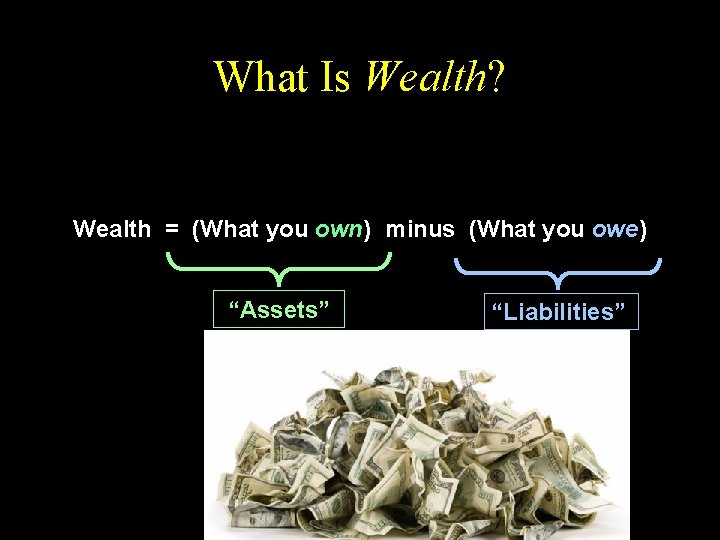
What Is Wealth? Wealth = (What you own) minus (What you owe) “Assets” “Liabilities”
What’s a Millionaire? • Household with a net worth (or wealth) of: • $1, 000 (or more)* • Let’s play a game. . . *Definition of millionaire often excludes primary residence.
The Millionaire Game* • Divide into two-person teams • Rules: – Statements appear on screen. – Each team decides True or False. – Circle chosen answer on sheet provided. • True or False * Shortened version of FFFL, 2 nd ed. , Lesson 1
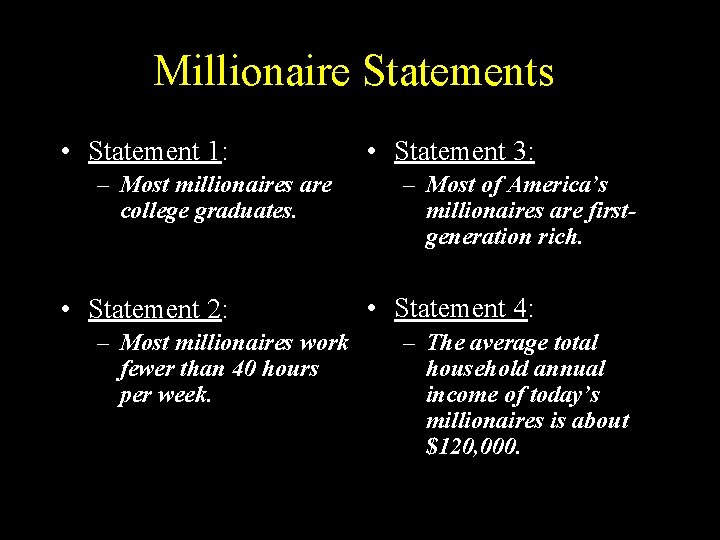
Millionaire Statements • Statement 1: – Most millionaires are college graduates. • Statement 2: – Most millionaires work fewer than 40 hours per week. • Statement 3: – Most of America’s millionaires are firstgeneration rich. • Statement 4: – The average total household annual income of today’s millionaires is about $120, 000.
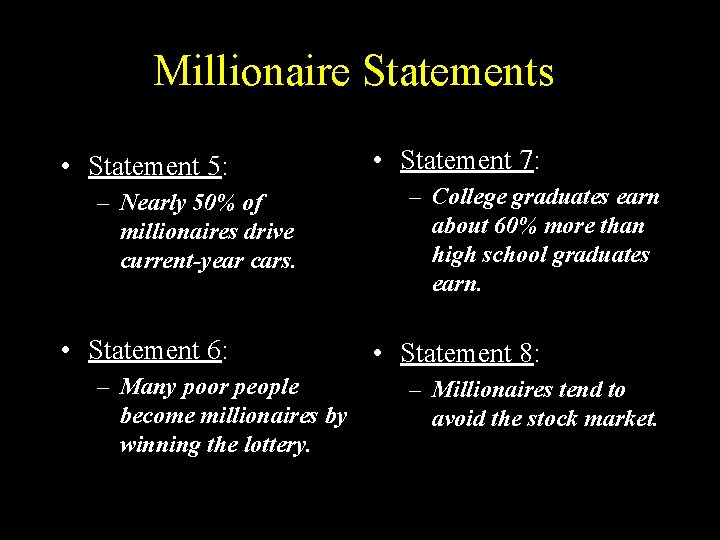
Millionaire Statements • Statement 5: – Nearly 50% of millionaires drive current-year cars. • Statement 6: – Many poor people become millionaires by winning the lottery. • Statement 7: – College graduates earn about 60% more than high school graduates earn. • Statement 8: – Millionaires tend to avoid the stock market.
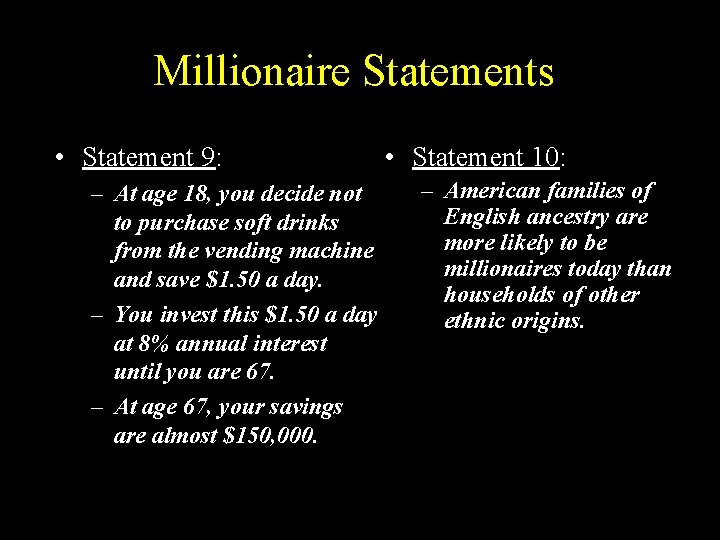
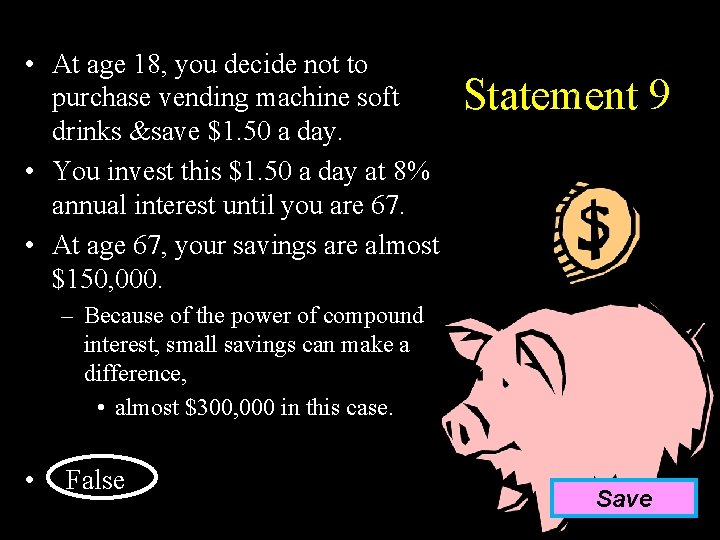
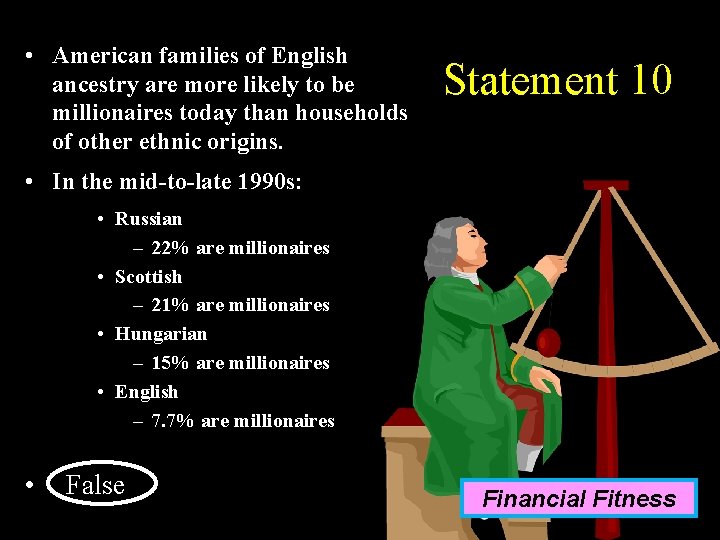
Millionaire Statements • Statement 9: – At age 18, you decide not to purchase soft drinks from the vending machine and save $1. 50 a day. – You invest this $1. 50 a day at 8% annual interest until you are 67. – At age 67, your savings are almost $150, 000. • Statement 10: – American families of English ancestry are more likely to be millionaires today than households of other ethnic origins.
How Did We Do? • For each statement, hold up the card – T for true – F for false CCEE Millionaire Champion • According to answer sheet: – correct answer – incorrect answer = +5 = - 5 • Each team has 1 Millionaire card – correct (+10); incorrect (-10) July 2012 Sources: Millionaire Next Door, Millionaire Mind, & Getting Rich in America
Statement 1 • Most millionaires are college graduates. Diploma • 80% of millionaires are college graduates. • • 18% have Master’s degrees 8% have law degrees 6% medical degrees 6% Ph. D. s University of Colorado Springs • True Education
Statement 2 • Most millionaires work fewer than 40 hours per week. • About 67% of millionaires work 45 to 55 hours a week. • False Earn
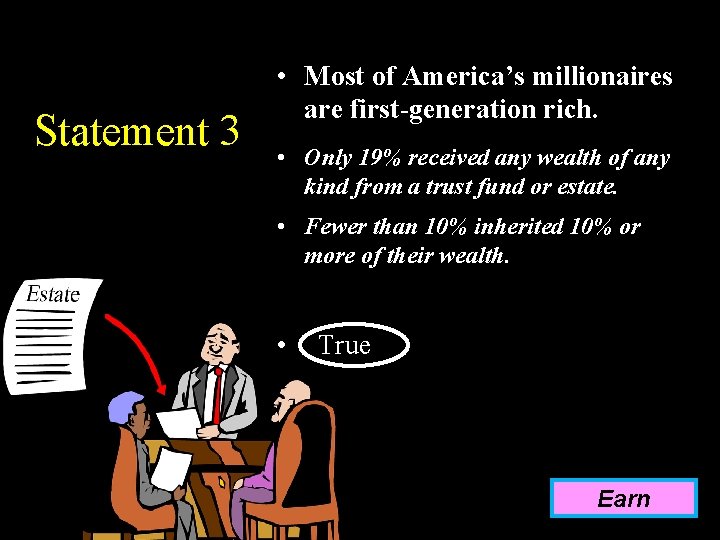
Statement 3 • Most of America’s millionaires are first-generation rich. • Only 19% received any wealth of any kind from a trust fund or estate. • Fewer than 10% inherited 10% or more of their wealth. • True Earn
Statement 4 • The average total household income of today’s millionaires is about $120, 000. • Total income reported among millionaire households averaged $119, 000 (2005). – Frugal, Frugal • True Save
• Nearly 50% of millionaires drive current-year cars. Statement 5 • Most millionaires spend under $30, 000 for a car. – Only 23% drive a currentyear [new model] car. • False Save
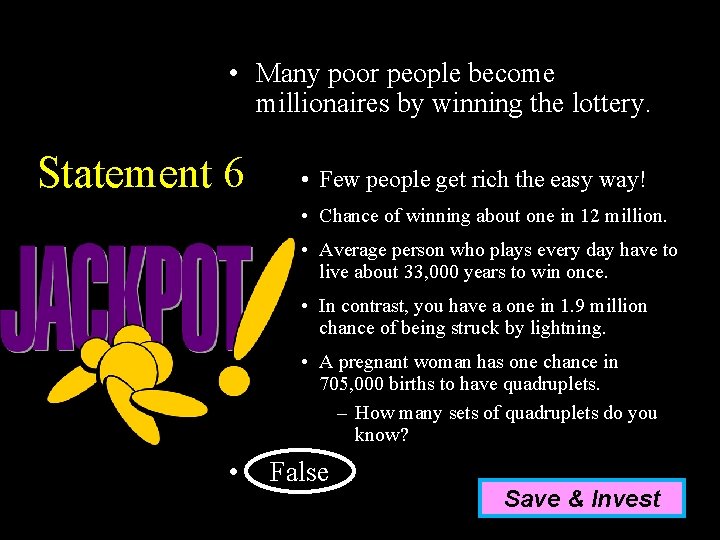
• Many poor people become millionaires by winning the lottery. Statement 6 • Few people get rich the easy way! • Chance of winning about one in 12 million. • Average person who plays every day have to live about 33, 000 years to win once. • In contrast, you have a one in 1. 9 million chance of being struck by lightning. • A pregnant woman has one chance in 705, 000 births to have quadruplets. – How many sets of quadruplets do you know? • False Save & Invest
Statement 7 • College graduates earn about 60% more than high school graduates earn. • In recent years the average college graduate earned 63% more than the average high school graduate did. • True Education
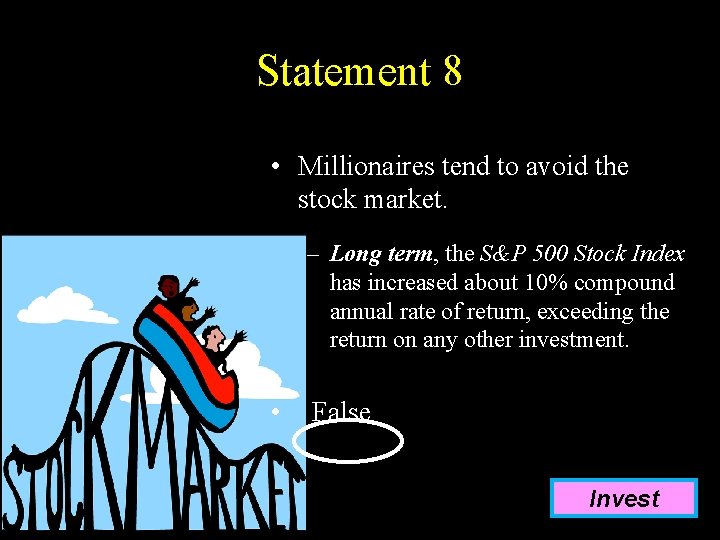
Statement 8 • Millionaires tend to avoid the stock market. – Long term, the S&P 500 Stock Index has increased about 10% compound annual rate of return, exceeding the return on any other investment. • False Invest
• At age 18, you decide not to purchase vending machine soft drinks &save $1. 50 a day. • You invest this $1. 50 a day at 8% annual interest until you are 67. • At age 67, your savings are almost $150, 000. Statement 9 – Because of the power of compound interest, small savings can make a difference, • almost $300, 000 in this case. • False Save
• American families of English ancestry are more likely to be millionaires today than households of other ethnic origins. Statement 10 • In the mid-to-late 1990 s: • Russian – 22% are millionaires • Scottish – 21% are millionaires • Hungarian – 15% are millionaires • English – 7. 7% are millionaires • False Financial Fitness
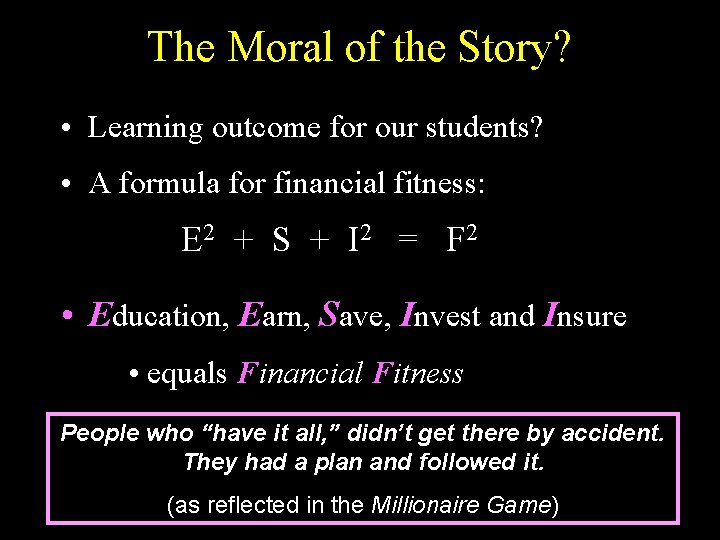
The Moral of the Story? • Learning outcome for our students? • A formula for financial fitness: E 2 + S + I 2 = F 2 • Education, Earn, Save, Invest and Insure • equals Financial Fitness People who “have it all, ” didn’t get there by accident. They had a plan and followed it. (as reflected in the Millionaire Game)
The Colorado PFL Content Standards
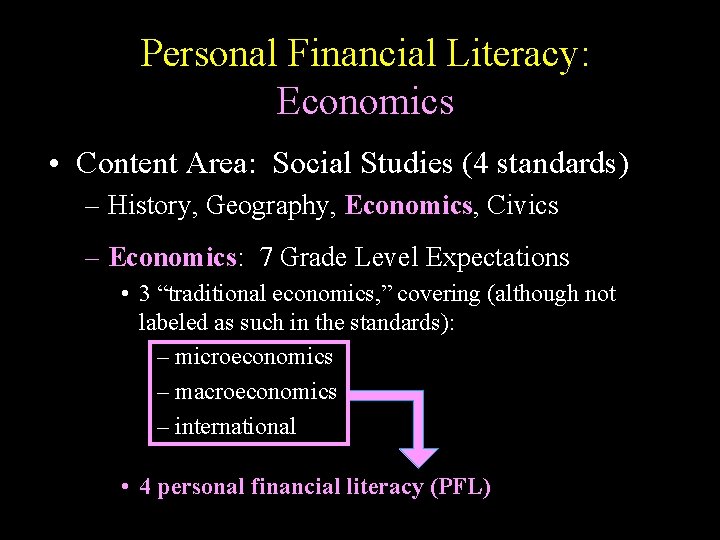
Personal Financial Literacy: Economics • Content Area: Social Studies (4 standards) – History, Geography, Economics, Civics – Economics: 7 Grade Level Expectations • 3 “traditional economics, ” covering (although not labeled as such in the standards): – microeconomics – macroeconomics – international • 4 personal financial literacy (PFL)
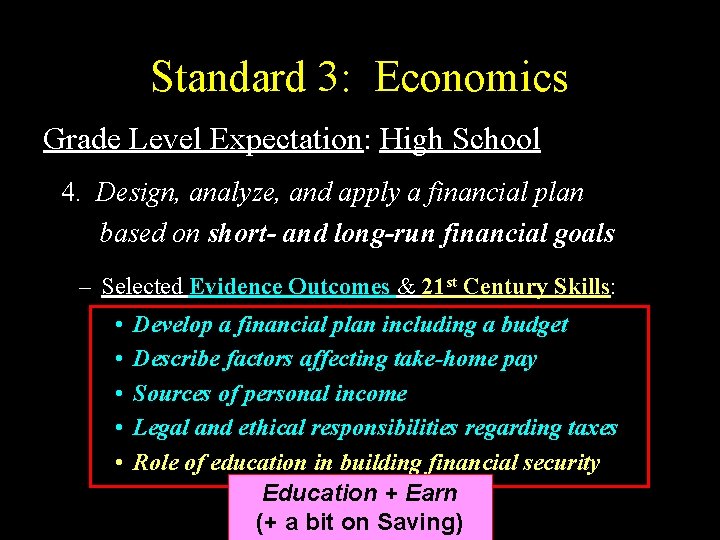
Standard 3: Economics Grade Level Expectation: High School 4. Design, analyze, and apply a financial plan based on short- and long-run financial goals – Selected Evidence Outcomes & 21 st Century Skills: • • • Develop a financial plan including a budget Describe factors affecting take-home pay Sources of personal income Legal and ethical responsibilities regarding taxes Role of education in building financial security Education + Earn (+ a bit on Saving)
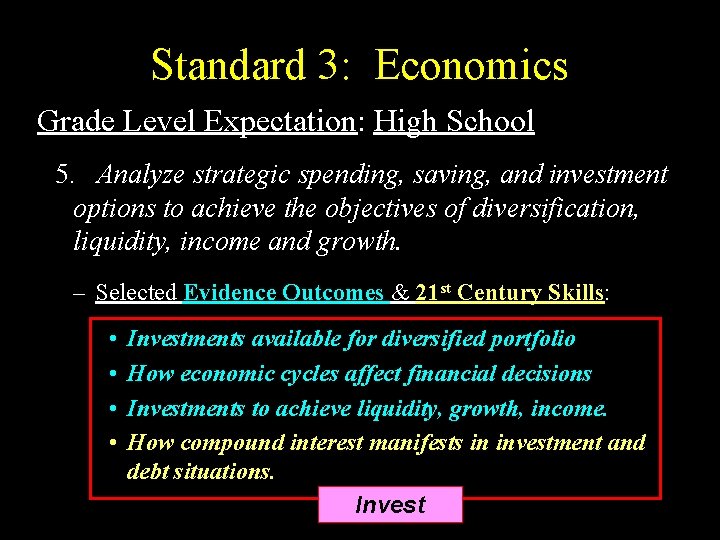
Standard 3: Economics Grade Level Expectation: High School 5. Analyze strategic spending, saving, and investment options to achieve the objectives of diversification, liquidity, income and growth. – Selected Evidence Outcomes & 21 st Century Skills: • • Investments available for diversified portfolio How economic cycles affect financial decisions Investments to achieve liquidity, growth, income. How compound interest manifests in investment and debt situations. Invest
Standard 3: Economics Grade Level Expectation: High School 6. The components of personal credit to manage credit and debt. – Selected Evidence Outcomes & 21 st Century Skills: • Analyze lending sources, services & financial institutions • Building and maintaining a credit history • Similarities & differences in revolving credit, personal loans and mortgages Save (via responsible use of credit)
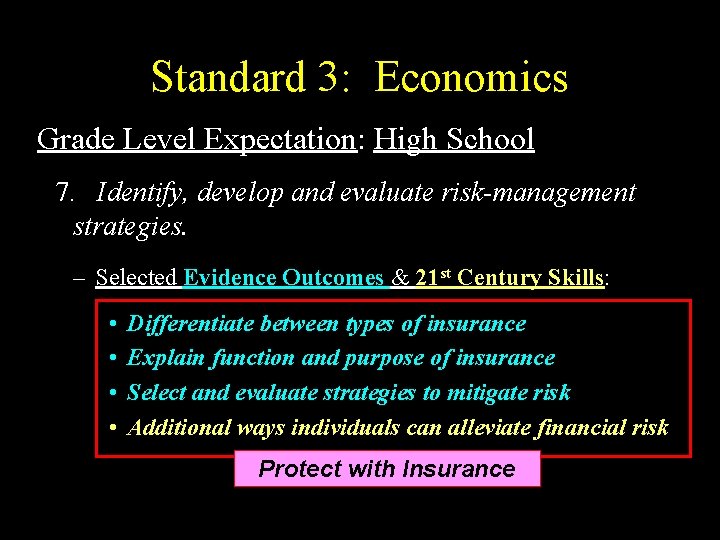
Standard 3: Economics Grade Level Expectation: High School 7. Identify, develop and evaluate risk-management strategies. – Selected Evidence Outcomes & 21 st Century Skills: • • Differentiate between types of insurance Explain function and purpose of insurance Select and evaluate strategies to mitigate risk Additional ways individuals can alleviate financial risk Protect with Insurance
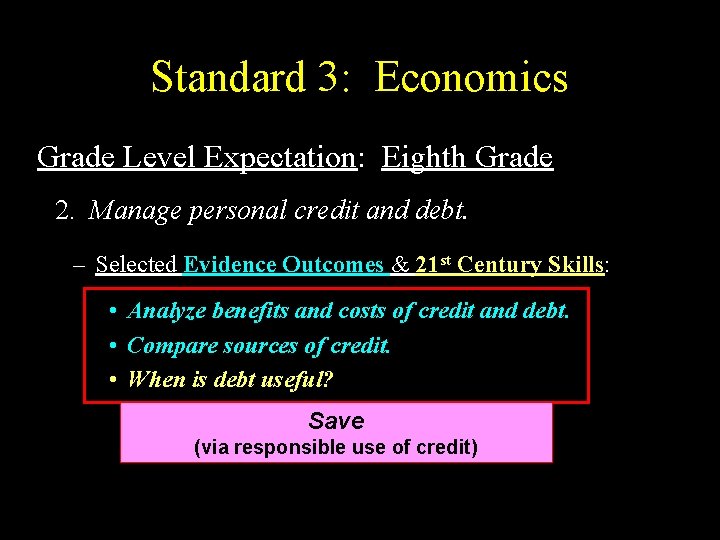
Standard 3: Economics Grade Level Expectation: Eighth Grade 2. Manage personal credit and debt. – Selected Evidence Outcomes & 21 st Century Skills: • Analyze benefits and costs of credit and debt. • Compare sources of credit. • When is debt useful? Save (via responsible use of credit)
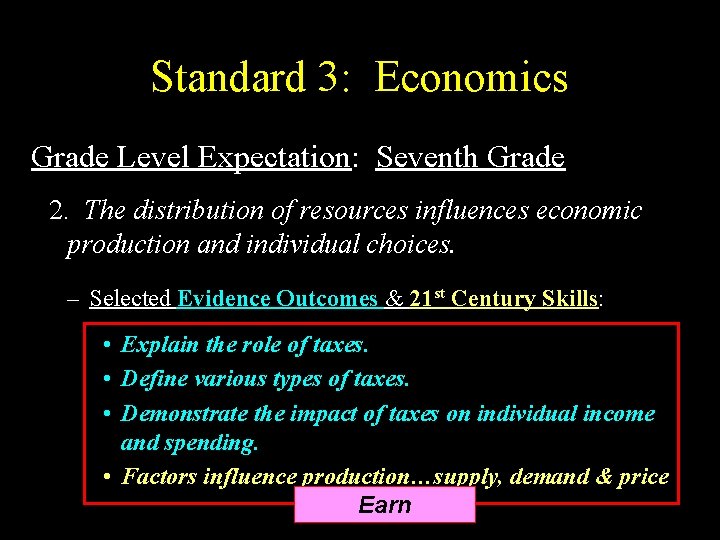
Standard 3: Economics Grade Level Expectation: Seventh Grade 2. The distribution of resources influences economic production and individual choices. – Selected Evidence Outcomes & 21 st Century Skills: • Explain the role of taxes. • Define various types of taxes. • Demonstrate the impact of taxes on individual income and spending. • Factors influence production…supply, demand & price Earn
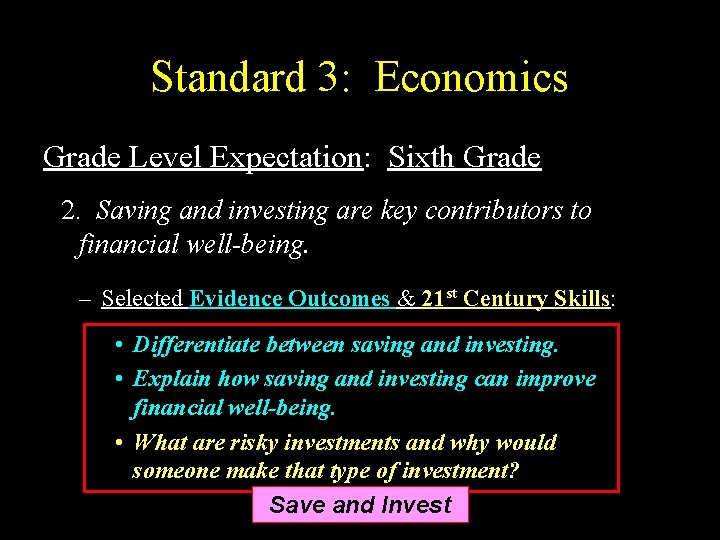
Standard 3: Economics Grade Level Expectation: Sixth Grade 2. Saving and investing are key contributors to financial well-being. – Selected Evidence Outcomes & 21 st Century Skills: • Differentiate between saving and investing. • Explain how saving and investing can improve financial well-being. • What are risky investments and why would someone make that type of investment? Save and Invest
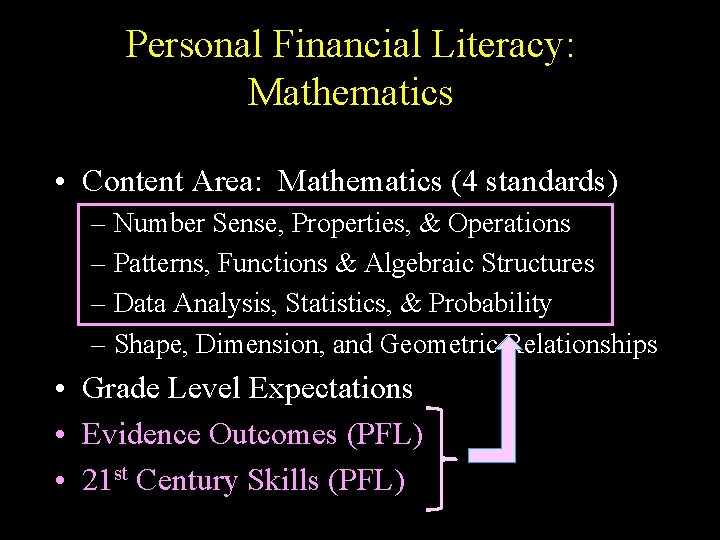
Personal Financial Literacy: Mathematics • Content Area: Mathematics (4 standards) – Number Sense, Properties, & Operations – Patterns, Functions & Algebraic Structures – Data Analysis, Statistics, & Probability – Shape, Dimension, and Geometric Relationships • Grade Level Expectations • Evidence Outcomes (PFL) • 21 st Century Skills (PFL)
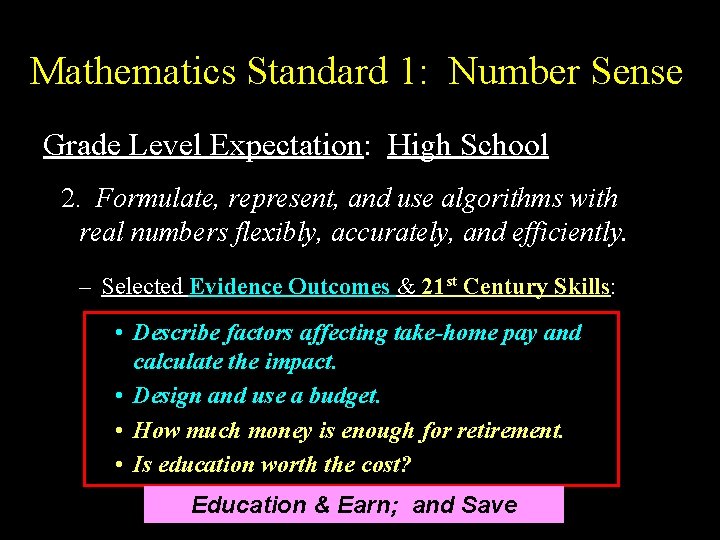
Mathematics Standard 1: Number Sense Grade Level Expectation: High School 2. Formulate, represent, and use algorithms with real numbers flexibly, accurately, and efficiently. – Selected Evidence Outcomes & 21 st Century Skills: • Describe factors affecting take-home pay and calculate the impact. • Design and use a budget. • How much money is enough for retirement. • Is education worth the cost? Education & Earn; and Save
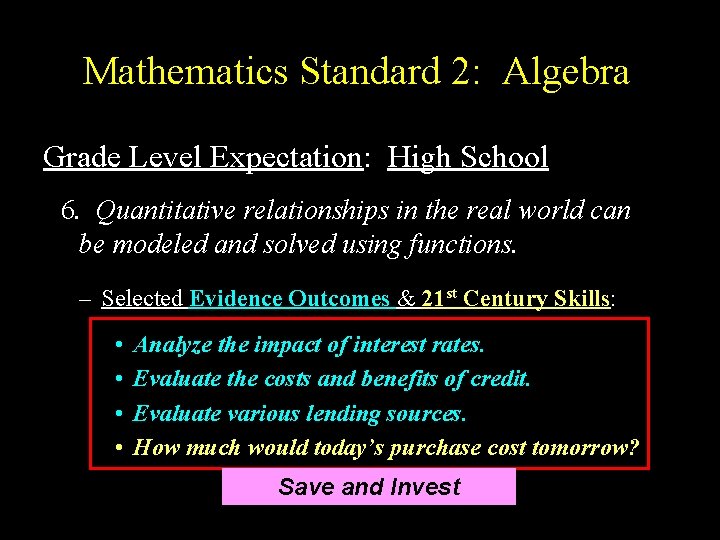
Mathematics Standard 2: Algebra Grade Level Expectation: High School 6. Quantitative relationships in the real world can be modeled and solved using functions. – Selected Evidence Outcomes & 21 st Century Skills: • • Analyze the impact of interest rates. Evaluate the costs and benefits of credit. Evaluate various lending sources. How much would today’s purchase cost tomorrow? Save and Invest
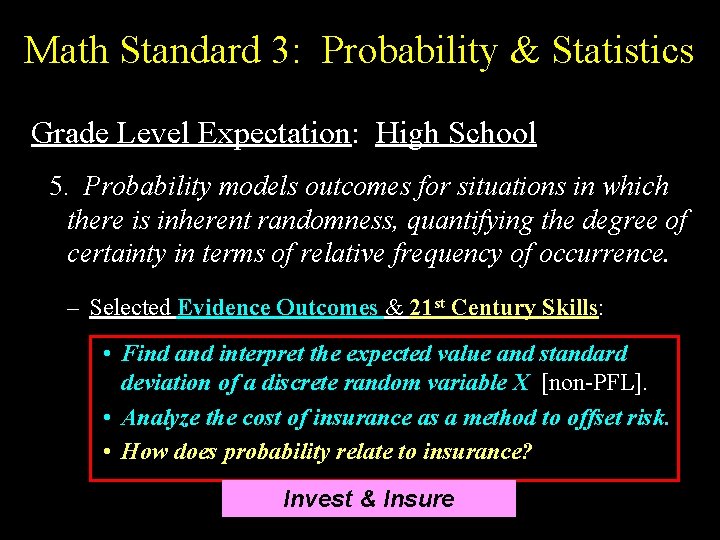
Math Standard 3: Probability & Statistics Grade Level Expectation: High School 5. Probability models outcomes for situations in which there is inherent randomness, quantifying the degree of certainty in terms of relative frequency of occurrence. – Selected Evidence Outcomes & 21 st Century Skills: • Find and interpret the expected value and standard deviation of a discrete random variable X [non-PFL]. • Analyze the cost of insurance as a method to offset risk. • How does probability relate to insurance? Invest & Insure
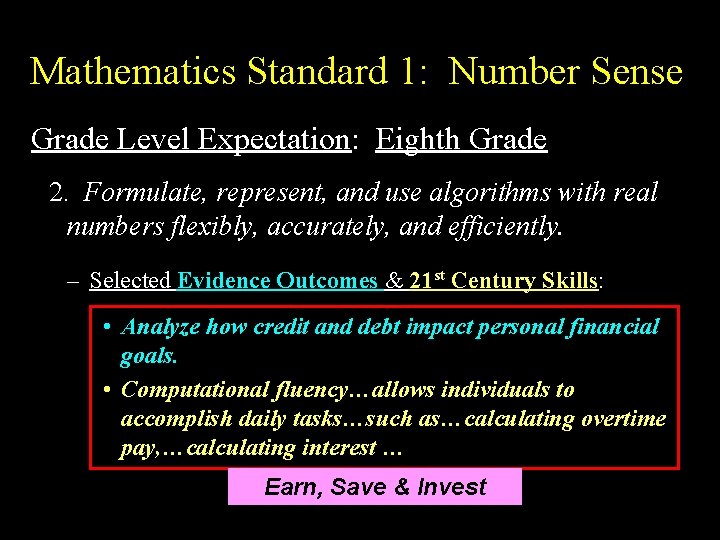
Mathematics Standard 1: Number Sense Grade Level Expectation: Eighth Grade 2. Formulate, represent, and use algorithms with real numbers flexibly, accurately, and efficiently. – Selected Evidence Outcomes & 21 st Century Skills: • Analyze how credit and debt impact personal financial goals. • Computational fluency…allows individuals to accomplish daily tasks…such as…calculating overtime pay, …calculating interest … Earn, Save & Invest
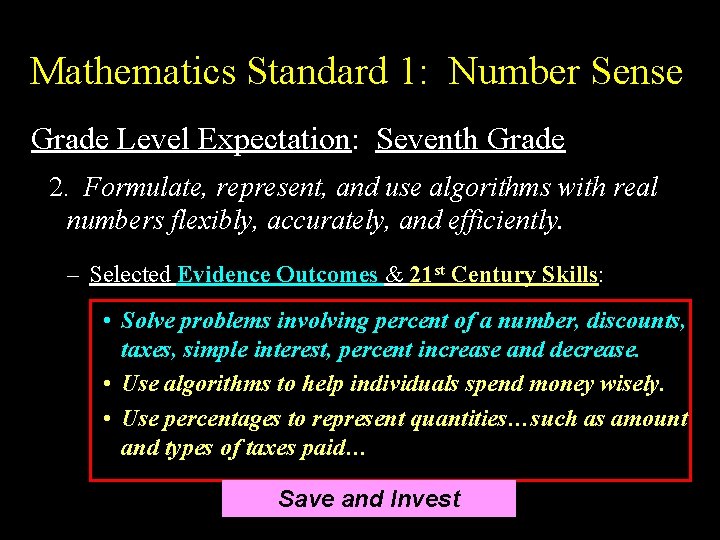
Mathematics Standard 1: Number Sense Grade Level Expectation: Seventh Grade 2. Formulate, represent, and use algorithms with real numbers flexibly, accurately, and efficiently. – Selected Evidence Outcomes & 21 st Century Skills: • Solve problems involving percent of a number, discounts, taxes, simple interest, percent increase and decrease. • Use algorithms to help individuals spend money wisely. • Use percentages to represent quantities…such as amount and types of taxes paid… Save and Invest
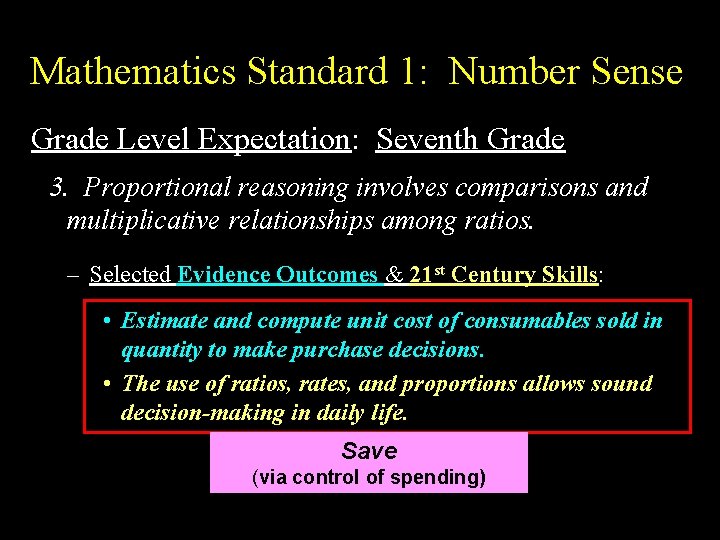
Mathematics Standard 1: Number Sense Grade Level Expectation: Seventh Grade 3. Proportional reasoning involves comparisons and multiplicative relationships among ratios. – Selected Evidence Outcomes & 21 st Century Skills: • Estimate and compute unit cost of consumables sold in quantity to make purchase decisions. • The use of ratios, rates, and proportions allows sound decision-making in daily life. Save (via control of spending)
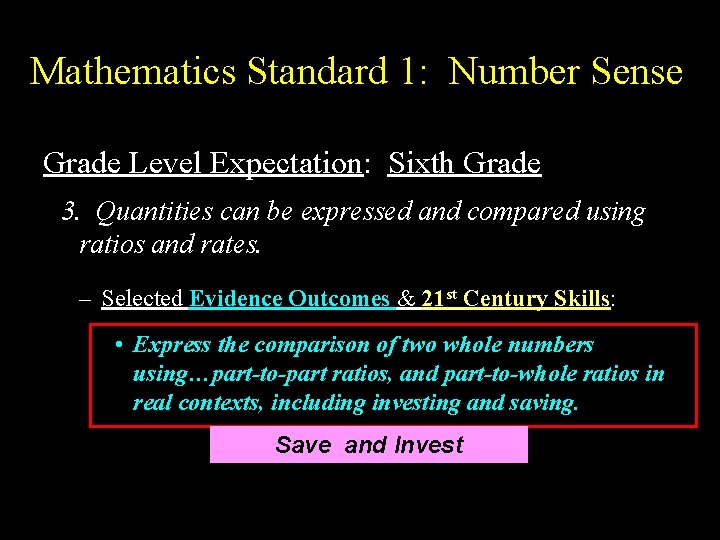
Mathematics Standard 1: Number Sense Grade Level Expectation: Sixth Grade 3. Quantities can be expressed and compared using ratios and rates. – Selected Evidence Outcomes & 21 st Century Skills: • Express the comparison of two whole numbers using…part-to-part ratios, and part-to-whole ratios in real contexts, including investing and saving. Save and Invest
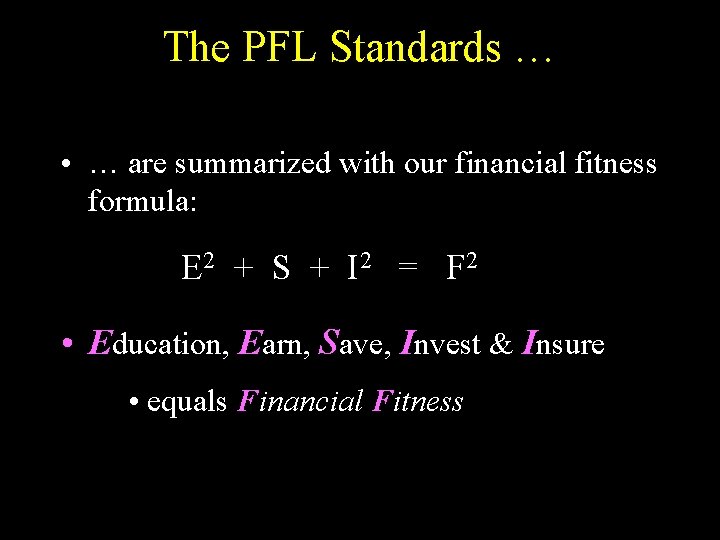
The PFL Standards … • … are summarized with our financial fitness formula: E 2 + S + I 2 = F 2 • Education, Earn, Save, Invest & Insure • equals Financial Fitness
Scarcity • Wants > Availability – or, • Unlimited wants > Limited resources
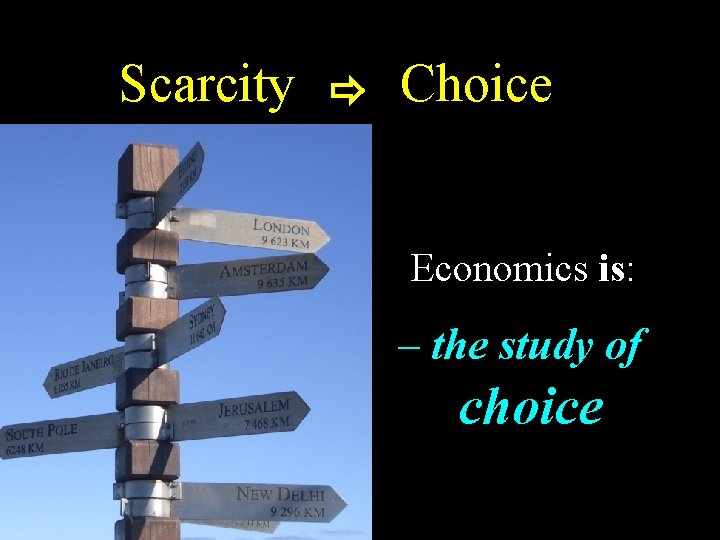
Scarcity Choice • Economics is: – the study of choice
The Economic Way of Thinking: Key Concept • Scarcity necessitates choice – people must choose
Develop a Decision-Making Framework for Students • Help make decisions – by learning a process for more careful choice
PACED Decision-Making Model • Define the Problem • List the Alternatives • State the Criteria • Evaluate the Alternatives • Make a Decision
Let’s Make Another Set of Choices …
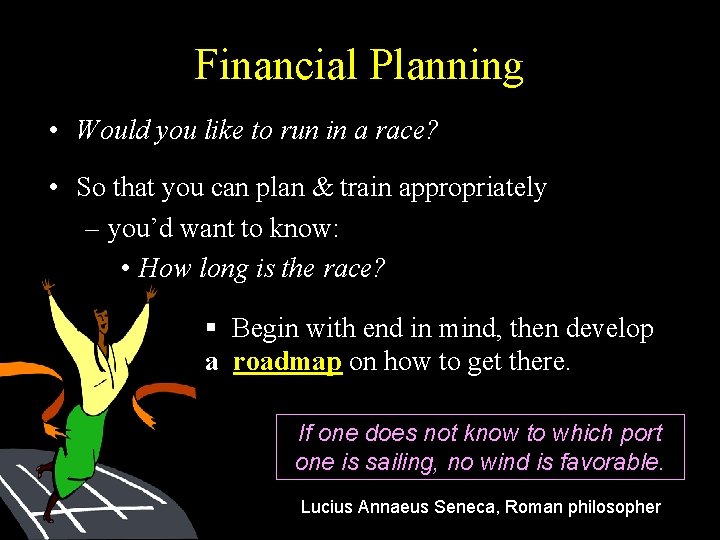
Financial Planning • Would you like to run in a race? • So that you can plan & train appropriately – you’d want to know: • How long is the race? § Begin with end in mind, then develop a roadmap on how to get there. If one does not know to which port one is sailing, no wind is favorable. Lucius Annaeus Seneca, Roman philosopher
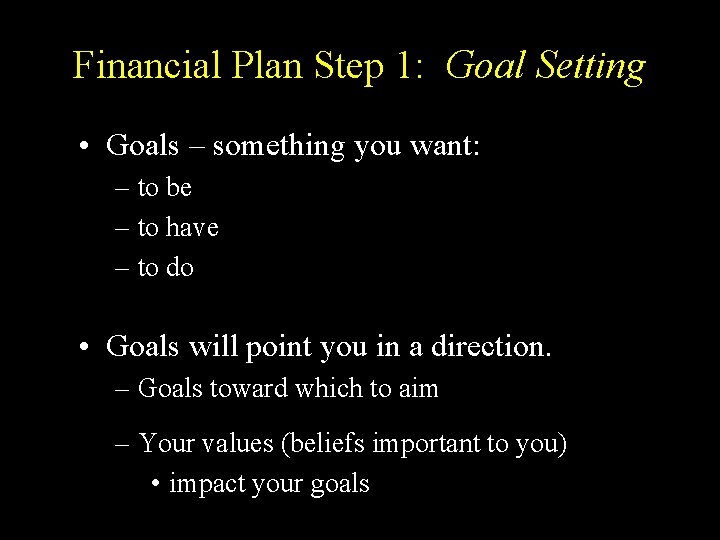
Financial Plan Step 1: Goal Setting • Goals – something you want: – to be – to have – to do • Goals will point you in a direction. – Goals toward which to aim – Your values (beliefs important to you) • impact your goals
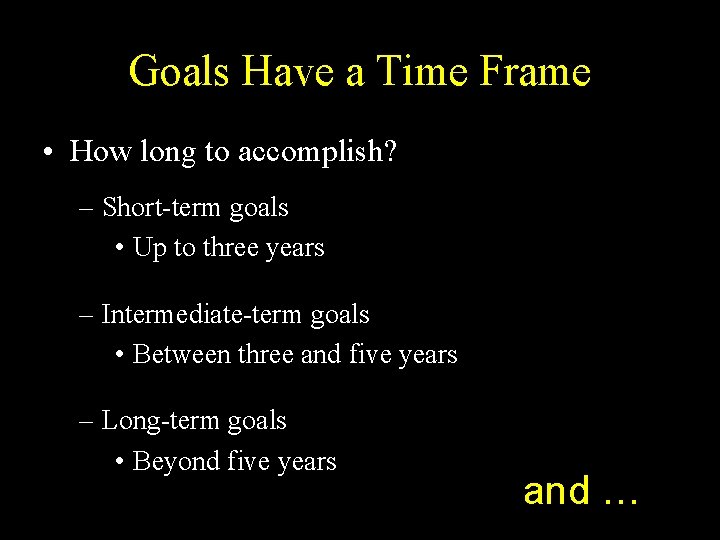
Goals Have a Time Frame • How long to accomplish? – Short-term goals • Up to three years – Intermediate-term goals • Between three and five years – Long-term goals • Beyond five years and …
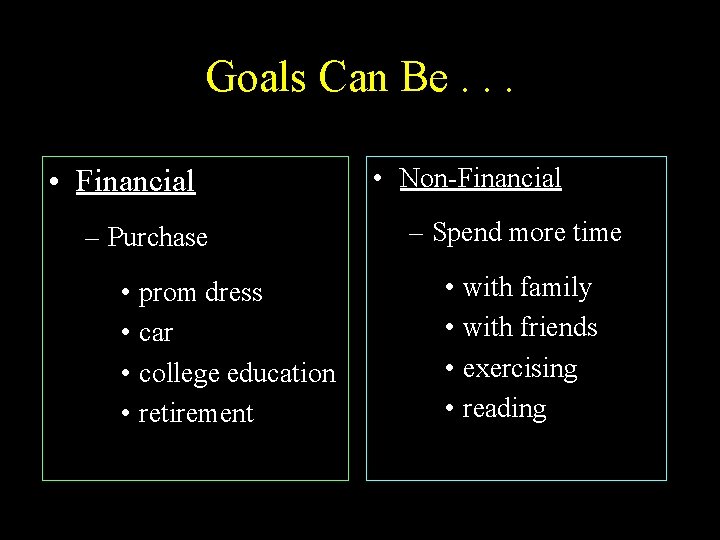
Goals Can Be. . . • Financial – Purchase • prom dress • car • college education • retirement • Non-Financial – Spend more time • with family • with friends • exercising • reading
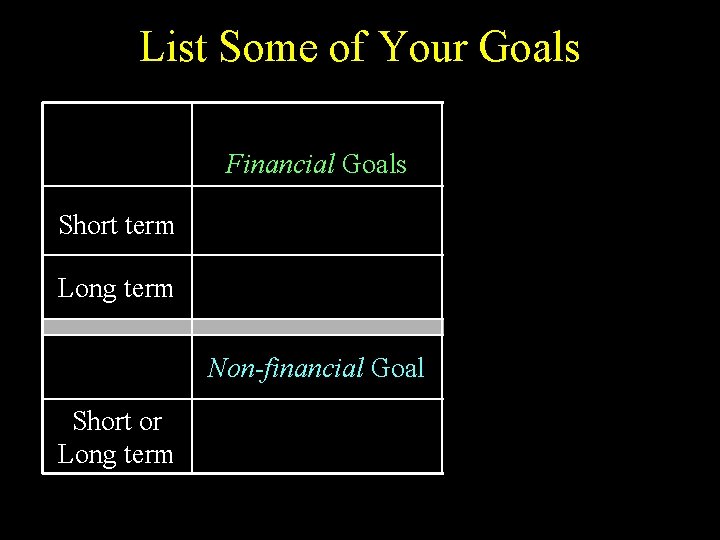
Write Down Three of Your Future Goals • Two “financial” – One short term and one long term • One “non-financial”
List Some of Your Goals Financial Goals Short term Long term Non-financial Goal Short or Long term Estimated Cost of Achieving Goal
Buyer Beware! If it sounds too good to be true, then it probably is. • What’s “too good to be true? ” • Recognizing “normal” rates of return can be helpful • Best way to protect yourself from a Scam is to remember that: There’s no such thing as a free lunch! • Speaking of scams … here’s a classic: http: //www. youtube. com/watch? v=yn. PJM 0 Zeqqg