
Methods For Producing Hollow Glass Microspheres Fabienne C
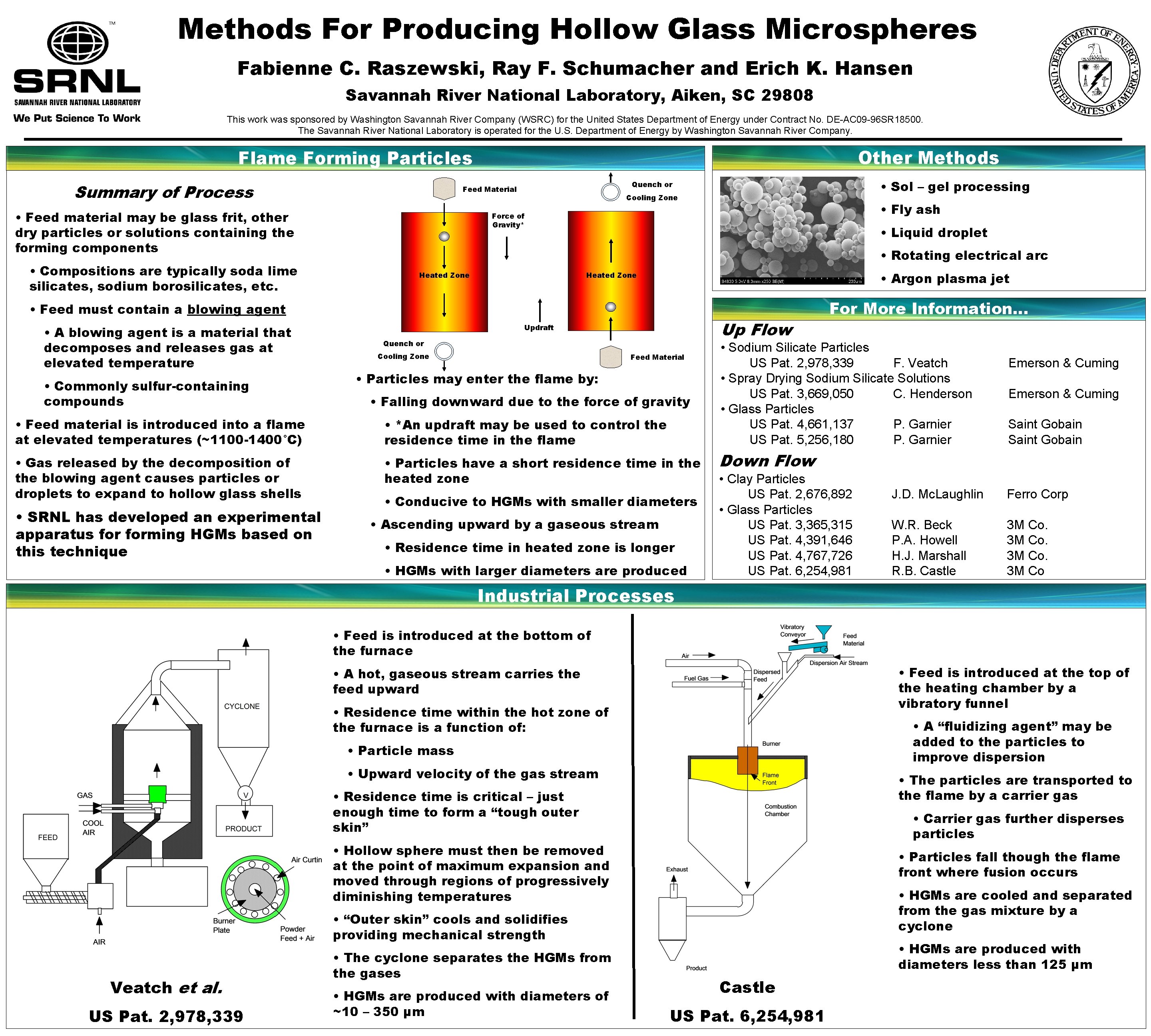
Methods For Producing Hollow Glass Microspheres Fabienne C. Raszewski, Ray F. Schumacher and Erich K. Hansen Savannah River National Laboratory, Aiken, SC 29808 This work was sponsored by Washington Savannah River Company (WSRC) for the United States Department of Energy under Contract No. DE-AC 09 -96 SR 18500. The Savannah River National Laboratory is operated for the U. S. Department of Energy by Washington Savannah River Company. Other Methods Flame Forming Particles Summary of Process • Feed material may be glass frit, other dry particles or solutions containing the forming components • Compositions are typically soda lime silicates, sodium borosilicates, etc. Cooling Zone • Commonly sulfur-containing compounds • Liquid droplet • Rotating electrical arc Heated Zone • Argon plasma jet Heated Zone Up Flow Updraft Quench or Cooling Zone Feed Material • Particles may enter the flame by: • Falling downward due to the force of gravity • Feed material is introduced into a flame at elevated temperatures (~1100 -1400°C) • *An updraft may be used to control the residence time in the flame • Gas released by the decomposition of the blowing agent causes particles or droplets to expand to hollow glass shells • Particles have a short residence time in the heated zone • SRNL has developed an experimental apparatus forming HGMs based on this technique • Fly ash Force of Gravity* • Feed must contain a blowing agent • A blowing agent is a material that decomposes and releases gas at elevated temperature • Sol – gel processing Quench or Feed Material • Conducive to HGMs with smaller diameters • Ascending upward by a gaseous stream • Residence time in heated zone is longer • HGMs with larger diameters are produced For More Information. . . • Sodium Silicate Particles US Pat. 2, 978, 339 F. Veatch • Spray Drying Sodium Silicate Solutions US Pat. 3, 669, 050 C. Henderson • Glass Particles US Pat. 4, 661, 137 P. Garnier US Pat. 5, 256, 180 P. Garnier Emerson & Cuming Saint Gobain Down Flow • Clay Particles US Pat. 2, 676, 892 • Glass Particles US Pat. 3, 365, 315 US Pat. 4, 391, 646 US Pat. 4, 767, 726 US Pat. 6, 254, 981 J. D. Mc. Laughlin Ferro Corp W. R. Beck P. A. Howell H. J. Marshall R. B. Castle 3 M Co Industrial Processes • Feed is introduced at the bottom of the furnace • Feed is introduced at the top of the heating chamber by a vibratory funnel • A hot, gaseous stream carries the feed upward • Residence time within the hot zone of the furnace is a function of: • A “fluidizing agent” may be added to the particles to improve dispersion • Particle mass • Upward velocity of the gas stream • The particles are transported to the flame by a carrier gas • Residence time is critical – just enough time to form a “tough outer skin” • Carrier gas further disperses particles • Hollow sphere must then be removed at the point of maximum expansion and moved through regions of progressively diminishing temperatures • Particles fall though the flame front where fusion occurs • HGMs are cooled and separated from the gas mixture by a cyclone • “Outer skin” cools and solidifies providing mechanical strength Veatch et al. US Pat. 2, 978, 339 • The cyclone separates the HGMs from the gases • HGMs are produced with diameters of ~10 – 350 μm • HGMs are produced with diameters less than 125 μm Castle US Pat. 6, 254, 981
- Slides: 1