
Methods for Dummies Random Field Theory Annika Lbbert
Methods for Dummies Random Field Theory Annika Lübbert & Marian Schneider
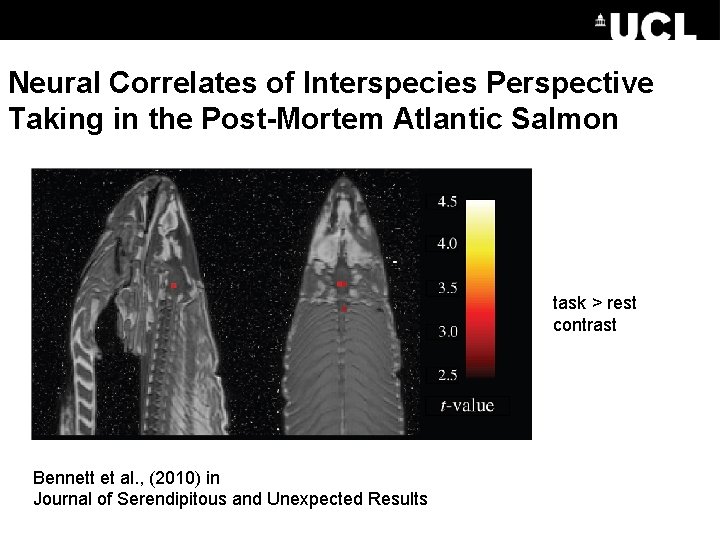
Neural Correlates of Interspecies Perspective Taking in the Post-Mortem Atlantic Salmon task > rest contrast Bennett et al. , (2010) in Journal of Serendipitous and Unexpected Results
Overview of Presentation 1. Multiple Comparisons Problem 2. Classical Approach to MCP 3. Random Field Theory 4. Implementation in SPM
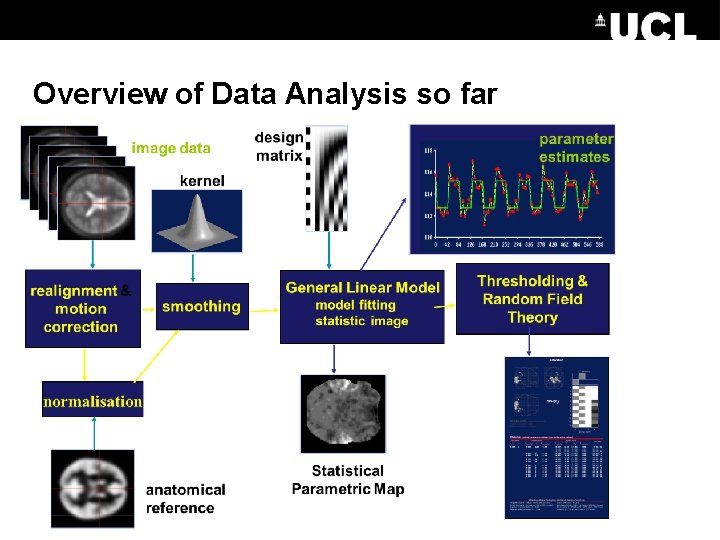
Overview of Data Analysis so far
1. Multiple Comparisons Problem
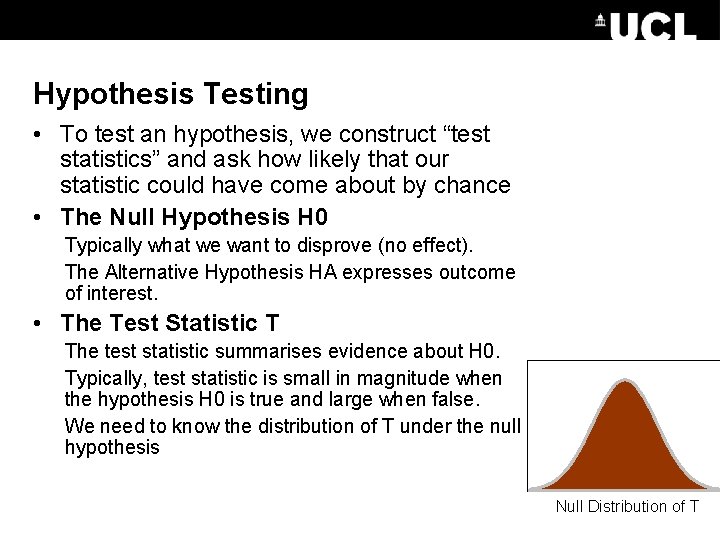
Hypothesis Testing • To test an hypothesis, we construct “test statistics” and ask how likely that our statistic could have come about by chance • The Null Hypothesis H 0 Typically what we want to disprove (no effect). The Alternative Hypothesis HA expresses outcome of interest. • The Test Statistic T The test statistic summarises evidence about H 0. Typically, test statistic is small in magnitude when the hypothesis H 0 is true and large when false. We need to know the distribution of T under the null hypothesis Null Distribution of T
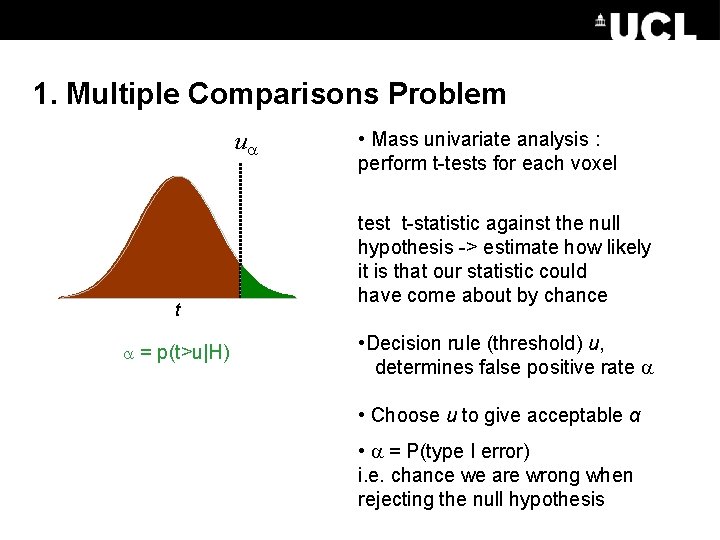
1. Multiple Comparisons Problem u t = p(t>u|H) • Mass univariate analysis : perform t-tests for each voxel test t-statistic against the null hypothesis -> estimate how likely it is that our statistic could have come about by chance • Decision rule (threshold) u, determines false positive rate • Choose u to give acceptable α • = P(type I error) i. e. chance we are wrong when rejecting the null hypothesis
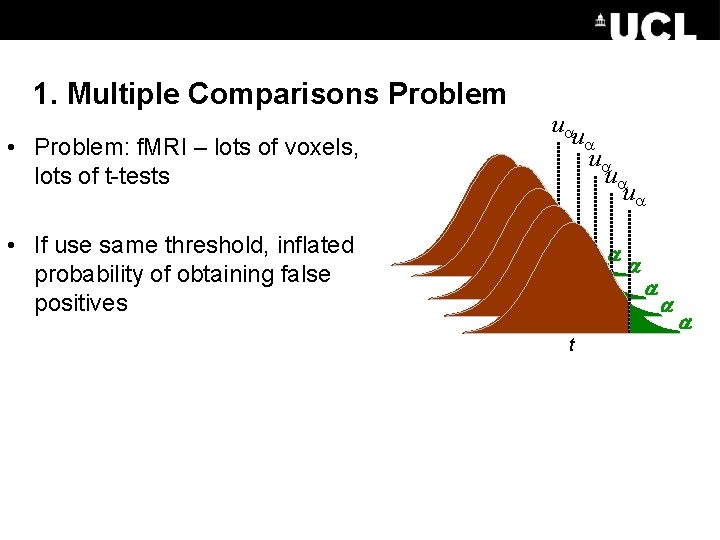
1. Multiple Comparisons Problem u u • Problem: f. MRI – lots of voxels, lots of t-tests • If use same threshold, inflated probability of obtaining false positives u u u t t t
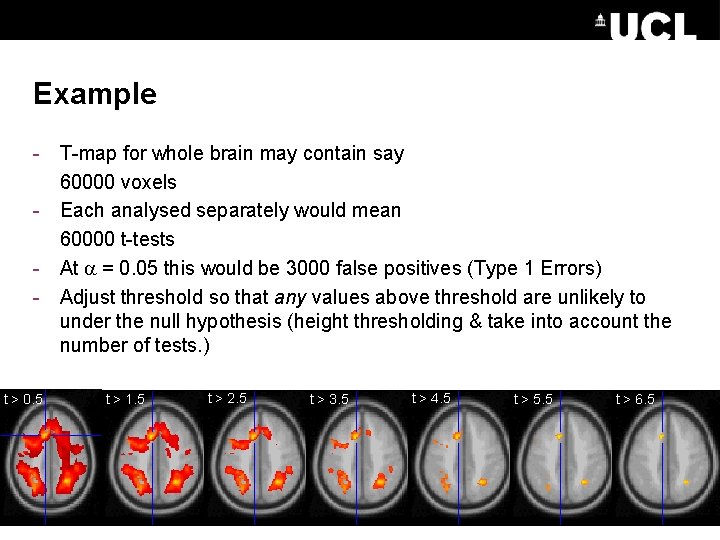
Example - T-map for whole brain may contain say 60000 voxels - Each analysed separately would mean 60000 t-tests - At = 0. 05 this would be 3000 false positives (Type 1 Errors) - Adjust threshold so that any values above threshold are unlikely to under the null hypothesis (height thresholding & take into account the number of tests. ) t > 0. 5 t > 1. 5 t > 2. 5 t > 3. 5 t > 4. 5 t > 5. 5 t > 6. 5
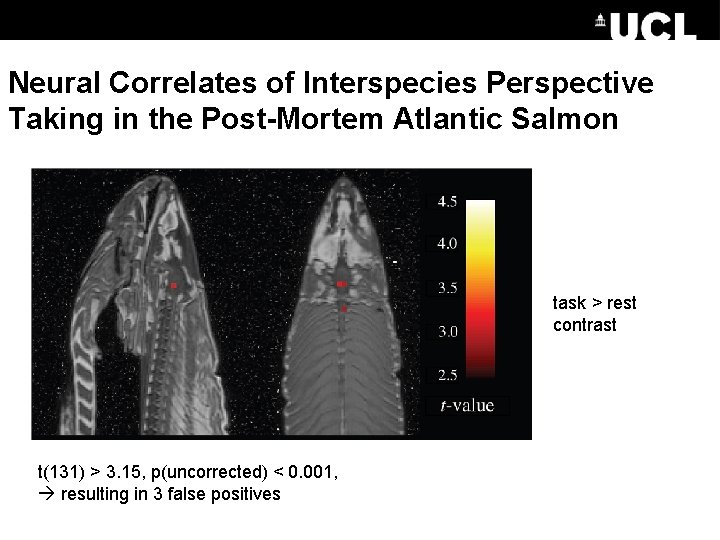
Neural Correlates of Interspecies Perspective Taking in the Post-Mortem Atlantic Salmon task > rest contrast t(131) > 3. 15, p(uncorrected) < 0. 001, resulting in 3 false positives
2. Classical Approach to MCP
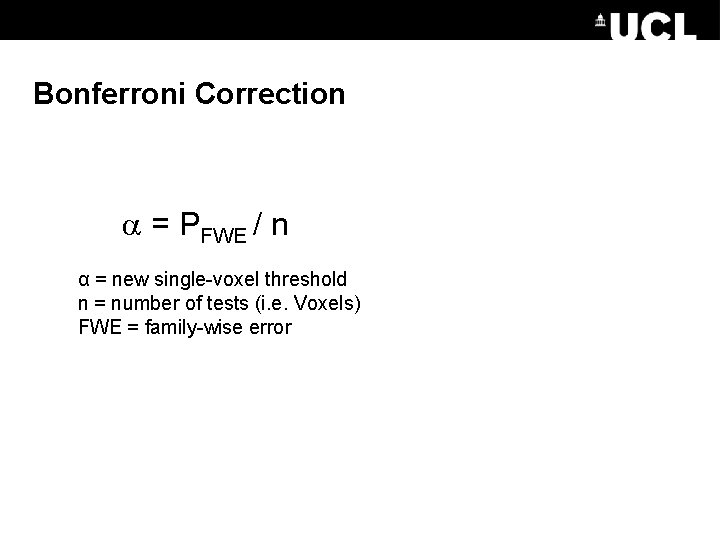
Bonferroni Correction = PFWE / n α = new single-voxel threshold n = number of tests (i. e. Voxels) FWE = family-wise error
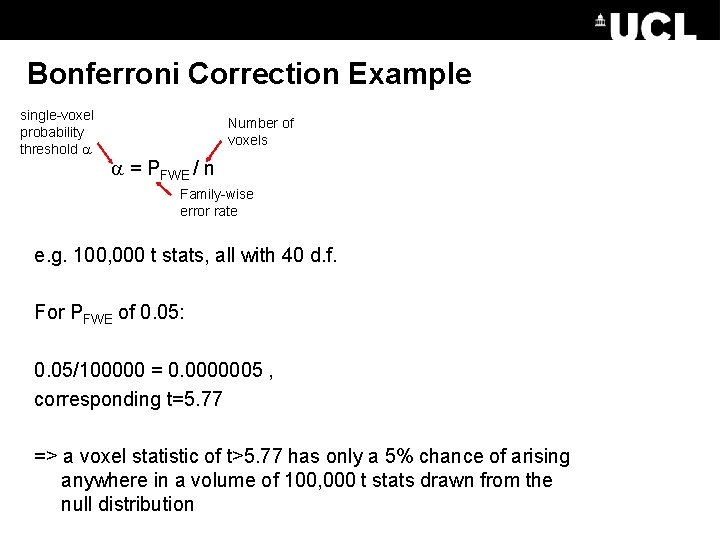
Bonferroni Correction Example single-voxel probability threshold Number of voxels = PFWE / n Family-wise error rate e. g. 100, 000 t stats, all with 40 d. f. For PFWE of 0. 05: 0. 05/100000 = 0. 0000005 , corresponding t=5. 77 => a voxel statistic of t>5. 77 has only a 5% chance of arising anywhere in a volume of 100, 000 t stats drawn from the null distribution
Why Bonferroni is too conservative • • Functional imaging data has a degree of spatial correlation Number of independent values < number of voxels Why? • • The way that the scanner collects and reconstructs the image Physiology Spatial preprocessing (resampling, smoothing) Fundamental problem: image data represent situation in which we have a continuous statistic image, not a series of independent tests
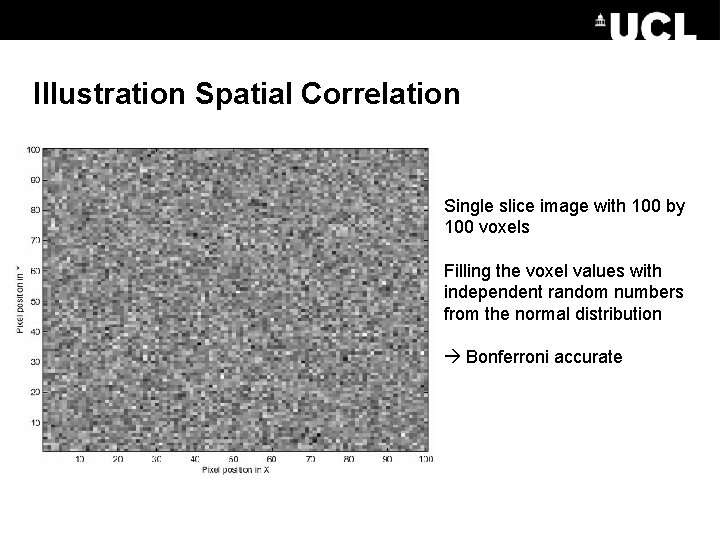
Illustration Spatial Correlation Single slice image with 100 by 100 voxels Filling the voxel values with independent random numbers from the normal distribution Bonferroni accurate
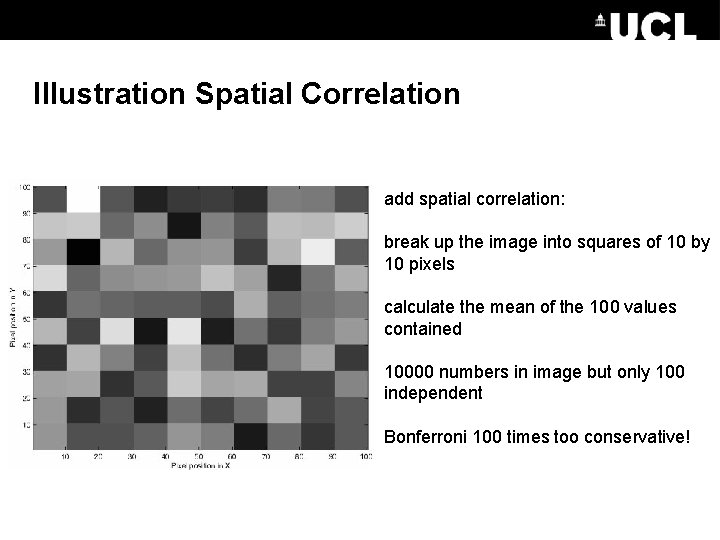
Illustration Spatial Correlation add spatial correlation: break up the image into squares of 10 by 10 pixels calculate the mean of the 100 values contained 10000 numbers in image but only 100 independent Bonferroni 100 times too conservative!
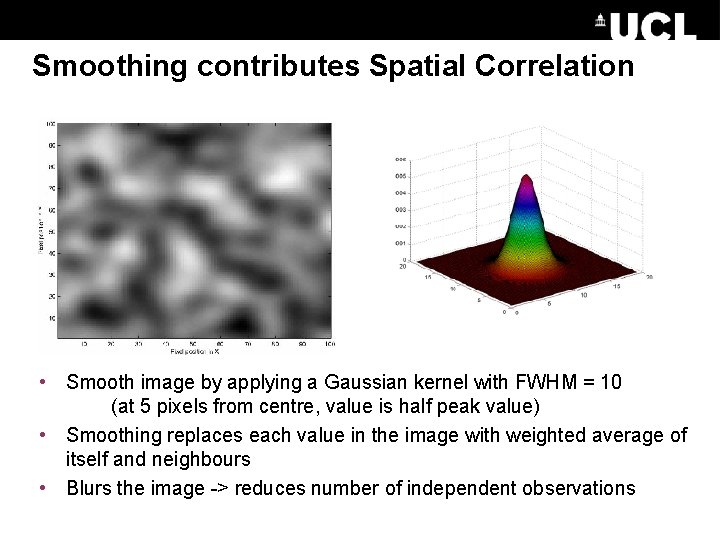
Smoothing contributes Spatial Correlation • Smooth image by applying a Gaussian kernel with FWHM = 10 (at 5 pixels from centre, value is half peak value) • Smoothing replaces each value in the image with weighted average of itself and neighbours • Blurs the image -> reduces number of independent observations
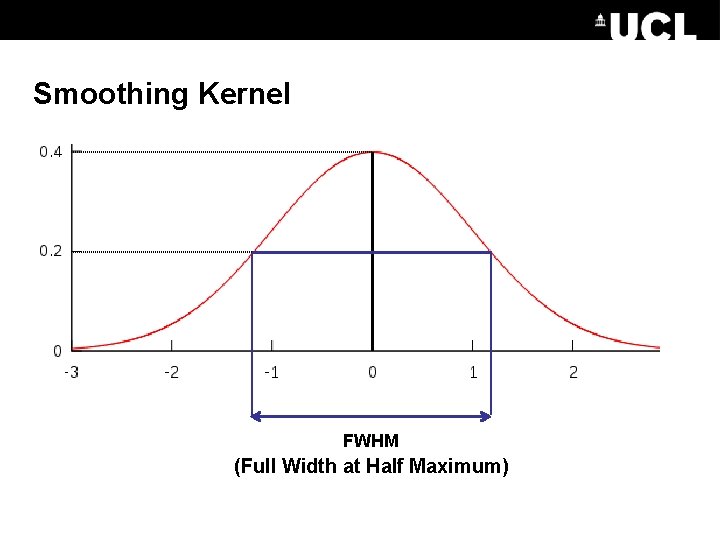
Smoothing Kernel FWHM (Full Width at Half Maximum)
3. Random Field Theory
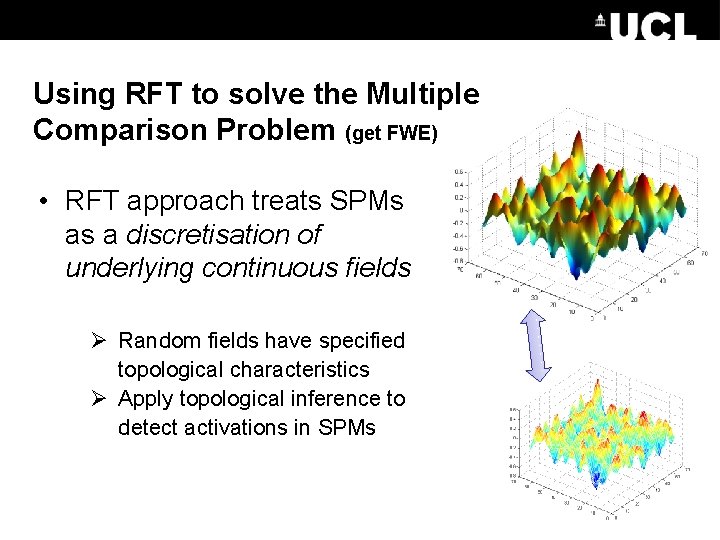
Using RFT to solve the Multiple Comparison Problem (get FWE) • RFT approach treats SPMs as a discretisation of underlying continuous fields Ø Random fields have specified topological characteristics Ø Apply topological inference to detect activations in SPMs
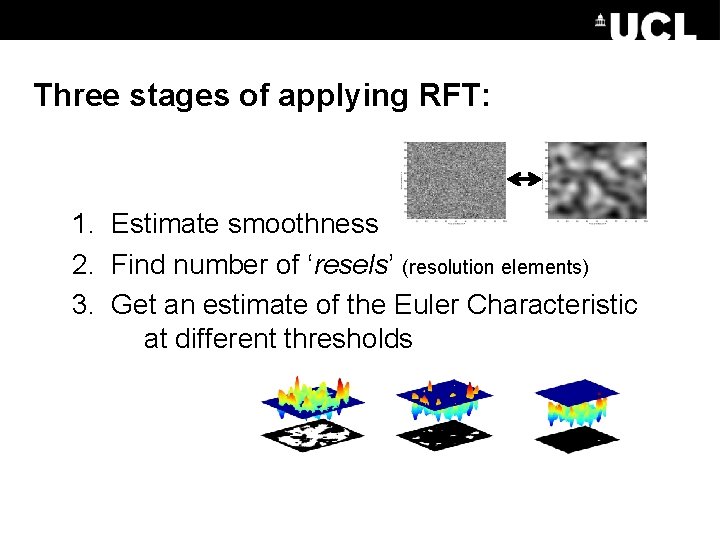
Three stages of applying RFT: 1. Estimate smoothness 2. Find number of ‘resels’ (resolution elements) 3. Get an estimate of the Euler Characteristic at different thresholds
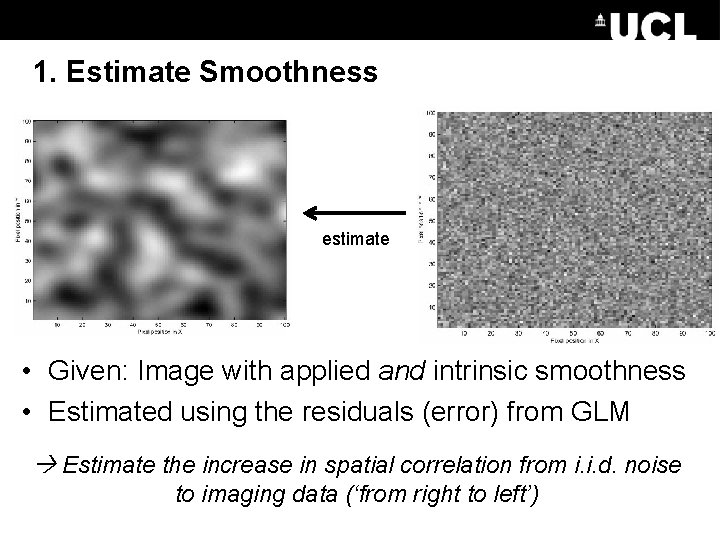
1. Estimate Smoothness estimate • Given: Image with applied and intrinsic smoothness • Estimated using the residuals (error) from GLM Estimate the increase in spatial correlation from i. i. d. noise to imaging data (‘from right to left’)
2. Calculate the number of resels • Look at your estimated smoothness (FWHM) • Express your search volume in resels Ø Resolution element (Ri = FWHMx x FWHMy x FWHMz) Ø # depends on smoothness of data (+volume of ROI) Ø “Restores” independence of the data
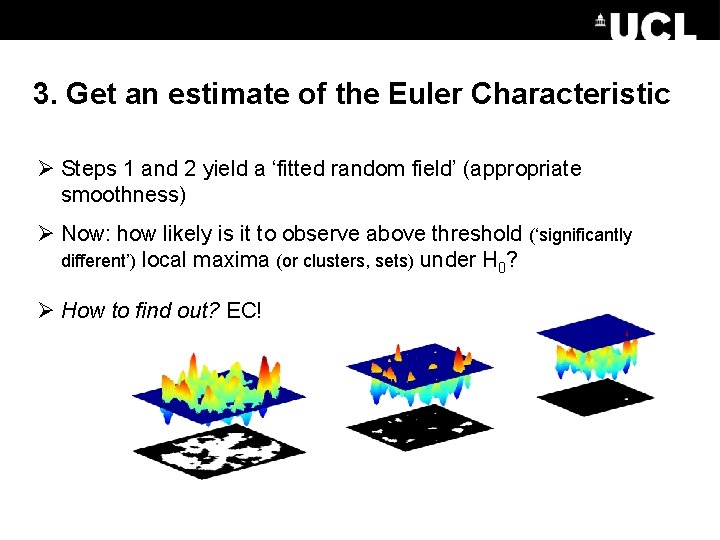
3. Get an estimate of the Euler Characteristic Ø Steps 1 and 2 yield a ‘fitted random field’ (appropriate smoothness) Ø Now: how likely is it to observe above threshold (‘significantly different’) local maxima (or clusters, sets) under H 0? Ø How to find out? EC!
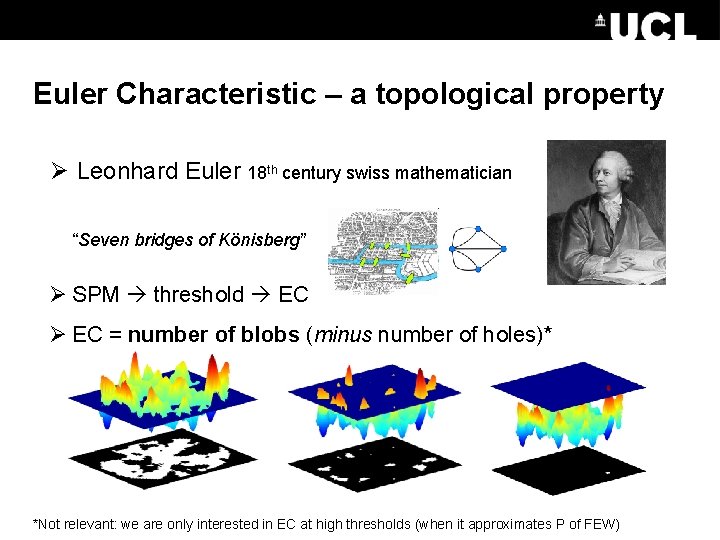
Euler Characteristic – a topological property Ø Leonhard Euler 18 th century swiss mathematician “Seven bridges of Kӧnisberg” Ø SPM threshold EC Ø EC = number of blobs (minus number of holes)* *Not relevant: we are only interested in EC at high thresholds (when it approximates P of FEW)
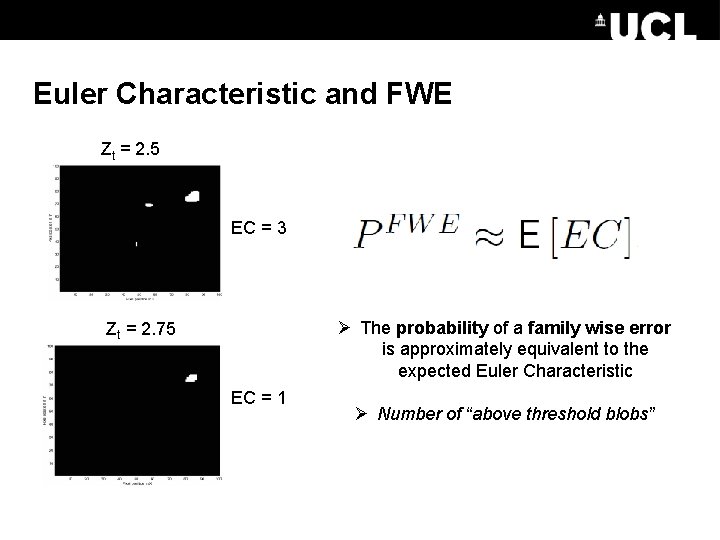
Euler Characteristic and FWE Zt = 2. 5 EC = 3 Ø The probability of a family wise error is approximately equivalent to the expected Euler Characteristic Zt = 2. 75 EC = 1 Ø Number of “above threshold blobs”
![How to get E [EC] at different thresholds # of resels Expected Euler Characteristic](http://slidetodoc.com/presentation_image/297724fac486a8346bbf82556853745a/image-27.jpg "How to get E [EC] at different thresholds # of resels Expected Euler Characteristic")
How to get E [EC] at different thresholds # of resels Expected Euler Characteristic Z (or T) -score threshold * Or Monte Carlo Simulation, but the formula is good! It gives exact estimates, as long as your smoothness is appropriate
![Given # of resels and E[EC], we can find the appropriate z/t-threshold E [EC]](http://slidetodoc.com/presentation_image/297724fac486a8346bbf82556853745a/image-28.jpg "Given # of resels and E[EC], we can find the appropriate z/t-threshold E [EC]")
Given # of resels and E[EC], we can find the appropriate z/t-threshold E [EC] for an image of 100 resels, for Z score thresholds 0 – 5
![How to get E [EC] at different thresholds # of resels Expected Euler Characteristic](http://slidetodoc.com/presentation_image/297724fac486a8346bbf82556853745a/image-29.jpg "How to get E [EC] at different thresholds # of resels Expected Euler Characteristic")
How to get E [EC] at different thresholds # of resels Expected Euler Characteristic Z (or T) -score threshold From this equation, it looks like threshold depends only on the number of resels in our image
![Shape of search region matters, too! #resels E [EC] Ø not strictly accurate! Ø](http://slidetodoc.com/presentation_image/297724fac486a8346bbf82556853745a/image-30.jpg "Shape of search region matters, too! #resels E [EC] Ø not strictly accurate! Ø")
Shape of search region matters, too! #resels E [EC] Ø not strictly accurate! Ø close approximation if ROI is large compared to the size of a resel # + shape + size resel E [EC] Ø Matters if small or oddly shaped ROI Example: 1. central 30 x 30 pixel box = max. 16 ‘resels’ (resel-width = 10 pixel) 2. edge 2. 5 pixel frame = same volume but max. 32 ‘resels’ Ø Multiple comparison correction for frame must be more stringent
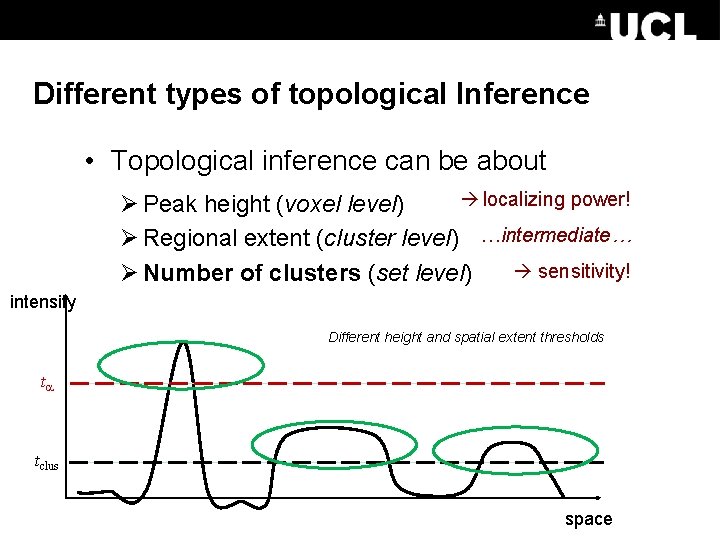
Different types of topological Inference • Topological inference can be about localizing power! Ø Peak height (voxel level) Ø Regional extent (cluster level) …intermediate… sensitivity! Ø Number of clusters (set level) intensity Different height and spatial extent thresholds t tclus space
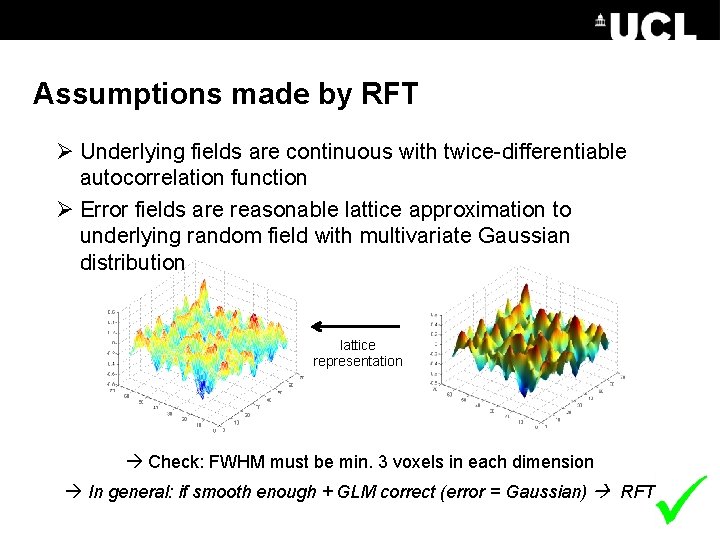
Assumptions made by RFT Ø Underlying fields are continuous with twice-differentiable autocorrelation function Ø Error fields are reasonable lattice approximation to underlying random field with multivariate Gaussian distribution lattice representation Check: FWHM must be min. 3 voxels in each dimension In general: if smooth enough + GLM correct (error = Gaussian) RFT
Assumptions are not met if. . . Ø Data is not sufficiently smooth • Small number of subjects • High-resolution data Non-parametric methods to get FWE (permutation) Alternative ways of controlling for errors: FDR (false discovery rate)
4. Implementation in SPM
4. Implementation in SPM
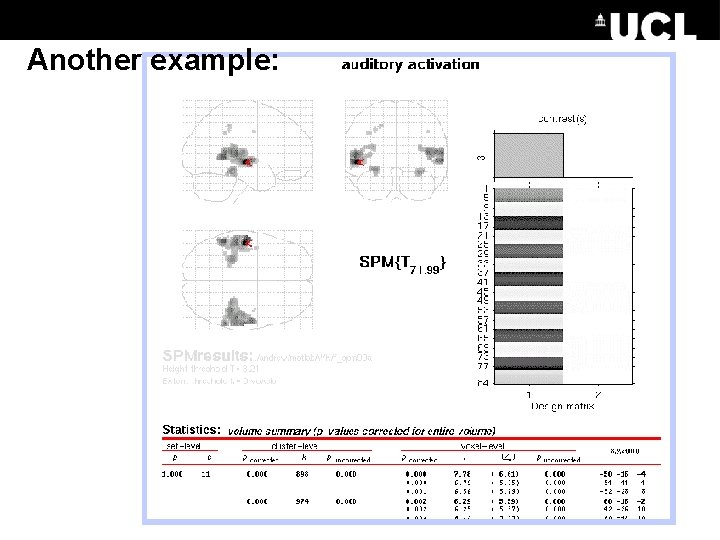
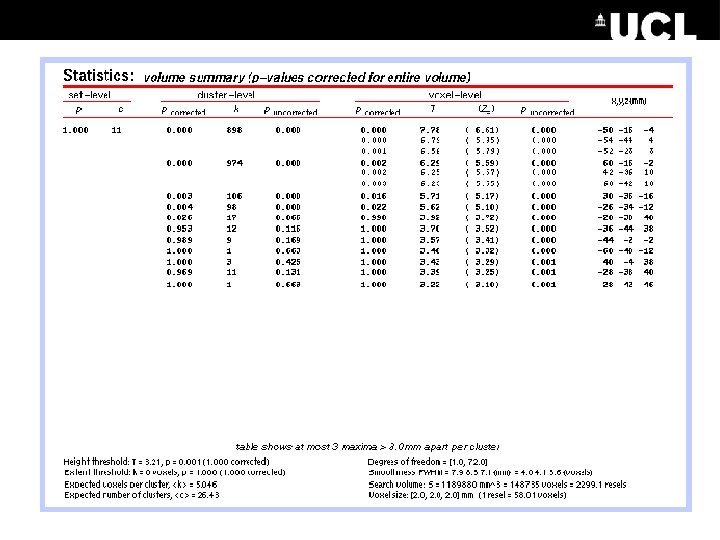
Another example:
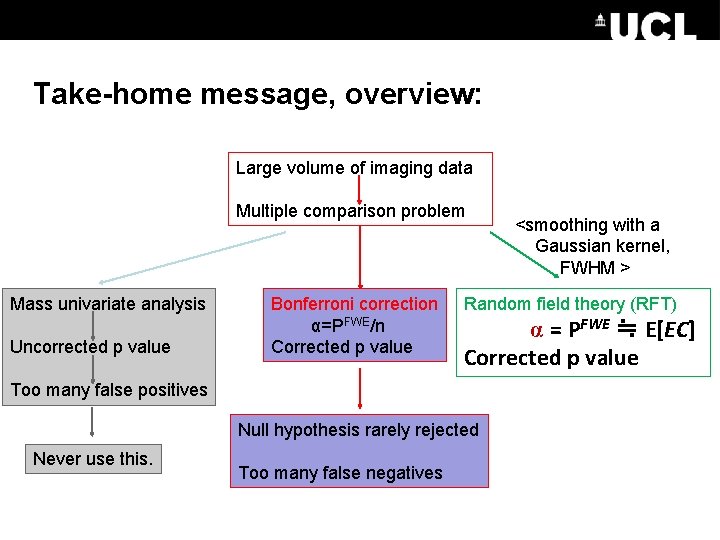
Take-home message, overview: Large volume of imaging data Multiple comparison problem Mass univariate analysis Uncorrected p value Bonferroni correction α=PFWE/n Corrected p value Random field theory (RFT) α = PFWE ≒ E[EC] Corrected p value Too many false positives Null hypothesis rarely rejected Never use this. Too many false negatives <smoothing with a Gaussian kernel, FWHM >
Thank you for your attention! …and special thanks to Guillaume!
Sources • Human Brain Function, Chapter 14, An Introduction to Random Field Theory (Brett, Penny, Kiebel) • http: //www. fil. ion. ucl. ac. uk/spm/course/video/#RFT • http: //www. fil. ion. ucl. ac. uk/spm/course/video/#MEEG _MCP • Former Mf. D Presentations • Expert Guillaume Flandin
- Slides: 41