
Methodology and Format I Definition of research Nunan

- Slides: 18
Methodology and Format I. Definition (of research) Nunan (1992): “Research is a process of formulating questions, problems, or hypotheses; collecting data or evidence relevant to these questions, problems, or hypotheses; and analyzing or interpreting these data.
Methodology and Format II. Common Research methods. 1. Dialectics (論證法) * logical reasoning: inductive (歸納, specific to general), deductive (演繹, general to specific). 2. Survey (調查法) * Collect samples (樣本) and infer the characteristics of the population (母體). Each question in the questionnaire can be regarded as a variable (變數).
Methodology and Format II. Common Research methods. 3. Interview (訪談法) * Collect data from interview (personal or group). Recording and transcribing (文字轉錄) data, and then analyze them. 4. Case Study (個案法) * See the object of the research as unity (統一性) and wholeness (整體性). An individual or a a group/organization can be used as the target of case study.
Methodology and Format II. Common Research methods. 5. Observation (觀察法) * Use our five senses to observe something with plan and purpose. It can be divided into participant observation and non-participant observation. 6. Experiment (實驗法) * discuss the relationship between independent variable (自變項) and dependable variable (依變項). Researchers usually divide the object of inquiry into two groups: experimental group and control group.
Methodology and Format III. How to Find your Research Topic 1. Put other people’s theories to test. 2. Reexamine other people’s conclusions 3. Repeat or modify a previous study 4. Use of calibrated psychological tests (標準的心理測 驗) 5. Focusing on a detail of a larger study and combining it with another question
Methodology and Format IV. Characteristics of Research Papers 1. Arguments: clear and systematic. 2. tone: objective, serious and formal 3. sentences: more complicated; use less of contraction, such as it’s, hasn’t.
Methodology and Format IV. Characteristics of Research Papers 4. Style: choosing the more formal alternative when selecting a verb, noun, or other part of speech. (1) Verbs: select a single verb to replace a phrasal verb * According to some biologists, coming up with clear proof of the decreasing numbers of frogs has been difficult. →According to some biologists, offering clear proof. . . (Exercise: Handout)
Methodology and Format IV. Characteristics of Research Papers 4. Style: (2) Noun and other parts of speech * There has been a lot of/considerable interest in how background sounds such as music affect an individual’s ability to concentrate. * Consumer interest in electronic billing and payment is getting bigger and bigger / increasing.
Methodology and Format IV. Characteristics of Research Papers 4. Style: (3) Some nonvocabulary-related tips. * Export figures won’t / will not improve until the economy is stronger. * The analysis didn’t yield any new results. → The analysis yielded no new results. (not. . . any → no). (not. . . much → few) * Avoid addressing the reader as you. You can see the results in Table 1. → The results can be seen in Table 1.
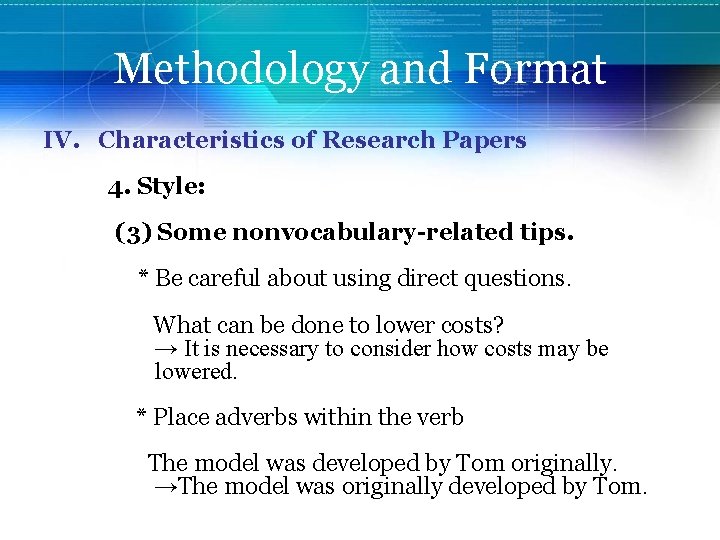
Methodology and Format IV. Characteristics of Research Papers 4. Style: (3) Some nonvocabulary-related tips. * Be careful about using direct questions. What can be done to lower costs? → It is necessary to consider how costs may be lowered. * Place adverbs within the verb The model was developed by Tom originally. →The model was originally developed by Tom.
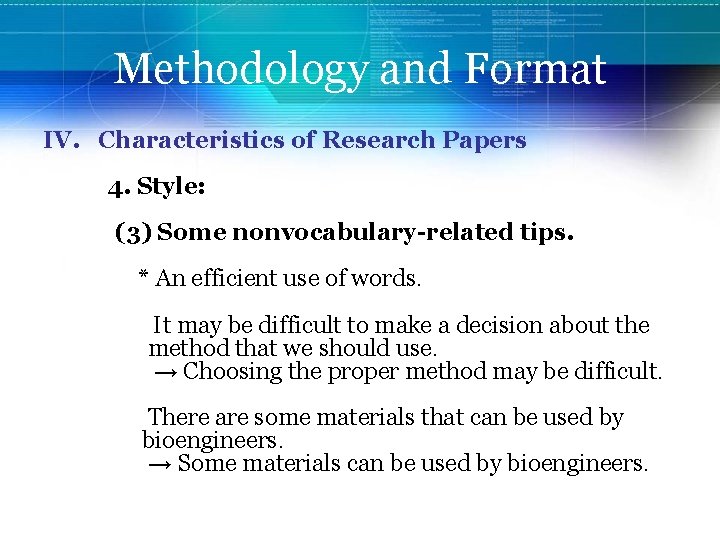
Methodology and Format IV. Characteristics of Research Papers 4. Style: (3) Some nonvocabulary-related tips. * An efficient use of words. It may be difficult to make a decision about the method that we should use. → Choosing the proper method may be difficult. There are some materials that can be used by bioengineers. → Some materials can be used by bioengineers.
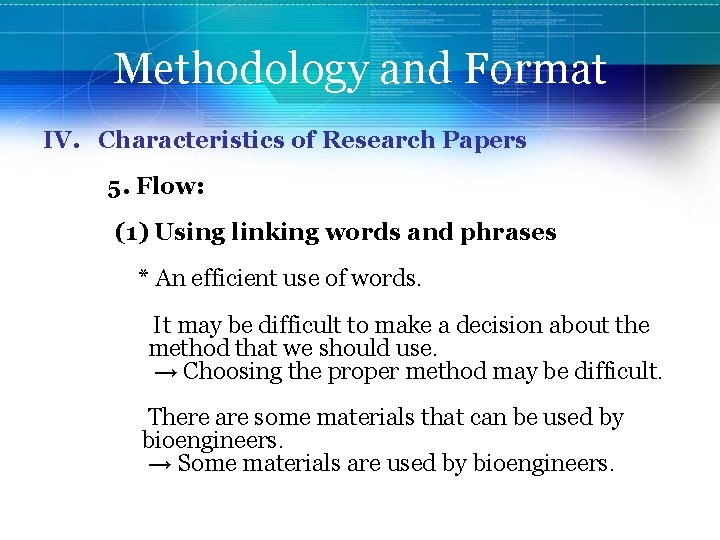
Methodology and Format IV. Characteristics of Research Papers 5. Flow: (1) Using linking words and phrases * An efficient use of words. It may be difficult to make a decision about the method that we should use. → Choosing the proper method may be difficult. There are some materials that can be used by bioengineers. → Some materials are used by bioengineers.
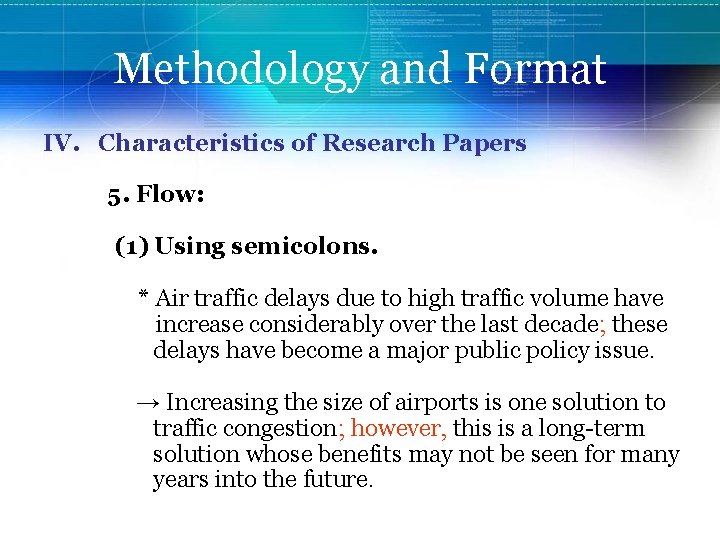
Methodology and Format IV. Characteristics of Research Papers 5. Flow: (1) Using semicolons. * Air traffic delays due to high traffic volume have increase considerably over the last decade; these delays have become a major public policy issue. → Increasing the size of airports is one solution to traffic congestion; however, this is a long-term solution whose benefits may not be seen for many years into the future.
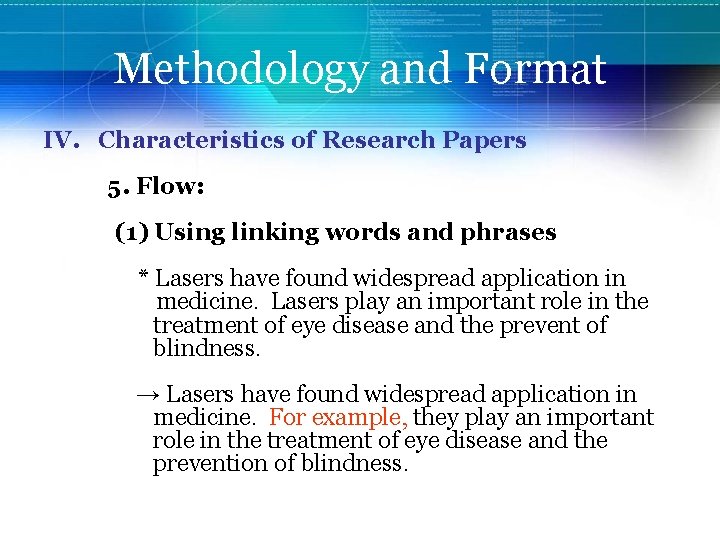
Methodology and Format IV. Characteristics of Research Papers 5. Flow: (1) Using linking words and phrases * Lasers have found widespread application in medicine. Lasers play an important role in the treatment of eye disease and the prevent of blindness. → Lasers have found widespread application in medicine. For example, they play an important role in the treatment of eye disease and the prevention of blindness.
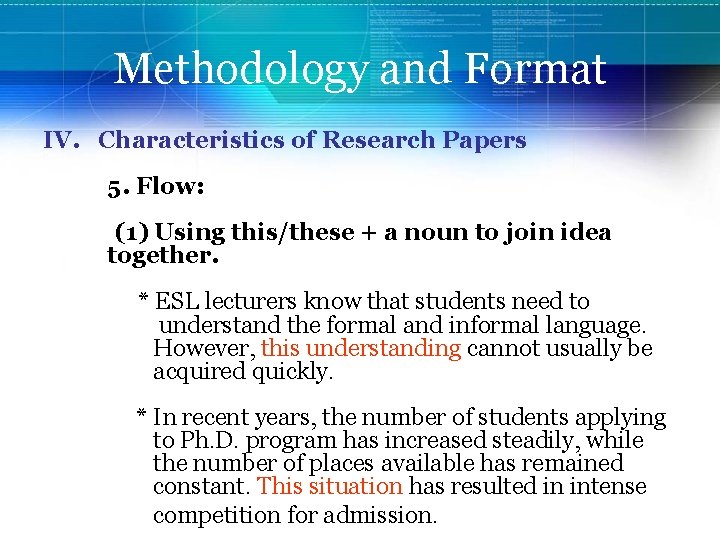
Methodology and Format IV. Characteristics of Research Papers 5. Flow: (1) Using this/these + a noun to join idea together. * ESL lecturers know that students need to understand the formal and informal language. However, this understanding cannot usually be acquired quickly. * In recent years, the number of students applying to Ph. D. program has increased steadily, while the number of places available has remained constant. This situation has resulted in intense competition for admission.
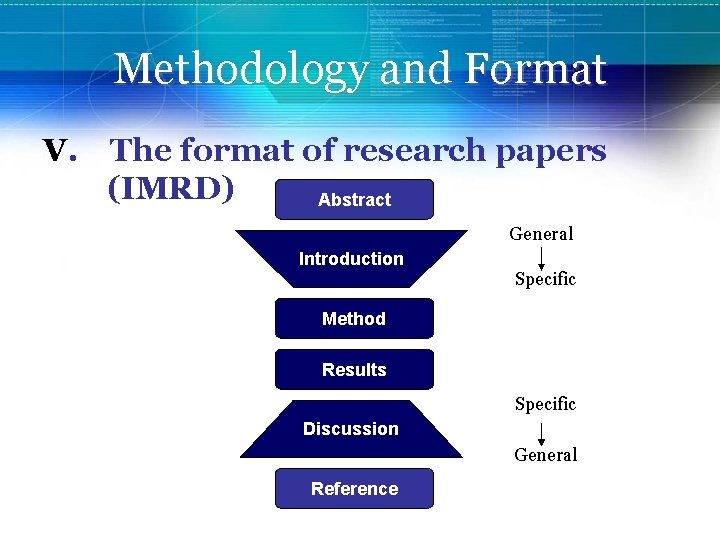
Methodology and Format V. The format of research papers (IMRD) Abstract General Introduction Specific Method Results Specific Discussion General Reference
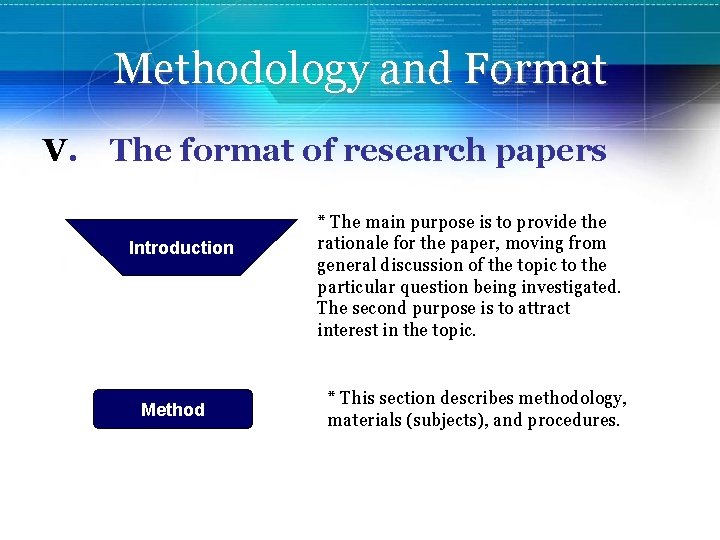
Methodology and Format V. The format of research papers Introduction Method * The main purpose is to provide the rationale for the paper, moving from general discussion of the topic to the particular question being investigated. The second purpose is to attract interest in the topic. * This section describes methodology, materials (subjects), and procedures.
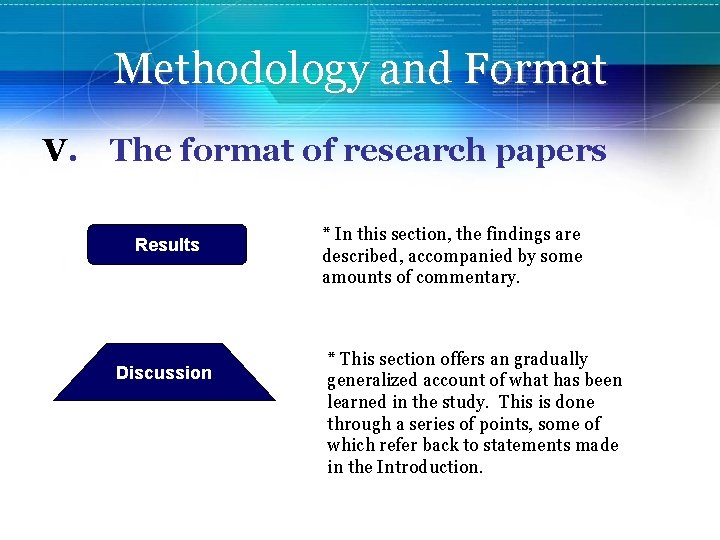
Methodology and Format V. The format of research papers Results Discussion * In this section, the findings are described, accompanied by some amounts of commentary. * This section offers an gradually generalized account of what has been learned in the study. This is done through a series of points, some of which refer back to statements made in the Introduction.