
Methodolo gy Revision Ethical guidelines Informed consent Participants


- Slides: 50
Methodolo gy Revision
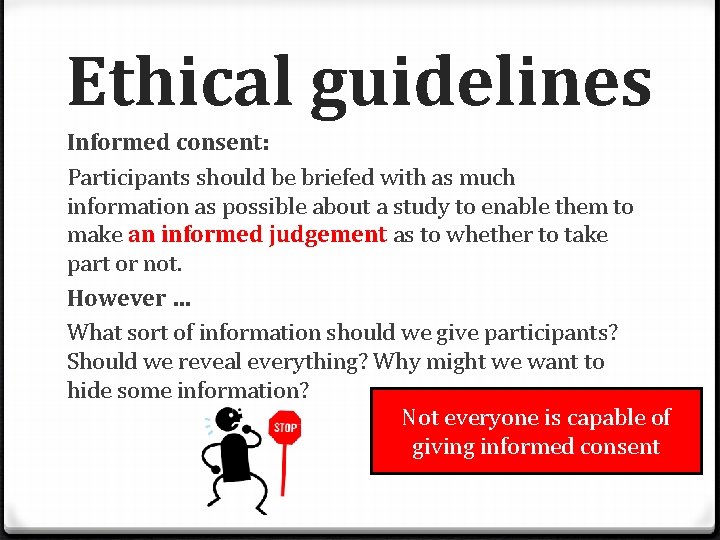
Ethical guidelines Informed consent: Participants should be briefed with as much information as possible about a study to enable them to make an informed judgement as to whether to take part or not. However … What sort of information should we give participants? Should we reveal everything? Why might we want to hide some information? Not everyone is capable of giving informed consent
Deception 0 Deception should only be used if there is no alternative 0 We should seek approval from an ethics committee 0 Debriefing does not justify deception Right to withdraw 0 We must make participants aware that they are free to leave a study at any time, even if we’ve paid them! They can also refuse permission for their data to be used
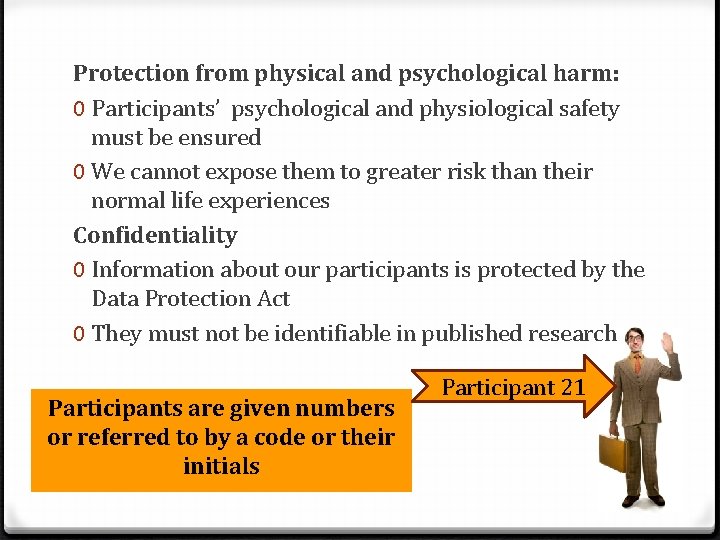
Protection from physical and psychological harm: 0 Participants’ psychological and physiological safety must be ensured 0 We cannot expose them to greater risk than their normal life experiences Confidentiality 0 Information about our participants is protected by the Data Protection Act 0 They must not be identifiable in published research Participants are given numbers or referred to by a code or their initials Participant 21
Privacy: 0 Often tricky if we’re conducting observations when people are unaware they’re being watched, but we must maintain their right to privacy 0 We should only observe people where they would expect to be observed by others in public places… Debriefing: We must always debrief participants after a study to allow them to ask questions and for the researcher to remind them again of their right to withdraw
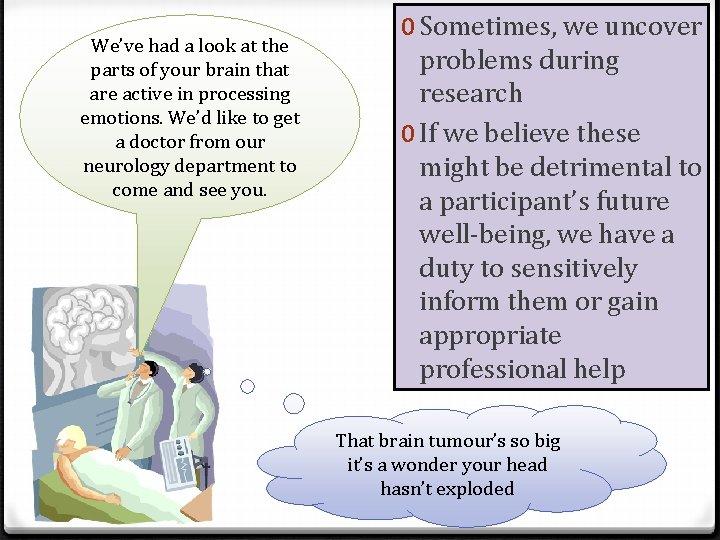
We’ve had a look at the parts of your brain that are active in processing emotions. We’d like to get a doctor from our neurology department to come and see you. 0 Sometimes, we uncover problems during research 0 If we believe these might be detrimental to a participant’s future well-being, we have a duty to sensitively inform them or gain appropriate professional help That brain tumour’s so big it’s a wonder your head hasn’t exploded
We must all take responsibility for good practice. We should challenge colleagues who are not acting in an ethical manner.
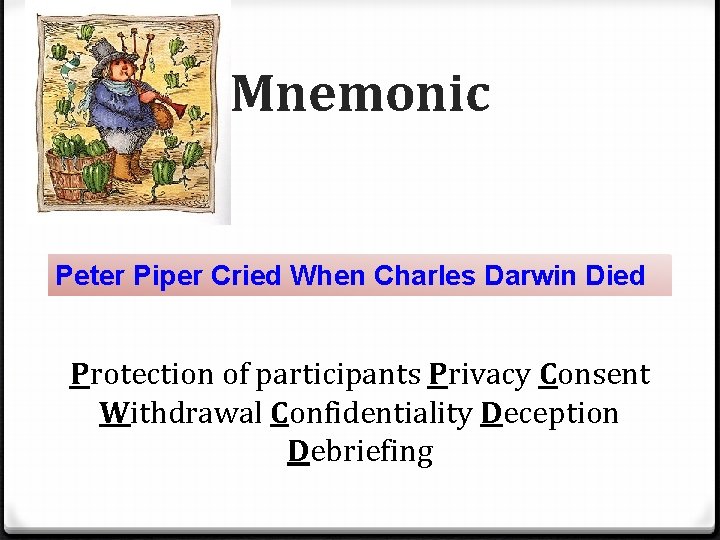
Mnemonic Peter Piper Cried When Charles Darwin Died Protection of participants Privacy Consent Withdrawal Confidentiality Deception Debriefing
When we carry out research we need people to take part, these are called participants. It is important to use suitable participants in your study. The population is the group of people from whom the sample is drawn. For example if the sample of participants is taken from sixth form colleges in Luton, the findings of the study can only be applied to that group of people and not all sixth form students in the UK and certainly not all people in the world because they are not representative (they might have different characteristics )
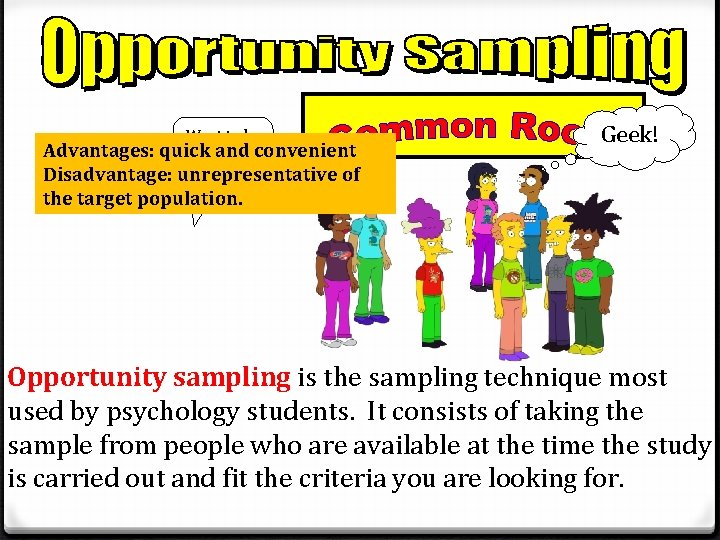
Want to be Advantages: quickin my and convenient study? Disadvantage: unrepresentative of Geek! the target population. Opportunity sampling is the sampling technique most used by psychology students. It consists of taking the sample from people who are available at the time the study is carried out and fit the criteria you are looking for.
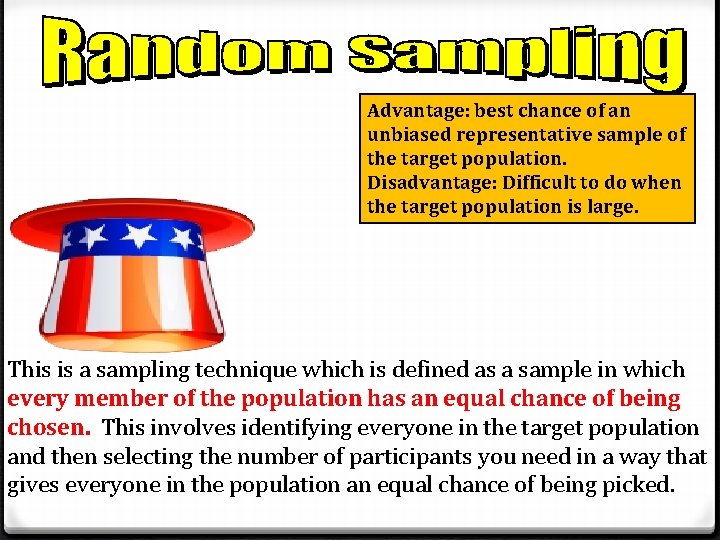
Advantage: best chance of an unbiased representative sample of the target population. Disadvantage: Difficult to do when the target population is large. This is a sampling technique which is defined as a sample in which every member of the population has an equal chance of being chosen. This involves identifying everyone in the target population and then selecting the number of participants you need in a way that gives everyone in the population an equal chance of being picked.
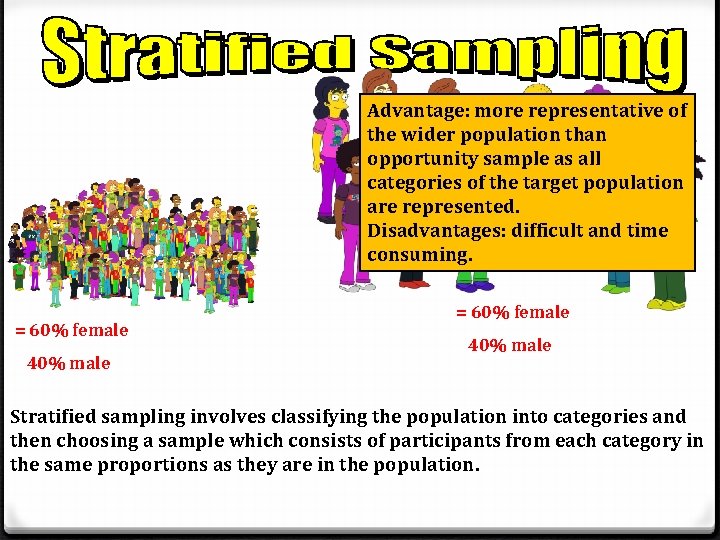
Advantage: more representative of the wider population than opportunity sample as all categories of the target population are represented. Disadvantages: difficult and time consuming. = 60% female 40% male Stratified sampling involves classifying the population into categories and then choosing a sample which consists of participants from each category in the same proportions as they are in the population.
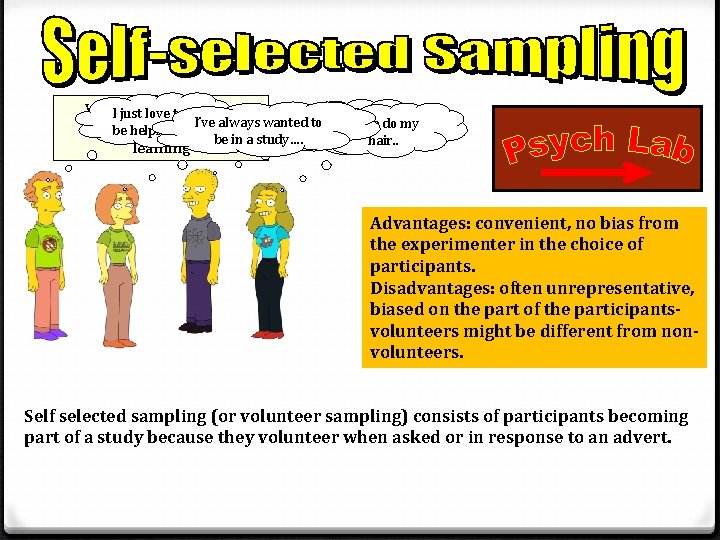
Volunteers needed for I just love to Sounds I’ve always wanted to Gotta do my psychological study on be helpful…. rubbish… be in a study…. hair. . learning Advantages: convenient, no bias from the experimenter in the choice of participants. Disadvantages: often unrepresentative, biased on the part of the participantsvolunteers might be different from nonvolunteers. Self selected sampling (or volunteer sampling) consists of participants becoming part of a study because they volunteer when asked or in response to an advert.
Pilot study This is a smaller version of a study carried out before the main research. The aim is to identify any flaw in the study and carry out the necessary modifications before doing the full scale study.
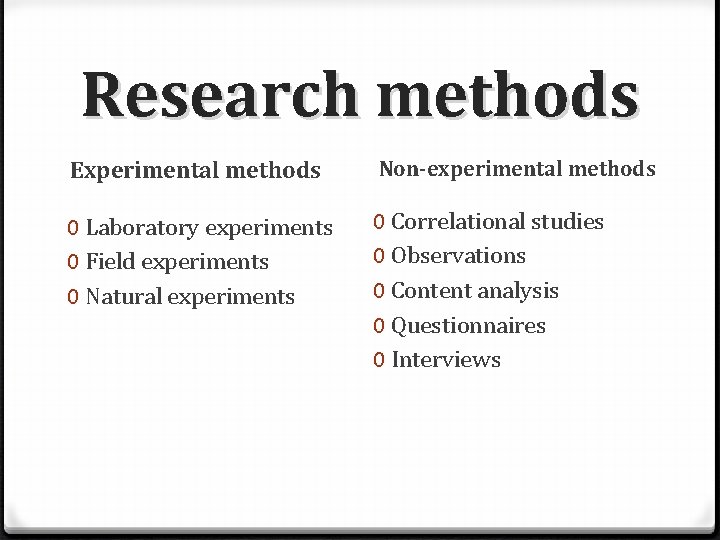
Research methods Experimental methods Non-experimental methods 0 Laboratory experiments 0 Field experiments 0 Natural experiments 0 Correlational studies 0 Observations 0 Content analysis 0 Questionnaires 0 Interviews
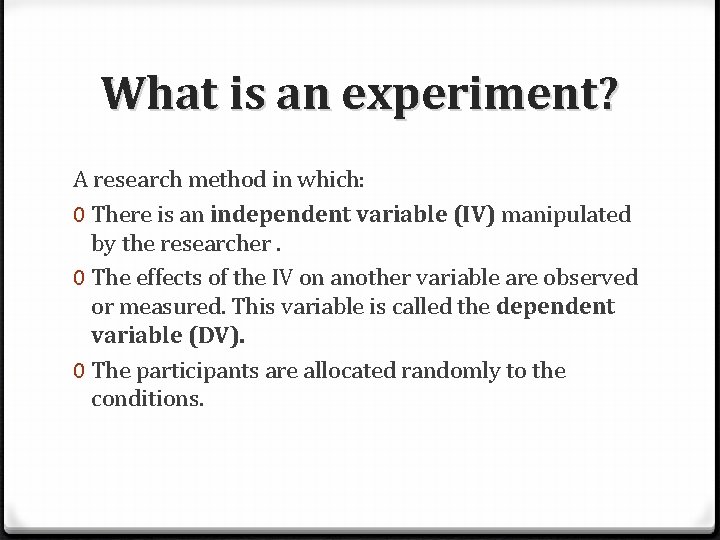
What is an experiment? A research method in which: 0 There is an independent variable (IV) manipulated by the researcher. 0 The effects of the IV on another variable are observed or measured. This variable is called the dependent variable (DV). 0 The participants are allocated randomly to the conditions.
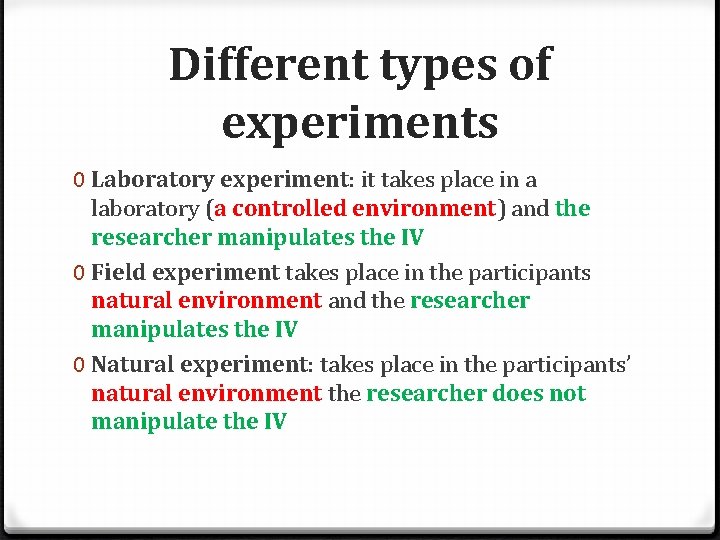
Different types of experiments 0 Laboratory experiment: it takes place in a laboratory (a controlled environment) and the researcher manipulates the IV 0 Field experiment takes place in the participants natural environment and the researcher manipulates the IV 0 Natural experiment: takes place in the participants’ natural environment the researcher does not manipulate the IV
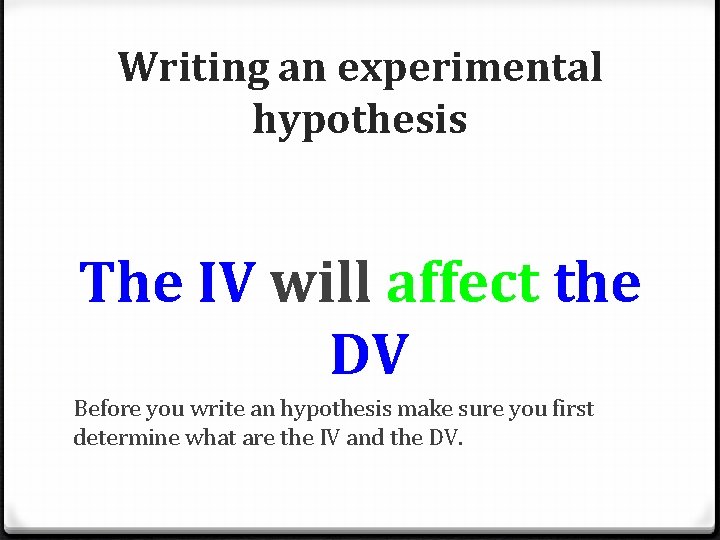
Writing an experimental hypothesis The IV will affect the DV Before you write an hypothesis make sure you first determine what are the IV and the DV.
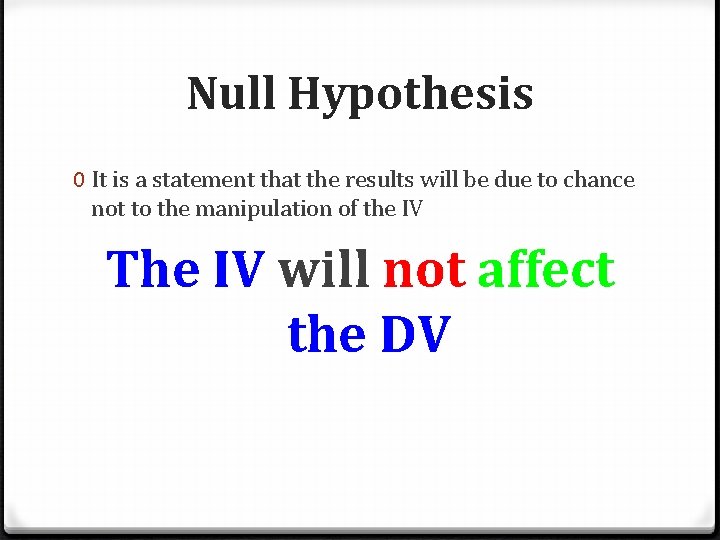
Null Hypothesis 0 It is a statement that the results will be due to chance not to the manipulation of the IV The IV will not affect the DV
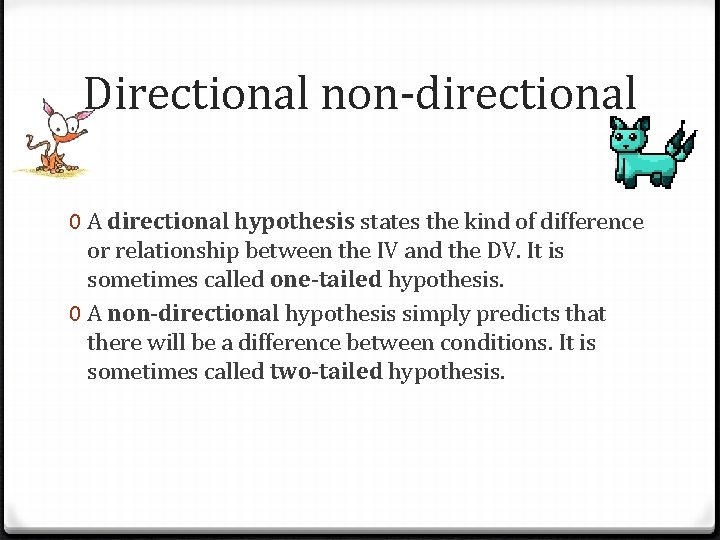
Directional non-directional 0 A directional hypothesis states the kind of difference or relationship between the IV and the DV. It is sometimes called one-tailed hypothesis. 0 A non-directional hypothesis simply predicts that there will be a difference between conditions. It is sometimes called two-tailed hypothesis.
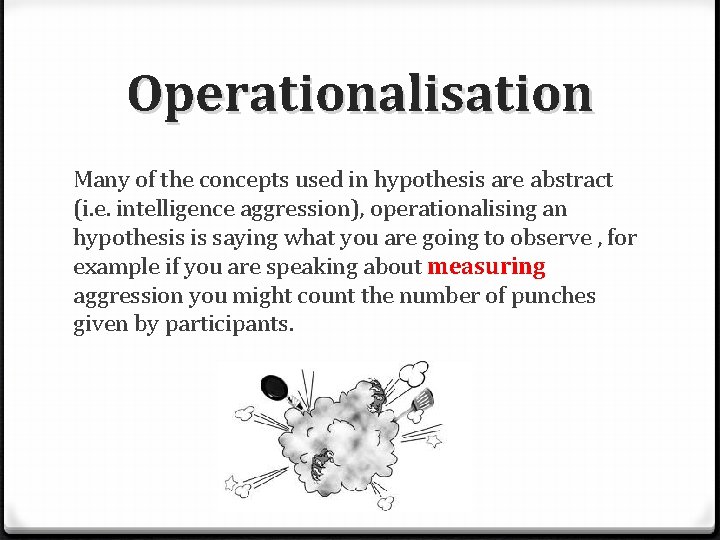
Operationalisation Many of the concepts used in hypothesis are abstract (i. e. intelligence aggression), operationalising an hypothesis is saying what you are going to observe , for example if you are speaking about measuring aggression you might count the number of punches given by participants.
Other variables… The results can be influenced by other variables: Extraneous variables Participants characteristics Situational variables Experimenter effects If you have a question on this topic, choose a variable which is relevant to the study you are given in the question.
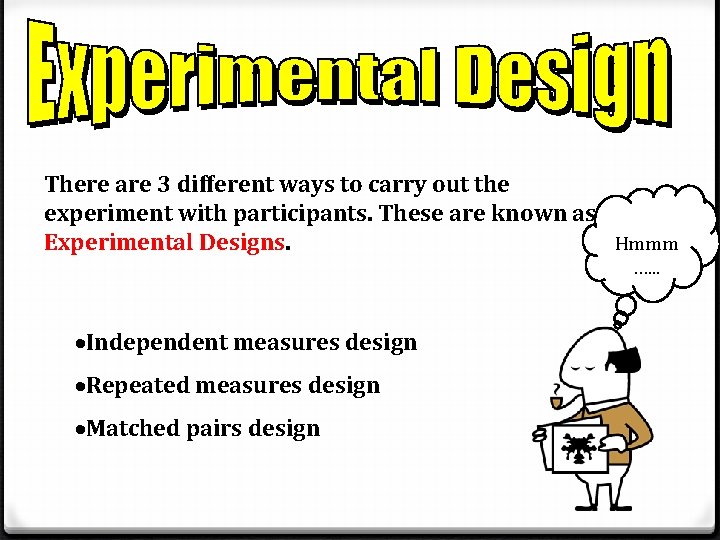
There are 3 different ways to carry out the experiment with participants. These are known as Experimental Designs. Hmmm …. . . Independent measures design Repeated measures design Matched pairs design
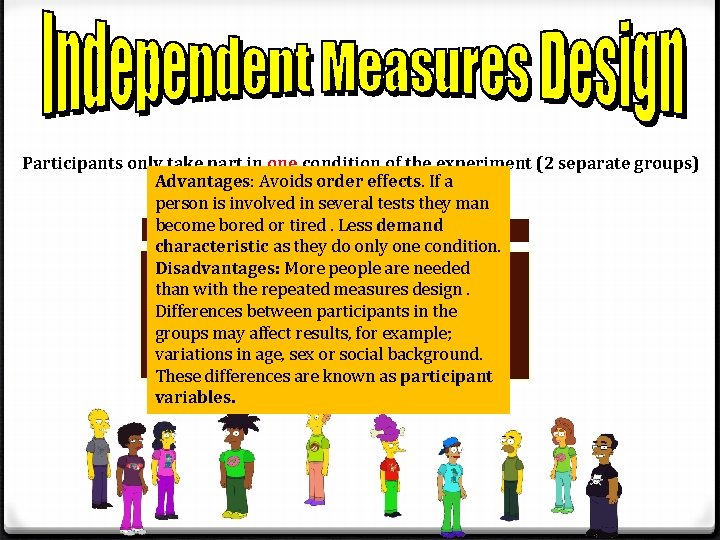
Participants only take part in one condition of the experiment (2 separate groups) Advantages: Avoids order effects. If a person is involved in several tests they man become bored or tired. Less demand Words Pictures characteristic as they do only one condition. Disadvantages: More people are needed than with the repeated measures design. Differences between participants in the groups may affect results, for example; variations in age, sex or social background. These differences are known as participant variables.
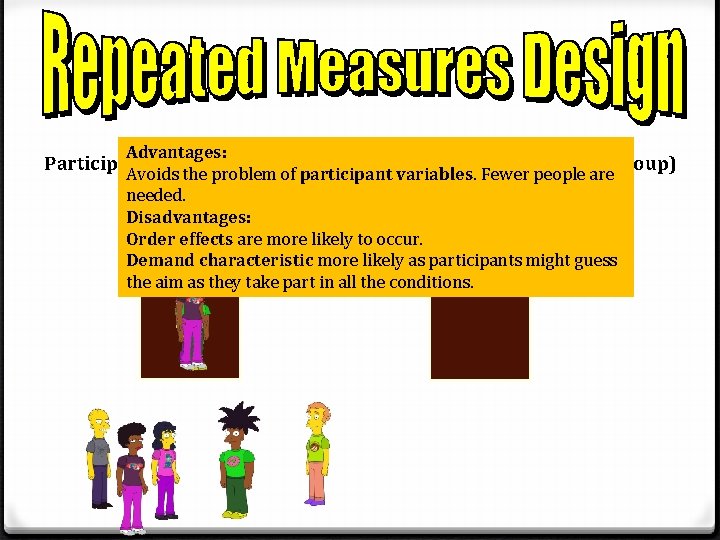
Advantages: Participants take part in both conditions of the experiment (1 group) Avoids the problem of participant variables. Fewer people are needed. Disadvantages: Words Pictures Order effects are more likely to occur. Demand characteristic more likely as participants might guess the aim as they take part in all the conditions.
Counterbalancing Alternating the order in which participants perform in different conditions of an experiment. For example, group 1 does ‘A’ then ‘B’, group 2 does ‘B’ then ‘A’ this is to eliminate order effects.
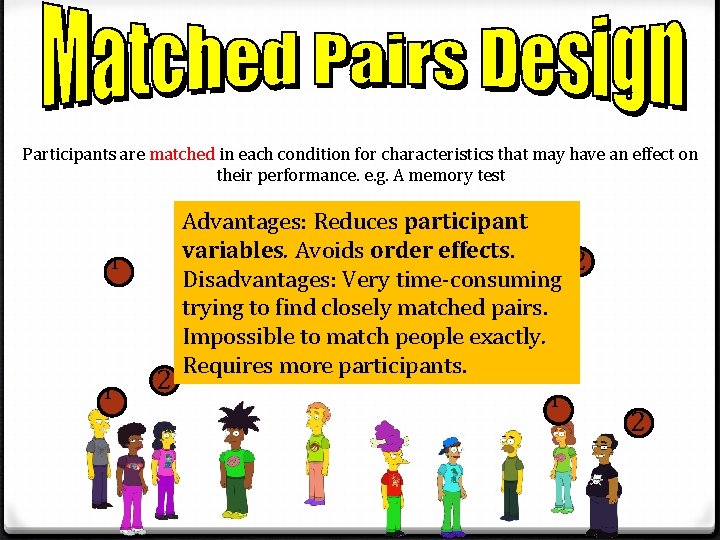
Participants are matched in each condition for characteristics that may have an effect on their performance. e. g. A memory test 1 1 2 Advantages: Reduces participant variables. Avoids order effects. 1 1 2 2 2 Disadvantages: Very time-consuming trying to find closely matched pairs. Impossible to match people exactly. Requires more participants. 1 2
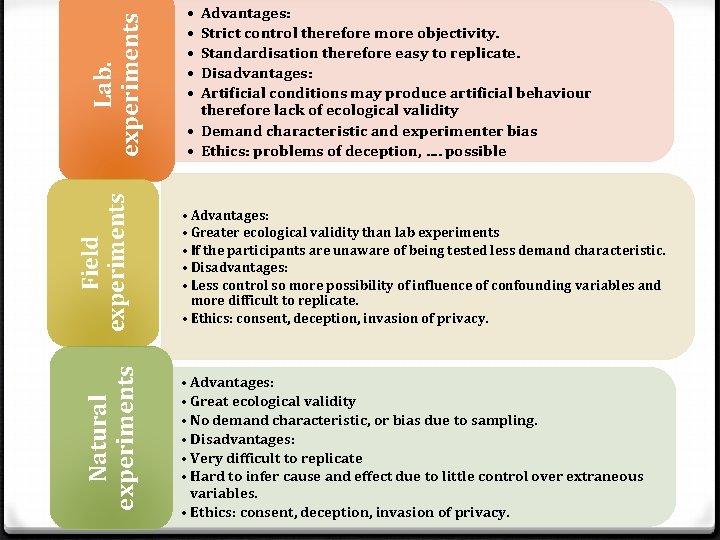
Lab. experiments Field experiments Natural experiments • • • Advantages: Strict control therefore more objectivity. Standardisation therefore easy to replicate. Disadvantages: Artificial conditions may produce artificial behaviour therefore lack of ecological validity • Demand characteristic and experimenter bias • Ethics: problems of deception, …. possible • Advantages: • Greater ecological validity than lab experiments • If the participants are unaware of being tested less demand characteristic. • Disadvantages: • Less control so more possibility of influence of confounding variables and more difficult to replicate. • Ethics: consent, deception, invasion of privacy. • Advantages: • Great ecological validity • No demand characteristic, or bias due to sampling. • Disadvantages: • Very difficult to replicate • Hard to infer cause and effect due to little control over extraneous variables. • Ethics: consent, deception, invasion of privacy.
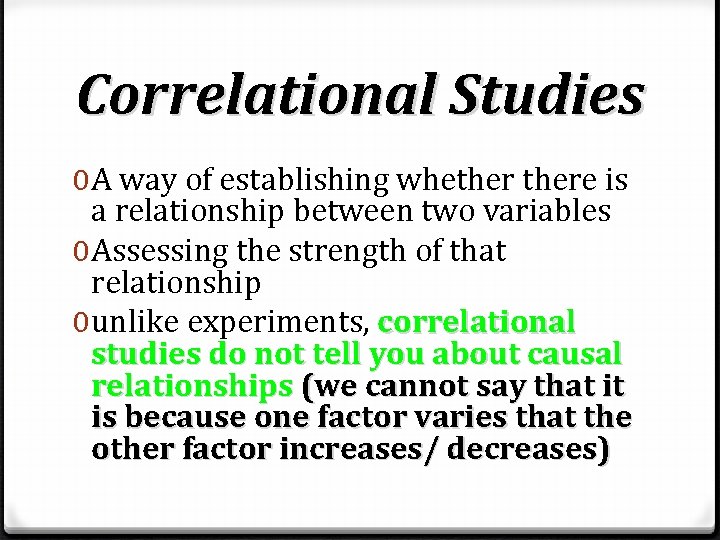
Correlational Studies 0 A way of establishing whethere is a relationship between two variables 0 Assessing the strength of that relationship 0 unlike experiments, correlational studies do not tell you about causal relationships (we cannot say that it is because one factor varies that the other factor increases/ decreases)
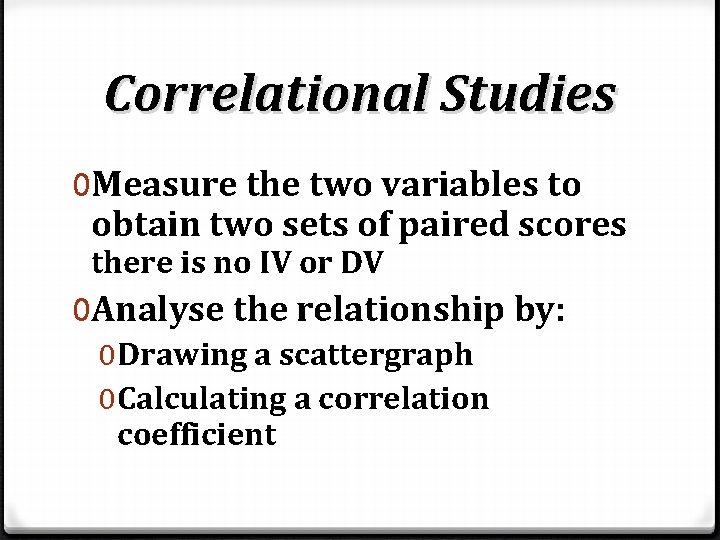
Correlational Studies 0 Measure the two variables to obtain two sets of paired scores there is no IV or DV 0 Analyse the relationship by: 0 Drawing a scattergraph 0 Calculating a correlation coefficient
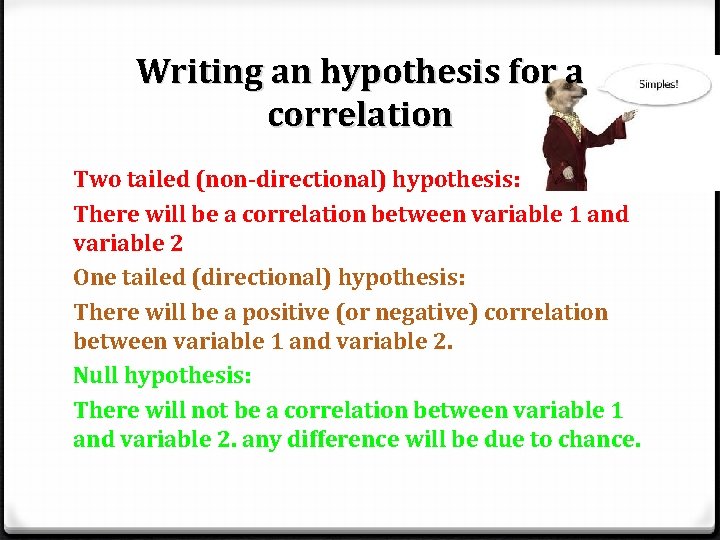
Writing an hypothesis for a correlation Two tailed (non-directional) hypothesis: There will be a correlation between variable 1 and variable 2 One tailed (directional) hypothesis: There will be a positive (or negative) correlation between variable 1 and variable 2. Null hypothesis: There will not be a correlation between variable 1 and variable 2. any difference will be due to chance.
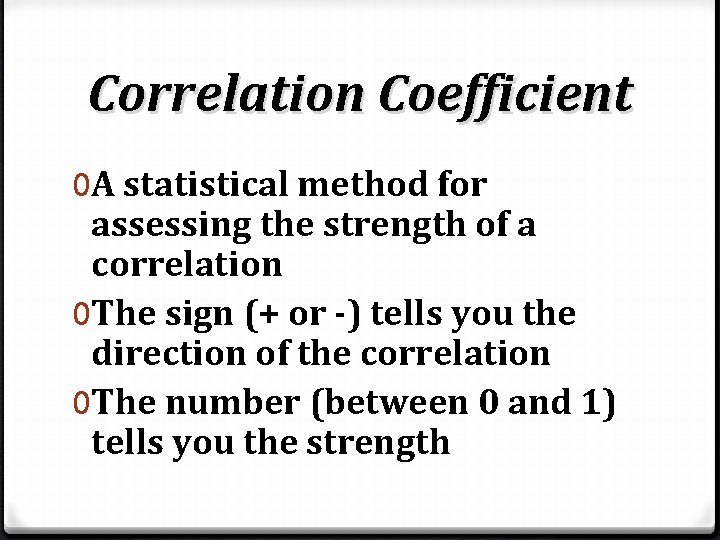
Correlation Coefficient 0 A statistical method for assessing the strength of a correlation 0 The sign (+ or -) tells you the direction of the correlation 0 The number (between 0 and 1) tells you the strength
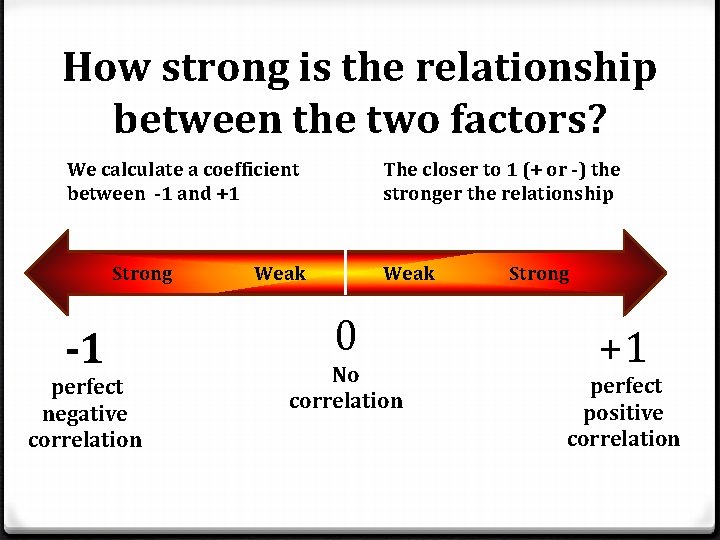
How strong is the relationship between the two factors? The closer to 1 (+ or -) the stronger the relationship We calculate a coefficient between -1 and +1 Strong -1 perfect negative correlation Weak 0 No correlation Strong +1 perfect positive correlation
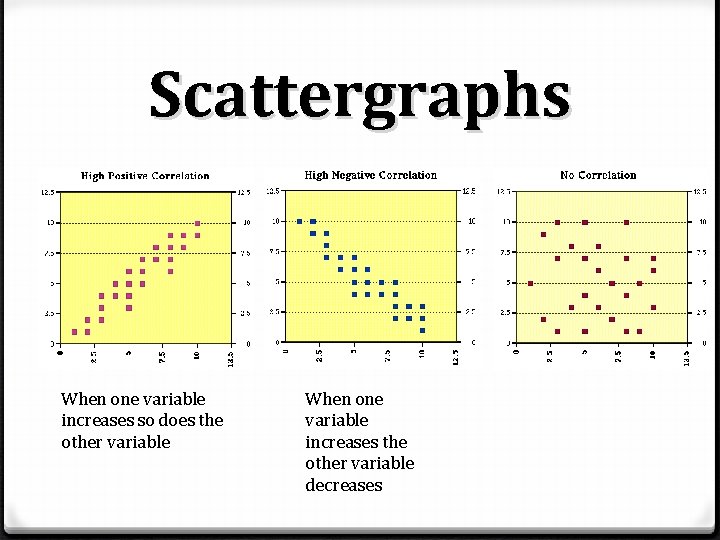
Scattergraphs When one variable increases so does the other variable When one variable increases the other variable decreases
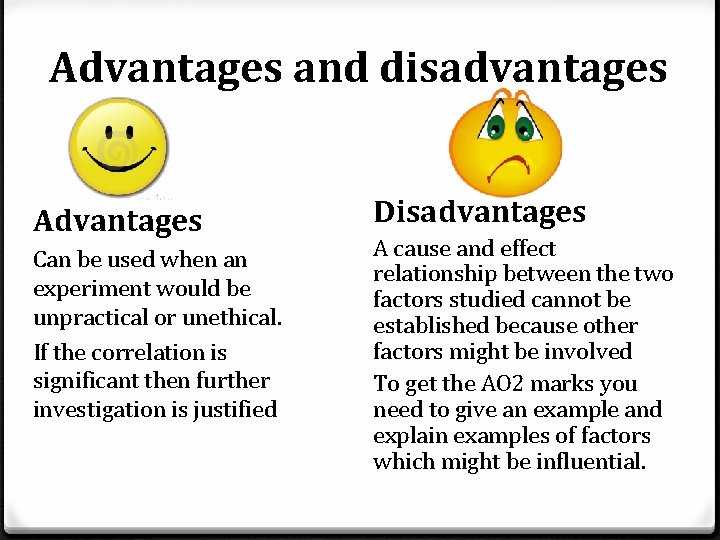
Advantages and disadvantages Advantages Can be used when an experiment would be unpractical or unethical. If the correlation is significant then further investigation is justified Disadvantages A cause and effect relationship between the two factors studied cannot be established because other factors might be involved To get the AO 2 marks you need to give an example and explain examples of factors which might be influential.
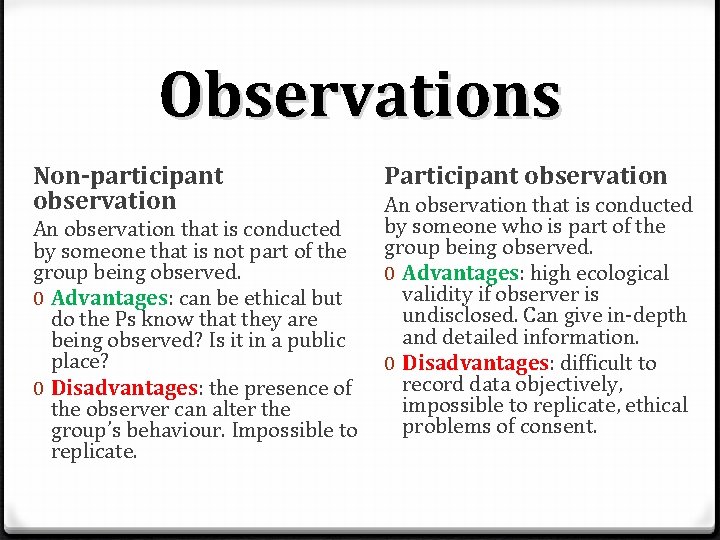
Observations Non-participant observation Participant observation An observation that is conducted by someone who is part of the An observation that is conducted by someone that is not part of the group being observed. 0 Advantages: high ecological validity if observer is 0 Advantages: can be ethical but undisclosed. Can give in-depth do the Ps know that they are and detailed information. being observed? Is it in a public place? 0 Disadvantages: difficult to record data objectively, 0 Disadvantages: the presence of impossible to replicate, ethical the observer can alter the problems of consent. group’s behaviour. Impossible to replicate.
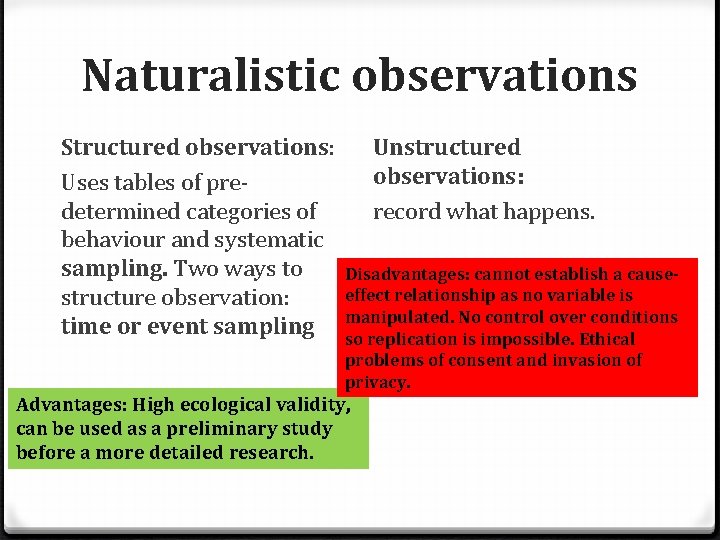
Naturalistic observations Structured observations: Unstructured observations: Uses tables of predetermined categories of record what happens. behaviour and systematic sampling. Two ways to Disadvantages: cannot establish a causeeffect relationship as no variable is structure observation: No control over conditions time or event sampling manipulated. so replication is impossible. Ethical problems of consent and invasion of privacy. Advantages: High ecological validity, can be used as a preliminary study before a more detailed research.
Carrying out an observation 1. Determine the behavioural categories to be observed 2. Train observers to classify the same behaviours in the same categories (inter-observer reliability) 3. Carry out a pilot study 4. Carry out the observation
Definition - Content Analysis A kind of observational study in which the behaviour is observed indirectly in written or verbal material. A detailed analysis is made of books, TV, newspapers…
How to conduct a content analysis 0 Decide a sampling method (what material is to be used for the research) 0 Decide the coding units Then decide how you are going to carry out the analysis: 1. Frequency - the number of times certain words or themes come up (e. g. number of times that sexual references come up in day-time television) 2. Amount of space devoted to a certain topic
Advantages Likely to have high ecological validity as the material is not produced for the research but as part of normal activities (i. e. TV & magazines) 0 Ethical as no participants are used however in diary analysis there might be an issue of invasion of privacy if no informed consent has been sought. 0 Fairly cheap as no new material has to be created and no participants are used. 0 Disadvantages 0 Very time consuming 0 Little or no control of extraneous variables 0 Open to bias as the researcher has to interpret the content in order to fit the data in the coding units and this depends on the interpretation of the material however this can be partly overcome by using more than one researcher and establishing inter- rater reliability. 0 Ethical issues could arise if using diary analysis (confidentiality and invasion of privacy)
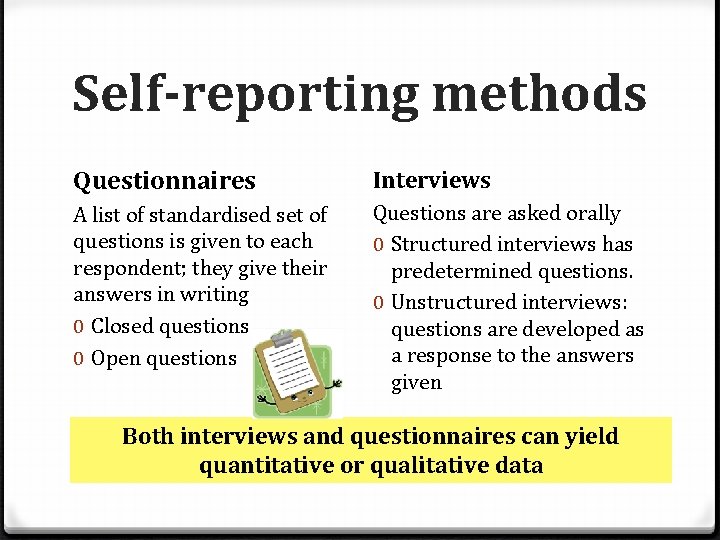
Self-reporting methods Questionnaires Interviews A list of standardised set of questions is given to each respondent; they give their answers in writing 0 Closed questions 0 Open questions Questions are asked orally 0 Structured interviews has predetermined questions. 0 Unstructured interviews: questions are developed as a response to the answers given Both interviews and questionnaires can yield quantitative or qualitative data
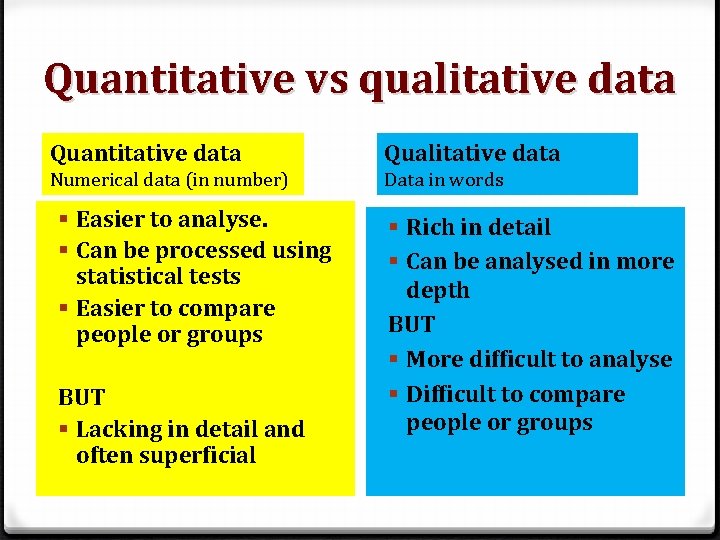
Quantitative vs qualitative data Quantitative data Qualitative data Numerical data (in number) Data in words Easier to analyse. Can be processed using statistical tests Easier to compare people or groups BUT Lacking in detail and often superficial Rich in detail Can be analysed in more depth BUT More difficult to analyse Difficult to compare people or groups
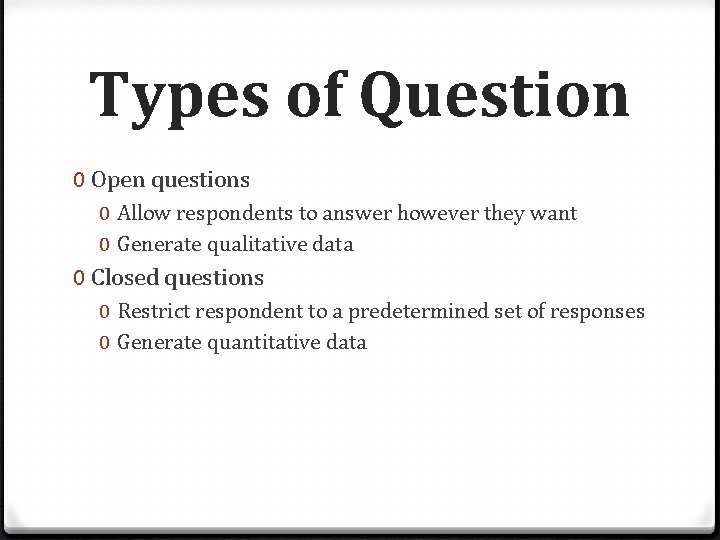
Types of Question 0 Open questions 0 Allow respondents to answer however they want 0 Generate qualitative data 0 Closed questions 0 Restrict respondent to a predetermined set of responses 0 Generate quantitative data
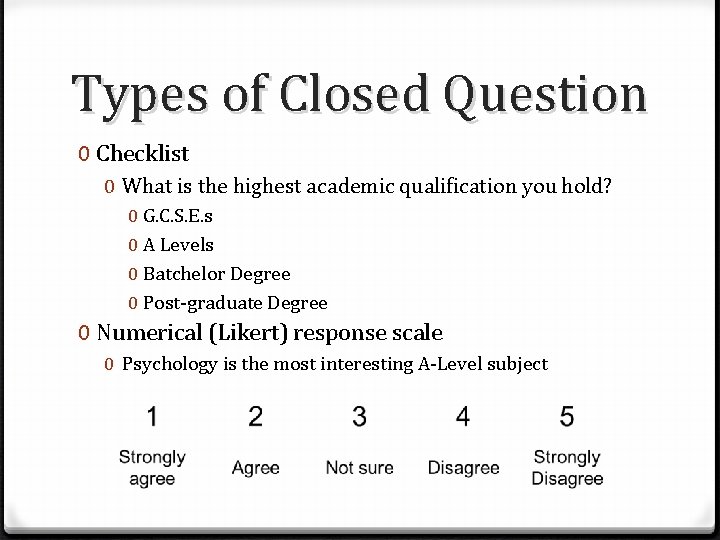
Types of Closed Question 0 Checklist 0 What is the highest academic qualification you hold? 0 G. C. S. E. s 0 A Levels 0 Batchelor Degree 0 Post-graduate Degree 0 Numerical (Likert) response scale 0 Psychology is the most interesting A-Level subject
Ranking scale Rank the following activities according to how much time you spend on them each day (1 = most time, 4 = least time) • Talking face to face • Talking on the telephone • Text messaging • Other (e. g. MSN, Facebook chat)
Ways of Administering: 0 Face to face in a private/public place. 0 En masse to a group in a public setting. 0 Through the post. 0 Via the internet. 0 Over the telephone.
Evaluating questionnaires Strengths Limitations 0 Large numbers of questionnaires can be administered quickly: costefficient and less time consuming. 0 Easy to reach a wide range of participants from target population. 0 Completed privately and easily made anonymous: more honest (valid) responses should be gained. 0 Response rates are low, making it hard to generalise the results to the target population. 0 Response bias: only certain types of people will return the questionnaire. 0 Respondents may misunderstand the questions, leading to invalid data. 0 Participants might be influenced by social desirability (they will give answers which make them look good).
Evaluation of interviews 0 Time consuming to 0 Closed questions give administer quantitative data, easy to analyse using statistical 0 The interviewer has to be trained tests. 0 Open questions yield 0 Open questions gather qualitative data which is more difficult to analyse rich in detail and depth and the interpretation can be biased. 0 Participants can be influenced by social desirability.