
METHOD OF WATER APPLICATION Methods of Irrigation Water





- Slides: 32
METHOD OF WATER APPLICATION
Methods of Irrigation Water Distribution / Application Introduction As there is shortage of Irrigation Water availability, therefore the available resource is being used in the most efficient and effective manner. The following economical water use methods are commonly applied in the field. However, each method is sites specific depending upon the controlling of command area as well as the soil and temperature characteristic. 1. Surface Irrigation 2. Sprinkler Irrigation 3. Sub Surface Irrigation 2
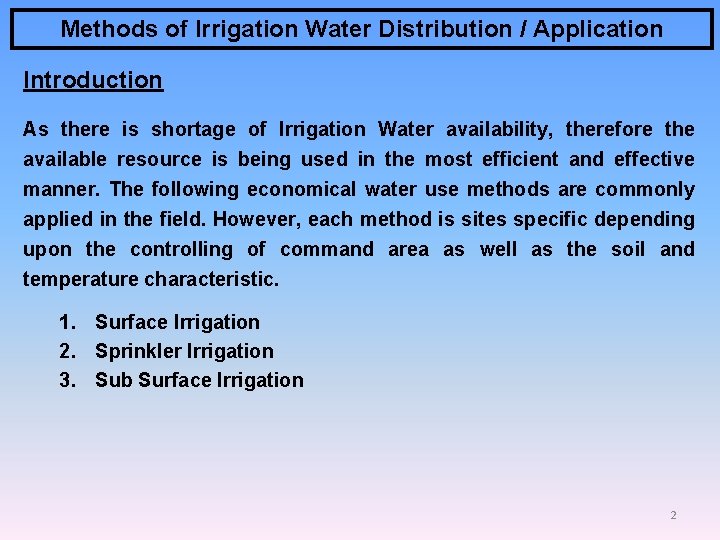
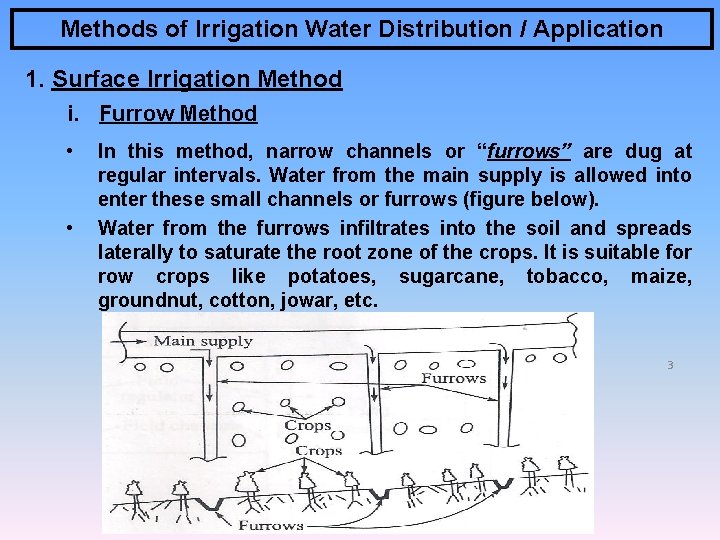
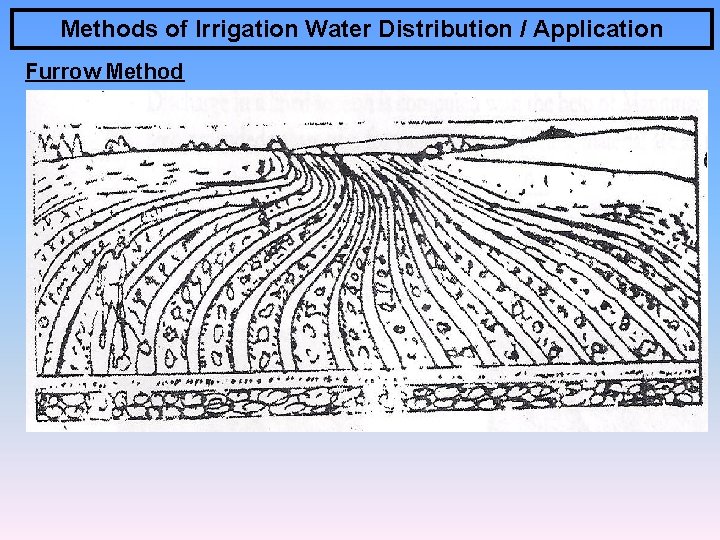
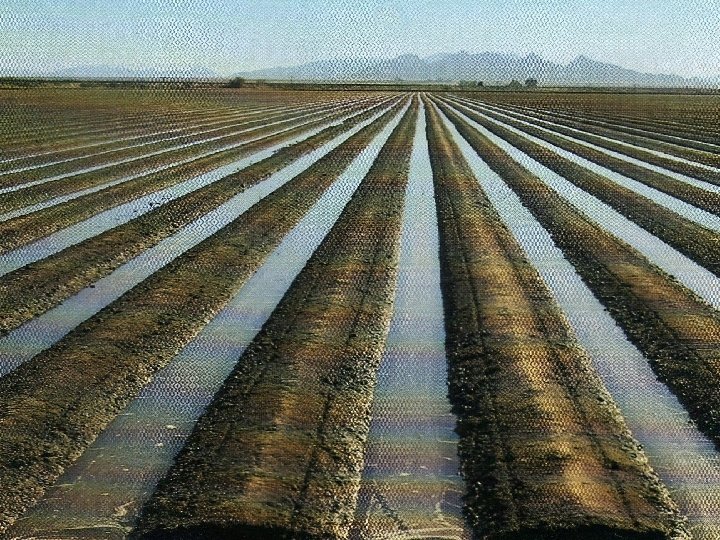
Methods of Irrigation Water Distribution / Application 1. Surface Irrigation Method i. Furrow Method • • In this method, narrow channels or “furrows” are dug at regular intervals. Water from the main supply is allowed into enter these small channels or furrows (figure below). Water from the furrows infiltrates into the soil and spreads laterally to saturate the root zone of the crops. It is suitable for row crops like potatoes, sugarcane, tobacco, maize, groundnut, cotton, jowar, etc. 3
Methods of Irrigation Water Distribution / Application Furrow Method 4
5
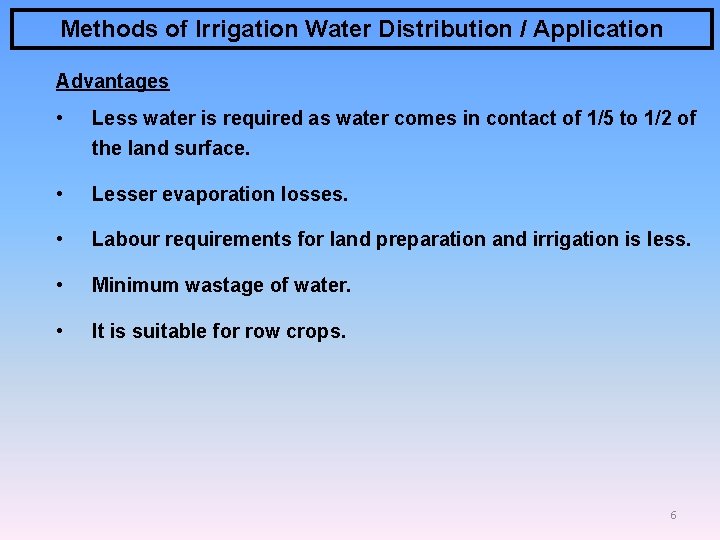
Methods of Irrigation Water Distribution / Application Advantages • Less water is required as water comes in contact of 1/5 to 1/2 of the land surface. • Lesser evaporation losses. • Labour requirements for land preparation and irrigation is less. • Minimum wastage of water. • It is suitable for row crops. 6
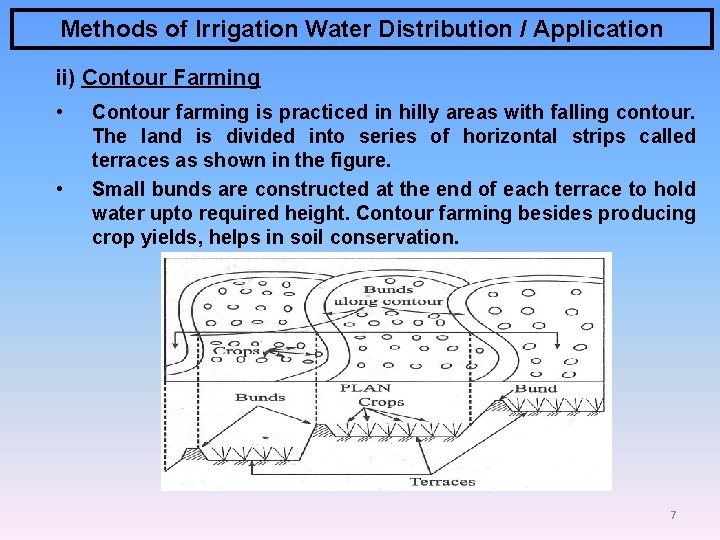
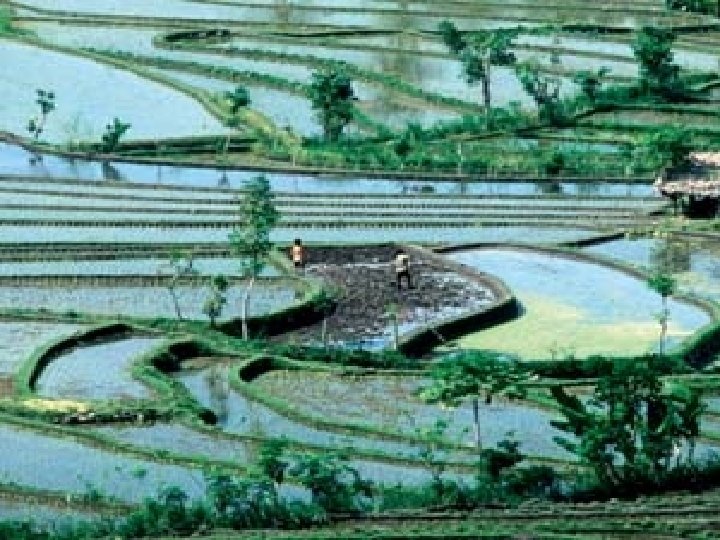
Methods of Irrigation Water Distribution / Application ii) Contour Farming • • Contour farming is practiced in hilly areas with falling contour. The land is divided into series of horizontal strips called terraces as shown in the figure. Small bunds are constructed at the end of each terrace to hold water upto required height. Contour farming besides producing crop yields, helps in soil conservation. 7
8
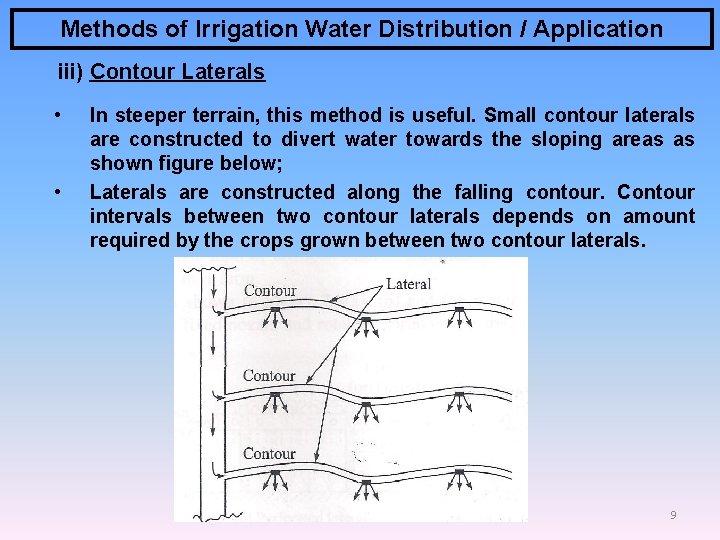
Methods of Irrigation Water Distribution / Application iii) Contour Laterals • • In steeper terrain, this method is useful. Small contour laterals are constructed to divert water towards the sloping areas as shown figure below; Laterals are constructed along the falling contour. Contour intervals between two contour laterals depends on amount required by the crops grown between two contour laterals. 9
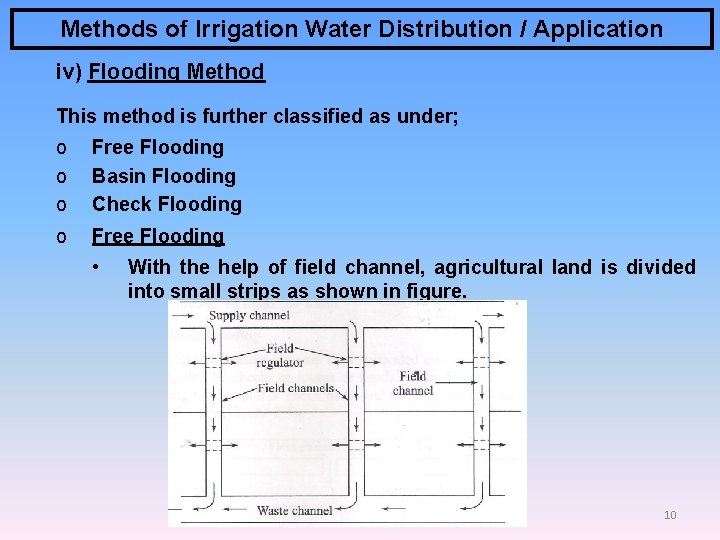
Methods of Irrigation Water Distribution / Application iv) Flooding Method This method is further classified as under; o o o Free Flooding Basin Flooding Check Flooding o Free Flooding • With the help of field channel, agricultural land is divided into small strips as shown in figure. 10
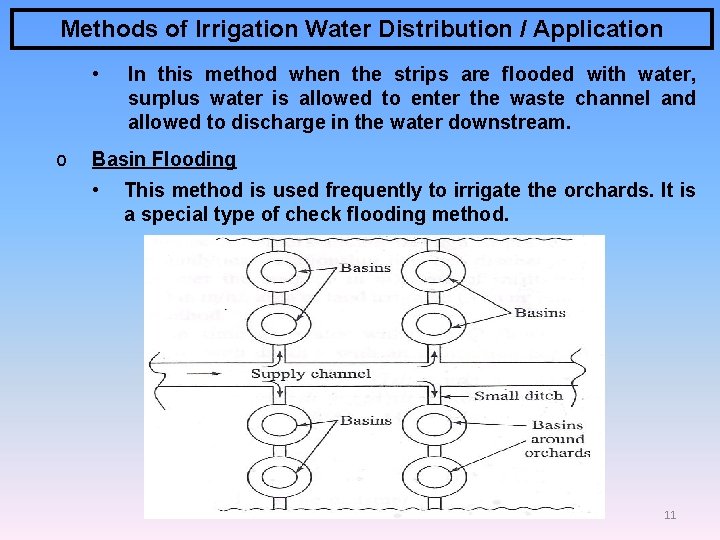
Methods of Irrigation Water Distribution / Application • o In this method when the strips are flooded with water, surplus water is allowed to enter the waste channel and allowed to discharge in the water downstream. Basin Flooding • This method is used frequently to irrigate the orchards. It is a special type of check flooding method. 11
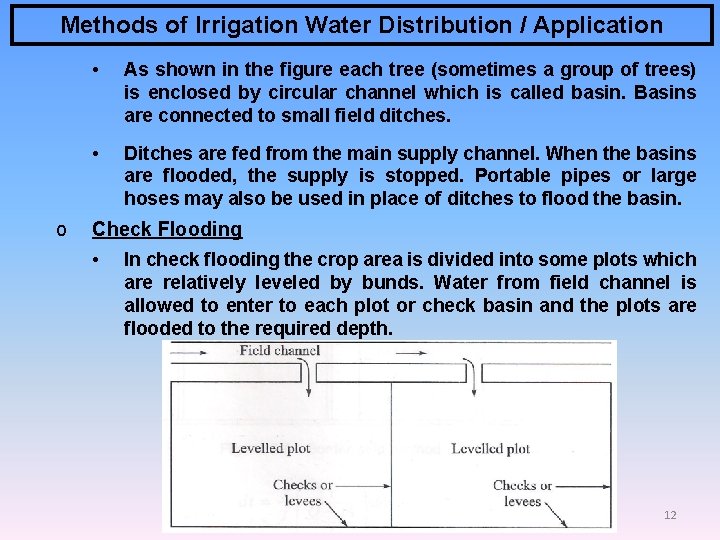
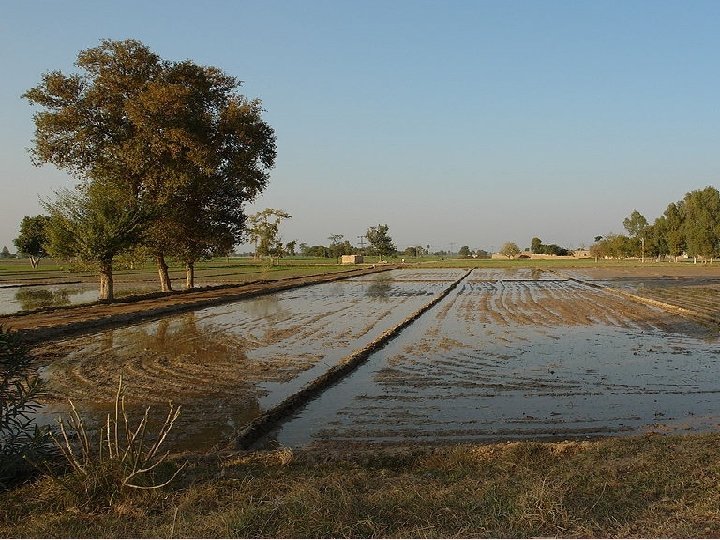
Methods of Irrigation Water Distribution / Application o • As shown in the figure each tree (sometimes a group of trees) is enclosed by circular channel which is called basin. Basins are connected to small field ditches. • Ditches are fed from the main supply channel. When the basins are flooded, the supply is stopped. Portable pipes or large hoses may also be used in place of ditches to flood the basin. Check Flooding • In check flooding the crop area is divided into some plots which are relatively leveled by bunds. Water from field channel is allowed to enter to each plot or check basin and the plots are flooded to the required depth. 12
13
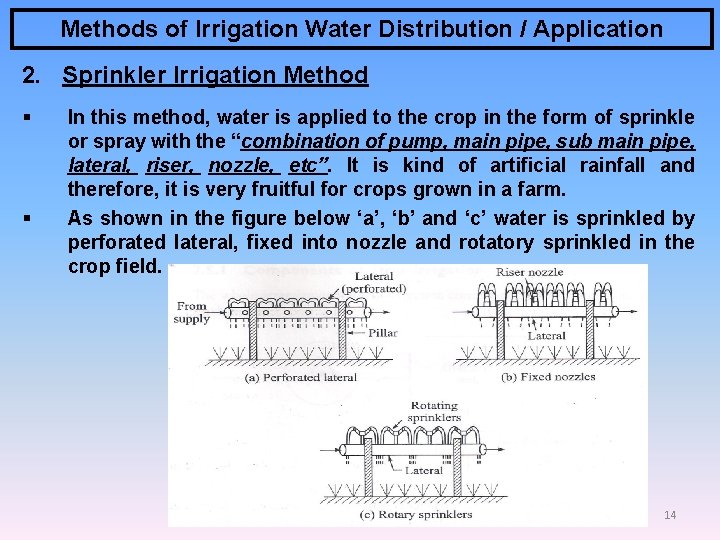
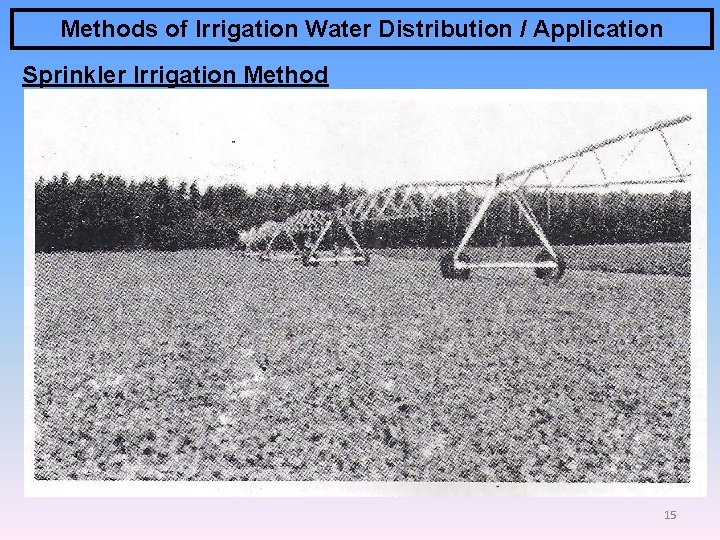
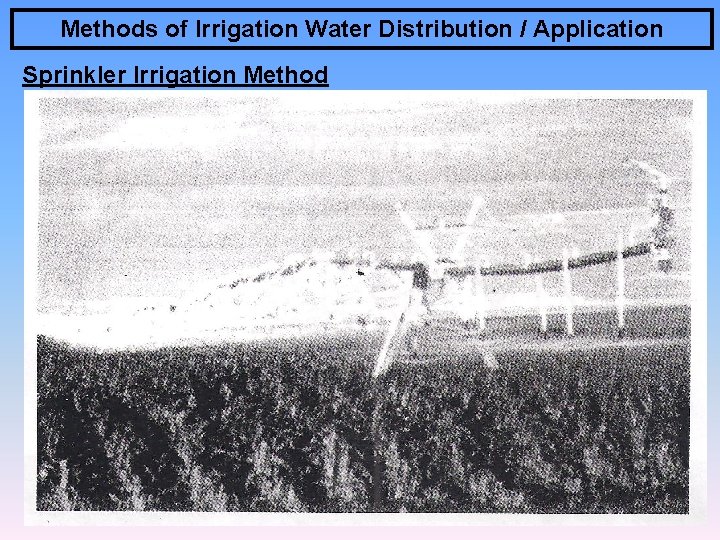
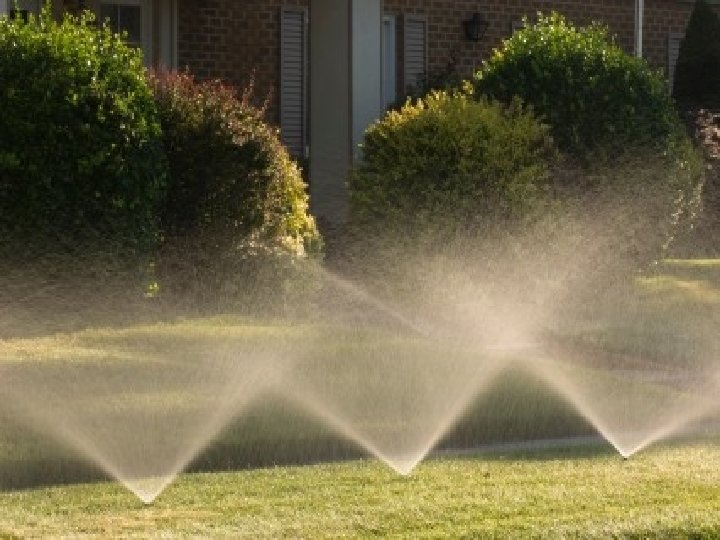
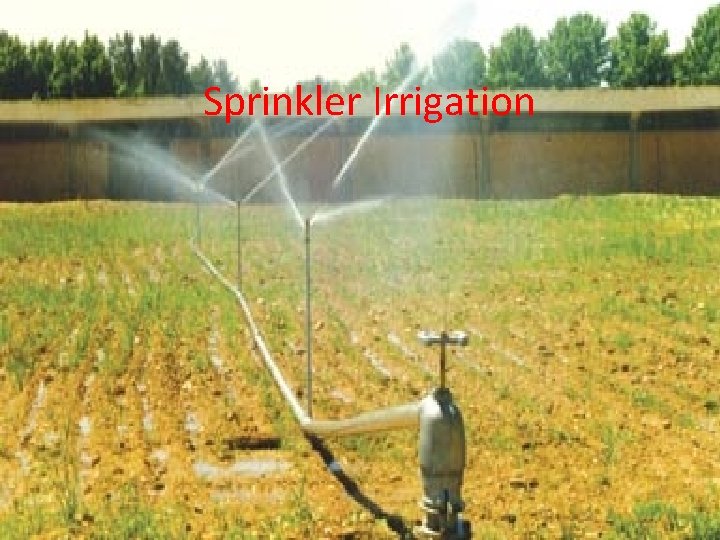
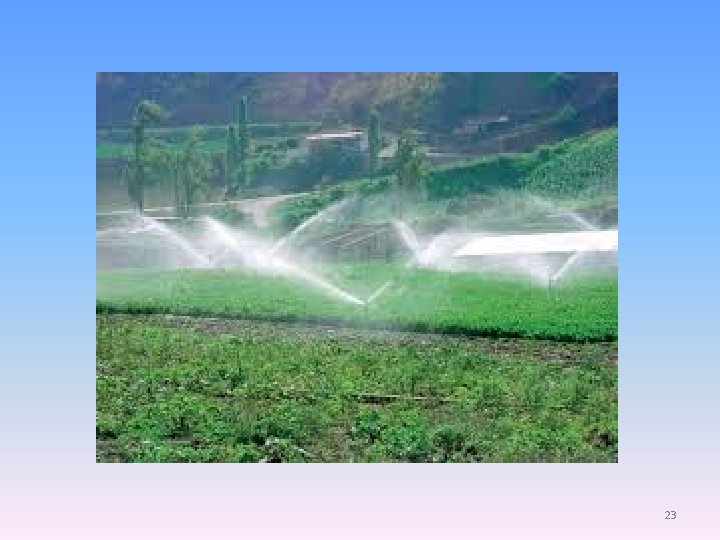
Methods of Irrigation Water Distribution / Application 2. Sprinkler Irrigation Method § § In this method, water is applied to the crop in the form of sprinkle or spray with the “combination of pump, main pipe, sub main pipe, lateral, riser, nozzle, etc”. It is kind of artificial rainfall and therefore, it is very fruitful for crops grown in a farm. As shown in the figure below ‘a’, ‘b’ and ‘c’ water is sprinkled by perforated lateral, fixed into nozzle and rotatory sprinkled in the crop field. 14
Methods of Irrigation Water Distribution / Application Sprinkler Irrigation Method 15
Methods of Irrigation Water Distribution / Application Sprinkler Irrigation Method 16
Sprinkler Irrigation
Methods of Irrigation Water Distribution / Application § “This method is useful where”; • Surface Irrigation method is not efficient • Slope of the crop field is higher • Topography of the crop field is irregular • Soil is erosive • Soil is permeable or impermeable • Depth of soil is shallow over gravel and sand. 19
Methods of Irrigation Water Distribution / Application Advantages § § § § Erosion of soil is avoided or controlled. It is possible to apply water uniformly. Irrigation of water is better controlled according to need of the crops in their different stages of growth. There is no surface run-off Labour cost is less Borders or ditches are not required to construct and hence, more area can be covered. Damage of crop due to frost is reduced. It is a standby drainage pumping set. It can be used even with high water table. It is useful for crops with shallow root crops requiring high and frequent irrigation. Seepage loss like earthen canal are eliminated. Water is applied at the rate smaller than infiltration capacity of soil. Fertilizers can be uniformly applied by mixing with water. 20
Methods of Irrigation Water Distribution / Application Limitations Although this method has number of advantages, yet it has some limitations. § Wind may disturb or distort sprinkling pattern. § A constant water supply is needed for commercial use of equipment. § Water is to be clean and free from sand. § Heavy soil with pore intake cannot be irrigated efficiently. § Areas with higher temperature increase evaporation loss. § They are not suitable for crops requiring frequent and deep water depth. § It requires high electrical power. 21
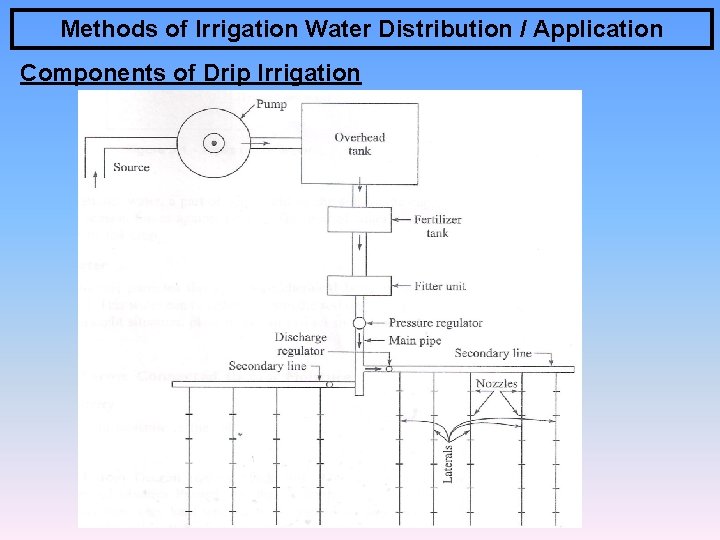
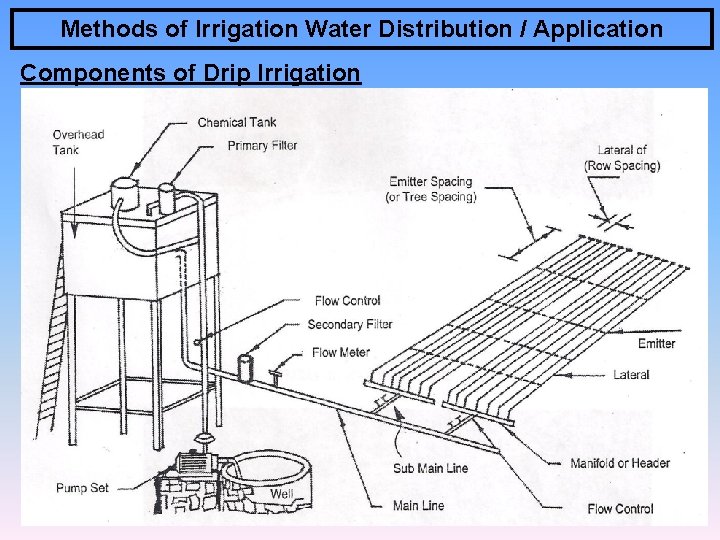
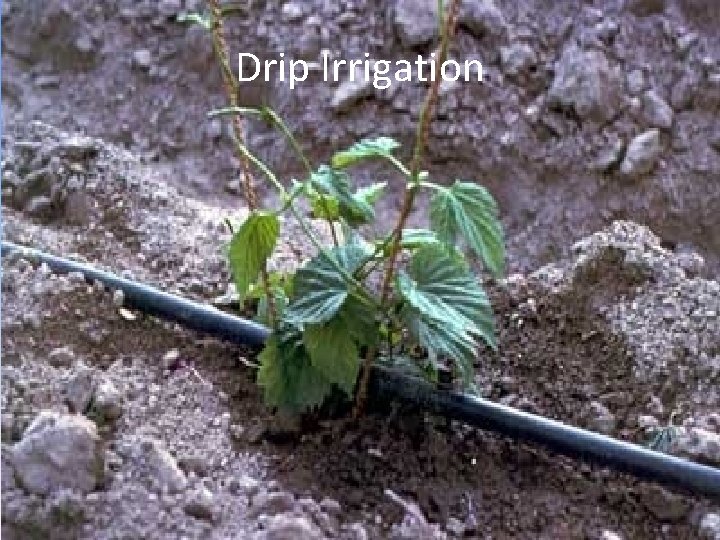
Methods of Irrigation Water Distribution / Application 3. Sub Surface Irrigation (Drip or Trickle Irrigation) § Sprinkler irrigation is not suitable in the region of high temperature, high wind velocity and low humidity due to excessive loss by evaporation. In such regions drip or trickle irrigation is most suitable. § This method consists of carrying the irrigation water through pipe and water is allowed to drip or trickle in the root zone of the crops under low pressure. § Two different pipes are used in this method. A perforated plastic pipe is laid along the ground at the base of a row of crops or plants. The perforations are designed to emit a trickle (about 5 litres/h) and spaced to produce a wetted strip along the crop row. § In the second system, irrigation water is conveyed through a large feeder pipe below the ground and is allowed to drip at the root zone of the crop slowly through nozzle or orifice practically at low pressure. Thus root zone is kept constantly wet.
23
Methods of Irrigation Water Distribution / Application Components of Drip Irrigation
Methods of Irrigation Water Distribution / Application Components of Drip Irrigation
Drip Irrigation
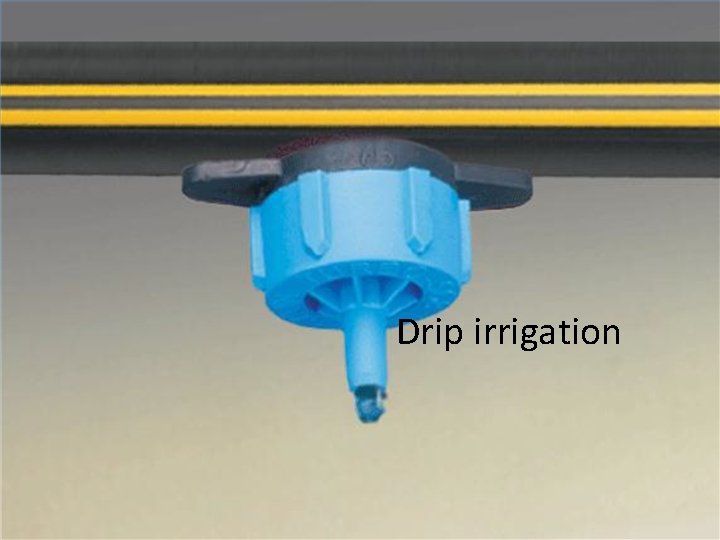
Drip irrigation
Methods of Irrigation Water Distribution / Application Advantages of Drip Irrigation § Excellent control of water is possible as water can be applied at the rate to the consumptive use of water. § Evaporation from soil is reduced to minimum. § Deep percolation of water is entirely eliminated. § Nutrients can be applied directly to plant roots by adding liquid fertilizer to the water. § Although initial cost is high, maintenance and labour may be low once the system is set up. § It is the best method of reclaiming desert areas. § Soil erosion and tail water loss do not take place. § Less requirement of water as loss is minimum. § Insect and pest combating chemical can be directly applied in the root zone.
Methods of Irrigation Water Distribution / Application § Water is carried through small diameter pipe, and hence, considerable saving in land increases the net irrigable area. § Variation of water application rate according to stages of growth of the plants is possible. § Method is specially suitable for cash crops like vegetables, fruits, tabacco and cotton etc. § Due to control of supply, water logging is avoided.
Methods of Irrigation Water Distribution / Application Disadvantages of Drip Irrigation § Heavy rainfall may push downwards the accumulated salts at the edge of wetted zone. This may affect the crop growth if this salt comes to the root zone. § Dripper or nozzle blockage is likely to occur by soil particles, as the size of nozzle varies from 0. 5 to 2 mm. § Due to high initial cost, farmers normally do not prefer this method. § It is only suitable for close growing crops like vegetables etc. § Plastic pipes used are of low durability, therefore, there is a need for frequent replacement. § Frequent change of trickle lines are necessary as spacing of nozzle is different for types of crops.
Methods of Irrigation Water Distribution / Application Benefits of Irrigation i) Improving Agriculture Production. ii) Enhance Corp Yield iii) Prosperity of Farmers iv) Source of Revenue v) Hydropower Generation vi) Providing Water Supply Facilities vii) Improving Communication viii) Navigation ix) Development of Fishery x) Tree Plantation xi) Increasing Ground Water Level xii) Recreations xiii) Social and Cultural Improvement xiv) Self Sufficiency in Food
Methods of Irrigation Water Distribution / Application Dis-Advantages i) Negative Impact on Water Table ii) Loss of Valuable Land iii) Poor Returns of Revenue iv) Damp Climate v) Social Injustice