
METHOD OF HANDLING AGGRESSIVE BEHAVIOR OF SCHOOLAGED CHILDREN
METHOD OF HANDLING AGGRESSIVE BEHAVIOR OF SCHOOL-AGED CHILDREN WITH HOLISTIC APPROACH (BIOLOGICAL, PSYCHOLOGICAL, SOCIO-CULTURALAND SPIRITUAL) IN MEDAN Wardiyah Daulay Sri Eka Wahyuni Mahnum Lailan Nst
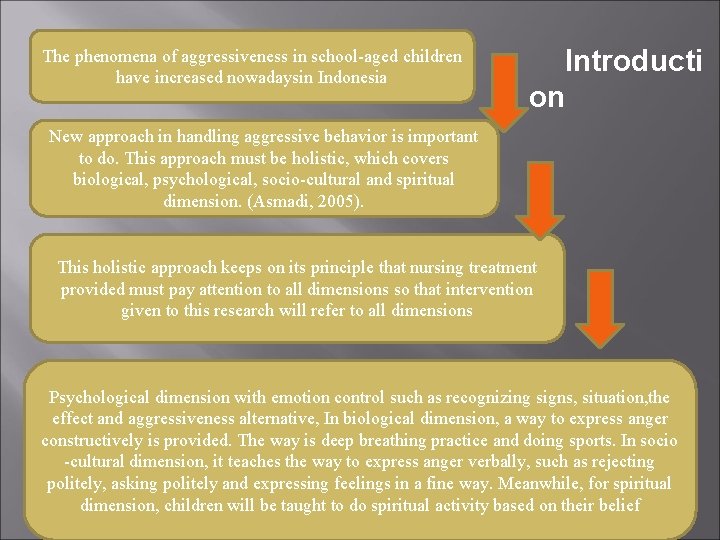
The phenomena of aggressiveness in school-aged children have increased nowadaysin Indonesia Introducti on New approach in handling aggressive behavior is important to do. This approach must be holistic, which covers biological, psychological, socio-cultural and spiritual dimension. (Asmadi, 2005). This holistic approach keeps on its principle that nursing treatment provided must pay attention to all dimensions so that intervention given to this research will refer to all dimensions Psychological dimension with emotion control such as recognizing signs, situation, the effect and aggressiveness alternative, In biological dimension, a way to express anger constructively is provided. The way is deep breathing practice and doing sports. In socio -cultural dimension, it teaches the way to express anger verbally, such as rejecting politely, asking politely and expressing feelings in a fine way. Meanwhile, for spiritual dimension, children will be taught to do spiritual activity based on their belief
AIMS This research aims to identify the influence of aggressiveness-handling method with holistic approachwhich involves biological, psychological, socio-cultural and spiritual dimensiontowards the aggressiveness of school-aged children METHOD The experiment research designis done to two groups.
Populasi & Sampel This research was conducted in 2 Private Primary School in Medan. The samples were 60 people who were divided into two groups, namely intervention group and control group
Result and Discussion Analysis result shows the children’s aggressiveness score before holistic handling 11. 40 and after it becomes 8. 93 (2. 47 in difference). The change of the score shows significant decline, meaning that the aggressiveness in school-agedchildren has declined. These data are supported with test result of t dependent, it obtains p value 0. 000 and alpha 0. 05. This signifies that there is significant influence between holistic handling and aggressive behavior of school-aged children
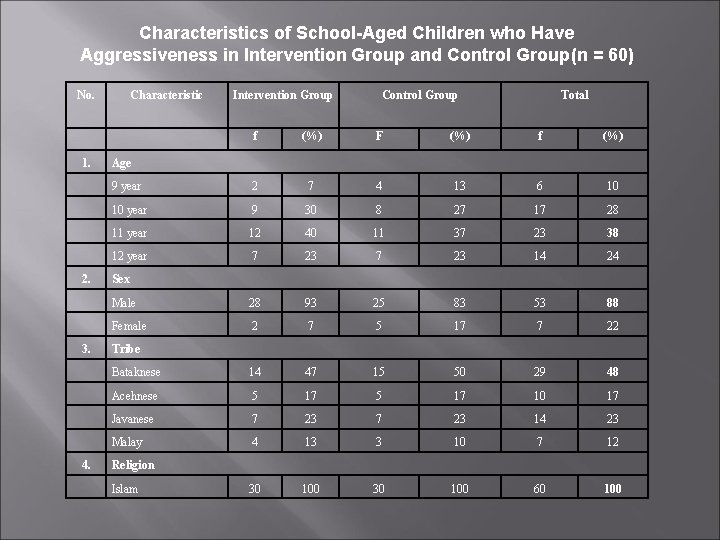
Characteristics of School-Aged Children who Have Aggressiveness in Intervention Group and Control Group(n = 60) No. 1. 2. 3. 4. Characteristic Intervention Group Control Group Total f (%) F (%) f (%) 9 year 2 7 4 13 6 10 10 year 9 30 8 27 17 28 11 year 12 40 11 37 23 38 12 year 7 23 14 24 Male 28 93 25 83 53 88 Female 2 7 5 17 7 22 Bataknese 14 47 15 50 29 48 Acehnese 5 17 10 17 Javanese 7 23 14 23 Malay 4 13 3 10 7 12 30 100 60 100 Age Sex Tribe Religion Islam
The result shows that school-aged children who behave aggressively are mostly males (88%), with mostly 11 years-old (38%)and majority of Bataknese(48%) Aggressiveness in school-aged children before the holistic treatment is conducted in the intervention group and control by comparing the mean score. The difference in mean score of before the intervention is 0. 1 and after the intervention, the score turns into a mean score difference of -2. 27. To see the difference between the children’s aggressiveness between intervention and control groups, independent t test is conducted. Theresult is pvalue 0. 939 before treatment and after treatment, value is 0. 014
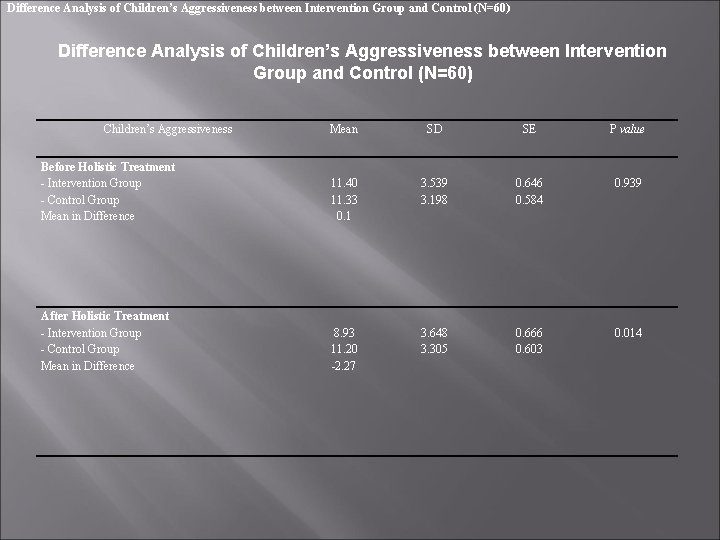
Difference Analysis of Children’s Aggressiveness between Intervention Group and Control (N=60) Children’s Aggressiveness Mean SD SE P value Before Holistic Treatment - Intervention Group - Control Group Mean in Difference 11. 40 11. 33 0. 1 3. 539 3. 198 0. 646 0. 584 0. 939 After Holistic Treatment - Intervention Group - Control Group Mean in Difference 8. 93 11. 20 -2. 27 3. 648 3. 305 0. 666 0. 603 0. 014
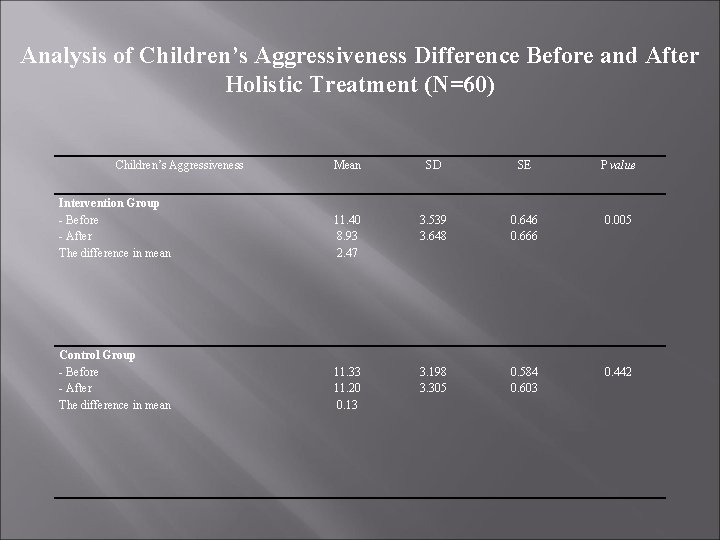
Analysis of Children’s Aggressiveness Difference Before and After Holistic Treatment (N=60) Children’s Aggressiveness Mean SD SE P value Intervention Group - Before - After The difference in mean 11. 40 8. 93 2. 47 3. 539 3. 648 0. 646 0. 666 0. 005 Control Group - Before - After The difference in mean 11. 33 11. 20 0. 13 3. 198 3. 305 0. 584 0. 603 0. 442
The analysis shows a score of children’s aggressive before holistic treatment 11: 40 and thereafter become 8. 93 (the difference of the score is 2. 47). The score change shows a significant decrease, meaning that there is a decrease in aggressive behavior in schoolaged children. This data is supported by the results obtained dependent t-test p value 0. 000; alpha of 0. 05. This value indicates that there is a significant effect between holistic treatment and aggressive behavior of school-aged children
ü This holistic treatment consists of several sessions. The first session is for the psychological dimension. In this session, children are taught to manage emotions with psychological self-adjustment capability, in which individuals are able to identify, recognize and able to manage it. Managing emotions is an act to regulate thoughts, feelings, passion of anger in an appropriate and positive manner and socially-accepted as well. It is expected to prevent something bad or prevent them from harming themselves and others
According to Goleman (1997), recognizing the emotion of anger is the ability to identify feelings of anger when anger arises, so that one is not controlled by anger. Someone who has the ability to recognize emotion of anger can react appropriately against rising anger at the right time. Recognizing the emotion of anger can be done by identifying the early signs that comes with anger. In addition, a person can also be more sensitive to recognize the emotion of anger by identifying situations or things which become the triggerof anger (Hershorn, 2005). Incapacity to recognize the emotion of anger also results in confusion in identifying the exact emotions he is experiencing, so the person often reacts inappropriately to emotional situations (Goleman, 1997).
In two sessions, school-aged children are taught to practice deep breathing. Deep breathing relaxation can reduce tension and give you peace. Deep breathing relaxation stimulates the body to release opioids endogenous, namely endorphins and enkephalins. The release of endorphins can strengthen the immune system, keeping the brain cells of young, anti-aging, lowering aggressiveness in human relationships, improving moral and creativity (Smeltzer& Bare, 2002)
On the third session, scholars are taught how to prevent verbal aggressiveness in a way that is expressing anger, asking for and refusing properly. Verbal way is also called assertive behavior. Assertive behavior is expressing ideas, wishes, desires, disapproval directly to the child. The purpose of assertive behavior is to communicate something in the atmosphere of mutual trust (Novianti, 2010). Aggressive behavior is one of the non-assertive behaviors. Assertive training is one of the ways in Anger Management which aims to remove the feelings, thoughts and beliefs which cause anger as well to other people (Reilly, Shopshire, Durazzo& Campbell, 2002).
At the fourth session, spiritual way is taught to control anger. Spiritual approach is conducted by doing spiritual activities. Spiritual is associated with belief in such things as: nature, science, religion or higher power that helps people achieve goals of life. It covers morals, values and ethics of a person. Therapywhich can be done is therapy of motivating children to conduct spiritual activities Religious activities such as praying and sholat prayer, is a positive activity that can raise expectations and a positive impact and improve the healing process in individuals (Gore, 2013). Results of previous studies have also shown that prayer is one of the coping mechanisms which are often used.
Recomendation Schools are advised to apply method of aggressiveness handling in schools through. School Health Program and also train the tutors such as teachers and family, especially mothers so that they are able to conduct this handling method independently at home and school.

Thanks
- Slides: 17