
METHOD OF AVERAGE ERROR By Navdeep Batth Lecturer
METHOD OF AVERAGE ERROR By Navdeep Batth Lecturer D. A. V. College For Girls Yamuna Nagar
• It is one of the oldest and most fundamental method. • The aim of the method is to determine equal stimuli by active adjustment. • Observer is provided with standard stimulus (Ss) • Variable stimulus (Vs) is also provided. • Variable stimulus is greater or less than standard stimulus • Observer adjusts variable stimulus until it seems equivalent to standard stimulus. • Number of such judgements are obtained from observer.
OTHER NAMES • Method of reproduction • Method of adjustment • Method of equivalent stimuli
ORIGIN OF THE METHOD • According to Titchner “ the method is free gift to psychophysics from the exact sciences of physics and astronomy. ” • Fechner introduced this method into psychophysics. • Used for visual and tactual measurements.
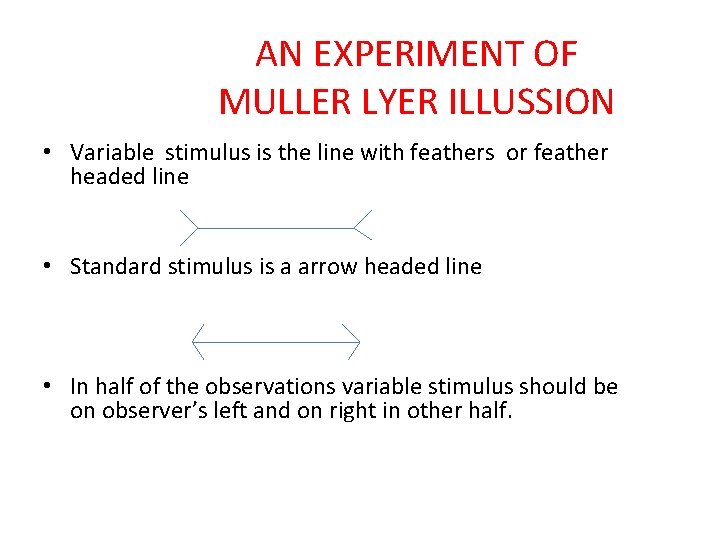
AN EXPERIMENT OF MULLER LYER ILLUSSION • Variable stimulus is the line with feathers or feather headed line • Standard stimulus is a arrow headed line • In half of the observations variable stimulus should be on observer’s left and on right in other half.
• These two space arrangements are denoted as L and R. • The trial should start with variable stimulus obviously too great so that the movement of the terminal arrow is inward. • In other half variable stimulus is set obviously too small so that the movement is outward. • This is denoted by I and O • There are consequently four possible combinations of condition RO, RI, LO and LI.
• Counterbalancing is followed within each set of trials. • Experimenter should randomize the setting among large, medium and small starting length for variable stimulus.
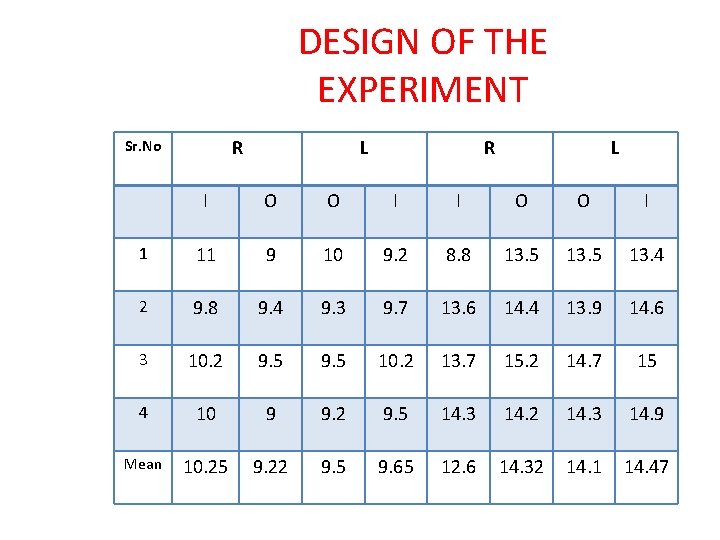
DESIGN OF THE EXPERIMENT R Sr. No L R L I O O I 1 11 9 10 9. 2 8. 8 13. 5 13. 4 2 9. 8 9. 4 9. 3 9. 7 13. 6 14. 4 13. 9 14. 6 3 10. 2 9. 5 10. 2 13. 7 15. 2 14. 7 15 4 10 9 9. 2 9. 5 14. 3 14. 2 14. 3 14. 9 Mean 10. 25 9. 22 9. 5 9. 65 12. 6 14. 32 14. 1 14. 47
• RLRL design is used. • This is used to control space error. • IOOI design is used to control movement error.
• If the mean of the judgment is greater than variable stimulus and difference is positive. • This shows that feather headed line is overestimated. • Arrow headed line has been underestimated. • There are other constant errors.
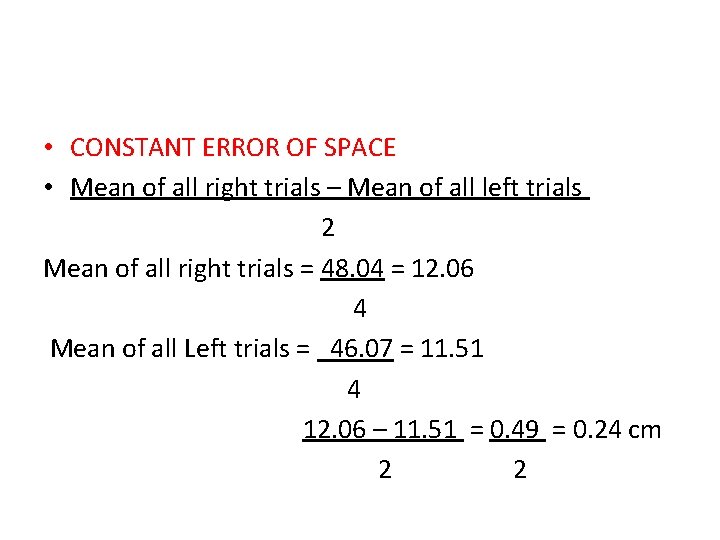
• CONSTANT ERROR OF SPACE • Mean of all right trials – Mean of all left trials 2 Mean of all right trials = 48. 04 = 12. 06 4 Mean of all Left trials = 46. 07 = 11. 51 4 12. 06 – 11. 51 = 0. 49 = 0. 24 cm 2 2
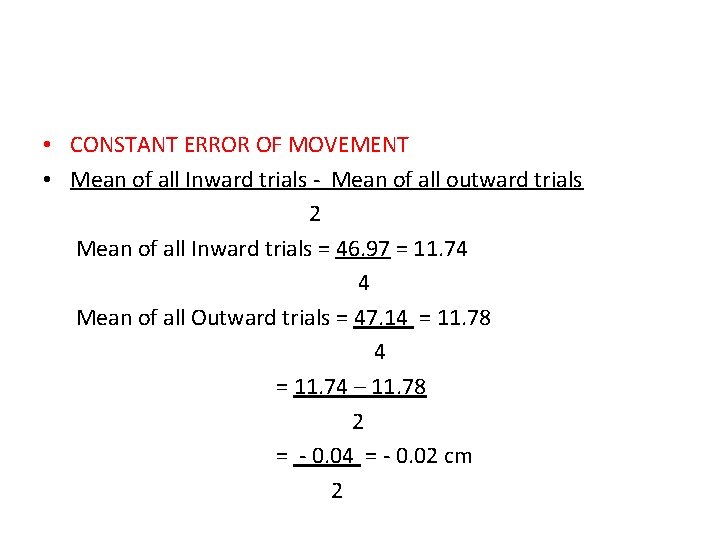
• CONSTANT ERROR OF MOVEMENT • Mean of all Inward trials - Mean of all outward trials 2 Mean of all Inward trials = 46. 97 = 11. 74 4 Mean of all Outward trials = 47. 14 = 11. 78 4 = 11. 74 – 11. 78 2 = - 0. 04 = - 0. 02 cm 2
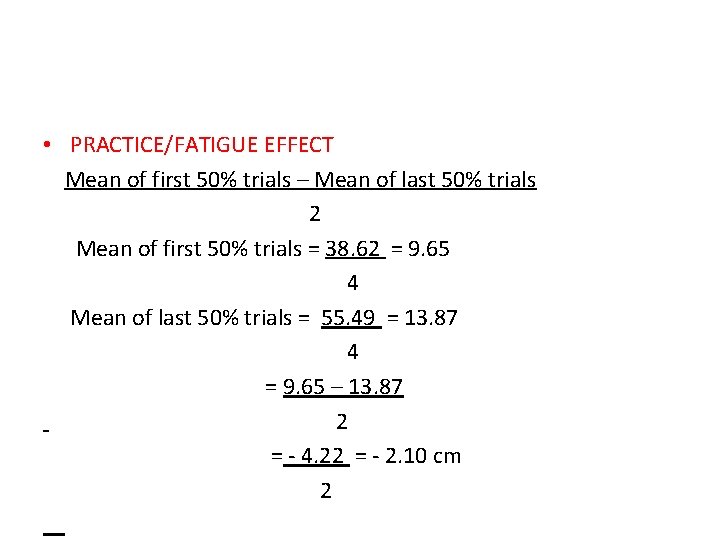
• PRACTICE/FATIGUE EFFECT Mean of first 50% trials – Mean of last 50% trials 2 Mean of first 50% trials = 38. 62 = 9. 65 4 Mean of last 50% trials = 55. 49 = 13. 87 4 = 9. 65 – 13. 87 2 = - 4. 22 = - 2. 10 cm 2
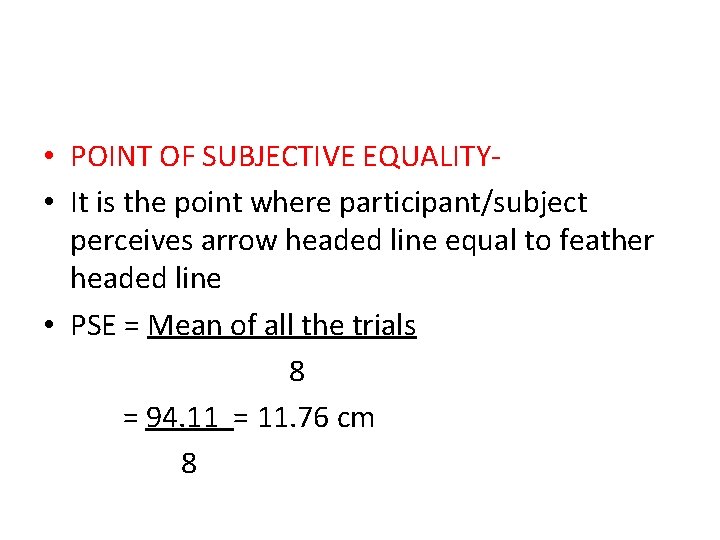
• POINT OF SUBJECTIVE EQUALITY • It is the point where participant/subject perceives arrow headed line equal to feather headed line • PSE = Mean of all the trials 8 = 94. 11 = 11. 76 cm 8
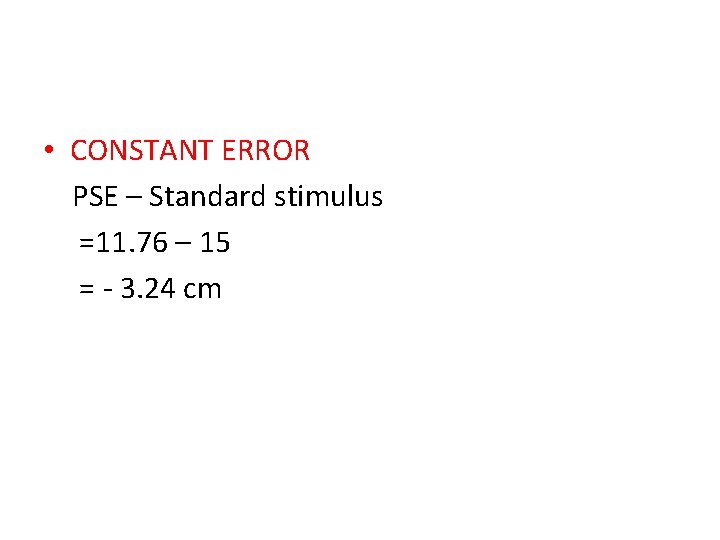
• CONSTANT ERROR PSE – Standard stimulus =11. 76 – 15 = - 3. 24 cm
DETERMINATION OF DL • Probable error is calculated. • Standard deviation from PSE value is measured. • Standard deviation is calculated from PSE value. • Standard deviation is multiplied with a constant value i. e. 0. 6475
ADVANTAGES • This method has practical advantage of economizing the time of both E and O. • This method is useful when number of measurements are to be made in a limited time. • This method is “most natural” of all methods. • The observer participates actively in the judgement.
DISADVANTAGES • Perceptual Vs Motor errors • Constant time error • Other uncontrolled errors
APPLICATIONS • It applies in those cases where observer can manipulate the variable stimulus. • Applied where variable stimulus is constantly variable. • Most useful application in study of visual extent. • It has been used in the study of visual intensities. • Used in study of tonal attributes, pitch and intensities.
• It has been adapted to the study of bodily movements. • It can be adapted to certain problems in memory.
Method OF CONSTANT STIMULI • It is most accurate and widely applicable method. • They are employed in the measurements of stimulus limens, differential limen equal sense distances and equivalent stimuli. • The difference between this method and method of constant stimuli is that the stimulus is presented in random and quasi random fashion. • This eliminates error of habituation and error of anticipation.
OTHER NAMES • METHOD OF CONSTANT STIMULUS DIFFERENCE- The same comparative stimulus are compared with standard stimulus. • FREQUENCY METHOD – As the frequency of each stimulus value to be presented to the participant is same.
• The experimenter presents the stimuli which lie in the transition zone. • Experimenter uses the stimuli which lie in the range between those which can always be perceived and those which can never be perceived. • Limited range is used because in each trial all the stimulus values have to be presented.
DETERMINATION OF AL • Determine the range of stimulus values – • The stimulus that is perceived just above zero percent of the trials. • The one that is perceived little below hundred percent of the trials. • This is selected as range to be employed.
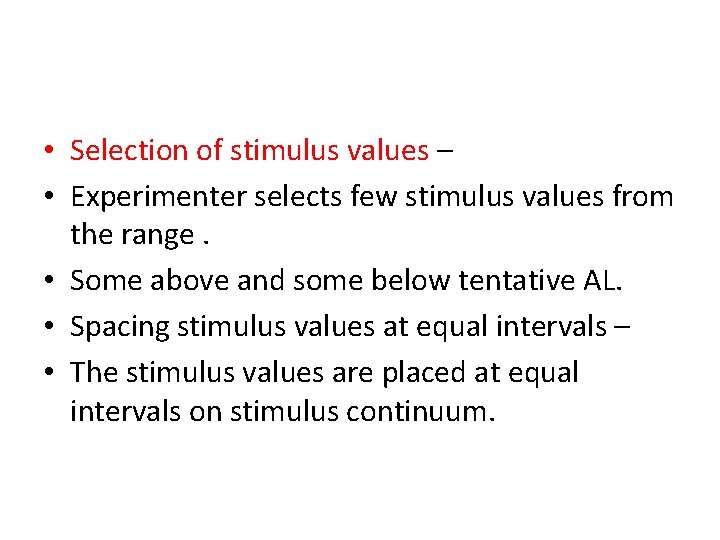
• Selection of stimulus values – • Experimenter selects few stimulus values from the range. • Some above and some below tentative AL. • Spacing stimulus values at equal intervals – • The stimulus values are placed at equal intervals on stimulus continuum.
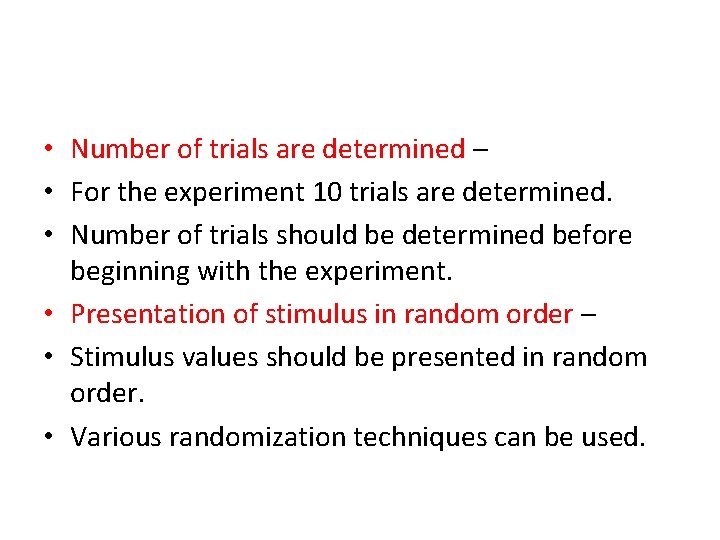
• Number of trials are determined – • For the experiment 10 trials are determined. • Number of trials should be determined before beginning with the experiment. • Presentation of stimulus in random order – • Stimulus values should be presented in random order. • Various randomization techniques can be used.
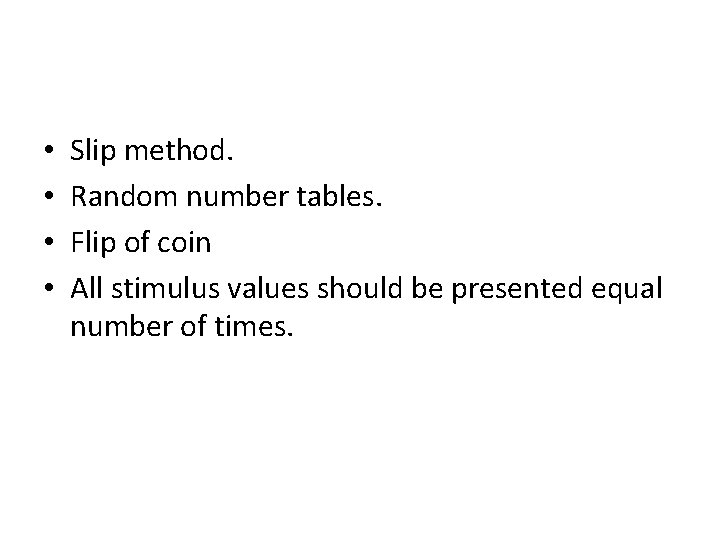
• • Slip method. Random number tables. Flip of coin All stimulus values should be presented equal number of times.
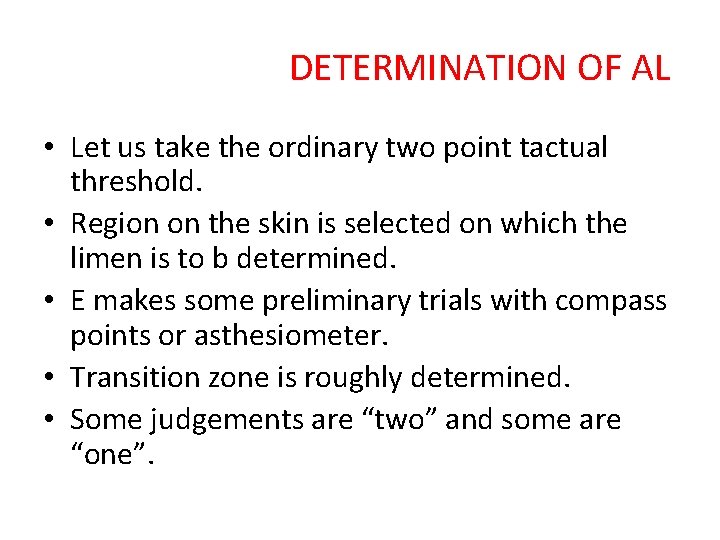
DETERMINATION OF AL • Let us take the ordinary two point tactual threshold. • Region on the skin is selected on which the limen is to b determined. • E makes some preliminary trials with compass points or asthesiometer. • Transition zone is roughly determined. • Some judgements are “two” and some are “one”.
• Experimenter selects five stimuli such that the middle one is probably close to the limen. • The smallest stimulus is likely to give report of “two” about 5% of the time. • The largest stimulus to give report of “two” 95% of the time. • The stimulus intervals are equal. • Experimenter then applies the stimulus in random until each stimulus has been applied equal number of times.
• The data from which the limen is to be computed consist of the proportion of the time each stimuli receives the judgment “two”.
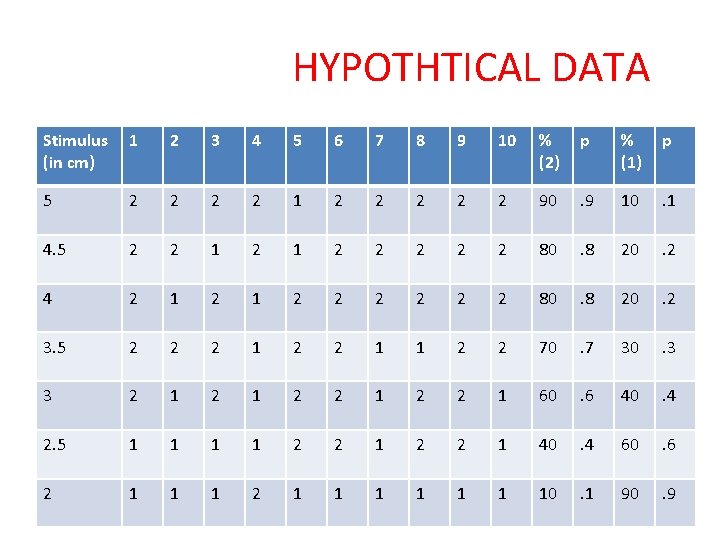
HYPOTHTICAL DATA Stimulus (in cm) 1 2 3 4 5 6 7 8 9 10 % (2) p % (1) p 5 2 2 1 2 2 2 90 . 9 10 . 1 4. 5 2 2 1 2 2 2 80 . 8 20 . 2 4 2 1 2 2 2 80 . 8 20 . 2 3. 5 2 2 2 1 1 2 2 70 . 7 30 . 3 3 2 1 2 2 1 60 . 6 40 . 4 2. 5 1 1 2 2 1 40 . 4 60 . 6 2 1 1 1 1 10 . 1 90 . 9
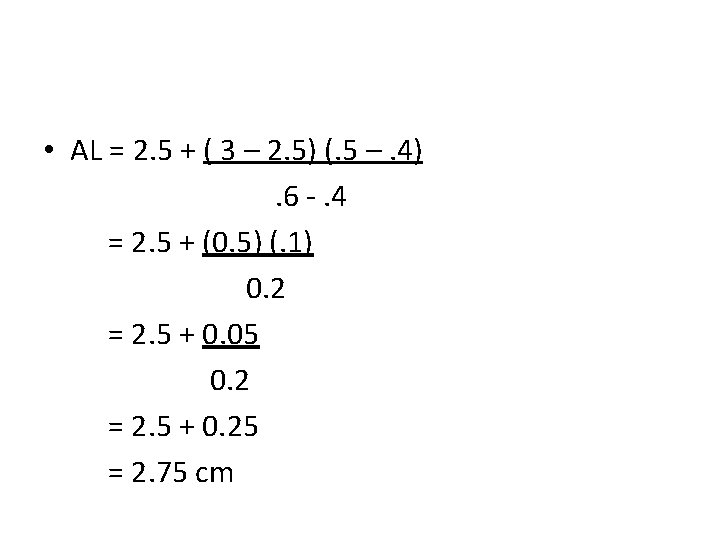
• THE INTERPOLATION METHOD • The two point limen is that separation of two points that yields 50% judgment of “two” and 50% judgment of “one”. • In the data 50% judgment of 2 responses lie between 40% to 60%. • AL is in between 3 cm and 2. 5 cm. • AL is computed by difference between 3 cm and 2. 5 cm.
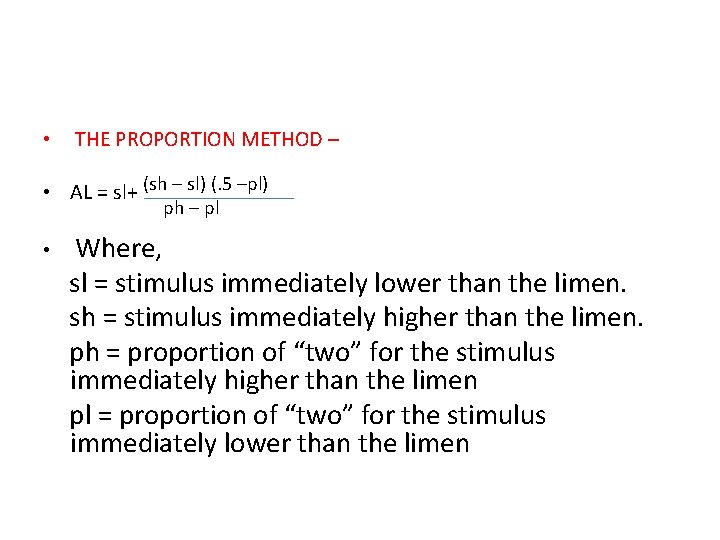
• THE PROPORTION METHOD – • AL = sl+ (sh – sl) (. 5 –pl) ph – pl • Where, sl = stimulus immediately lower than the limen. sh = stimulus immediately higher than the limen. ph = proportion of “two” for the stimulus immediately higher than the limen pl = proportion of “two” for the stimulus immediately lower than the limen
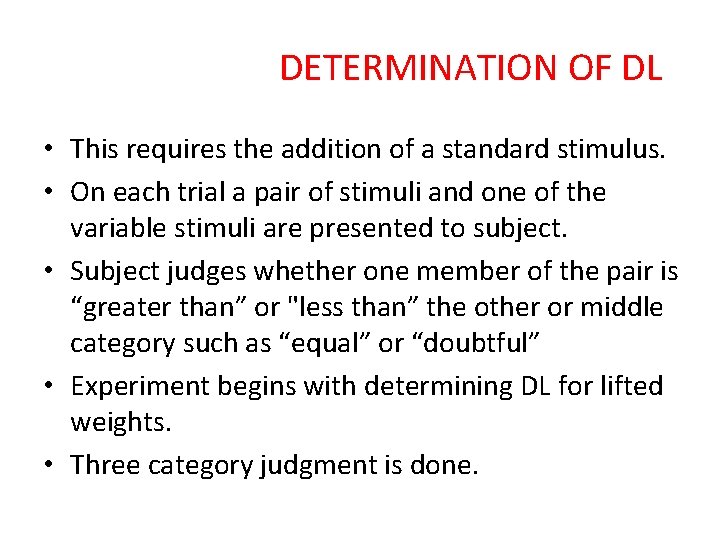
DETERMINATION OF DL • This requires the addition of a standard stimulus. • On each trial a pair of stimuli and one of the variable stimuli are presented to subject. • Subject judges whether one member of the pair is “greater than” or "less than” the other or middle category such as “equal” or “doubtful” • Experiment begins with determining DL for lifted weights. • Three category judgment is done.
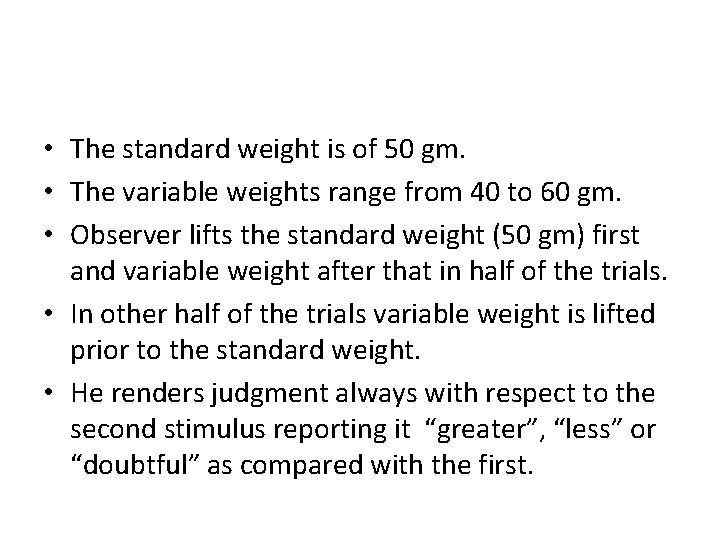
• The standard weight is of 50 gm. • The variable weights range from 40 to 60 gm. • Observer lifts the standard weight (50 gm) first and variable weight after that in half of the trials. • In other half of the trials variable weight is lifted prior to the standard weight. • He renders judgment always with respect to the second stimulus reporting it “greater”, “less” or “doubtful” as compared with the first.
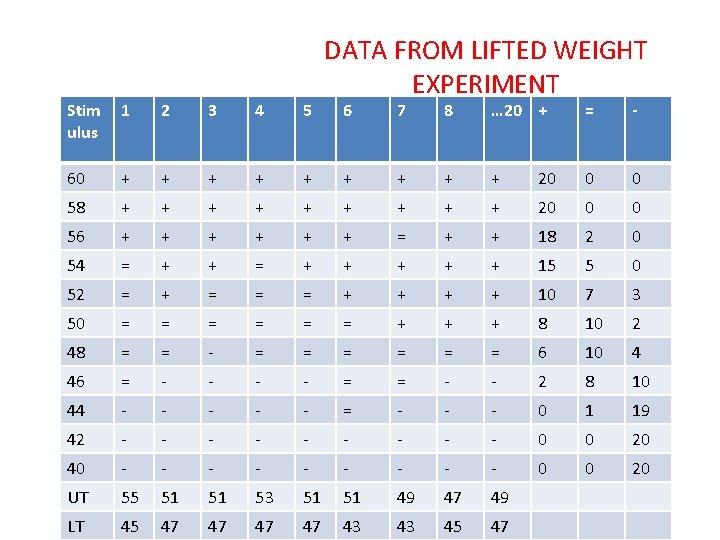
Stim ulus 1 2 3 4 5 60 + + 58 + + + 56 + + 54 = 52 DATA FROM LIFTED WEIGHT EXPERIMENT 6 7 8 … 20 + = - + + + + + 20 0 0 + + + + = + + 18 2 0 + + = + + + 15 5 0 = + = = = + + 10 7 3 50 = = = + + + 8 10 2 48 = = - = = = 6 10 4 46 = - - = = - - 2 8 10 44 - - - = - - - 0 1 19 42 - - - - - 0 0 20 40 - - - - - 0 0 20 UT 55 51 51 53 51 51 49 47 49 LT 45 47 47 43 43 45 47
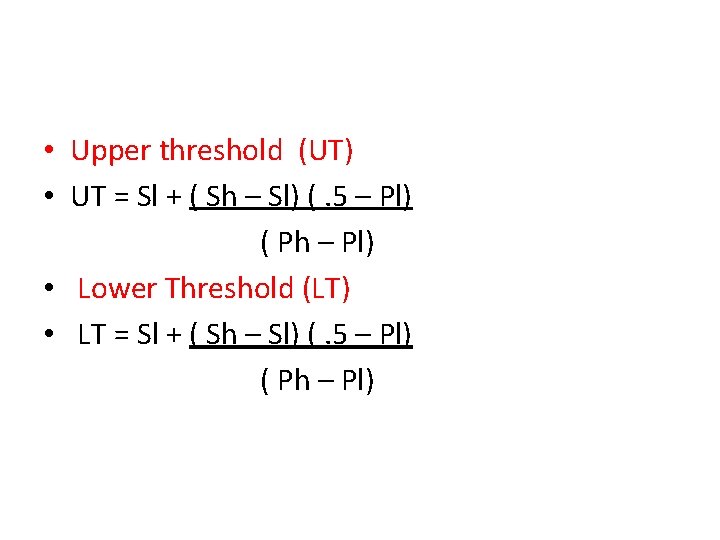
• Upper threshold (UT) • UT = Sl + ( Sh – Sl) (. 5 – Pl) ( Ph – Pl) • Lower Threshold (LT) • LT = Sl + ( Sh – Sl) (. 5 – Pl) ( Ph – Pl)
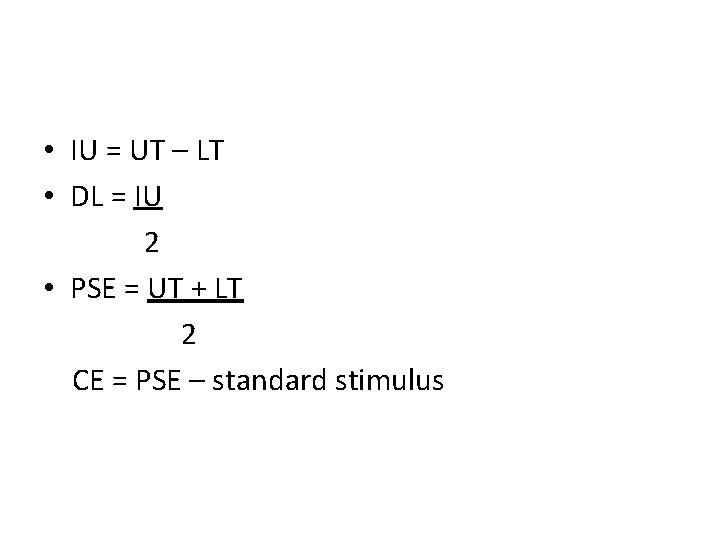
• IU = UT – LT • DL = IU 2 • PSE = UT + LT 2 CE = PSE – standard stimulus
ADVANTAGES • It is a versatile method and has broad range of applicability. • Limens can be determined accurately. • Computational processes are very refined. • Experimental errors as found in method of limits are avoided.
DISADVANTAGES • The method is not as economical as other methods. • Various kinds of biases in judgment can be there.
THANK YOU
- Slides: 42