
Method for Hot RealTime Sampling of Gasification Products


- Slides: 21
Method for Hot Real-Time Sampling of Gasification Products Bioenergy 2016 – Rome, Italy Marc Pomeroy June 14, 2016 NREL is a national laboratory of the U. S. Department of Energy, Office of Energy Efficiency and Renewable Energy, operated by the Alliance for Sustainable Energy, LLC.
Thermochemical Biomass Conversions • Rapid heating of biomass to around 500°C in absence of oxygen o Primary product is complex bio-oil – Over 400 compounds – Chemistry changes when condensing from vapor to oil – Acidic – High oxygen content – Up to 60% of material does not revolatilize making analysis challenging • Rapid heating of biomass to around 825°C in presence of controlled oxygen or steam o Primary product Syngas (H 2 + CO) for liquid fuel synthesis – Still a complex mixture with tars and inorganic contaminants – Up to 70% steam content – Formation of catalytic poisons such as hydrogen sulfide 2
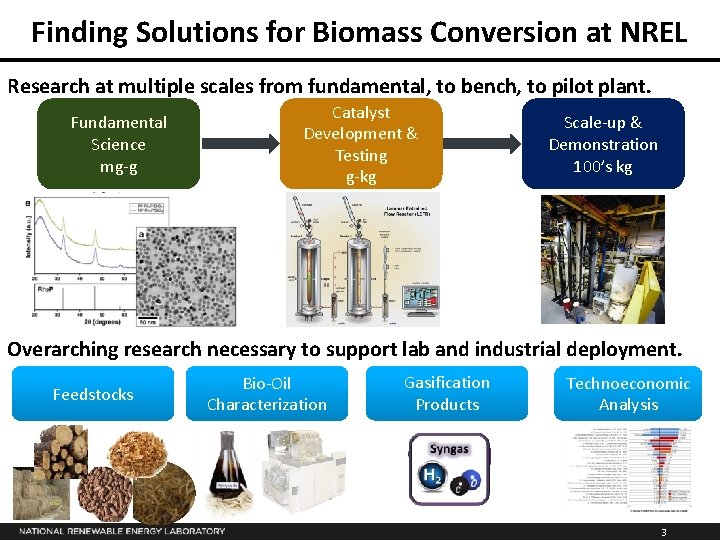
Finding Solutions for Biomass Conversion at NREL Research at multiple scales from fundamental, to bench, to pilot plant. Fundamental Science mg-g Catalyst Development & Testing g-kg Scale-up & Demonstration 100’s kg Overarching research necessary to support lab and industrial deployment. Feedstocks Bio-Oil Characterization Gasification Products Technoeconomic Analysis 3
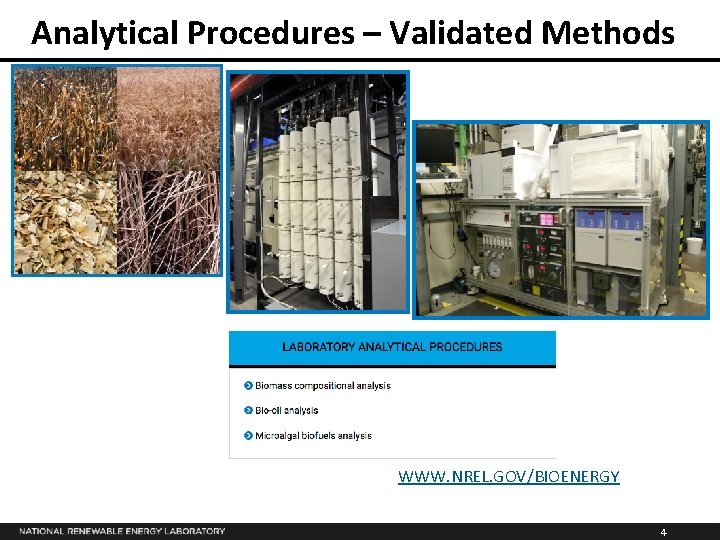
Analytical Procedures – Validated Methods WWW. NREL. GOV/BIOENERGY 4
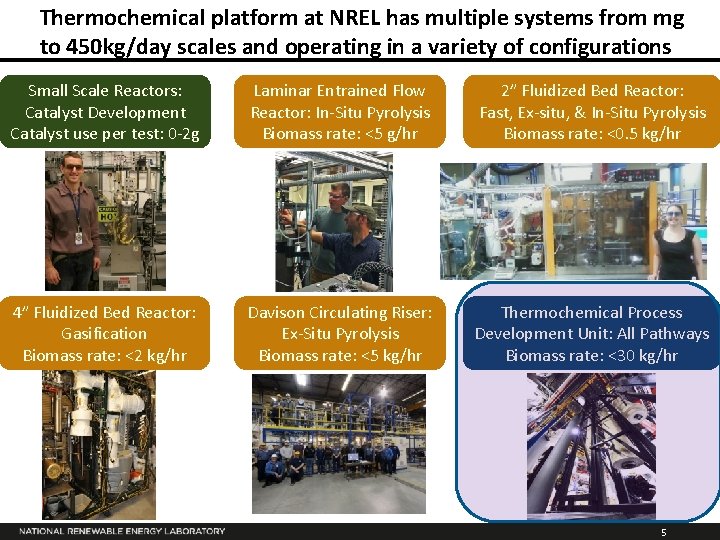
Thermochemical platform at NREL has multiple systems from mg to 450 kg/day scales and operating in a variety of configurations Small Scale Reactors: Catalyst Development Catalyst use per test: 0 -2 g Laminar Entrained Flow Reactor: In-Situ Pyrolysis Biomass rate: <5 g/hr 2” Fluidized Bed Reactor: Fast, Ex-situ, & In-Situ Pyrolysis Biomass rate: <0. 5 kg/hr 4” Fluidized Bed Reactor: Gasification Biomass rate: <2 kg/hr Davison Circulating Riser: Ex-Situ Pyrolysis Biomass rate: <5 kg/hr Thermochemical Process Development Unit: All Pathways Biomass rate: <30 kg/hr 5
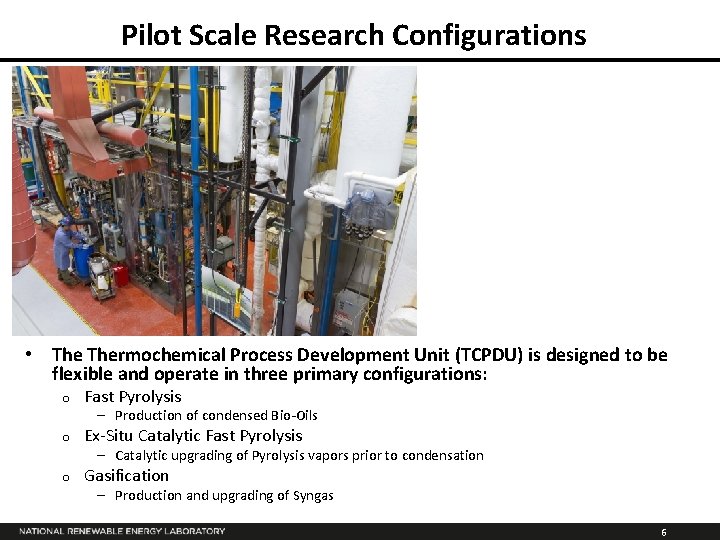
Pilot Scale Research Configurations • Thermochemical Process Development Unit (TCPDU) is designed to be flexible and operate in three primary configurations: o Fast Pyrolysis o Ex-Situ Catalytic Fast Pyrolysis o Gasification – Production of condensed Bio-Oils – Catalytic upgrading of Pyrolysis vapors prior to condensation – Production and upgrading of Syngas 6
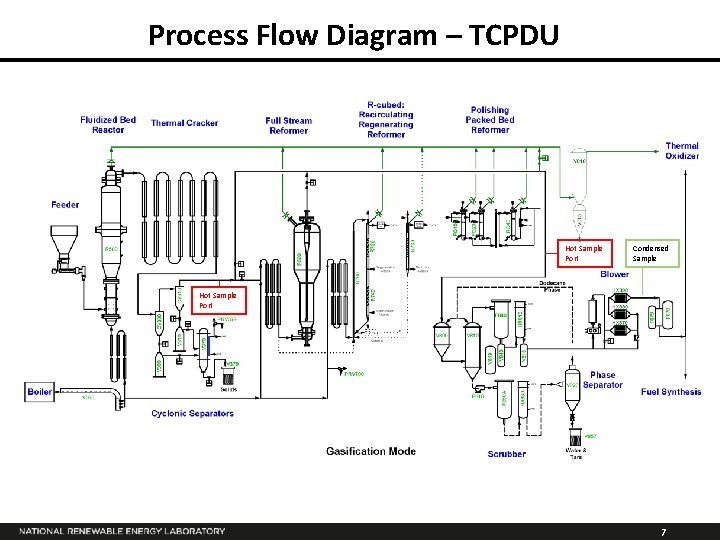
Process Flow Diagram – TCPDU Hot Sample Port Condensed Sample Hot Sample Port 7
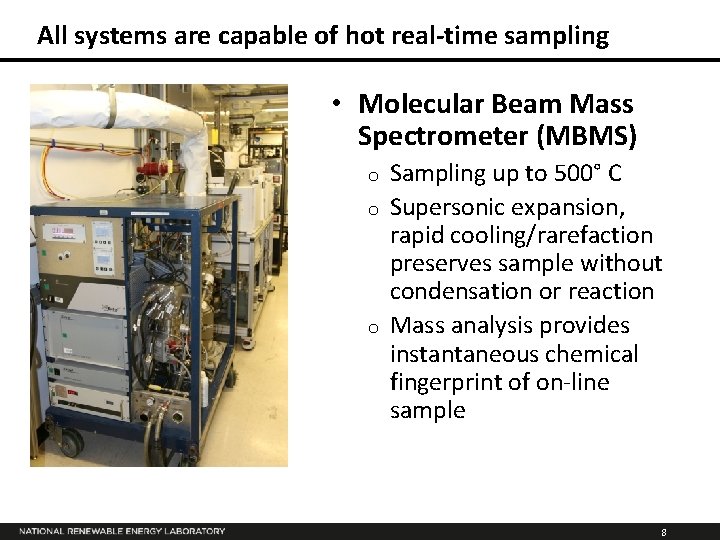
All systems are capable of hot real-time sampling • Molecular Beam Mass Spectrometer (MBMS) Sampling up to 500° C o Supersonic expansion, rapid cooling/rarefaction preserves sample without condensation or reaction o Mass analysis provides instantaneous chemical fingerprint of on-line sample o 8
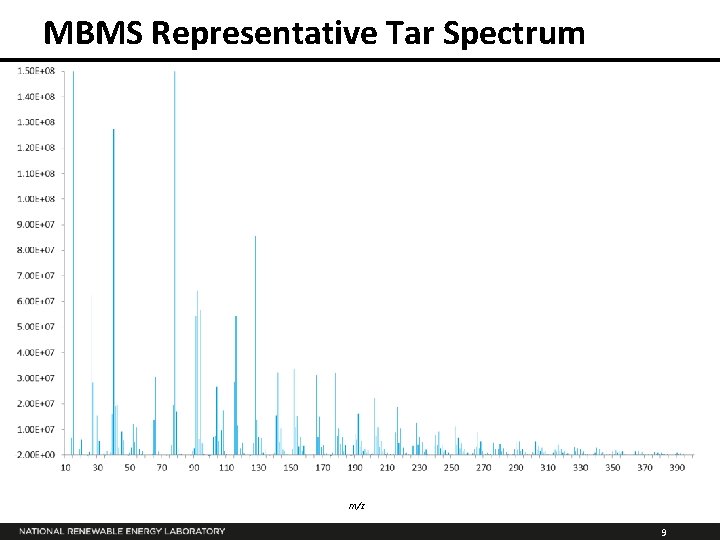
MBMS Representative Tar Spectrum m/z 9
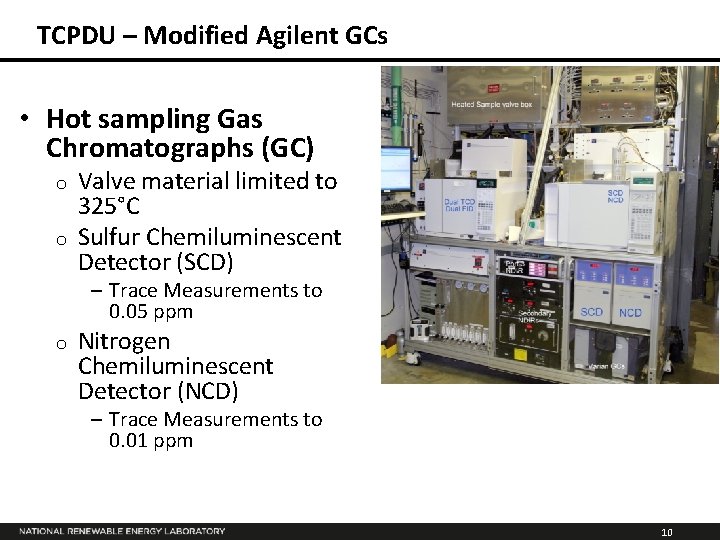
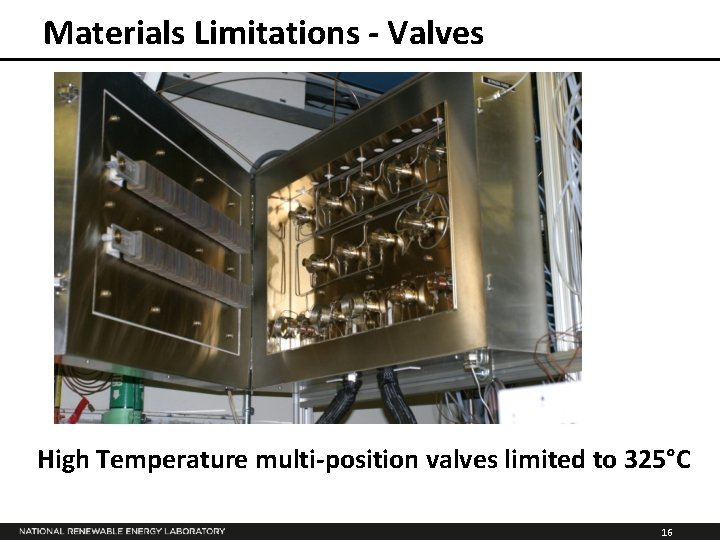
TCPDU – Modified Agilent GCs • Hot sampling Gas Chromatographs (GC) Valve material limited to 325°C o Sulfur Chemiluminescent Detector (SCD) o – Trace Measurements to 0. 05 ppm o Nitrogen Chemiluminescent Detector (NCD) – Trace Measurements to 0. 01 ppm 10
Challenges of Sampling at the Pilot Scale Operational Constraints Representative Sample • Analytical equipment adversely affected by high ambient temperatures/dust • Space around reactors required for plant maintenance and operation • Multiple sampling points • Residence time o Pre- and Post-catalytic Reactors o Thermal changes – Cracking, further reaction chemistries • Catalytic effects o Ash, char, anti-seize • Material Selection o Sulfur interactions with steel • Plugging and flow issues 11
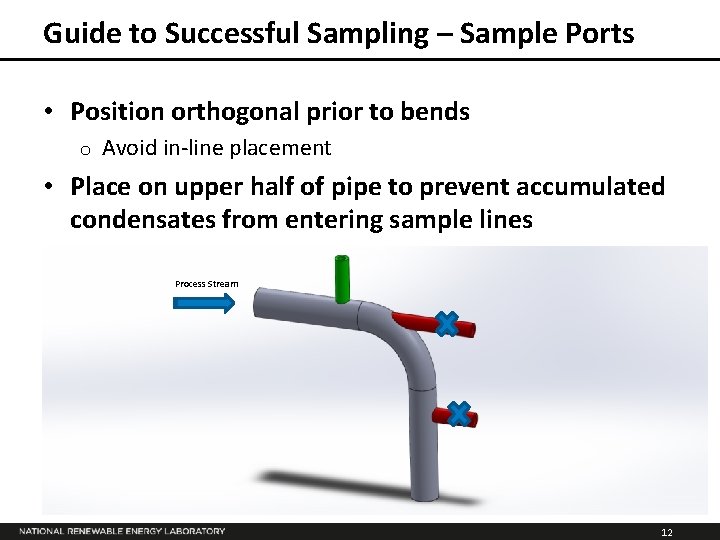
Guide to Successful Sampling – Sample Ports • Position orthogonal prior to bends o Avoid in-line placement • Place on upper half of pipe to prevent accumulated condensates from entering sample lines Process Stream 12
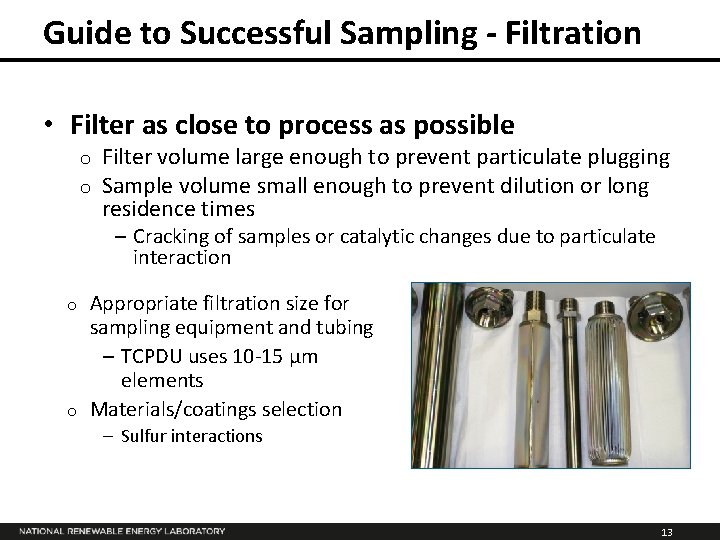
Guide to Successful Sampling - Filtration • Filter as close to process as possible o o Filter volume large enough to prevent particulate plugging Sample volume small enough to prevent dilution or long residence times – Cracking of samples or catalytic changes due to particulate interaction Appropriate filtration size for sampling equipment and tubing – TCPDU uses 10 -15 μm elements o Materials/coatings selection o – Sulfur interactions 13
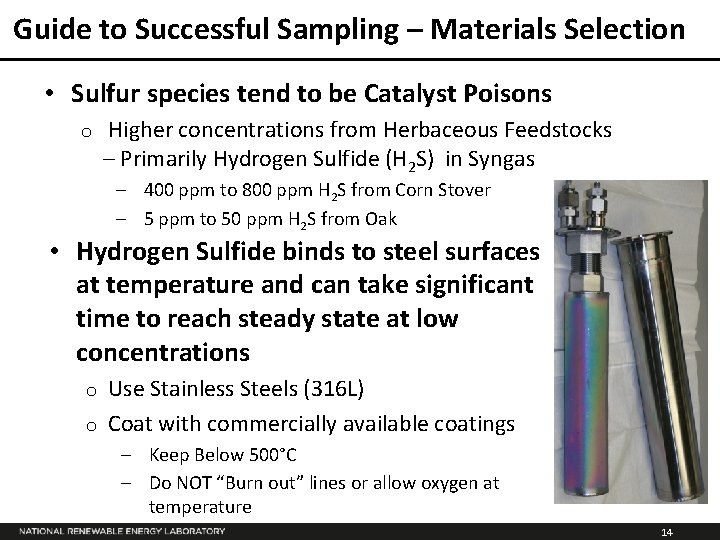
Guide to Successful Sampling – Materials Selection • Sulfur species tend to be Catalyst Poisons o Higher concentrations from Herbaceous Feedstocks – Primarily Hydrogen Sulfide (H 2 S) in Syngas – 400 ppm to 800 ppm H 2 S from Corn Stover – 5 ppm to 50 ppm H 2 S from Oak • Hydrogen Sulfide binds to steel surfaces at temperature and can take significant time to reach steady state at low concentrations Use Stainless Steels (316 L) o Coat with commercially available coatings o – Keep Below 500°C – Do NOT “Burn out” lines or allow oxygen at temperature 14
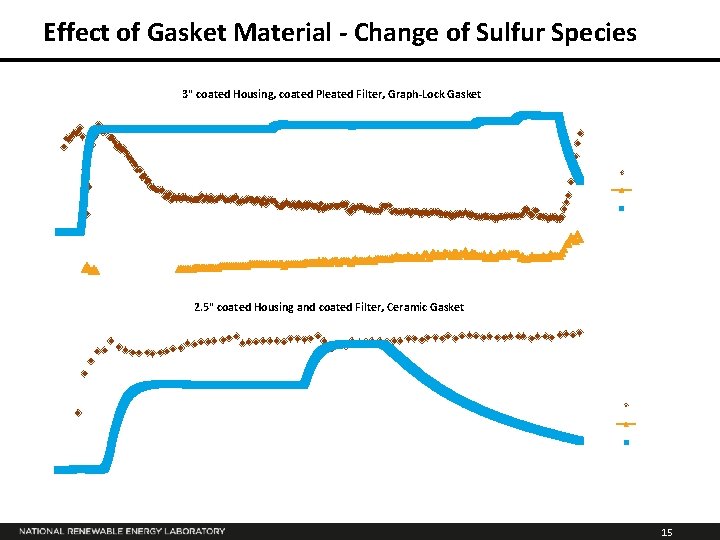
Temp in °C Sulfur in ppm Effect of Gasket Material - Change of Sulfur Species 15
Materials Limitations - Valves High Temperature multi-position valves limited to 325°C 16
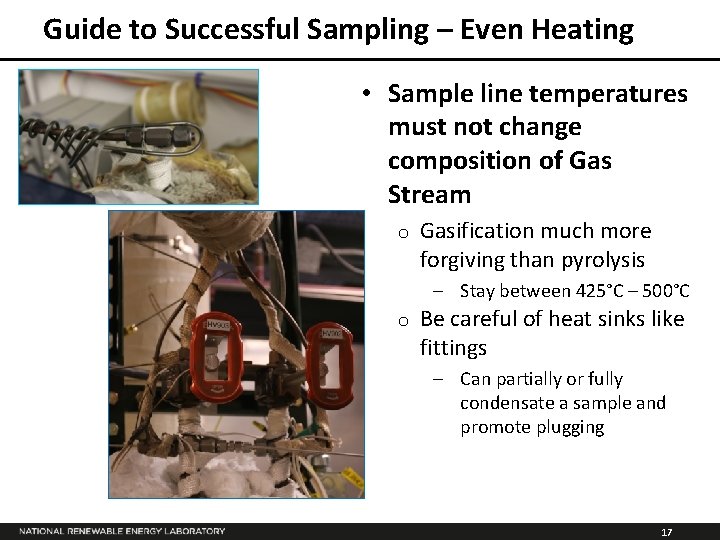
Guide to Successful Sampling – Even Heating • Sample line temperatures must not change composition of Gas Stream o Gasification much more forgiving than pyrolysis – Stay between 425°C – 500°C o Be careful of heat sinks like fittings – Can partially or fully condensate a sample and promote plugging 17
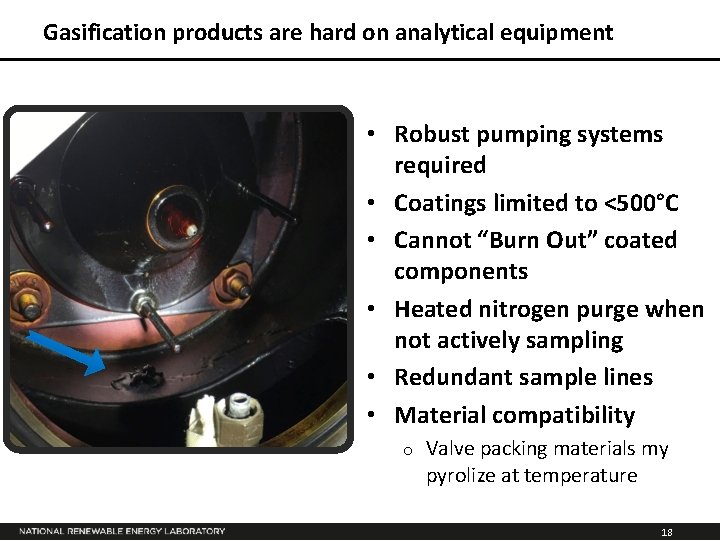
Gasification products are hard on analytical equipment • Robust pumping systems required • Coatings limited to <500°C • Cannot “Burn Out” coated components • Heated nitrogen purge when not actively sampling • Redundant sample lines • Material compatibility o Valve packing materials my pyrolize at temperature 18
Robust Sampling System - Summary • Leave time for commissioning of sampling system o May need to optimize for an individual feedstock • Place your sample ports effectively • Filter close to the process • Carefully select materials and coatings o Do not oxidize or exceed 500°C • Even heating of sample components is critical • Solvent cleaning of residual tars may be required • Analytical equipment must be designed for high temperatures and condensable components • Adequate sample flow for as short a sample time as reasonable 19
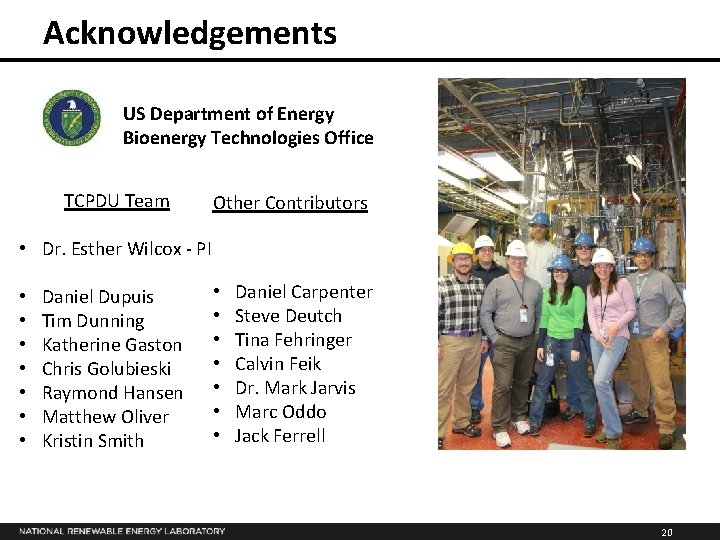
Acknowledgements US Department of Energy Bioenergy Technologies Office TCPDU Team Other Contributors • Dr. Esther Wilcox - PI • • Daniel Dupuis Tim Dunning Katherine Gaston Chris Golubieski Raymond Hansen Matthew Oliver Kristin Smith • • Daniel Carpenter Steve Deutch Tina Fehringer Calvin Feik Dr. Mark Jarvis Marc Oddo Jack Ferrell 20
Questions?