
Method Declarations A method declaration specifies the code
- Slides: 14
Method Declarations Ø A method declaration specifies the code that will be executed when the method is invoked (or called) Ø When a method is invoked, the flow of control jumps to the method and executes its code Ø When complete, the flow returns to the place where the method was called and continues Ø The invocation may or may not return a value, depending on how the method is defined
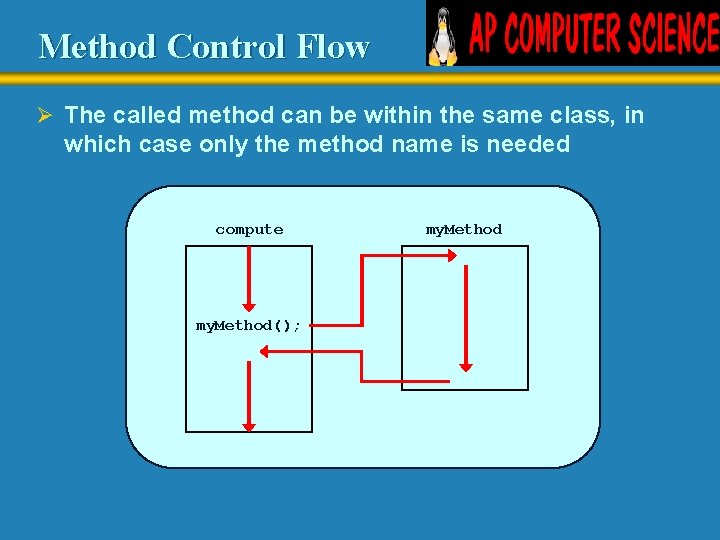
Method Control Flow Ø The called method can be within the same class, in which case only the method name is needed compute my. Method(); my. Method
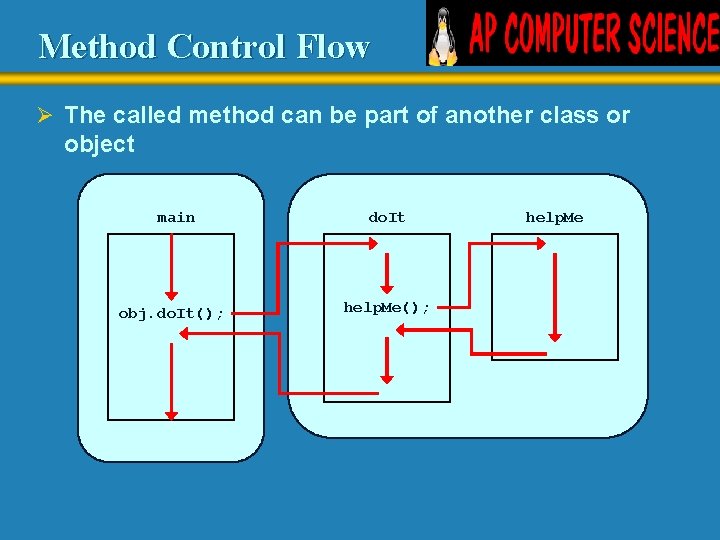
Method Control Flow Ø The called method can be part of another class or object main obj. do. It(); do. It help. Me(); help. Me
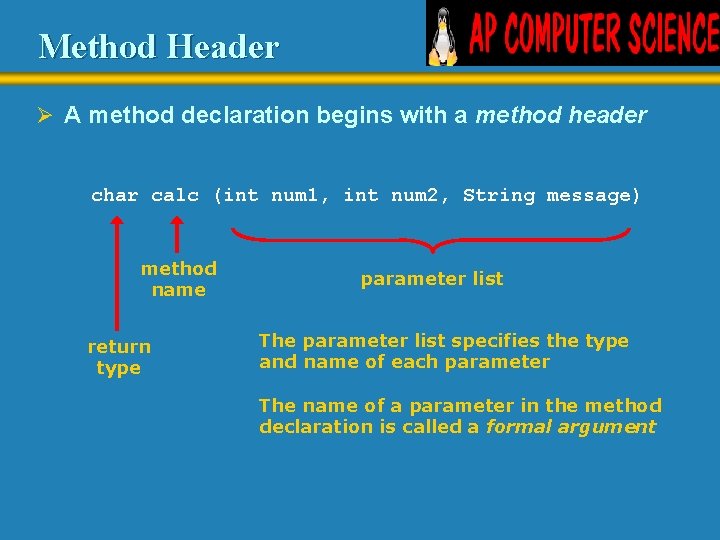
Method Header Ø A method declaration begins with a method header char calc (int num 1, int num 2, String message) method name return type parameter list The parameter list specifies the type and name of each parameter The name of a parameter in the method declaration is called a formal argument
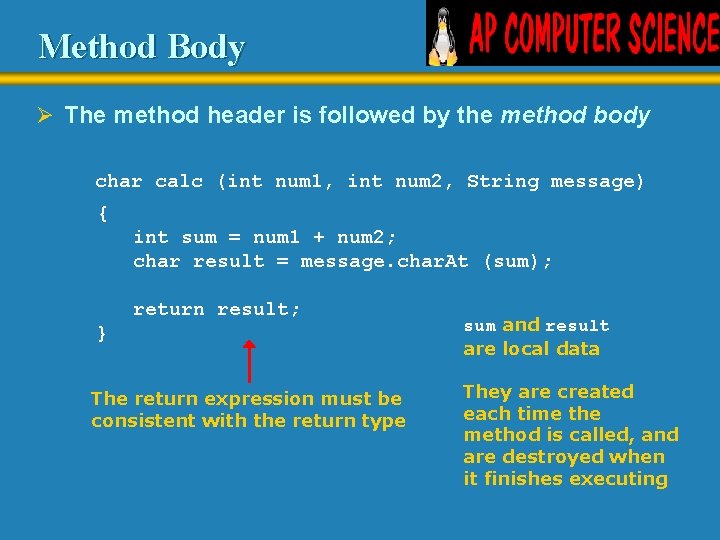
Method Body Ø The method header is followed by the method body char calc (int num 1, int num 2, String message) { int sum = num 1 + num 2; char result = message. char. At (sum); return result; } The return expression must be consistent with the return type sum and result are local data They are created each time the method is called, and are destroyed when it finishes executing
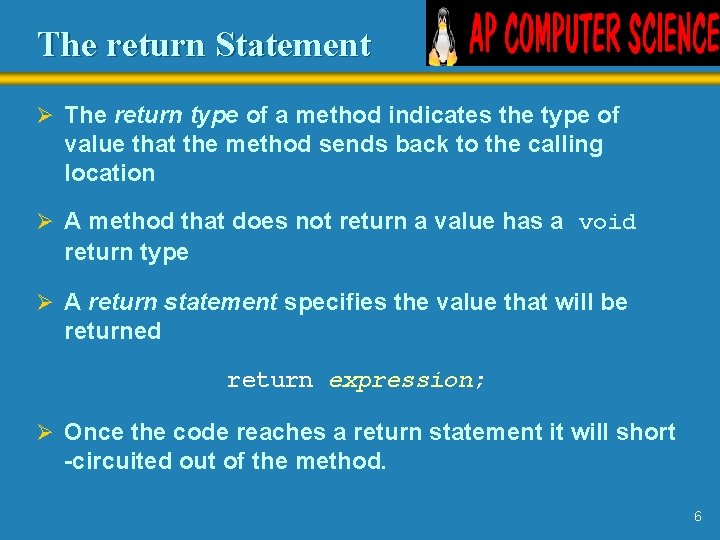
The return Statement Ø The return type of a method indicates the type of value that the method sends back to the calling location Ø A method that does not return a value has a void return type Ø A return statement specifies the value that will be returned return expression; Ø Once the code reaches a return statement it will short -circuited out of the method. 6
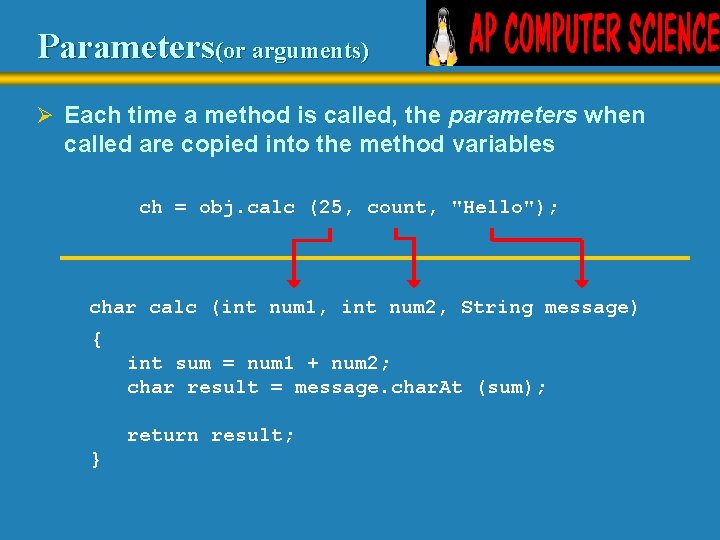
Parameters(or arguments) Ø Each time a method is called, the parameters when called are copied into the method variables ch = obj. calc (25, count, "Hello"); char calc (int num 1, int num 2, String message) { int sum = num 1 + num 2; char result = message. char. At (sum); return result; }
Local Data Ø Local variables can be declared inside a method Ø The parameters of a method create automatic local variables when the method is invoked Ø When the method finishes, all local variables are destroyed (including the parameters)
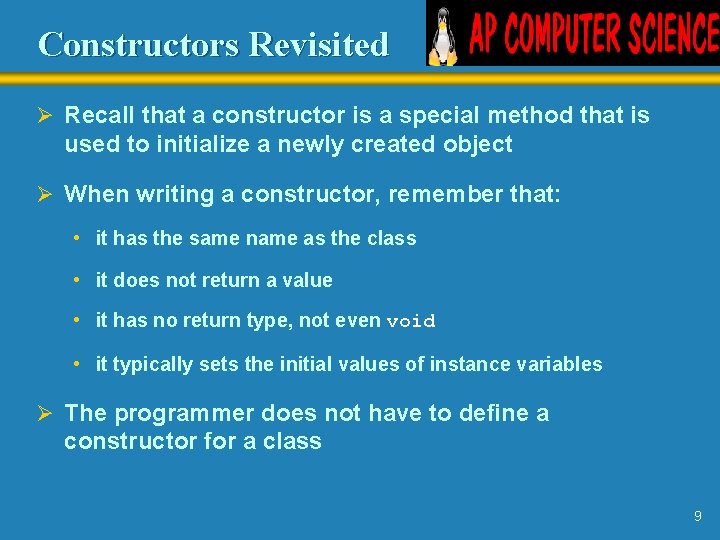
Constructors Revisited Ø Recall that a constructor is a special method that is used to initialize a newly created object Ø When writing a constructor, remember that: • it has the same name as the class • it does not return a value • it has no return type, not even void • it typically sets the initial values of instance variables Ø The programmer does not have to define a constructor for a class 9
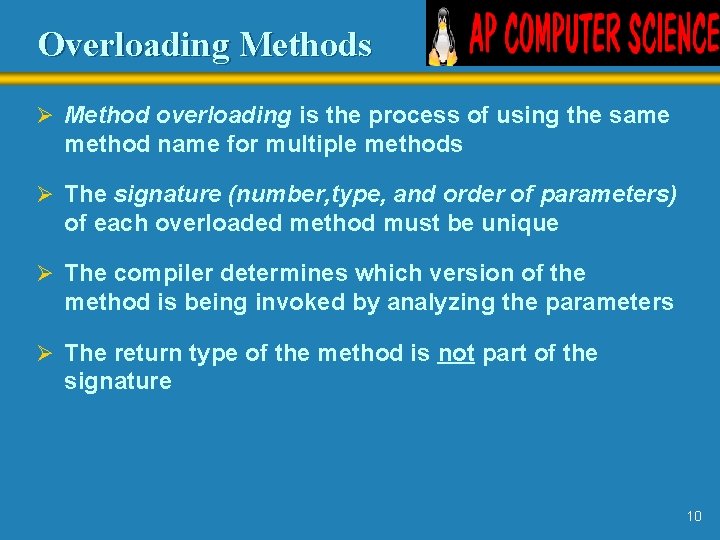
Overloading Methods Ø Method overloading is the process of using the same method name for multiple methods Ø The signature (number, type, and order of parameters) of each overloaded method must be unique Ø The compiler determines which version of the method is being invoked by analyzing the parameters Ø The return type of the method is not part of the signature 10
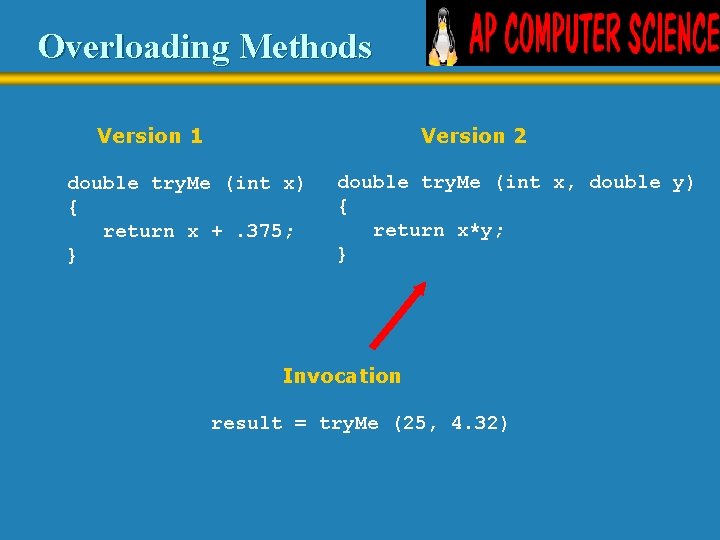
Overloading Methods Version 1 Version 2 double try. Me (int x) { return x +. 375; } double try. Me (int x, double y) { return x*y; } Invocation result = try. Me (25, 4. 32)
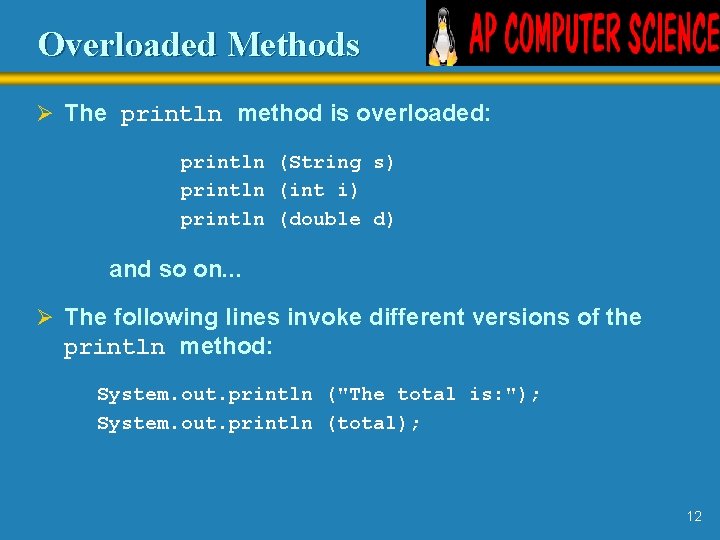
Overloaded Methods Ø The println method is overloaded: println (String s) println (int i) println (double d) and so on. . . Ø The following lines invoke different versions of the println method: System. out. println ("The total is: "); System. out. println (total); 12
Overloading Methods Ø Constructors can be overloaded Ø Overloaded constructors provide multiple ways to initialize a new object Ø For example: • public Circle () //define a new circle with default center • public Circle (int x, int y) // define a new circle with center x, y 13
Method Decomposition Ø A method should be relatively small, so that it can be understood as a single entity Ø A potentially large method should be decomposed into several smaller methods as needed for clarity Ø A method of an object may call one or more support methods to accomplish its goal Ø Support methods could call other support methods if appropriate