
METER The heartbeat of a poem METER v
METER The heartbeat of a poem.
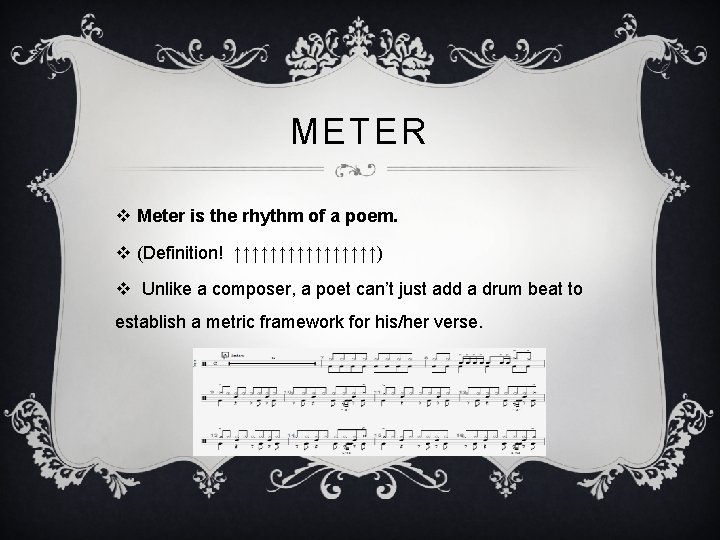
METER v Meter is the rhythm of a poem. v (Definition! ↑↑↑↑↑↑↑↑) v Unlike a composer, a poet can’t just add a drum beat to establish a metric framework for his/her verse.
HOW METER IS CREATED v Meter is created using the cadence of language. Poets choose words for their length and how the syllables are emphasized. v To begin to recognize it, you need to look at words with two or more syllables and note which syllables are emphasized (stressed). v Many types of poems are categorized by their meter.
SCANNING FOR METER–. The process of marking stressed and unstressed syllables in a poem

SCANNING FOR METER– The process of marking stressed and unstressed syllables in a poem. / v Break the words down to syllables. v Mark the stressed Fow / Dav syllable/s with a “/” / v Mark the unstressed Cee syllables with a “U” U ler U U en port U ly U / Syl vest U er
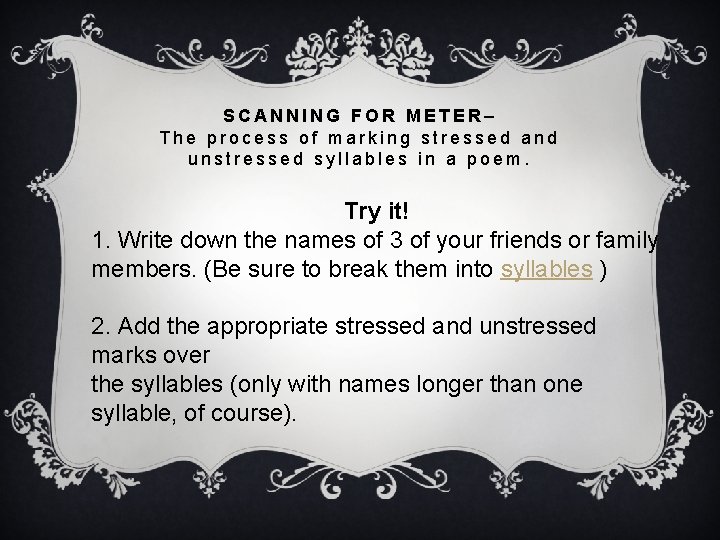
SCANNING FOR METER– The process of marking stressed and unstressed syllables in a poem. Try it! 1. Write down the names of 3 of your friends or family members. (Be sure to break them into syllables ) 2. Add the appropriate stressed and unstressed marks over the syllables (only with names longer than one syllable, of course).
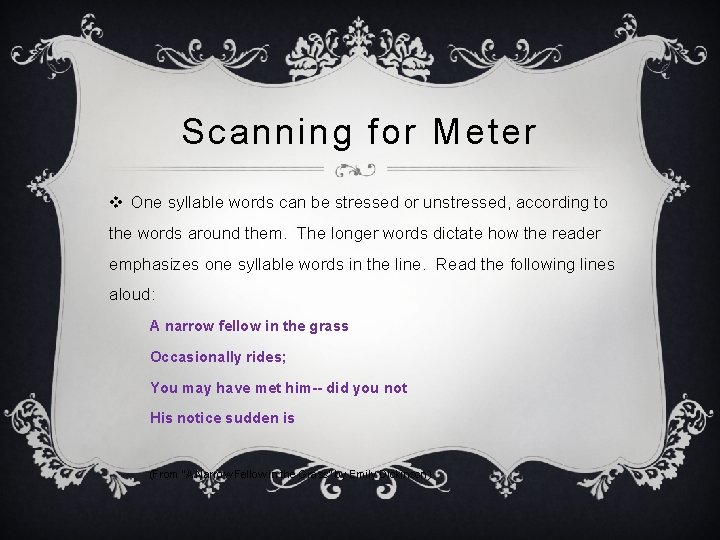
Scanning for Meter v One syllable words can be stressed or unstressed, according to the words around them. The longer words dictate how the reader emphasizes one syllable words in the line. Read the following lines aloud: A narrow fellow in the grass Occasionally rides; You may have met him-- did you not His notice sudden is (From “A Narrow Fellow in the Grass” by Emily Dickinson)
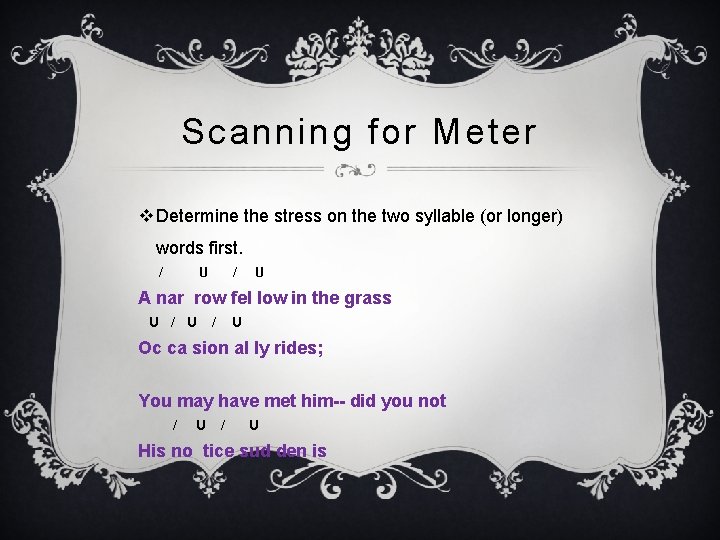
Scanning for Meter v Determine the stress on the two syllable (or longer) words first. / U A nar row fel low in the grass U / U Oc ca sion al ly rides; You may have met him-- did you not / U His no tice sud den is
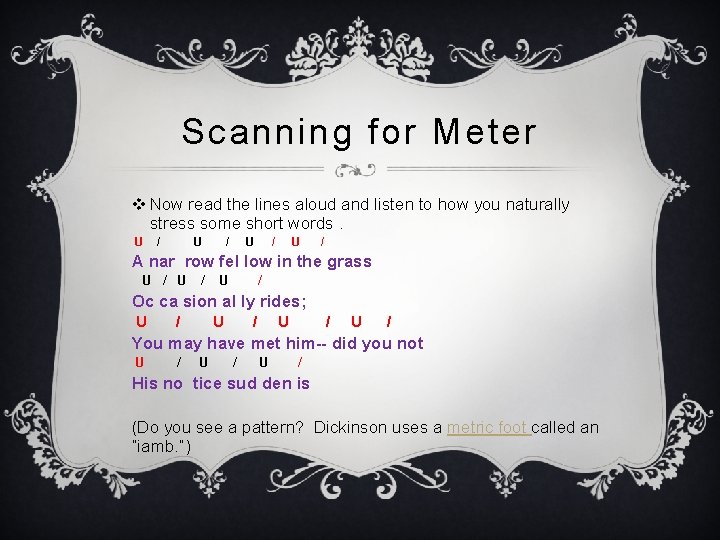
Scanning for Meter v Now read the lines aloud and listen to how you naturally stress some short words. U / U / A nar row fel low in the grass U / U / Oc ca sion al ly rides; U / U / You may have met him-- did you not U / U / His no tice sud den is (Do you see a pattern? Dickinson uses a metric foot called an “iamb. ”)
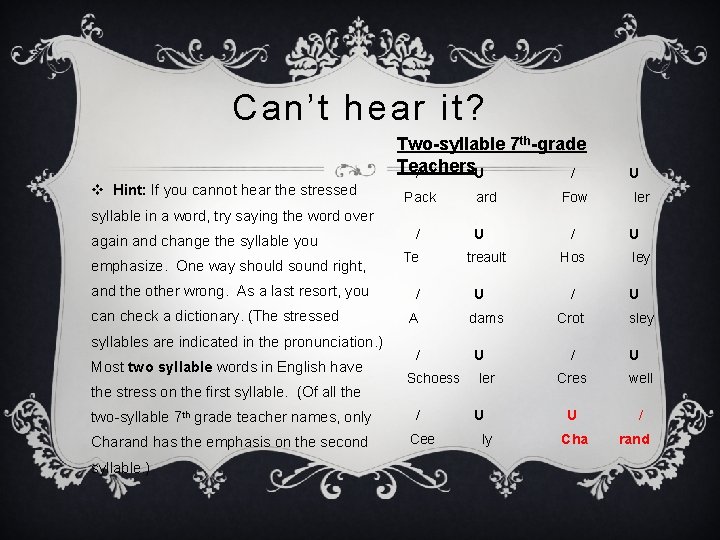
Can’t hear it? Two-syllable 7 th-grade Teachers / / U v Hint: If you cannot hear the stressed Pack ard Fow U ler syllable in a word, try saying the word over again and change the syllable you emphasize. One way should sound right, and the other wrong. As a last resort, you can check a dictionary. (The stressed syllables are indicated in the pronunciation. ) Most two syllable words in English have the stress on the first syllable. (Of all the / Te / A / Schoess two-syllable 7 th grade teacher names, only / Charand has the emphasis on the second Cee syllable. ) U treault U dams U ler U ly / Hos / Crot / U ley U sley U Cres well U / Cha rand

Poems Categorized by Meter v Sonnets– 14 lines in iambic pentameter. (Each line has 5 iambs= 10 syllables alternating between unstressed and stressed: U ) v Blank Verse– Unrhymed iambic pentameter. Many of Shakespeare’s plays are written in blank verse. v Free Verse—A poem with no rhyme or meter. v Limerick– Five anapestic lines. An anapest is a three- syllable metric foot: U U (unstressed, stressed) Something to note: In Modern English (1550 s to now) the earlier the poem was written, the stricter poets were about meter (see: Shakespeare, Spenser). Many 20 th century poets wrote in free verse, or wrote lyrically, but with no prescribed overall pattern of meter and/or rhyme (see Frost, Angelou, Hughes). TAKE ME BACK!
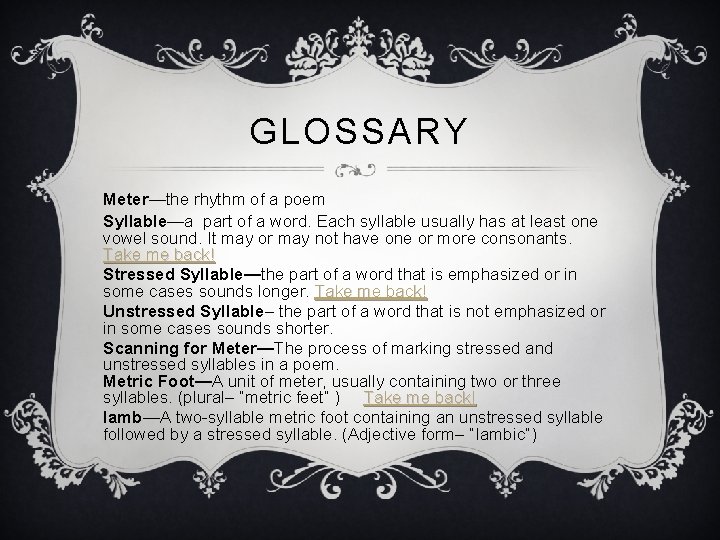
GLOSSARY Meter—the rhythm of a poem Syllable—a part of a word. Each syllable usually has at least one vowel sound. It may or may not have one or more consonants. Take me back! Stressed Syllable—the part of a word that is emphasized or in some cases sounds longer. Take me back! Unstressed Syllable– the part of a word that is not emphasized or in some cases sounds shorter. Scanning for Meter—The process of marking stressed and unstressed syllables in a poem. Metric Foot—A unit of meter, usually containing two or three syllables. (plural– “metric feet” ) Take me back! Iamb—A two-syllable metric foot containing an unstressed syllable followed by a stressed syllable. (Adjective form– “Iambic”)
FIN au revoir— —ciao—it’s done
- Slides: 13