
METER OR HOW TO SCAN A POEM This
- Slides: 10
METER OR HOW TO SCAN A POEM This is easy
ANYONE CAN HEAR METER v Do you know the difference between the words “refer” and “reefer” when you hear them? • If not, you might have trouble in your next job interview v That’s all you need in order to hear the meter of a poem. v You need a little more information to explain it, so that’s what we’ll cover.
A QUICK DEMONSTRATION v Mark accented syllables (louder parts of the word or phrase) with a forward slash on top of the word / v Mark unaccented syllables (quieter parts of the word or phrase) with a loop like a U v Here’s a piece from Hamlet with scanning marks: • http: //www. youtube. com/watch? v=l. Gu. Ffps 63 YI
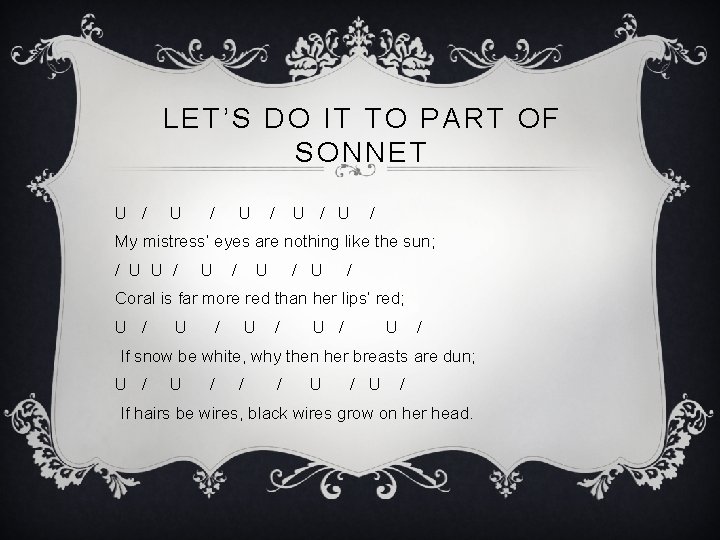
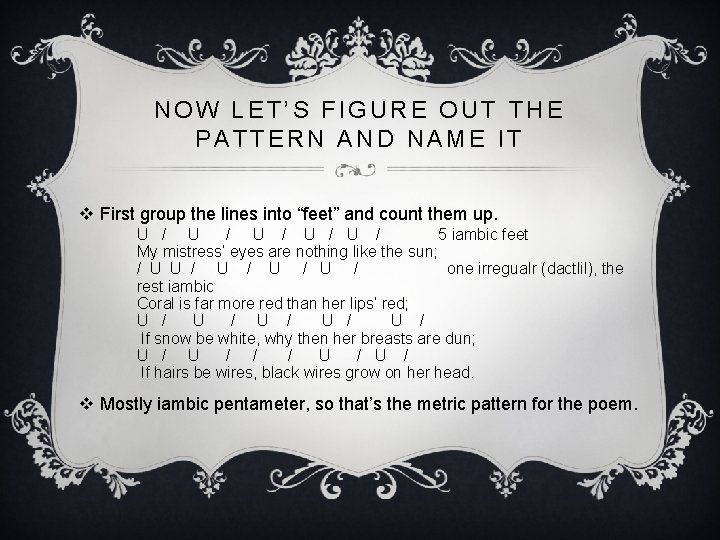
LET’S DO IT TO PART OF SONNET U / U / My mistress’ eyes are nothing like the sun; / U U / U / U / Coral is far more red than her lips’ red; U / U / If snow be white, why then her breasts are dun; U / U / / / U / U / If hairs be wires, black wires grow on her head.
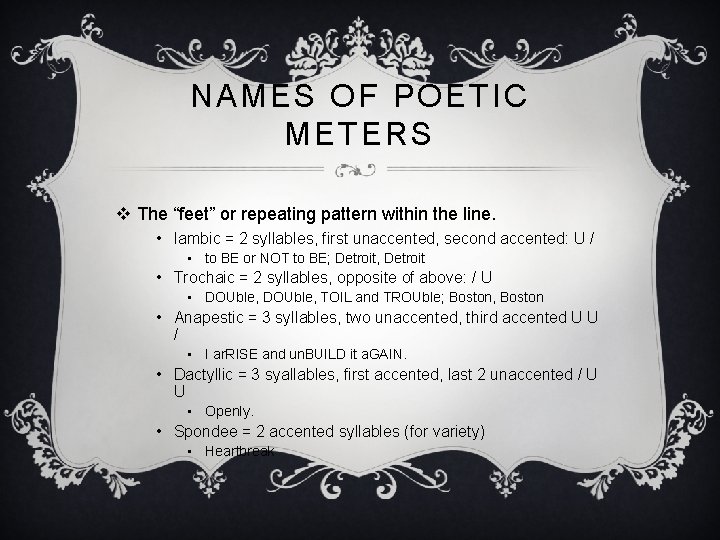
NAMES OF POETIC METERS v The “feet” or repeating pattern within the line. • Iambic = 2 syllables, first unaccented, second accented: U / • to BE or NOT to BE; Detroit, Detroit • Trochaic = 2 syllables, opposite of above: / U • DOUble, TOIL and TROUble; Boston, Boston • Anapestic = 3 syllables, two unaccented, third accented U U / • I ar. RISE and un. BUILD it a. GAIN. • Dactyllic = 3 syallables, first accented, last 2 unaccented / U U • Openly. • Spondee = 2 accented syllables (for variety) • Heartbreak
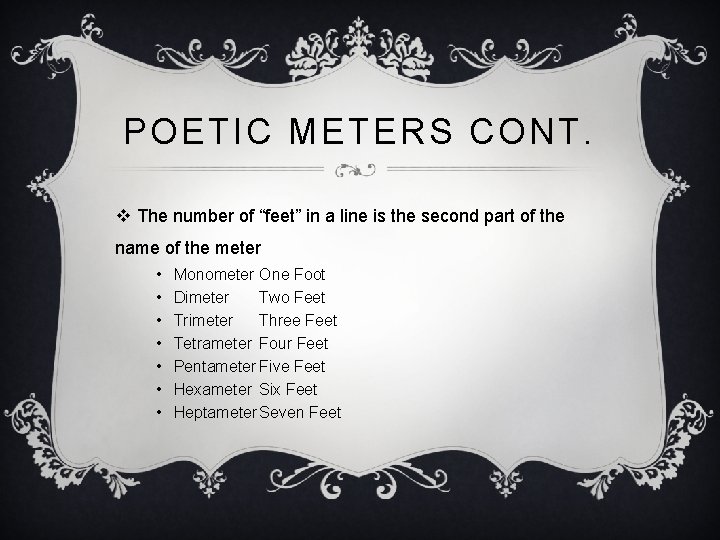
POETIC METERS CONT. v The number of “feet” in a line is the second part of the name of the meter • • Monometer One Foot Dimeter Two Feet Trimeter Three Feet Tetrameter Four Feet Pentameter Five Feet Hexameter Six Feet Heptameter Seven Feet
NOW LET’S FIGURE OUT THE PATTERN AND NAME IT v First group the lines into “feet” and count them up. U / U / 5 iambic feet My mistress’ eyes are nothing like the sun; / U U / U / U / one irregualr (dactlil), the rest iambic Coral is far more red than her lips’ red; U / U / If snow be white, why then her breasts are dun; U / U / / / U / U / If hairs be wires, black wires grow on her head. v Mostly iambic pentameter, so that’s the metric pattern for the poem.
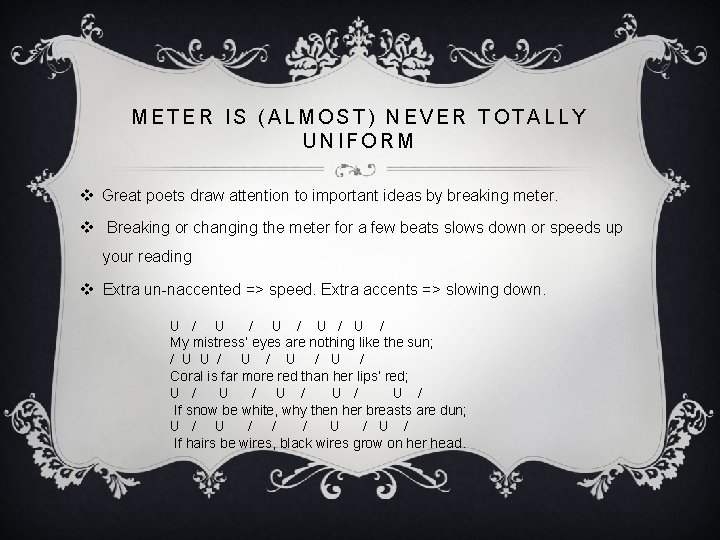
METER IS (ALMOST) NEVER TOTALLY UNIFORM v Great poets draw attention to important ideas by breaking meter. v Breaking or changing the meter for a few beats slows down or speeds up your reading v Extra un-naccented => speed. Extra accents => slowing down. U / U / My mistress’ eyes are nothing like the sun; / U U / U / U / Coral is far more red than her lips’ red; U / U / If snow be white, why then her breasts are dun; U / U / / / U / U / If hairs be wires, black wires grow on her head.
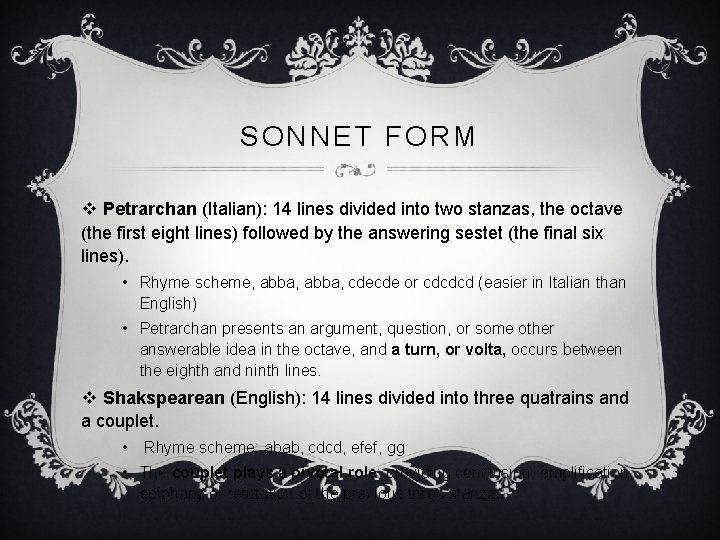
SONNET FORM v Petrarchan (Italian): 14 lines divided into two stanzas, the octave (the first eight lines) followed by the answering sestet (the final six lines). • Rhyme scheme, abba, cdecde or cdcdcd (easier in Italian than English) • Petrarchan presents an argument, question, or some other answerable idea in the octave, and a turn, or volta, occurs between the eighth and ninth lines. v Shakspearean (English): 14 lines divided into three quatrains and a couplet. • Rhyme scheme: abab, cdcd, efef, gg • The couplet plays a pivotal role: providing conclusion, amplification, epiphany or refutation of the previous three stanzas.
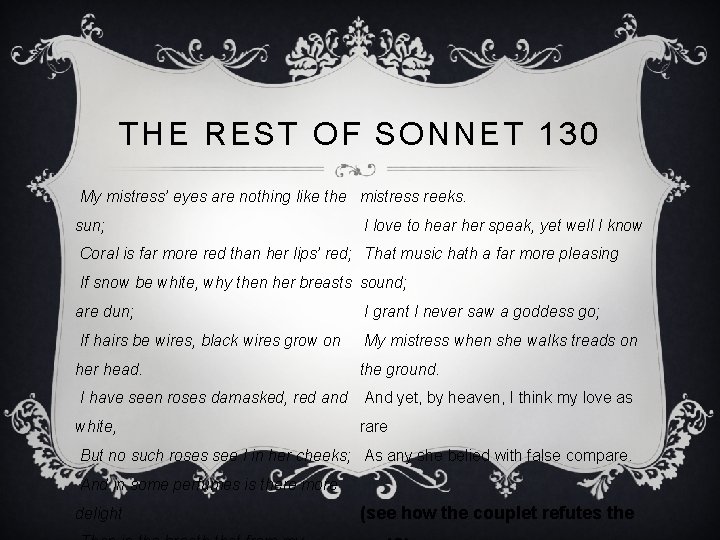
THE REST OF SONNET 130 My mistress’ eyes are nothing like the mistress reeks. sun; I love to hear her speak, yet well I know Coral is far more red than her lips’ red; That music hath a far more pleasing If snow be white, why then her breasts sound; are dun; I grant I never saw a goddess go; If hairs be wires, black wires grow on My mistress when she walks treads on her head. the ground. I have seen roses damasked, red and And yet, by heaven, I think my love as white, rare But no such roses see I in her cheeks; As any she belied with false compare. And in some perfumes is there more delight (see how the couplet refutes the