
Meteosat capability for fire detection and monitoring jose

Meteosat capability for fire detection and monitoring jose. prieto@eumetsat. int

Contents Meteosat Second Generation channels and differences • Differences between 3. 9µm and 10. 8µm channels • Solar channels for monitoring vegetation moisture Remote sensing of fires and smoke • Subpixel effect • Thresholds • All-channel view • Smoke Better monitoring with the Meteosat Third Generation

Subpixel detection at 3. 9µm Colour from Meteosat-9 channel 3. 9µm. Blue=270 K Red=280 K rites o Mete

Satellite detection of fires • Detection targets: Strelec. Study in Croatia for fires 2007 -2009. • hotspots • burn scars, burnt areas • smoke plumes • (piro)cloud • Limitations of satellites as a result of: • small active surface • cloud or smoke cover • location uncertainty inside the big pixel (for fire brigades) • sensor saturation and digital artifacts

12 1 2 3 4 5 6 7 8 9 10 11

Fire, scars and smoke seen by satellites 30% of channel 3. 9µm on top of HRV 2006 -July-7 16: 00

Fire, scars and smoke. . . better some times of the day 30% transparency of channels 3. 9µm, 10. 8µm and 13. 4µm on top of HRV 2011 -August-1 12: 00 Where is the smoke?

Smoke at sunset 5 -6 September 2007, Meteosat-9 Around sunrise and sunset times for central south America Assuming no major smoke sink or source in 24 hours, the intensity difference is due to the sun angle

Image contrast for smoke or dust in solar images Early morning at E North Pole W E • The solar radiation reflects mainly forwards on smoke particles, comparable in size to the wavelengths (Mie) • Asymmetry forward / backward for a. m and p. m. • At East in the early morning (and at West in the late afternoon) there is strong image contrast for smoke or dust Late afternoon at E Meteosat at 0° longitude
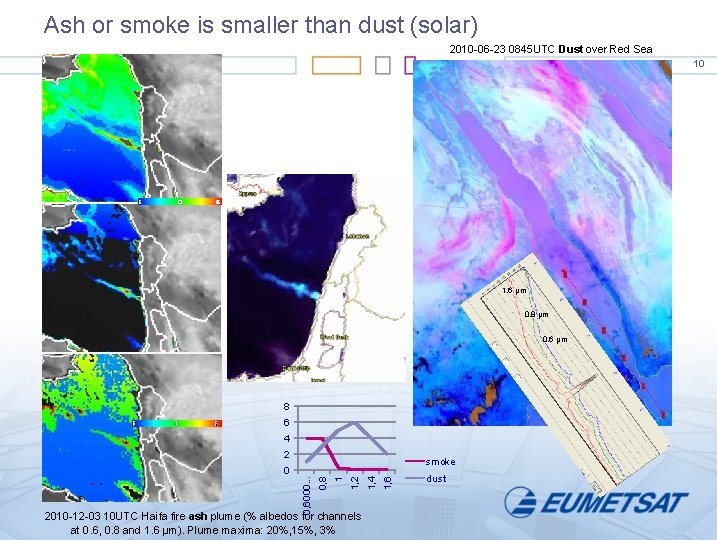
Ash or smoke is smaller than dust (solar) 2010 -06 -23 0845 UTC Dust over Red Sea 10 1. 6 µm 0. 8 µm 0. 6 µm 8 6 4 2 2010 -12 -03 10 UTC Haifa fire ash plume (% albedos for channels at 0. 6, 0. 8 and 1. 6 µm). Plume maxima: 20%, 15%, 3% 1, 6 1, 4 1, 2 1 0, 8 smoke 0, 6000. . . 0 dust
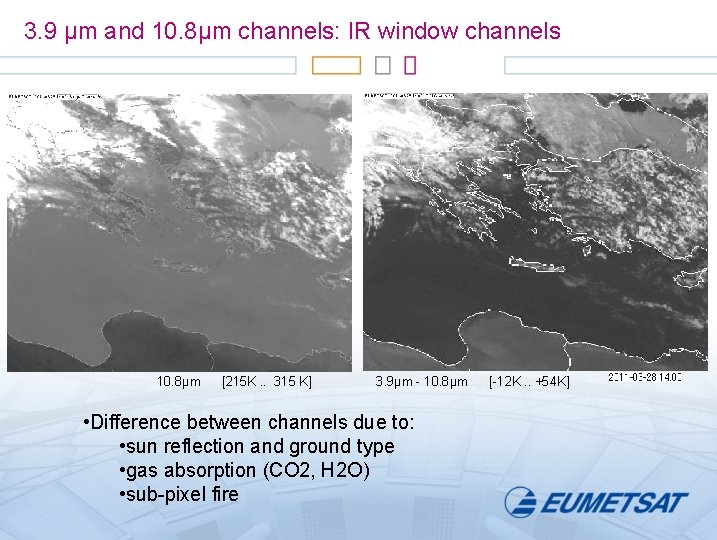
3. 9 µm and 10. 8µm channels: IR window channels 10. 8µm [215 K. . 315 K] 3. 9µm - 10. 8µm • Difference between channels due to: • sun reflection and ground type • gas absorption (CO 2, H 2 O) • sub-pixel fire [-12 K. . +54 K]
3. 9 µm and 10. 8µm: window channels v 3. 9 µm v. Negligible absorption by atmospheric humidity v. Close to a CO 2 absorption band, 4 -7 Kelvin signal reduction v. High temperature sensitivity (big sub-pixel effects) ~Temperature^11 v. Blinding effect by hot pixels, affecting some measurements west of the saturated pixel v. Digital filter artifacts, affecting sorrounding pixels even in other lines v. Sun enhancement during day, but only emission during night v 10. 8 µm v 1 -2 kelvin absorption by atmospheric humidity v. No signal reduction by CO 2, 1 -2 Kelvin due to H 2 O vapour v. Lower temperature sensitivity (small subpixel effects) ~Temperature^4 v. No sensor blinding by fires v. Low values compared with 3. 9µm due to semitransparent cloud or smoke.
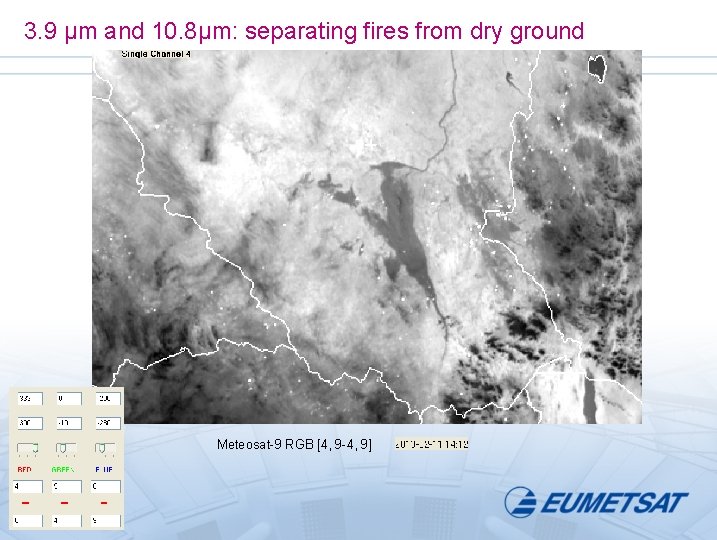
3. 9 µm and 10. 8µm: separating fires from dry ground Meteosat-9 RGB [4, 9 -4, 9]
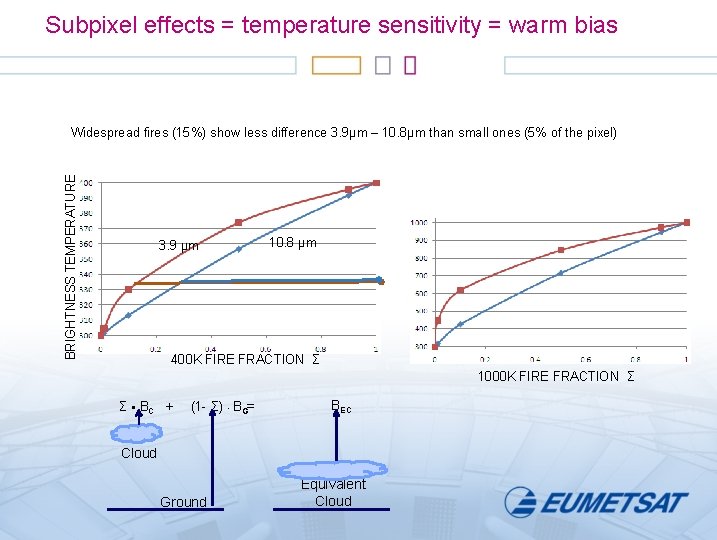
Subpixel effects = temperature sensitivity = warm bias BRIGHTNESS TEMPERATURE Widespread fires (15%) show less difference 3. 9µm – 10. 8µm than small ones (5% of the pixel) 3. 9 µm 10. 8 µm 400 K FIRE FRACTION Σ 1000 K FIRE FRACTION Σ Σ • BC + (1 - Σ) • BG= BEC Cloud Ground Equivalent Cloud
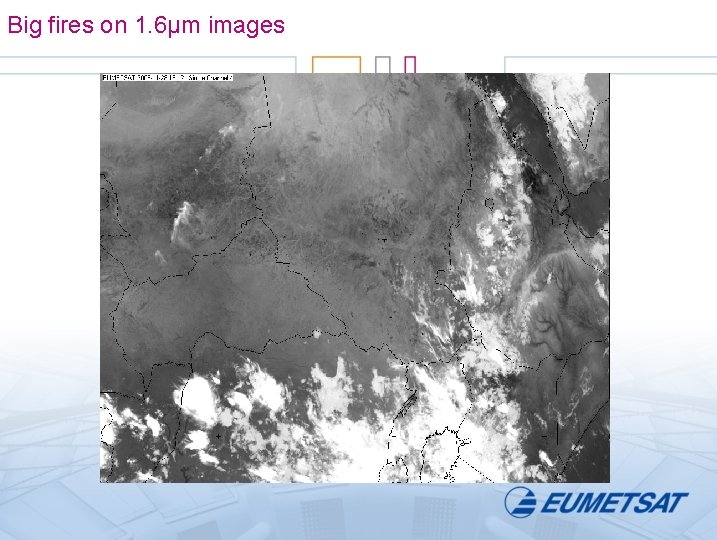
Big fires on 1. 6µm images
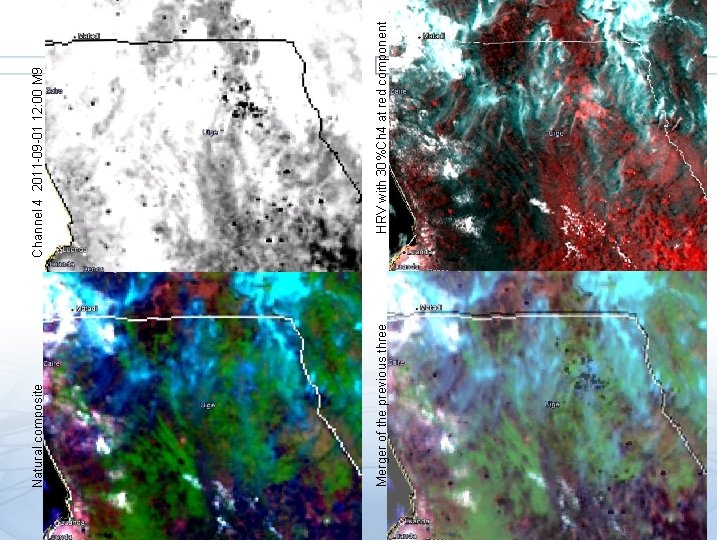
Merger of the previous three Natural composite HRV with 30%Ch 4 at red component Channel 4 2011 -09 -01 12: 00 M 9
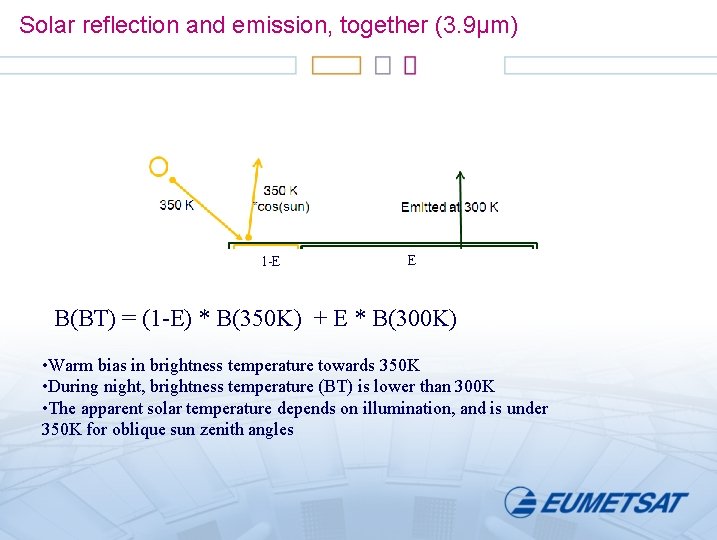
Solar reflection and emission, together (3. 9µm) 1 -E E B(BT) = (1 -E) * B(350 K) + E * B(300 K) • Warm bias in brightness temperature towards 350 K • During night, brightness temperature (BT) is lower than 300 K • The apparent solar temperature depends on illumination, and is under 350 K for oblique sun zenith angles
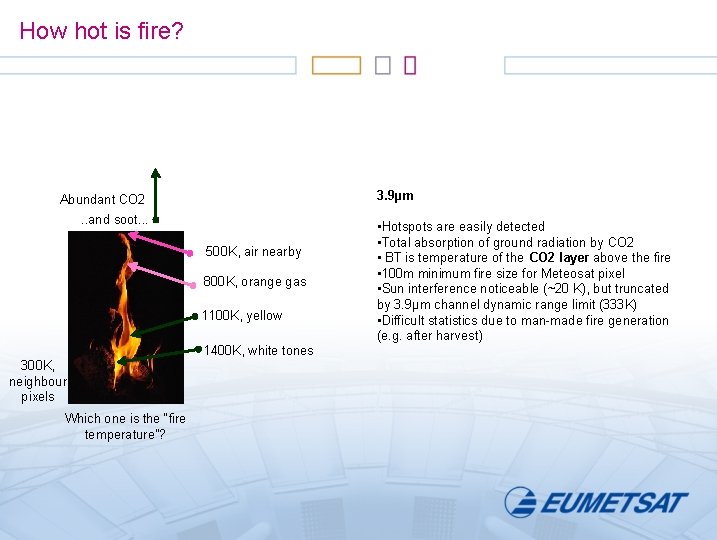
How hot is fire? 3. 9µm Abundant CO 2. . and soot. . . 500 K, air nearby 800 K, orange gas 1100 K, yellow 1400 K, white tones 300 K, neighbour pixels Which one is the “fire temperature”? • Hotspots are easily detected • Total absorption of ground radiation by CO 2 • BT is temperature of the CO 2 layer above the fire • 100 m minimum fire size for Meteosat pixel • Sun interference noticeable (~20 K), but truncated by 3. 9µm channel dynamic range limit (333 K) • Difficult statistics due to man-made fire generation (e. g. after harvest)
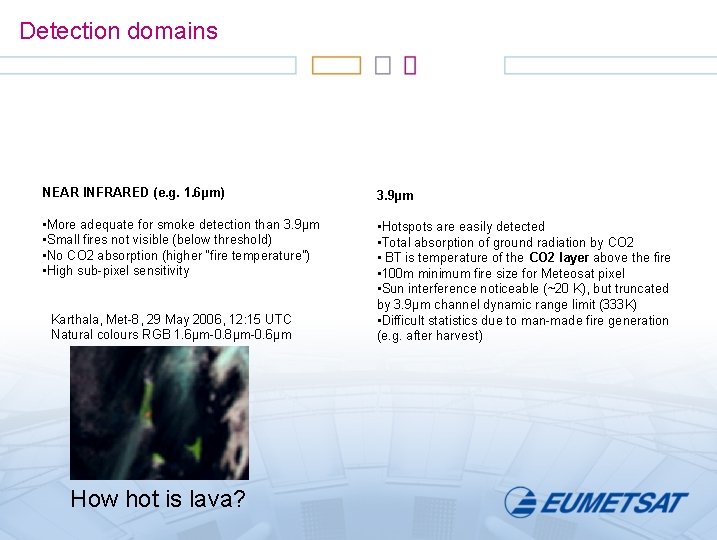
Detection domains NEAR INFRARED (e. g. 1. 6µm) 3. 9µm • More adequate for smoke detection than 3. 9µm • Small fires not visible (below threshold) • No CO 2 absorption (higher “fire temperature”) • High sub-pixel sensitivity • Hotspots are easily detected • Total absorption of ground radiation by CO 2 • BT is temperature of the CO 2 layer above the fire • 100 m minimum fire size for Meteosat pixel • Sun interference noticeable (~20 K), but truncated by 3. 9µm channel dynamic range limit (333 K) • Difficult statistics due to man-made fire generation (e. g. after harvest) Karthala, Met-8, 29 May 2006, 12: 15 UTC Natural colours RGB 1. 6µm-0. 8µm-0. 6µm How hot is lava?
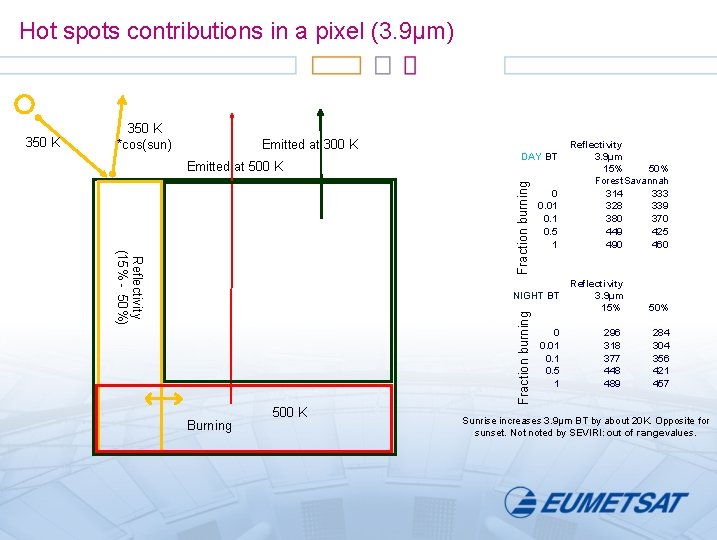
Hot spots contributions in a pixel (3. 9µm) 350 K *cos(sun) Emitted at 300 K Reflectivity (15% - 50%) Fraction burning Emitted at 500 K DAY BT 0 0. 01 0. 5 1 NIGHT BT Fraction burning 350 K Burning 500 K 0 0. 01 0. 5 1 Reflectivity 3. 9µm 15% 50% Forest Savannah 314 333 328 339 380 370 449 425 490 460 Reflectivity 3. 9µm 15% 50% 296 318 377 448 489 284 304 356 421 457 Sunrise increases 3. 9µm BT by about 20 K. Opposite for sunset. Not noted by SEVIRI: out of rangevalues.
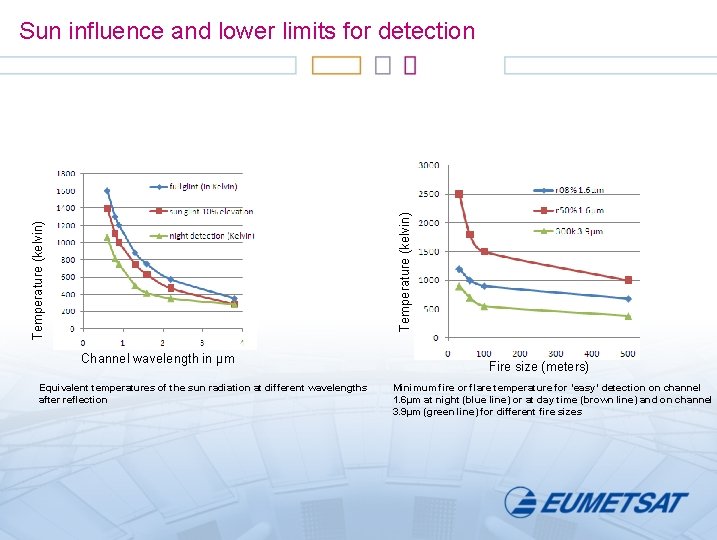
Temperature (kelvin) Sun influence and lower limits for detection Channel wavelength in µm Equivalent temperatures of the sun radiation at different wavelengths after reflection Fire size (meters) Minimum fire or flare temperature for ‘easy’ detection on channel 1. 6µm at night (blue line) or at day time (brown line) and on channel 3. 9µm (green line) for different fire sizes
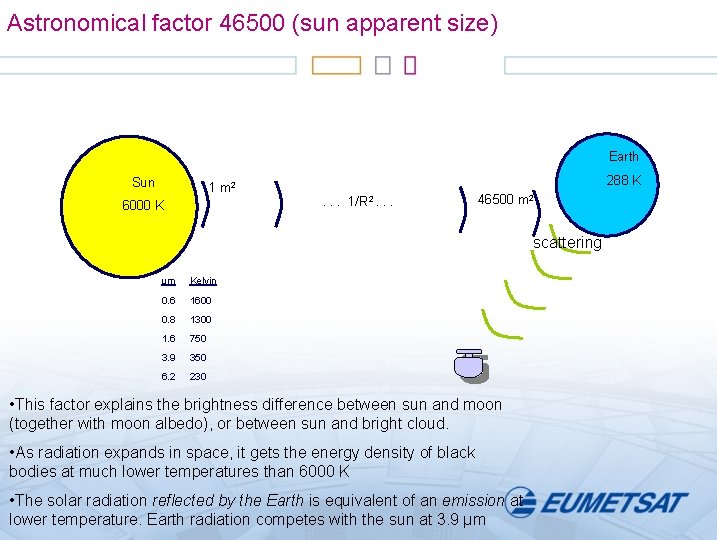
Astronomical factor 46500 (sun apparent size) Earth Sun 1 m 2 6000 K 288 K. . . 1/R 2. . . 46500 m 2 scattering µm Kelvin 0. 6 1600 0. 8 1300 1. 6 750 3. 9 350 6. 2 230 • This factor explains the brightness difference between sun and moon (together with moon albedo), or between sun and bright cloud. • As radiation expands in space, it gets the energy density of black bodies at much lower temperatures than 6000 K • The solar radiation reflected by the Earth is equivalent of an emission at lower temperature. Earth radiation competes with the sun at 3. 9 µm
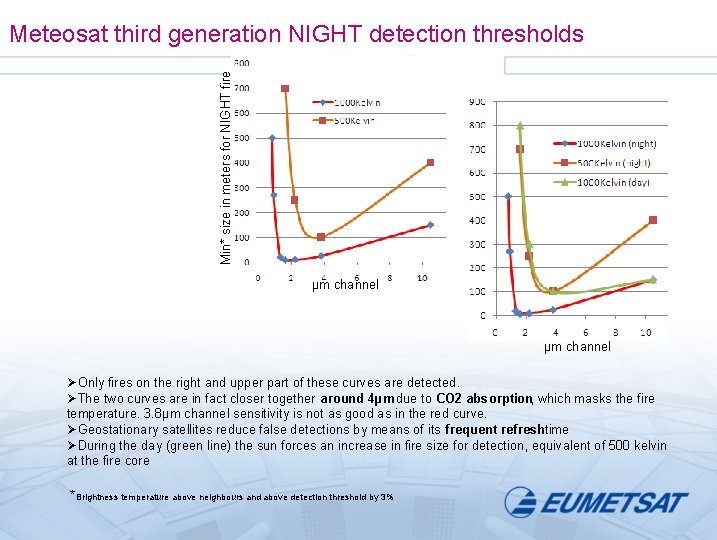
Min* size in meters for NIGHT fire Meteosat third generation NIGHT detection thresholds µm channel ØOnly fires on the right and upper part of these curves are detected. ØThe two curves are in fact closer together around 4µm due to CO 2 absorption, which masks the fire temperature. 3. 8µm channel sensitivity is not as good as in the red curve. ØGeostationary satellites reduce false detections by means of its frequent refreshtime ØDuring the day (green line) the sun forces an increase in fire size for detection, equivalent of 500 kelvin at the fire core *Brightness temperature above neighbours and above detection threshold by 3%
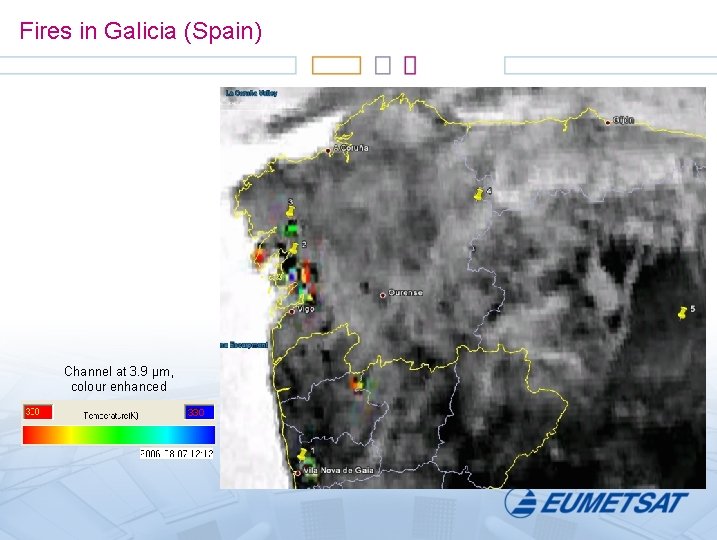
Fires in Galicia (Spain) Channel at 3. 9 µm, colour enhanced 330
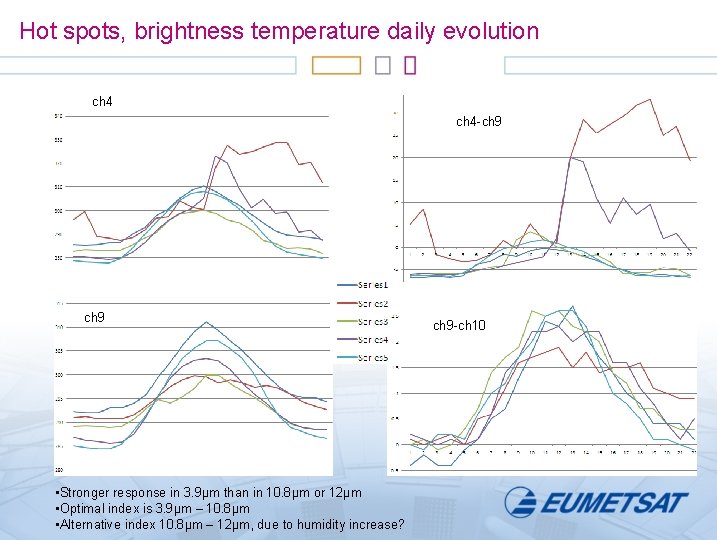
Hot spots, brightness temperature daily evolution ch 4 -ch 9 • Stronger response in 3. 9µm than in 10. 8µm or 12µm • Optimal index is 3. 9µm – 10. 8µm • Alternative index 10. 8µm – 12µm, due to humidity increase? ch 9 -ch 10
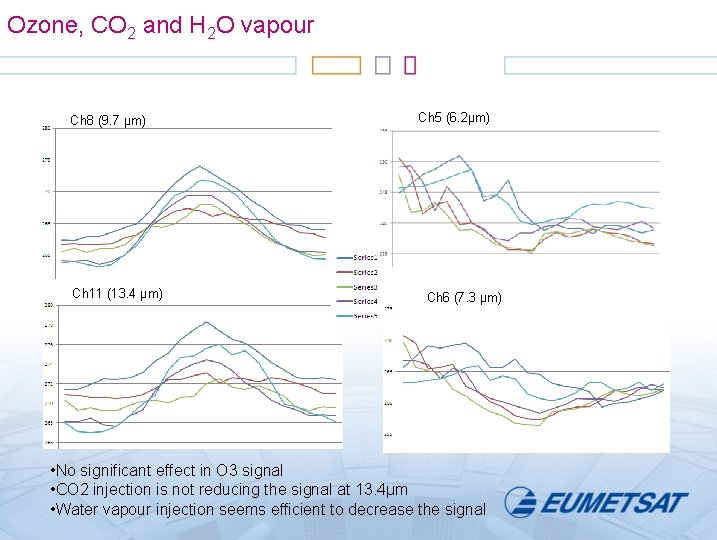
Ozone, CO 2 and H 2 O vapour Ch 8 (9. 7 µm) Ch 11 (13. 4 µm) Ch 5 (6. 2µm) Ch 6 (7. 3 µm) • No significant effect in O 3 signal • CO 2 injection is not reducing the signal at 13. 4µm • Water vapour injection seems efficient to decrease the signal
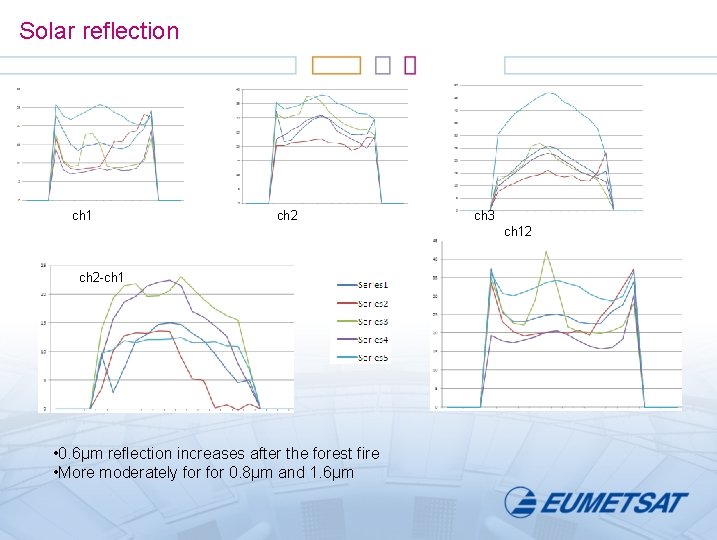
Solar reflection ch 1 ch 2 ch 3 ch 12 ch 2 -ch 1 • 0. 6µm reflection increases after the forest fire • More moderately for 0. 8µm and 1. 6µm
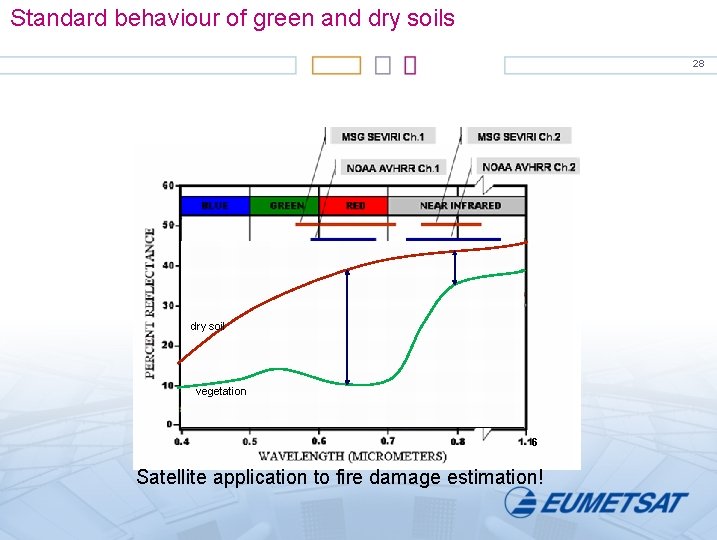
Standard behaviour of green and dry soils 28 dry soil vegetation 6 Satellite application to fire damage estimation!

Sunglint on water surfaces (cold or warm) is NOT fire Sunglint on the Congo river MSG 1 2004 March 24 09: 00 UTC Channel 3. 9 m

Implementation of the EUMETSAT Geostationary Programme 30 MOP+MTP 1977 MSG 2003 MTG 2018 1 observation mission: -MVIRI: 3 channels -Spinning satellite 1 ton 2 observation missions: - SEVIRI: 12 channels - GERB - Spinning satellite 2 ton . . . towards 60 years of operations. . . 4 observation missions: - Combined Imager: 16 channels - Infra-Red Sounder - Lightning Imager -3 -axis stabilised satellite(s) 3 ton Coordinated with atmospheric chemistry from GMES Sentinel 4
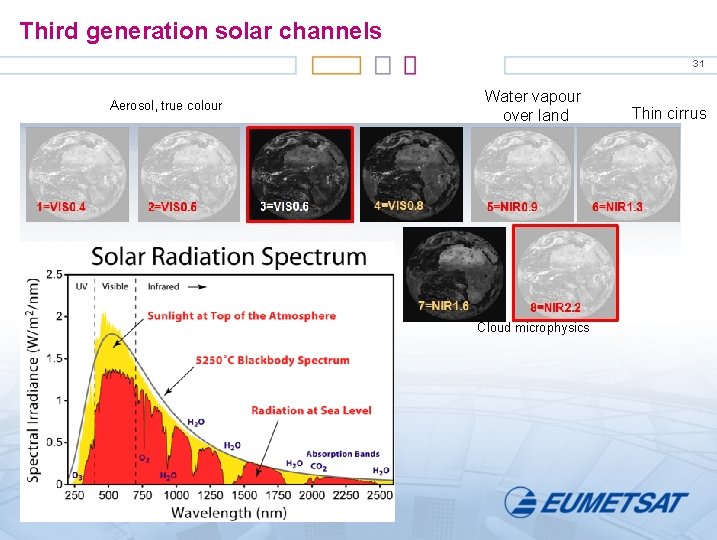
Third generation solar channels 31 Aerosol, true colour Water vapour over land Cloud microphysics Thin cirrus

Meteosat IR dynamic range top limits (kelvin) Channel (µm) 3. 8 8. 7 9. 7 10. 5 12. 3 13. 3 Absorber CO 2 Sx O 3 small H 2 O CO 2 Dynamic MSG 335 300 310 335 300 Dynamic MTG 580 330 310 340 300 Meteosat-8, 9, 10 looking concurrently at gas flares in Kuwait through channel 1. 6µm VIIRS 2013 -02 -17: 2200

Aerosol, ocean colour, flooding 33
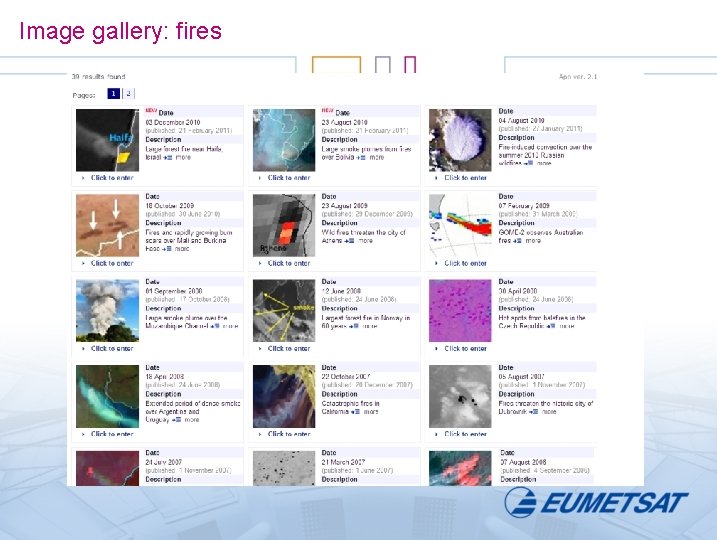
Image gallery: fires
Conclusions | Solar channels at 0. 6µm and 0. 8µm are designed to measure vegetation growth. Channel at 1. 6µm supplies an additional index of fire risk, vegetation stress or drought. | Channel 3. 9µm in Meteosat is an excellent detection tool for active fires above 100 m across (4 Ha), and for measuring the burnt area as reflectivity change (for large burnt areas) | Statistics on fires (natural or man-made) are scarce and truncated by sensor saturation. An approximate retrieval can be attempted based on frequency curves below saturation, or on polar satellites THANK YOU FOR YOUR ATTENTION!
- Slides: 35