
Meteorological Satellite Center MSC of JMA Migration Trial




- Slides: 19
Meteorological Satellite Center (MSC) of JMA Migration Trial from MODIS to VIIRS on AHI VIS/NIR RTM Simulation Approach † Yusuke YOGO Japan Meteorological Agency / Meteorological Satellite Center † yogo@met. kishou. go. jp
Meteorological Satellite Center (MSC) of JMA’s AHI VIS/NIR Cal. Approaches • RTM simulation approach vs Aqua, Terra/MODIS – Need to migrate to VIIRS -> We made a trial to replace Aqua, Terra/MODIS with S-NPP/VIIRS • “Ray-Matching” method vs S-NPP/VIIRS • Comparison between Himawari-8 and 9/AHIs (or with adjacent GEOs) • Lunar calibration • DCC method 2019 -03 -06 GSICS Annual Meeting 2019 @ ESA/ESRIN, Italy 2
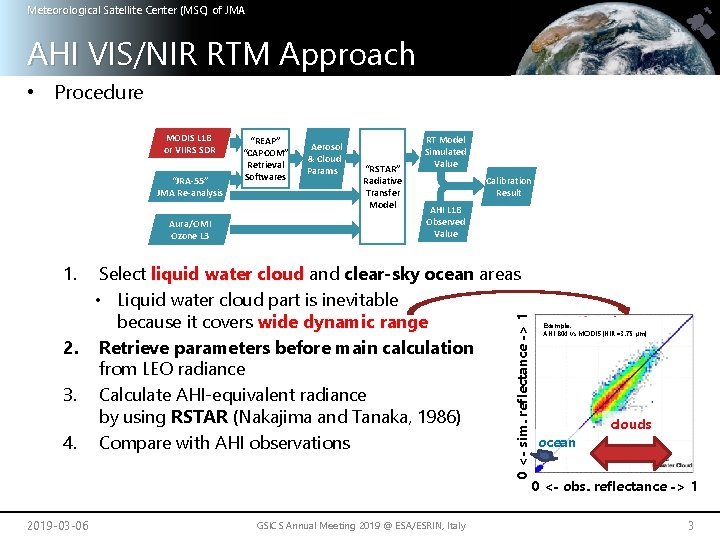
Meteorological Satellite Center (MSC) of JMA AHI VIS/NIR RTM Approach • Procedure MODIS L 1 B or VIIRS SDR “JRA-55” JMA Re-analysis Aura/OMI Ozone L 3 “REAP” “CAPCOM” Retrieval Softwares Aerosol & Cloud Params “RSTAR” Radiative Transfer Model RT Model Simulated Value Calibration Result AHI L 1 B Observed Value 1. 0 <- sim. reflectance -> 1 Select liquid water cloud and clear-sky ocean areas • Liquid water cloud part is inevitable because it covers wide dynamic range 2. Retrieve parameters before main calculation from LEO radiance 3. Calculate AHI-equivalent radiance by using RSTAR (Nakajima and Tanaka, 1986) 4. Compare with AHI observations 2019 -03 -06 GSICS Annual Meeting 2019 @ ESA/ESRIN, Italy Example: AHI B 04 vs MODIS (NIR=3. 75 μm) clouds ocean 0 <- obs. reflectance -> 1 3
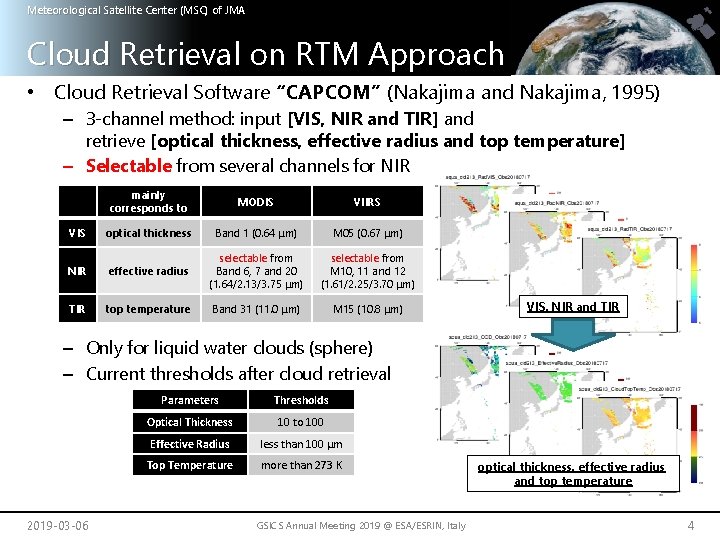
Meteorological Satellite Center (MSC) of JMA Cloud Retrieval on RTM Approach • Cloud Retrieval Software “CAPCOM” (Nakajima and Nakajima, 1995) – 3 -channel method: input [VIS, NIR and TIR] and retrieve [optical thickness, effective radius and top temperature] – Selectable from several channels for NIR mainly corresponds to MODIS VIIRS VIS optical thickness Band 1 (0. 64 μm) M 05 (0. 67 μm) NIR effective radius selectable from Band 6, 7 and 20 (1. 64/2. 13/3. 75 μm) selectable from M 10, 11 and 12 (1. 61/2. 25/3. 70 μm) TIR top temperature Band 31 (11. 0 μm) M 15 (10. 8 μm) VIS, NIR and TIR – Only for liquid water clouds (sphere) – Current thresholds after cloud retrieval 2019 -03 -06 Parameters Thresholds Optical Thickness 10 to 100 Effective Radius less than 100 μm Top Temperature more than 273 K GSICS Annual Meeting 2019 @ ESA/ESRIN, Italy optical thickness, effective radius and top temperature 4
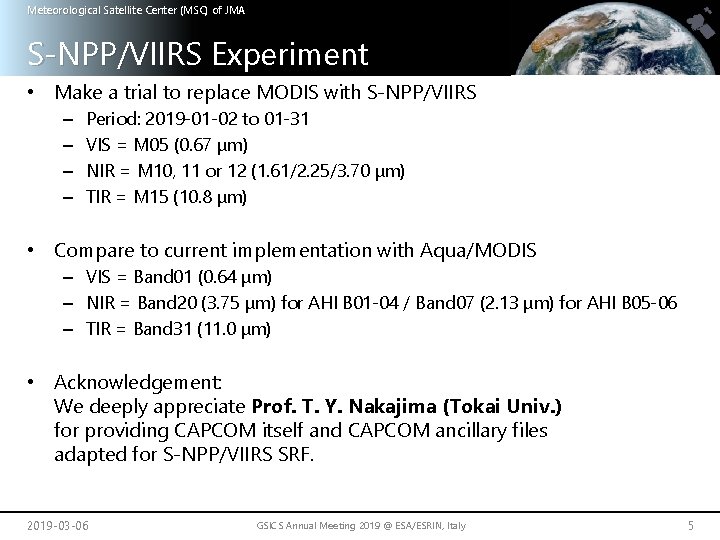
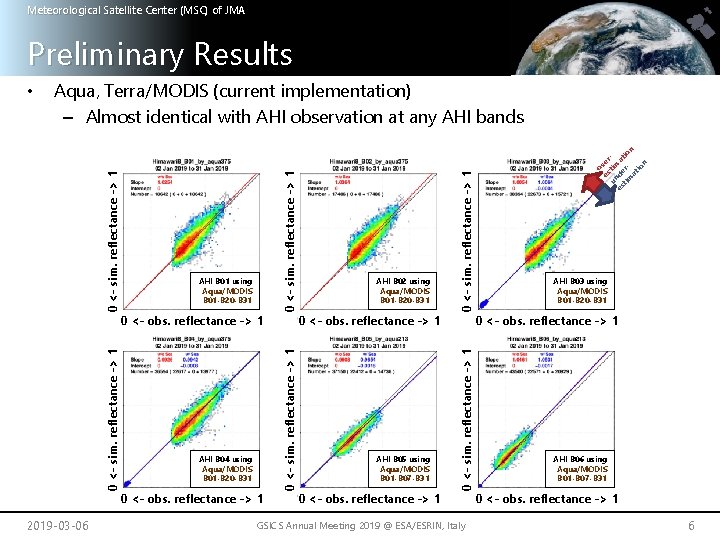
Meteorological Satellite Center (MSC) of JMA S-NPP/VIIRS Experiment • Make a trial to replace MODIS with S-NPP/VIIRS – – Period: 2019 -01 -02 to 01 -31 VIS = M 05 (0. 67 μm) NIR = M 10, 11 or 12 (1. 61/2. 25/3. 70 μm) TIR = M 15 (10. 8 μm) • Compare to current implementation with Aqua/MODIS – VIS = Band 01 (0. 64 μm) – NIR = Band 20 (3. 75 μm) for AHI B 01 -04 / Band 07 (2. 13 μm) for AHI B 05 -06 – TIR = Band 31 (11. 0 μm) • Acknowledgement: We deeply appreciate Prof. T. Y. Nakajima (Tokai Univ. ) for providing CAPCOM itself and CAPCOM ancillary files adapted for S-NPP/VIIRS SRF. 2019 -03 -06 GSICS Annual Meeting 2019 @ ESA/ESRIN, Italy 5
Meteorological Satellite Center (MSC) of JMA Preliminary Results AHI B 04 using Aqua/MODIS B 01 -B 20 -B 31 0 <- obs. reflectance -> 1 AHI B 05 using Aqua/MODIS B 01 -B 07 -B 31 0 <- obs. reflectance -> 1 GSICS Annual Meeting 2019 @ ESA/ESRIN, Italy o es ver t u im es nde at tim r- io n at io n 0 <- sim. reflectance -> 1 AHI B 02 using Aqua/MODIS B 01 -B 20 -B 31 0 <- sim. reflectance -> 1 0 <- obs. reflectance -> 1 0 <- sim. reflectance -> 1 2019 -03 -06 AHI B 01 using Aqua/MODIS B 01 -B 20 -B 31 0 <- sim. reflectance -> 1 Aqua, Terra/MODIS (current implementation) – Almost identical with AHI observation at any AHI bands 0 <- sim. reflectance -> 1 • AHI B 03 using Aqua/MODIS B 01 -B 20 -B 31 0 <- obs. reflectance -> 1 AHI B 06 using Aqua/MODIS B 01 -B 07 -B 31 0 <- obs. reflectance -> 1 6
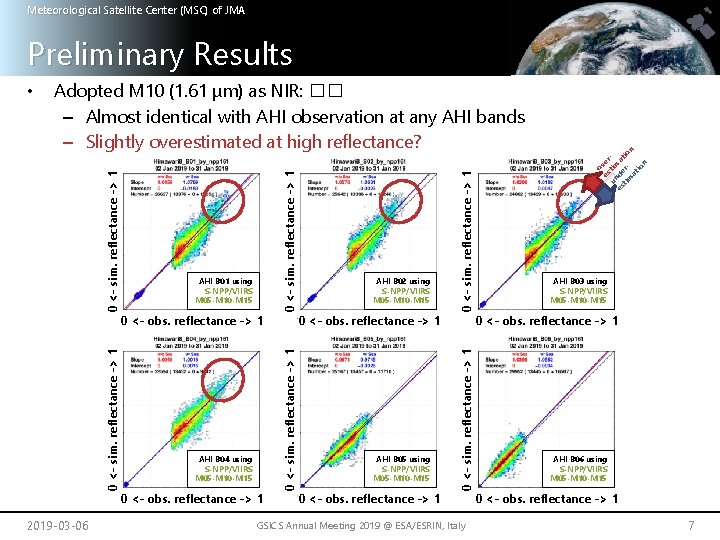
Meteorological Satellite Center (MSC) of JMA AHI B 04 using S-NPP/VIIRS M 05 -M 10 -M 15 0 <- obs. reflectance -> 1 AHI B 05 using S-NPP/VIIRS M 05 -M 10 -M 15 0 <- obs. reflectance -> 1 0 <- sim. reflectance -> 1 AHI B 02 using S-NPP/VIIRS M 05 -M 10 -M 15 0 <- sim. reflectance -> 1 0 <- obs. reflectance -> 1 0 <- sim. reflectance -> 1 2019 -03 -06 AHI B 01 using S-NPP/VIIRS M 05 -M 10 -M 15 0 <- sim. reflectance -> 1 Adopted M 10 (1. 61 μm) as NIR: �� – Almost identical with AHI observation at any AHI bands – Slightly overestimated at high reflectance? 0 <- sim. reflectance -> 1 • GSICS Annual Meeting 2019 @ ESA/ESRIN, Italy o es ver t u im es nde at tim r- io n at io n Preliminary Results AHI B 03 using S-NPP/VIIRS M 05 -M 10 -M 15 0 <- obs. reflectance -> 1 AHI B 06 using S-NPP/VIIRS M 05 -M 10 -M 15 0 <- obs. reflectance -> 1 7
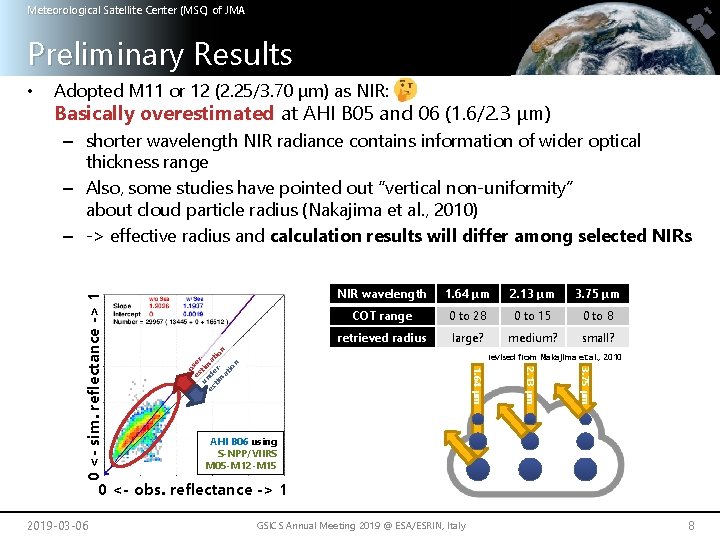
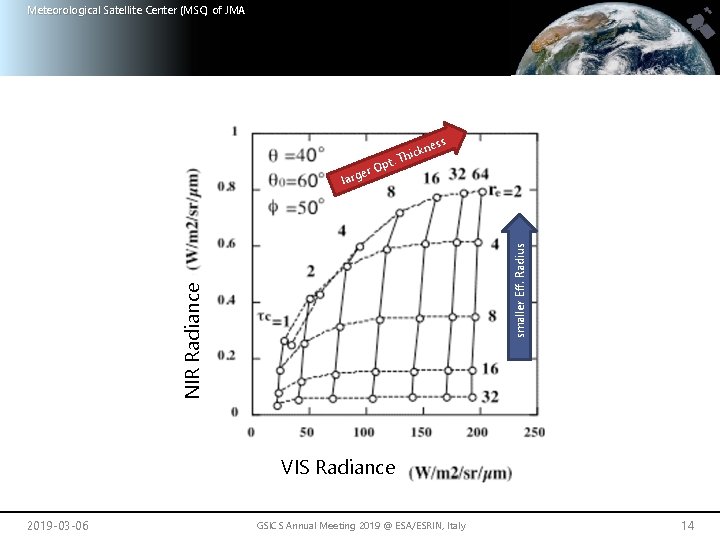
Meteorological Satellite Center (MSC) of JMA Preliminary Results • Adopted M 11 or 12 (2. 25/3. 70 μm) as NIR: Basically overestimated at AHI B 05 and 06 (1. 6/2. 3 μm) 1. 64 μm 2. 13 μm 3. 75 μm COT range 0 to 28 0 to 15 0 to 8 retrieved radius large? medium? small? o es ver t u im es nde at tim r- io n at io n NIR wavelength revised from Nakajima et al. , 2010 3. 75 μm 2. 13 μm 1. 64 μm 0 <- sim. reflectance -> 1 – shorter wavelength NIR radiance contains information of wider optical thickness range – Also, some studies have pointed out “vertical non-uniformity” about cloud particle radius (Nakajima et al. , 2010) – -> effective radius and calculation results will differ among selected NIRs AHI B 06 using S-NPP/VIIRS M 05 -M 12 -M 15 0 <- obs. reflectance -> 1 2019 -03 -06 GSICS Annual Meeting 2019 @ ESA/ESRIN, Italy 8
Meteorological Satellite Center (MSC) of JMA Preliminary Results Adopted M 11 or 12 (2. 25/3. 70 μm) as NIR: • Occasionally underestimated at all AHI VNIR bands (0. 47 -2. 3 μm) – Underestimation can be seen mainly around East/South China Sea – Turbid ocean/dust were misdetected as clouds? • But not sure why it couldn’t be seen when using S-NPP/VIIRS M 10 • Sometimes MODIS shows the same situation at same region and season o es ver t u im es nde at tim r- io n at io n 0 <- sim. reflectance -> 1 – -> We can avoid this problem by choosing region and/or adjusting thresholds underestimated (sim/obs < 0. 75) = blue turbid ocean (particularly winter) dust (yellow sand) from the continent (particularly spring) AHI B 03 using S-NPP/VIIRS M 05 -M 12 -M 15 S-NPP/VIIRS True Color, 2019 -01 -24 credit: NASA Worldview 0 <- obs. reflectance -> 1 2019 -03 -06 GSICS Annual Meeting 2019 @ ESA/ESRIN, Italy 9
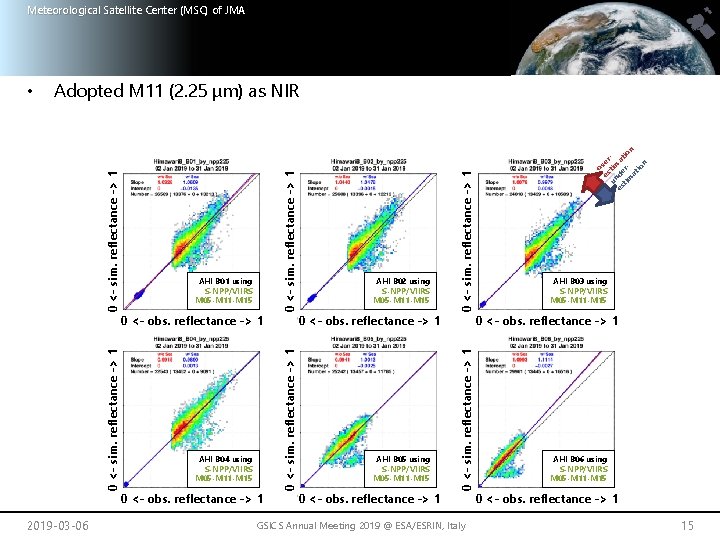
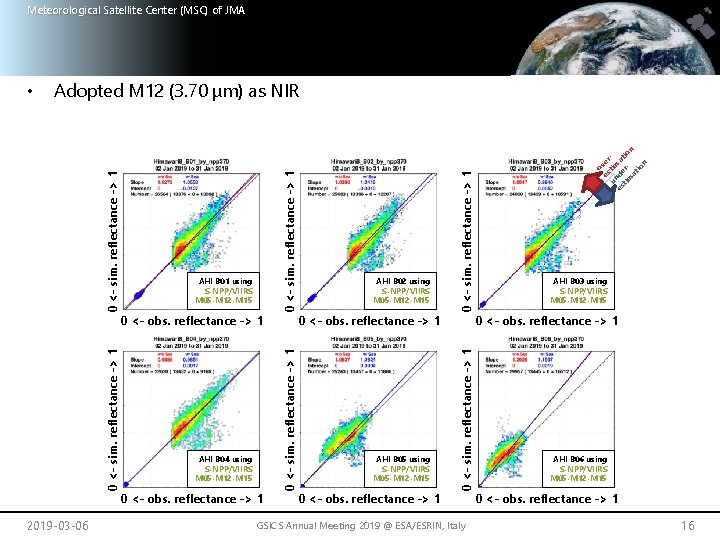
Meteorological Satellite Center (MSC) of JMA Summary • We made a trial to replace Aqua, Terra/MODIS with S-NPP/VIIRS on AHI VIS/NIR RTM simulation approach – This approach uses 3 -channel (VIS, NIR and TIR) cloud retrieval software “CAPCOM” • • Choosing S-NPP/VIIRS M 10 (1. 61 μm) as NIR worked well But M 11 and 12 (2. 25/3. 70 μm) showed over/underestimation against AHI obs – Overestimation was probably caused by optical thickness range dependency by NIR selection and “vertical non-uniformity” inside cloud – Underestimation was probably caused by wrong detection of turbid ocean/dust around East/South China Sea • • Need to select a NIR channel properly (Is shortwave NIR like 1. 61 μm the best option? Any ideas? ) Need to choose region and/or adjust thresholds to avoid wrong detection 2019 -03 -06 GSICS Annual Meeting 2019 @ ESA/ESRIN, Italy 10
Meteorological Satellite Center (MSC) of JMA End • Thanks for your attention / Grazie! 2019 -03 -06 GSICS Annual Meeting 2019 @ ESA/ESRIN, Italy 11
Meteorological Satellite Center (MSC) of JMA References • • • Nakajima, T. , and M. Tanaka, 1986: Matrix formulations for the transfer of solar radiation in a plane-parallel scattering atmosphere. J. Quant. Spectrosc. Radiat. Transf. , 35, 13– 21. Nakajima, T. Y. , and T. Nakajima, 1995: Wide-area determination of cloud microphysical properties from NOAA AVHRR measurements for FIRE and ASTEX regions. J. Atmos. Sci. , 52, 4043– 4059. Nakajima, T. Y. , K. Suzuki, and G. L. Stephens, 2010: Droplet growth in warm water clouds observed by the A-Train. Part I: Sensitivity analysis of the MODIS-derived cloud droplet sizes. J. Atmos. Sci. , 67, 1884– 1896. 2019 -03 -06 GSICS Annual Meeting 2019 @ ESA/ESRIN, Italy 12
Meteorological Satellite Center (MSC) of JMA Why we chose those MODIS bands as NIR • When we started the research (GMS-MTSAT era), we chose 3. 7 μm as NIR • We thought it is reasonable to use MODIS NIR of 1. 6 and 2. 1 μm when we compute about AHI B 05 (1. 6 μm) and B 06 (2. 3 μm), respectively • However Terra/MODIS SD cover and Aqua/MODIS 1. 6 μm band have some malfunction • Finally we chose Aqua 3. 7 μm for B 01 -04 and Aqua 2. 1 μm for B 05 -06 2019 -03 -06 GSICS Annual Meeting 2019 @ ESA/ESRIN, Italy 13
Meteorological Satellite Center (MSC) of JMA pt. r. O rge ess NIR Radiance smaller Eff. Radius la kn Thic VIS Radiance 2019 -03 -06 GSICS Annual Meeting 2019 @ ESA/ESRIN, Italy 14
Meteorological Satellite Center (MSC) of JMA AHI B 04 using S-NPP/VIIRS M 05 -M 11 -M 15 0 <- obs. reflectance -> 1 AHI B 05 using S-NPP/VIIRS M 05 -M 11 -M 15 0 <- obs. reflectance -> 1 GSICS Annual Meeting 2019 @ ESA/ESRIN, Italy o es ver t u im es nde at tim r- io n at io n 0 <- sim. reflectance -> 1 AHI B 02 using S-NPP/VIIRS M 05 -M 11 -M 15 0 <- sim. reflectance -> 1 0 <- obs. reflectance -> 1 0 <- sim. reflectance -> 1 2019 -03 -06 AHI B 01 using S-NPP/VIIRS M 05 -M 11 -M 15 0 <- sim. reflectance -> 1 Adopted M 11 (2. 25 μm) as NIR 0 <- sim. reflectance -> 1 • AHI B 03 using S-NPP/VIIRS M 05 -M 11 -M 15 0 <- obs. reflectance -> 1 AHI B 06 using S-NPP/VIIRS M 05 -M 11 -M 15 0 <- obs. reflectance -> 1 15
Meteorological Satellite Center (MSC) of JMA AHI B 04 using S-NPP/VIIRS M 05 -M 12 -M 15 0 <- obs. reflectance -> 1 AHI B 05 using S-NPP/VIIRS M 05 -M 12 -M 15 0 <- obs. reflectance -> 1 GSICS Annual Meeting 2019 @ ESA/ESRIN, Italy o es ver t u im es nde at tim r- io n at io n 0 <- sim. reflectance -> 1 AHI B 02 using S-NPP/VIIRS M 05 -M 12 -M 15 0 <- sim. reflectance -> 1 0 <- obs. reflectance -> 1 0 <- sim. reflectance -> 1 2019 -03 -06 AHI B 01 using S-NPP/VIIRS M 05 -M 12 -M 15 0 <- sim. reflectance -> 1 Adopted M 12 (3. 70 μm) as NIR 0 <- sim. reflectance -> 1 • AHI B 03 using S-NPP/VIIRS M 05 -M 12 -M 15 0 <- obs. reflectance -> 1 AHI B 06 using S-NPP/VIIRS M 05 -M 12 -M 15 0 <- obs. reflectance -> 1 16
Meteorological Satellite Center (MSC) of JMA Optical Thickness where NPP vs Aqua collocated roughly: Δlon < 0. 01 deg Δlat < 0. 01 deg Δt < 5 min 2019 -03 -06 GSICS Annual Meeting 2019 @ ESA/ESRIN, Italy 17
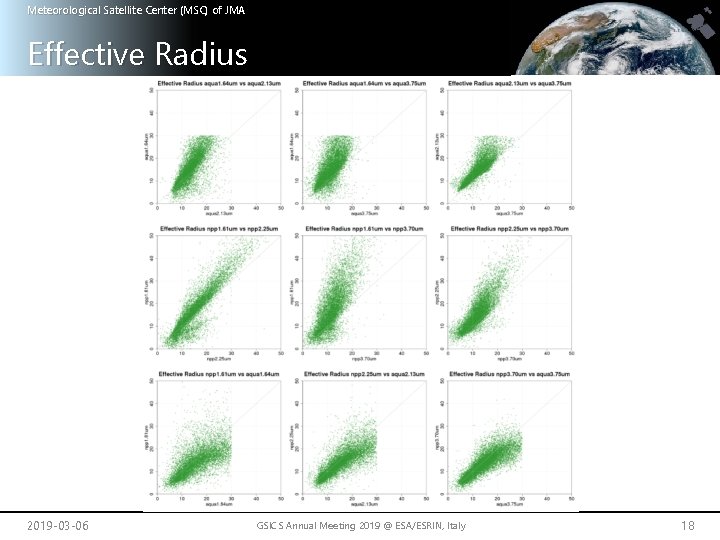
Meteorological Satellite Center (MSC) of JMA Effective Radius 2019 -03 -06 GSICS Annual Meeting 2019 @ ESA/ESRIN, Italy 18
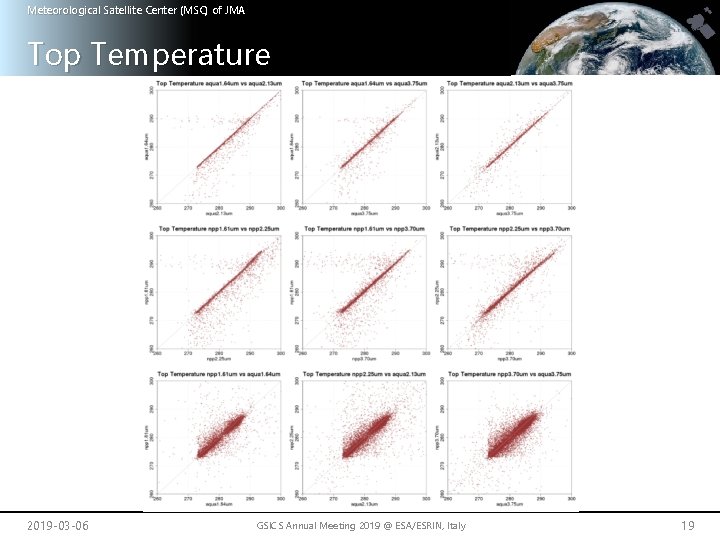
Meteorological Satellite Center (MSC) of JMA Top Temperature 2019 -03 -06 GSICS Annual Meeting 2019 @ ESA/ESRIN, Italy 19