
Meteorological Applications of Dualpolarization Radar Alexander Ryzhkov Weather
- Slides: 13
Meteorological Applications of Dual-polarization Radar Alexander Ryzhkov Weather Radar Research
Motivation 1. Single-polarization Doppler radar does not distinguish between different hydrometeor types Dual-polarization radar promises unique classification capability 2. Data quality issues with conventional radar can be overwhelming and difficult to address Polarimetry provides very efficient ways to improve data quality 3. The accuracy of rainfall measurements with standard Doppler radars is restricted estimation Polarimetric radar offers significant improvement in the accuracy of rain 4. Inadequate microphysical parametrization of existing numerical mesoscale models limits their prognostic ability The performance of numerical models can be improved via better parametrization justified by polarimetric measurements and microphysical retrievals NSSL Laboratory Review February 17 -19, 2009 2
Classification capability of polarimetric radar Polarimetric radar is efficient for 1. Discrimination between rain and hail 2. Discrimination between rain and snow of different types 3. Detection of freezing rain / icing 4. Localization of convective updrafts 4. Identification of ground clutter / anomalous propagation 5. Identification of insects and birds 6. Tornado detection (tornadic debris) 7. Detection of military chaff 8. Detection of fires NSSL Laboratory Review February 17 -19, 2009 3
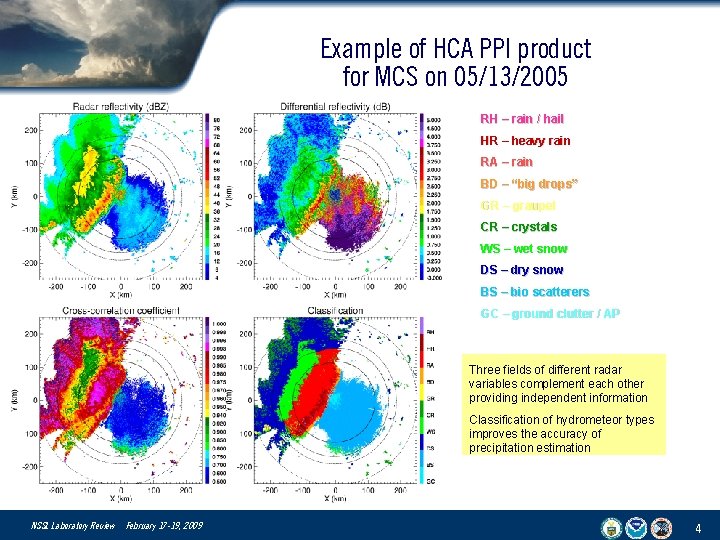
Example of HCA PPI product for MCS on 05/13/2005 RH – rain / hail HR – heavy rain RA – rain BD – “big drops” GR – graupel CR – crystals WS – wet snow DS – dry snow BS – bio scatterers GC – ground clutter / AP Three fields of different radar variables complement each other providing independent information Classification of hydrometeor types improves the accuracy of precipitation estimation NSSL Laboratory Review February 17 -19, 2009 4
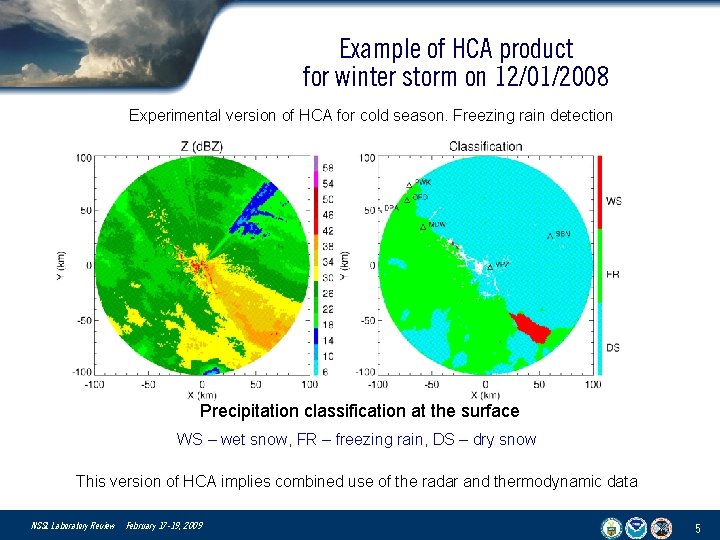
Example of HCA product for winter storm on 12/01/2008 Experimental version of HCA for cold season. Freezing rain detection Precipitation classification at the surface WS – wet snow, FR – freezing rain, DS – dry snow This version of HCA implies combined use of the radar and thermodynamic data NSSL Laboratory Review February 17 -19, 2009 5
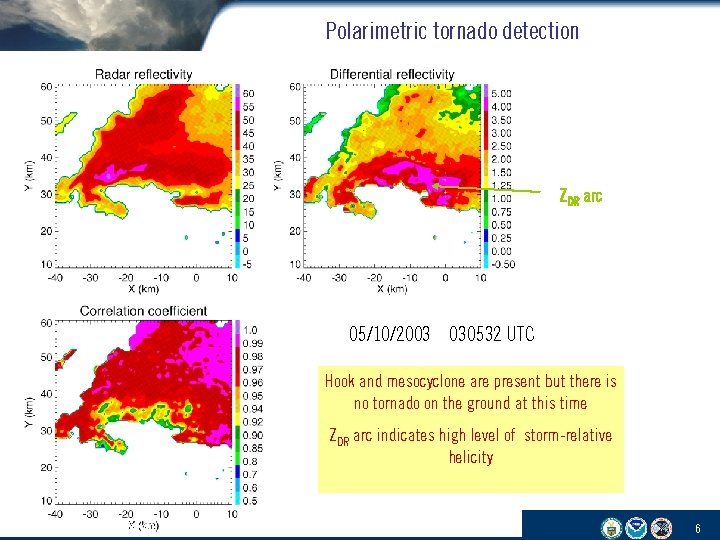
Polarimetric tornado detection ZDR arc 05/10/2003 030532 UTC Hook and mesocyclone are present but there is no tornado on the ground at this time ZDR arc indicates high level of storm-relative helicity NSSL Laboratory Review February 17 -19, 2009 6
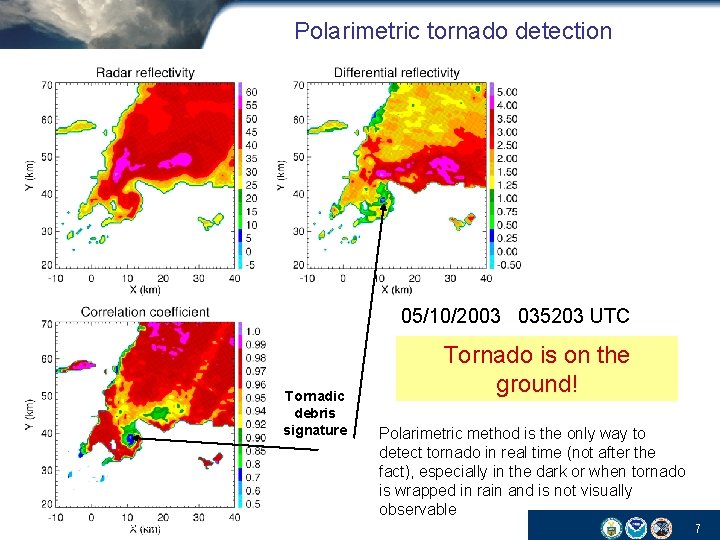
Polarimetric tornado detection 05/10/2003 035203 UTC Tornadic debris signature NSSL Laboratory Review February 17 -19, 2009 Tornado is on the ground! Polarimetric method is the only way to detect tornado in real time (not after the fact), especially in the dark or when tornado is wrapped in rain and is not visually observable 7
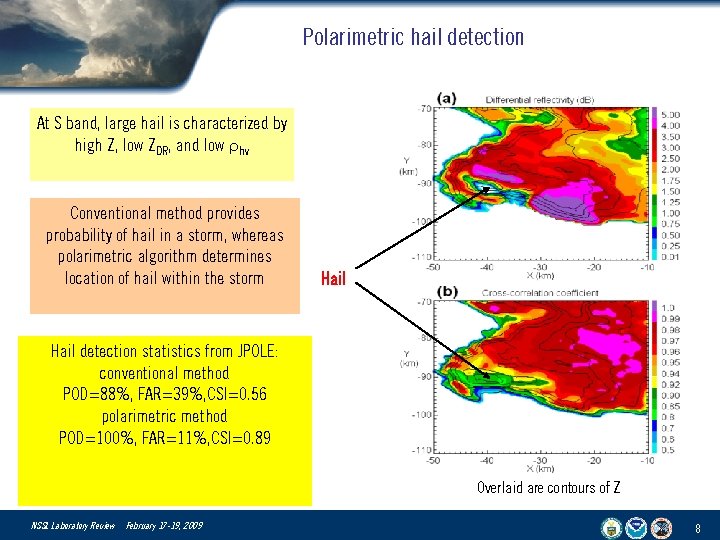
Polarimetric hail detection At S band, large hail is characterized by high Z, low ZDR, and low ρhv Conventional method provides probability of hail in a storm, whereas polarimetric algorithm determines location of hail within the storm Hail detection statistics from JPOLE: conventional method POD=88%, FAR=39%, CSI=0. 56 polarimetric method POD=100%, FAR=11%, CSI=0. 89 Overlaid are contours of Z NSSL Laboratory Review February 17 -19, 2009 8
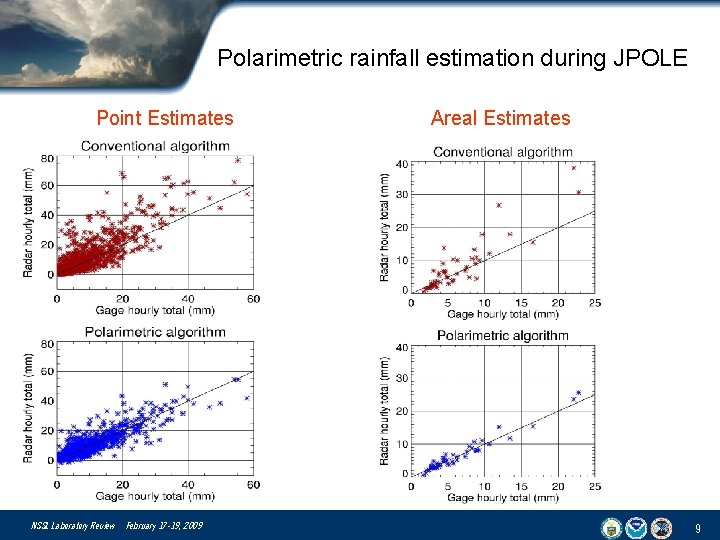
Polarimetric rainfall estimation during JPOLE Point Estimates NSSL Laboratory Review February 17 -19, 2009 Areal Estimates 9
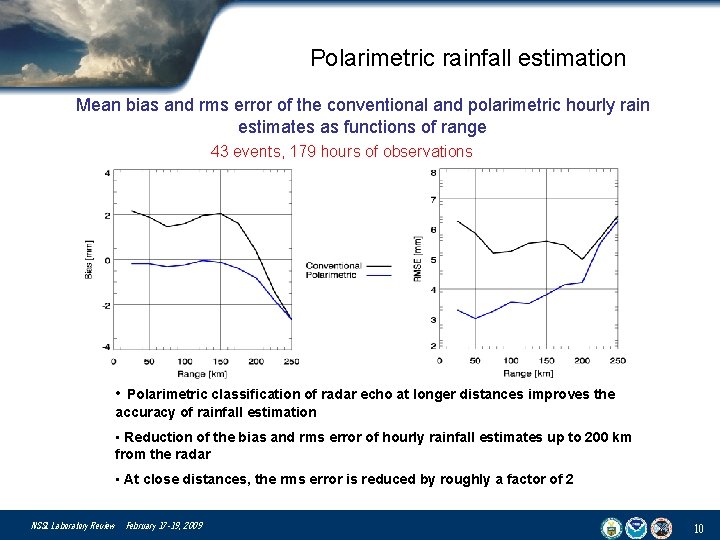
Polarimetric rainfall estimation Mean bias and rms error of the conventional and polarimetric hourly rain estimates as functions of range 43 events, 179 hours of observations • Polarimetric classification of radar echo at longer distances improves the accuracy of rainfall estimation • Reduction of the bias and rms error of hourly rainfall estimates up to 200 km from the radar • At close distances, the rms error is reduced by roughly a factor of 2 NSSL Laboratory Review February 17 -19, 2009 10
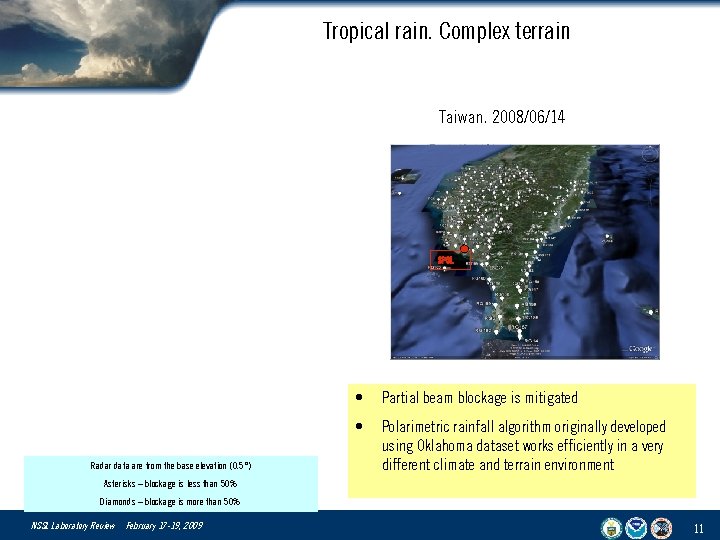
Tropical rain. Complex terrain Taiwan. 2008/06/14 SPOL Radar data are from the base elevation (0. 5°) • Partial beam blockage is mitigated • Polarimetric rainfall algorithm originally developed using Oklahoma dataset works efficiently in a very different climate and terrain environment Asterisks – blockage is less than 50% Diamonds – blockage is more than 50% NSSL Laboratory Review February 17 -19, 2009 11
Future directions • Estimation of hail size from polarimetric measurements • Hydrometeor classification for winter transitional weather (freezing rain and icing) • Polarimetric measurements of snow • Development of polarimetric methods for hydrometeor classification and rainfall estimation at shorter radar wavelengths (C and X bands) • Improvement in microphysical parametrization of numerical models using explicit microphysical modeling and polarimetric data • Assimilation of polarimetric data into numerical models NSSL Laboratory Review February 17 -19, 2009 12
Summary ü Polarimetry will revolutionize the whole area of operational applications of weather radars via - unique capability to identify the source of radar echoes - dramatic improvement in the accuracy of precipitation estimation - assimilation of polarimetric radar data into numerical weather prediction models ü NSSL is recognized as a world leader in development of polarimetric technology and methodology and their transfer to operational field NSSL Laboratory Review February 17 -19, 2009 13