
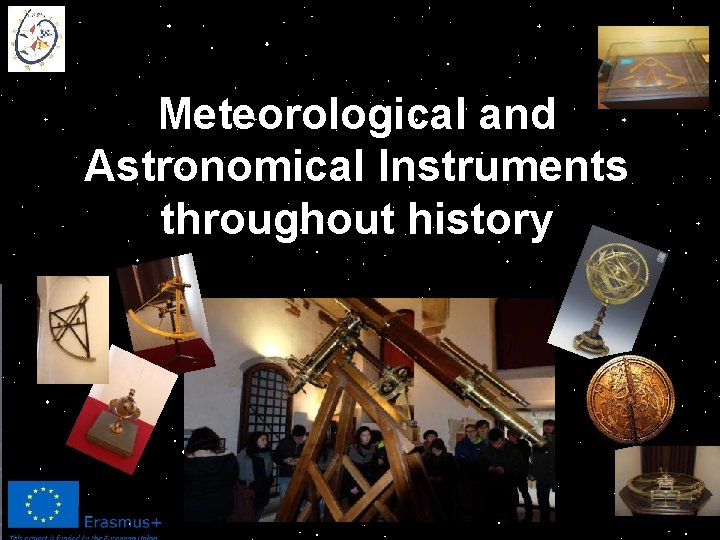
Meteorological and Astronomical Instruments throughout history ASTRONOMICAL QUADRANT

- Slides: 12
Meteorological and Astronomical Instruments throughout history
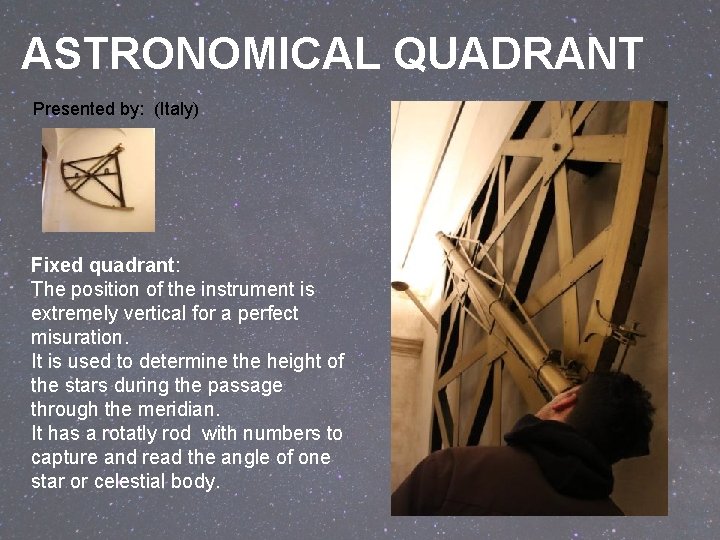
ASTRONOMICAL QUADRANT Presented by: (Italy) Fixed quadrant: The position of the instrument is extremely vertical for a perfect misuration. It is used to determine the height of the stars during the passage through the meridian. It has a rotatly rod with numbers to capture and read the angle of one star or celestial body.
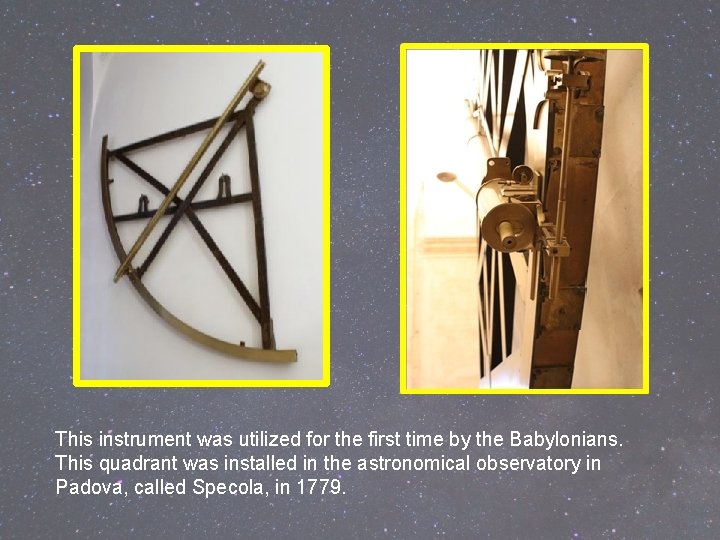
This instrument was utilized for the first time by the Babylonians. This quadrant was installed in the astronomical observatory in Padova, called Specola, in 1779.
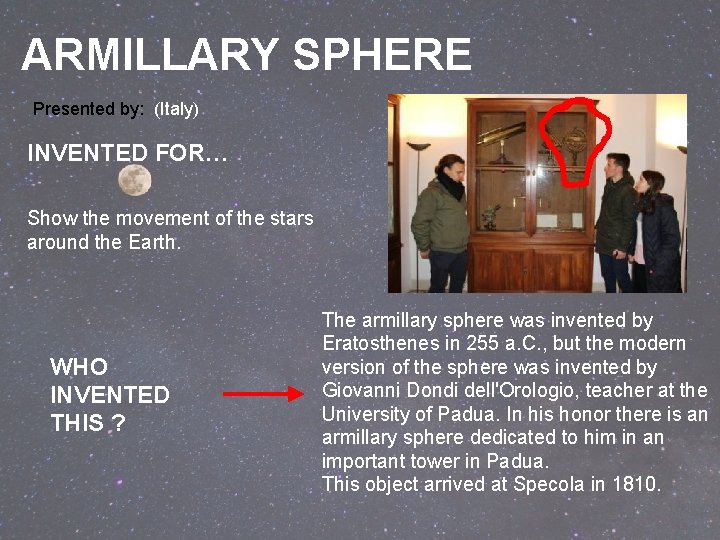
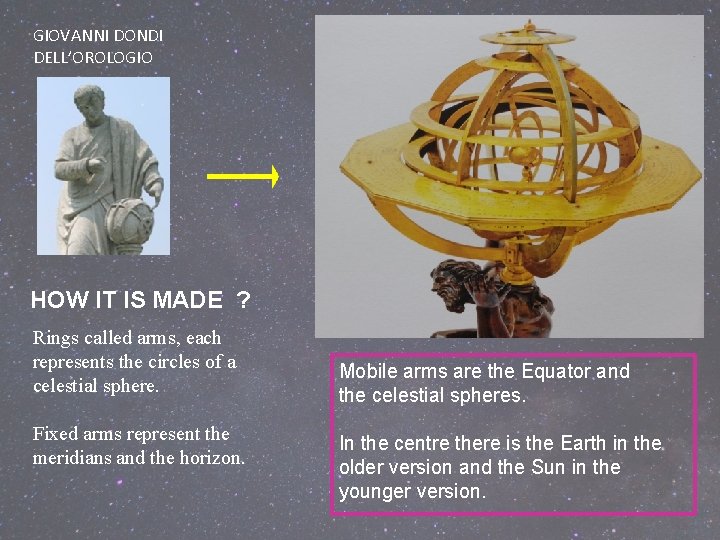
ARMILLARY SPHERE Presented by: (Italy) INVENTED FOR… Show the movement of the stars around the Earth. WHO INVENTED THIS ? The armillary sphere was invented by Eratosthenes in 255 a. C. , but the modern version of the sphere was invented by Giovanni Dondi dell'Orologio, teacher at the University of Padua. In his honor there is an armillary sphere dedicated to him in an important tower in Padua. This object arrived at Specola in 1810.
GIOVANNI DONDI DELL’OROLOGIO HOW IT IS MADE ? Rings called arms, each represents the circles of a celestial sphere. Fixed arms represent the meridians and the horizon. Mobile arms are the Equator and the celestial spheres. In the centre there is the Earth in the older version and the Sun in the younger version.
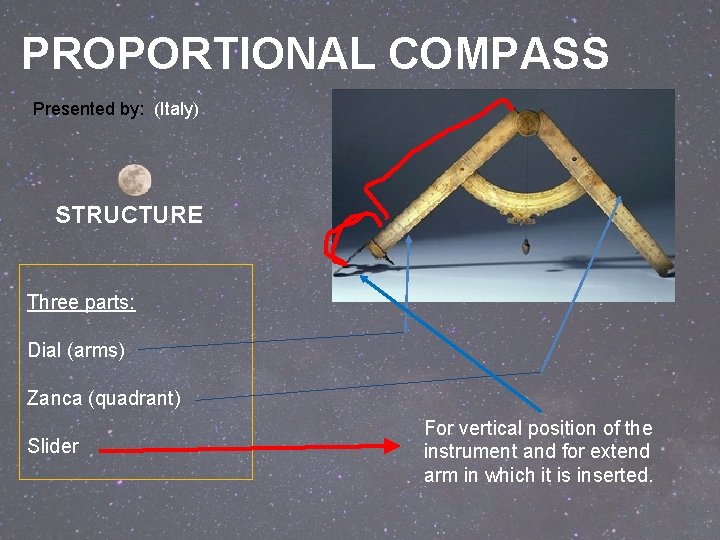
PROPORTIONAL COMPASS Presented by: (Italy) STRUCTURE Three parts: Dial (arms) Zanca (quadrant) Slider For vertical position of the instrument and for extend arm in which it is inserted.
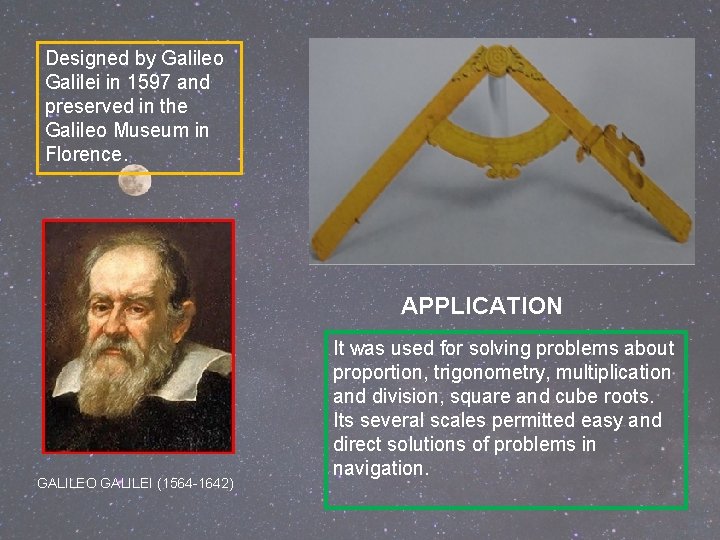
Designed by Galileo Galilei in 1597 and preserved in the Galileo Museum in Florence. APPLICATION GALILEO GALILEI (1564 -1642) It was used for solving problems about proportion, trigonometry, multiplication and division, square and cube roots. Its several scales permitted easy and direct solutions of problems in navigation.
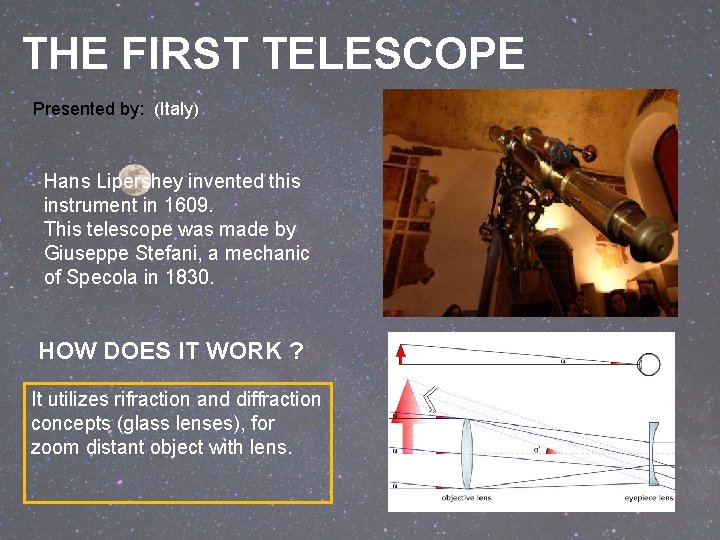
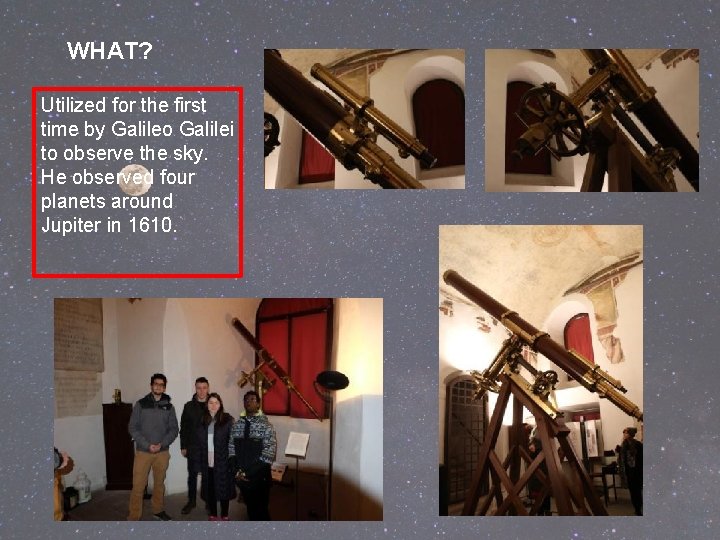
THE FIRST TELESCOPE Presented by: (Italy) Hans Lipershey invented this instrument in 1609. This telescope was made by Giuseppe Stefani, a mechanic of Specola in 1830. HOW DOES IT WORK ? It utilizes rifraction and diffraction concepts (glass lenses), for zoom distant object with lens.
WHAT? Utilized for the first time by Galileo Galilei to observe the sky. He observed four planets around Jupiter in 1610.
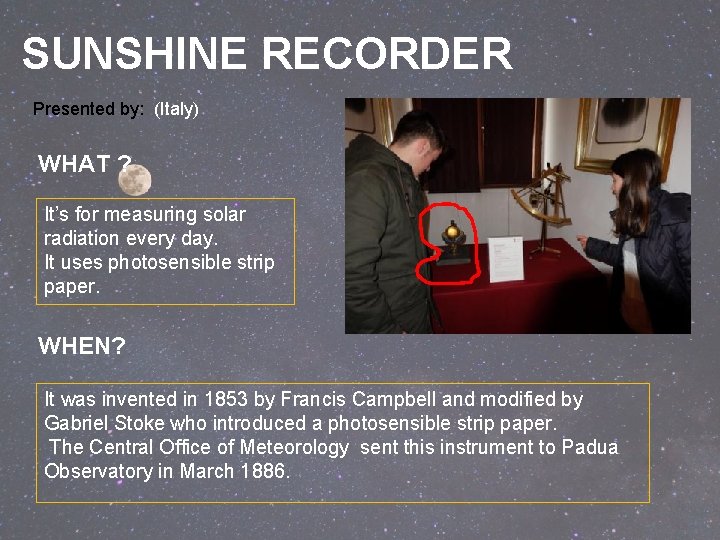
SUNSHINE RECORDER Presented by: (Italy) WHAT ? It’s for measuring solar radiation every day. It uses photosensible strip paper. WHEN? It was invented in 1853 by Francis Campbell and modified by Gabriel Stoke who introduced a photosensible strip paper. The Central Office of Meteorology sent this instrument to Padua Observatory in March 1886.
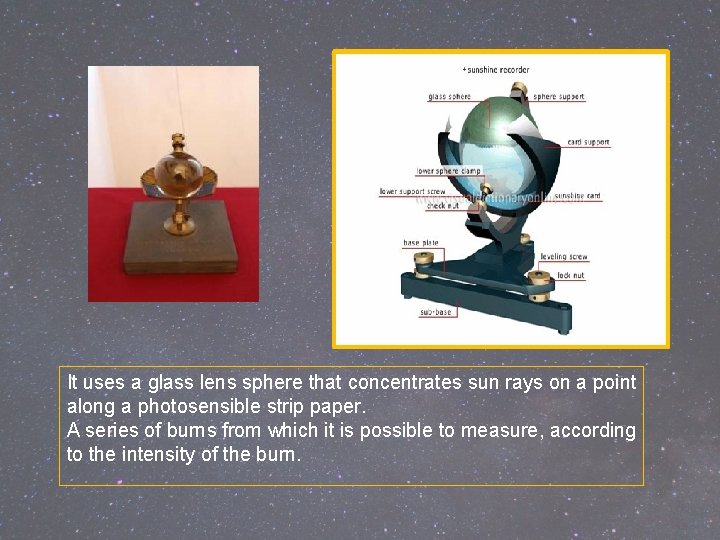
It uses a glass lens sphere that concentrates sun rays on a point along a photosensible strip paper. A series of burns from which it is possible to measure, according to the intensity of the burn.