
Metaphysics Part Three Minds Freedom Causation Thomas hobbes
Metaphysics Part Three Minds, Freedom & Causation
Thomas hobbes (1588 -1679) background Background Personal Information Influence: Galileo’s Works Influence: Euclidean Geometry Influence: English Civil War The Leviathan (1651) Physics & Philosophy Goal & Method Empiricism Metaphysical Materialism God Ontology
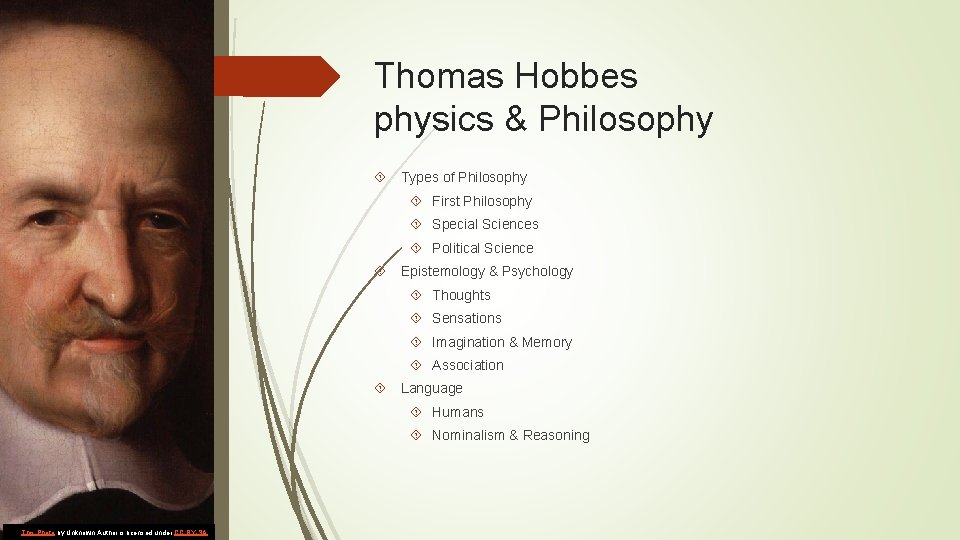
Thomas Hobbes physics & Philosophy Types of Philosophy First Philosophy Special Sciences Political Science Epistemology & Psychology Thoughts Sensations Imagination & Memory Association Language Humans Nominalism & Reasoning This Photo by Unknown Author is licensed under CC BY-SA
Thomas hobbes Metaphysics Determinism Human Behavior Voluntary Motions Hobbes account of Deliberation Ethics Morality & Materialism

Rene Descartes Cartesian dualism Dualism Substance Two Substances: Mental & Physical Meditations: Doubt Meditations: Different Humans & Animals Dualism The Cartesian Compromise Reconciliation The Dualist Solution: The Body The Dualist Solution: The Mind This Photo by Unknown Author is licensed under CC BY-SA
Rene Descartes Cartesian dualism Interactionism Mind-Body Problem Ship & Pilot Analogy The Pineal Gland
The Automatism of Animals Descartes Error & Motion Error Two Different Principles of Movements Appearance of Thought Proof Argument for Animals Thinking Criticism of the Argument
The Automatism of Animals Bodies & Motion Argument Automata Argument Language Argument Life
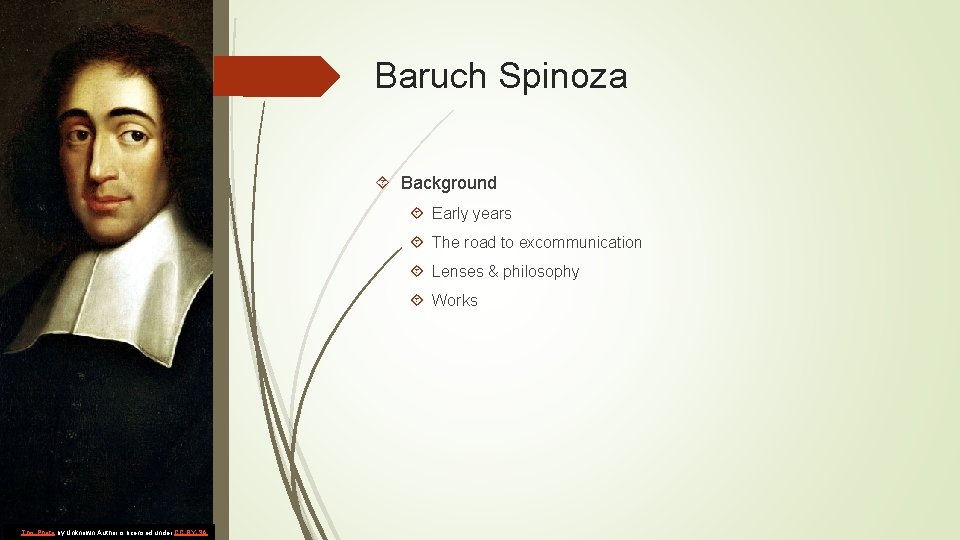
Baruch Spinoza Background Early years The road to excommunication Lenses & philosophy Works This Photo by Unknown Author is licensed under CC BY-SA
Spinoza: Goals & Methods Goal: Freedom Ethics Method Ethics Foundation Assumptions
Spinoza: Epistemology Truth Necessity Appearance of contingency Ideas Opinion/Imagination Reason Intuition
Spinoza: Metaphysics Substance Defining substance Infinity Defining God Ontological Argument for God’s existence God Argument for one substance Pantheism Is God a Person
Spinoza: Metaphysics Atheist or Mystic Labels False Dilemma Freedom & necessity Apparent contradiction Creation & Necessity Two types of events Free Will
Spinoza: Metaphysics Mind-Body problem God’s attributes Mind-Body
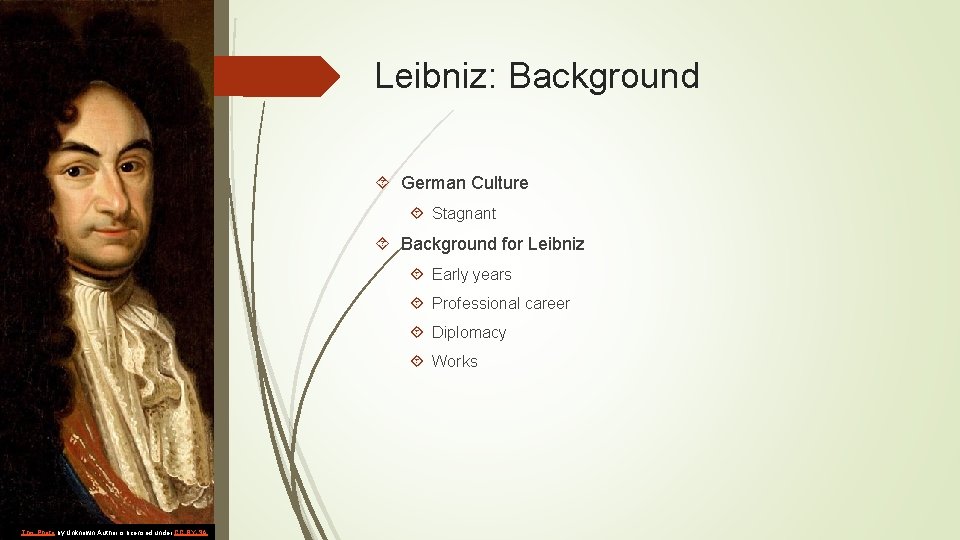
Leibniz: Background German Culture Stagnant Background for Leibniz Early years Professional career Diplomacy Works This Photo by Unknown Author is licensed under CC BY-SA
Leibniz: Goal & Method Goal Unified Logical Method Logic Method Application of the method Assumptions
Leibniz: Metaphysics Metaphysical Points Problems & Solutions Introduction Problems with Cartesian matter Problems with Spinoza Rejection of materialism Phenomenology Metaphysical Points
Leibniz: Metaphysics Monads Nature of Monads Introduction Minds Perception Continuity The identity of indiscernibles
Leibniz: Metaphysics Monads Windowless Pre-Established harmony Inner World One World Space & Time Extended Things Space & Time
Leibniz: Metaphysics Monads Mind-Body Problem Bodies Interaction Teleology & Mechanism Reconciliation Two Realms Freedom & Determinism Freedom Compatibilism
Leibniz: Metaphysics Monads The City of God Souls Why did God create the world? Harmony, reward & punishment Machinery of Justice
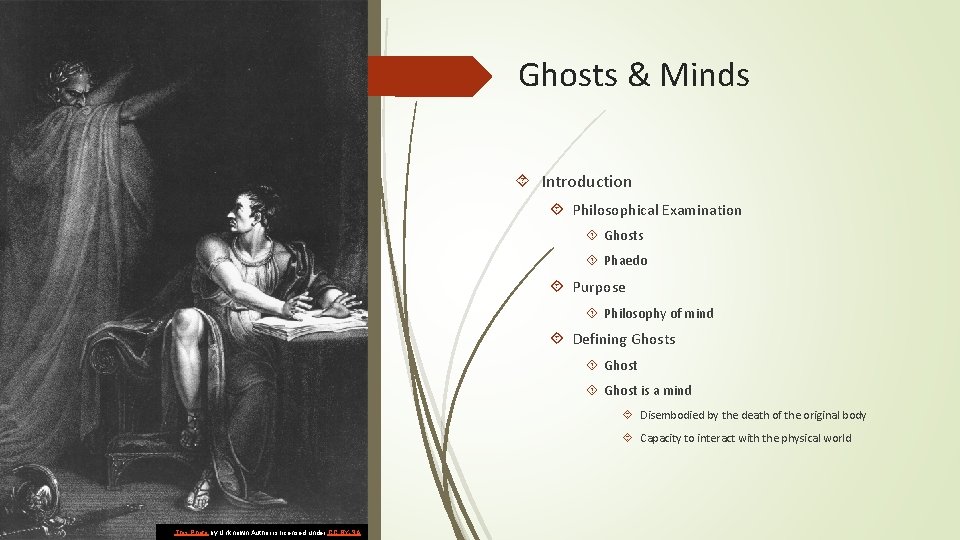
Ghosts & Minds Introduction Philosophical Examination Ghosts Phaedo Purpose Philosophy of mind Defining Ghosts Ghost is a mind Disembodied by the death of the original body Capacity to interact with the physical world This Photo by Unknown Author is licensed under CC BY-SA
Ghosts & Minds Interaction Not assumed that a ghost must be immaterial Theories of Mind Identity Theory Materialist theory Each mental state is identical to a state of the CNS Mind is equivalent to the CNS and its states. There are ghosts.
Ghosts & Minds Substance Dualism Reality contains at least two types of entities Material Immaterial Mind is immaterial Ghosts are a possibility Interaction after death
Ghosts & Minds Property Dualism The mind & body are not distinct substances. The mind is composed of mental properties. Example The mind and body are distinct, but not different substances.
Ghosts & Minds Property Dualism: Epiphenomenalism One way relation between mental and physical properties. Mental properties are caused by physical properties. The mind is causally inert. Mental properties are causally dependent on physical properties. There are no ghosts.
Ghosts & Minds Property Dualism: Interactionism Mental properties of the mind interact with the physical properties. Mental properties can bring about changes. Mental properties could survive bodily death. Mental properties might exist as a bundle. Mental properties might require a substance. New body Interaction with the physical world.
Ghosts & Minds Functionalism Functional terms Functional definition of a mental state Materialist view of the mind Differences between identity theory & functionalism Ghosts are possible Functions of the mind Interaction with physical world New physical system
Ghosts & Minds Conclusion Dualism, property dualism and functionalism allow for ghosts. Identity theory permits no ghosts.
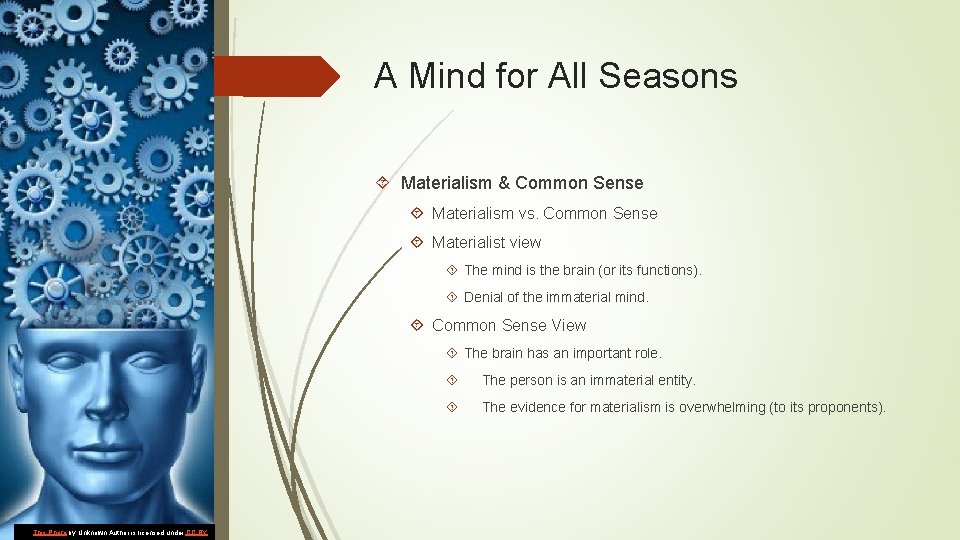
A Mind for All Seasons Materialism & Common Sense Materialism vs. Common Sense Materialist view The mind is the brain (or its functions). Denial of the immaterial mind. Common Sense View The brain has an important role. This Photo by Unknown Author is licensed under CC BY The person is an immaterial entity. The evidence for materialism is overwhelming (to its proponents).
A Mind for All Seasons Arguments for and against Materialism Errors of common sense Argument by example—examples of how the errors of common sense are exposed and corrected by science. Example: Germ theory of disease vs. witches and demons. Example: Heliocentric vs geocentric view. Common sense is unreliable. It is mistaken about the mind. So, materialism is correct.
A Mind for All Seasons Arguments for and against Materialism Reply: Common sense is generally reliable. If most people were wrong most of the time, there would be more trouble. Examples: wood burns, ice cools, sharp things can kill, food and drink are needed for life. Science has had its share of serious failures and errors. Thus, this method is hardly conclusive.
A Mind for All Seasons Arguments for and against Materialism Paul Bloom’s Kantian Argument Psychologist Bloom contends the mind-body distinction is an inherent part of thought. Kant: although we have no evidence for a metaphysical self, we cannot help but believe in it. Materialist: until science sets us straight. We believe in the immaterial mind because of the nature of the (material) mind. Thus, the belief is accounted for without the existence of immaterial minds. Reply: Errors If one intrinsic part of thought is in error, then there are probably other defects. This provides good grounds for being skeptical about human reason-including science. Thus, given this defect it is prudent to be skeptical of materialism.
A Mind for All Seasons Arguments for and against Materialism The Moral Argument Against Materialism is alleged to be a threat to morality. It was feared the heliocentric view and its materialism would have dire consequences. The worry was groundless. So, there is no to worry a materialistic view of the mind is a threat to morality. Reply The materialist view of the outer world has had serious moral consequences. As the material view of the world developed, so did the tendency to regard it as a mere commodity. The same would also be true of the inner world: The more people regard others as material mechanisms, the more likely they will regard them as things to be used and exploited. The last thing we need is another reason to treat people worse than we already do.
First God, then the Mind Eliminating the Designer Thesis If we do not need to postulate an intelligent designer to explain the universe, we do not need to postulate intelligent beings to explain human behavior. Argument from Design The e existence of an intelligent designer can be inferred from the apparent design of the world. The fine-tuned argument. Given the amazing complexity of the earth and life it, untold numbers of factors would have to be just right. Given the odds, it is reasonable to infer an intelligent designer. This Photo by Unknown Author is licensed under CC BY-NC-ND
First God, then the Mind Eliminating the Designer Argument from Design The existence of an intelligent designer can be inferred from the apparent design of the world. The fine-tuned argument. Given the amazing complexity of the earth and life it, untold numbers of factors would have to be just right. Given the odds, it is reasonable to infer an intelligent designer. Refutation of Design-Big Universe The standard response based on the size of the universe and probability. Even if the odds a specific planet will be ‘just right’ are slim, the odds of a planet that is ‘just right’ increases as the number of planets increases. Given the size of the universe it is reasonable to accept life emerged by unguided chance. . Apply Occam’s razor and accept the chance hypothesis over the existence of an intelligent designer.
First God, then the Mind Eliminating the Designer Counter: Fine Tuned Universe The entire universe. The universe seems fine-tuned for our existence. Given the universe is ‘just right’ and the odds of this occurring without guidance, accept an intelligent designer. Counter-Counter: Many Universes Even if the odds a specific universe would be ‘just right’ are small, the odds that there is a universe that is ‘just right’ will increase in proportion to the number of universes. Many physicists and cosmologists claim that a multitude of universes exists. The razor is a metaphysical injunction against multiplying the kinds of entities. Having multiple universes involves only one kind of entity. Having one universe and an intelligent designer involves two kinds of entities. Hence, the multiple universe hypothesis has the advantage over the intelligent design hypothesis.
First God, then the Mind Eliminating the Mind Design Argument for Intelligence Humans are intelligent beings. Reasoning. Some behavior exhibited by human beings seems to indicate the presence of intelligence. It would be unreasonable to attribute such behavior to unguided chance. This reasoning matches the argument from design. Thus, it can be countered in the same way. Argument Against Intelligence Even if the odds that creatures on a planet will behave in ways that seem intelligent are incredibly slim, the odds of there being such a planet will increase as the number of planets increases. Given the size of the universe and Occam’s razor, infer that all apparently intelligent behavior on earth is the result of unguided chance.
First God, then the Mind Eliminating the Mind Counter-More Beings The existence of intelligence could be supported by finding other apparently intelligent beings. Even if the entire universe were teaming with seemingly intelligent life, it shouldn’t be inferred there are intelligent beings. Postulate the existence of many universes to counter that hypothesis. Even if the odds a specific universe is inhabited by creatures that appear to behave intelligently are small, the odds that there is such a universe increase in proportion to the number of universes. Given Occam’s razor and a choice between a multitude of universes or accepting one universe containing intelligent beings, the multitude of universes is the one that must be chosen.
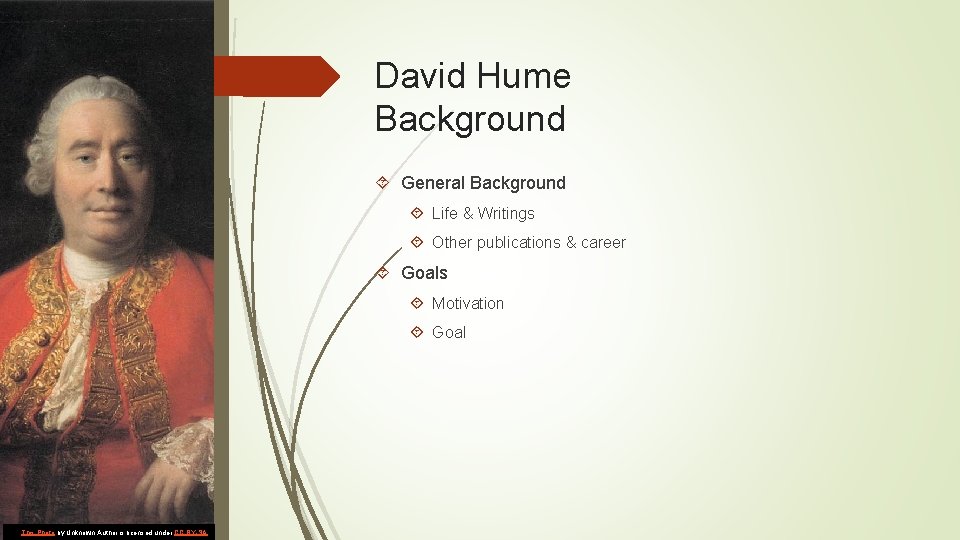
David Hume Background General Background Life & Writings Other publications & career Goals Motivation Goal This Photo by Unknown Author is licensed under CC BY-SA
David Hume Epistemology &Metaphysics: Theory of Causation Goal External Objects No idea of necessary connection Internal Impressions Introduction Mind-Body problem Voluntary control The process is unknown The power is unknown
David Hume Epistemology &Metaphysics: Theory of Causation Unintelligibility Causes Extraordinary Phenomena Philosophers No Necessary Connection Position Single Instances Mind & Body No Connection Conclusion
David Hume Epistemology &Metaphysics: Theory of Causation Experience & the Origin of the Idea Experience & Foretelling Origin of Idea Billiard ball example Cause & effect First definition of “cause” Second definition of “cause” Problems with the definitions Example of the problems: vibrations
David Hume Epistemology &Metaphysics: Theory of Causation Customs & Conclusion Custom Distant times & places Infinite Regress Conclusion
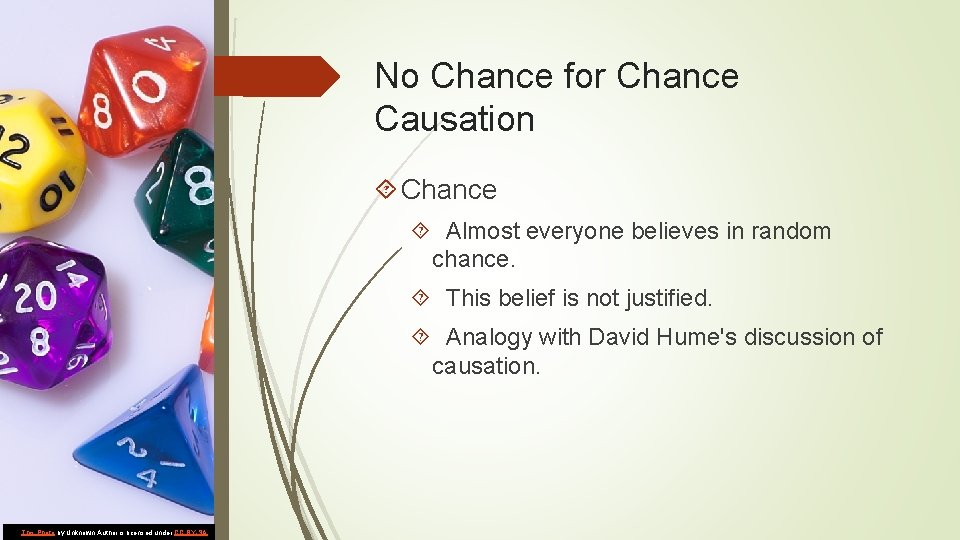
No Chance for Chance Causation Chance Almost everyone believes in random chance. This belief is not justified. Analogy with David Hume's discussion of causation. This Photo by Unknown Author is licensed under CC BY-SA
No Chance for Chance Causation Hume’s Causation Argument Most people believe in causation. Seeing a billiard ball striking and apparently moving another ball, we think we witnessed causation. We do not observe causation. All we observe is event X followed by event Y. Hume: if we observe enough instances of X following Y we begin to expect that X will always follow Y. Regardless of the number of observations, we are not justified in our belief. Saying X causes Y, reports a psychological claim that we expect Y when we observe X.
No Chance for Chance Most people believe in chance. Dice example. We do not see chance - we just see the die roll and land. Two ‘Reasons’ for Believing in Chance-First Reason First, we tend to attribute chance to matters that are unpredictable. Example: dice roll Because we cannot predict the outcome, we come to believe that chance must be involved. This explains the psychology of the belief. But, there are many things that are unpredictable that are not matters of chance. Chemical mixing example. Saying something is unpredictable reports our ignorance - it does not reveal the nature of chance.
No Chance for Chance Second Reason A matter of chance: if things could have turned out differently. Example: rolling a die. We come to believe things could have been different and thus believe that chance was involved. Chance is more than the possibility that things could have been different. Things could turn out differently in non-chance situations. Weight and scale example. Something more is needed.
No Chance for Chance Something More Something more: things could have been different, even if everything was identical to the original event. Dice example-perfect recreation. Flaw: we cannot perfectly recreate the events. Dice Example-factors changed from the original. It might be thought the conditions could be recreated perfectly through various means. One factor that could never be duplicated - time. Recreating is a recreation; does not show things could have been different. Dice Example: just shows that the result was what it was and then the second result was what it was.
No Chance for Chance Time Travel back in time and witness the event again. If things turn out differently, then perhaps evidence of chance has been found. But, perhaps what changed the outcome was not chance but our presence in the past.
No Chance for Chance Parallel Worlds Other worlds. To prove that chance is real, we would need a parallel world just like ours in which, using the die example, the die came up some number other than three on the first roll. This would not help - the die roll in the parallel world would not be identical to the first die roll in our world. For the rolls to be identical, the worlds would be identical. We would have just one world, not two. Conclusion Our belief in chance, like our belief in causation, is based in our psychology and not on any firm foundation.
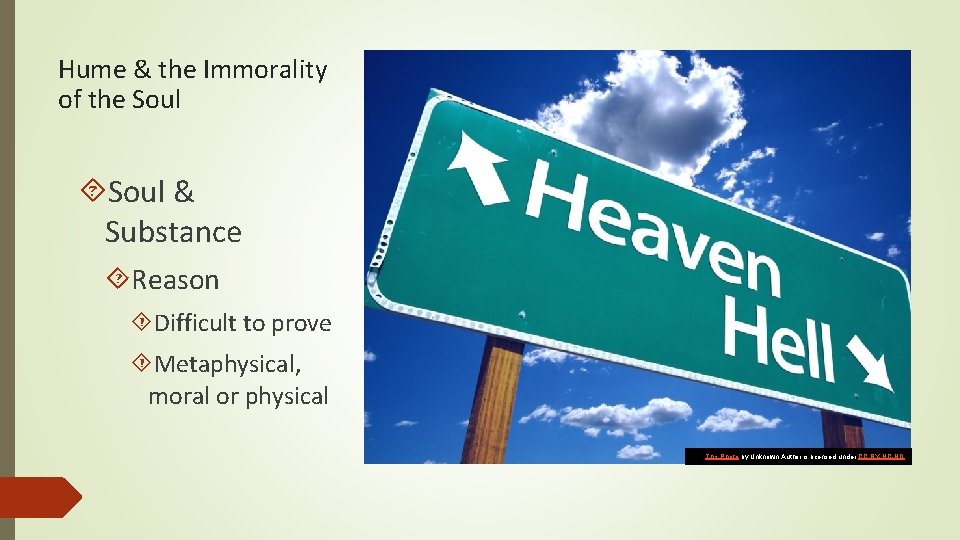
Hume & the Immorality of the Soul & Substance Reason Difficult to prove Metaphysical, moral or physical This Photo by Unknown Author is licensed under CC BY-NC-ND
Hume & the Immorality of the Soul Metaphysics Unknown Substance Immaterial & material Confused & Imperfect Unknown Cause & effect Abstract reasoning Spiritual Substances analogous to Material Substance Analogy Clay Dissolved Immortal substance
Hume & the Immorality of the Soul Memory, Consciousness & Substances Loss of memory & consciousness Incorruptible & ingenerable Existence before birth Animals Souls Moral Arguments God’s Justice Moral arguments Punishment Attributes This universe
Hume & the Immorality of the Soul Present Life Fostering fears Fear the Future Fear Riches Present life Deceit
Hume & the Immorality of the Soul Humans & Animals Powers Parity of reasoning Women Mortal soul Religious theory Equal No Object of God’s Punishment First cause Ordained by Him Nothing
Hume & the Immorality of the Soul Punishment without purpose Proportion in punishment Proportional Damnation Additional concerns Heaven & Hell Lenience Infancy
Hume & the Immorality of the Soul Physical Arguments Sleep Argument Connected Sleep Proportion Argument Proportional Dissolution
Hume & the Immorality of the Soul Condition Argument Analogy Dissolution Souls of Animals Mortal Analogy Change Argument Flux Immortal
Hume & the Immorality of the Soul Infinite Number of Souls Infinite Planets Lack of Argument Insensibility Argument
Hume & the Immorality of the Soul Horrors & Passions Horrors Nothing in vain Postpone Death Passions Hopes Defending a Negative Advantage Arguments New logic Divine revelation
- Slides: 61