
Metaphors in the mentallexicon Christiane Fellbaum Princeton University
Metaphors in the (mental)lexicon Christiane Fellbaum Princeton University and Berlin-Brandenburg Academy of Science
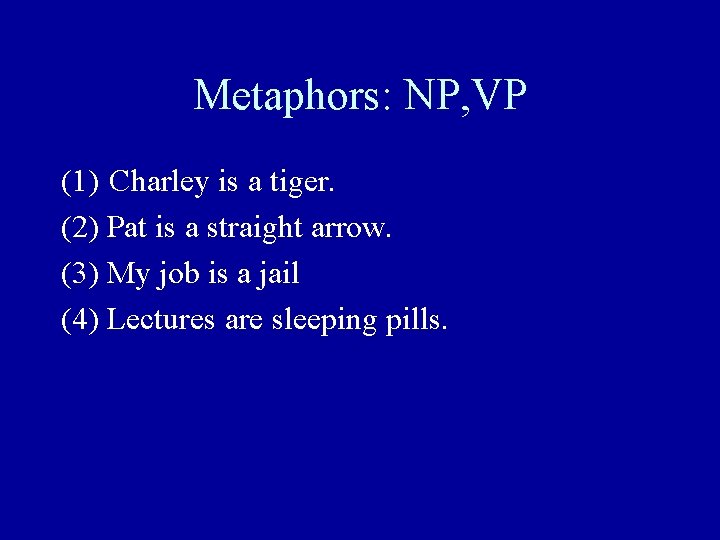
Metaphors: NP, VP (1) Charley is a tiger. (2) Pat is a straight arrow. (3) My job is a jail (4) Lectures are sleeping pills.
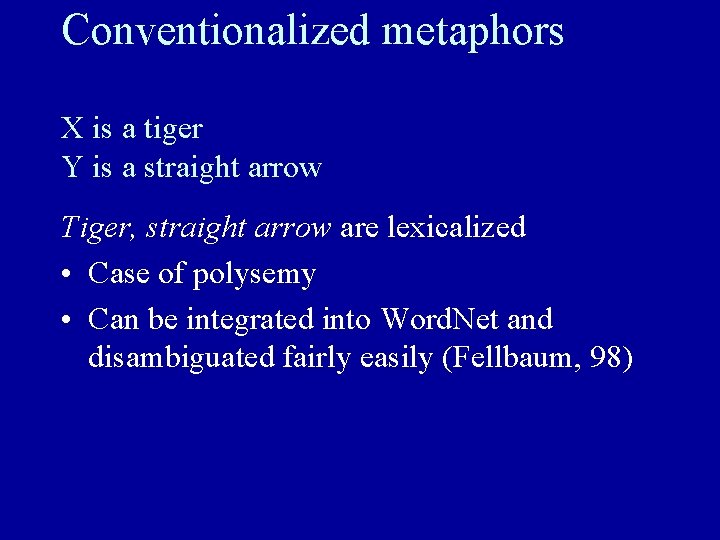
Conventionalized metaphors X is a tiger Y is a straight arrow Tiger, straight arrow are lexicalized • Case of polysemy • Can be integrated into Word. Net and disambiguated fairly easily (Fellbaum, 98)
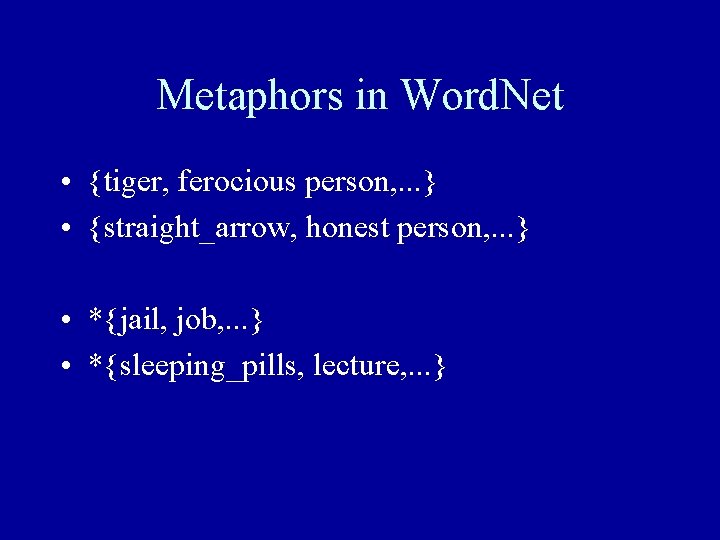
Metaphors in Word. Net • {tiger, ferocious person, . . . } • {straight_arrow, honest person, . . . } • *{jail, job, . . . } • *{sleeping_pills, lecture, . . . }
Ad-hoc metaphors • • • Jail, sleeping pills are not lexicalized Should not appear in dictionaries Are created on the fly There are infinitely many Based on similarity between vehicle (jail) and topic (job) in terms of salient features
What to do about ad-hoc metaphors in the lexicon/Word. Net • • Metaphors are based on similarity Similarity is based on shared features Hyponymy captures only some features This accounts for ad-hoc superordinates and metaphors
Is-A statements ISA-statements are ambiguous between class inclusion and identity: A car is an automobile (identity/synonymy) A Ford is a car (class inclusion) Only identity statements can be reversed: An automobile is a car *A car is a Ford
Class Inclusion? Glucksberg&Keysar (1990): metaphors are class inclusion statements • Attribution to an ad-hoc superordinate of which vehicle is a prototypical member • jail 1 = prison • jail 2 = confinement, lack of freedom, . . . • jail 2 is prototypical member of category jail 2
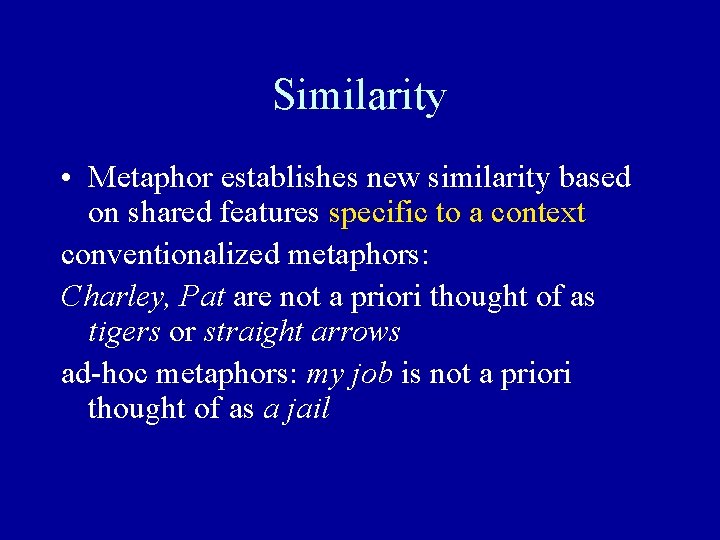
Similarity • Metaphor establishes new similarity based on shared features specific to a context conventionalized metaphors: Charley, Pat are not a priori thought of as tigers or straight arrows ad-hoc metaphors: my job is not a priori thought of as a jail
Rather than add metaphors as lexical entries in Wordnet. . . . Add more similarity-based links to Word. Net
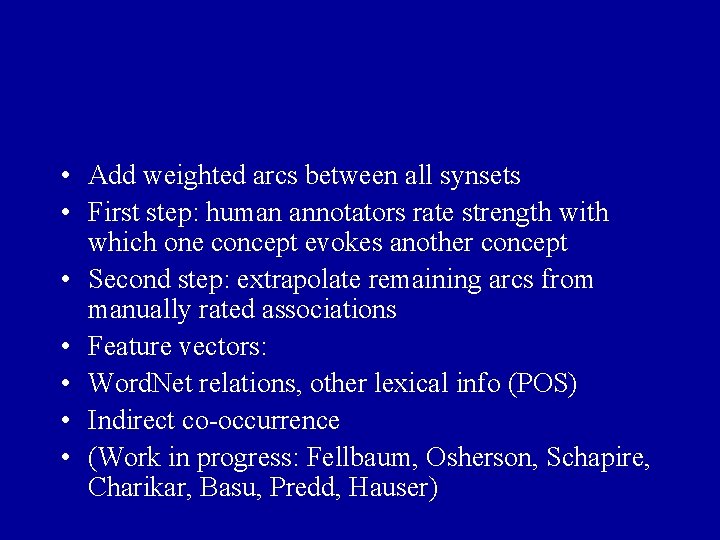
• Add weighted arcs between all synsets • First step: human annotators rate strength with which one concept evokes another concept • Second step: extrapolate remaining arcs from manually rated associations • Feature vectors: • Word. Net relations, other lexical info (POS) • Indirect co-occurrence • (Work in progress: Fellbaum, Osherson, Schapire, Charikar, Basu, Predd, Hauser)
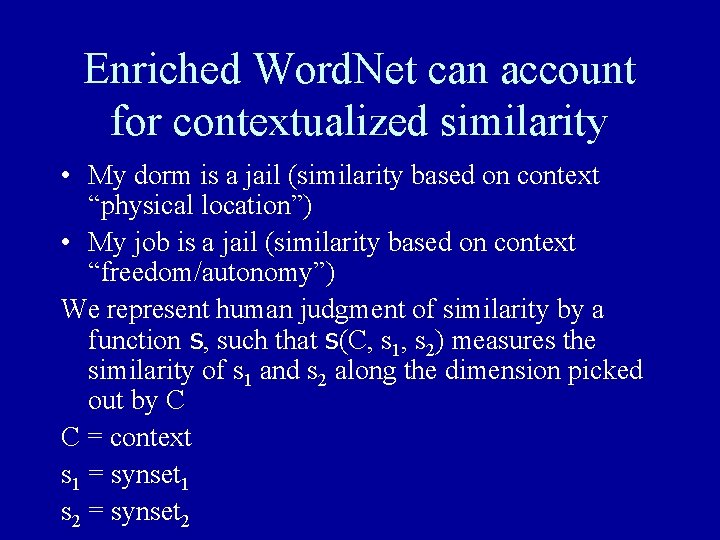
Enriched Word. Net can account for contextualized similarity • My dorm is a jail (similarity based on context “physical location”) • My job is a jail (similarity based on context “freedom/autonomy”) We represent human judgment of similarity by a function s, such that s(C, s 1, s 2) measures the similarity of s 1 and s 2 along the dimension picked out by C C = context s 1 = synset 1 s 2 = synset 2
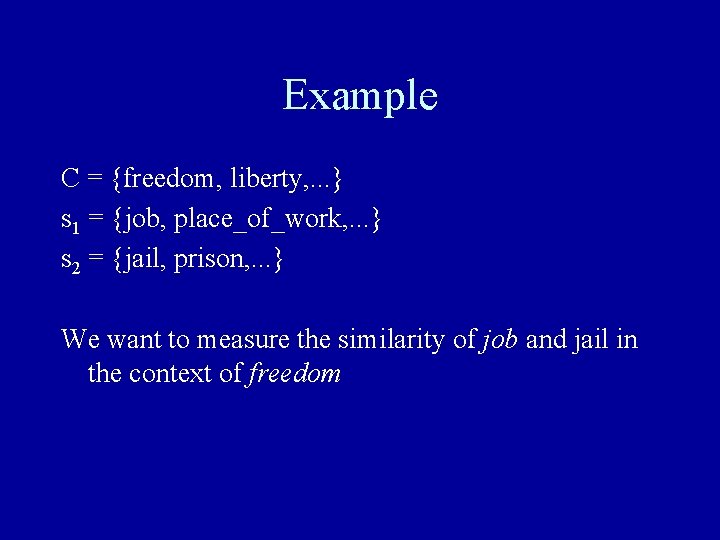
Example C = {freedom, liberty, . . . } s 1 = {job, place_of_work, . . . } s 2 = {jail, prison, . . . } We want to measure the similarity of job and jail in the context of freedom
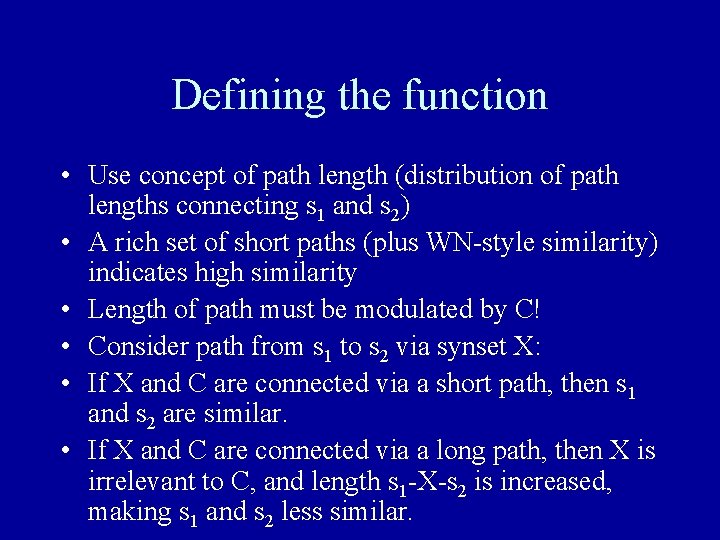
Defining the function • Use concept of path length (distribution of path lengths connecting s 1 and s 2) • A rich set of short paths (plus WN-style similarity) indicates high similarity • Length of path must be modulated by C! • Consider path from s 1 to s 2 via synset X: • If X and C are connected via a short path, then s 1 and s 2 are similar. • If X and C are connected via a long path, then X is irrelevant to C, and length s 1 -X-s 2 is increased, making s 1 and s 2 less similar.
Prospects Don’t know the results of the experiments yet but: many more connections will be created may teach us about mechanics of metaphor production and comprehension
- Slides: 15