
Metaphor in poetry Metaphor universals and universal metaphors
- Slides: 25
Metaphor in poetry
Metaphor universals and universal metaphors • We should make a distinction between metaphor universals and universal metaphors. • Metaphor universals: • there is no poetry without the use of metaphors in some form. • Why?
• typical topics of poetry, such as love, freedom, beauty, history, time, life, honor, nature, suffering, and so on, all invite metaphoric conceptualization, as they are highly abstract concepts that make excellent target domains in conceptual metaphors.
• Universal metaphors: • Conceptual metaphors such as • LOVE IS FIRE, • TIME IS MOTION or • LIFE IS A JOURNEY • are potential universal conceptual metaphors in everyday linguistic usage, but also in literature, as poetry in many unrelated languages around the world shows.
The cognitive-linguistic study of conceptual metaphors in poetry • Lakoff and Turner’s book, More than cool reason • Two important claims: • First, they showed that poets share with everyday people most of the conceptual metaphors they use in poetry. The reason for this is that the conceptual metaphors such as the ones mentioned above are based on shared bodily experiences – for non-poets and poets alike.
• Second, Lakoff and Turner suggested that metaphorical creativity in poetry is the result of four common conceptual devices that poets use in manipulating otherwise shared conceptual metaphors. These include the devices of • elaboration, • extension, • questioning, and • combining.
• However, these exist • also in more ordinary forms of language use, such as journalism (see, e. g. , Jackendoff and Aaron, Review Article; Semino, Metaphor in Discourse). • Thus, on this basis alone, it is not possible to distinguish poetic from nonpoetic metaphor. • Moreover, in accounting for poetic metaphors, Turner (see, e. g. , The Literary Mind) proposed that in many cases poetry (and literature in general) makes use of what he and Fauconnier call “blends, ” in which various elements from two or more domains, or frames, can be conceptually fused, or integrated (see, e. g. , Turner, The Literary Mind; Fauconnier and Turner, The Way We Think).
• Although many conceptual metaphors are shared by poets and nonpoets, many are clearly not. These are metaphors that are not based on universal bodily experiences but on certain creative analogies between a source and a target domain set up either by lay people or poets. • Resemblance metaphors.
• The resemblance metaphors range from simple to complex: • I wandered lonely as a cloud That floats on high o’er vales and hills…
• So foul a sky clears not without a storm. • Pour down thy weather. • the appearance of the sky ⇒ the appearance of the messenger’s face • the imminent storm ⇒ the bad message likely to be delivered • the rain ⇒ the act of telling the bad news
Metaphorical universality and nonuniversality in poetry • Primary metaphors: • On this view, there are correlations between certain sensorimotor and subjective, abstract experiences, such as between destinations and purposes, body heat and emotion, verticality and amount, and so on. The repeated experience of such correlations results in primary metaphors that are, at least potentially, universal, including PURPOSES ARE DESTINATIONS, INTIMACY IS CLOSENESS, EMOTION IS HEAT, MORE IS UP.
• The primary metaphors constitute the basis for complex or compound conceptual metaphors such as LIFE IS A JOURNEY and LOVE IS A UNITY. • For example, PURPOSES ARE DESTINATIONS is one primary metaphor that, in part, conceptually constitutes LIFE IS A JOURNEY, • INTIMACY IS CLOSENESS is one that, in part, constitutes LOVE IS A UNITY, • and EMOTION IS HEAT is one that, in part, constitutes ANGER IS A HOT FLUID IN A CONTAINER.
• Anne Bradstreet, a 17 th-century American poet, who in her poem “To My Dear and Loving Husband” wrote: • • If ever two were one, then surely we. • If man were loved by wife, then thee; • LOVE IS A UNITY (OF TWO COMPLEMENTARY PARTS (see Kövecses, The ) Language of Love). It is very likely that the UNITY metaphor for love can be found in the poetry of many languages and cultures around the world.
• Where does non-universality in everyday and poetic metaphorical thought come from? • Two adjustments to the standard vies: • The adjustments concern the role of context in the creation of novel metaphors (both conceptual and linguistic), on the one hand (see Kövecses, Where Metaphors Come From), and the various degrees of schematicity of conceptual metaphors (and their linguistic expressions), on the other (see Kövecses, “Levels of metaphor”).
• We can term the resulting conception a contextualist and multi-level view of conceptual metaphors. • They point to two major forms of deviation from universality. • First, the insistence on the role of context helps us account for the kind of metaphor variation that derives from individual and group differences in human experience.
• And second, the multi-level view can explain the divergences in the use of metaphor resulting from individual and group differences in how higher-level conceptual metaphors are elaborated by lower-level ones. • the two processes are related: various contextual factors can trigger particular elaborations of higher-level conceptual metaphors.
How context shapes metaphorical conceptualization SITUATIONAL CONTEXT: Dover Beach (Matthew Arnold) • The sea is calm to-night. • The tide is full, the moon lies fair • Upon the straits, - on the French coast, the light • Gleams and is gone; the cliffs of England stand, • Glimmering and vast, out in the tranquil bay. • Come to the window, sweet is the night-air!
• The sea of Faith • Was once, too, at the full, and round earth’s shore • Lay like the folds of a bright girdle furl’d. • (CHRISTIAN) FAITH IS THE SEA (Matthew Arnold)
• DISCOURSE CONTEXT: Sylvia Plath’s poem, “Medusa. ” • Off that landspit of stony mouth-plugs, Eyes rolled by white sticks, Ears cupping the sea's incoherences, You house your unnerving head -- God-ball, Lens of mercies, Your stooges Plying their wild cells in my keel's shadow, Pushing by like hearts, Red stigmata at the very center, Riding the rip tide to the nearest point of departure, • Dragging their Jesus hair. Did I escape, I wonder?
• BODILY CONTEXT: • … I propose to concentrate on the fact of illness itself as a governing factor in Dickinson’s development as a poet. We are already accustomed to thinking about ways in which illness or deformity modulate the registers of expression we hear while reading Milton, Keats, Emily Bronte, Lord Byron. For Dickinson, illness was a formative experience as well, one which shaped her entire poetic methodology from perception to inscription and which very likely shook the foundations of her faith. Reading Dickinson’s poems in the full knowledge and belief that, while writing them, she was suffering acutely from a seemingly irremediable illness renders many of them recuperable as almost diaristic records of a rather ordinary person’s courageous struggle against profound adversity. (Guthrie, Emily Dickinson: 4 -5)
• CONCEPTUAL-COGNITIVE CONTEXT: • Dante, “Divine Comedy”: • • Nel mezzo del cammin di nostra vita mi ritrovai per una selva oscura, • (In the middle of life’s road • I found myself in a dark wood, )
• Robert Frost, “The Road Not Taken”: • • Two roads diverged in a wood, and I— • I took the one less traveled by, • And that has made all the difference.
• LIFE IS A JOURNEY • the two poets share the same conceptual metaphor, but the metaphor is extended differently by Dante and Frost. And the extensions result in different manifestations of the conceptual metaphor: loss of goals in life by the former and making choices in life by the latter.
Elaborations of higher level conceptual metaphors American poet Karl Sandburg, “Skyscraper”: • • BY day the skyscraper looms in the smoke and sun and has a soul. Prairie and valley, streets of the city, pour people into it and they mingle among its twenty floors and are poured out again back to the streets, prairies and valleys. It is the men and women, boys and girls so poured in and out all day that give the building a soul of dreams and thoughts and memories. (Dumped in the sea or fixed in a desert, who would care for the building or speak its name or ask a policeman the way to it? )
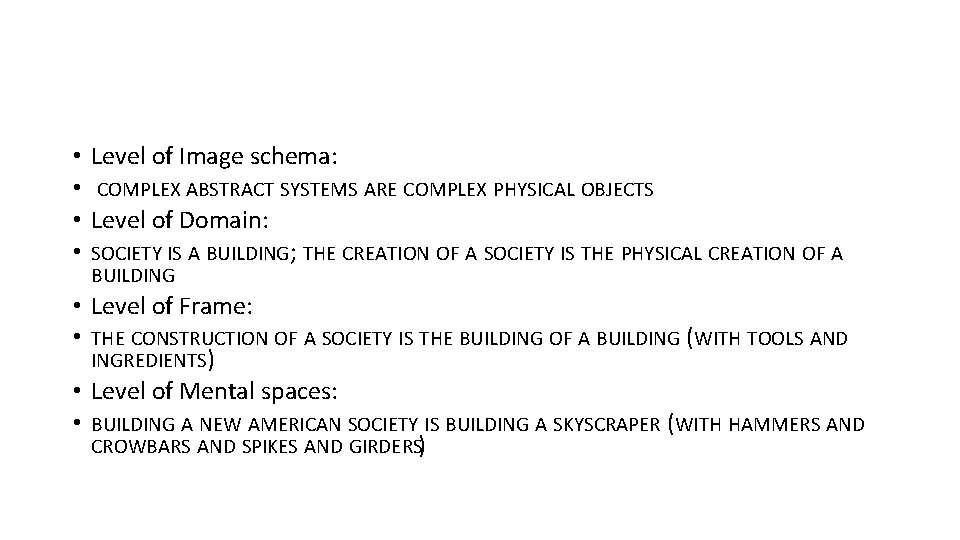
• Level of Image schema: • COMPLEX ABSTRACT SYSTEMS ARE COMPLEX PHYSICAL OBJECTS • Level of Domain: • SOCIETY IS A BUILDING; THE CREATION OF A SOCIETY IS THE PHYSICAL CREATION OF A BUILDING • Level of Frame: • THE CONSTRUCTION OF A SOCIETY IS THE BUILDING OF A BUILDING (WITH TOOLS AND INGREDIENTS) • Level of Mental spaces: • BUILDING A NEW AMERICAN SOCIETY IS BUILDING A SKYSCRAPER (WITH HAMMERS AND CROWBARS AND SPIKES AND GIRDERS)