
Metaphor as a Rhetorical Device The semantic meaning
- Slides: 41
Metaphor as a Rhetorical Device: The semantic meaning, types and ways of translation
Table of content: 1. Abstract 2. Introduction 3. Terminology 4. Purpose of the study; objectives, methodology, research questions 5. Literature review - The traditional & the Modern theory of metaphor - Differences between Metaphor and Simile - Pillars of metaphor in English 6. Types of metaphors - Metaphors in terms of its use and its meaning - metaphors in terms of its concepts 7. Strategies of Translating Metaphors - Translating a metaphor by an identical metaphor in the target language - Metaphors having similar mapping conditions but lexically realized differently - Metaphors of different mapping conditions: Demostication & Foreignization 1. Recommendations 2. Conclusion 3. References
Abstract Metaphor is the flavor of language; the decoration that gives our language the taste. It is a means for description that goes beyond the ordinary way of describing things by using usual languages. The aim of this paper is to show that metaphors are not only means by literal language but that they are actually part of our every-day communication. The basis for this paper is theory of Lakoff and Johnson who dealt with this topic in their work “Metaphors we live by”. This theory is presented and supported by a number of examples of common language. In addition to this, types of metaphors, ways of translating metaphors, and some fields where metaphors are present are shown. The researcher states some recommendations of how to translate and how a translator should take into consideration the value and the culture of the SL when translating, showing that metaphors cannot be ignored in our common language.
Terminology Definitions of metaphor vary from one language to another and from one school of language to another. Figures like Aristotle understood metaphor differently than did the modern linguists, philosophers, and rhetoricians. . By going back to Aristotle, he looked at metaphor as the language of the elites that needs special abilities to be produced, whereas modern rhetoricians dealt with metaphor as a figure of speech that needs some cognitive and linguistic abilities to be produced and that can be produced by anyone even by ordinary people in their every-day communication. (Kovecses, Metaphor: A Practical Introduction, 2010).
Purpose of the Paper 1 - Highlight the different views of metaphors; the traditional and the modern. 2 - Explain the different types of metaphors. 3 - Investigate the meaning of different types of metaphors 4 - Explain how to translate metaphors
Methodology The basis for this paper is theory of Lakoff and Johnson (1980) who dealt with this topic in their work “Metaphors we live by”.
Research Questions: - What are the similarities and differences between the traditional and the modern view towards metaphors? - What are the semantic features of metaphorical expressions in English? - What are the key elements translators should undertake when translating metaphors?
Literature Review “We are in the midst of metaphormania. Only three decades ago, the situation was just the opposite: poets created metaphors, everybody used them, and philosophers. . . ignored them. Today we seem possessed by metaphor. ” (Johnson M. as cited in Benjamins, 1998, p. 2)
The traditional theory of metaphor: There had been some characteristics of the traditional metaphor. These characteristics were proved to be false by modern rhetoricians. These characteristics, as mentioned by (Lakoff, The Contemporary Theory of Metaphor, 1993) are: 1 - All everyday conventional language is literal, and none is metaphorical. 2 - All subject matter can be comprehended literally, without metaphor. 3 - Only literal language can be contingently true or false. 4 - All definitions given in the lexicon of a language are literal, not metaphorical. 5 - The concepts used in the grammar of a language are all literal, none are metaphorical
The modern theory of metaphor: Based on (Lakkoff & Johnson, 1980), this perspective holds that metaphors are present in emotions, events and activities. They claimed, according to (Kovecses, Metaphor: A Practical Introduction, 2010), that metaphor is characterized by the following: 1 - Metaphor is a property of concepts, and not of words. This means that a metaphor is a conceptual view (rather than a sequence of words). 2 - The function of metaphor is to better understand certain concepts, and not just some artistic or esthetic purpose. 3 - Metaphor is often not based on similarity. 4 - Metaphor is not only used by special talented people, but it is also used by ordinary people effortlessly in everyday life. Metaphor is an inevitable process of human thought and reasoning. This means that it is a cognitive & linguistic phenomenon.
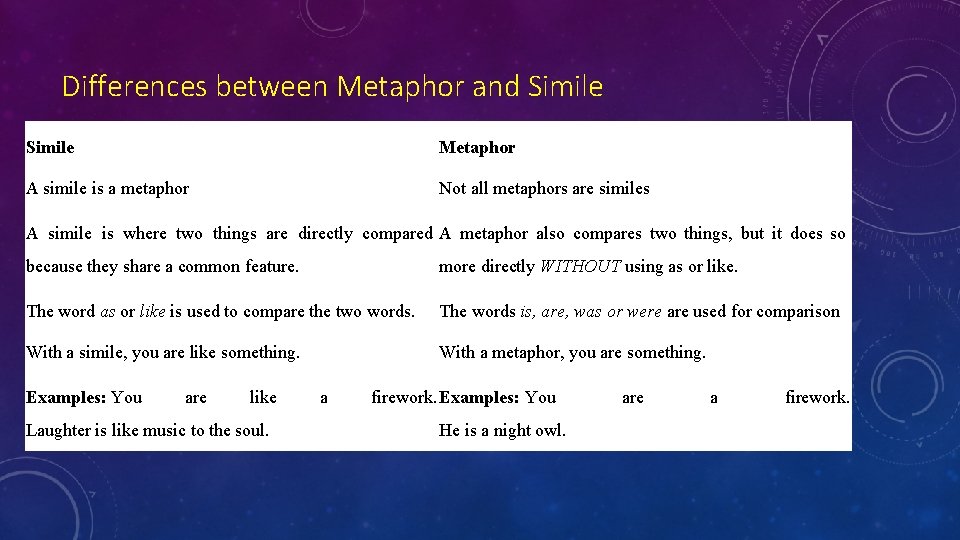
Differences between Metaphor and Simile Metaphor A simile is a metaphor Not all metaphors are similes A simile is where two things are directly compared A metaphor also compares two things, but it does so because they share a common feature. more directly WITHOUT using as or like. The word as or like is used to compare the two words. The words is, are, was or were are used for comparison With a simile, you are like something. With a metaphor, you are something. Examples: You are like Laughter is like music to the soul. a firework. Examples: You He is a night owl. are a firework.
Pillars of metaphor in English The linguists of the English language, have differed much difference in determining the elements of metaphor. Some linguists consider them two elements; others consider them three elements (Newmark, 1982) says that metaphor has four pillars. 1 - The object which describes the metaphor. 2 - The image which is described by the object 3 - The sense which shows the similarities between the object and the image 4 - The metaphor; a word or words taken from. Example: - A sunny smile. The object is the word 'smile', and the image is the word 'sun'. The sense may be cheerful, happy, warm. The metaphor is the word sunny i. e. sunny and bright
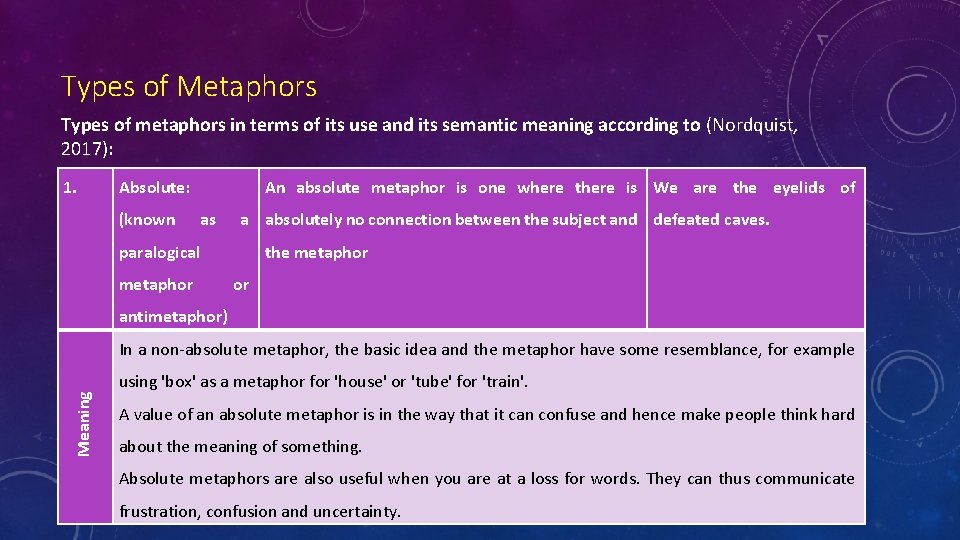
Types of Metaphors Types of metaphors in terms of its use and its semantic meaning according to (Nordquist, 2017): 1. Absolute: (known An absolute metaphor is one where there is We are the eyelids of as a absolutely no connection between the subject and defeated caves. paralogical metaphor the metaphor or antimetaphor) Meaning In a non-absolute metaphor, the basic idea and the metaphor have some resemblance, for example using 'box' as a metaphor for 'house' or 'tube' for 'train'. A value of an absolute metaphor is in the way that it can confuse and hence make people think hard about the meaning of something. Absolute metaphors are also useful when you are at a loss for words. They can thus communicate frustration, confusion and uncertainty.
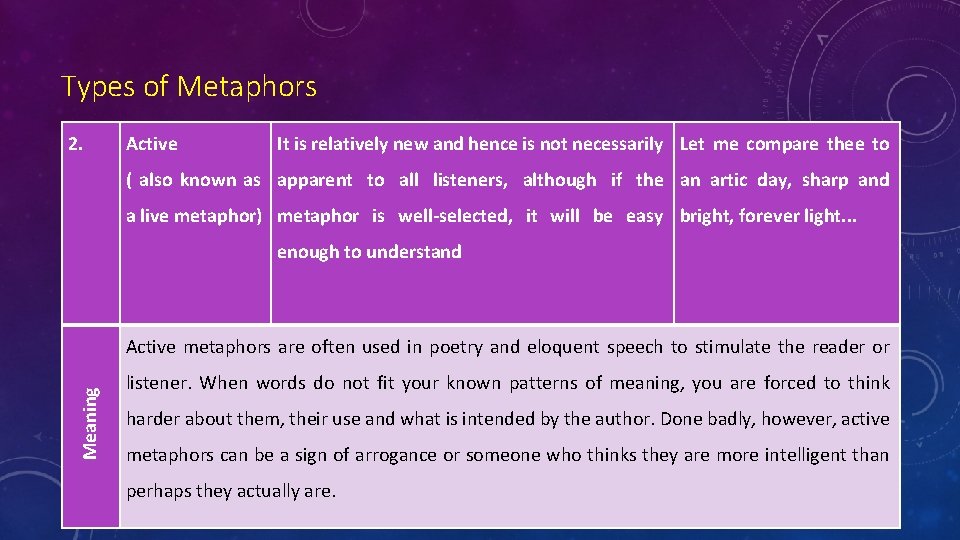
Types of Metaphors 2. Active It is relatively new and hence is not necessarily Let me compare thee to ( also known as apparent to all listeners, although if the an artic day, sharp and a live metaphor) metaphor is well-selected, it will be easy bright, forever light. . . enough to understand Meaning Active metaphors are often used in poetry and eloquent speech to stimulate the reader or listener. When words do not fit your known patterns of meaning, you are forced to think harder about them, their use and what is intended by the author. Done badly, however, active metaphors can be a sign of arrogance or someone who thinks they are more intelligent than perhaps they actually are.
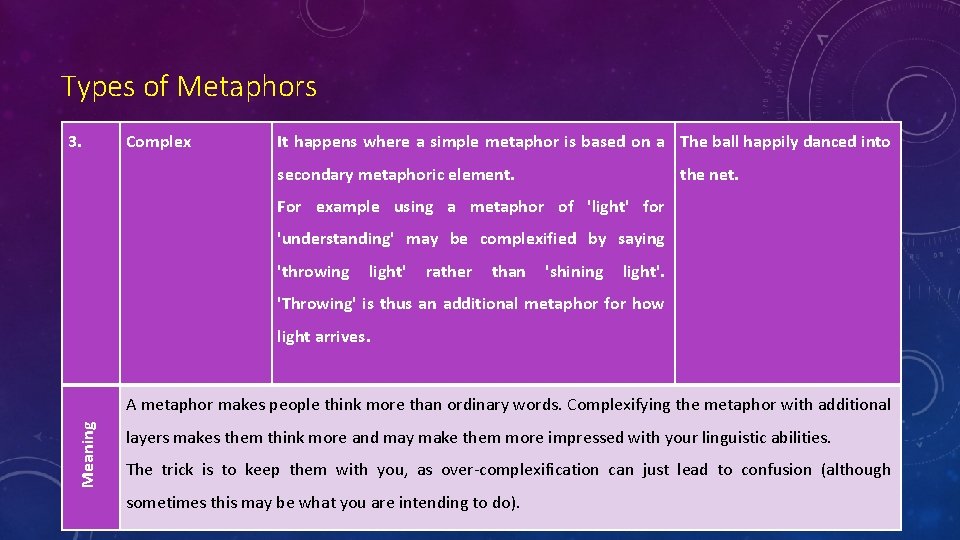
Types of Metaphors 3. Complex It happens where a simple metaphor is based on a The ball happily danced into secondary metaphoric element. the net. For example using a metaphor of 'light' for 'understanding' may be complexified by saying 'throwing light' rather than 'shining light'. 'Throwing' is thus an additional metaphor for how light arrives. Meaning A metaphor makes people think more than ordinary words. Complexifying the metaphor with additional layers makes them think more and may make them more impressed with your linguistic abilities. The trick is to keep them with you, as over-complexification can just lead to confusion (although sometimes this may be what you are intending to do).
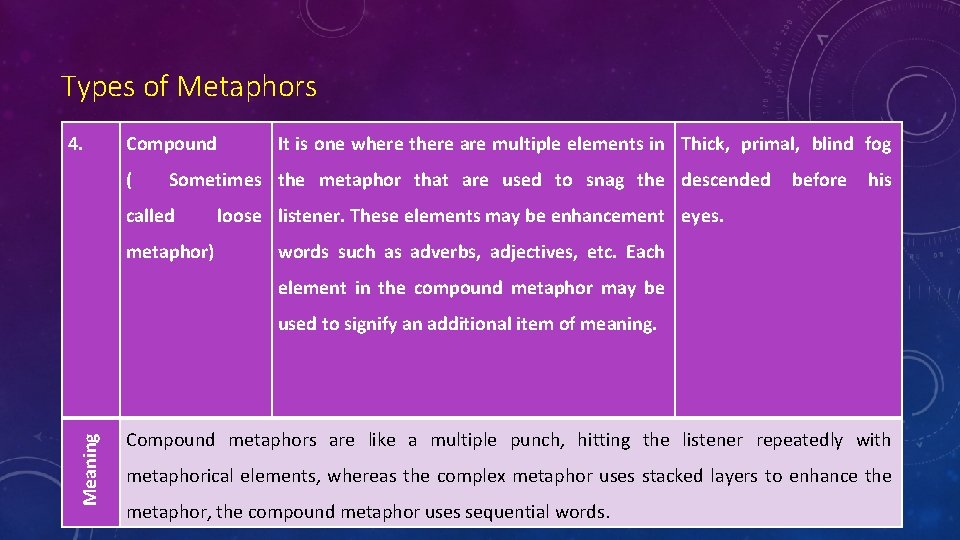
Types of Metaphors 4. Compound ( It is one where there are multiple elements in Thick, primal, blind fog Sometimes the metaphor that are used to snag the descended called metaphor) before his loose listener. These elements may be enhancement eyes. words such as adverbs, adjectives, etc. Each element in the compound metaphor may be Meaning used to signify an additional item of meaning. Compound metaphors are like a multiple punch, hitting the listener repeatedly with metaphorical elements, whereas the complex metaphor uses stacked layers to enhance the metaphor, the compound metaphor uses sequential words.
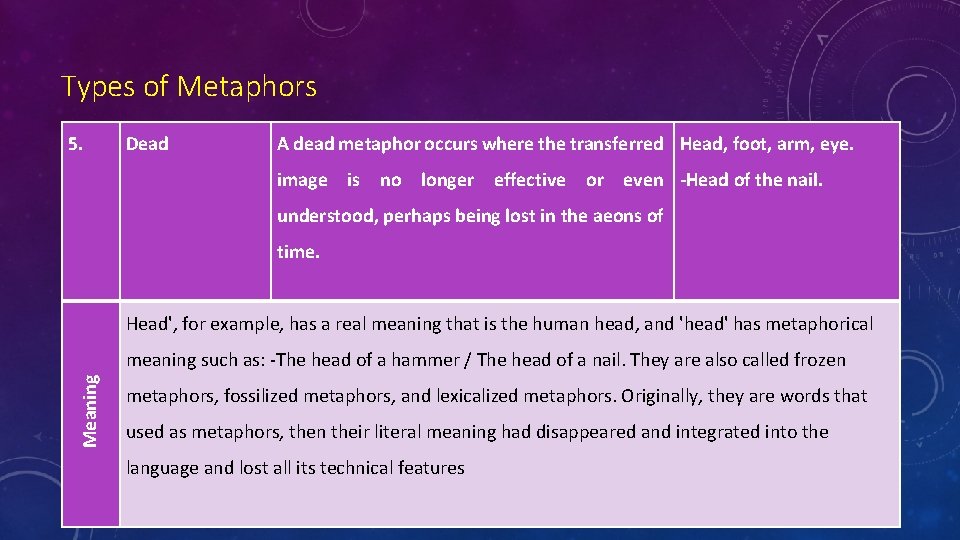
Types of Metaphors 5. Dead A dead metaphor occurs where the transferred Head, foot, arm, eye. image is no longer effective or even -Head of the nail. understood, perhaps being lost in the aeons of time. Head', for example, has a real meaning that is the human head, and 'head' has metaphorical Meaning meaning such as: -The head of a hammer / The head of a nail. They are also called frozen metaphors, fossilized metaphors, and lexicalized metaphors. Originally, they are words that used as metaphors, then their literal meaning had disappeared and integrated into the language and lost all its technical features
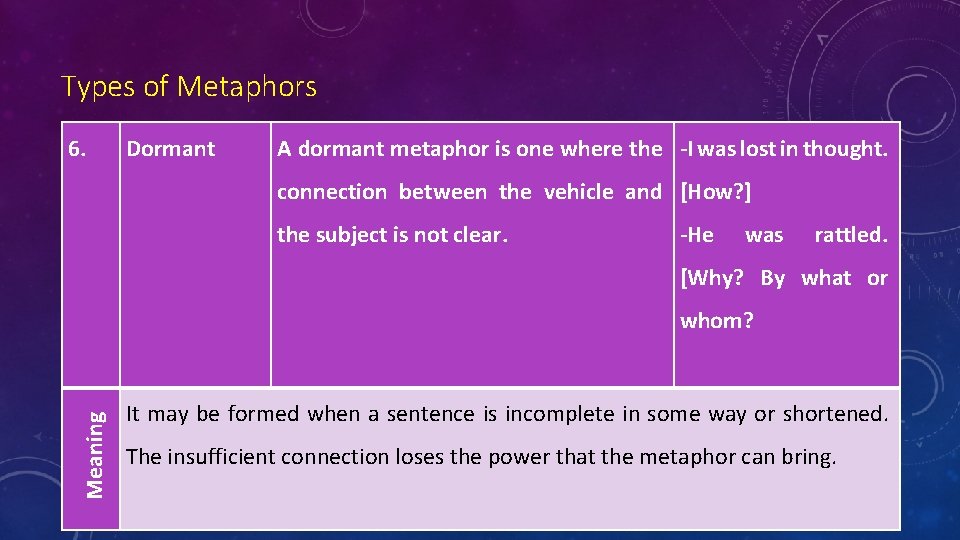
Types of Metaphors 6. Dormant A dormant metaphor is one where the -I was lost in thought. connection between the vehicle and [How? ] the subject is not clear. -He was rattled. [Why? By what or Meaning whom? It may be formed when a sentence is incomplete in some way or shortened. The insufficient connection loses the power that the metaphor can bring.
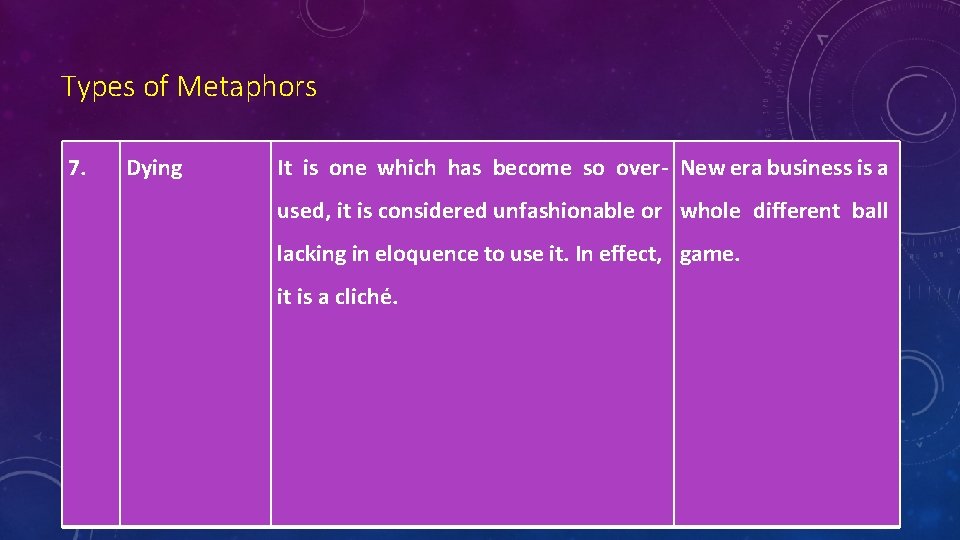
Types of Metaphors 7. Dying It is one which has become so over- New era business is a used, it is considered unfashionable or whole different ball lacking in eloquence to use it. In effect, game. it is a cliché.
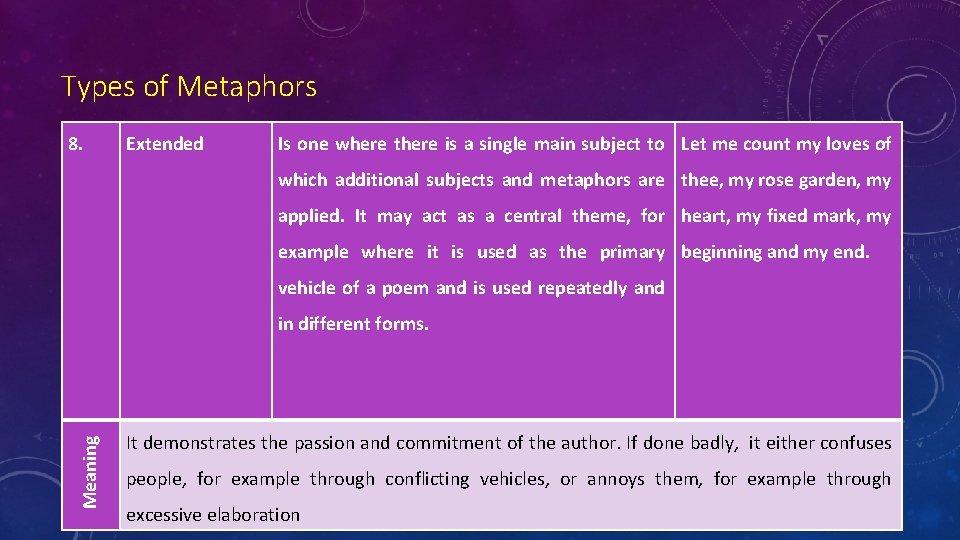
Types of Metaphors 8. Extended Is one where there is a single main subject to Let me count my loves of which additional subjects and metaphors are thee, my rose garden, my applied. It may act as a central theme, for heart, my fixed mark, my example where it is used as the primary beginning and my end. vehicle of a poem and is used repeatedly and Meaning in different forms. It demonstrates the passion and commitment of the author. If done badly, it either confuses people, for example through conflicting vehicles, or annoys them, for example through excessive elaboration
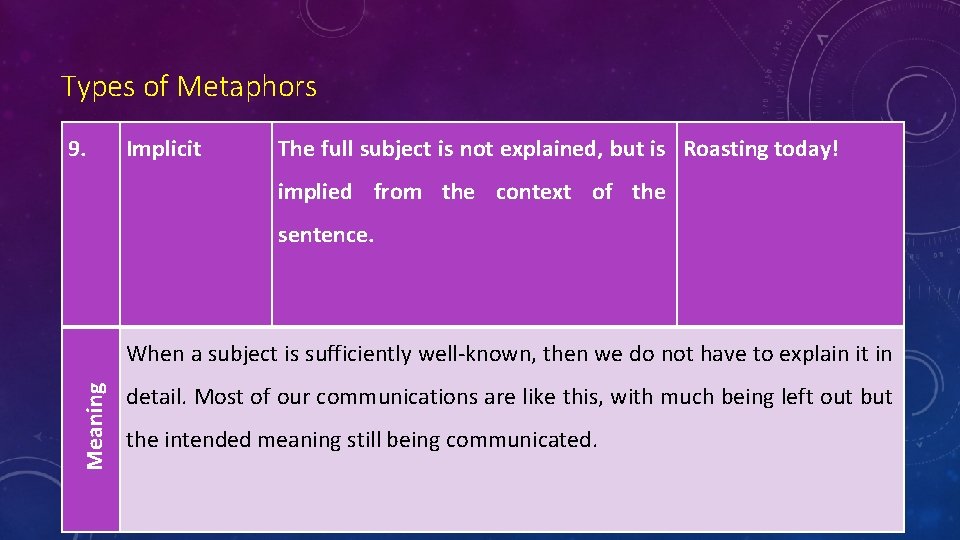
Types of Metaphors 9. Implicit The full subject is not explained, but is Roasting today! implied from the context of the sentence. Meaning When a subject is sufficiently well-known, then we do not have to explain it in detail. Most of our communications are like this, with much being left out but the intended meaning still being communicated.
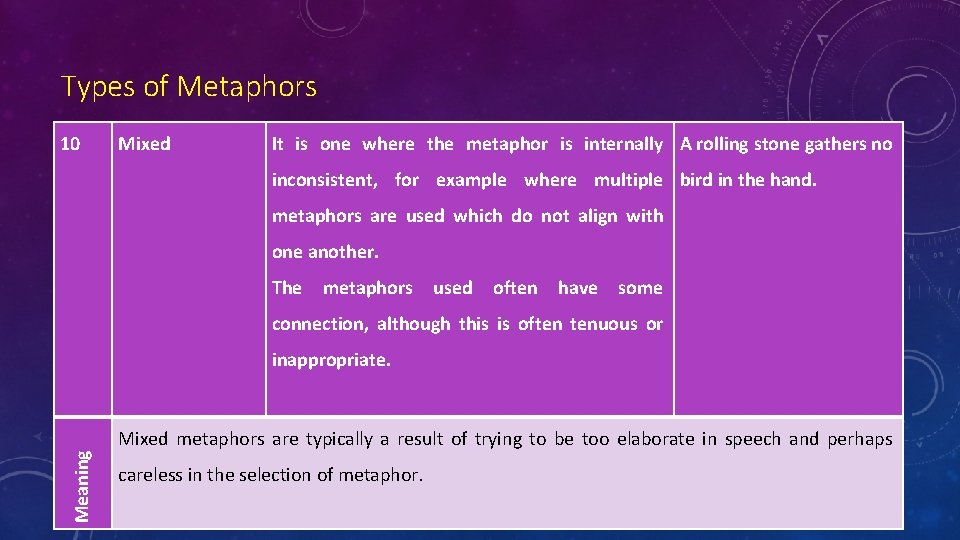
Types of Metaphors 10 Mixed It is one where the metaphor is internally A rolling stone gathers no inconsistent, for example where multiple bird in the hand. metaphors are used which do not align with one another. The metaphors used often have some connection, although this is often tenuous or Meaning inappropriate. Mixed metaphors are typically a result of trying to be too elaborate in speech and perhaps careless in the selection of metaphor.
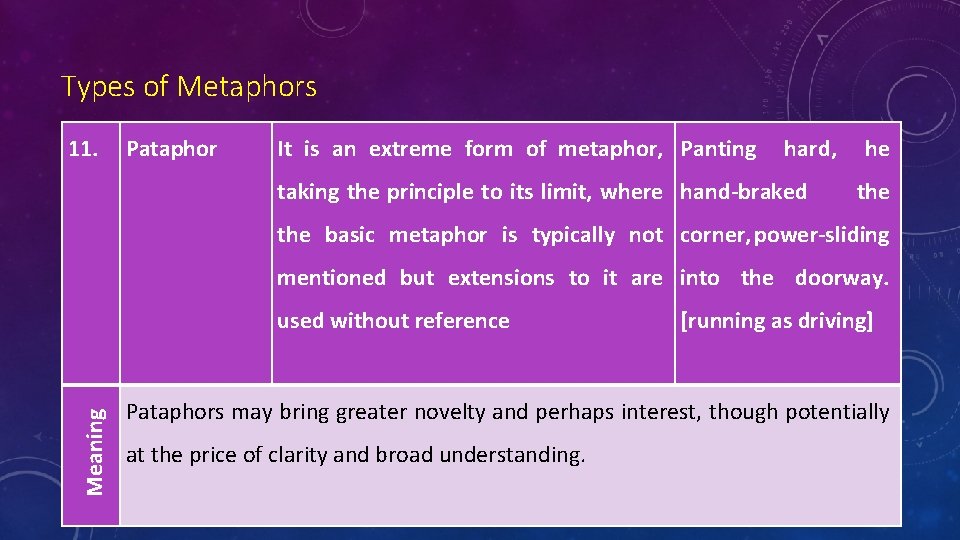
Types of Metaphors 11. Pataphor It is an extreme form of metaphor, Panting hard, taking the principle to its limit, where hand-braked he the basic metaphor is typically not corner, power-sliding mentioned but extensions to it are into the doorway. Meaning used without reference [running as driving] Pataphors may bring greater novelty and perhaps interest, though potentially at the price of clarity and broad understanding.
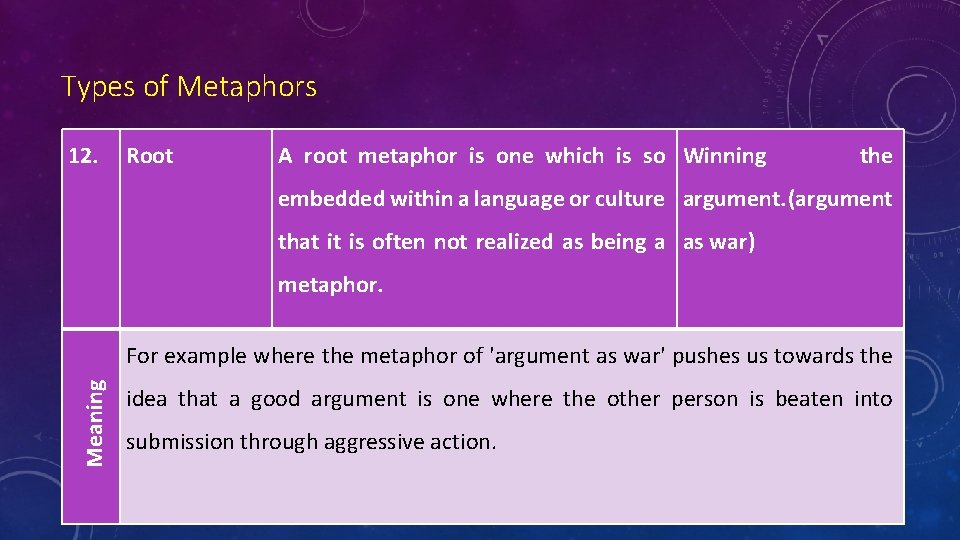
Types of Metaphors 12. Root A root metaphor is one which is so Winning the embedded within a language or culture argument. (argument that it is often not realized as being a as war) metaphor. Meaning For example where the metaphor of 'argument as war' pushes us towards the idea that a good argument is one where the other person is beaten into submission through aggressive action.
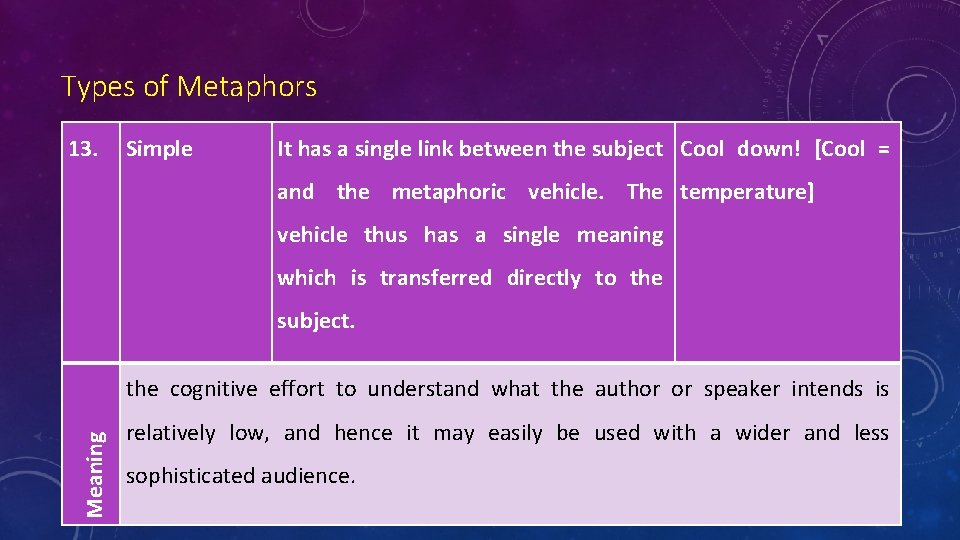
Types of Metaphors 13. Simple It has a single link between the subject Cool down! [Cool = and the metaphoric vehicle. The temperature] vehicle thus has a single meaning which is transferred directly to the subject. Meaning the cognitive effort to understand what the author or speaker intends is relatively low, and hence it may easily be used with a wider and less sophisticated audience.
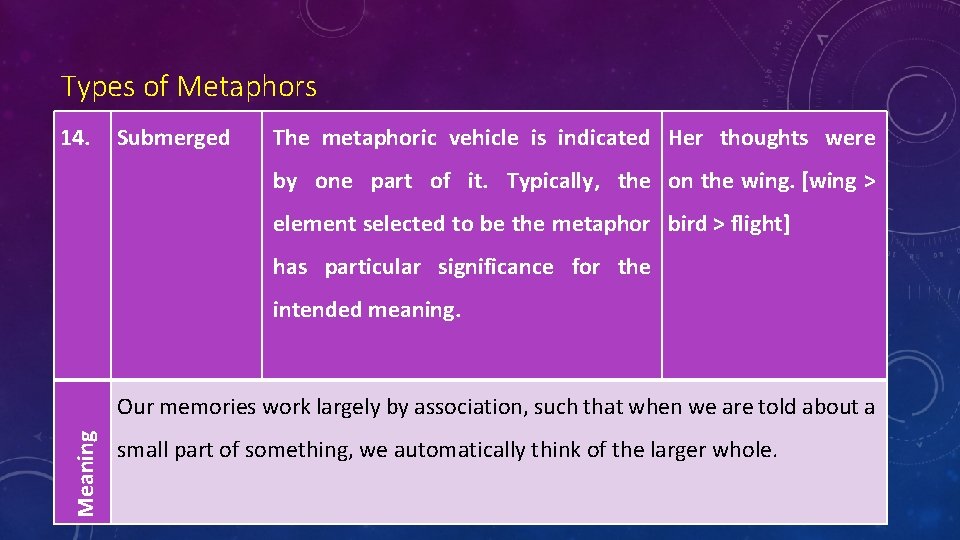
Types of Metaphors 14. Submerged The metaphoric vehicle is indicated Her thoughts were by one part of it. Typically, the on the wing. [wing > element selected to be the metaphor bird > flight] has particular significance for the intended meaning. Meaning Our memories work largely by association, such that when we are told about a small part of something, we automatically think of the larger whole.
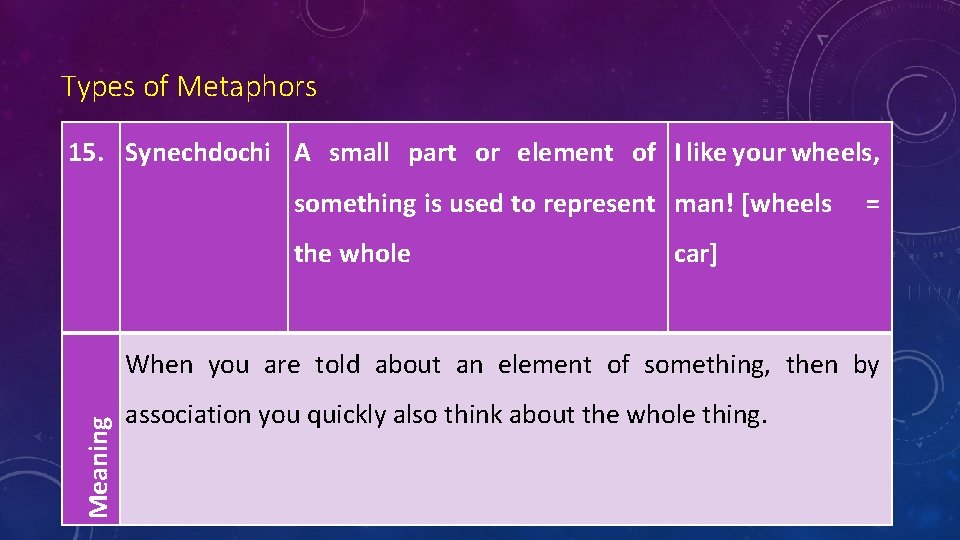
Types of Metaphors 15. Synechdochi A small part or element of I like your wheels, something is used to represent man! [wheels the whole = car] Meaning When you are told about an element of something, then by association you quickly also think about the whole thing.
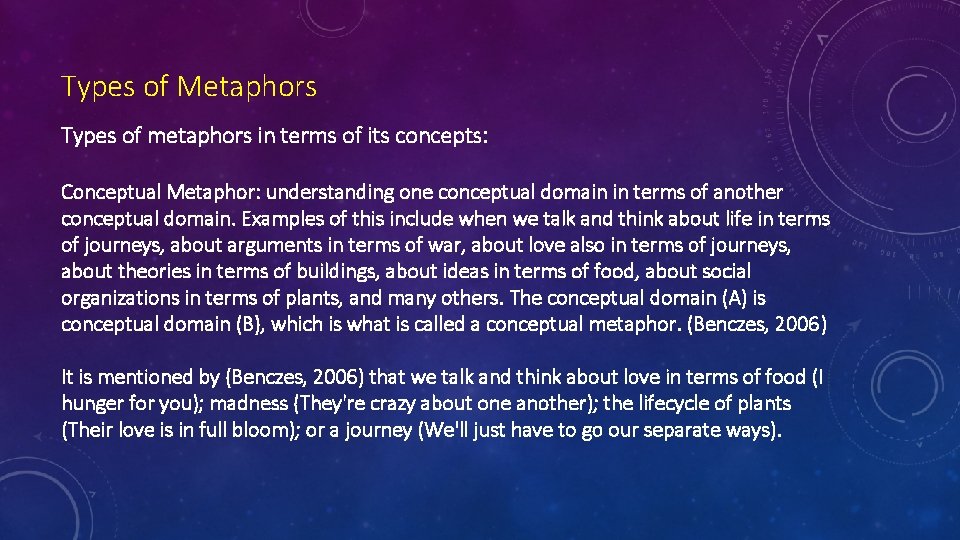
Types of Metaphors Types of metaphors in terms of its concepts: Conceptual Metaphor: understanding one conceptual domain in terms of another conceptual domain. Examples of this include when we talk and think about life in terms of journeys, about arguments in terms of war, about love also in terms of journeys, about theories in terms of buildings, about ideas in terms of food, about social organizations in terms of plants, and many others. The conceptual domain (A) is conceptual domain (B), which is what is called a conceptual metaphor. (Benczes, 2006) It is mentioned by (Benczes, 2006) that we talk and think about love in terms of food (I hunger for you); madness (They're crazy about one another); the lifecycle of plants (Their love is in full bloom); or a journey (We'll just have to go our separate ways).
Types of Metaphors Conceptual Metaphor A- Orientational Metaphor: An orientational metaphor, as stated by (Nordquist, 2017) is metaphor (or figurative comparison) that involves spatial relationships (such as up-down, in-out, -on-off, and front-back) More is up; less is down: Speak up, please. Keep your voice down, please. Healthy is up; sick is down: He fell ill. Conscious is up; unconscious is down: Wake up. He sank into a coma. Control is up; lack of control is down: I'm on top of the situation. He is under my control. Happy is up; sad is down: I'm feeling up today. He's really low these days. Virtue is up; lack of virtue is down: She's an upstanding citizen. That was a lowdown thing to do. Rational is up; nonrational is down: The discussion fell to an emotional level. He couldn't rise above his emotions.
Types of Metaphors Conceptual Metaphor B) Ontological Metaphor: It is a type of metaphor or (figurative comparison) in which something concrete is projected onto something abstract. It is a figure that provides ways of viewing events, activities, emotions, ideas, etc. , as entities and substances. Examples: Life has cheated me. Inflation is eating up our profits. Cancer finally caught up with him. The computer went dead on me.
Types of Metaphors Conceptual Metaphor C) Structural Metaphor: A structural metaphor is a metaphorical system in which one complex concept (typically abstract) is presented in terms of some other (usually more concrete) concept. A structural metaphor Example: Argument is war is an example of a structural metaphor. Structural metaphors are cases where one concept is metaphorically structured in terms of another.
Strategies of Translating Metaphors Translators, whose task is to produce a TL text that bears a close resemblance to the SL text, should be aware of cognitive and cultural issues when translating from Arabic into English or vice-versa Therefore, it is not enough for translators to be bilingual, but they should be bicultural as well
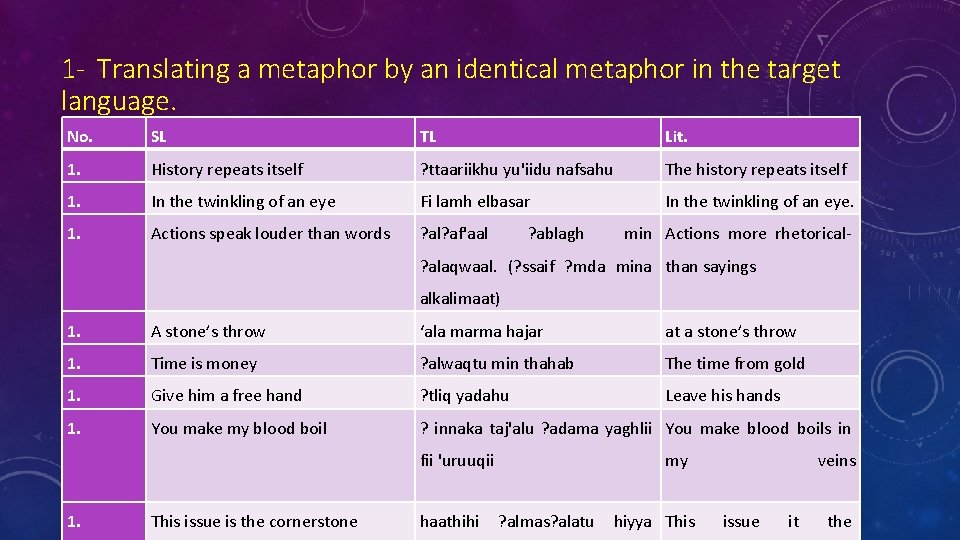
1 - Translating a metaphor by an identical metaphor in the target language. This category represents metaphors expressing a small number of ideas shared by the two languages and hence expressed, roughly speaking, by similar expressions. Anthropologists call theses shared ideas 'cultural universals. ' A universal culture can be thought of as a constellation of common core attitudes and values reflected by practices common to most of the subcultures (Emanatian, 1995, p. 165)
1 - Translating a metaphor by an identical metaphor in the target language. No. SL TL Lit. 1. History repeats itself ? ttaariikhu yu'iidu nafsahu The history repeats itself 1. In the twinkling of an eye Fi lamh elbasar In the twinkling of an eye. 1. Actions speak louder than words ? al? af'aal ? ablagh min Actions more rhetorical- ? alaqwaal. (? ssaif ? mda mina than sayings alkalimaat) 1. A stone’s throw ‘ala marma hajar at a stone’s throw 1. Time is money ? alwaqtu min thahab The time from gold 1. Give him a free hand ? tliq yadahu Leave his hands 1. You make my blood boil ? innaka taj'alu ? adama yaghlii You make blood boils in fii 'uruuqii 1. This issue is the cornerstone haathihi my ? almas? alatu hiyya This veins issue it the
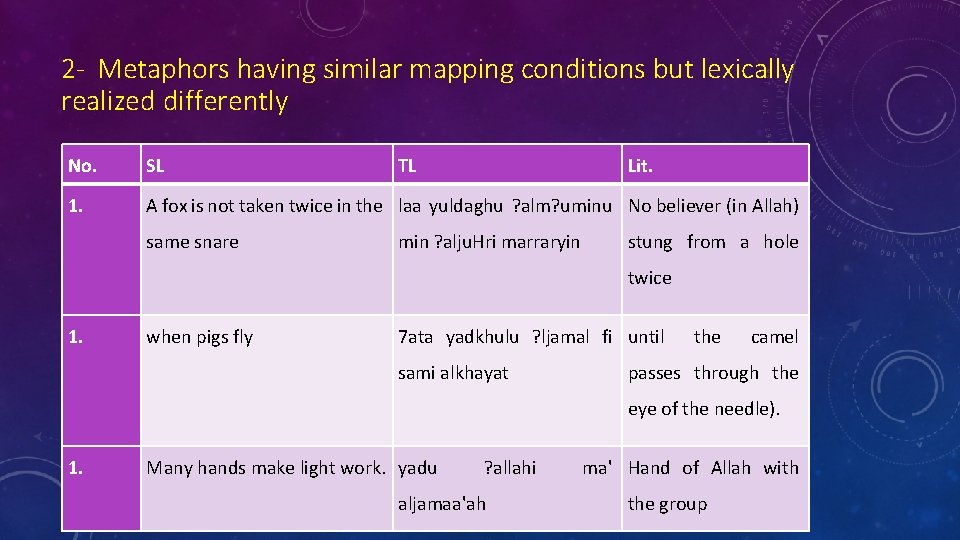
2 - Metaphors having similar mapping conditions but lexically realized differently Beliefs and religion are aspects of culture that play a very significant role in translation. As is shown in the following examples, although the English examples and their Arabic counterpart metaphors are related to the same conceptual domain, the religion or ethical system in the TL has led to major differences in lexical choice.
2 - Metaphors having similar mapping conditions but lexically realized differently No. SL 1. A fox is not taken twice in the laa yuldaghu ? alm? uminu No believer (in Allah) same snare TL Lit. min ? alju. Hri marraryin stung from a hole twice 1. when pigs fly 7 ata yadkhulu ? ljamal fi until sami alkhayat the camel passes through the eye of the needle). 1. Many hands make light work. yadu ? allahi aljamaa'ah ma' Hand of Allah with the group
3 - Metaphors of different mapping conditions 1. Domestication: It means “negotiating the metaphorical elements of the source text in terms of target language norms, values, and conventions” (Hatim, 1999, p. 214). A foreign text needs to be domesticated. i. e. brought as nearest as possible to the domestic culture. And a domestic text needs to be brought as closest as possible to the foreign culture in the target language. Such a task could require the translator to move, in the process of transferring the meaning of the metaphoric expression, between the ‘paraphrase’ and ‘metaphrase’ in the absence of the right equivalent. The metaphoric expression ‘to break the ice’ in English has no equivalent metaphoric expression in Arabic. The translation of this image has come to be known as ( ) ﻳﻜﺴﺮ ﺣﺎﺟﺰ ﺍﻟﺼﻤﺖ where part of the image is kept ( )ﻳﻜﺴﺮ whereas ‘the ice’ is conceptualized as ‘silence’. But, ‘break’ and ‘silence’ can not stand on their own to trigger the same effect of the source language image on the recipient in the target language. Therefore, different concept is introduced to shape, in full, the image. The barrier ( )ﺣﺎﺟﺰ is the additional component, which can be ‘broken’.
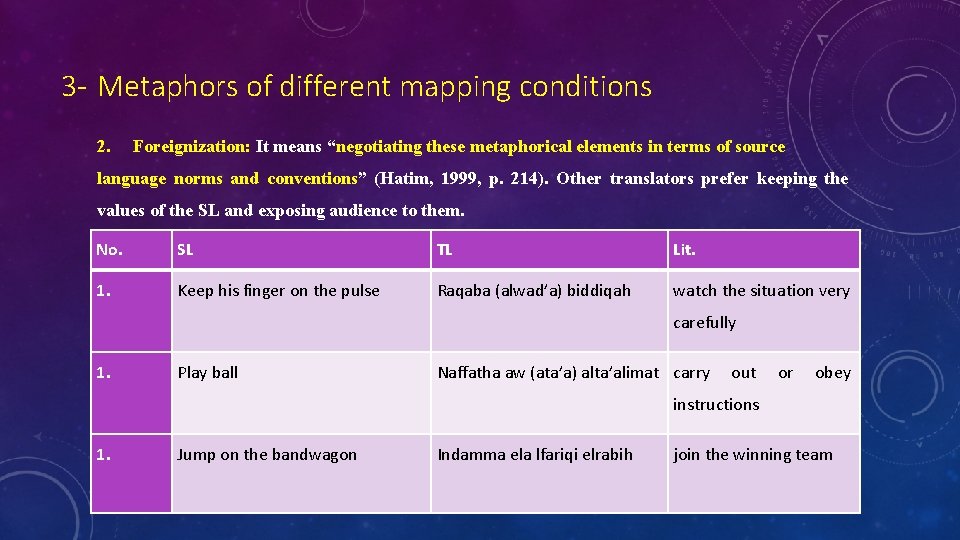
3 - Metaphors of different mapping conditions 2. Foreignization: It means “negotiating these metaphorical elements in terms of source language norms and conventions” (Hatim, 1999, p. 214). Other translators prefer keeping the values of the SL and exposing audience to them. No. SL TL Lit. 1. Keep his finger on the pulse Raqaba (alwad’a) biddiqah watch the situation very carefully 1. Play ball Naffatha aw (ata’a) alta’alimat carry out or obey instructions 1. Jump on the bandwagon Indamma ela lfariqi elrabih join the winning team
Recommendations Translators, whose task is to produce a TL text that bears a close resemblance to the SL text, should be aware of cognitive and cultural issues when translating from Arabic into English or viceversa. Therefore, it is not enough for translators to be bilingual, but they should be bicultural as well. It is recommended that translators be trained in coping with metaphor translation not only in foreign-language programs, but also in their native language. Sometimes, even native speakers are not always able to comprehend the figurative meaning of messages in their own language. Some translators prefer changing the SL values and making them readable for the TL audience. This is termed Domestication. Other translators prefer keeping the values of the SL and exposing audience to them.
References: Abu-Ssaydeh, A. -F. (2004). Translation of English idioms into Arabic. Babel, 50(2), pp. 114 -131. Al-Ali, M. (2004). Familiar words in unfamiliar contexts. Perspectives. Studies in Translatology, 12 (2), pp. 134 -144. Al-Hasnawi, A. R. (2007). A Cognitive Approach to Translating Metaphors. Translation Journal, 11(3). Retrieved 05 08, 2017, from http: //translationjournal. net/journal/41 metaphor. htm Benczes, R. (2006). Creative Compounding in English: The Semantics of Metaphorical and Metonymical Noun-Noun Combinations. AmsterdamPhiladelphia: John Benjamins Publishing. Benjamins, J. (1998). The Contemporary Theory of Metaphor: A Perspective from Chinese. Amsterdam/ Philadelphia: John Benjamins Publishing Company. Brown, T. L. (2003). Making Truth: Metaphor in Science. Illinois: University of Illinois Press. Cohen, M. Z. (2003). Three Approaches to Biblical Metaphor: From Abraham Ibn Ezra and Maimonides to David Kimhi. Leiden: Brill.
Emanatian, M. (1995). Metaphor and the Expression of Emotion: The Value of Cross- Cultural Perspectives. Metaphor and Symbolic Activity, 10(3), pp. 163 -182. Hatim, B. (1999). Implications of Research into Translator Invisibility. International Journal of Translation Studies, 11(2), pp. 201 -222. Kant, C. C. (2007). Cognitive Metaphor and Continental Philosophy. London and New York: Routledge. Knowles, M. , & Moon, R. (2006). Introducing Metaphor. London and New York: Routledge. Kovecses, Z. (2010). Metaphor: A Practical Introduction (2 ed. ). Oxford: Oxford University Press. Kovecses, Z. (2010). Metaphor: A Practical Introduction (2 ed. ). Oxford: University Press. Lakoff, G. (1993). The Contemporary Theory of Metaphor. In A. Ortony (Ed. ), Metaphor and Thought (2 ed. ). Cambridge: Cambridge University Press. Lakoff, G. , & Johnson, M. (1980). Metaphors We Live By. Chicago and London: The University of Chicago Press. Mandelblit, N. (1995). The cognitive view of metaphor and its implications for translation theory: Translation and Meaning. Maastricht: Maastricht Universitaire Press. Newmark, P. (1982). Approaches to Translation. Oxford: Pergamon Press. Nordquist, R. (2017, 04 25). Thought Co. Retrieved 05 07, 2017, from Conceptual Metaphor: https: //www. thoughtco. com/what-is-conceptual-metaphor-1689899 Radden, G. , & Dirven, R. (2007). Cognitive English Grammar (Vol. 2). AmsterdamPhiladelphia: John Benjamins Publishing. Dagut, M. (1976). Can metaphor be translated? Bebel. International Journal of Translation, 22 (1), pp. 21 -33. Deignan, A. (2005). Metaphor and Corpus Linguistics. Amersterdam: John Benjamins Publishing Co. Dickins, J. , Harvey, S. , & Higgins, I. (2002). Thinking Arabic Translation: A Course in Translation Method: Arabic to English. London: Routledge.