
Metamorphism New Rocks from Old Chapter 10 Geology
- Slides: 38
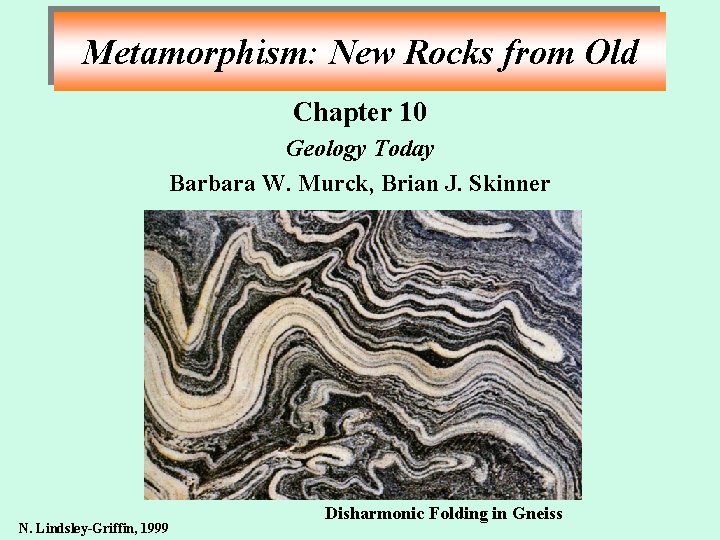
Metamorphism: New Rocks from Old Chapter 10 Geology Today Barbara W. Murck, Brian J. Skinner N. Lindsley-Griffin, 1999 Disharmonic Folding in Gneiss
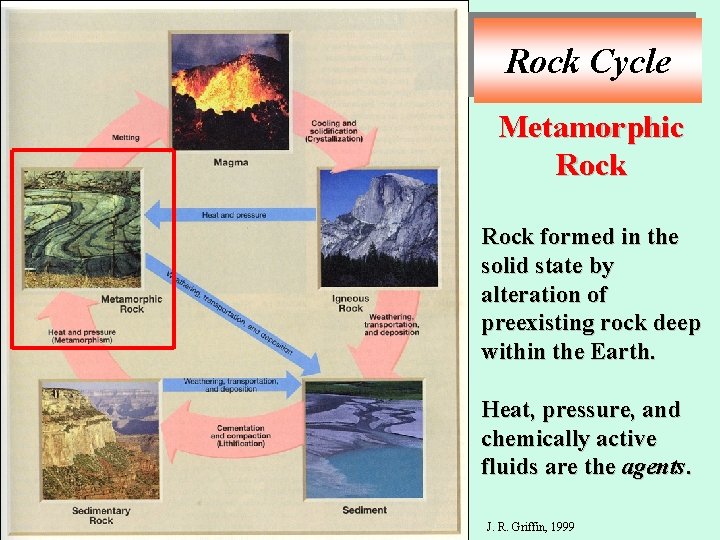
Rock Cycle Metamorphic Rock formed in the solid state by alteration of preexisting rock deep within the Earth. Heat, pressure, and chemically active fluids are the agents. J. R. Griffin, 1999
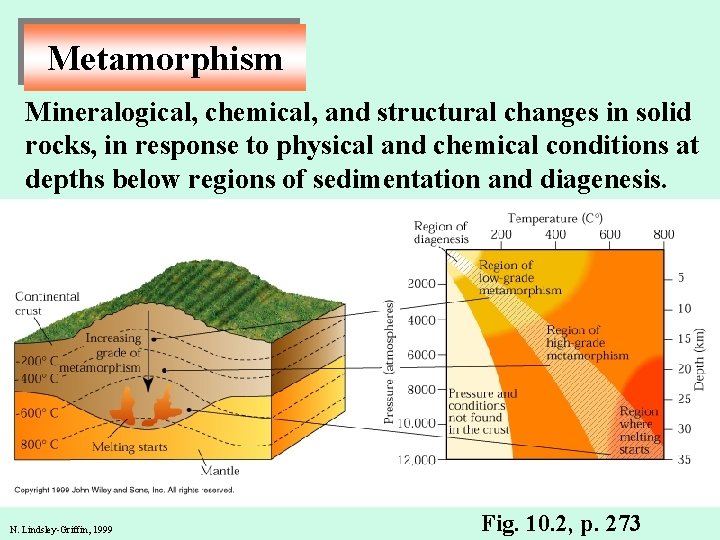
Metamorphism Mineralogical, chemical, and structural changes in solid rocks, in response to physical and chemical conditions at depths below regions of sedimentation and diagenesis. N. Lindsley-Griffin, 1999 Fig. 10. 2, p. 273
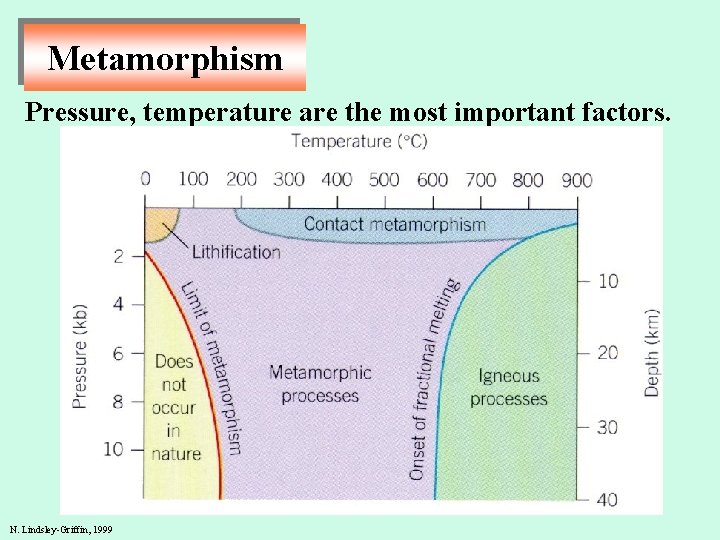
Metamorphism Pressure, temperature are the most important factors. N. Lindsley-Griffin, 1999
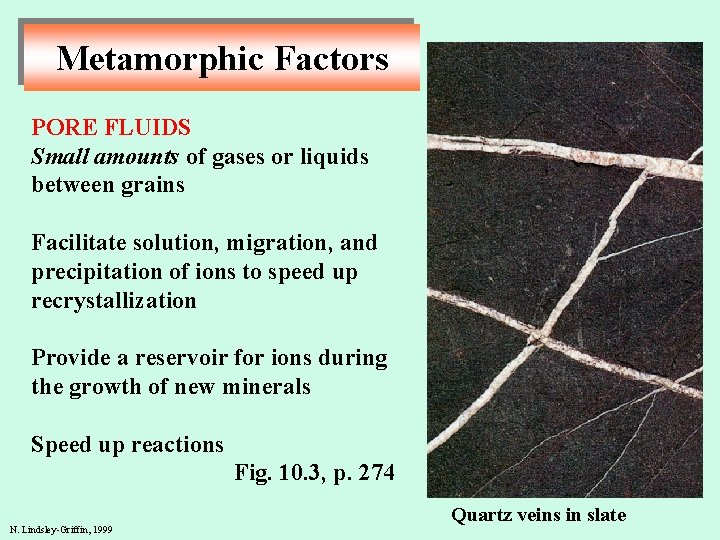
Metamorphic Factors PORE FLUIDS Small amounts of gases or liquids between grains Facilitate solution, migration, and precipitation of ions to speed up recrystallization Provide a reservoir for ions during the growth of new minerals Speed up reactions Fig. 10. 3, p. 274 N. Lindsley-Griffin, 1999 Quartz veins in slate
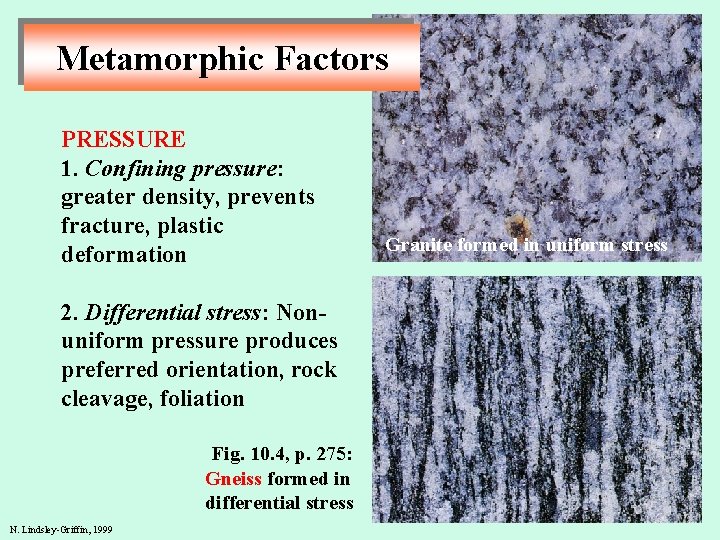
Metamorphic Factors PRESSURE 1. Confining pressure: greater density, prevents fracture, plastic deformation 2. Differential stress: Nonuniform pressure produces preferred orientation, rock cleavage, foliation Fig. 10. 4, p. 275: Gneiss formed in differential stress N. Lindsley-Griffin, 1999 Granite formed in uniform stress
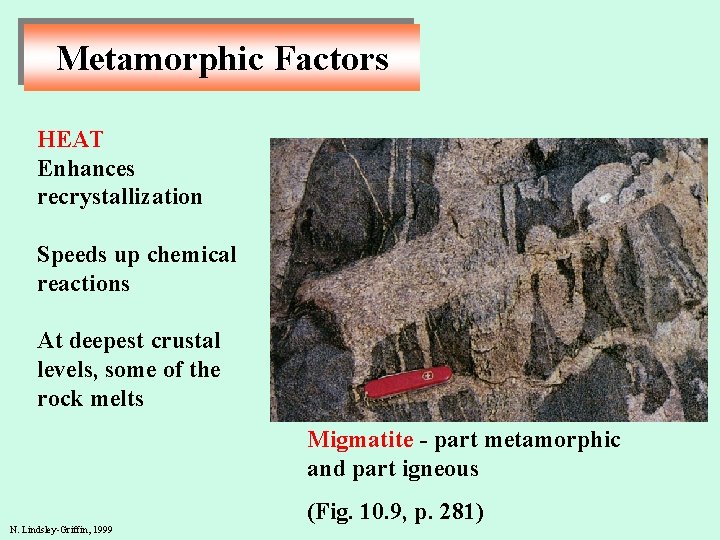
Metamorphic Factors HEAT Enhances recrystallization Speeds up chemical reactions At deepest crustal levels, some of the rock melts Migmatite - part metamorphic and part igneous N. Lindsley-Griffin, 1999 (Fig. 10. 9, p. 281)
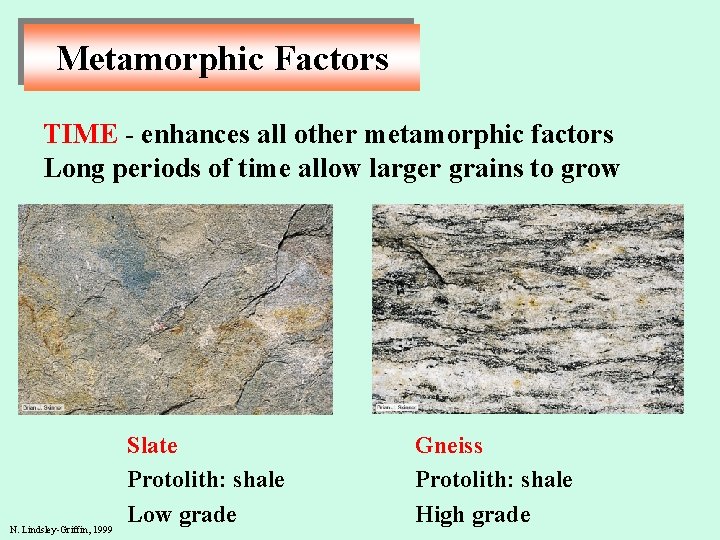
Metamorphic Factors TIME - enhances all other metamorphic factors Long periods of time allow larger grains to grow N. Lindsley-Griffin, 1999 Slate Protolith: shale Low grade Gneiss Protolith: shale High grade
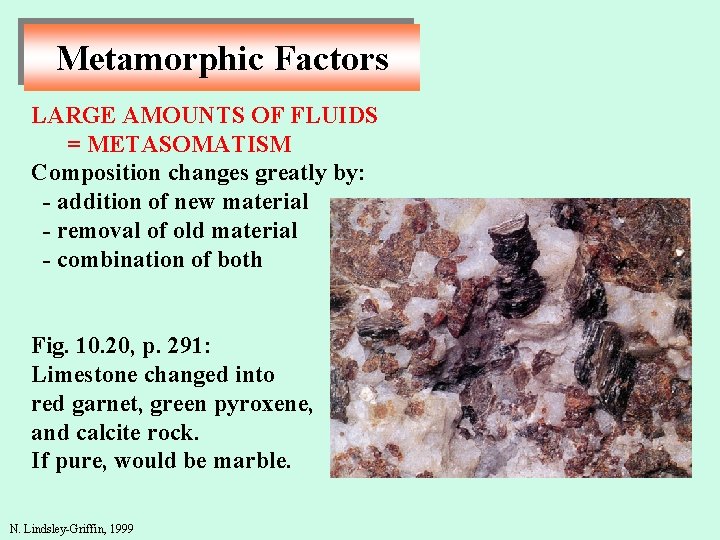
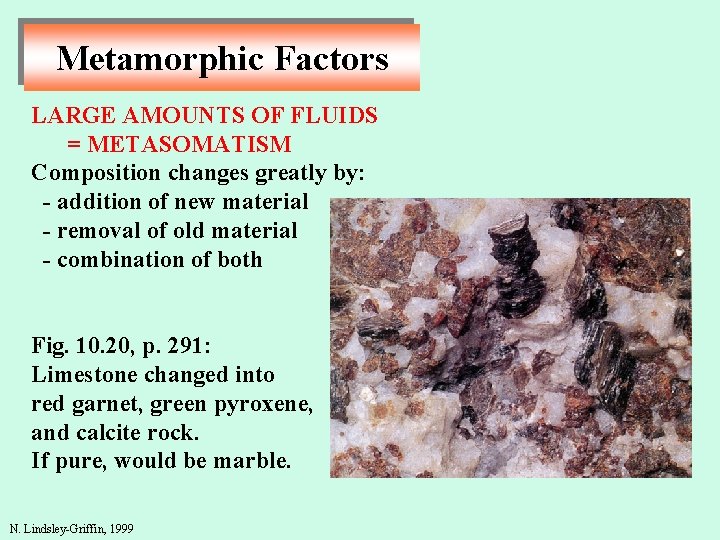
Metamorphic Factors LARGE AMOUNTS OF FLUIDS = METASOMATISM Composition changes greatly by: - addition of new material - removal of old material - combination of both Fig. 10. 20, p. 291: Limestone changed into red garnet, green pyroxene, and calcite rock. If pure, would be marble. N. Lindsley-Griffin, 1999
Metamorphic Factors LARGE AMOUNTS OF FLUIDS = METASOMATISM Composition changes greatly by: - addition of new material - removal of old material - combination of both Fig. 10. 20, p. 291: Limestone changed into red garnet, green pyroxene, and calcite rock. If pure, would be marble. N. Lindsley-Griffin, 1999
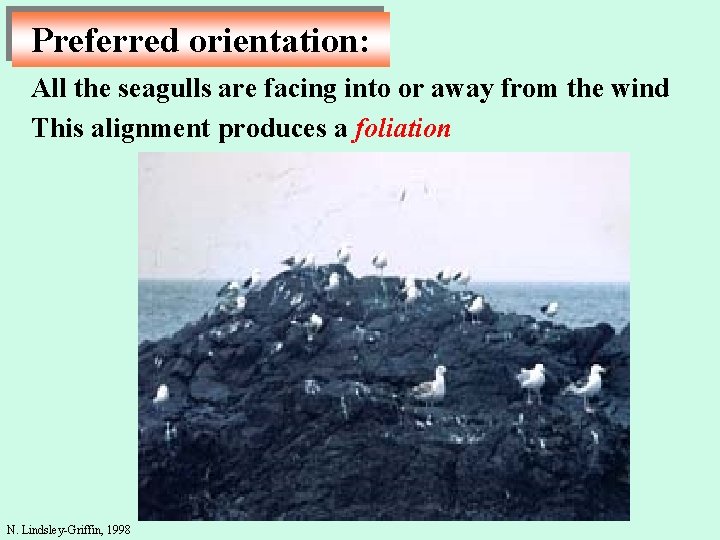
Preferred orientation: All the seagulls are facing into or away from the wind This alignment produces a foliation N. Lindsley-Griffin, 1998
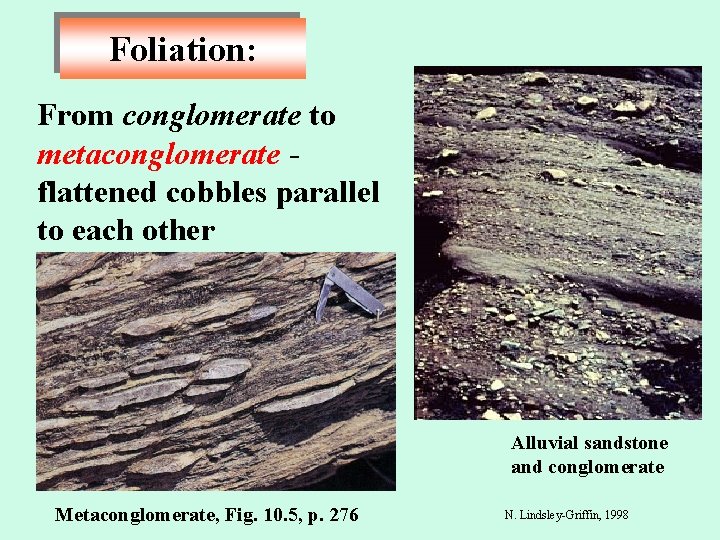
Foliation: From conglomerate to metaconglomerate flattened cobbles parallel to each other Alluvial sandstone and conglomerate Metaconglomerate, Fig. 10. 5, p. 276 N. Lindsley-Griffin, 1998
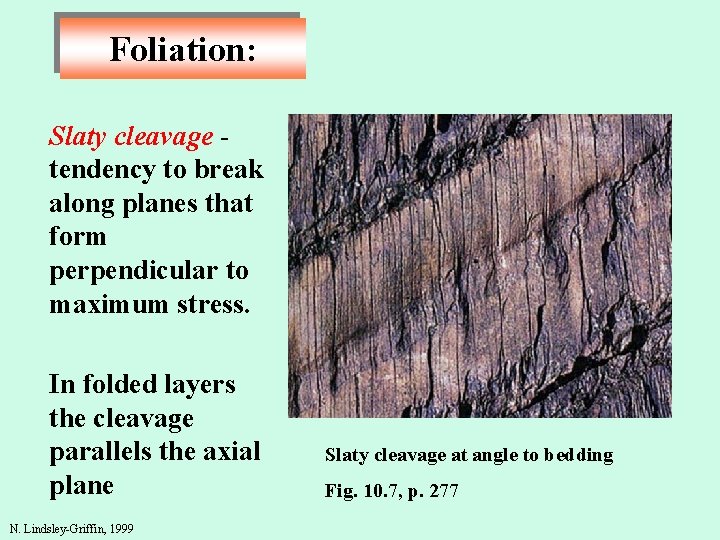
Foliation: Slaty cleavage tendency to break along planes that form perpendicular to maximum stress. In folded layers the cleavage parallels the axial plane N. Lindsley-Griffin, 1999 Slaty cleavage at angle to bedding Fig. 10. 7, p. 277
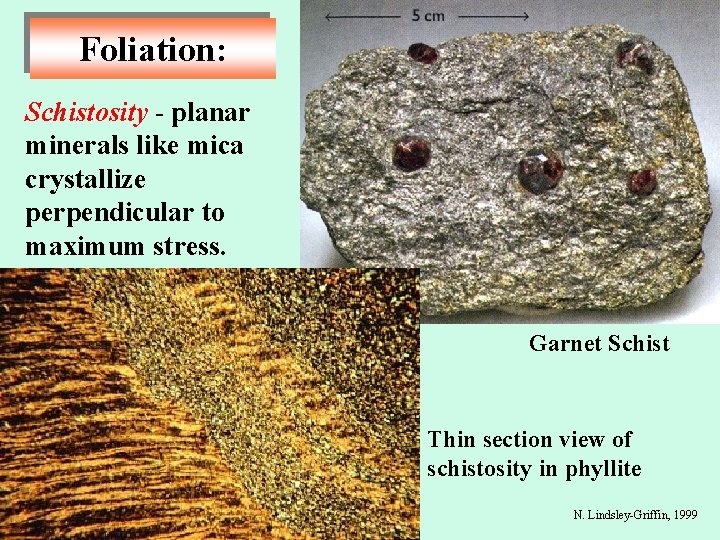
Foliation: Schistosity - planar minerals like mica crystallize perpendicular to maximum stress. Garnet Schist Thin section view of schistosity in phyllite N. Lindsley-Griffin, 1999
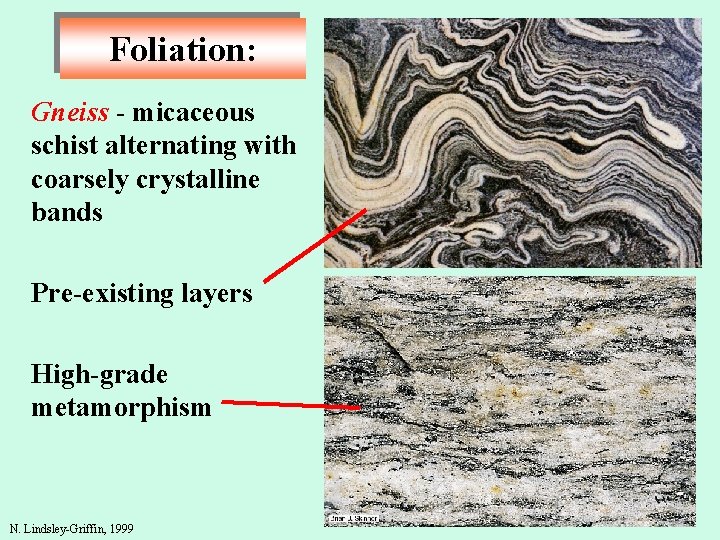
Foliation: Gneiss - micaceous schist alternating with coarsely crystalline bands Pre-existing layers High-grade metamorphism N. Lindsley-Griffin, 1999
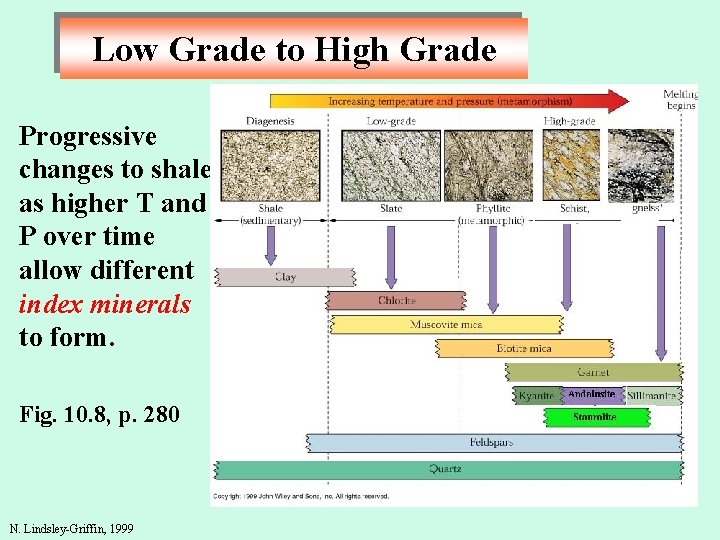
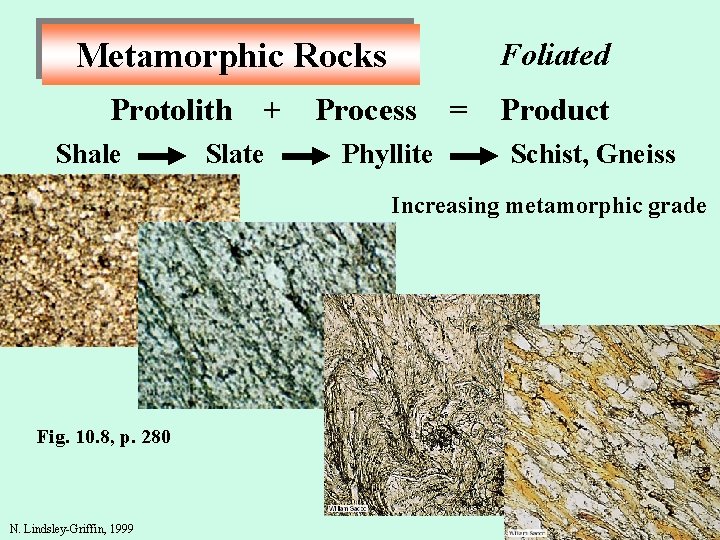
Low Grade to High Grade Progressive changes to shale as higher T and P over time allow different index minerals to form. Fig. 10. 8, p. 280 N. Lindsley-Griffin, 1999
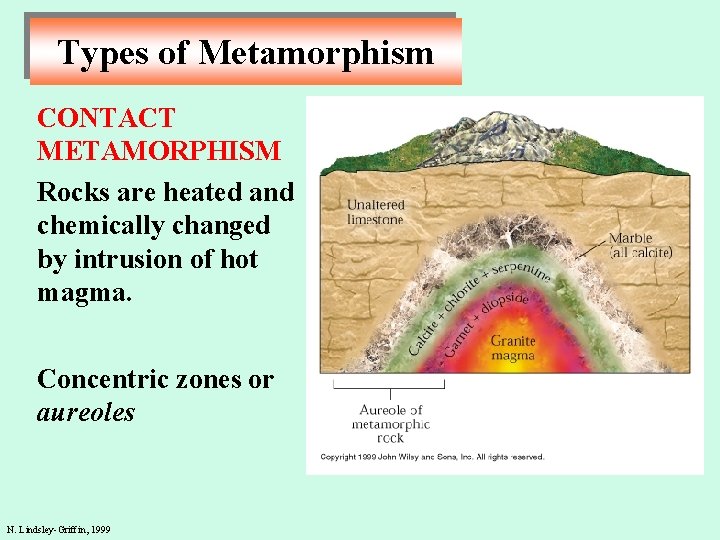
Types of Metamorphism CONTACT METAMORPHISM Rocks are heated and chemically changed by intrusion of hot magma. Concentric zones or aureoles N. Lindsley-Griffin, 1999
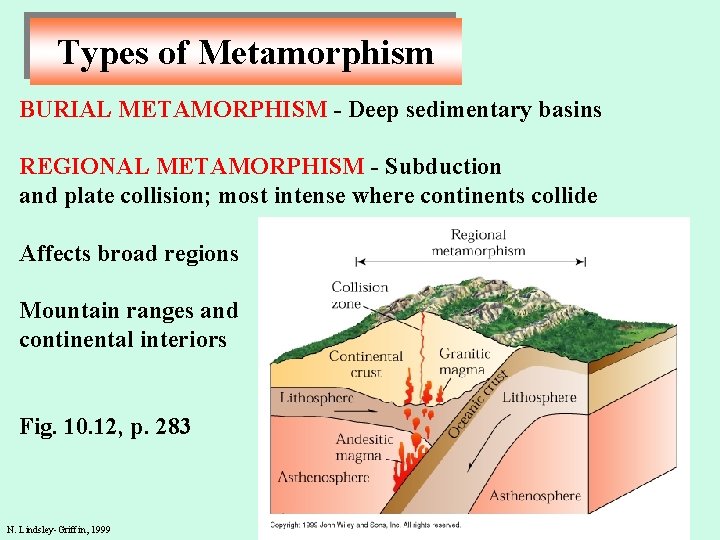
Types of Metamorphism BURIAL METAMORPHISM - Deep sedimentary basins REGIONAL METAMORPHISM - Subduction and plate collision; most intense where continents collide Affects broad regions Mountain ranges and continental interiors Fig. 10. 12, p. 283 N. Lindsley-Griffin, 1999
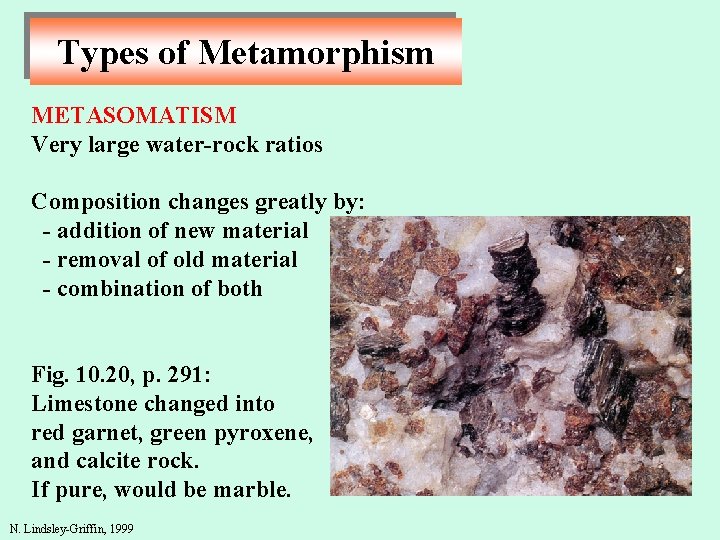
Types of Metamorphism METASOMATISM Very large water-rock ratios Composition changes greatly by: - addition of new material - removal of old material - combination of both Fig. 10. 20, p. 291: Limestone changed into red garnet, green pyroxene, and calcite rock. If pure, would be marble. N. Lindsley-Griffin, 1999
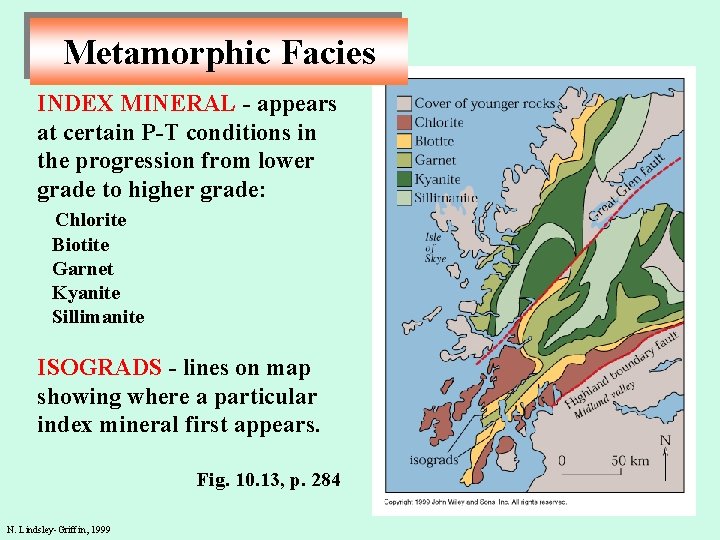
Metamorphic Facies INDEX MINERAL - appears at certain P-T conditions in the progression from lower grade to higher grade: Chlorite Biotite Garnet Kyanite Sillimanite ISOGRADS - lines on map showing where a particular index mineral first appears. Fig. 10. 13, p. 284 N. Lindsley-Griffin, 1999
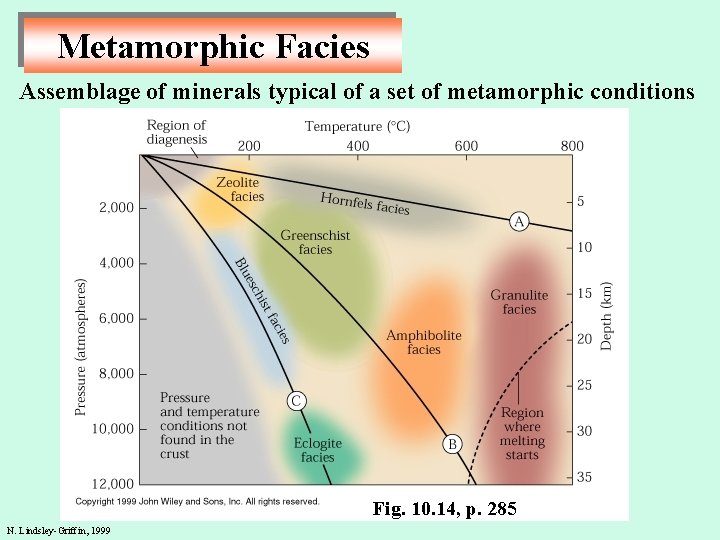
Metamorphic Facies Assemblage of minerals typical of a set of metamorphic conditions Fig. 10. 14, p. 285 N. Lindsley-Griffin, 1999
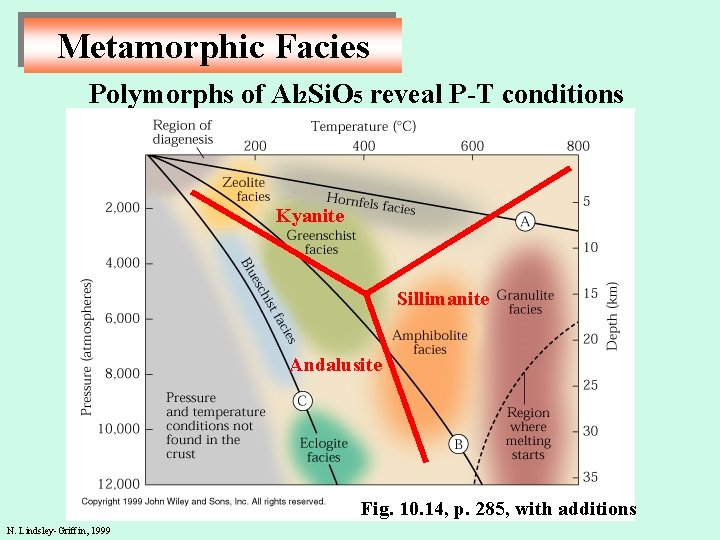
Metamorphic Facies Polymorphs of Al 2 Si. O 5 reveal P-T conditions Kyanite Sillimanite Andalusite Fig. 10. 14, p. 285, with additions N. Lindsley-Griffin, 1999
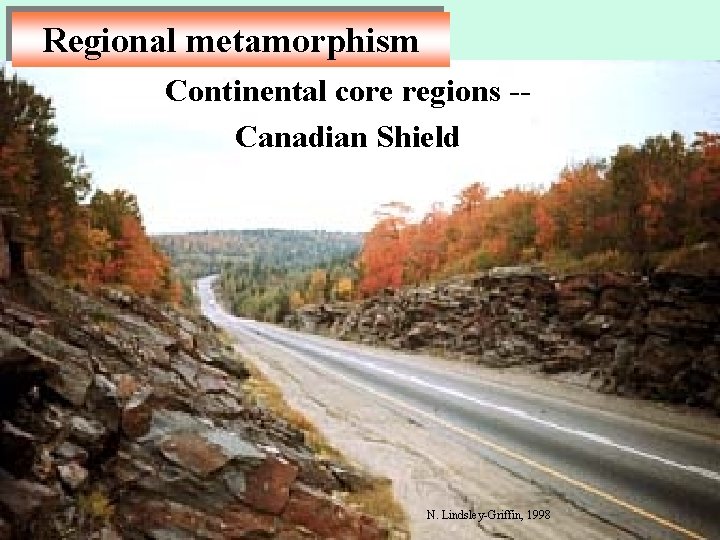
Regional metamorphism Continental core regions -Canadian Shield N. Lindsley-Griffin, 1998
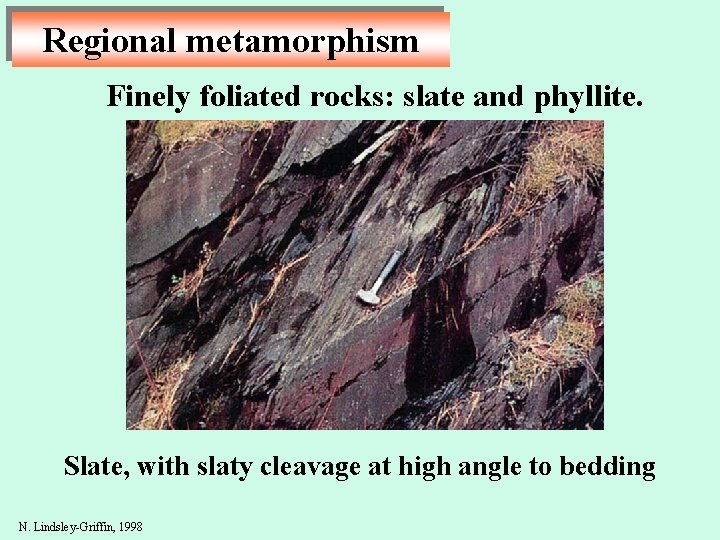
Regional metamorphism Finely foliated rocks: slate and phyllite. Slate, with slaty cleavage at high angle to bedding N. Lindsley-Griffin, 1998
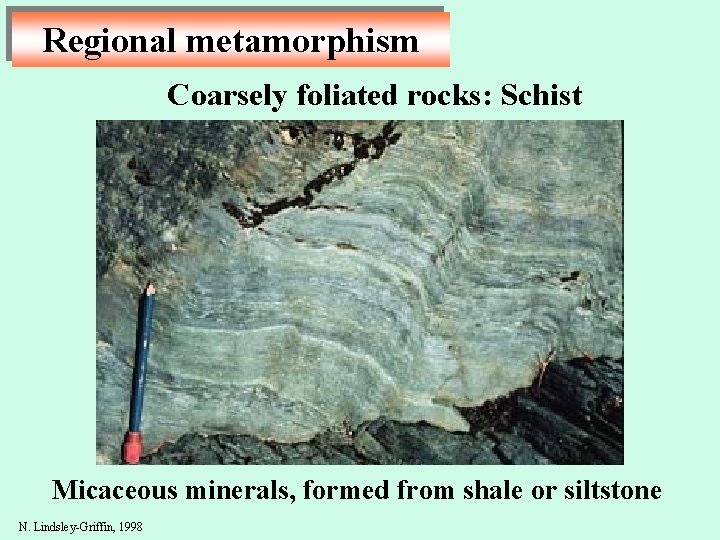
Regional metamorphism Coarsely foliated rocks: Schist Micaceous minerals, formed from shale or siltstone N. Lindsley-Griffin, 1998
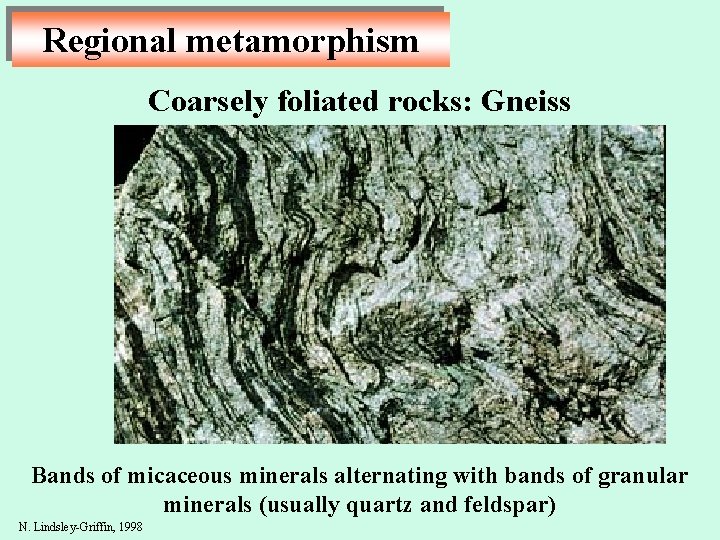
Regional metamorphism Coarsely foliated rocks: Gneiss Bands of micaceous minerals alternating with bands of granular minerals (usually quartz and feldspar) N. Lindsley-Griffin, 1998
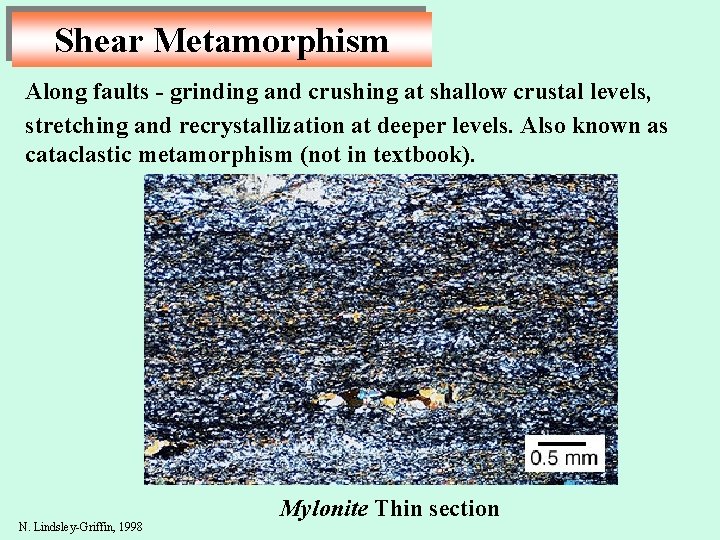
Shear Metamorphism Along faults - grinding and crushing at shallow crustal levels, stretching and recrystallization at deeper levels. Also known as cataclastic metamorphism (not in textbook). N. Lindsley-Griffin, 1998 Mylonite Thin section
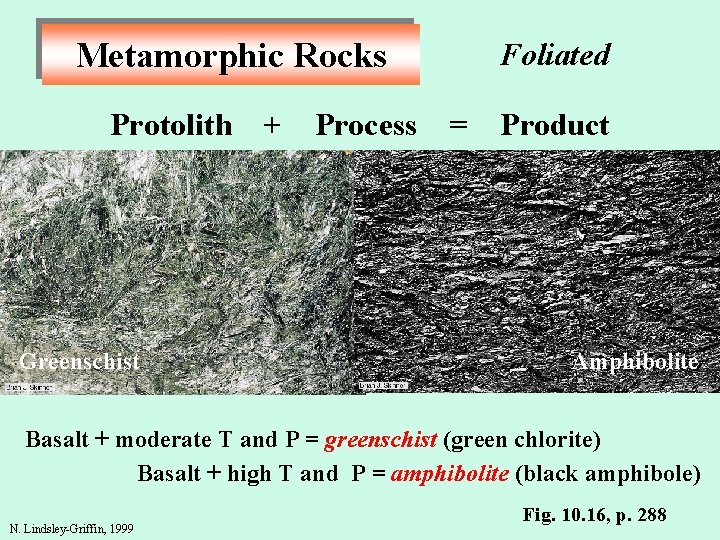
Metamorphic Rocks Protolith Greenschist + Process Foliated = Product Amphibolite Basalt + moderate T and P = greenschist (green chlorite) Basalt + high T and P = amphibolite (black amphibole) N. Lindsley-Griffin, 1999 Fig. 10. 16, p. 288
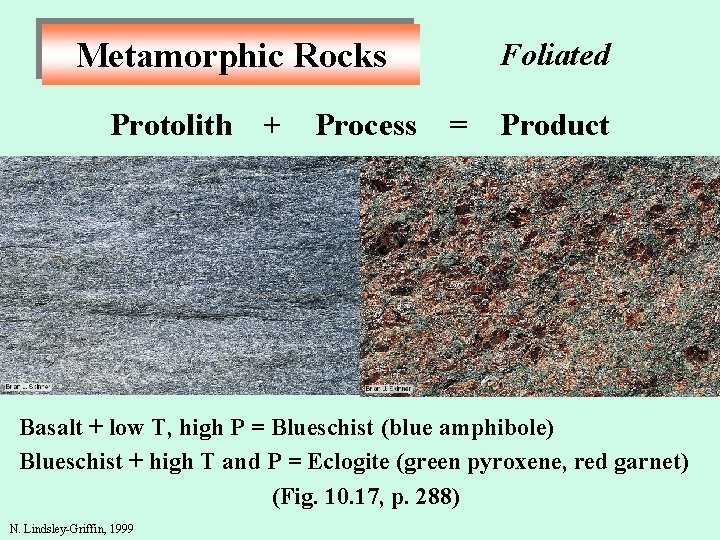
Metamorphic Rocks Protolith + Process Foliated = Product Basalt + low T, high P = Blueschist (blue amphibole) Blueschist + high T and P = Eclogite (green pyroxene, red garnet) (Fig. 10. 17, p. 288) N. Lindsley-Griffin, 1999
Metamorphic Rocks Protolith Shale + Slate Foliated Process Phyllite = Product Schist, Gneiss Increasing metamorphic grade Fig. 10. 8, p. 280 N. Lindsley-Griffin, 1999
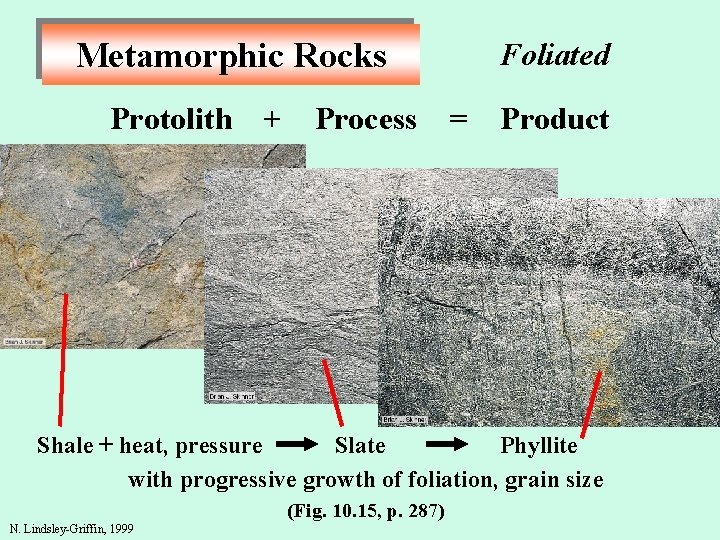
Metamorphic Rocks Protolith + Process Foliated = Product Shale + heat, pressure Slate Phyllite with progressive growth of foliation, grain size (Fig. 10. 15, p. 287) N. Lindsley-Griffin, 1999
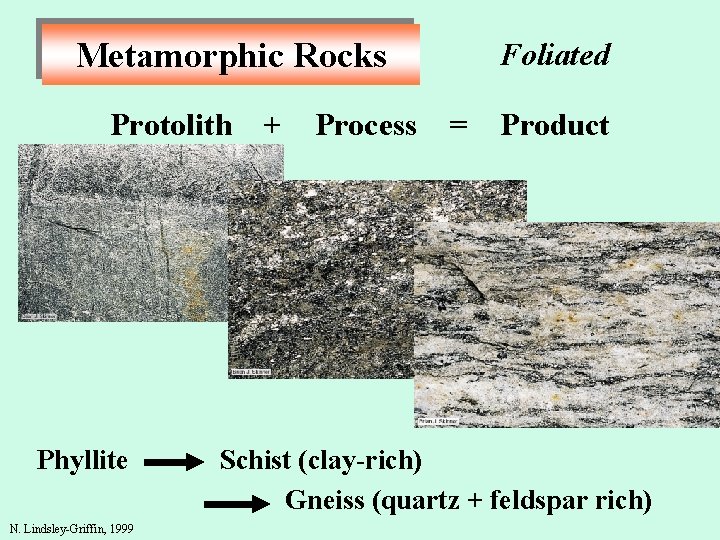
Metamorphic Rocks Protolith Phyllite N. Lindsley-Griffin, 1999 + Process Foliated = Product Schist (clay-rich) Gneiss (quartz + feldspar rich)
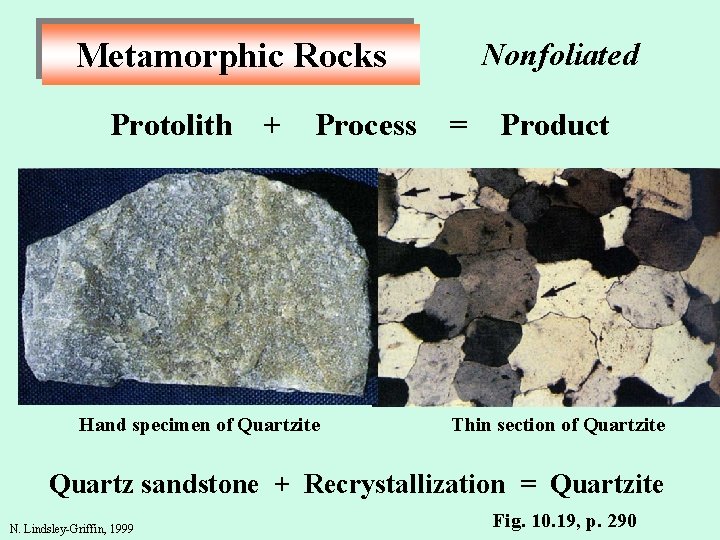
Metamorphic Rocks Protolith + Process Hand specimen of Quartzite Nonfoliated = Product Thin section of Quartzite Quartz sandstone + Recrystallization = Quartzite N. Lindsley-Griffin, 1999 Fig. 10. 19, p. 290
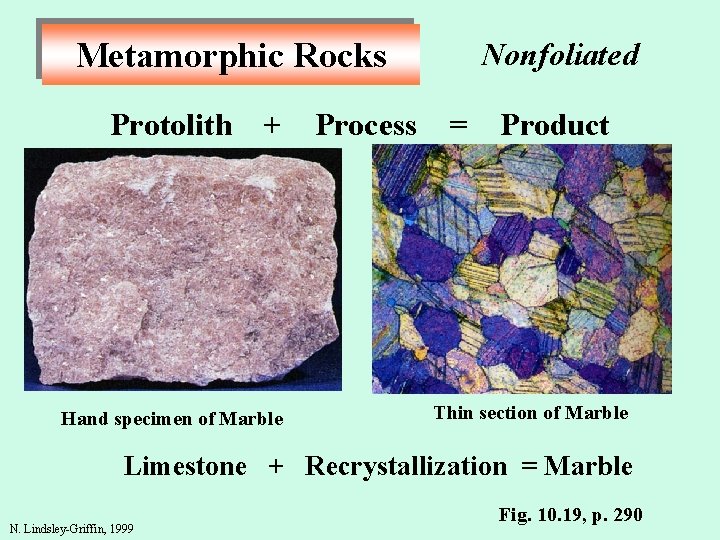
Metamorphic Rocks Protolith + Hand specimen of Marble Process Nonfoliated = Product Thin section of Marble Limestone + Recrystallization = Marble N. Lindsley-Griffin, 1999 Fig. 10. 19, p. 290
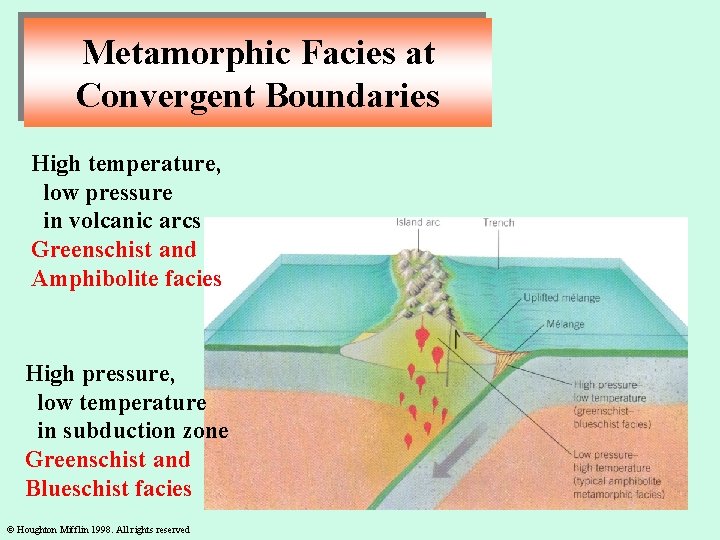
Metamorphic Facies at Convergent Boundaries High temperature, low pressure in volcanic arcs Greenschist and Amphibolite facies High pressure, low temperature in subduction zone Greenschist and Blueschist facies © Houghton Mifflin 1998. All rights reserved
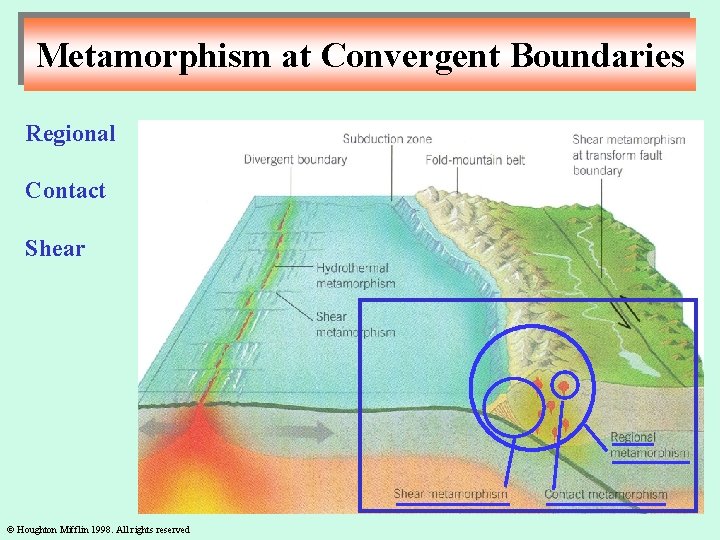
Metamorphism at Convergent Boundaries Regional Contact Shear © Houghton Mifflin 1998. All rights reserved
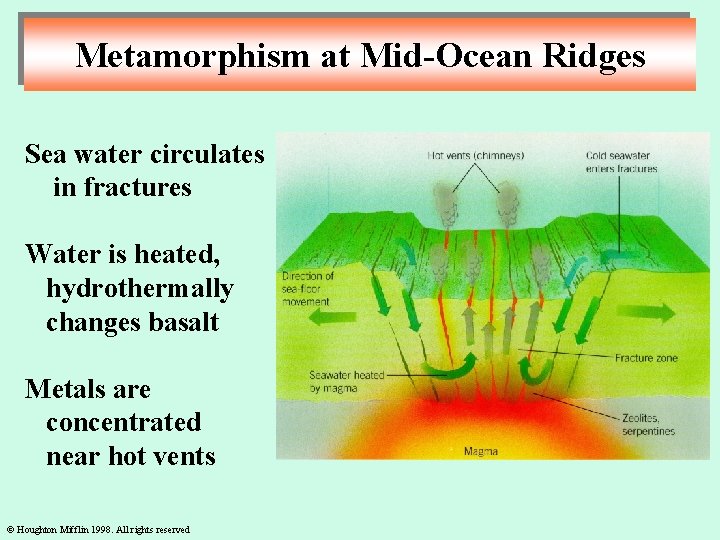
Metamorphism at Mid-Ocean Ridges Sea water circulates in fractures Water is heated, hydrothermally changes basalt Metals are concentrated near hot vents © Houghton Mifflin 1998. All rights reserved
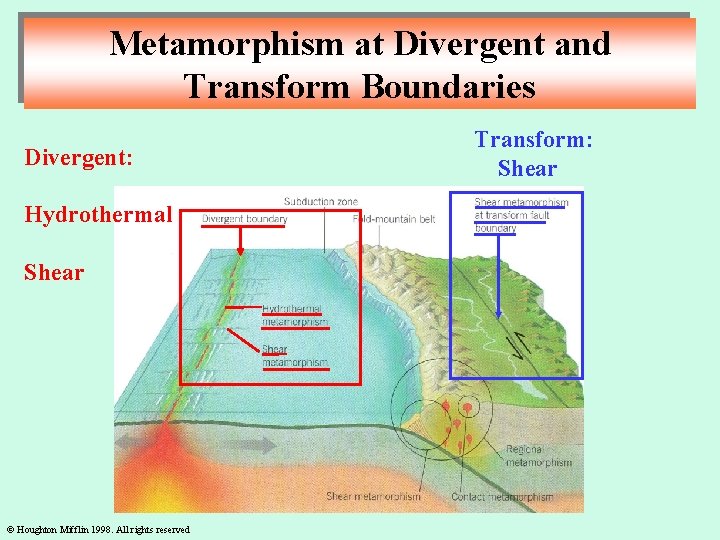
Metamorphism at Divergent and Transform Boundaries Divergent: Hydrothermal Shear © Houghton Mifflin 1998. All rights reserved Transform: Shear