
Metamorphic Rocks Metamorphism Literally translates to change of
- Slides: 19
Metamorphic Rocks
Metamorphism • Literally translates to “change of form” • In geology it refers to solid-state changes in mineral assemblages of a rock, and/or the texture of these minerals • Due to changes in temperature and/or pressure
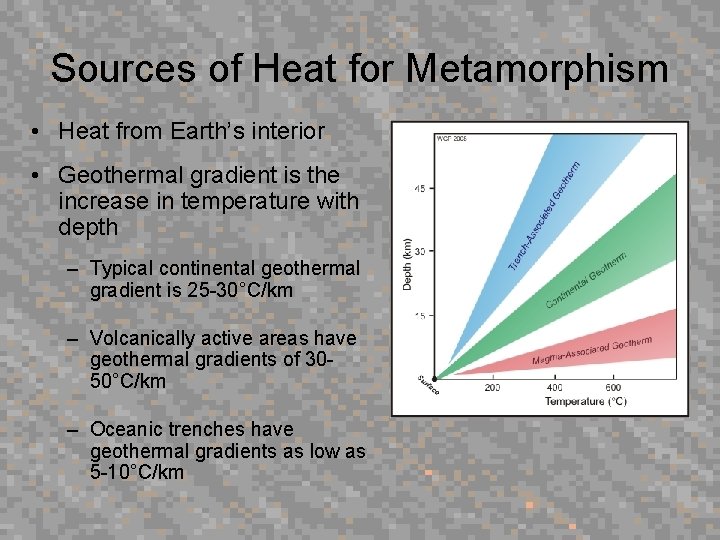
Sources of Heat for Metamorphism • Heat from Earth’s interior • Geothermal gradient is the increase in temperature with depth – Typical continental geothermal gradient is 25 -30°C/km – Volcanically active areas have geothermal gradients of 3050°C/km – Oceanic trenches have geothermal gradients as low as 5 -10°C/km
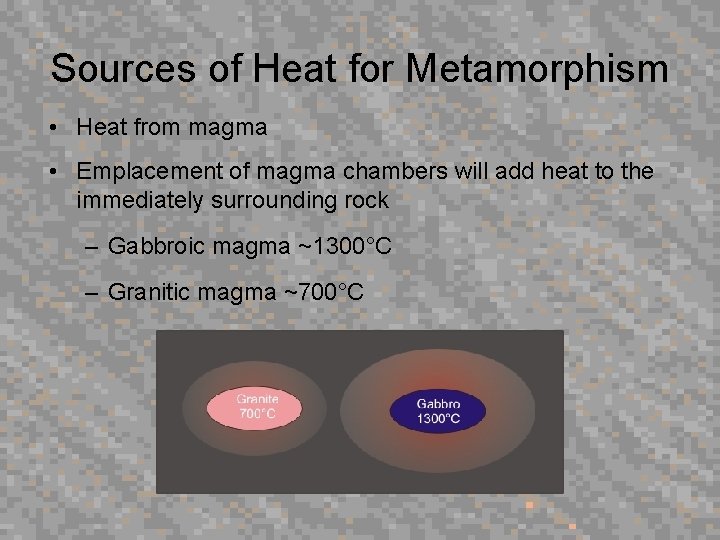
Sources of Heat for Metamorphism • Heat from magma • Emplacement of magma chambers will add heat to the immediately surrounding rock – Gabbroic magma ~1300°C – Granitic magma ~700°C
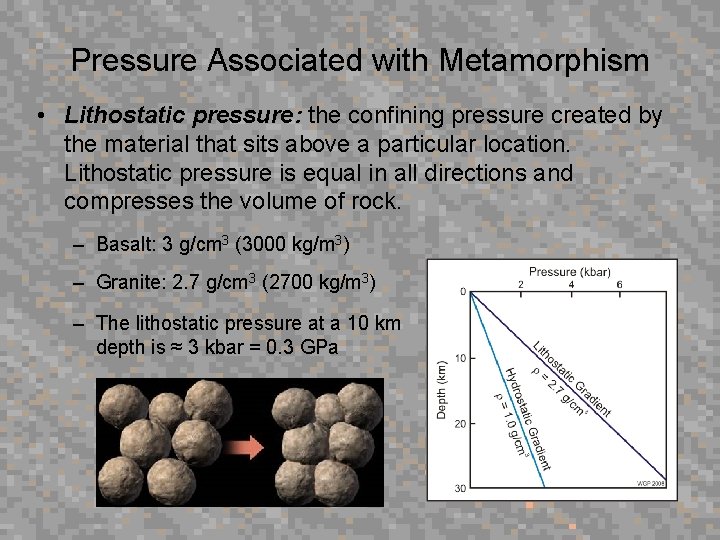
Pressure Associated with Metamorphism • Lithostatic pressure: the confining pressure created by the material that sits above a particular location. Lithostatic pressure is equal in all directions and compresses the volume of rock. – Basalt: 3 g/cm 3 (3000 kg/m 3) – Granite: 2. 7 g/cm 3 (2700 kg/m 3) – The lithostatic pressure at a 10 km depth is ≈ 3 kbar = 0. 3 GPa
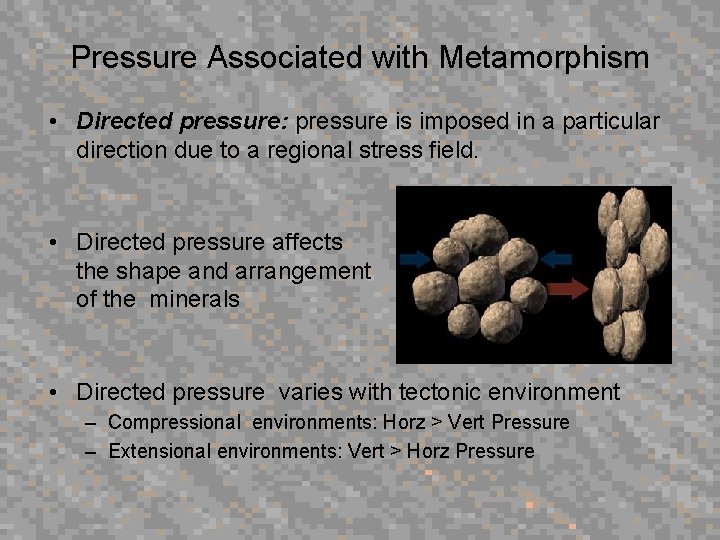
Pressure Associated with Metamorphism • Directed pressure: pressure is imposed in a particular direction due to a regional stress field. • Directed pressure affects the shape and arrangement of the minerals • Directed pressure varies with tectonic environment – Compressional environments: Horz > Vert Pressure – Extensional environments: Vert > Horz Pressure
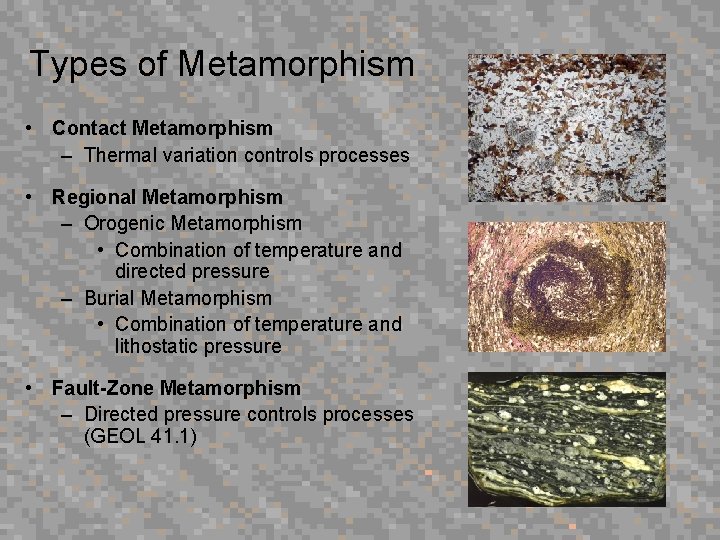
Types of Metamorphism • Contact Metamorphism – Thermal variation controls processes • Regional Metamorphism – Orogenic Metamorphism • Combination of temperature and directed pressure – Burial Metamorphism • Combination of temperature and lithostatic pressure • Fault-Zone Metamorphism – Directed pressure controls processes (GEOL 41. 1)
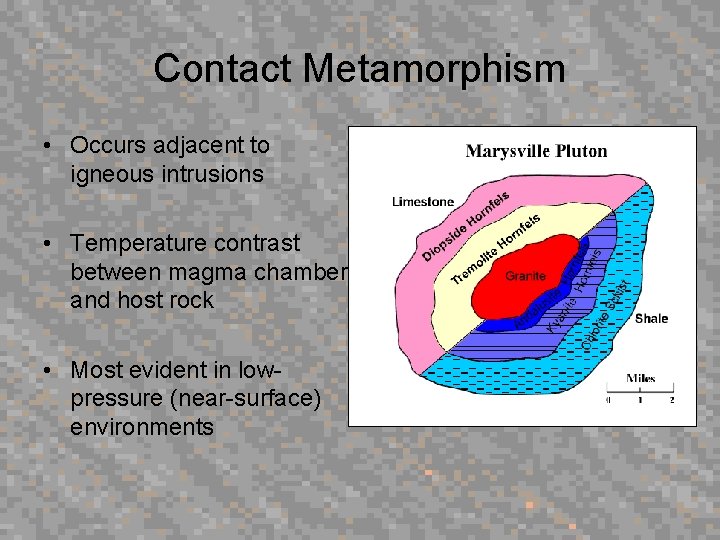
Contact Metamorphism • Occurs adjacent to igneous intrusions • Temperature contrast between magma chamber and host rock • Most evident in lowpressure (near-surface) environments
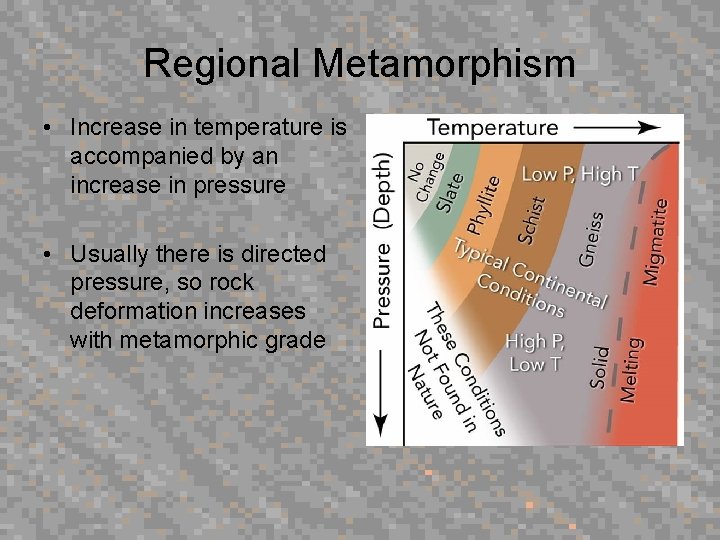
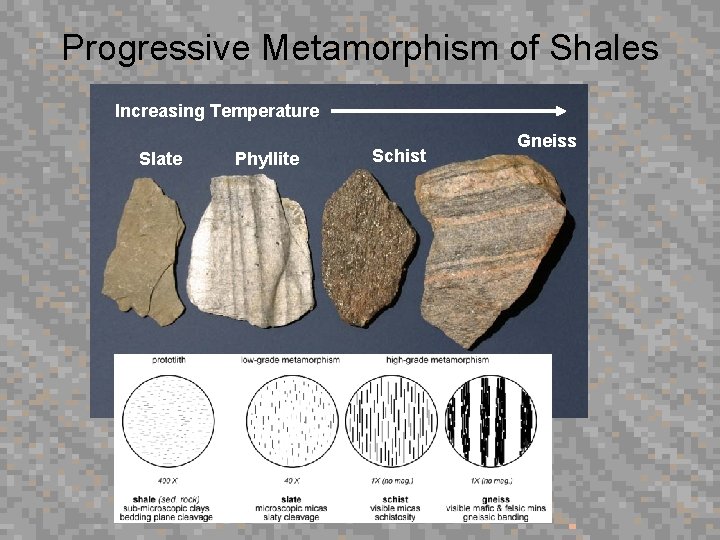
Regional Metamorphism • Increase in temperature is accompanied by an increase in pressure • Usually there is directed pressure, so rock deformation increases with metamorphic grade
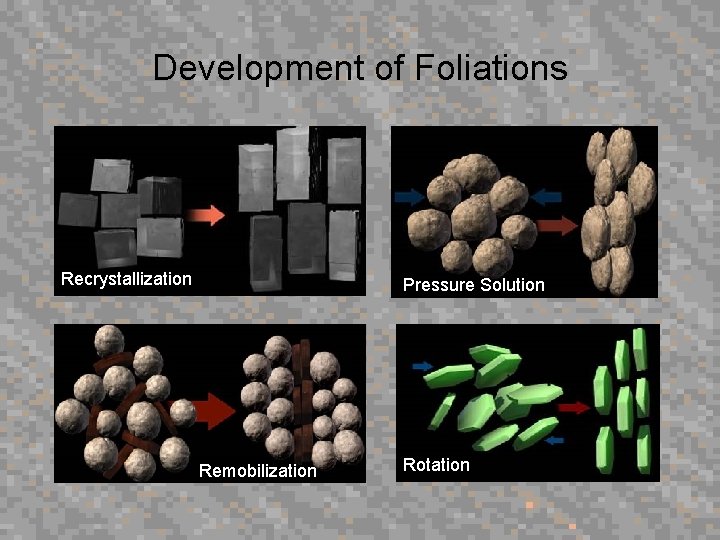
Development of Foliations Recrystallization Pressure Solution Remobilization Rotation
Metamorphic Zones and Facies
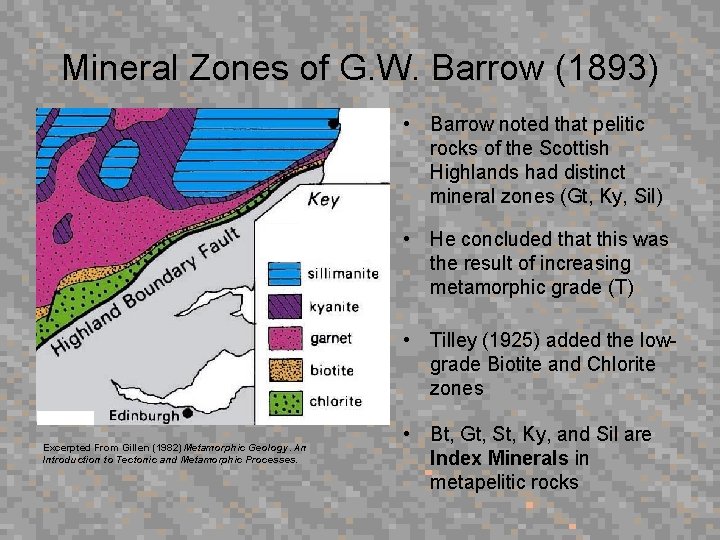
Mineral Zones of G. W. Barrow (1893) • Barrow noted that pelitic rocks of the Scottish Highlands had distinct mineral zones (Gt, Ky, Sil) • He concluded that this was the result of increasing metamorphic grade (T) • Tilley (1925) added the lowgrade Biotite and Chlorite zones Excerpted From Gillen (1982) Metamorphic Geology. An Introduction to Tectonic and Metamorphic Processes. • Bt, Gt, St, Ky, and Sil are Index Minerals in metapelitic rocks
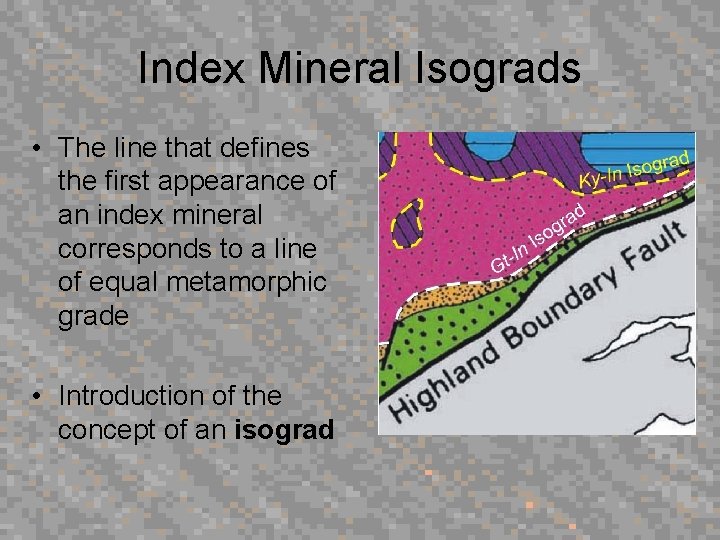
Index Mineral Isograds • The line that defines the first appearance of an index mineral corresponds to a line of equal metamorphic grade • Introduction of the concept of an isograd
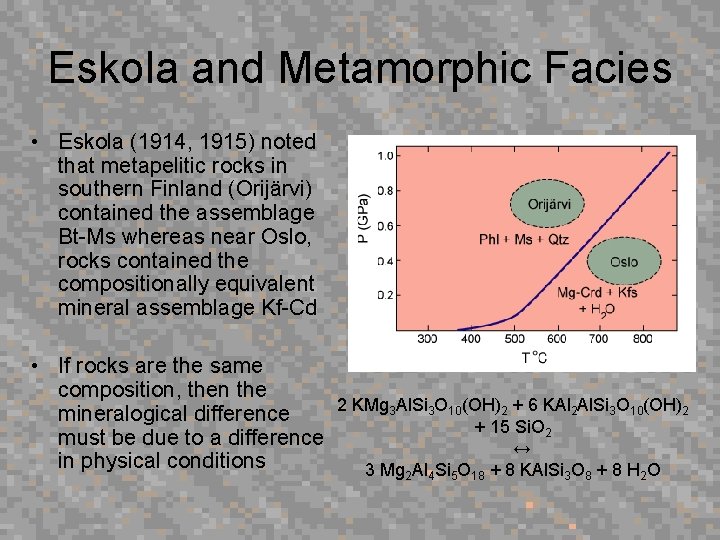
Eskola and Metamorphic Facies • Eskola (1914, 1915) noted that metapelitic rocks in southern Finland (Orijärvi) contained the assemblage Bt-Ms whereas near Oslo, rocks contained the compositionally equivalent mineral assemblage Kf-Cd • If rocks are the same composition, then the mineralogical difference must be due to a difference in physical conditions 2 KMg 3 Al. Si 3 O 10(OH)2 + 6 KAl 2 Al. Si 3 O 10(OH)2 + 15 Si. O 2 ↔ 3 Mg 2 Al 4 Si 5 O 18 + 8 KAl. Si 3 O 8 + 8 H 2 O
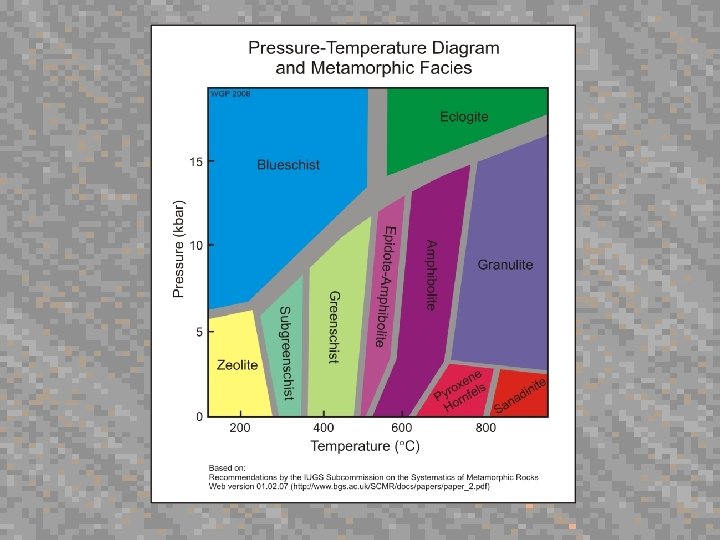
Eskola and Metamorphic Facies • Eskola (1915) introduced the concept of metamorphic facies: – “In any rock or metamorphic formation which has arrived at a chemical equilibrium through metamorphism at constant temperature and pressure conditions, the mineral composition is controlled only by the chemical composition. ” • A metamorphic facies is a set of repeatedly associated metamorphic mineral assemblages • If you find a specified mineral assemblage, then you can assign a metamorphic facies to the area, and thereby assign a range of pressure and temperature conditions.
Eskola and Metamorphic Facies • In 1920, Eskola introduced five metamorphic facies that were defined by mineral assemblages in metabasites: – Greenschist – Amphibolite – Hornfels – Sanidinite – Eclogite • In 1939, Eskola added an additional 3 metamorphic facies: – Granulite – Epidote-amphibolite – Glaucophane-schist (now called Blueschist) • In 1959 and 1960, Coombs added two additional metamorphic facies: – Zeolite – Prehnite-Pumpellyite (now called Subgreenschist)
Progressive Metamorphism of Shales Increasing Temperature Slate Phyllite Schist Gneiss
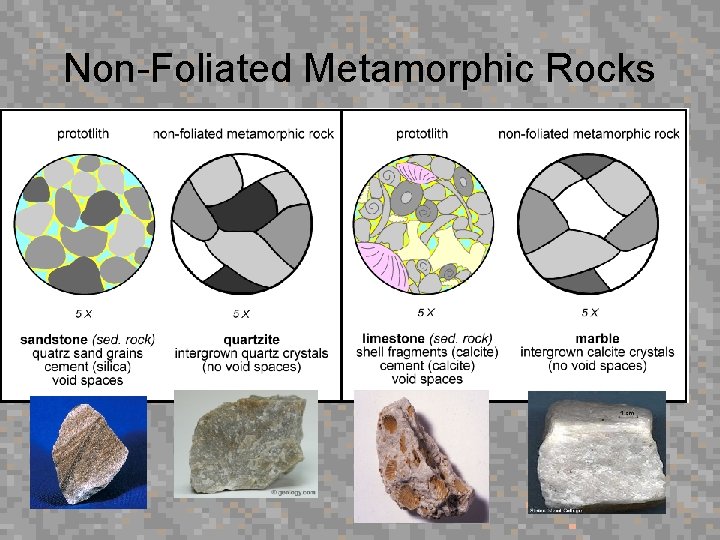
Non-Foliated Metamorphic Rocks