
Metamorphic and how to Identify them THE ROCK







- Slides: 51
Metamorphic and how to Identify them
THE ROCK CYCLE (*)
IGNEOUS ROCKS are “born of fire”. In other words, they were once molten and upon cooling, the magma (molten rock) crystallized into solid rock. Igneous rocks may form deep inside the Earth or at the Earth’s surface when a volcano erupts.
IGNEOUS ROCKS Slow cooling deep beneath the Earth’s surface allows crystals to grow to large size (1/8” or more). These crystals are easily visible and distinguish this group of igneous rocks as INTRUSIVE. Rapid cooling near or at the Earth’s surface, produces many small crystals that are not readily seen by the unaided eye. This group of igneous rocks is called EXTRUSIVE and are typically volcanic in origin. Cooling may be so rapid that crystals do not have a chance to form and instead a glass is produced.
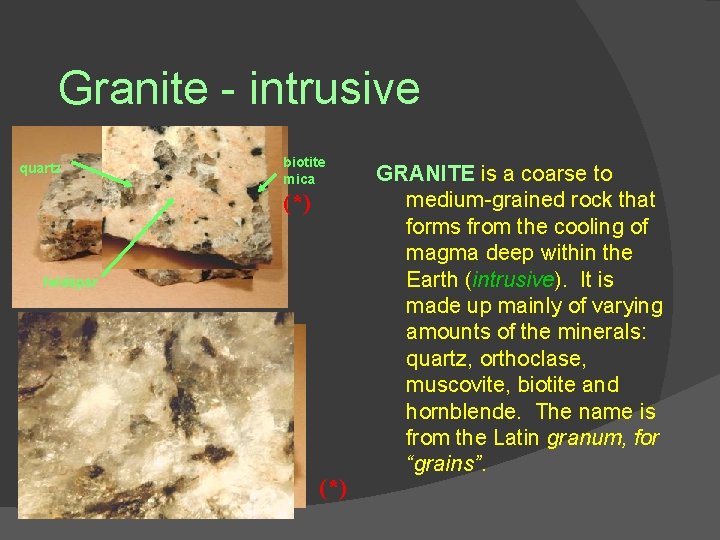
Granite - intrusive quartz biotite mica (*) feldspar (*) GRANITE is a coarse to medium-grained rock that forms from the cooling of magma deep within the Earth (intrusive). It is made up mainly of varying amounts of the minerals: quartz, orthoclase, muscovite, biotite and hornblende. The name is from the Latin granum, for “grains”.
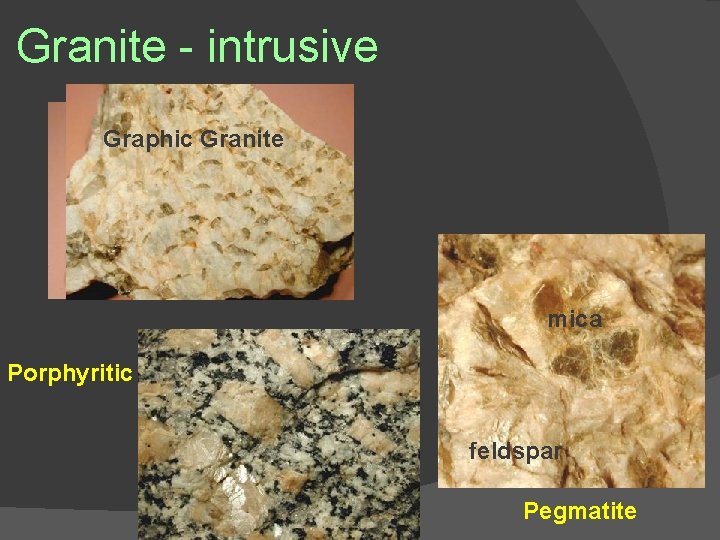
Granite - intrusive Graphic Granite mica Porphyritic feldspar Pegmatite
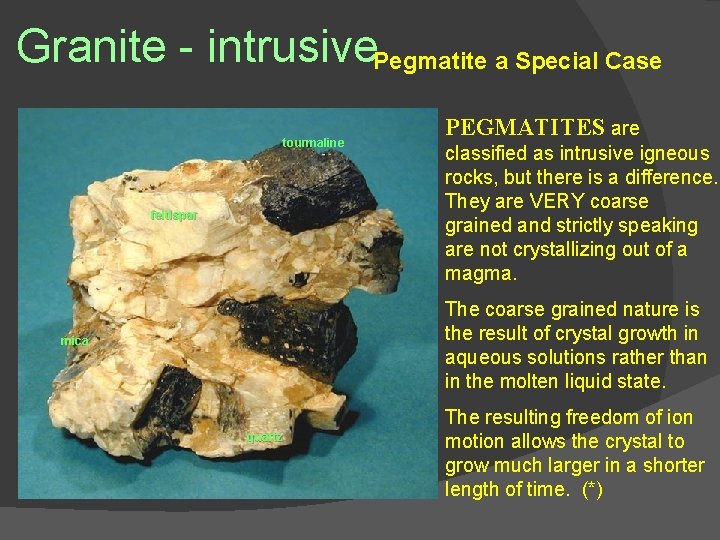
Granite - intrusive. Pegmatite a Special Case tourmaline feldspar PEGMATITES are classified as intrusive igneous rocks, but there is a difference. They are VERY coarse grained and strictly speaking are not crystallizing out of a magma. The coarse grained nature is the result of crystal growth in aqueous solutions rather than in the molten liquid state. mica quartz The resulting freedom of ion motion allows the crystal to grow much larger in a shorter length of time. (*)
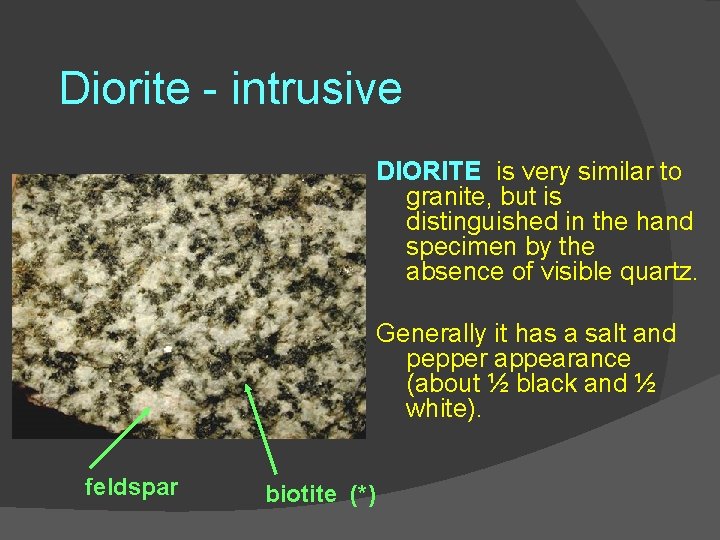
Diorite - intrusive DIORITE is very similar to granite, but is distinguished in the hand specimen by the absence of visible quartz. Generally it has a salt and pepper appearance (about ½ black and ½ white). feldspar biotite (*)
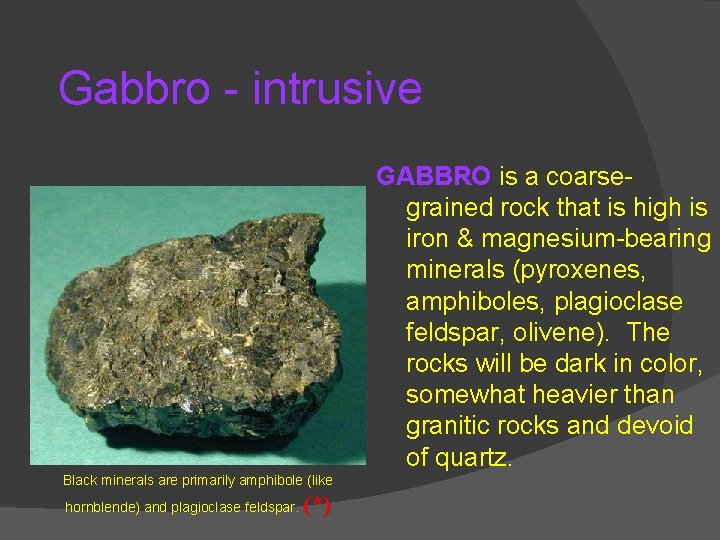
Gabbro - intrusive GABBRO is a coarsegrained rock that is high is iron & magnesium-bearing minerals (pyroxenes, amphiboles, plagioclase feldspar, olivene). The rocks will be dark in color, somewhat heavier than granitic rocks and devoid of quartz. Black minerals are primarily amphibole (like hornblende) and plagioclase feldspar. (*)
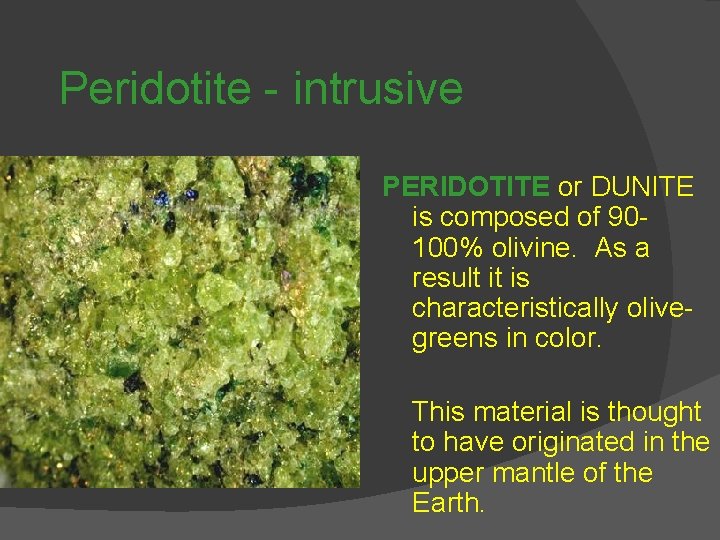
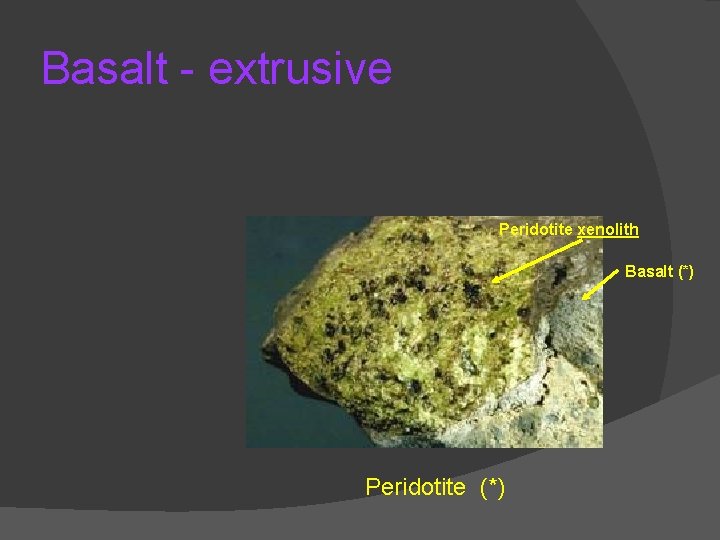
Peridotite - intrusive PERIDOTITE or DUNITE is composed of 90100% olivine. As a result it is characteristically olivegreens in color. This material is thought to have originated in the upper mantle of the Earth.
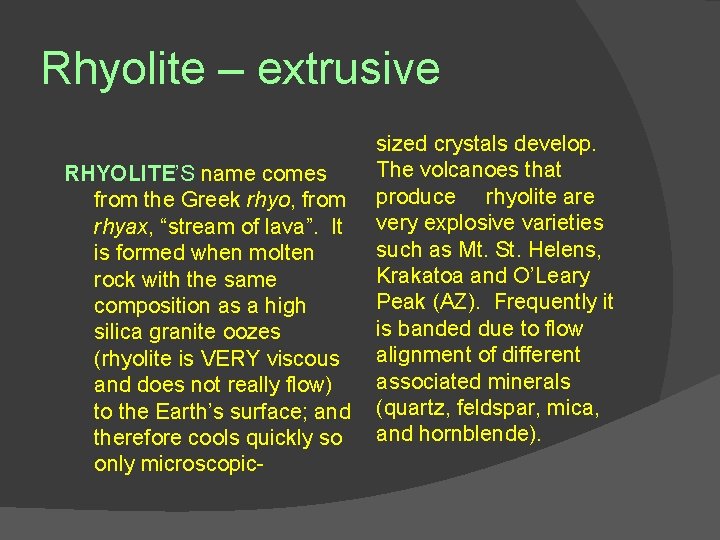
Rhyolite – extrusive RHYOLITE’S RHYOLITE name comes from the Greek rhyo, from rhyax, “stream of lava”. It is formed when molten rock with the same composition as a high silica granite oozes (rhyolite is VERY viscous and does not really flow) to the Earth’s surface; and therefore cools quickly so only microscopic- sized crystals develop. The volcanoes that produce rhyolite are very explosive varieties such as Mt. St. Helens, Krakatoa and O’Leary Peak (AZ). Frequently it is banded due to flow alignment of different associated minerals (quartz, feldspar, mica, and hornblende).
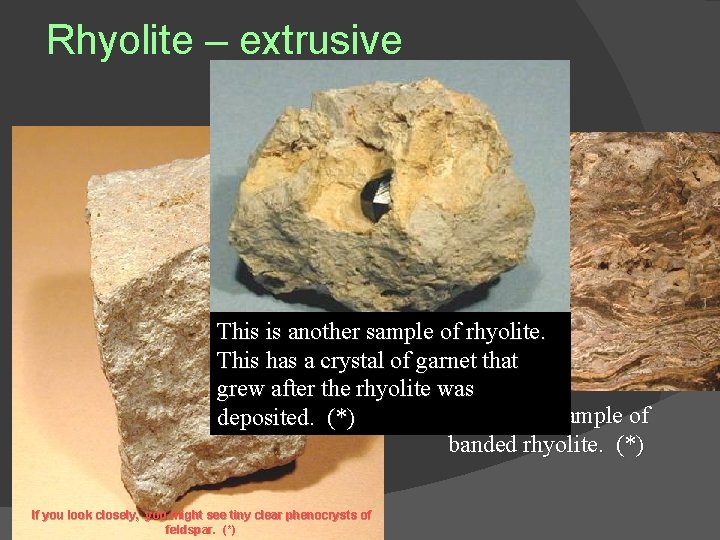
Rhyolite – extrusive This is another sample of rhyolite. This has a crystal of garnet that grew after the rhyolite was This is an example of deposited. (*) banded rhyolite. (*) If you look closely, you might see tiny clear phenocrysts of feldspar. (*)
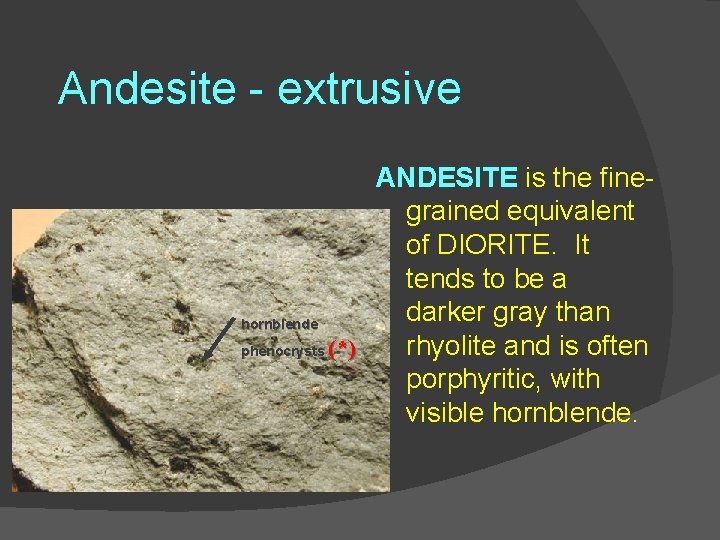
Andesite - extrusive ANDESITE is the finegrained equivalent of DIORITE. It tends to be a darker gray than hornblende rhyolite and is often phenocrysts (*) porphyritic, with visible hornblende.
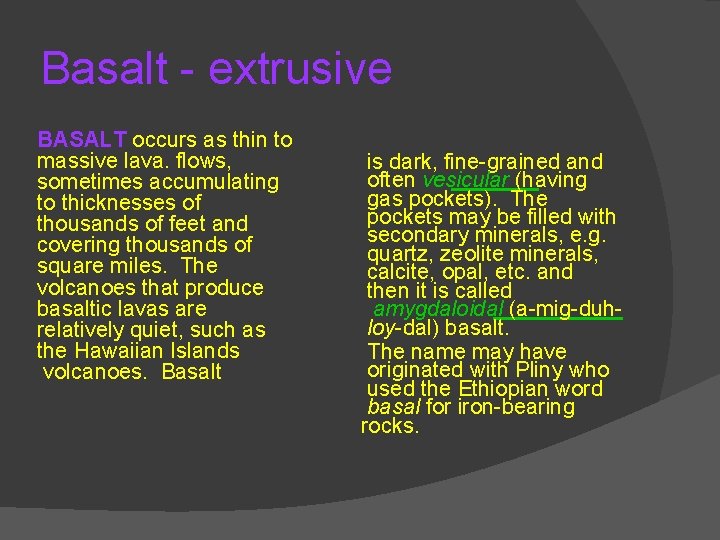
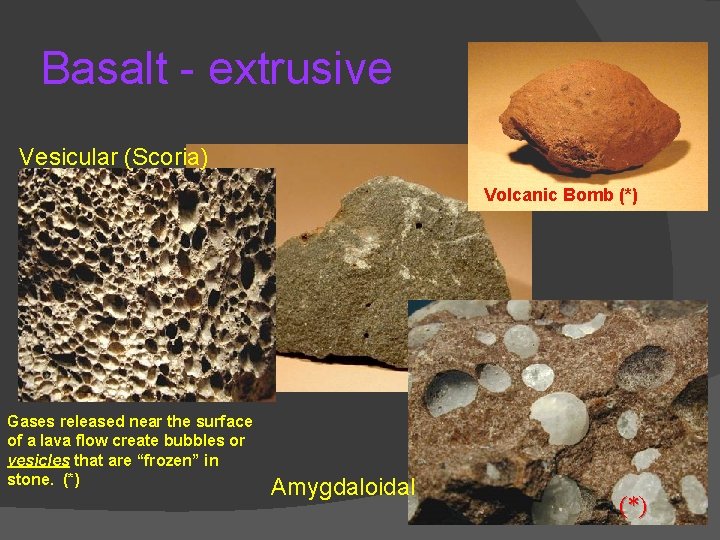
Basalt - extrusive BASALT occurs as thin to massive lava. flows, sometimes accumulating to thicknesses of thousands of feet and covering thousands of square miles. The volcanoes that produce basaltic lavas are relatively quiet, such as the Hawaiian Islands volcanoes. Basalt is dark, fine-grained and often vesicular (having gas pockets). The pockets may be filled with secondary minerals, e. g. quartz, zeolite minerals, calcite, opal, etc. and then it is called amygdaloidal (a-mig-duhloy-dal) basalt. The name may have originated with Pliny who used the Ethiopian word basal for iron-bearing rocks.
Basalt - extrusive Vesicular (Scoria) Volcanic Bomb (*) Gases released near the surface of a lava flow create bubbles or vesicles that are “frozen” in stone. (*) Amygdaloidal (*)
Basalt - extrusive Peridotite xenolith Basalt (*) Peridotite (*)
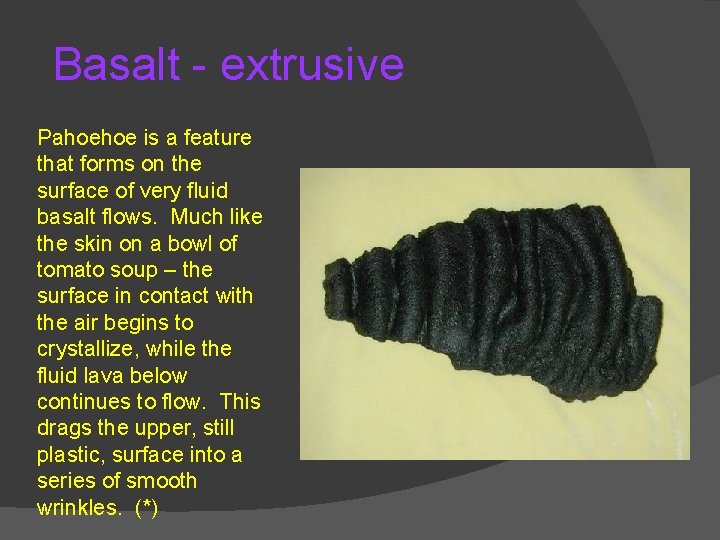
Basalt - extrusive Pahoehoe is a feature that forms on the surface of very fluid basalt flows. Much like the skin on a bowl of tomato soup – the surface in contact with the air begins to crystallize, while the fluid lava below continues to flow. This drags the upper, still plastic, surface into a series of smooth wrinkles. (*)
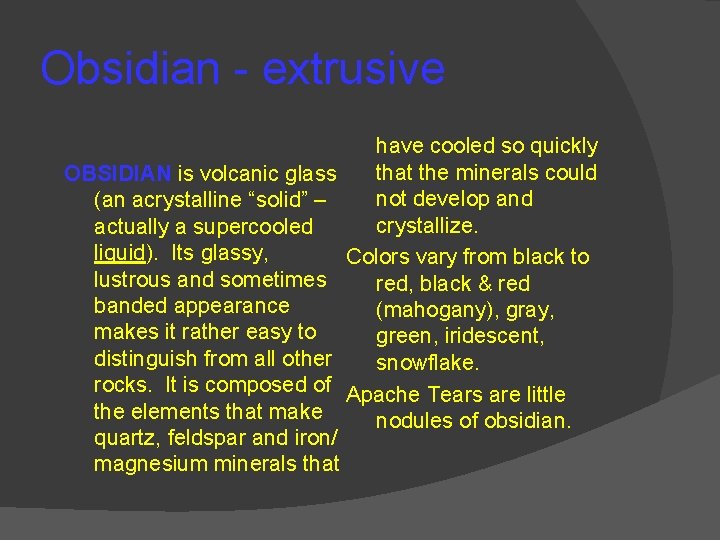
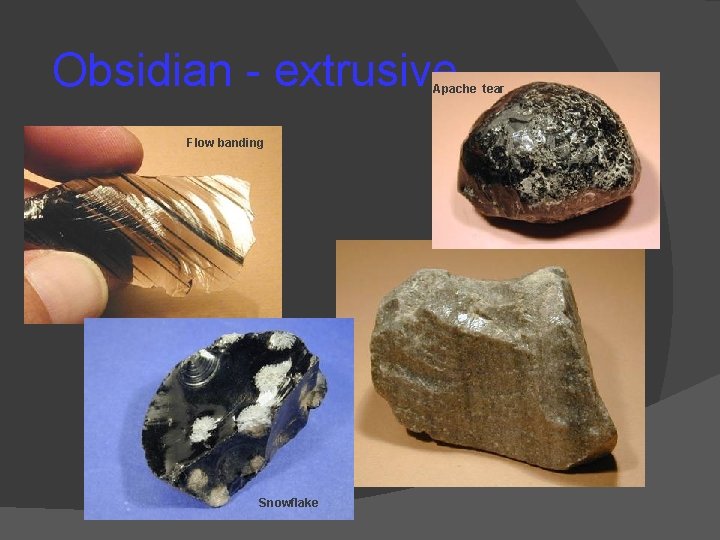
Obsidian - extrusive OBSIDIAN is volcanic glass (an acrystalline “solid” – actually a supercooled liquid). Its glassy, lustrous and sometimes banded appearance makes it rather easy to distinguish from all other rocks. It is composed of the elements that make quartz, feldspar and iron/ magnesium minerals that have cooled so quickly that the minerals could not develop and crystallize. Colors vary from black to red, black & red (mahogany), gray, green, iridescent, snowflake. Apache Tears are little nodules of obsidian.
Obsidian - extrusive Apache tear Flow banding Snowflake
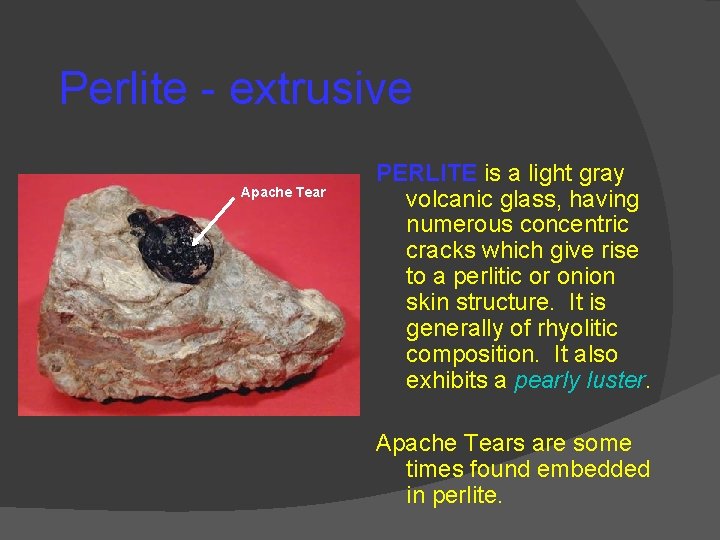
Perlite - extrusive Apache Tear PERLITE is a light gray volcanic glass, having numerous concentric cracks which give rise to a perlitic or onion skin structure. It is generally of rhyolitic composition. It also exhibits a pearly luster. Apache Tears are some times found embedded in perlite.
Pumice - extrusive PUMICE is highly vesicular (i. e. it has lots of gas bubble holes) and is of rhyolitic composition. Due to the many small holes, it is lightweight and will often float in water.
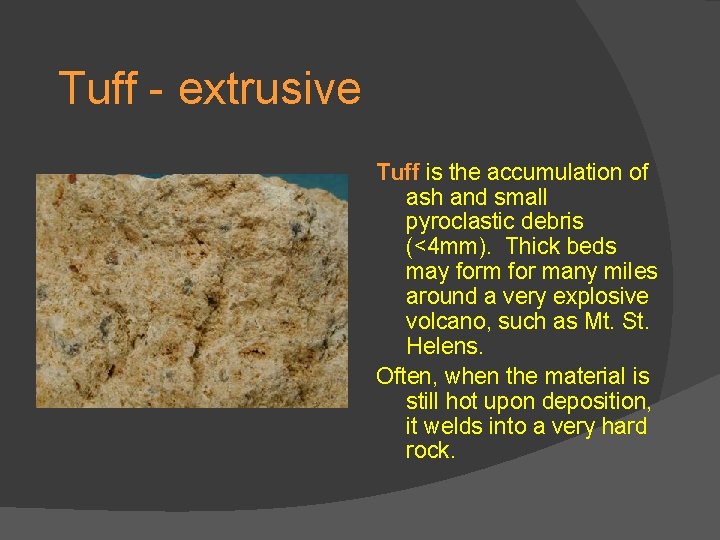
Tuff - extrusive Tuff is the accumulation of ash and small pyroclastic debris (<4 mm). Thick beds may form for many miles around a very explosive volcano, such as Mt. St. Helens. Often, when the material is still hot upon deposition, it welds into a very hard rock.
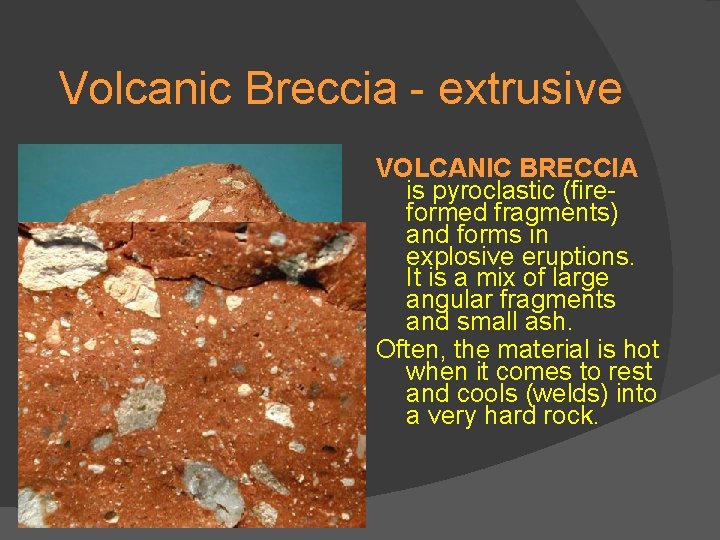
Volcanic Breccia - extrusive VOLCANIC BRECCIA is pyroclastic (fireformed fragments) and forms in explosive eruptions. It is a mix of large angular fragments and small ash. Often, the material is hot when it comes to rest and cools (welds) into a very hard rock.
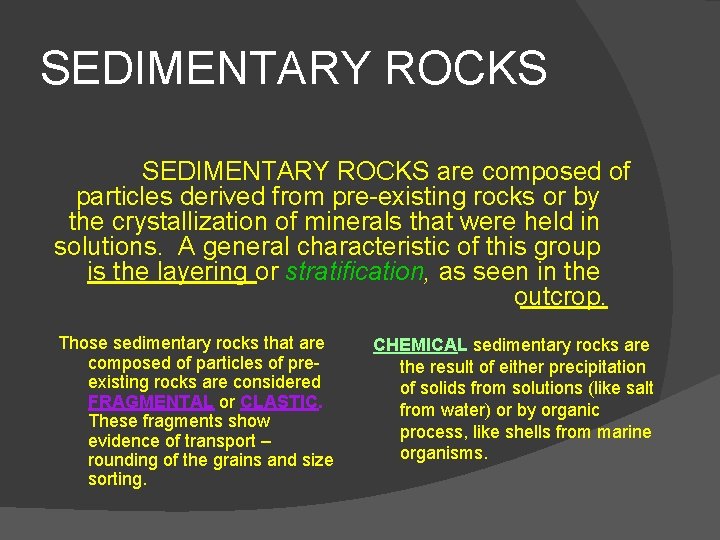
SEDIMENTARY ROCKS are composed of particles derived from pre-existing rocks or by the crystallization of minerals that were held in solutions. A general characteristic of this group is the layering or stratification, as seen in the outcrop. Those sedimentary rocks that are composed of particles of preexisting rocks are considered FRAGMENTAL or CLASTIC. These fragments show evidence of transport – rounding of the grains and size sorting. CHEMICAL sedimentary rocks are the result of either precipitation of solids from solutions (like salt from water) or by organic process, like shells from marine organisms.
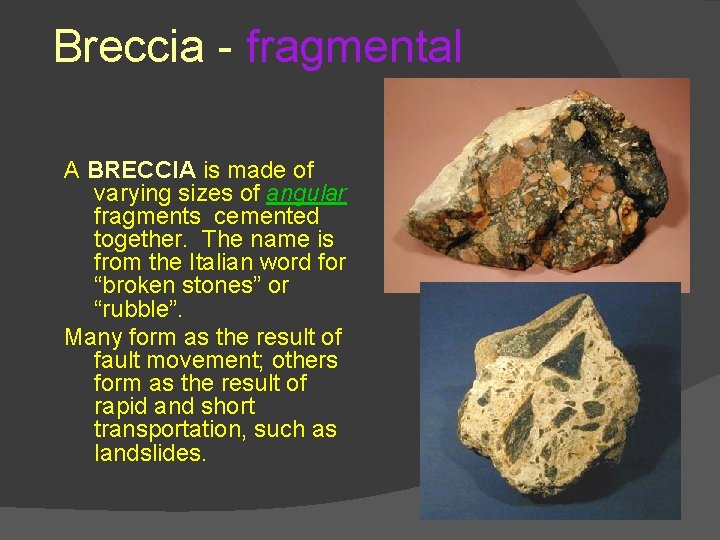
Breccia - fragmental A BRECCIA is made of varying sizes of angular fragments cemented together. The name is from the Italian word for “broken stones” or “rubble”. Many form as the result of fault movement; others form as the result of rapid and short transportation, such as landslides.
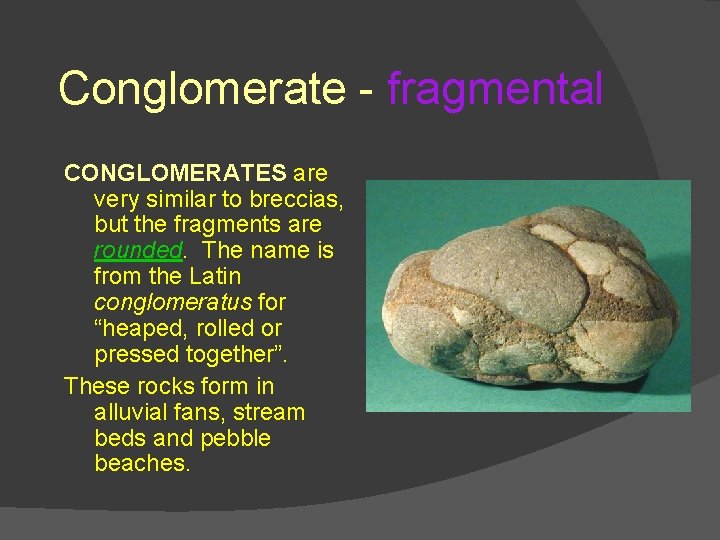
Conglomerate - fragmental CONGLOMERATES are very similar to breccias, but the fragments are rounded. The name is from the Latin conglomeratus for “heaped, rolled or pressed together”. These rocks form in alluvial fans, stream beds and pebble beaches.
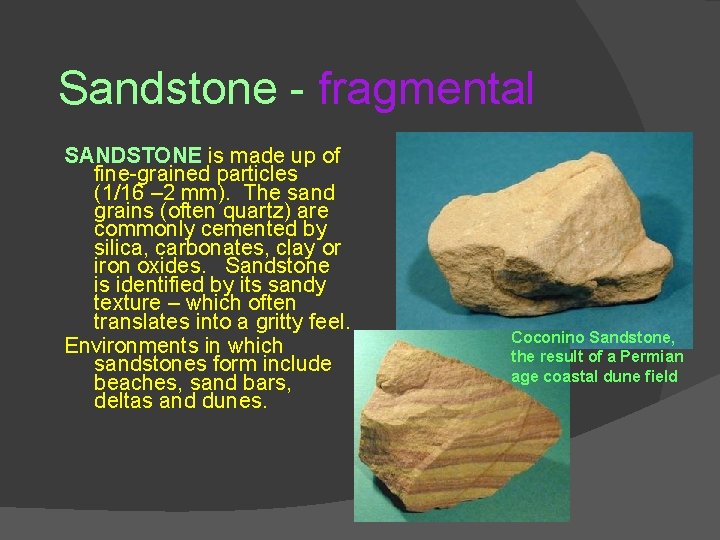
Sandstone - fragmental SANDSTONE is made up of fine-grained particles (1/16 – 2 mm). The sand grains (often quartz) are commonly cemented by silica, carbonates, clay or iron oxides. Sandstone is identified by its sandy texture – which often translates into a gritty feel. Environments in which sandstones form include beaches, sand bars, deltas and dunes. Coconino Sandstone, the result of a Permian age coastal dune field
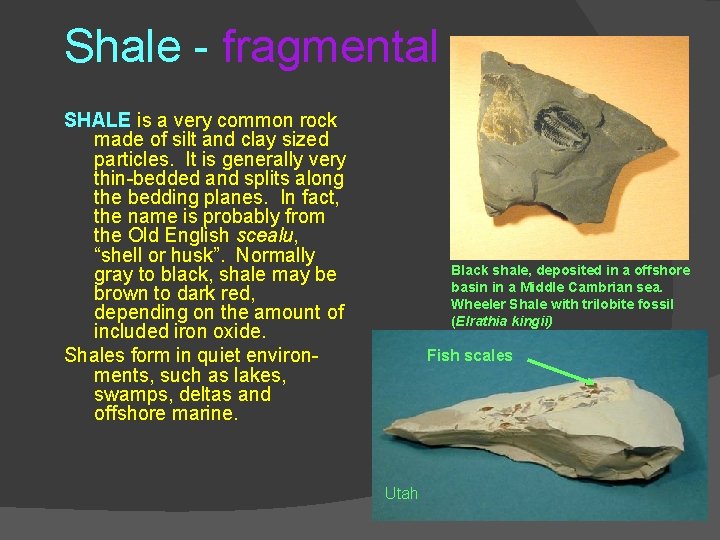
Shale - fragmental SHALE is a very common rock made of silt and clay sized particles. It is generally very thin-bedded and splits along the bedding planes. In fact, the name is probably from the Old English scealu, “shell or husk”. Normally gray to black, shale may be brown to dark red, depending on the amount of included iron oxide. Shales form in quiet environments, such as lakes, swamps, deltas and offshore marine. Black shale, deposited in a offshore basin in a Middle Cambrian sea. Wheeler Shale with trilobite fossil (Elrathia kingii) Fish scales Utah
Limestone - chemical LIMESTONE is composed primarily of calcite. Generally it is dense, fine -grained, and usually white to dark gray. Its most distinguishing feature is its solubility in weak hydrochloric or acetic acid accompanied by brisk effervescence. The environment of deposition if generally warm, shallow seas. Therefore, marine invertebrate fossils are Uses: Ø Manufacture of lime and Ø Ø Ø Portland cement & to neutralize smokestack gases. Finely ground, used as a functional filler in products such as paint, countertops & plastics. The dust on chewing gum is ground limestone. Mild abrasive additive to toothpaste. Soil conditioner Flux in processing iron and copper ores. Building and ornamental stone.
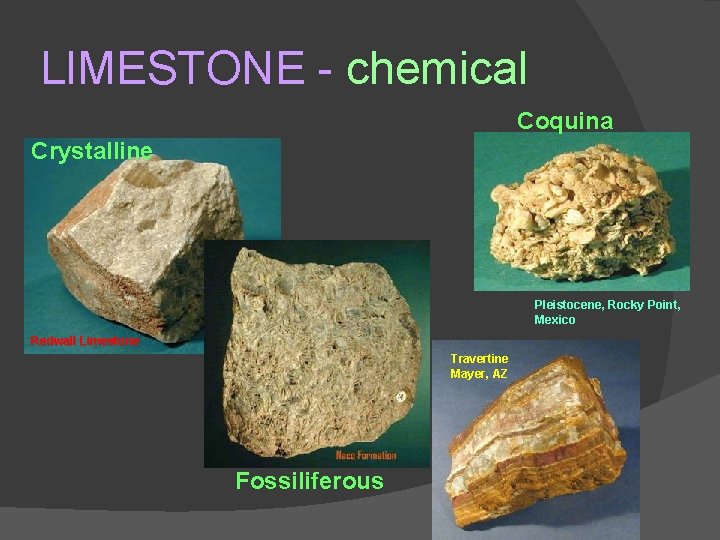
LIMESTONE - chemical Coquina Crystalline Pleistocene, Rocky Point, Mexico Redwall Limestone Travertine Mayer, AZ Fossiliferous
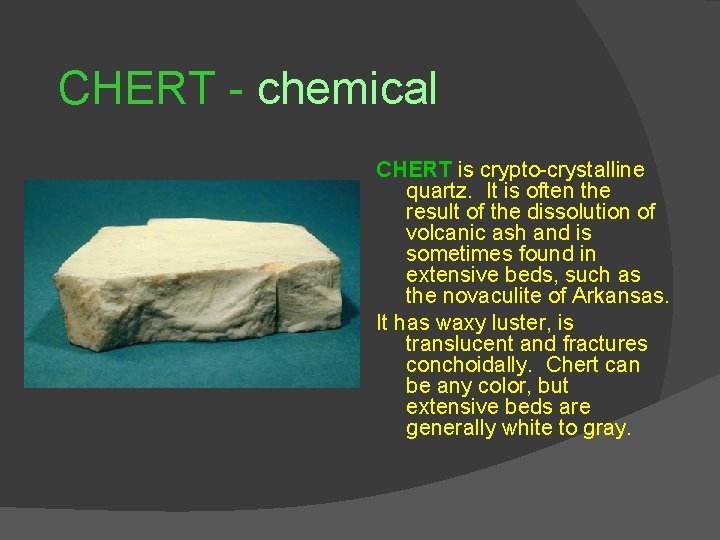
CHERT - chemical CHERT is crypto-crystalline quartz. It is often the result of the dissolution of volcanic ash and is sometimes found in extensive beds, such as the novaculite of Arkansas. It has waxy luster, is translucent and fractures conchoidally. Chert can be any color, but extensive beds are generally white to gray.
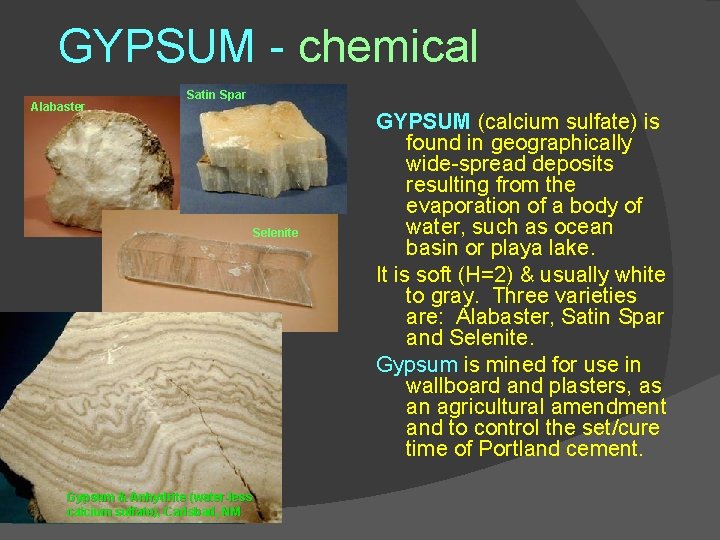
GYPSUM - chemical Alabaster Satin Spar Selenite Gypsum & Anhydrite (water-less calcium sulfate), Carlsbad, NM GYPSUM (calcium sulfate) is found in geographically wide-spread deposits resulting from the evaporation of a body of water, such as ocean basin or playa lake. It is soft (H=2) & usually white to gray. Three varieties are: Alabaster, Satin Spar and Selenite. Gypsum is mined for use in wallboard and plasters, as an agricultural amendment and to control the set/cure time of Portland cement.
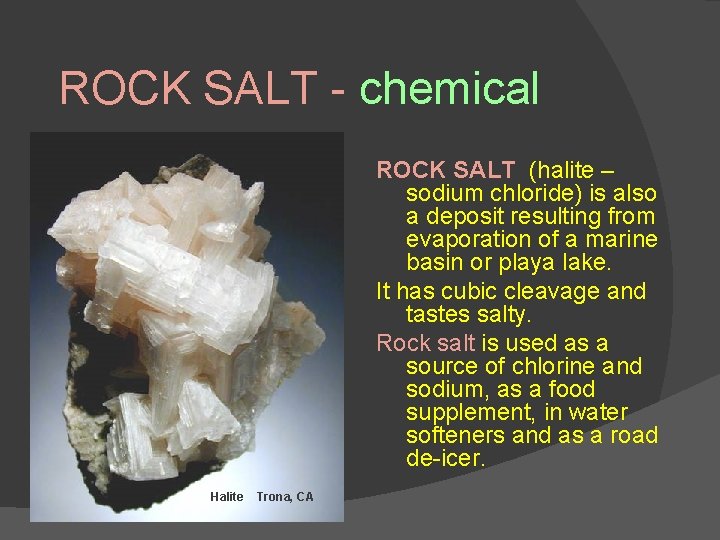
ROCK SALT - chemical ROCK SALT (halite – sodium chloride) is also a deposit resulting from evaporation of a marine basin or playa lake. It has cubic cleavage and tastes salty. Rock salt is used as a source of chlorine and sodium, as a food supplement, in water softeners and as a road de-icer. Halite Trona, CA
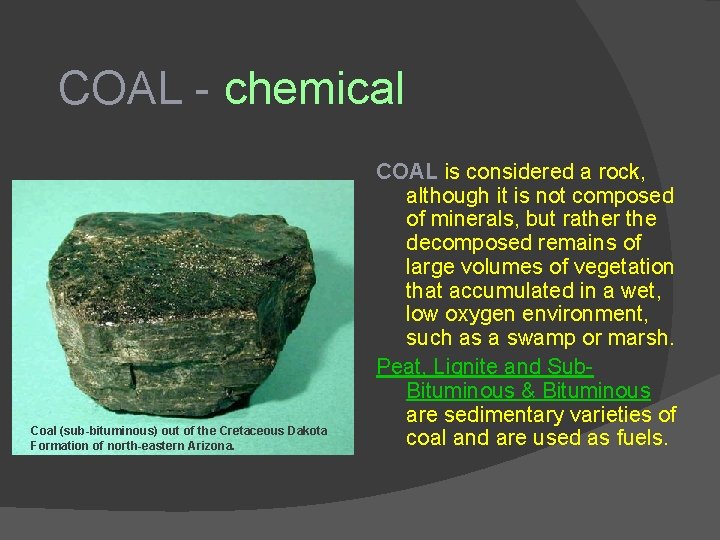
COAL - chemical Coal (sub-bituminous) out of the Cretaceous Dakota Formation of north-eastern Arizona. COAL is considered a rock, although it is not composed of minerals, but rather the decomposed remains of large volumes of vegetation that accumulated in a wet, low oxygen environment, such as a swamp or marsh. Peat, Lignite and Sub. Bituminous & Bituminous are sedimentary varieties of coal and are used as fuels.
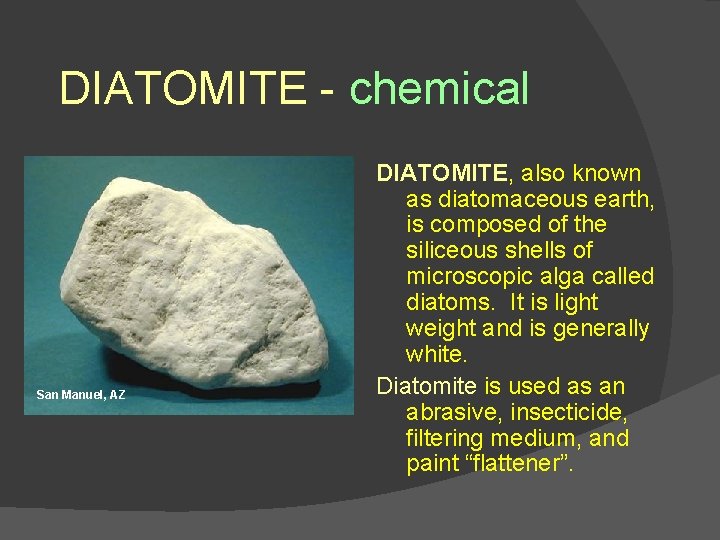
DIATOMITE - chemical San Manuel, AZ DIATOMITE, DIATOMITE also known as diatomaceous earth, is composed of the siliceous shells of microscopic alga called diatoms. It is light weight and is generally white. Diatomite is used as an abrasive, insecticide, filtering medium, and paint “flattener”.
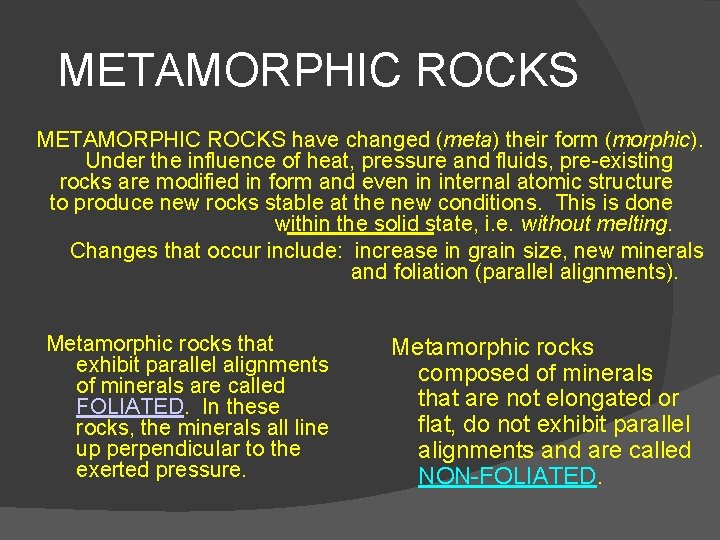
METAMORPHIC ROCKS have changed (meta) their form (morphic). Under the influence of heat, pressure and fluids, pre-existing rocks are modified in form and even in internal atomic structure to produce new rocks stable at the new conditions. This is done within the solid state, i. e. without melting. Changes that occur include: increase in grain size, new minerals and foliation (parallel alignments). Metamorphic rocks that exhibit parallel alignments of minerals are called FOLIATED. In these rocks, the minerals all line up perpendicular to the exerted pressure. Metamorphic rocks composed of minerals that are not elongated or flat, do not exhibit parallel alignments and are called NON-FOLIATED.
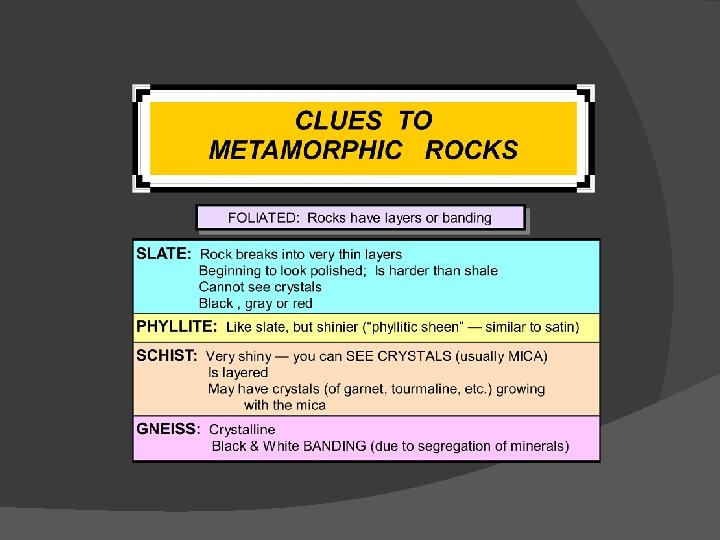
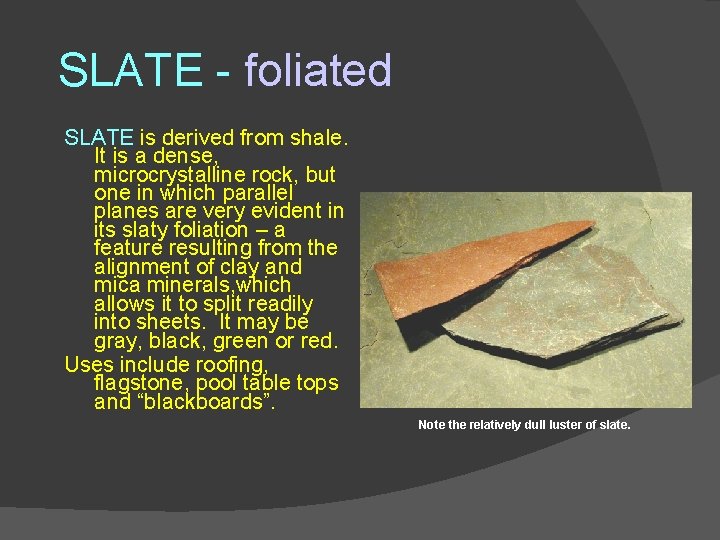
SLATE - foliated SLATE is derived from shale. It is a dense, microcrystalline rock, but one in which parallel planes are very evident in its slaty foliation – a feature resulting from the alignment of clay and mica minerals, which allows it to split readily into sheets. It may be gray, black, green or red. Uses include roofing, flagstone, pool table tops and “blackboards”. Note the relatively dull luster of slate.
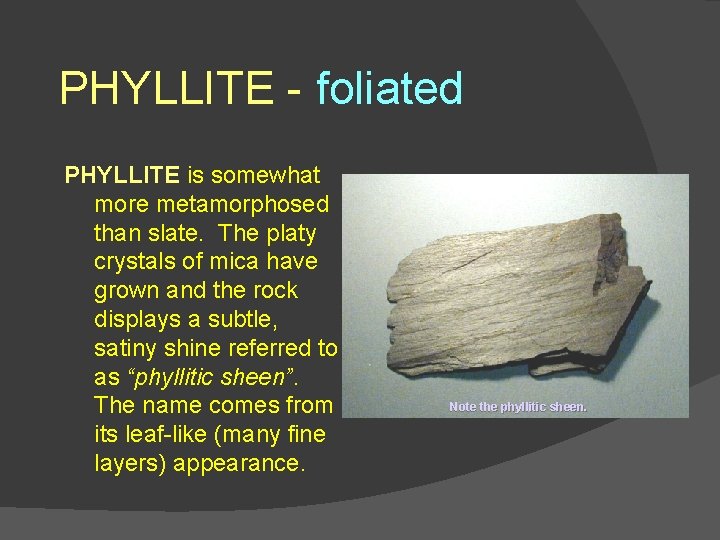
PHYLLITE - foliated PHYLLITE is somewhat more metamorphosed than slate. The platy crystals of mica have grown and the rock displays a subtle, satiny shine referred to as “phyllitic sheen”. The name comes from its leaf-like (many fine layers) appearance. Note the phyllitic sheen.
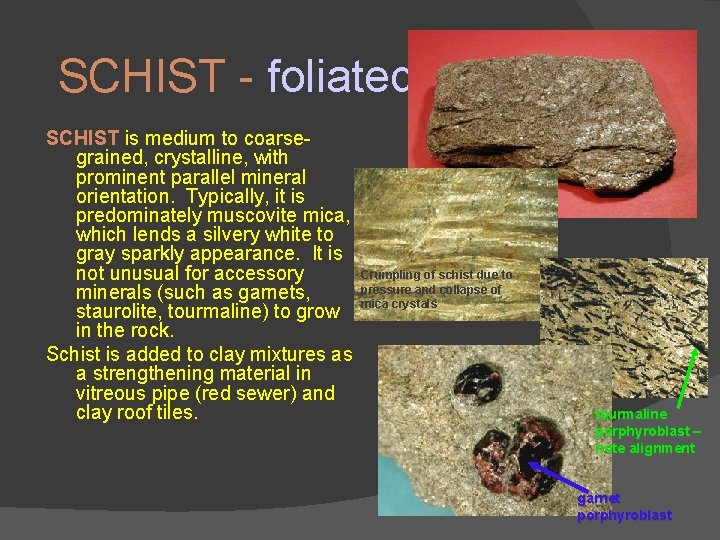
SCHIST - foliated SCHIST is medium to coarsegrained, crystalline, with prominent parallel mineral orientation. Typically, it is predominately muscovite mica, which lends a silvery white to gray sparkly appearance. It is not unusual for accessory minerals (such as garnets, staurolite, tourmaline) to grow in the rock. Schist is added to clay mixtures as a strengthening material in vitreous pipe (red sewer) and clay roof tiles. Crumpling of schist due to pressure and collapse of mica crystals tourmaline porphyroblast – note alignment garnet porphyroblast
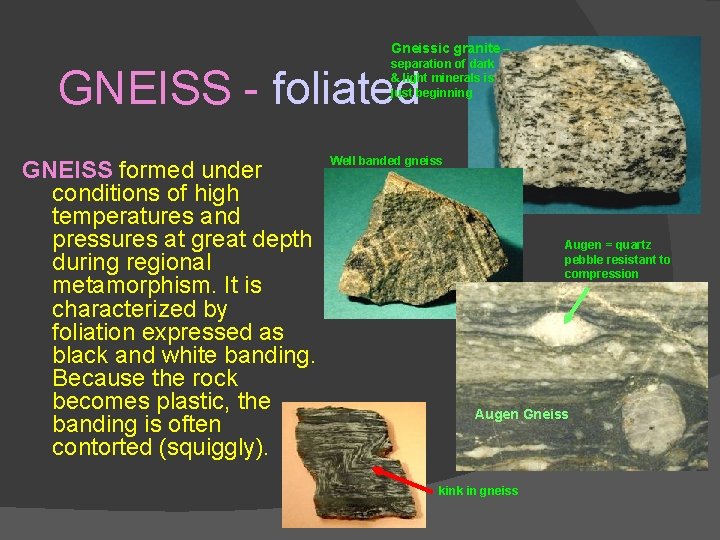
Gneissic granite – separation of dark & light minerals is just beginning GNEISS - foliated GNEISS formed under conditions of high temperatures and pressures at great depth during regional metamorphism. It is characterized by foliation expressed as black and white banding. Because the rock becomes plastic, the banding is often contorted (squiggly). Well banded gneiss Augen = quartz pebble resistant to compression Augen Gneiss kink in gneiss
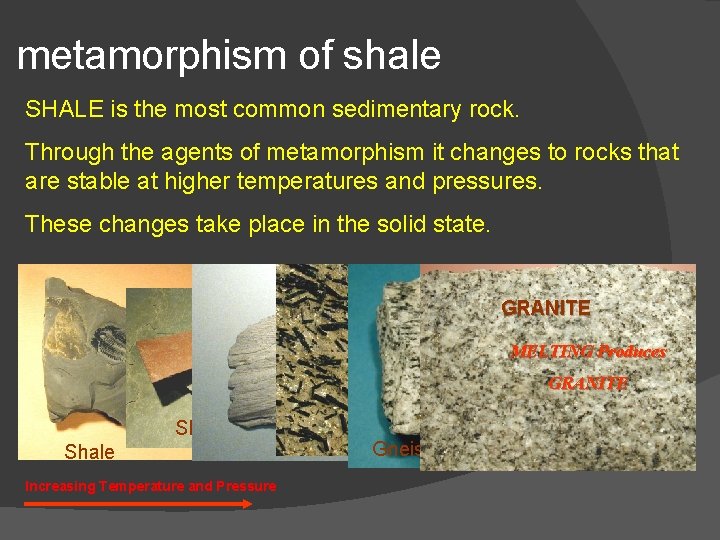
metamorphism of shale SHALE is the most common sedimentary rock. Through the agents of metamorphism it changes to rocks that are stable at higher temperatures and pressures. These changes take place in the solid state. GRANITE MELTING Produces GRANITE Slate Shale Increasing Temperature and Pressure Schist Phyllite Gneiss
THE ROCK CYCLE
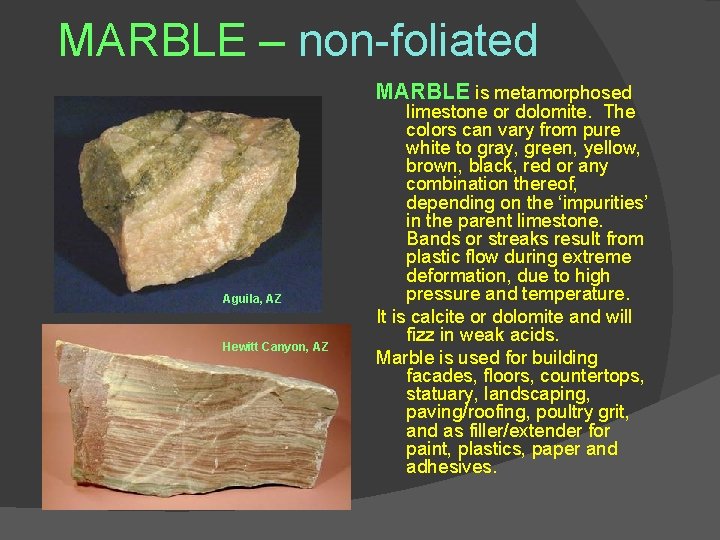
MARBLE – non-foliated MARBLE is metamorphosed Aguila, AZ Hewitt Canyon, AZ limestone or dolomite. The colors can vary from pure white to gray, green, yellow, brown, black, red or any combination thereof, depending on the ‘impurities’ in the parent limestone. Bands or streaks result from plastic flow during extreme deformation, due to high pressure and temperature. It is calcite or dolomite and will fizz in weak acids. Marble is used for building facades, floors, countertops, statuary, landscaping, paving/roofing, poultry grit, and as filler/extender for paint, plastics, paper and adhesives.
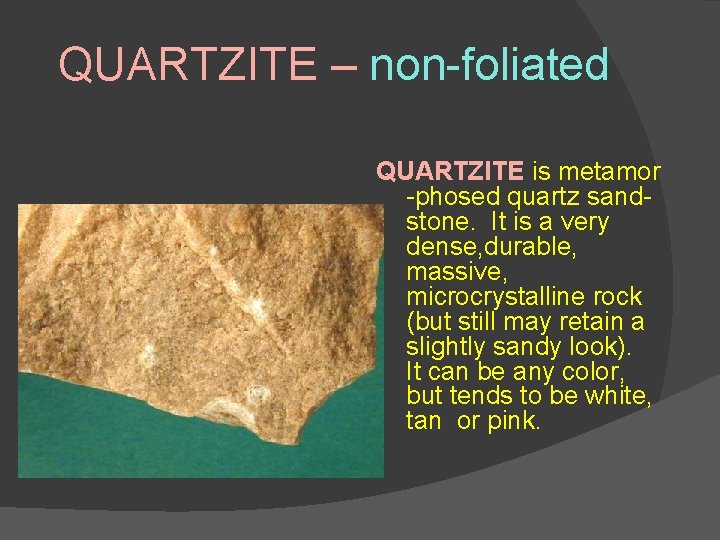
QUARTZITE – non-foliated QUARTZITE is metamor -phosed quartz sandstone. It is a very dense, durable, massive, microcrystalline rock (but still may retain a slightly sandy look). It can be any color, but tends to be white, tan or pink.
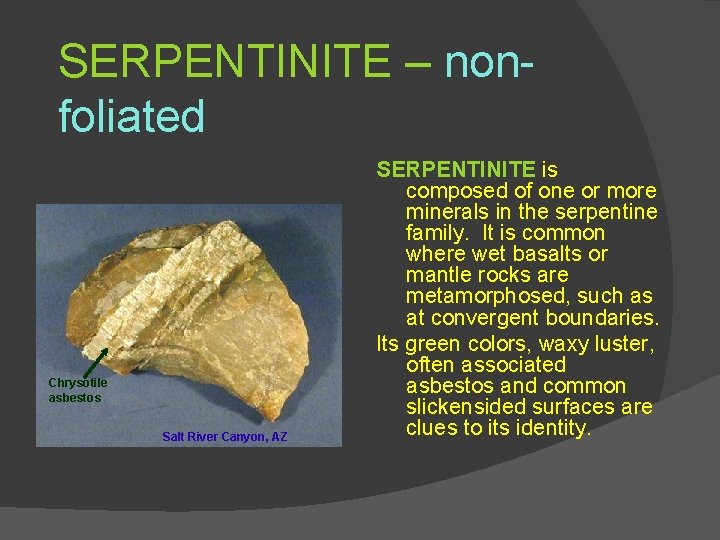
SERPENTINITE – nonfoliated Chrysotile asbestos Salt River Canyon, AZ SERPENTINITE is composed of one or more minerals in the serpentine family. It is common where wet basalts or mantle rocks are metamorphosed, such as at convergent boundaries. Its green colors, waxy luster, often associated asbestos and common slickensided surfaces are clues to its identity.
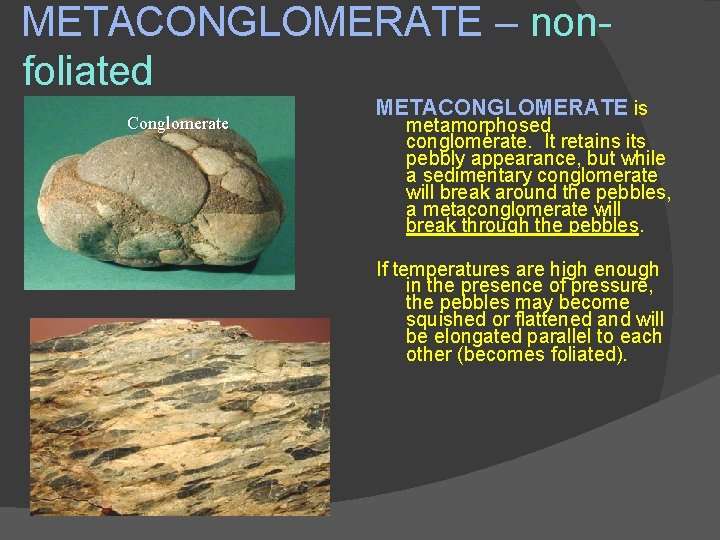
METACONGLOMERATE – nonfoliated Conglomerate METACONGLOMERATE is metamorphosed conglomerate. It retains its pebbly appearance, but while a sedimentary conglomerate will break around the pebbles, a metaconglomerate will break through the pebbles. If temperatures are high enough in the presence of pressure, the pebbles may become squished or flattened and will be elongated parallel to each other (becomes foliated).