
Metamaterials for particle accelerator applications Ian Mc Gregor

- Slides: 18
Metamaterials for particle accelerator applications Ian Mc. Gregor Boss: Kai Hock
Contents 1. 2. 3. 4. 5. Metamaterial Basics Properties of Metamaterials Examples of Metamaterials New Analyses of Metamaterial Elements New Technique for suppressing unwanted resonant modes in accelerating cavities – simple rectangular waveguide Example
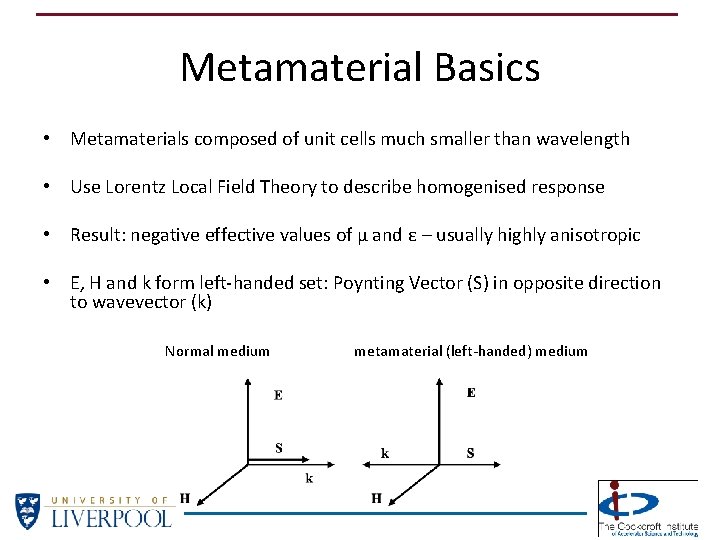
Metamaterial Basics • Metamaterials composed of unit cells much smaller than wavelength • Use Lorentz Local Field Theory to describe homogenised response • Result: negative effective values of µ and ε – usually highly anisotropic • E, H and k form left-handed set: Poynting Vector (S) in opposite direction to wavevector (k) Normal medium metamaterial (left-handed) medium
Some Properties of Left-Handed Media • ‘Backward’ wave propagation – points of constant phase travel backwards whilst power flows forwards • Negative refraction • Inverse Doppler effect • Backward-orientated Cerenkov Radiation
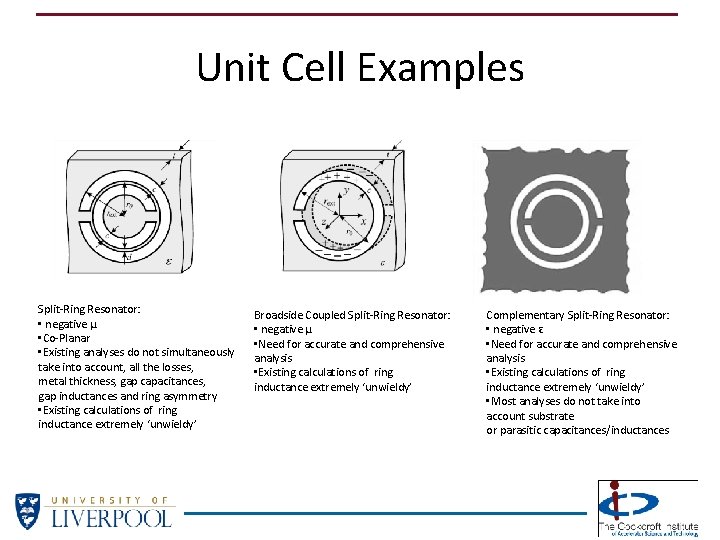
Unit Cell Examples Split-Ring Resonator: • negative µ • Co-Planar • Existing analyses do not simultaneously take into account, all the losses, metal thickness, gap capacitances, gap inductances and ring asymmetry • Existing calculations of ring inductance extremely ‘unwieldy’ Broadside Coupled Split-Ring Resonator: • negative µ • Need for accurate and comprehensive analysis • Existing calculations of ring inductance extremely ‘unwieldy’ Complementary Split-Ring Resonator: • negative ε • Need for accurate and comprehensive analysis • Existing calculations of ring inductance extremely ‘unwieldy’ • Most analyses do not take into account substrate or parasitic capacitances/inductances
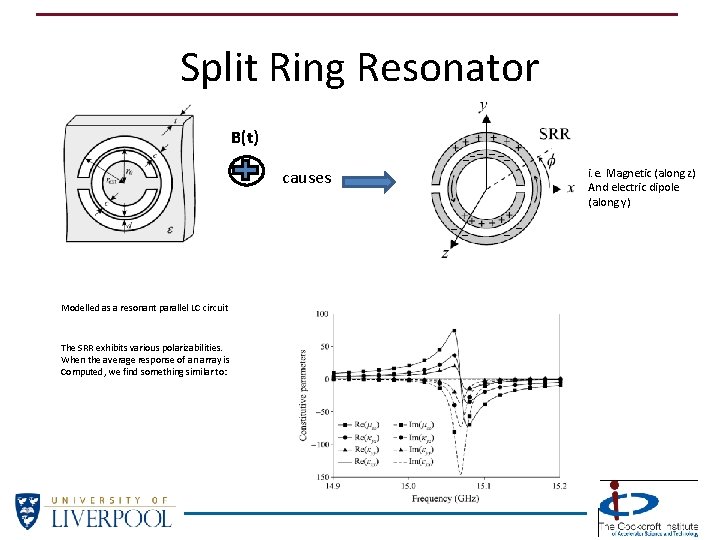
Split Ring Resonator B(t) causes Modelled as a resonant parallel LC circuit The SRR exhibits various polarizabilities. When the average response of an array is Computed, we find something similar to: i. e. Magnetic (along z) And electric dipole (along y)
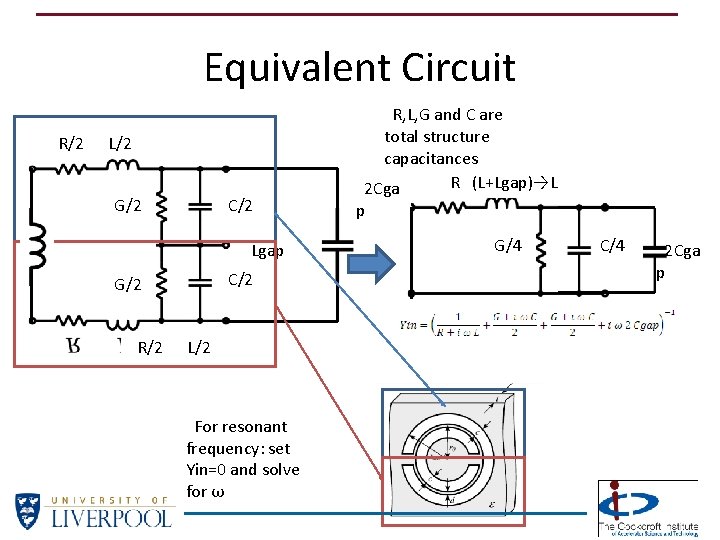
Equivalent Circuit R/2 L/2 G/2 C/2 Lgap C/2 G/2 R/2 L/2 For resonant frequency: set Yin=0 and solve for ω R, L, G and C are total structure capacitances R (L+Lgap)→L 2 Cga p G/4 C/4 2 Cga p
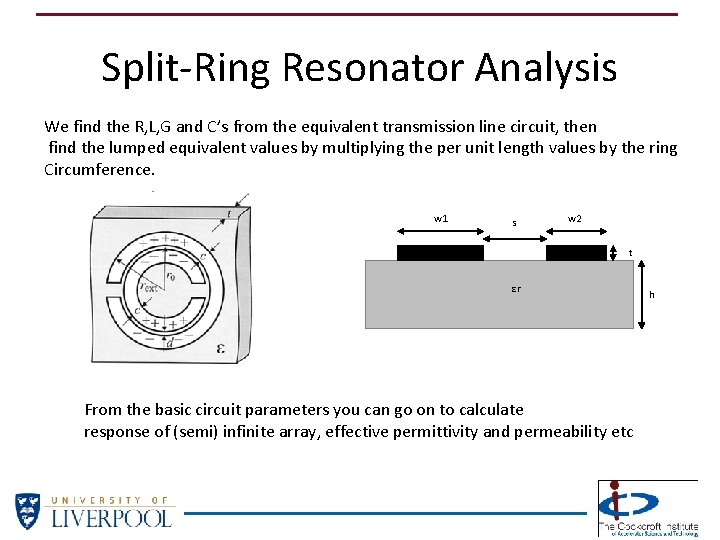
Split-Ring Resonator Analysis We find the R, L, G and C’s from the equivalent transmission line circuit, then find the lumped equivalent values by multiplying the per unit length values by the ring Circumference. w 1 s w 2 t εr From the basic circuit parameters you can go on to calculate response of (semi) infinite array, effective permittivity and permeability etc h
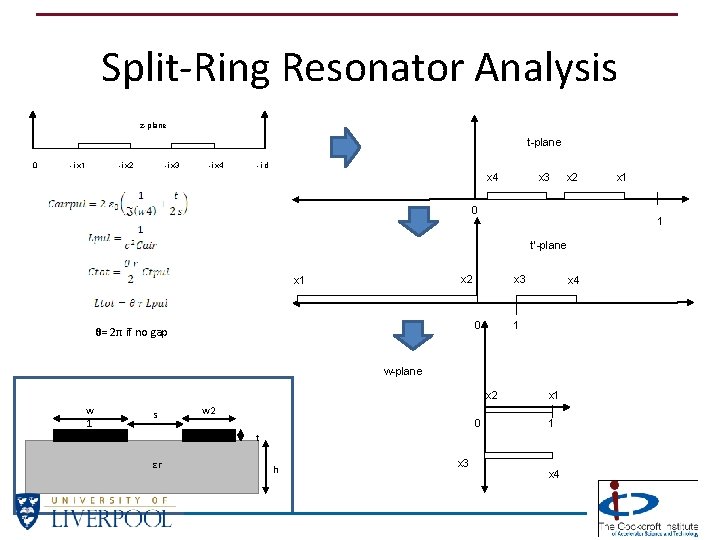
Split-Ring Resonator Analysis z-plane t-plane 0 -i x 1 -i x 2 -i x 3 -i x 4 -i d x 4 x 3 x 2 0 1 t'-plane x 2 x 1 x 3 x 4 1 0 θ= 2π if no gap w-plane x 2 w 1 s w 2 0 x 1 1 t εr h x 3 x 1 x 4
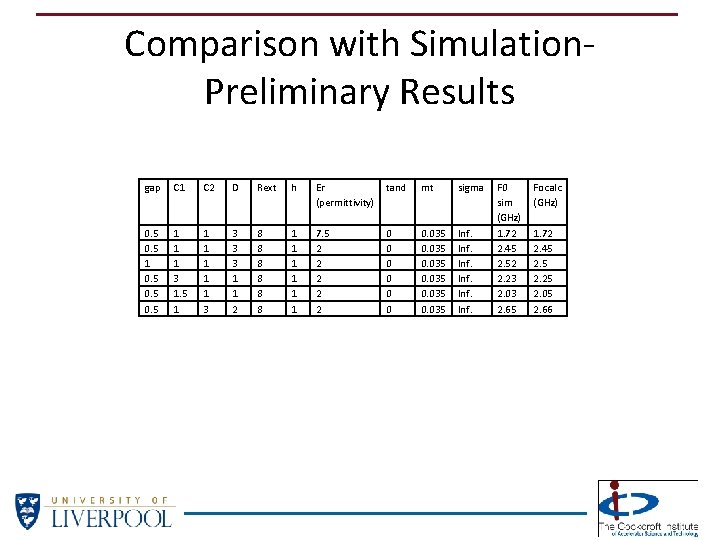
Comparison with Simulation. Preliminary Results gap C 1 C 2 D Rext h Er tand (permittivity) mt sigma 0. 5 1 0. 5 1 1 1 3 1. 5 1 1 1 3 3 1 1 2 8 8 8 1 1 1 7. 5 2 2 2 0. 035 Inf. 0 0 0 F 0 sim (GHz) 1. 72 2. 45 2. 52 2. 23 2. 03 2. 65 Focalc (GHz) 1. 72 2. 45 2. 25 2. 05 2. 66
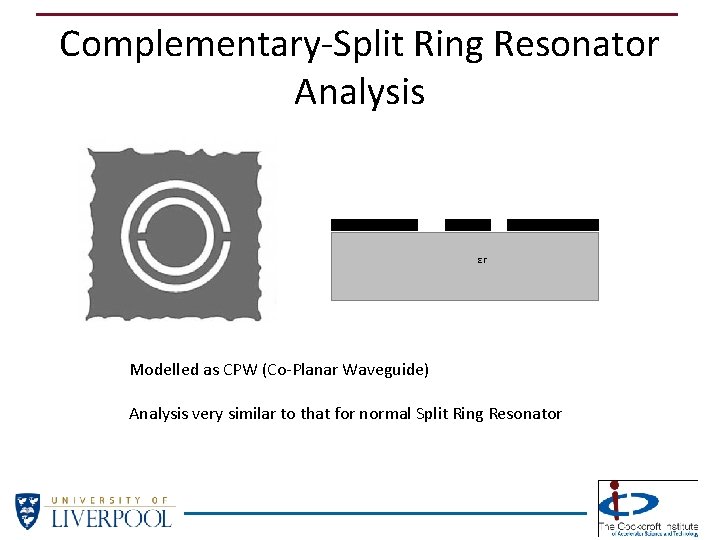
Complementary-Split Ring Resonator Analysis εr Modelled as CPW (Co-Planar Waveguide) Analysis very similar to that for normal Split Ring Resonator
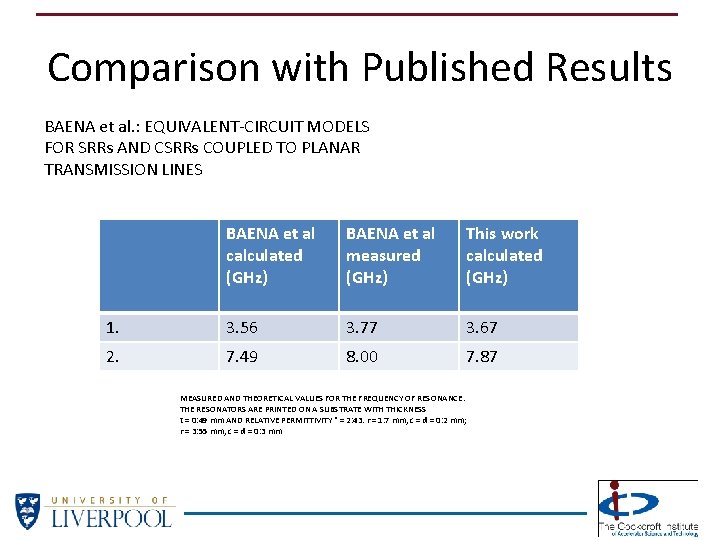
Comparison with Published Results BAENA et al. : EQUIVALENT-CIRCUIT MODELS FOR SRRs AND CSRRs COUPLED TO PLANAR TRANSMISSION LINES BAENA et al calculated (GHz) BAENA et al measured (GHz) This work calculated (GHz) 1. 3. 56 3. 77 3. 67 2. 7. 49 8. 00 7. 87 MEASURED AND THEORETICAL VALUES FOR THE FREQUENCY OF RESONANCE. THE RESONATORS ARE PRINTED ON A SUBSTRATE WITH THICKNESS t = 0: 49 mm AND RELATIVE PERMITTIVITY " = 2: 43. r = 1: 7 mm, c = d = 0: 2 mm; r = 3: 55 mm, c = d = 0: 3 mm
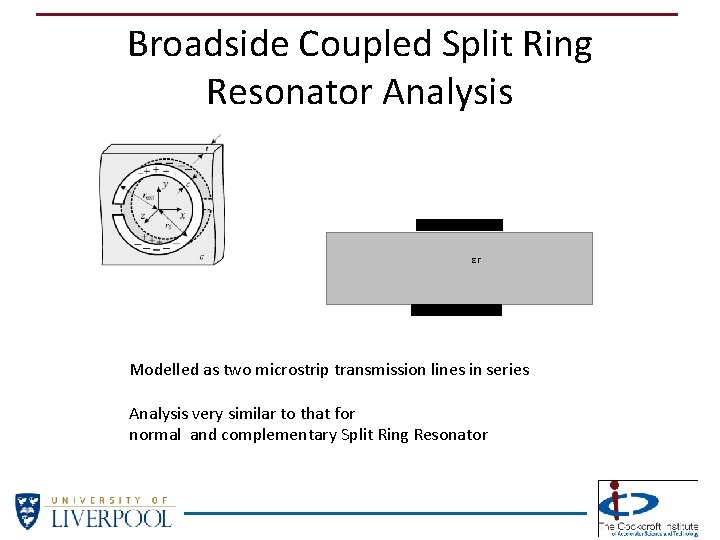
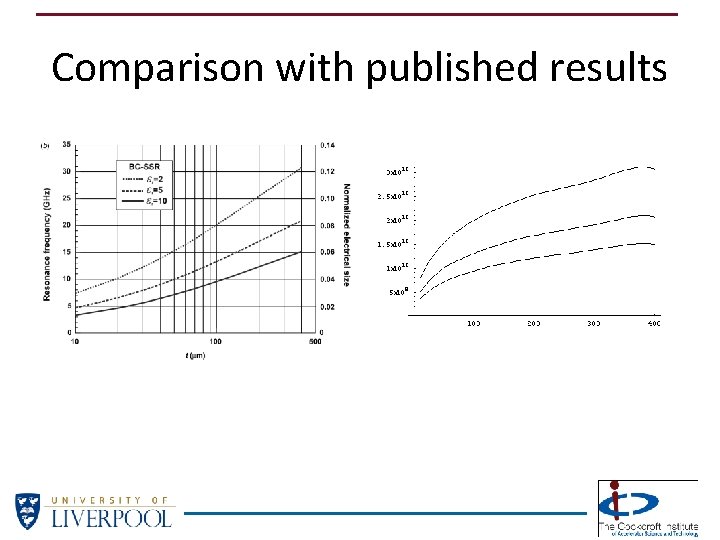
Broadside Coupled Split Ring Resonator Analysis εr Modelled as two microstrip transmission lines in series Analysis very similar to that for normal and complementary Split Ring Resonator
Comparison with published results
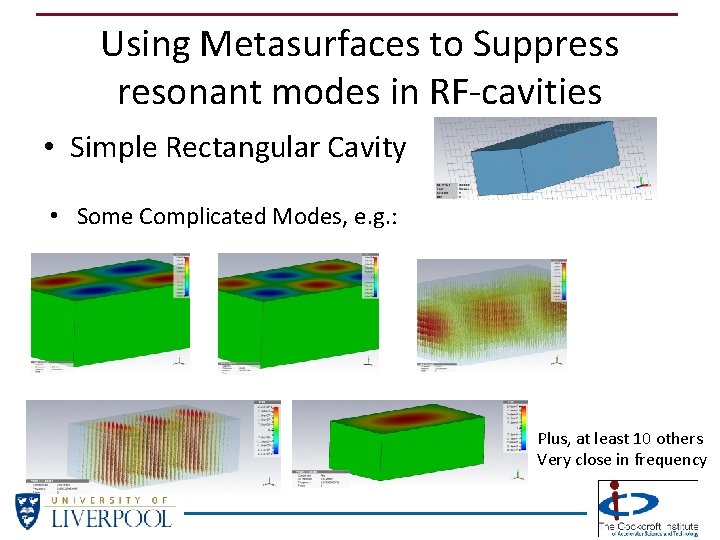
Using Metasurfaces to Suppress resonant modes in RF-cavities • Simple Rectangular Cavity • Some Complicated Modes, e. g. : Plus, at least 10 others Very close in frequency
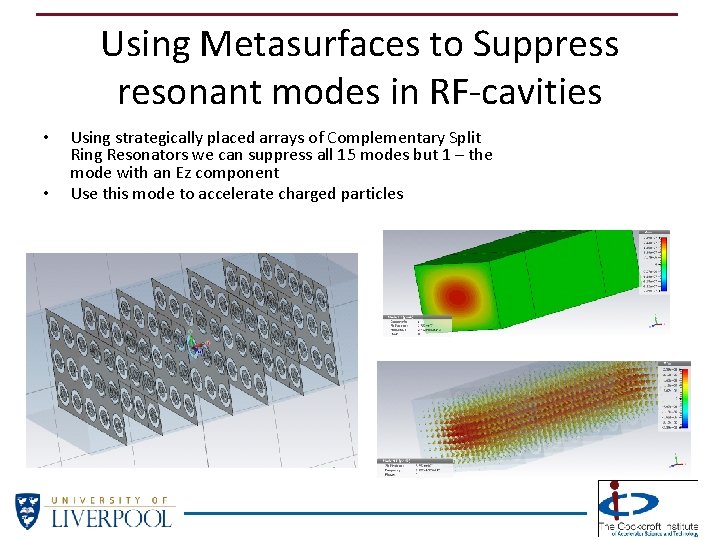
Using Metasurfaces to Suppress resonant modes in RF-cavities • • Using strategically placed arrays of Complementary Split Ring Resonators we can suppress all 15 modes but 1 – the mode with an Ez component Use this mode to accelerate charged particles
Conclusions • Metamaterials have some unusual characteristics which make them attractive for particle accelerator applications • Accurate analysis techniques for 3 different unit cells have been shown • Method for suppressing unwanted modes in resonant cavities has been demonstrated
Future Work • Use unit cell parameters to derive responses of (semi) infinite arrays • Develop more realistic and practical accelerating cavities with unwanted modes suppressed • Investigate using metamaterials to provide beam focusing and bending