
METAMATERIAL DESIGN FOR IDEAL SOLAR ABSORBER USING MULTISCALE
METAMATERIAL DESIGN FOR IDEAL SOLAR ABSORBER USING MULTISCALE SIMULATIONS ON COMSOL MULTI-PHYSICS. Presenter : Dr. Mohamed El Hachemi. Project Team: Ms Nikhar Khanna Dr. Gullaum Lamblin Dr. Emanuele Barborini 1

INTRODUCTION What is about? The absorber coating is the crucial component in Concentrated Solar Power(CSP) units. Absorber Heat sink, Thermoelectric Unit 2
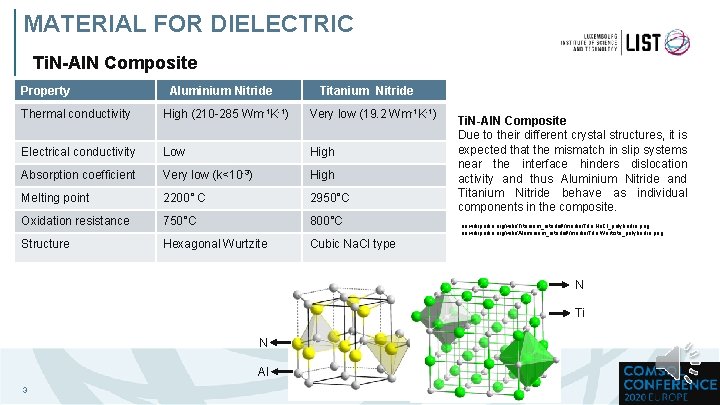
MATERIAL FOR DIELECTRIC Ti. N-Al. N Composite Property Aluminium Nitride Titanium Nitride Thermal conductivity High (210 -285 Wm-1 K-1) Very low (19. 2 Wm-1 K-1) Electrical conductivity Low High Absorption coefficient Very low (k<10 -3) High Melting point 2200° C 2950°C Oxidation resistance 750°C 800°C Structure Hexagonal Wurtzite Cubic Na. Cl type Ti. N-Al. N Composite Due to their different crystal structures, it is expected that the mismatch in slip systems near the interface hinders dislocation activity and thus Aluminium Nitride and Titanium Nitride behave as individual components in the composite. en. wikipedia. org/wiki/Titanium_nitride#/media/File: Na. Cl_polyhedra. png en. wikipedia. org/wiki/Aluminium_nitride#/media/File: Wurtzite_polyhedra. png N Ti N Al 3
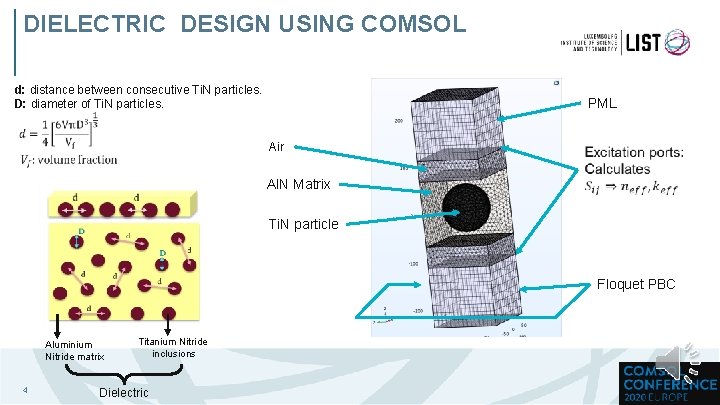
DIELECTRIC DESIGN USING COMSOL d: distance between consecutive Ti. N particles. D: diameter of Ti. N particles. PML Air Al. N Matrix Ti. N particle Floquet PBC Aluminium Nitride matrix 4 Titanium Nitride inclusions Dielectric
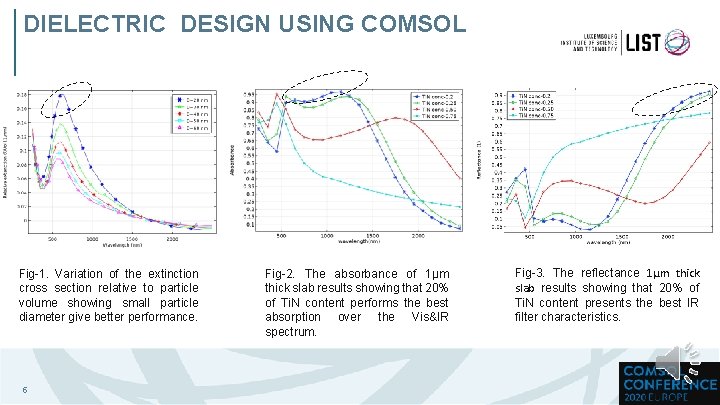
DIELECTRIC DESIGN USING COMSOL Fig-1. Variation of the extinction cross section relative to particle volume showing small particle diameter give better performance. 5 Fig-2. The absorbance of 1µm thick slab results showing that 20% of Ti. N content performs the best absorption over the Vis&IR spectrum. Fig-3. The reflectance 1µm thick slab results showing that 20% of Ti. N content presents the best IR filter characteristics.
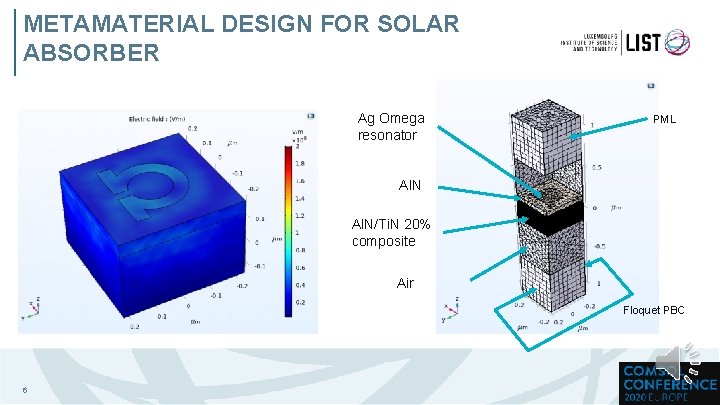
METAMATERIAL DESIGN FOR SOLAR ABSORBER Ag Omega resonator PML Al. N/Ti. N 20% composite Air Floquet PBC 6

METAMATERIAL DESIGN FOR SOLAR ABSORBER The reflectance 100 nm thick metamaterial layer results showing good IR filter characteristics. 7
CONCLUSION • Multiscale simulations using CMSOL wave optics were successfully performed. • The nanoscale simulations allowed the investigation for best dielectric design • The microscale simulations allowed the prediction of reflectance/absorbance of the metamaterial • Future investigations will consist on using the predictive capability of COMSOL wave optics to optimise for best geometrical parameters of the resonant nanostructure that produce Ideal absorber filter. 8
Thanks for your attention We acknowledge the Luxembourg National Research Fund for the FNR INTER-RCUK grant: Projet MADISSA INTER -RCUK/1611584556. 9
- Slides: 9