
Metals and Metallic Bonding What are Metals n
Metals and Metallic Bonding
What are Metals? n A metal is an element that readily forms positive ions (cations) and has metallic bonds.

What are Metals? n On the periodic table, a diagonal or stair step line drawn from boron (B) to polonium (Po) separates the metals from the nonmetals. Elements on this line are metalloids, sometimes called semi-metals; elements to the lower left are metals; elements to the upper right are nonmetals. n Almost 80% of the elements on the periodic table are metals.
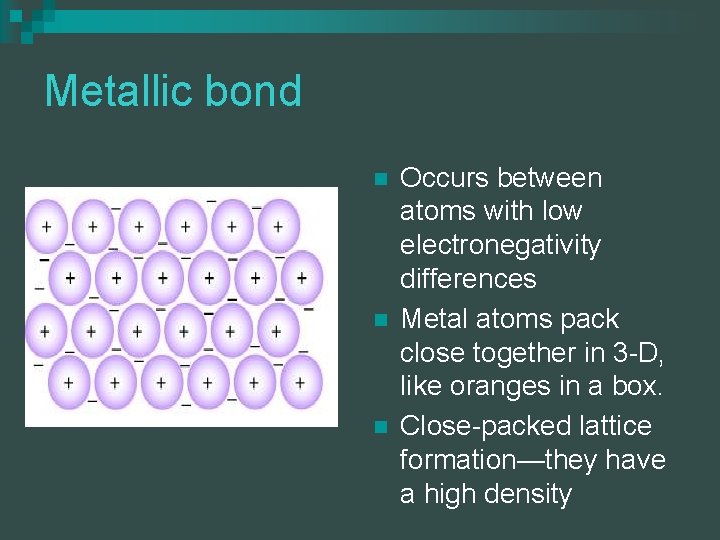
Metallic bond n n n Occurs between atoms with low electronegativity differences Metal atoms pack close together in 3 -D, like oranges in a box. Close-packed lattice formation—they have a high density
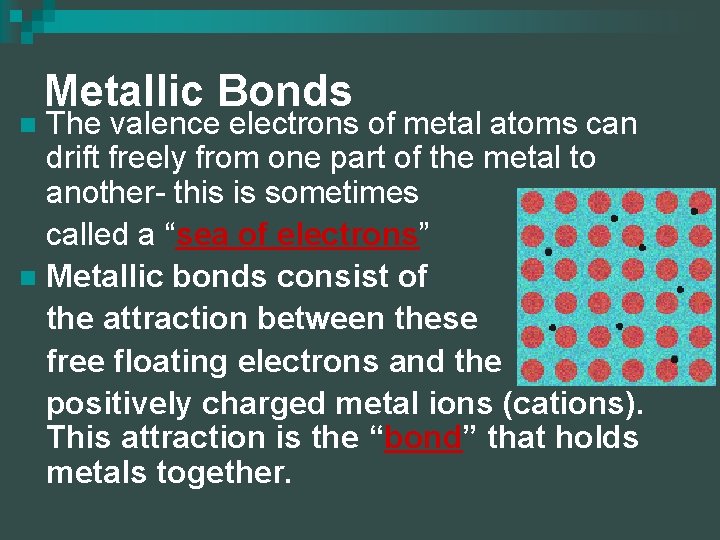
Metallic Bonds The valence electrons of metal atoms can drift freely from one part of the metal to another- this is sometimes called a “sea of electrons” n Metallic bonds consist of the attraction between these free floating electrons and the positively charged metal ions (cations). This attraction is the “bond” that holds metals together. n
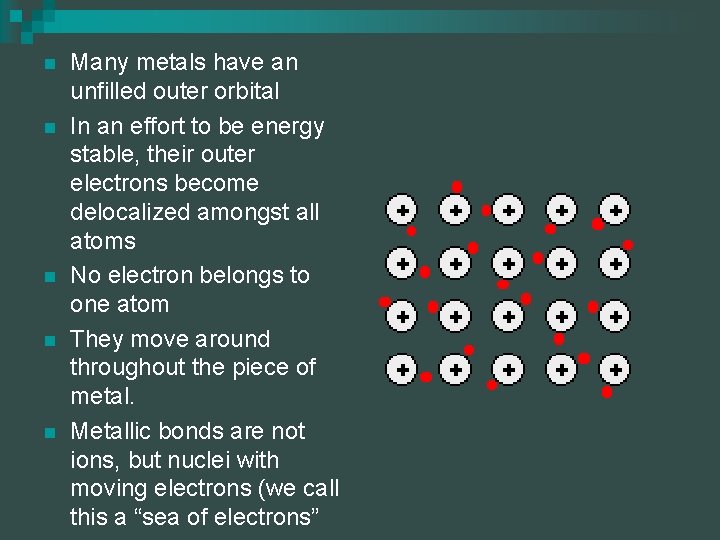
n n n Many metals have an unfilled outer orbital In an effort to be energy stable, their outer electrons become delocalized amongst all atoms No electron belongs to one atom They move around throughout the piece of metal. Metallic bonds are not ions, but nuclei with moving electrons (we call this a “sea of electrons”
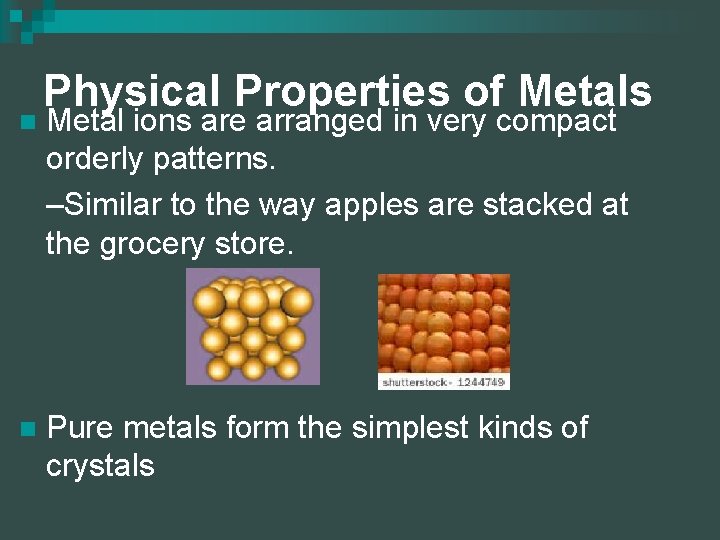
n n Physical Properties of Metals Metal ions are arranged in very compact orderly patterns. –Similar to the way apples are stacked at the grocery store. Pure metals form the simplest kinds of crystals

Physical Properties of Metals Lusterous- they are shiny! n High density- atoms are tightly packed. n Good conductors of electricity and heat. n ¨ Reason- electrons can flow freely.

Physical Properties Conductivity n Delocalized electrons are free to move so when a potential electrical difference is applied they can carry the current along n Mobile electrons also mean they can transfer heat well n Their interaction with light makes them shiny (luster)
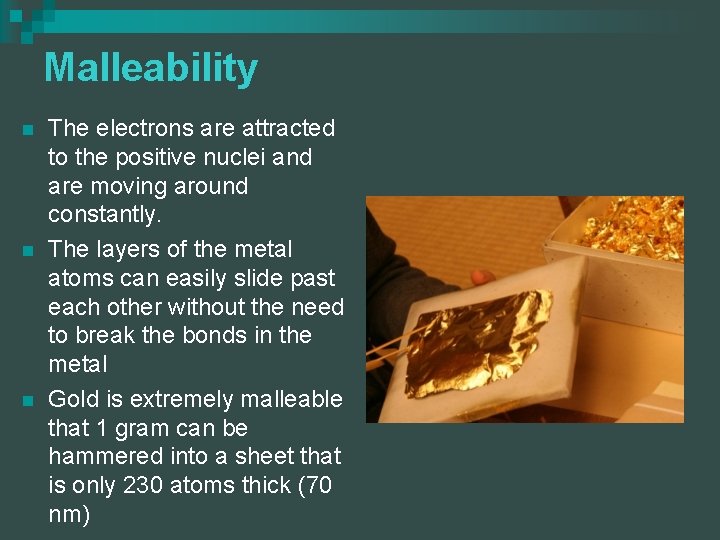
Malleability n n n The electrons are attracted to the positive nuclei and are moving around constantly. The layers of the metal atoms can easily slide past each other without the need to break the bonds in the metal Gold is extremely malleable that 1 gram can be hammered into a sheet that is only 230 atoms thick (70 nm)
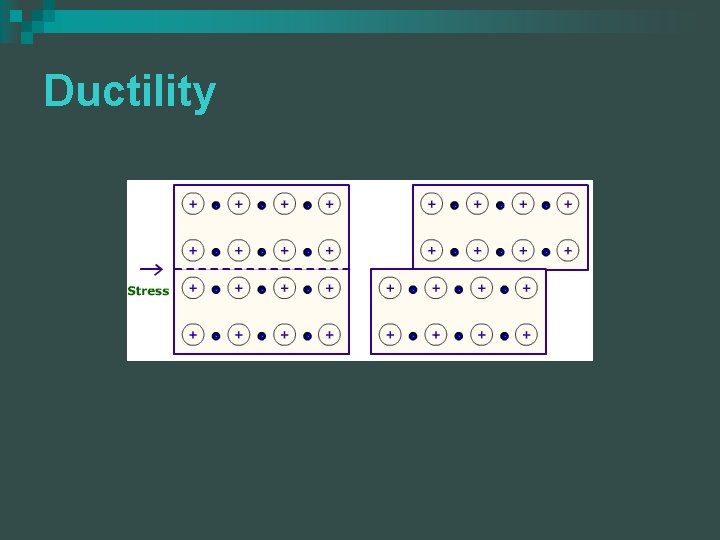
Ductility
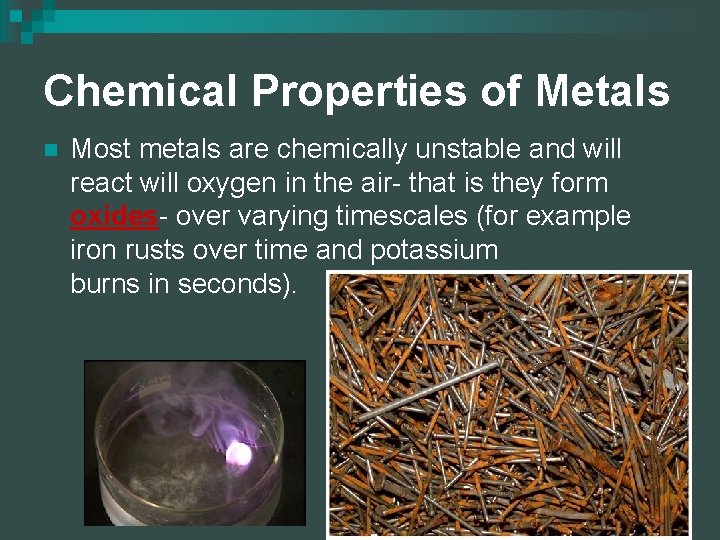
Chemical Properties of Metals n Most metals are chemically unstable and will react will oxygen in the air- that is they form oxides- over varying timescales (for example iron rusts over time and potassium burns in seconds).
Chemical Properties of Metals -The alkali metals react quickest followed by the alkaline earth metals. -The transition metals take much longer to oxidize (such as iron, copper, zinc, nickel). Others, like palladium, platinum and gold, do not react with the atmosphere at all. -Some metals form a barrier layer of oxide on their surface which cannot be penetrated by further oxygen molecules and thus retain their shiny appearance and good conductivity for many decades (like aluminium, some steels, and titanium).
Alloys n n n Very few metals that you encounter daily are pure metals. Most metals are alloys, a mixture of two or more elements of which at least one is a metal. They are generally less malleable and ductile Some alloys are made by melting and mixing two or more metals ¨ Examples: n Brass is an alloy of copper and zinc n Sterling silver is an alloy of silver (92%) and copper (8%) n Stainless Steel is an alloy of iron (81%), chromium (18%), nickel (1%), and trace amounts of carbon.
Alloys n Alloys are important because their properties are often superior to those of their component elements. ¨ Examples: n Sterling silver is harder and more durable than pure silver, but still soft enough to make jewelry and tableware. n Brass is harder and easier to shape than either copper or zinc n Steel is stronger than pure iron because the carbon prevents the delocalized electrons to move so readily. ¨ If too much carbon is added then the metal is brittle.
Economic importance Iron is found by certain percentages in minerals, such as iron oxides like magnetite (Fe 3 O 4) and hematite (Fe 2 O 3). n Hematite- up to 66% pure could be put in a blast furnace directly for the production of iron metal n 98% of iron production is destined for making steel n
Who needs it? n China, then Japan, then Korea are the world’s largest consumer's of iron Where does it come from? • Iron rich minerals are commonly found everywhere in the world, however China, Brazil and Australia are the highest producers of iron ore mining • The main constraint is the position of the iron ore relative to market, the cost of rail infrastructure to get it to market and the energy cost required to do so.
- Slides: 17