
Metallurgical processing of high silicon 6 4 wt
- Slides: 1
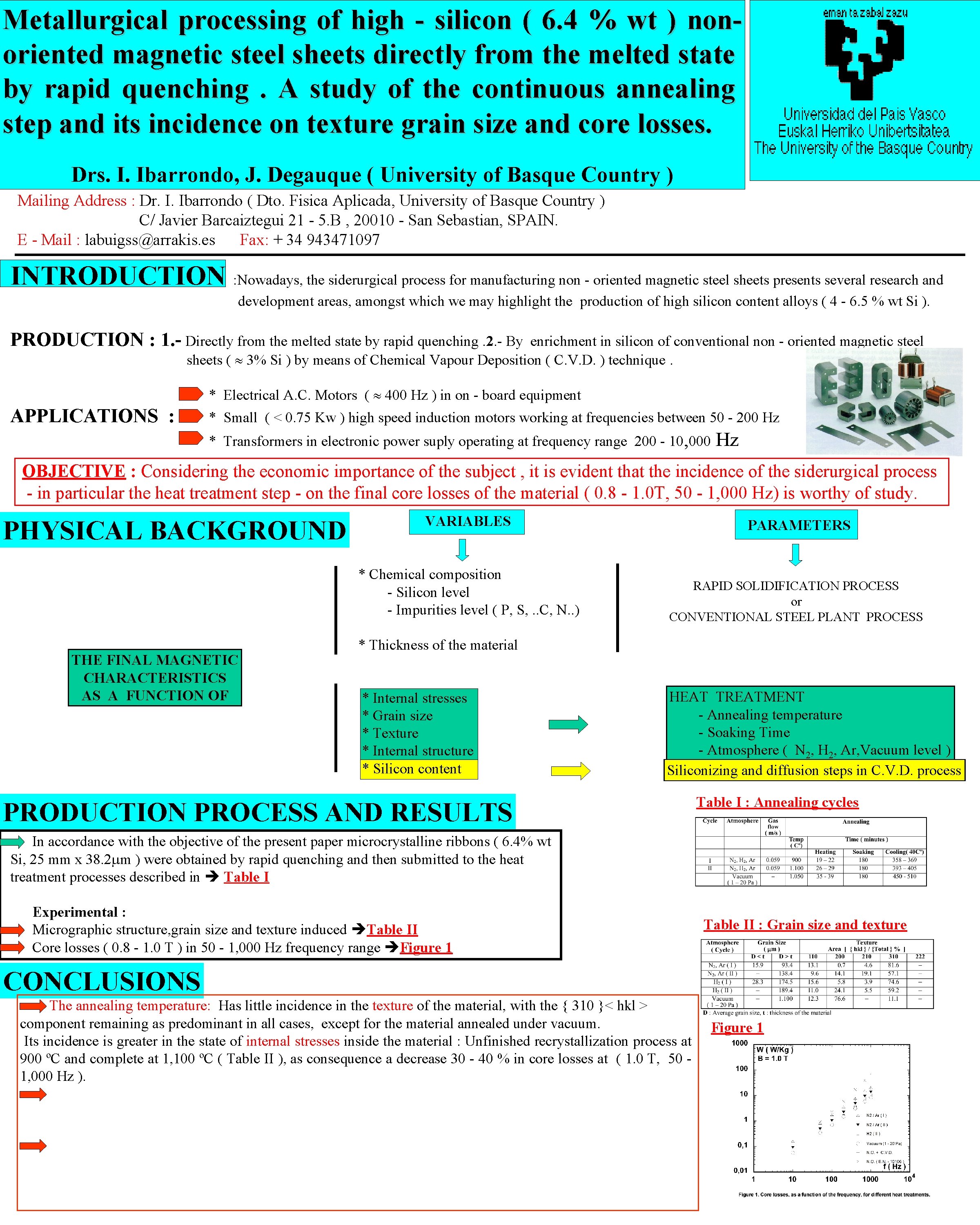
Metallurgical processing of high - silicon ( 6. 4 % wt ) nonoriented magnetic steel sheets directly from the melted state by rapid quenching. A study of the continuous annealing step and its incidence on texture grain size and core losses. Drs. I. Ibarrondo, J. Degauque ( University of Basque Country ) Mailing Address : Dr. I. Ibarrondo ( Dto. Fisica Aplicada, University of Basque Country ) C/ Javier Barcaiztegui 21 - 5. B , 20010 - San Sebastian, SPAIN. E - Mail : labuigss@arrakis. es Fax: + 34 943471097 INTRODUCTION : Nowadays, the siderurgical process for manufacturing non - oriented magnetic steel sheets presents several research and development areas, amongst which we may highlight the production of high silicon content alloys ( 4 - 6. 5 % wt Si ). PRODUCTION : 1. - Directly from the melted state by rapid quenching. 2. - By enrichment in silicon of conventional non - oriented magnetic steel sheets ( 3% Si ) by means of Chemical Vapour Deposition ( C. V. D. ) technique. * Electrical A. C. Motors ( 400 Hz ) in on - board equipment APPLICATIONS : * Small ( < 0. 75 Kw ) high speed induction motors working at frequencies between 50 - 200 Hz * Transformers in electronic power suply operating at frequency range 200 - 10, 000 Hz OBJECTIVE : Considering the economic importance of the subject , it is evident that the incidence of the siderurgical process - in particular the heat treatment step - on the final core losses of the material ( 0. 8 - 1. 0 T, 50 - 1, 000 Hz) is worthy of study. PHYSICAL BACKGROUND THE FINAL MAGNETIC CHARACTERISTICS AS A FUNCTION OF VARIABLES PARAMETERS * Chemical composition - Silicon level - Impurities level ( P, S, . . C, N. . ) RAPID SOLIDIFICATION PROCESS or CONVENTIONAL STEEL PLANT PROCESS * Thickness of the material * Internal stresses * Grain size * Texture * Internal structure * Silicon content HEAT TREATMENT - Annealing temperature - Soaking Time - Atmosphere ( N 2, H 2, Ar, Vacuum level ) Siliconizing and diffusion steps in C. V. D. process PRODUCTION PROCESS AND RESULTS Table I : Annealing cycles In accordance with the objective of the present paper microcrystalline ribbons ( 6. 4% wt Si, 25 mm x 38. 2 m ) were obtained by rapid quenching and then submitted to the heat treatment processes described in Table I Experimental : Micrographic structure, grain size and texture induced Table II Core losses ( 0. 8 - 1. 0 T ) in 50 - 1, 000 Hz frequency range Figure 1 Table II : Grain size and texture CONCLUSIONS The annealing temperature: Has little incidence in the texture of the material, with the { 310 }< hkl > component remaining as predominant in all cases, except for the material annealed under vacuum. Its incidence is greater in the state of internal stresses inside the material : Unfinished recrystallization process at 900 ºC and complete at 1, 100 ºC ( Table II ), as consequence a decrease 30 - 40 % in core losses at ( 1. 0 T, 50 1, 000 Hz ). Figure 1