
Metallgesellschaft AG A Case Study Lecture 4 Background

Metallgesellschaft AG: A Case Study Lecture 4:
Background • Metallgesellschaft AG, or MG, was a German conglomerate • MG, a traditional metal company, has evolved in the last four years into a provider of risk management services • MGRM's expanded venture into the derivatives world began in 1991 with the hiring of Mr. Arthur Benson from Louis Dreyfus Energy • It was Benson's strategy that eventually contributed to the massive cash flow crisis that MG experienced
The Deals • MGRM committed to sell, at prices fixed in 1992, certain amounts of petroleum every month for up to 10 years • These contracts initially proved to be very successful since, in some cases the profit margin was around $5 per barrel • By September of 1993, MGRM had sold forward contracts amounting to the equivalent of 160 million barrels • .
Cause • In the fall of 1993, Metallgesellschaft went long on approximately 55 million barrels of gasoline and heating oil futures • At that time, the average trading volume for gas was only between 15, 000 and 30, 000 barrels • By December of that year, Metallgesellschaft had long positions in energy derivatives equivalent to 185 million barrels of oil
Hedging Strategy • Short forward. In 1991, Metallgesellschaft wrote forward contracts of up to 10 years. • Futures: Metallgesellschaft used another strategy to hedge the risk of upward price movements: it entered into huge positions in the futures market for each month • then stacked and rolled over these contracts every month
• Backwardation: spot>future • Contango: future spot<futures • Losses • Margin calls • Liquidity issues • German accounting standardards

Risk areas affected • Basis risk • Dealing risk: huge positions • Liqudity risk • Operational Risk
Some more jargons related to options • If price of the common stock S exceeds the exercise price of a call, E, the call is said to be in the money • If the price of common stocks is less than the exercise price, it is said to be out of money

Intrinsic Values • If a call is in the money, it will have positive intrinsic value. • Intrinsic value is equal to the difference between current price and exercise price • Example: FFC current price is Rs. 65, a call option on FFC is Rs. 60, the option is in the money • IV = 65 -60 = 5
Pricing an option • Pricing an option means “finding the amount that you pay to have the right/option” • Or pricing an option is finding the “fair” value of the agreement • “fair” means the value that precludes any arbitrage opportunity • Let’s use an example to find the value of call option at expiration
Pricing call option at expiration • Suppose you own a call option on one share of PTCL stock with a strike price of Rs. 30 • Suppose that at expiration one share of PTCL trades at Rs. 35 • What should be the minimum price of this call now?
Price of call option • Minimum price should be • 35 – 30 = 5 OR • Market price – Exercise Price Or • S – E which is equal to Intrinsic value • In other words, price of call option can never be lower than intrinsic value

Determinants of option prices • 1. Exercise Price • An increase in the exercise price reduces the value of the call • In the previous example, if exercise price was 32 instead of 30, the value of the call option will be • 35 – 32 = 3 instead of 5
Determinants of option prices • Expiration date : the higher the maturity, the higher will be the value of a call option • The reason is that the option holder has more time to exercise the option • The extra time increases the probability of profit for option holder and loss for option writer
Determinants of option prices • Stock Price: Other things being equal, the higher the stock price, the more valuable the call option will be. • In our earlier example, if current market price of PTCL share was Rs. 40, then option value would have been • 40 – 30 = 10 in stead of 5
Determinants of option prices • The Variability of the Underlying Asset • The greater the variability of the underlying asset, the more valuable the call option will be • Greater variability can subject the option writer to higher losses, this is why option writer will need higher premium for giving such option
Determinants of option prices • The Interest Rate • Call prices are also a function of the level of interest rates. • Buyers of calls do not pay the exercise price until they exercise the option. • The ability to delay payment is more valuable when interest rates are high and less valuable when interest rates are low. • Thus, the value of a call is positively related to interest rates.
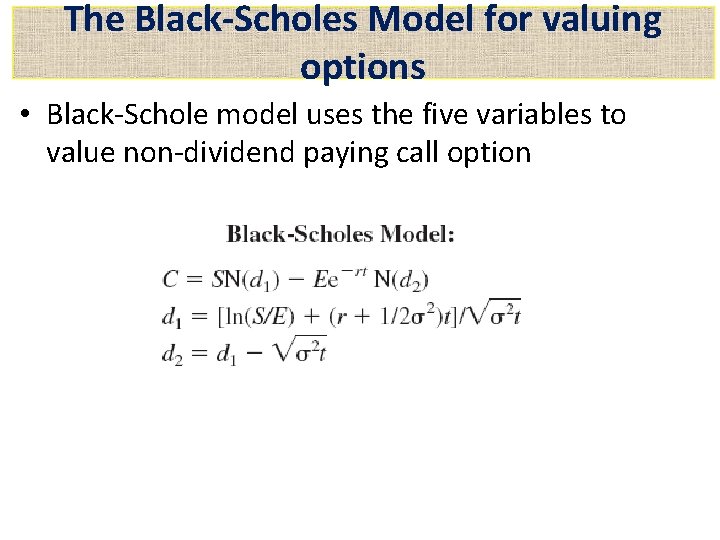
The Black-Scholes Model for valuing options • Black-Schole model uses the five variables to value non-dividend paying call option
• S = Current stock price • E = Exercise price of call • r = Annual risk-free rate of return, continually compounded • δ 2 =Variance (per year) of the continuous return on the stock • t = Time (in years) to expiration date • N(d)= Probability that a standardized, normally distributed, random variable will be less than or equal to d
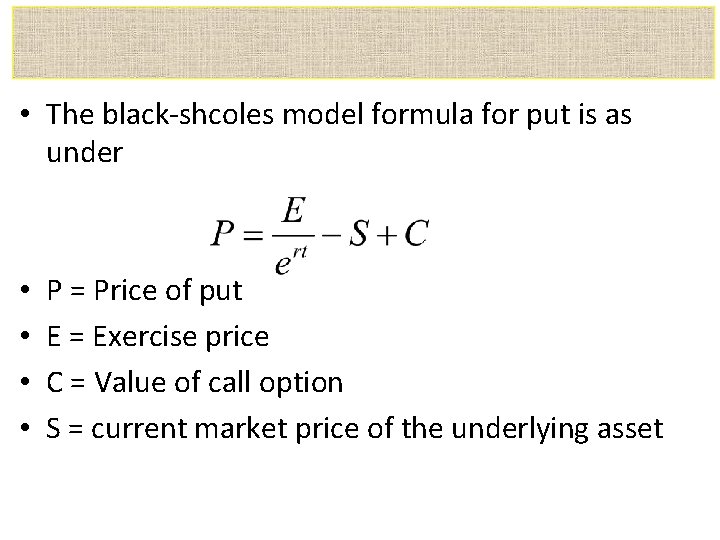
• The black-shcoles model formula for put is as under • • P = Price of put E = Exercise price C = Value of call option S = current market price of the underlying asset




- Slides: 24