
METAL PACKAGING MATERIALS Instructor Assist Prof Dr Eda


- Slides: 46
METAL PACKAGING MATERIALS Instructor Assist. Prof. Dr. Eda Demirok Soncu E-mail: edemirok@eng. ankara. edu. tr Phone: +90312 203 3300 (3639 ext. ) Office: 2 nd floor #212 FDE 216 FOOD PACKAGING
2 The importance of container design The shapes of metal containers are very relevant to their cost, physical performance and compatibility with the filled product In can design; � metal thickness is determined by the need for physical performance in handling, processing and storage of the filled container � surface area is determined by the volume contents and the chosen shape of the container FDE 216 -FP 3/10/2021
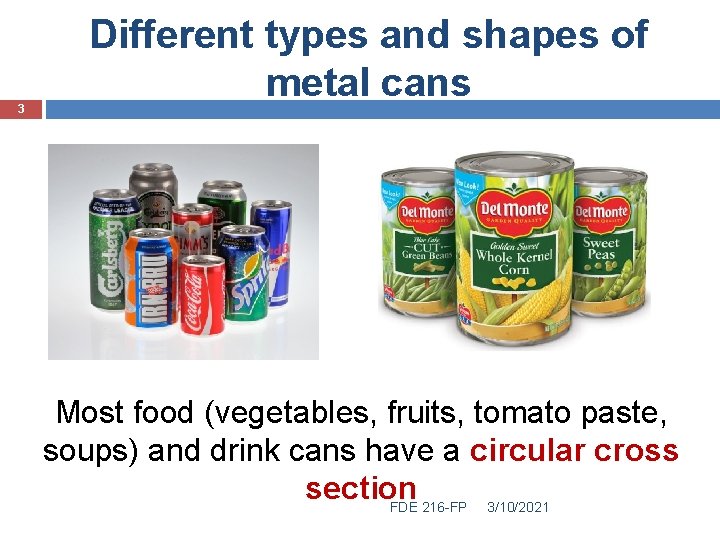
3 Different types and shapes of metal cans Most food (vegetables, fruits, tomato paste, soups) and drink cans have a circular cross section FDE 216 -FP 3/10/2021
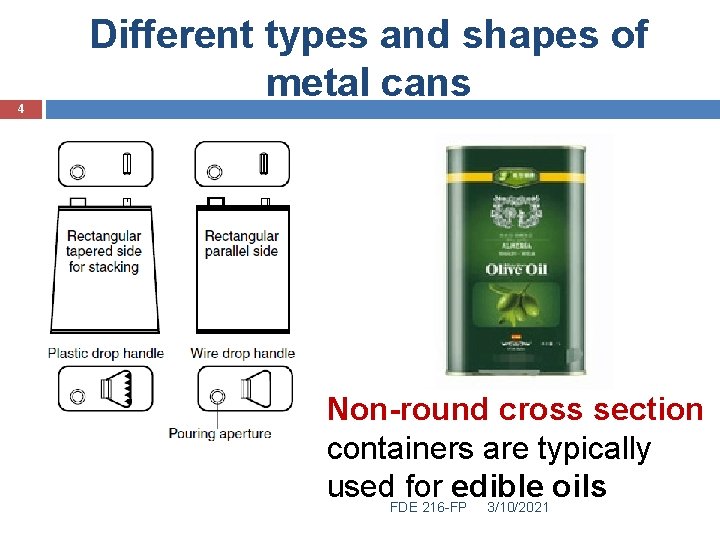
4 Different types and shapes of metal cans Non-round cross section containers are typically used. FDEfor edible oils 216 -FP 3/10/2021
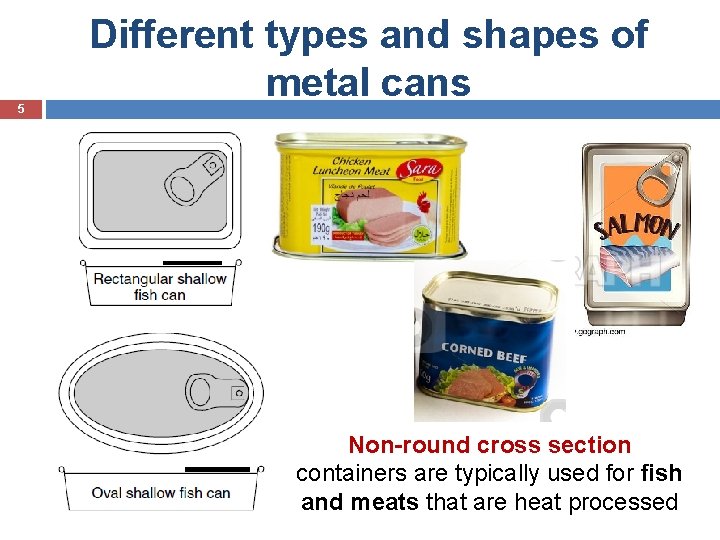
5 Different types and shapes of metal cans Non-round cross section containers are typically used for fish and meats that are heat processed
What properties should metal packages have? 6 Metal packages for food products must perform the functions given below 1) preserve and protect the product 2) resist chemical actions of product (e. g. after carbonated bevarages are filled, the metal container is closed. Carbonation pressure provides physical support to the container and the container must be durable against to this pressure) 3) withstand the handling and processing conditions (e. g. after blanched vegetables are filled into metal container, heat process is applied to prolong the shelf life up to 2 -3 years. Therefore, metal cans must be durable 3/10/2021 against to high temperature and pressure conditions FDE 216 -FP
What properties should metal packages have? 7 Metal packages for food products must perform the functions given below 4) withstand the external environment conditions 5) have the correct dimensions for easy transportation 6) have the required shelf display properties at the point of sale 7) give easy opening and simple/safe product removal 216 -FP 3/10/2021 8) be constructed from. FDErecyclable raw
8 What type of materials are used for can making? FDE 216 -FP 3/10/2021
9 Raw materials used for can making Steel Aluminium Recycling of metal packages: Both aluminium- and steel-based packaging materials are re-melted by the metal producers. Aluminium and steel do not loss its quality during the remelting process; therefore, they may be reused an unlimited number of times for the production of first -quality packaging material.
10 Raw materials used for can making Steel and aluminium are the raw materials which are used for metal containers and metal closing tools They have some advantages, which are Low-cost Non-toxic Adequate strenght Suitable for hard material making FDE 216 -FP 3/10/2021
A raw material for can making: Steel 11 In the first stage, low-carbon steel is produced as blackplate Then, it is converted into tinplate or tin -free steel (TFS) for container and closure manufacture FDE 216 -FP 3/10/2021
Tinplate from steel 12 Tinplate is produced by coating of blackplate with a thin layer of tin (Sn) Tin coating provides good barrier properties against to corrosion of steel Tin coating makes the can suitable for direct contact with many food products such as fruits and tomato based product For most foods and drinks, application of organic coating to the inside surface of tinplate is neccessary to provide an inert barrier between the metal and the product packed FDE 216 -FP 3/10/2021
Tin-free steel (TFS) from steel 13 TFS is produced by coating of blackplate with a thin layer of chromium/chrome oxide Then, it must be coated with an organic material to provide a resistant surface against to corrosion As compared to tinplate, TFS is less expensive and have matt surface FDE 216 -FP 3/10/2021
14 A raw material for can making: Aluminium has good mechanical properties, which are It is the lightest material It is easy to reduce its thickness Aluminium has good thermal properties, which are It has high thermal conductivity, which means heat process applied to Al packages is more effective Its melting temperature is lower than 700°C and it evaporates at lower pressure. Thanks to these properties, Al can be used as a surface coating material for plastic films or paper material It resists againts to low or freezing temperatures FDE 216 -FP 3/10/2021
15 Production process of metal cans FDE 216 -FP 3/10/2021
Can making process 16 Making process for upper (lid) and bottom side of can Making process for can body Body of can is made by using three methods � Three-piece welded cans � Two-piece single drawn and multiple drawn (DRD) cans � Two-piece drawn and The process, which is used to produce upper and bottom parts of cans, is called as endmaking process FDE 216 -FP 3/10/2021
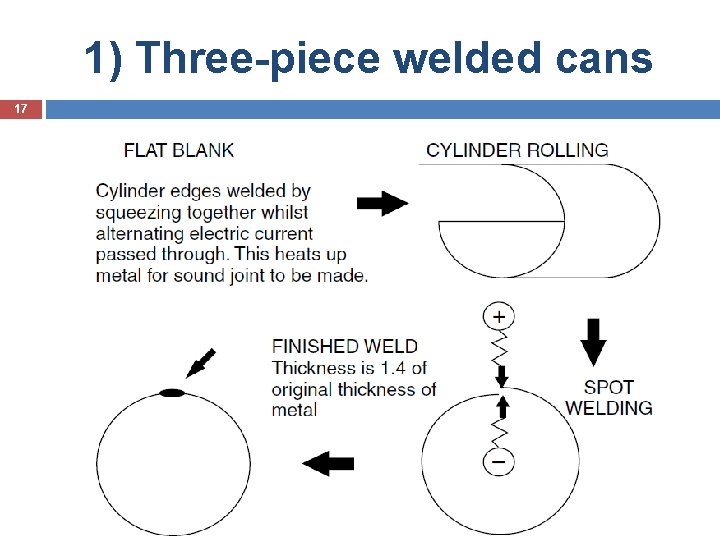
1) Three-piece welded cans 17
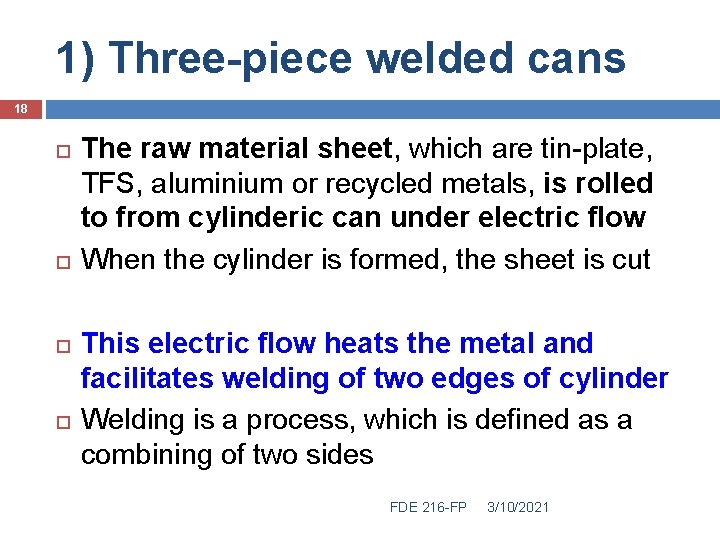
1) Three-piece welded cans 18 The raw material sheet, which are tin-plate, TFS, aluminium or recycled metals, is rolled to from cylinderic can under electric flow When the cylinder is formed, the sheet is cut This electric flow heats the metal and facilitates welding of two edges of cylinder Welding is a process, which is defined as a combining of two sides FDE 216 -FP 3/10/2021
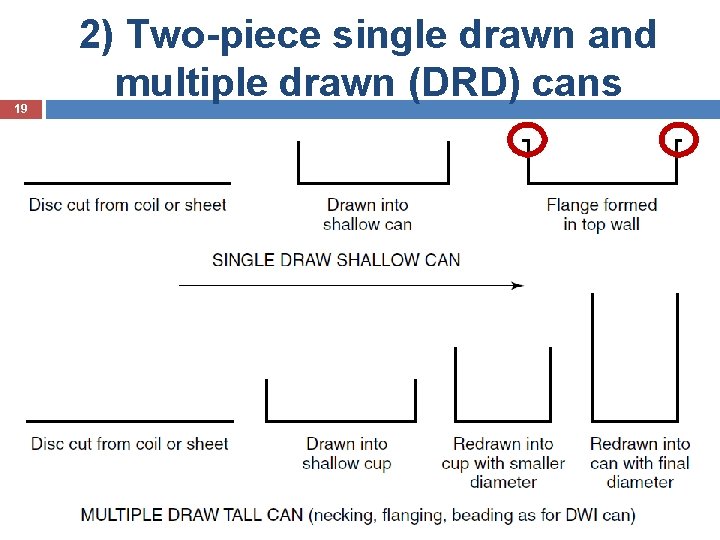
19 2) Two-piece single drawn and multiple drawn (DRD) cans
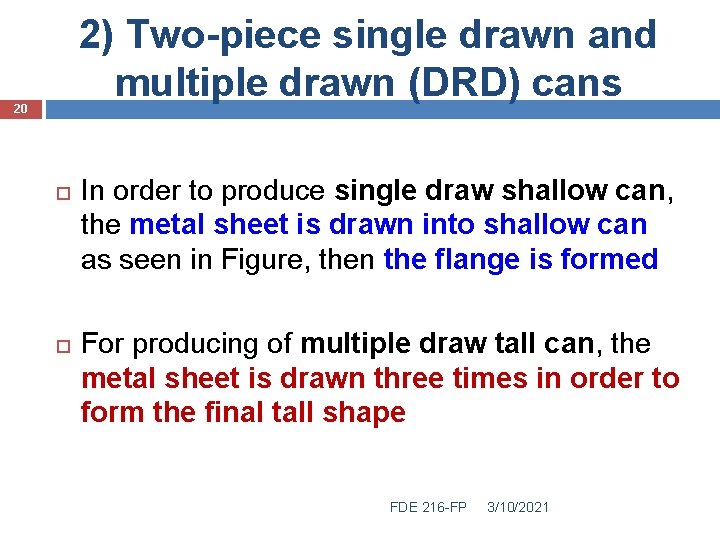
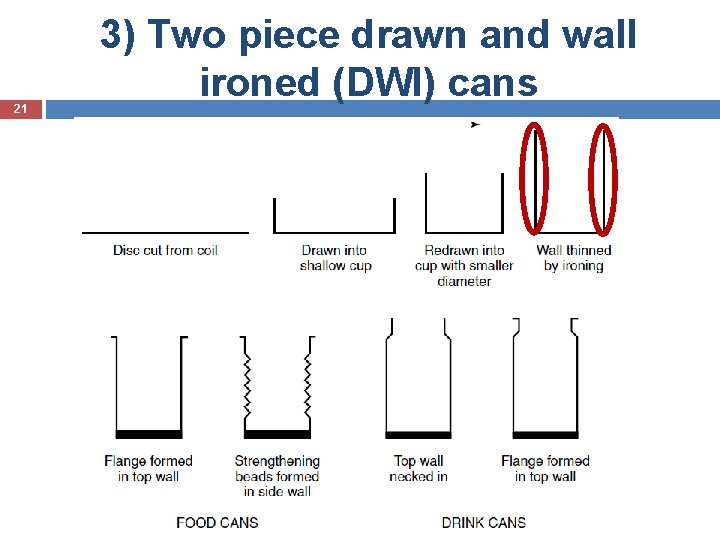
2) Two-piece single drawn and multiple drawn (DRD) cans 20 In order to produce single draw shallow can, the metal sheet is drawn into shallow can as seen in Figure, then the flange is formed For producing of multiple draw tall can, the metal sheet is drawn three times in order to form the final tall shape FDE 216 -FP 3/10/2021
21 3) Two piece drawn and wall ironed (DWI) cans
3) Two piece drawn and wall ironed (DWI) cans 22 After the metal sheet is drawn into tall can by multiple times, the wall of the can is thickened by ironing After the flange is formed, the can body is reshaped by drawing multiple round circle to strenght it Then the neck followed by flange are fromed by using former to finalize the can production FDE 216 -FP 3/10/2021
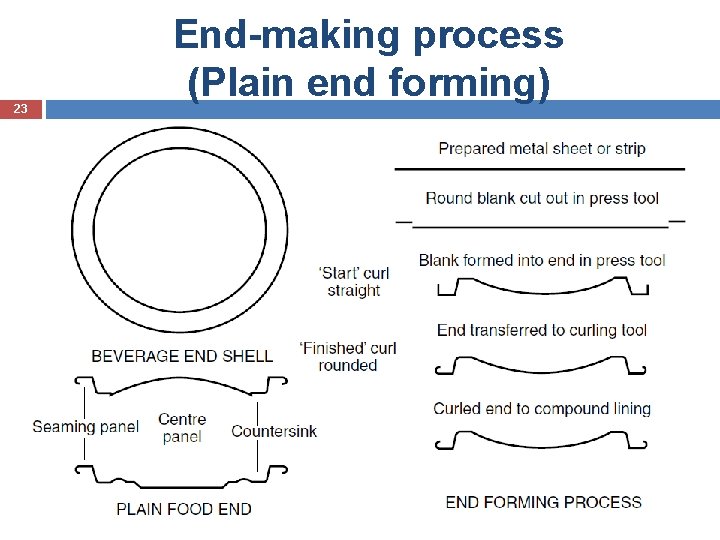
23 End-making process (Plain end forming) FDE 216 -FP 3/10/2021
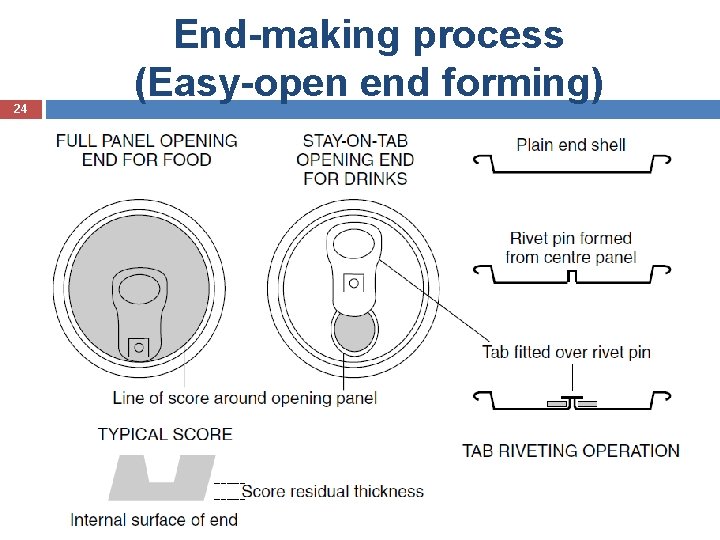
24 End-making process (Easy-open end forming)
End-making process (Plain end and easy-open end forming) 25 The metal sheet is cut and then formed into semi-elliptic round Then the cover curl is formed by using curling tool This curling part is used to combine the upper or bottom lid with can body by seaming After plain end is formed, rivet pin is formed at the centre and the opening tool is fitted FDE 216 -FP 3/10/2021 over the rivet pin
26 How canned foods are produced? FDE 216 -FP 3/10/2021
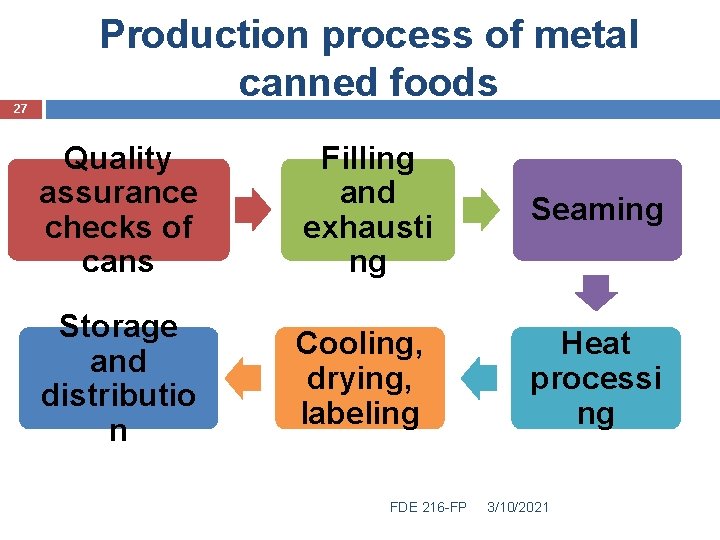
27 Production process of metal canned foods Quality assurance checks of cans Filling and exhausti ng Seaming Storage and distributio n Cooling, drying, labeling Heat processi ng FDE 216 -FP 3/10/2021
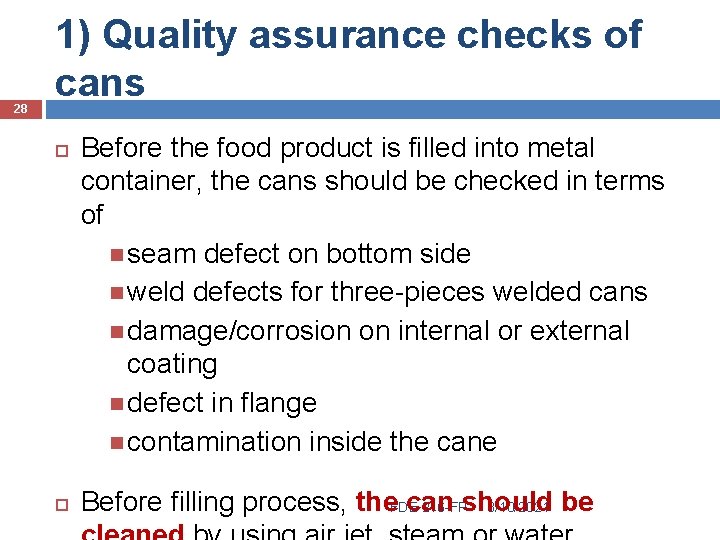
28 1) Quality assurance checks of cans Before the food product is filled into metal container, the cans should be checked in terms of seam defect on bottom side weld defects for three-pieces welded cans damage/corrosion on internal or external coating defect in flange contamination inside the cane Before filling process, the. FDEcan 216 -FPshould 3/10/2021 be
2) Filling and exhausting 29 Filling should be carried out carefully. During the filling process, it is important to note that � The filling is performed without damaging the can � Required amount of product should be filled into container and required amount of empty place should be left at the upper side of the can for closing process and vacuum formation � External contamination of flage shoud be avoided, since it negatively affects the seaming process at closing FDE 216 -FP 3/10/2021
2) Filling and exhausting 30 In order to achieve an effective vacuum, cans may be (a) hot-filled with product and closed with or without direct steam injection into the headspace during double seaming (b) filled with product (ambient or hot-fill) and then exhausted prior to double seaming (c) closed in a vacuum chamber The choosen of one of these methods depends on cost, product characteristics, FDE 216 -FP production 3/10/2021
2) Filling and exhausting 31 Exhausting process is defined as passing filled cans through a steam-heated chamber (in other words, exhaust box) at 90°C Exhausting serves to remove entrapped air from the product, raise initial temperature of the product prior to heat processing and help ensure that a good vacuum level is achieved FDE 216 -FP 3/10/2021
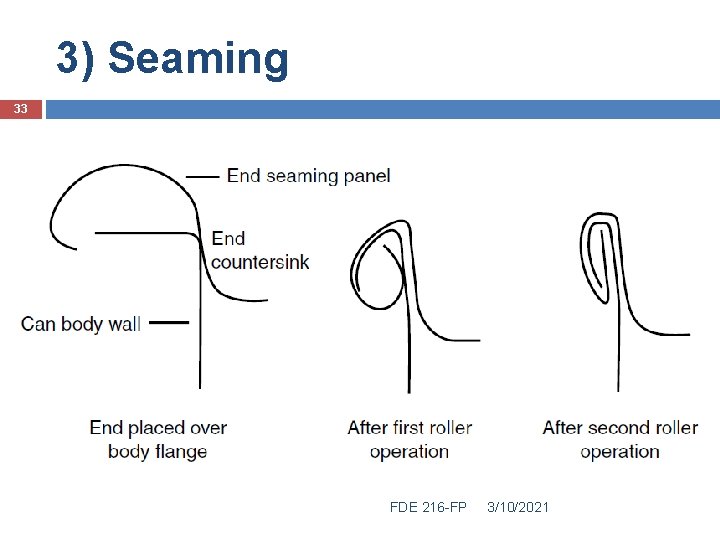
3) Seaming 32 The most important closure type used for metal containers is the double seam The seam is formed in two operations from the curl of the can end (lid) and the flange of the can body For heat-processed foods, the operation of the can seamer is critical control point for process safety If there is seam defect, the external air enters FDE 216 -FP 3/10/2021 inside the can and results in chemical and
3) Seaming 33 FDE 216 -FP 3/10/2021
Seaming process https: //www. youtube. com/watch? v=y. Mg. SGgi. UO 4 A 34 FDE 216 -FP 3/10/2021
4) Heat processing 35 Upon seaming, the cans are exposed to sterilization or pasteurization process in order to provide microbial safety The most important microbial risk for canned foods is the presence of Clostridium botulinum spores These spores can cause a potentially fatal food poisoning, which is called as botulism FDE 216 -FP 3/10/2021
36 5) Cooling, drying and labeling Effective washing of cans is often required to minimise external contaminated food/drink components that may contribute to container corrosion at a later process stage Acid syrups or brine is used in canned foods as a filling solution. External contamination of can with these solutions will cause a corrosion on the external surface FDE 216 -FP 3/10/2021
37 5) Cooling, drying and labeling After the can temperature is cooled down at 40 °C, the cans is dried to remove residual moisture from the external surface of can Because the presence of water on can surface results in external corrosion and microbial contamination of external surface These microorganisms can enter inside through the can seams and cause microbial spoilage Use of correct label and adhesive is important, since highly acidic/alkaline starch-based FDE 216 -FP 3/10/2021 adhesive can effect external corrosion
6) Storage and distribution 38 Canned foods should be stored at ambient temperature Air temperature and air humidity inside the storage room as weel as canned temperature are important factors for storage conditions Since potential water condensation in the case of sudden temperature changes results in external corrison On the other side, damaged cans should be removed immediately, because it can trigger a chain reaction through the spread of moisture FDE 216 -FP 3/10/2021 and corrosion between other cans
Canned food process https: //www. youtube. com/watch? v=Id. Ala. Gq. Xx Q 0 39 FDE 216 -FP 3/10/2021
Shelf life of canned food 40 Hermetic sealing and heat treatment (sterilization/pasteurization) are the methods, which are used to provide long shelf life for canned foods Therefore, no preservatives are needed However, some chemical reactions, occur between the can and the food products, limit the shelf life of canned foods These reactions affect the sensory quality (such as color, flavor, appearance) and safety 216 -FP 3/10/2021 (some metals have toxic FDE properties) of food
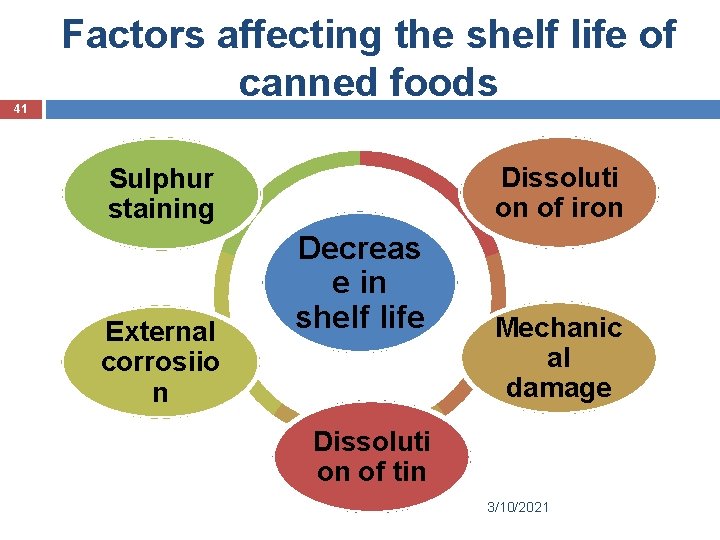
41 Factors affecting the shelf life of canned foods Dissoluti on of iron Sulphur staining External corrosiio n Decreas e in shelf life Mechanic al damage Dissoluti on of tin 3/10/2021
Use of lacquers 42 In order to prevent the chemical reactions between metal can and food, the can is coated with some lacquers such as; � Epoxy phenolic group or oleoresinous group are suitable for meat, fish, vegetable and fruits � Vinyl resins are used for dry products such as biscuits and powders and also some drinks � Organosol groups are found in application for beverage cans FDE 216 -FP 3/10/2021
Troubles in canned foods 43 Mechanical damage caused by poor transportation or manufacturing fault results in cracking of internal lacquer In the case of damaged lacquer, tin start to dissolve slowly into the product. Dissolution rate increases depending on increased time, increased temperature, exposure area, tin coating with thin thickness, the presence of high acidic foods FDE 216 -FP 3/10/2021
Troubles in canned foods 44 Corrosion in steel base starts towards the end of tin corrosion Corrosion in steel results in releasimg of iron into the food, changes in color and flavor (e. g. metalic taste) External corrosion caused by moisture condensation, physically damaged of external coating, poor drying conditions and leakage from neighbouring cans External corrision simply begins at the 216 -FP 3/10/2021 weakest point of the can. FDE (seam points and
Troubles in canned foods (sulphur staining) 45 Sulphur staining is formed via a reaction between iron, comes from steel part of a can, and sulphur compounds, comes from protein-rich foods, in the presence of oxygen during processing This reactions results in the formation of blue-black or brown points inside the can It is seen in canned peas, sweet corn, meat or fish It is not harmful for human health, but it affects products appearance and causes consumer complaints Solution is coating of can with lacquer which resist FDE 216 -FP 3/10/2021 sulphur compounds
References 46 Coles R. et al. (2003). Food Packaging Technology. Blackwell Publishing and CRC Press. (in Chapter 5 pages 120 -151) Piergiovanni, L. & Limbo, S. (2016). Food Packaging Materials. Springer. (in Chapter 3 pages 13 -22) Jeantet, R. et al. (2016). Packaging (Part 5) In Handbook of Food Science and Technology 2/Food Process Engineering and Packaging. John FDE 216 -FP 3/10/2021 Wiley&Sons, Inc. USA. (pages 298 -301)