
METAL OXIDE SEMICONDUCTOR FIELD EFFECT TRANSISTORSMOSFET MOSFET Voltage
- Slides: 37
METAL OXIDE SEMICONDUCTOR FIELD EFFECT TRANSISTORS(MOSFET) MOSFET: Ø Ø Ø Voltage controlled device Requires small area in Silicon IC chip Manufacturing process is simple Low power device MOSFET can substitute--- Resistor, Capacitor 1
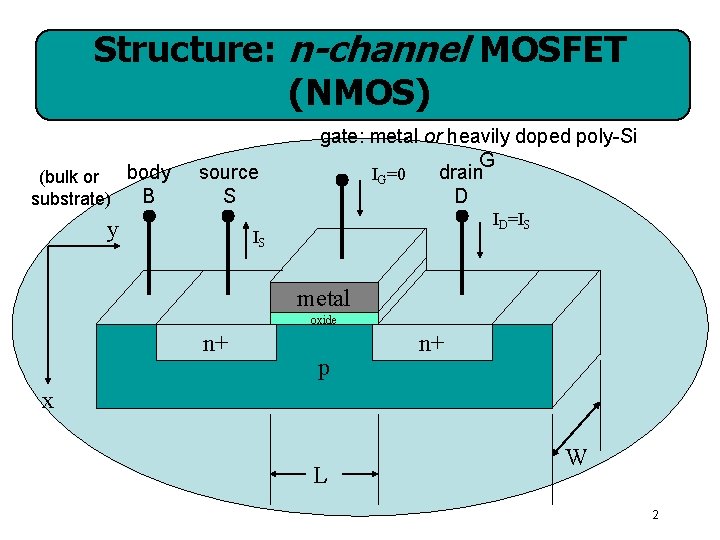
Structure: n-channel MOSFET (NMOS) body (bulk or B substrate) source S y gate: metal or heavily doped poly-Si G drain IG=0 D ID=IS IS metal oxide n+ p n+ x L W 2
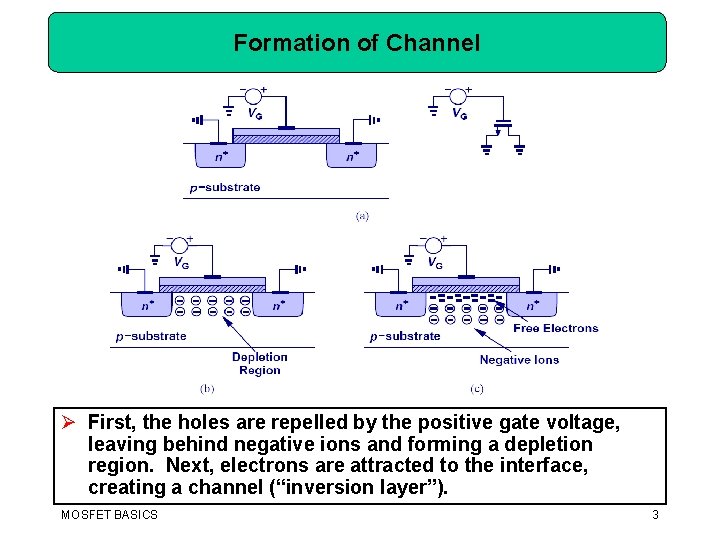
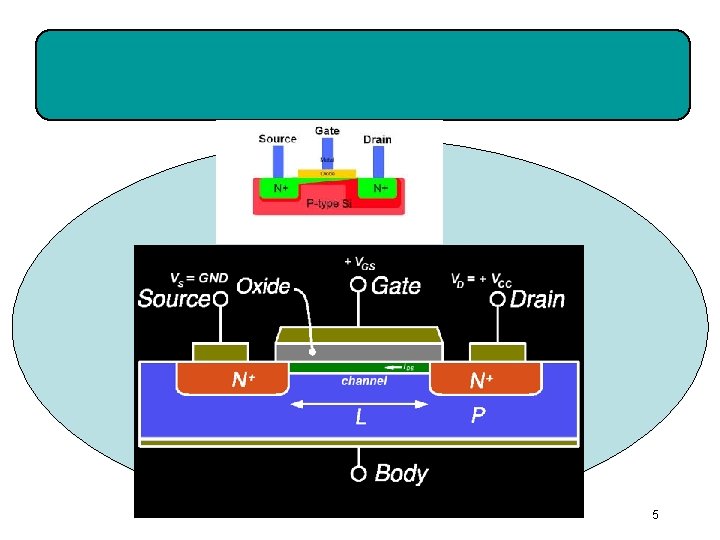
Formation of Channel Ø First, the holes are repelled by the positive gate voltage, leaving behind negative ions and forming a depletion region. Next, electrons are attracted to the interface, creating a channel (“inversion layer”). MOSFET BASICS 3
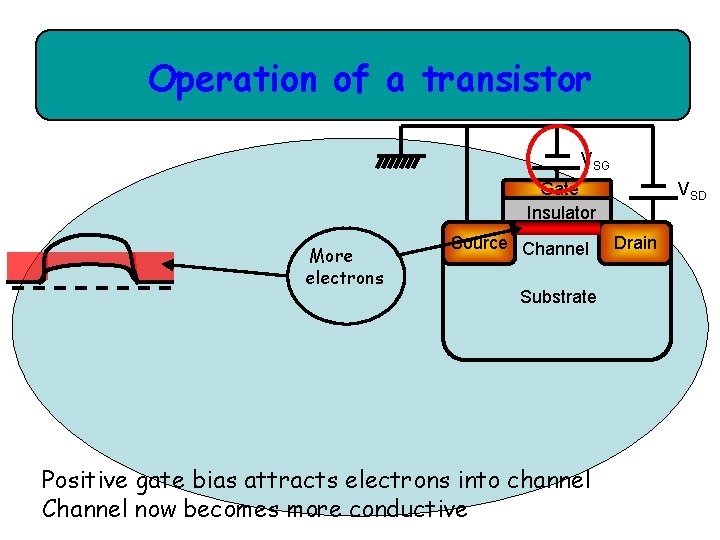
Operation of a transistor VSG Gate Insulator More electrons Source Channel Substrate Positive gate bias attracts electrons into channel Channel now becomes more conductive VSD Drain
5
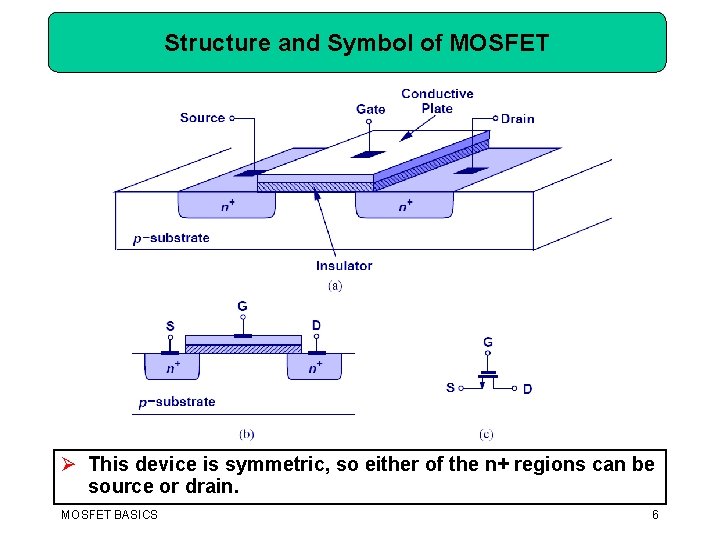
Structure and Symbol of MOSFET Ø This device is symmetric, so either of the n+ regions can be source or drain. MOSFET BASICS 6
MOSFET TYPES Ø Enhancement (widely used) Ø Depletion type 7
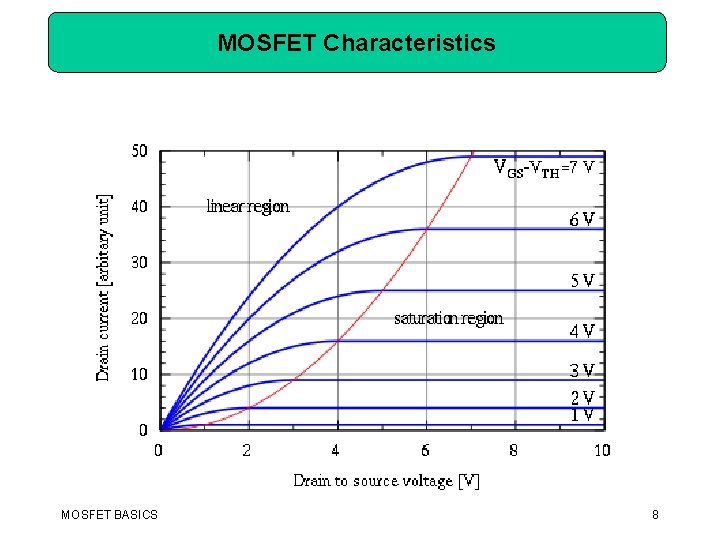
MOSFET Characteristics MOSFET BASICS 8
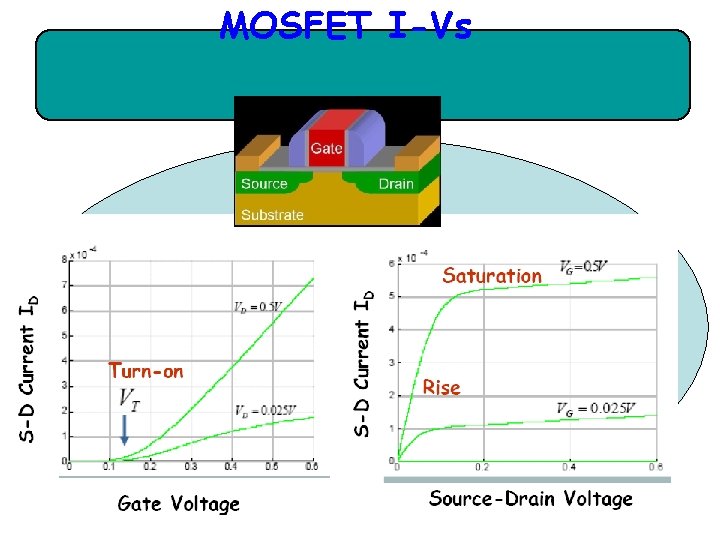
MOSFET I-Vs ECE 663
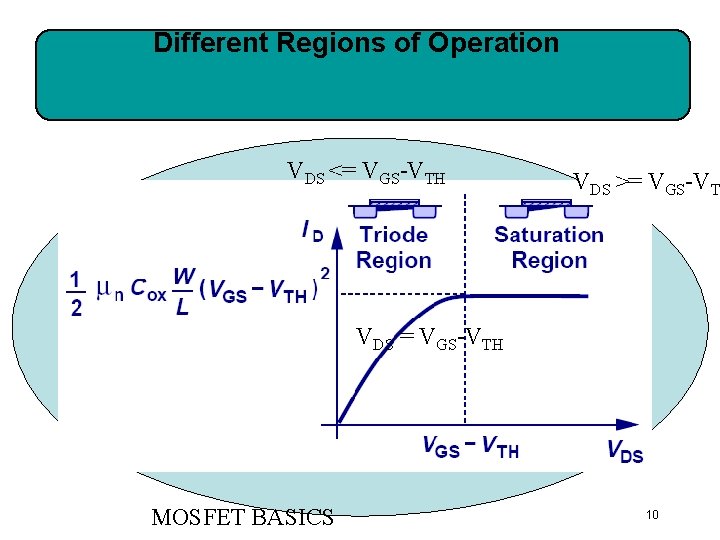
Different Regions of Operation VDS <= VGS-VTH VDS >= VGS-VT VDS = VGS-VTH MOSFET BASICS 10
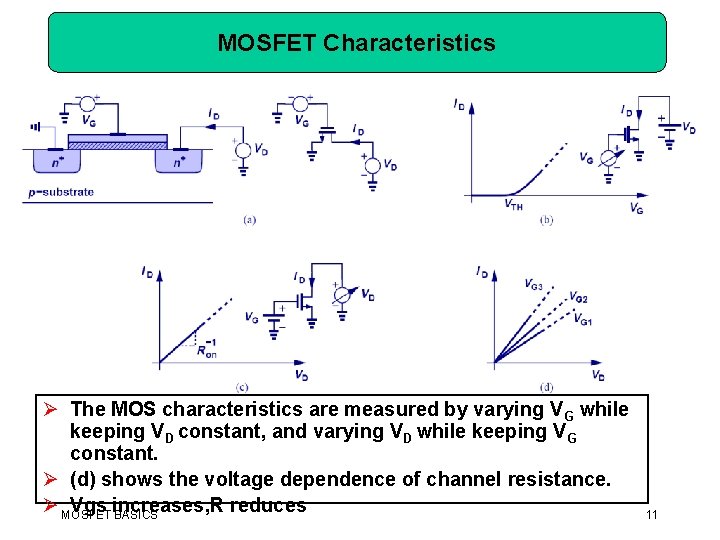
MOSFET Characteristics Ø The MOS characteristics are measured by varying VG while keeping VD constant, and varying VD while keeping VG constant. Ø (d) shows the voltage dependence of channel resistance. Ø MOSFET Vgs increases, R reduces BASICS 11
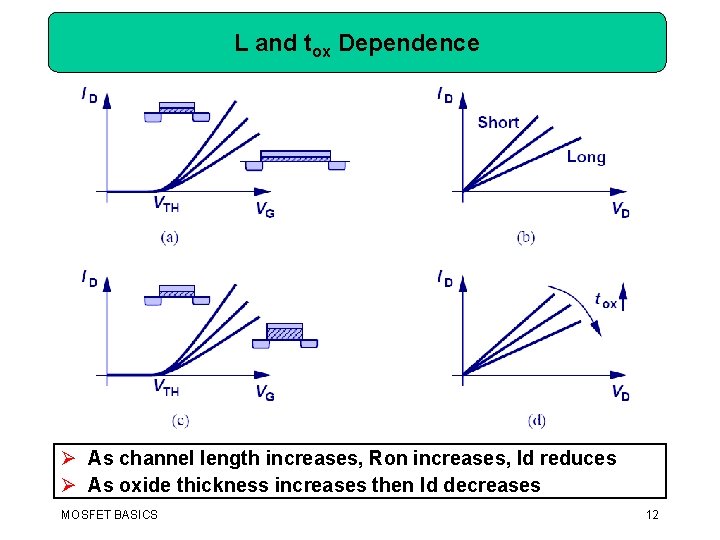
L and tox Dependence Ø As channel length increases, Ron increases, Id reduces Ø As oxide thickness increases then Id decreases MOSFET BASICS 12
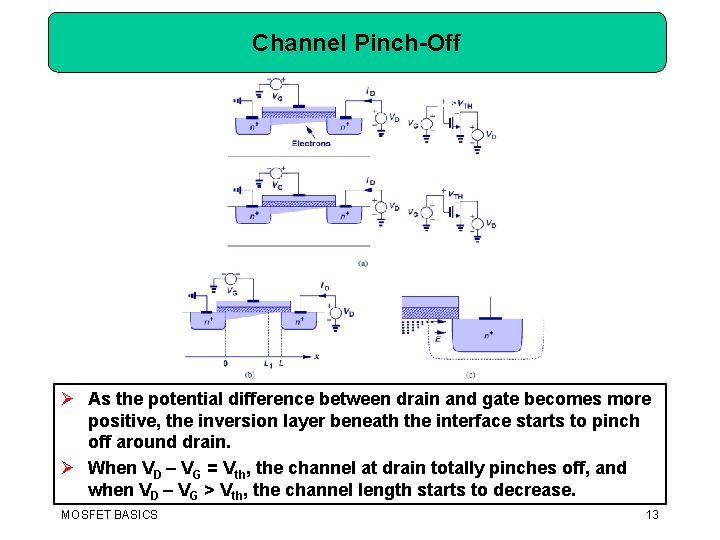
Channel Pinch-Off Ø As the potential difference between drain and gate becomes more positive, the inversion layer beneath the interface starts to pinch off around drain. Ø When VD – VG = Vth, the channel at drain totally pinches off, and when VD – VG > Vth, the channel length starts to decrease. MOSFET BASICS 13
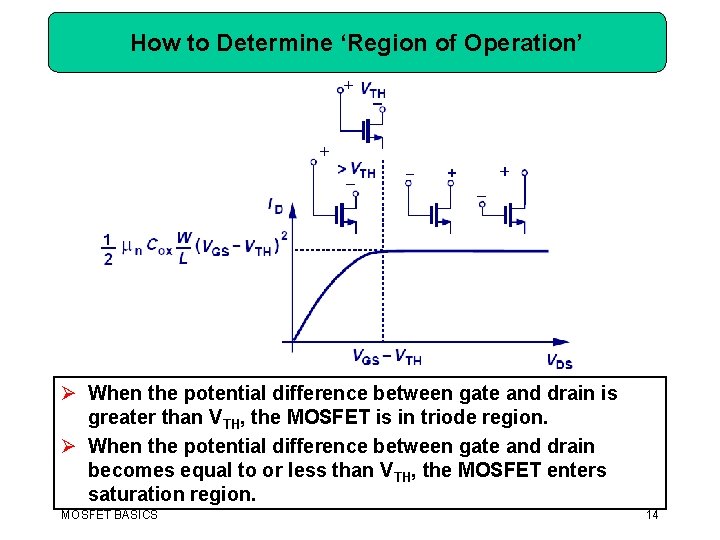
How to Determine ‘Region of Operation’ Ø When the potential difference between gate and drain is greater than VTH, the MOSFET is in triode region. Ø When the potential difference between gate and drain becomes equal to or less than VTH, the MOSFET enters saturation region. MOSFET BASICS 14
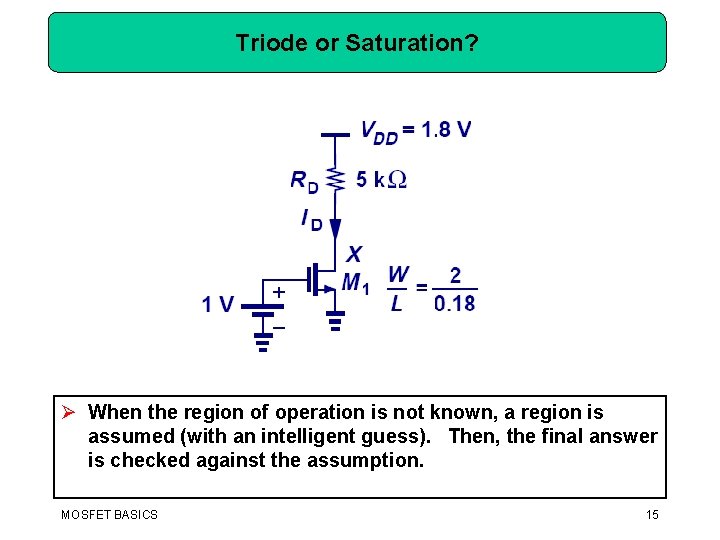
Triode or Saturation? Ø When the region of operation is not known, a region is assumed (with an intelligent guess). Then, the final answer is checked against the assumption. MOSFET BASICS 15
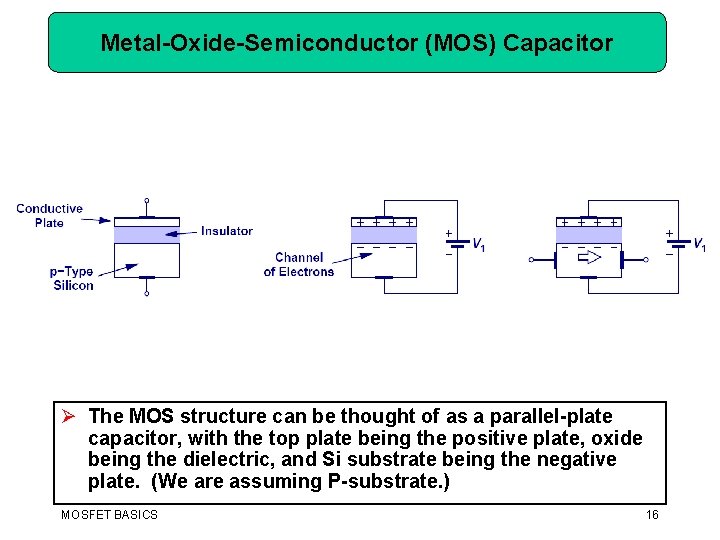
Metal-Oxide-Semiconductor (MOS) Capacitor Ø The MOS structure can be thought of as a parallel-plate capacitor, with the top plate being the positive plate, oxide being the dielectric, and Si substrate being the negative plate. (We are assuming P-substrate. ) MOSFET BASICS 16
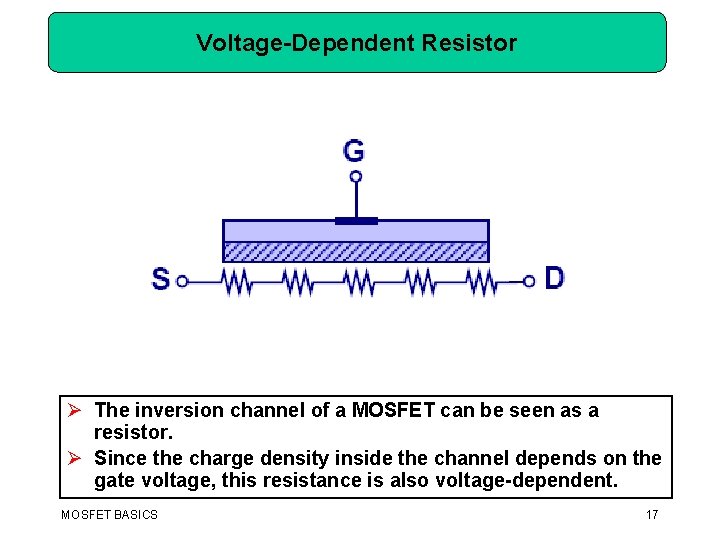
Voltage-Dependent Resistor Ø The inversion channel of a MOSFET can be seen as a resistor. Ø Since the charge density inside the channel depends on the gate voltage, this resistance is also voltage-dependent. MOSFET BASICS 17
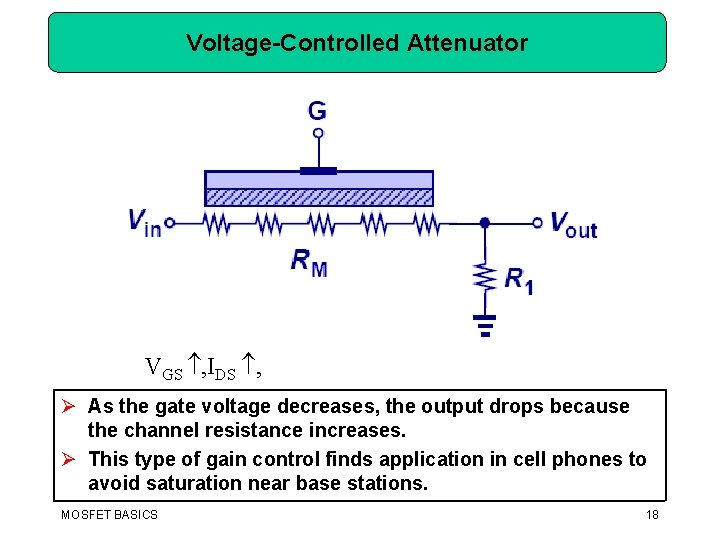
Voltage-Controlled Attenuator VGS , IDS , Ø As the gate voltage decreases, the output drops because the channel resistance increases. Ø This type of gain control finds application in cell phones to avoid saturation near base stations. MOSFET BASICS 18
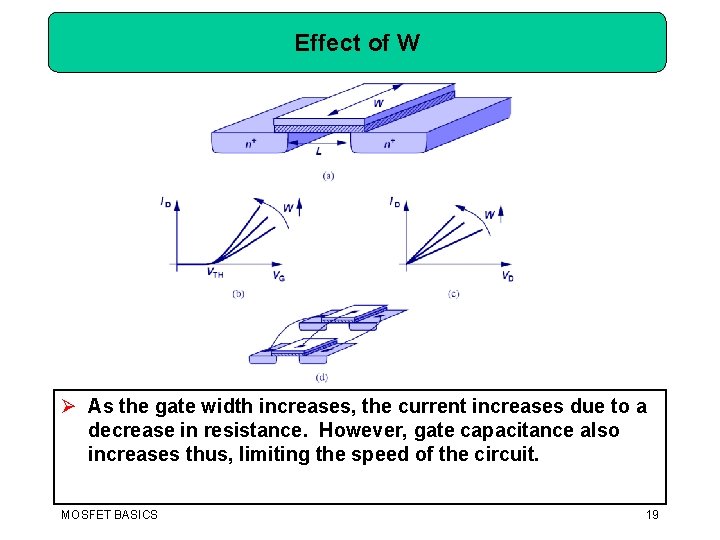
Effect of W Ø As the gate width increases, the current increases due to a decrease in resistance. However, gate capacitance also increases thus, limiting the speed of the circuit. MOSFET BASICS 19
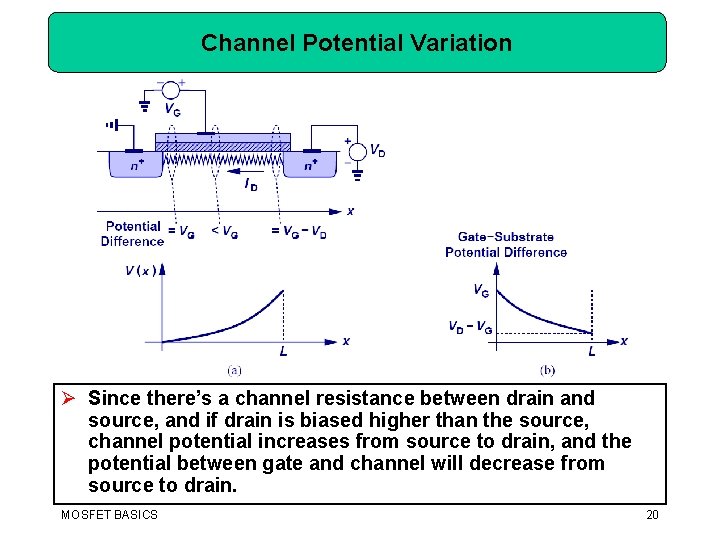
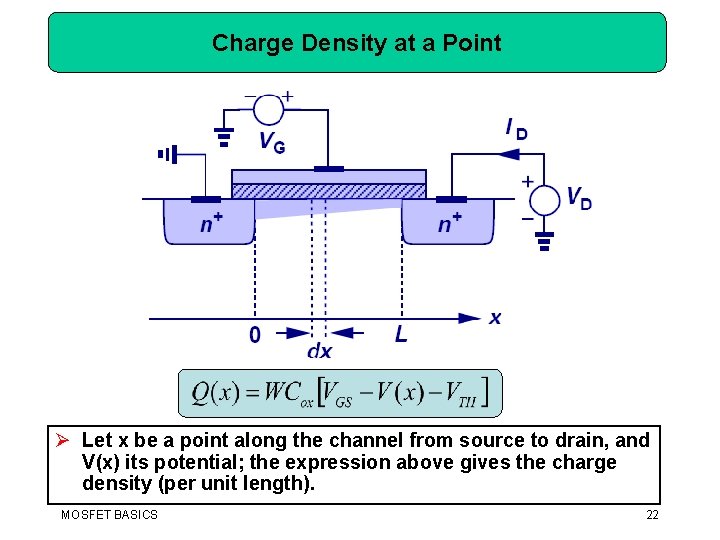
Channel Potential Variation Ø Since there’s a channel resistance between drain and source, and if drain is biased higher than the source, channel potential increases from source to drain, and the potential between gate and channel will decrease from source to drain. MOSFET BASICS 20
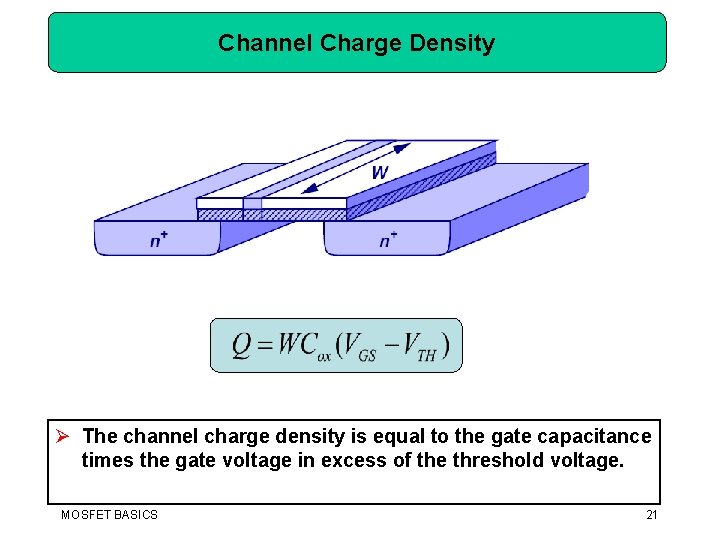
Channel Charge Density Ø The channel charge density is equal to the gate capacitance times the gate voltage in excess of the threshold voltage. MOSFET BASICS 21
Charge Density at a Point Ø Let x be a point along the channel from source to drain, and V(x) its potential; the expression above gives the charge density (per unit length). MOSFET BASICS 22
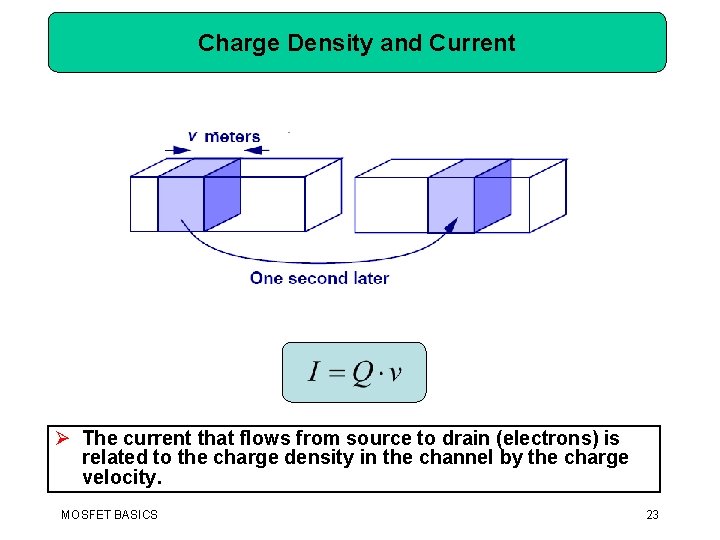
Charge Density and Current Ø The current that flows from source to drain (electrons) is related to the charge density in the channel by the charge velocity. MOSFET BASICS 23
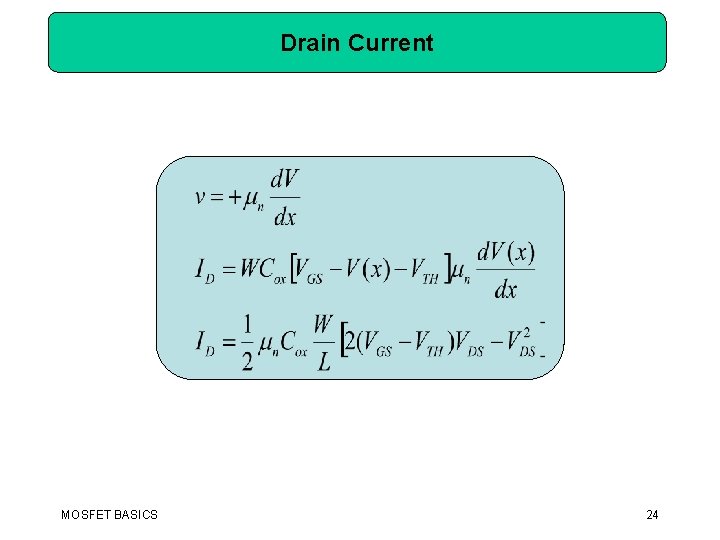
Drain Current MOSFET BASICS 24
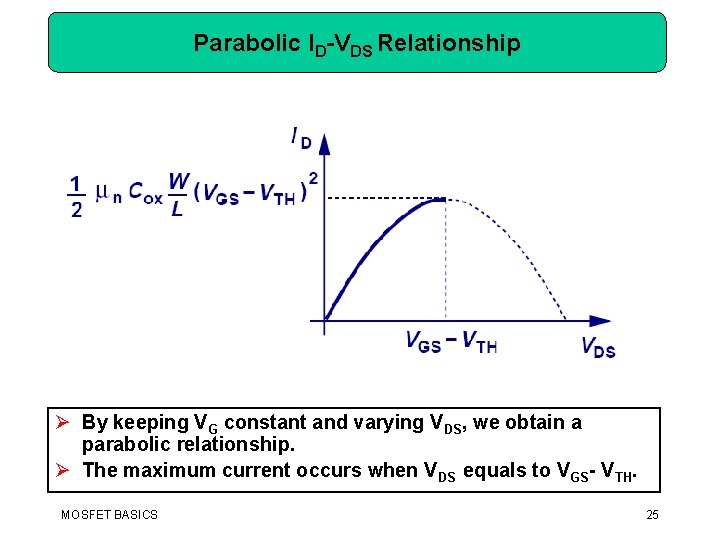
Parabolic ID-VDS Relationship Ø By keeping VG constant and varying VDS, we obtain a parabolic relationship. Ø The maximum current occurs when VDS equals to VGS- VTH. MOSFET BASICS 25
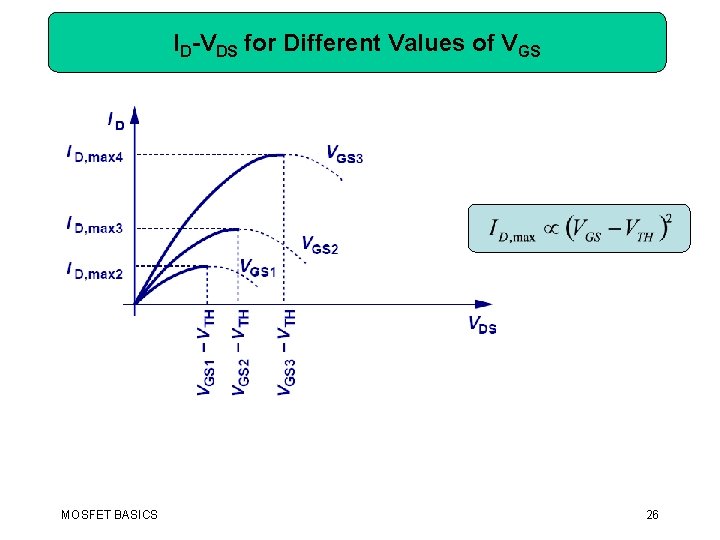
ID-VDS for Different Values of VGS MOSFET BASICS 26
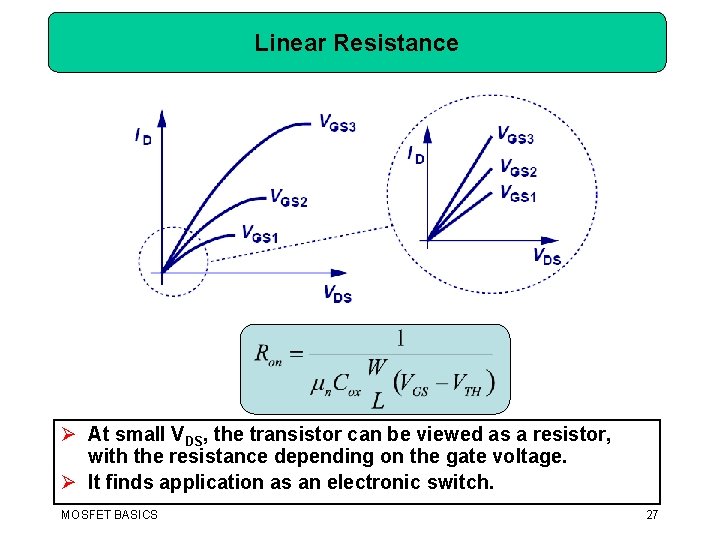
Linear Resistance Ø At small VDS, the transistor can be viewed as a resistor, with the resistance depending on the gate voltage. Ø It finds application as an electronic switch. MOSFET BASICS 27
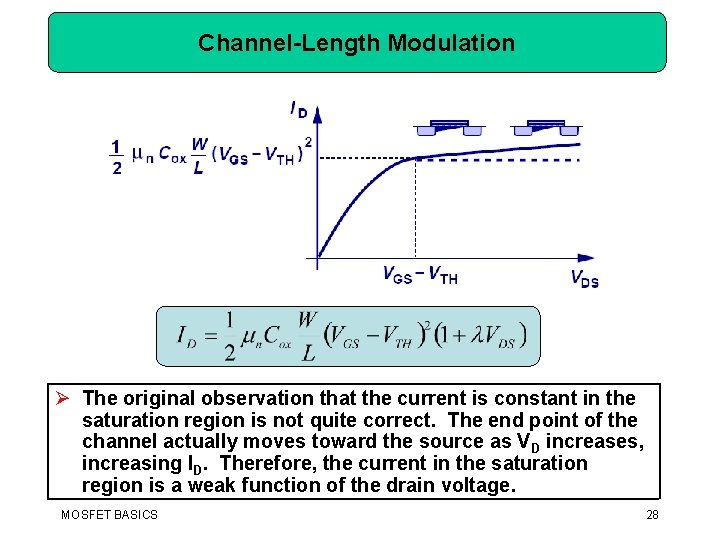
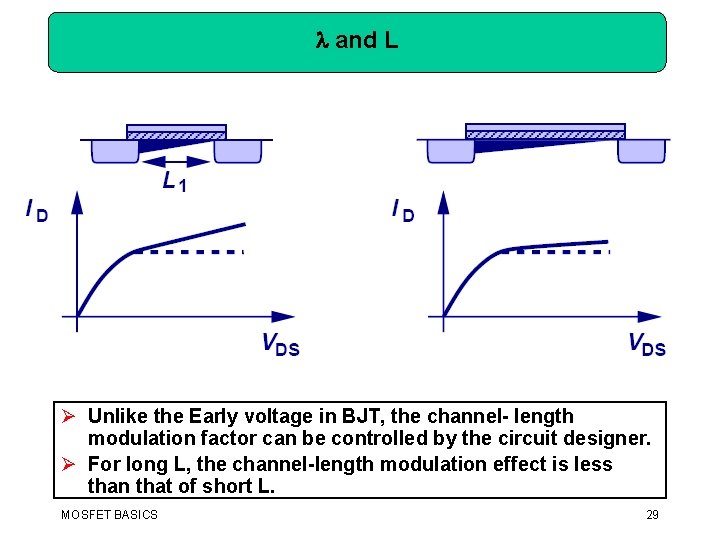
Channel-Length Modulation Ø The original observation that the current is constant in the saturation region is not quite correct. The end point of the channel actually moves toward the source as VD increases, increasing ID. Therefore, the current in the saturation region is a weak function of the drain voltage. MOSFET BASICS 28
and L Ø Unlike the Early voltage in BJT, the channel- length modulation factor can be controlled by the circuit designer. Ø For long L, the channel-length modulation effect is less than that of short L. MOSFET BASICS 29
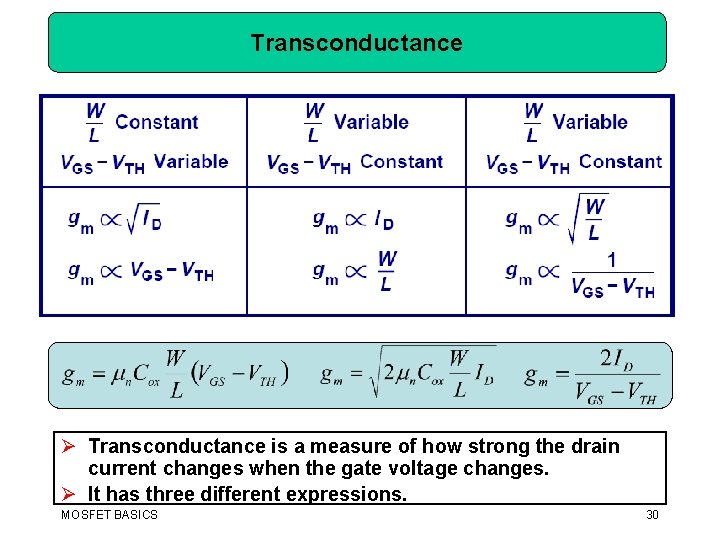
Transconductance Ø Transconductance is a measure of how strong the drain current changes when the gate voltage changes. Ø It has three different expressions. MOSFET BASICS 30
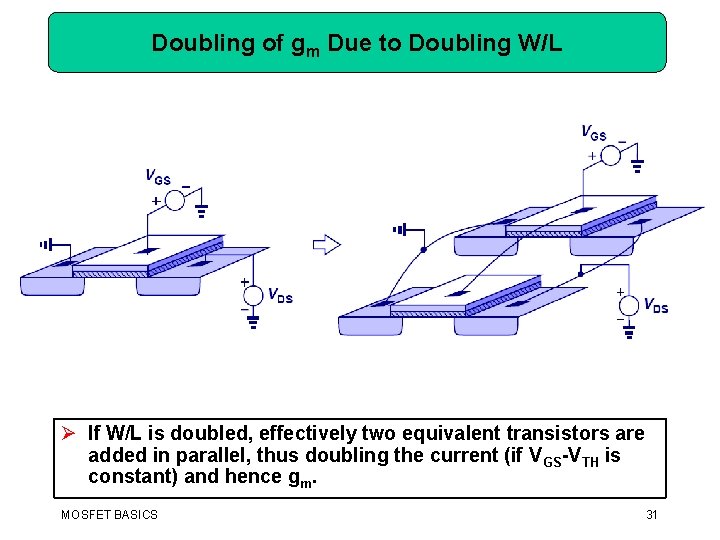
Doubling of gm Due to Doubling W/L Ø If W/L is doubled, effectively two equivalent transistors are added in parallel, thus doubling the current (if VGS-VTH is constant) and hence gm. MOSFET BASICS 31
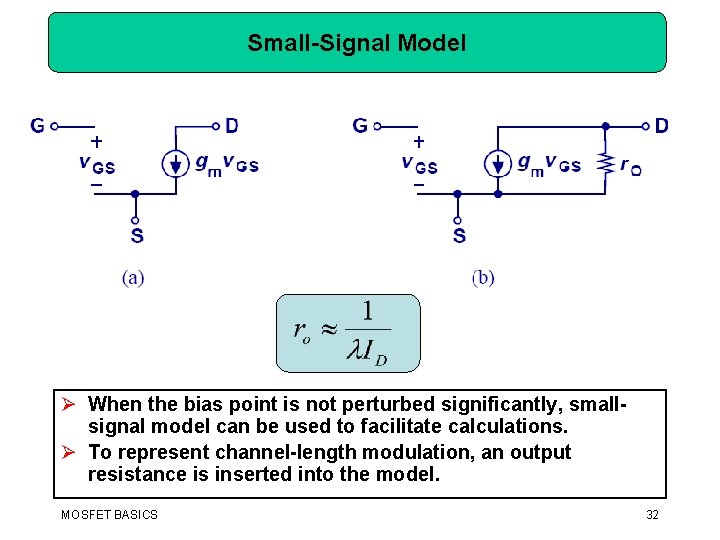
Small-Signal Model Ø When the bias point is not perturbed significantly, smallsignal model can be used to facilitate calculations. Ø To represent channel-length modulation, an output resistance is inserted into the model. MOSFET BASICS 32
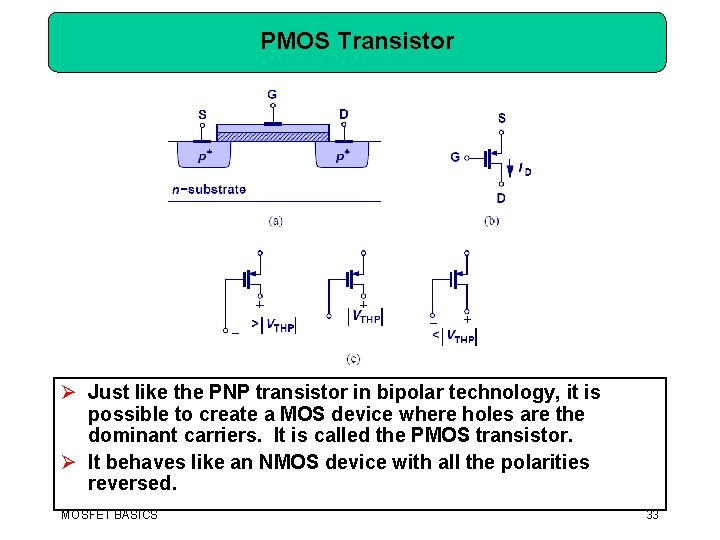
PMOS Transistor Ø Just like the PNP transistor in bipolar technology, it is possible to create a MOS device where holes are the dominant carriers. It is called the PMOS transistor. Ø It behaves like an NMOS device with all the polarities reversed. MOSFET BASICS 33
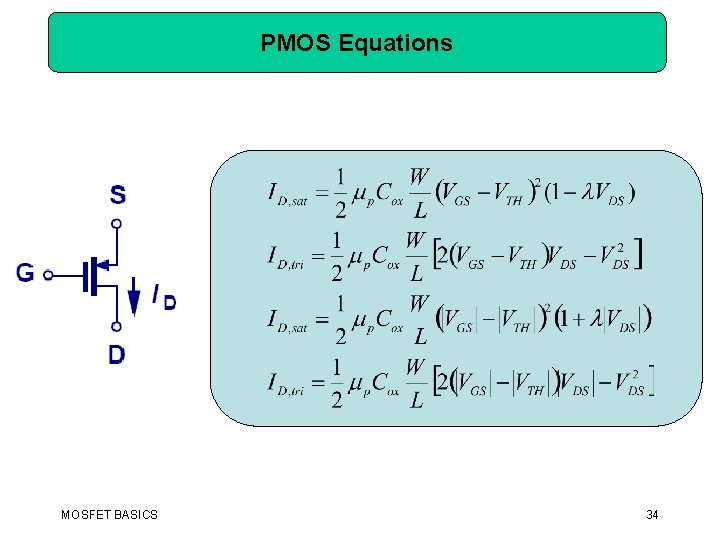
PMOS Equations MOSFET BASICS 34
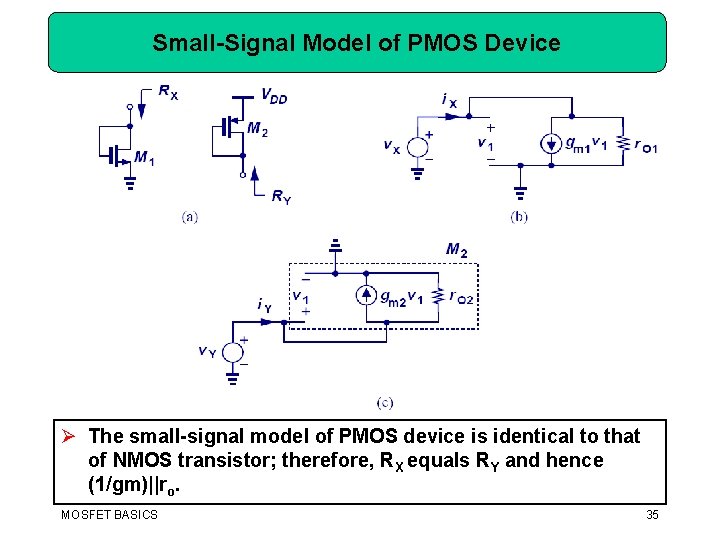
Small-Signal Model of PMOS Device Ø The small-signal model of PMOS device is identical to that of NMOS transistor; therefore, RX equals RY and hence (1/gm)||ro. MOSFET BASICS 35
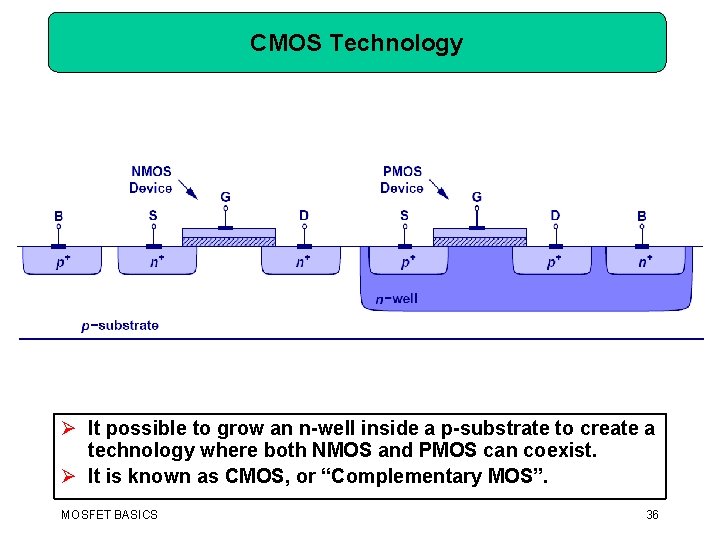
CMOS Technology Ø It possible to grow an n-well inside a p-substrate to create a technology where both NMOS and PMOS can coexist. Ø It is known as CMOS, or “Complementary MOS”. MOSFET BASICS 36
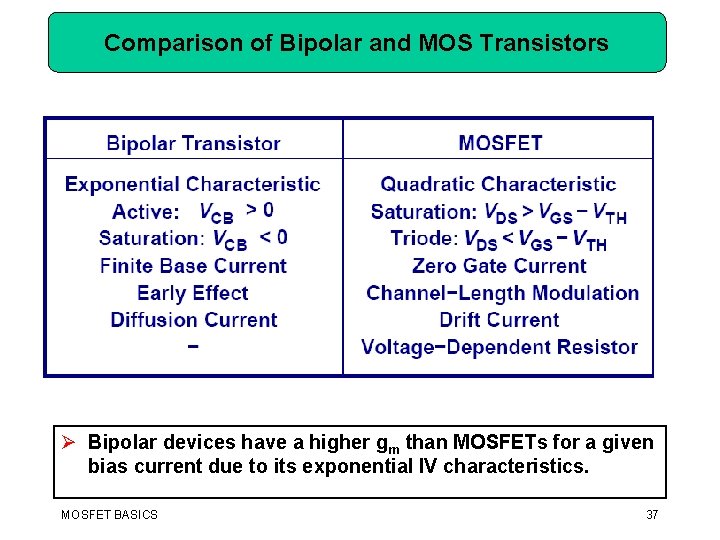
Comparison of Bipolar and MOS Transistors Ø Bipolar devices have a higher gm than MOSFETs for a given bias current due to its exponential IV characteristics. MOSFET BASICS 37