
Metal Dusting Corrosion in Steam Reforming Plants J

- Slides: 20
Metal Dusting Corrosion in Steam Reforming Plants J. Bohle, Dr. C. Beyer, U. Wolf, Dr. D Ulber Steam Reforming Technology User Conference Labuan, Malaysia March 5 -7, 2007 1 Metal Dusting Corrosion in SMR plants
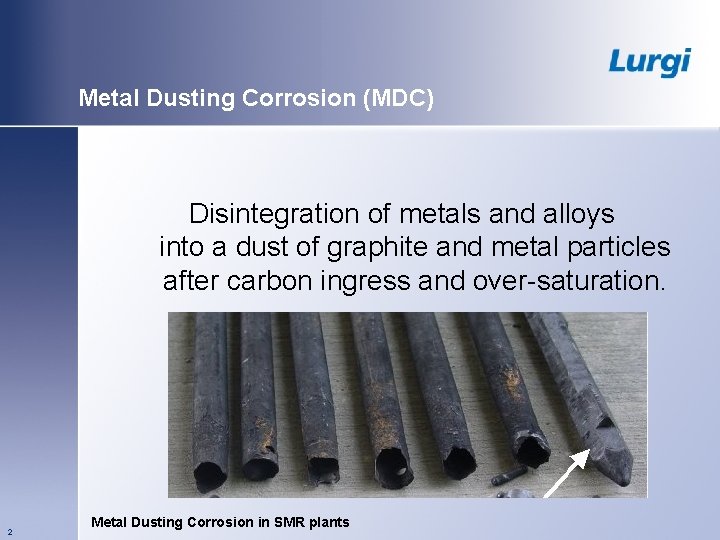
Metal Dusting Corrosion (MDC) Disintegration of metals and alloys into a dust of graphite and metal particles after carbon ingress and over-saturation. 2 Metal Dusting Corrosion in SMR plants
Overview 4 Phenomena of Metal Dusting Corrosion (MDC) 4 Mechanism involved / Reactions 4 Material considerations 4 Examples of MDC in Steam Reforming Plants 4 Prevention of MDC 4 Influence of MDC on process design 4 Literature 3 Metal Dusting Corrosion in SMR plants
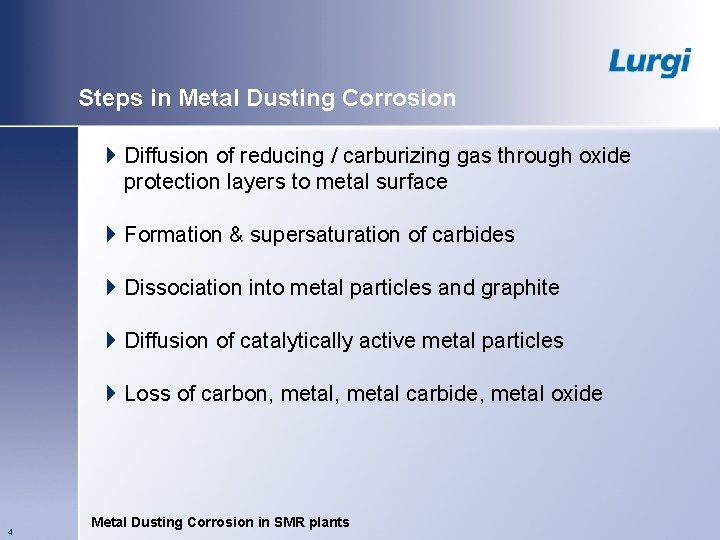
Steps in Metal Dusting Corrosion 4 Diffusion of reducing / carburizing gas through oxide protection layers to metal surface 4 Formation & supersaturation of carbides 4 Dissociation into metal particles and graphite 4 Diffusion of catalytically active metal particles 4 Loss of carbon, metal carbide, metal oxide 4 Metal Dusting Corrosion in SMR plants
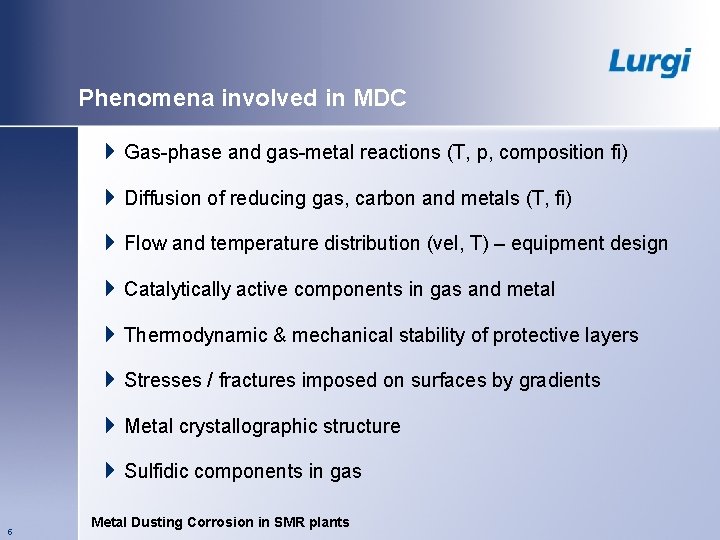
Phenomena involved in MDC 4 Gas-phase and gas-metal reactions (T, p, composition fi) 4 Diffusion of reducing gas, carbon and metals (T, fi) 4 Flow and temperature distribution (vel, T) – equipment design 4 Catalytically active components in gas and metal 4 Thermodynamic & mechanical stability of protective layers 4 Stresses / fractures imposed on surfaces by gradients 4 Metal crystallographic structure 4 Sulfidic components in gas 5 Metal Dusting Corrosion in SMR plants
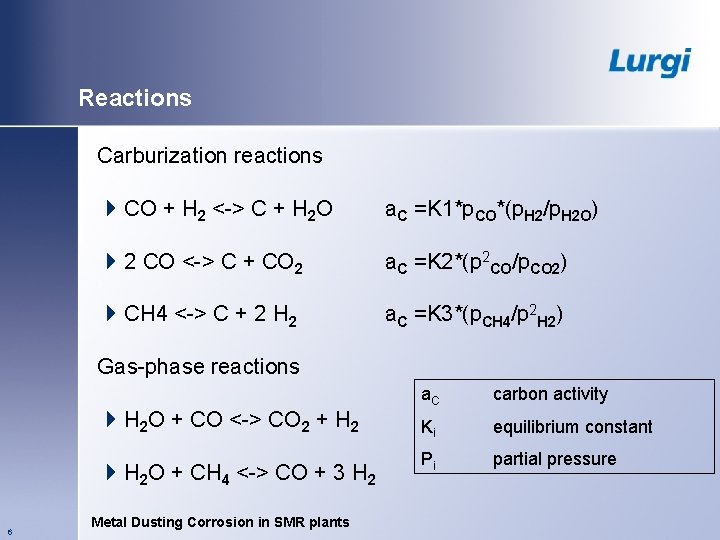
Reactions Carburization reactions 4 CO + H 2 <-> C + H 2 O a. C =K 1*p. CO*(p. H 2/p. H 2 O) 42 CO <-> C + CO 2 a. C =K 2*(p 2 CO/p. CO 2) 4 CH 4 <-> C + 2 H 2 a. C =K 3*(p. CH 4/p 2 H 2) Gas-phase reactions 4 H 2 O + CO <-> CO 2 + H 2 4 H 2 O + CH 4 <-> CO + 3 H 2 6 Metal Dusting Corrosion in SMR plants a. C carbon activity Ki equilibrium constant Pi partial pressure
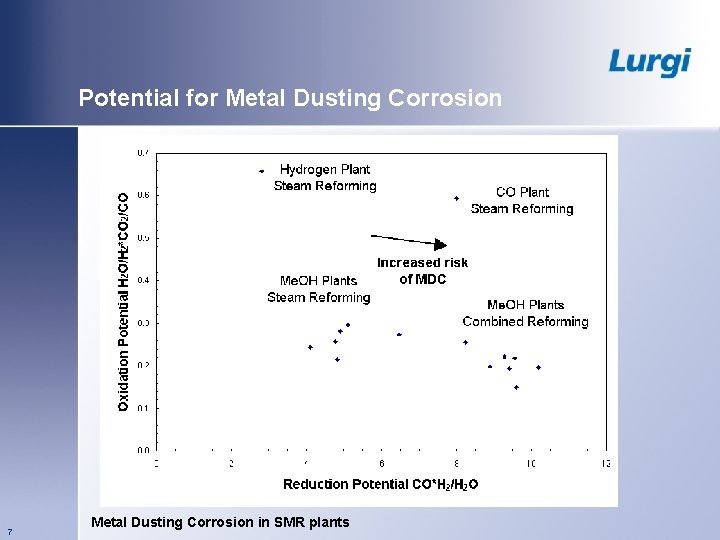
Potential for Metal Dusting Corrosion 7 Metal Dusting Corrosion in SMR plants
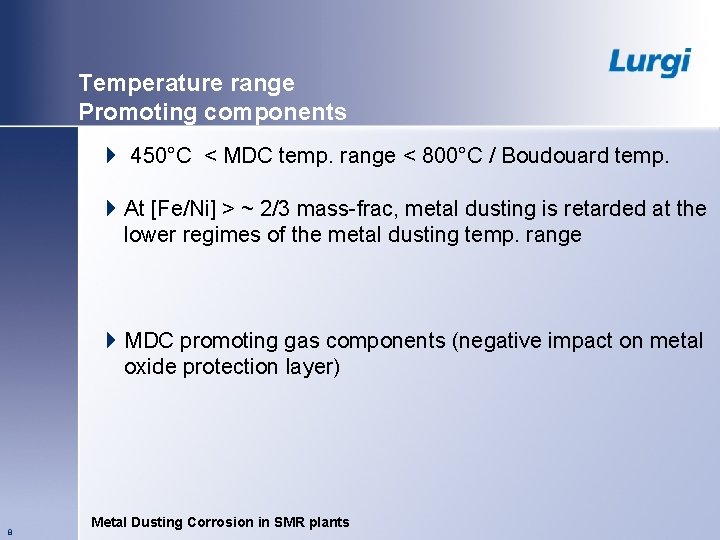
Temperature range Promoting components 4 450°C < MDC temp. range < 800°C / Boudouard temp. 4 At [Fe/Ni] > ~ 2/3 mass-frac, metal dusting is retarded at the lower regimes of the metal dusting temp. range 4 MDC promoting gas components (negative impact on metal oxide protection layer) 8 Metal Dusting Corrosion in SMR plants
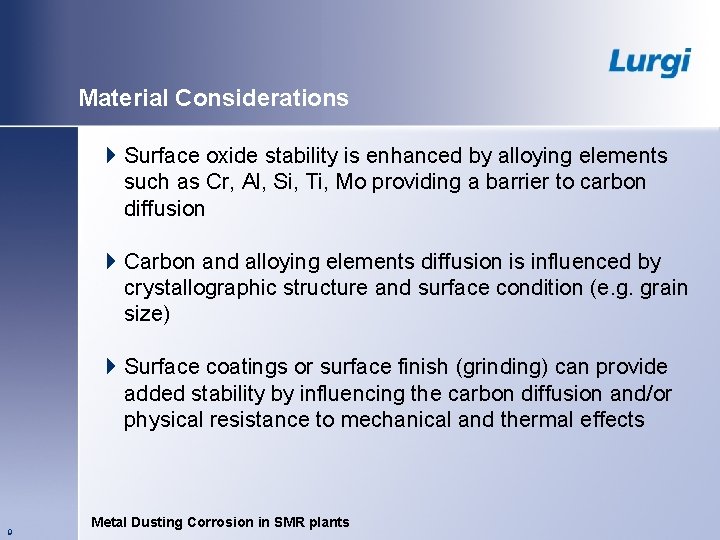
Material Considerations 4 Surface oxide stability is enhanced by alloying elements such as Cr, Al, Si, Ti, Mo providing a barrier to carbon diffusion 4 Carbon and alloying elements diffusion is influenced by crystallographic structure and surface condition (e. g. grain size) 4 Surface coatings or surface finish (grinding) can provide added stability by influencing the carbon diffusion and/or physical resistance to mechanical and thermal effects 9 Metal Dusting Corrosion in SMR plants
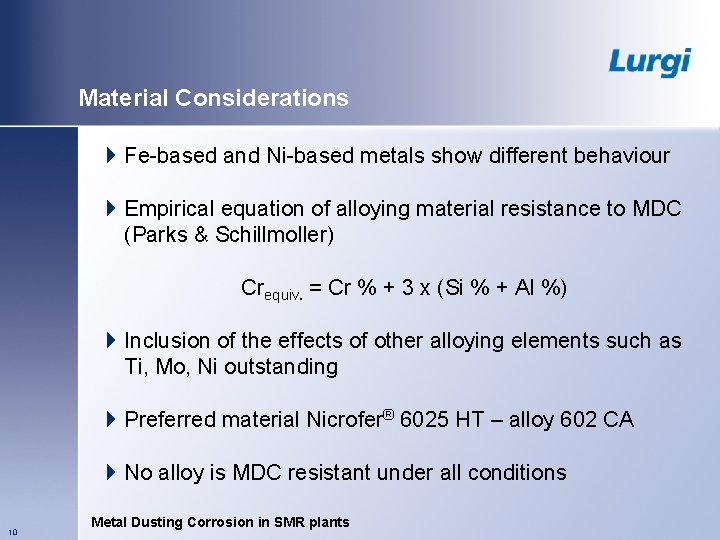
Material Considerations 4 Fe-based and Ni-based metals show different behaviour 4 Empirical equation of alloying material resistance to MDC (Parks & Schillmoller) Crequiv. = Cr % + 3 x (Si % + Al %) 4 Inclusion of the effects of other alloying elements such as Ti, Mo, Ni outstanding 4 Preferred material Nicrofer® 6025 HT – alloy 602 CA 4 No alloy is MDC resistant under all conditions 10 Metal Dusting Corrosion in SMR plants
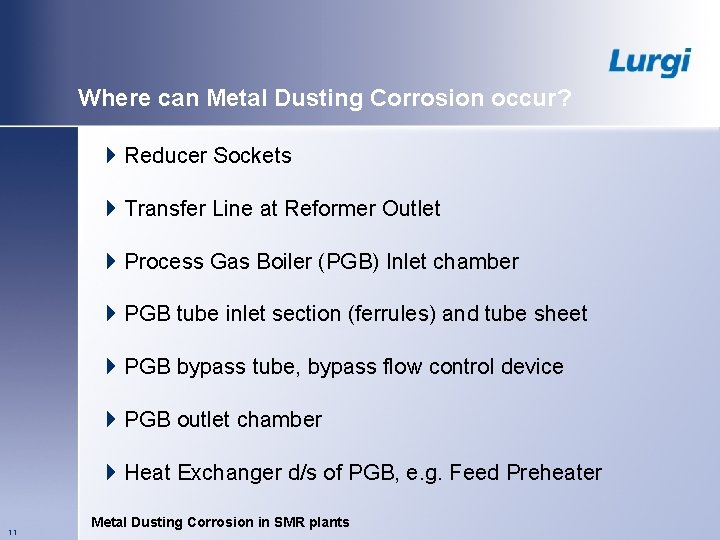
Where can Metal Dusting Corrosion occur? 4 Reducer Sockets 4 Transfer Line at Reformer Outlet 4 Process Gas Boiler (PGB) Inlet chamber 4 PGB tube inlet section (ferrules) and tube sheet 4 PGB bypass tube, bypass flow control device 4 PGB outlet chamber 4 Heat Exchanger d/s of PGB, e. g. Feed Preheater 11 Metal Dusting Corrosion in SMR plants
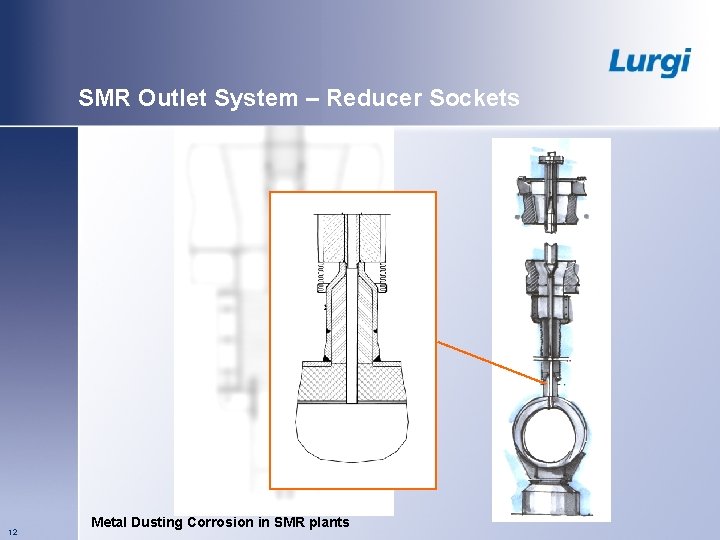
SMR Outlet System – Reducer Sockets 12 Metal Dusting Corrosion in SMR plants
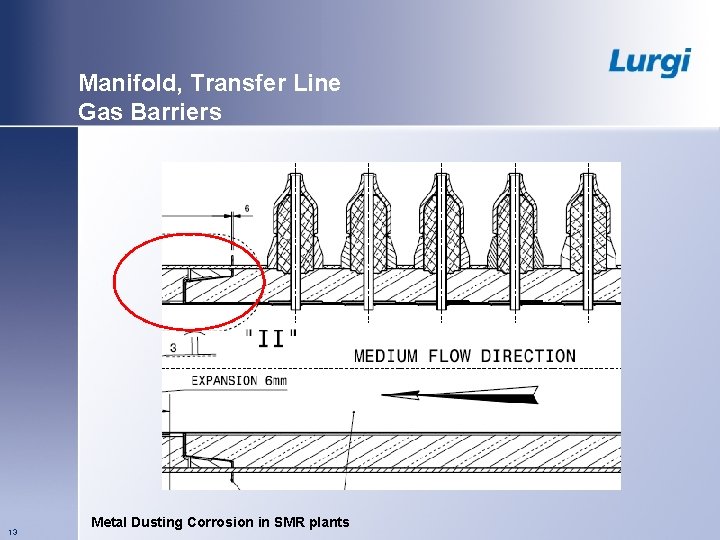
Manifold, Transfer Line Gas Barriers 13 Metal Dusting Corrosion in SMR plants
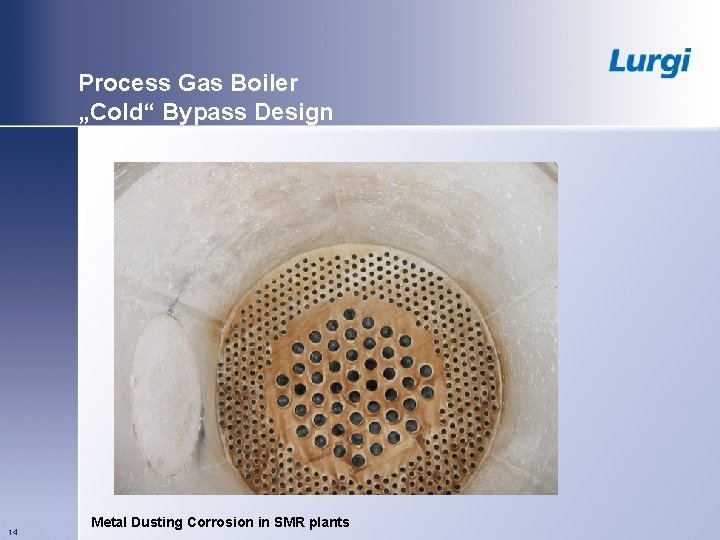
Process Gas Boiler „Cold“ Bypass Design 14 Metal Dusting Corrosion in SMR plants
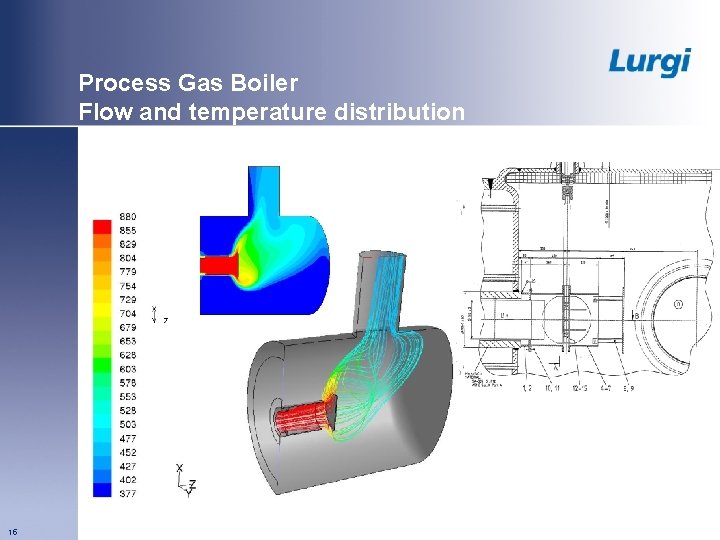
Process Gas Boiler Flow and temperature distribution 15 Metal Dusting Corrosion in SMR plants
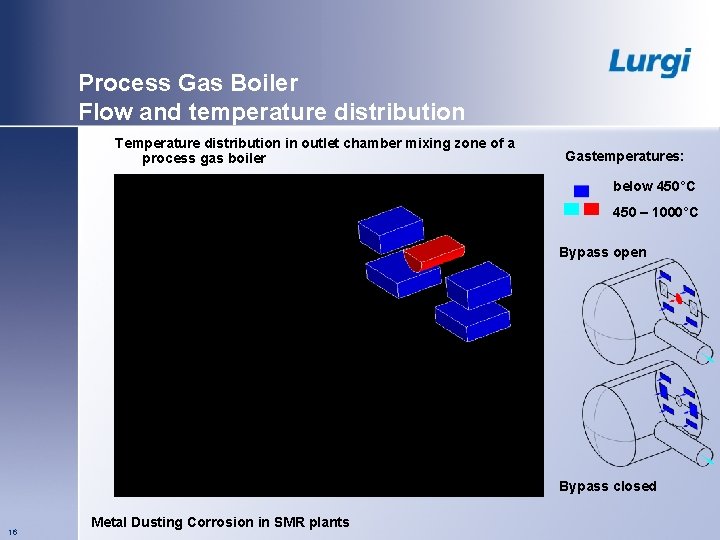
Process Gas Boiler Flow and temperature distribution Temperature distribution in outlet chamber mixing zone of a process gas boiler Gastemperatures: below 450°C 450 – 1000°C Bypass open Bypass closed 16 Metal Dusting Corrosion in SMR plants
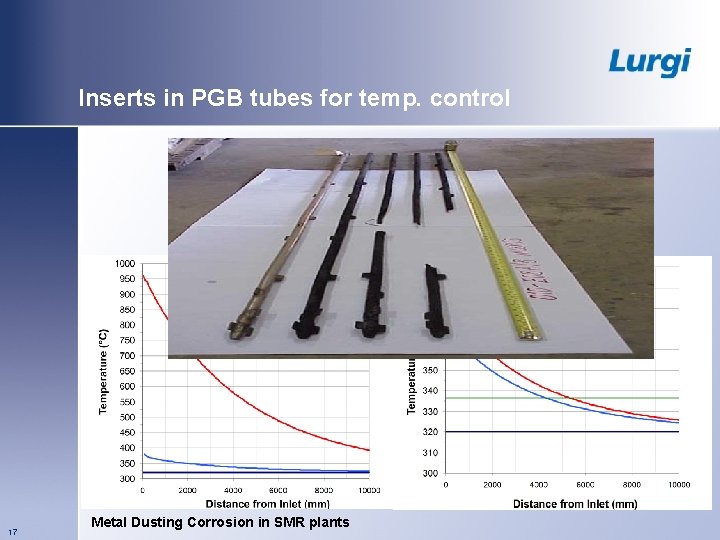
Inserts in PGB tubes for temp. control 17 Metal Dusting Corrosion in SMR plants
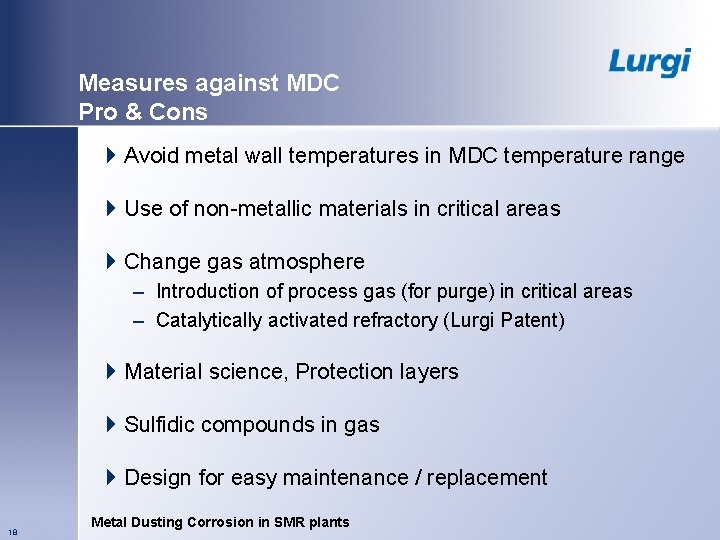
Measures against MDC Pro & Cons 4 Avoid metal wall temperatures in MDC temperature range 4 Use of non-metallic materials in critical areas 4 Change gas atmosphere – Introduction of process gas (for purge) in critical areas – Catalytically activated refractory (Lurgi Patent) 4 Material science, Protection layers 4 Sulfidic compounds in gas 4 Design for easy maintenance / replacement 18 Metal Dusting Corrosion in SMR plants
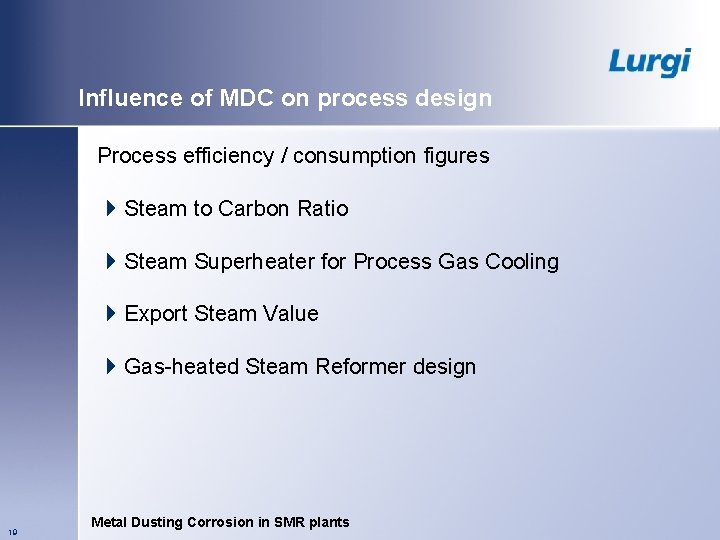
Influence of MDC on process design Process efficiency / consumption figures 4 Steam to Carbon Ratio 4 Steam Superheater for Process Gas Cooling 4 Export Steam Value 4 Gas-heated Steam Reformer design 19 Metal Dusting Corrosion in SMR plants
Literature References 4 R. T. Jones, K. L. Baumert; Metal Dusting – An Overview of Current Literature; Corrosion 2001; No. 01372 4 H. J. Grabke, E. M. Müller-Lorenz; Occurrence and Prevention of Metal Dusting on Stainless Steel; Corrosion 2001; No. 01373 4 F. Hohmann; Improve Steam Reformer Performance; Hydrocarbon Processing; 03/1996; p. 71 -74 20 Metal Dusting Corrosion in SMR plants