
Metadata slide Slides for 45 min presentation to
- Slides: 43
Metadata slide • Slides for 45 min presentation to Bryan Heidorn’s LMIS research methods class - student oriented presentation • Based on 2017_03_15_heidorn_librarians_role. pptx by Chris Kollen • Updates • 2018 -02 -08 Fernando Rios – add osf
The Library’s Role in the Research Data Lifecycle & Open and Reproducible Scholarship via the Open Science Framework Chris Kollen and Fernando Rios Office of Digital Innovation and Stewardship, UA Libraries
Faniel & Connaway (2016) Questions to keep in mind • What are some disconnects between how librarians envision themselves providing service and how the service is actually provided to researchers? • What skills gaps do you feel that you might have if you were asked to provide RDM services? • How might you fill said gaps? How might you identify those that could help you fill those gaps?
Background and History • Late 1990 s to 2000’s – digital data and new forms of research increasing discussion changed to e-science, cyberinfrastructure, digital curation, data deluge • ARL recognized the need for building members awareness of these changes and how they will be primary areas of library engagement • Quotes from data management/curation leaders “Data sets are the new special collections” (Sayeed Choudhury, 2007, as quoted in Palmer et al. , 2010) “Librarians are testing the waters to identify what present and future roles they may have; but these are early days, and it is still unclear what those roles may be” (Gold, 2007)
Background and history (continued) • Increased involvement by libraries • In 2010, 37% of ARL libraries reported providing infrastructure or support services for e-science; the rest are either planning services or don’t have any plans to provide support (Soehner et al. 2010) • In 2012, 44% provide reference support for finding data, 20% or less provide other types of data related services (Tenopir et al. , 2012) • By 2013, 74% of ARL respondents offer RDS providing guidance and assistance with DMPs (Fearon et al. , 2013) • ARL institutions are approaching RDS issues in diverse ways. RDS will evolve depending on: • • Institutional and funder policies Financial and human resources available Leadership support Communication, coordination, and collaboration
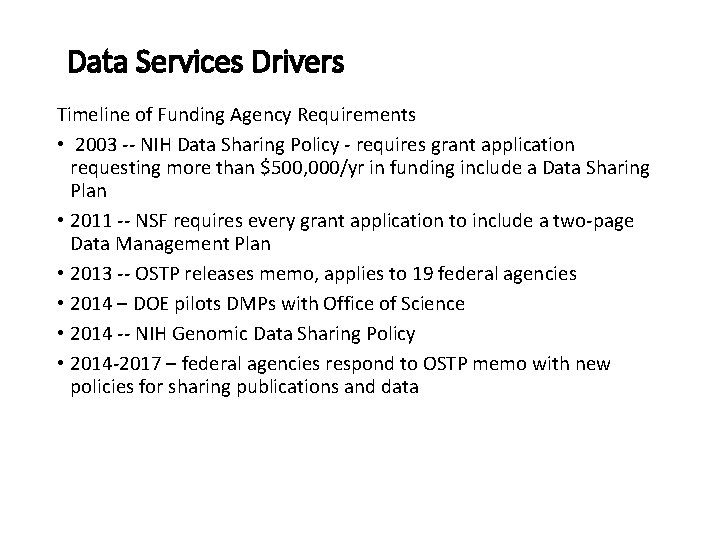
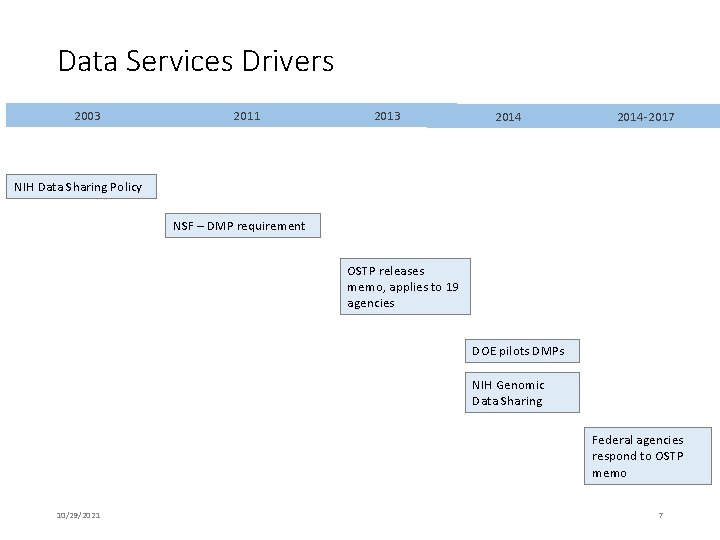
Data Services Drivers Timeline of Funding Agency Requirements • 2003 -- NIH Data Sharing Policy - requires grant application requesting more than $500, 000/yr in funding include a Data Sharing Plan • 2011 -- NSF requires every grant application to include a two-page Data Management Plan • 2013 -- OSTP releases memo, applies to 19 federal agencies • 2014 – DOE pilots DMPs with Office of Science • 2014 -- NIH Genomic Data Sharing Policy • 2014 -2017 – federal agencies respond to OSTP memo with new policies for sharing publications and data
Data Services Drivers 2003 2011 2013 2014 -2017 NIH Data Sharing Policy NSF – DMP requirement OSTP releases memo, applies to 19 agencies DOE pilots DMPs NIH Genomic Data Sharing Federal agencies respond to OSTP memo 10/29/2021 7
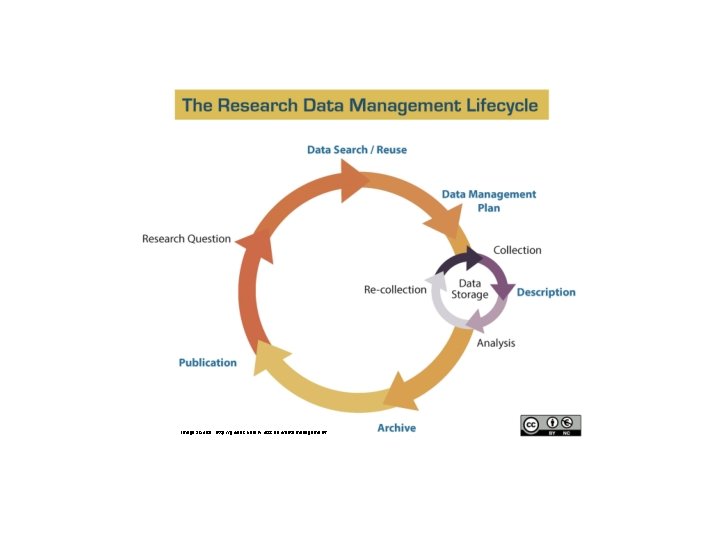
Image Source: http: //guides. library. ucsc. edu/datamanagement/
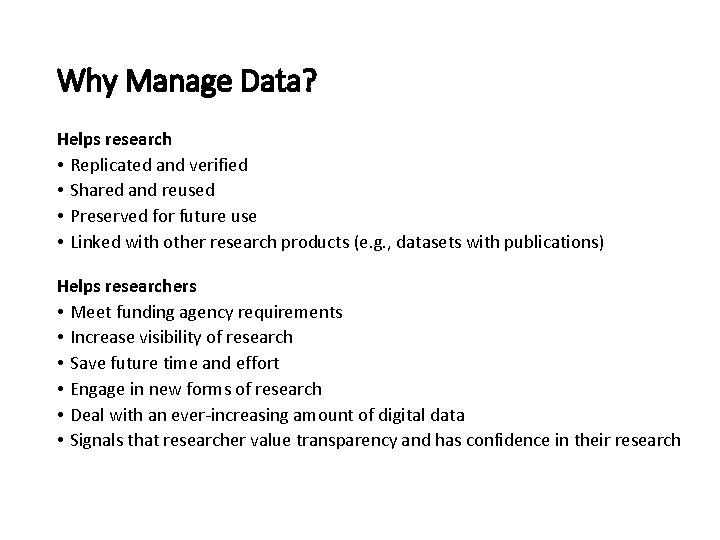
Why Manage Data? Helps research • Replicated and verified • Shared and reused • Preserved for future use • Linked with other research products (e. g. , datasets with publications) Helps researchers • Meet funding agency requirements • Increase visibility of research • Save future time and effort • Engage in new forms of research • Deal with an ever-increasing amount of digital data • Signals that researcher value transparency and has confidence in their research
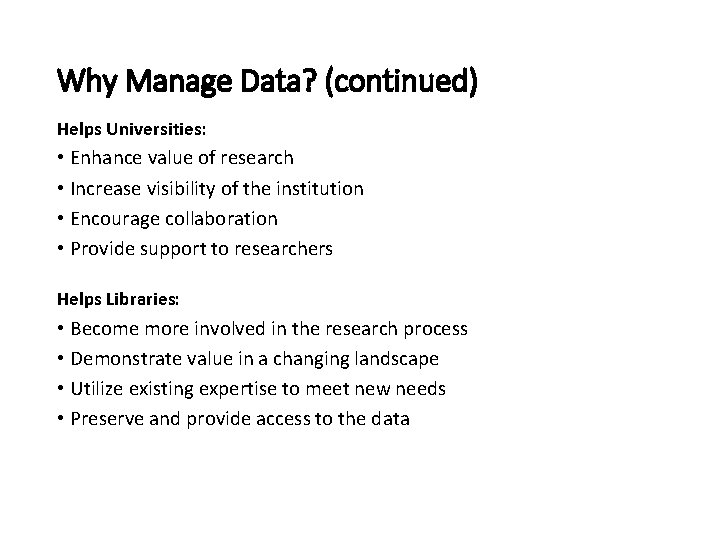
Why Manage Data? (continued) Helps Universities: • Enhance value of research • Increase visibility of the institution • Encourage collaboration • Provide support to researchers Helps Libraries: • Become more involved in the research process • Demonstrate value in a changing landscape • Utilize existing expertise to meet new needs • Preserve and provide access to the data
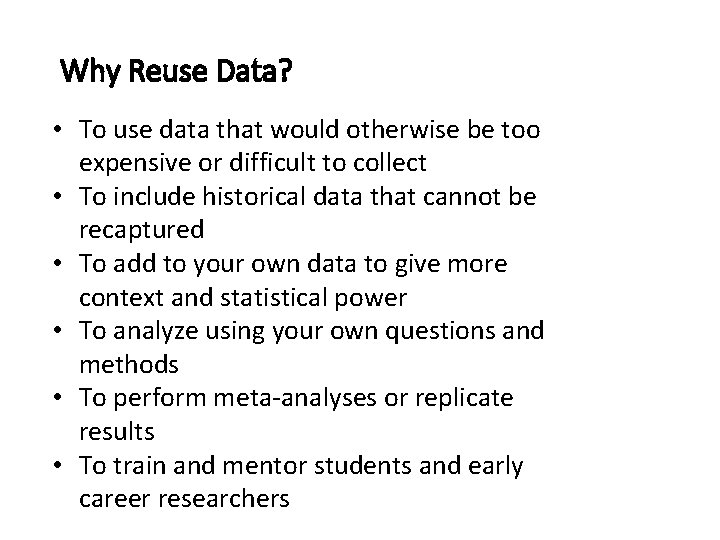
Why Reuse Data? • To use data that would otherwise be too expensive or difficult to collect • To include historical data that cannot be recaptured • To add to your own data to give more context and statistical power • To analyze using your own questions and methods • To perform meta-analyses or replicate results • To train and mentor students and early career researchers
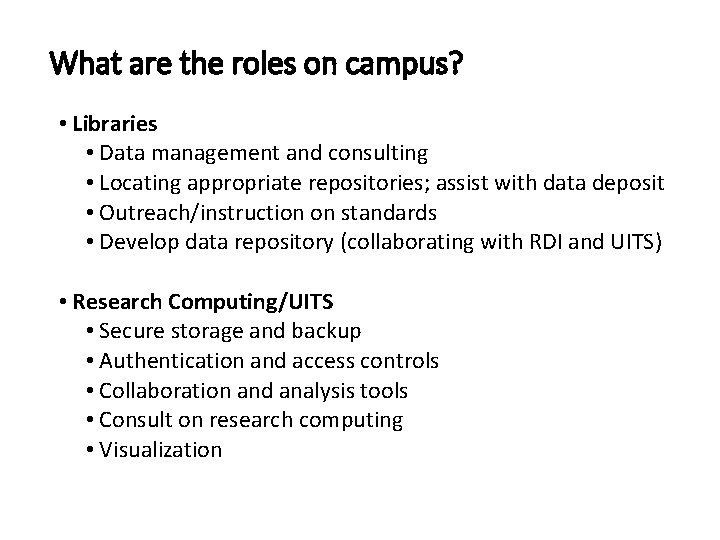
What are the roles on campus? • Libraries • Data management and consulting • Locating appropriate repositories; assist with data deposit • Outreach/instruction on standards • Develop data repository (collaborating with RDI and UITS) • Research Computing/UITS • Secure storage and backup • Authentication and access controls • Collaboration and analysis tools • Consult on research computing • Visualization
What are the roles on campus? (cont. ) Grants Administration (RDI)/Schools/Departments • Connecting researchers with appropriate services • Policy compliance • Assist with grant proposals • Connect faculty on campus for collaboration
How are other libraries involved in data services? • How to Find Data (we do this for other information sources) • Where to look, what’s available, variety of sources • Help them assess the quality • What to do with it? • Clean up the data (such as Open. Refine) • What software to use • Where to put it? • Data archiving, publication • Help people participate in projects involving “Citizen Science”
Data Sources Disciplinary repositories Campus repositories Online journals with linked data Government databases Subscription databases (available through library) • Direct request to another researcher • • •
How Did UA Start? • Dean of Libraries designated 1 FTE for data management/curation • Task Force with members from – Libraries, Faculty, RDI, and UITS • Result – Recommend that library serve as the point of contact, refer to RDI and UITS • Why the Libraries? • UITS with Libraries and RDI - develop a long-term strategy for the support of data storage, data access, and data preservation in support of UA’s research needs. • Establish Campus Data Management and Curation Committee
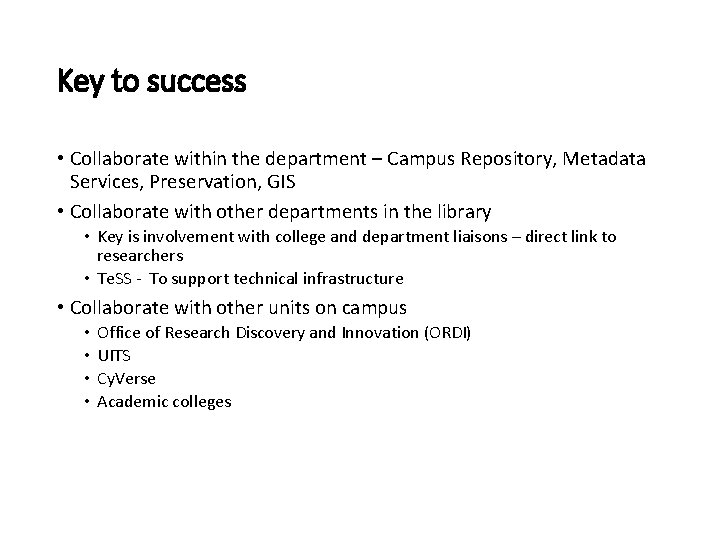
Key to success • Collaborate within the department – Campus Repository, Metadata Services, Preservation, GIS • Collaborate with other departments in the library • Key is involvement with college and department liaisons – direct link to researchers • Te. SS - To support technical infrastructure • Collaborate with other units on campus • • Office of Research Discovery and Innovation (ORDI) UITS Cy. Verse Academic colleges
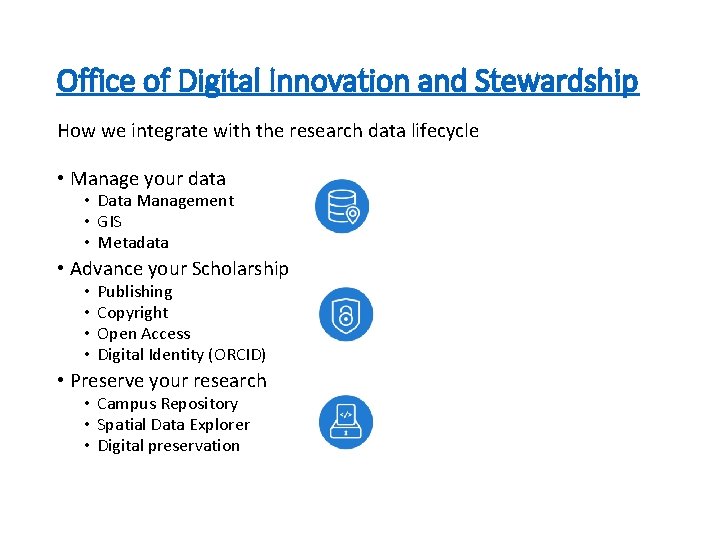
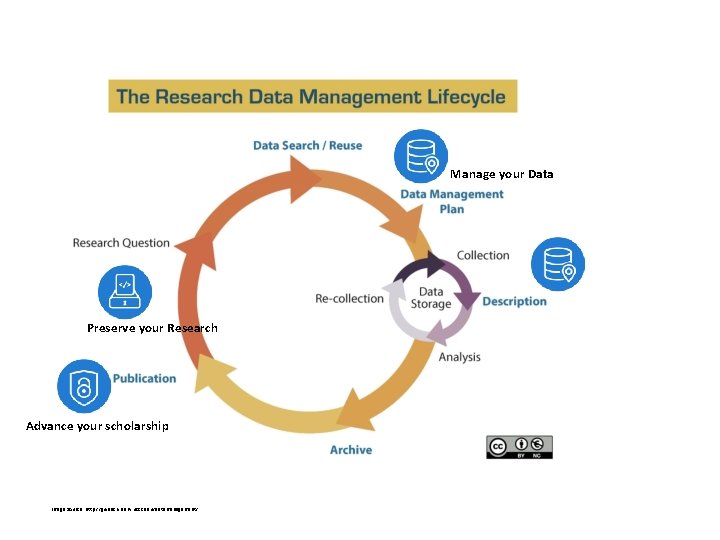
Office of Digital Innovation and Stewardship How we integrate with the research data lifecycle • Manage your data • Data Management • GIS • Metadata • Advance your Scholarship • • Publishing Copyright Open Access Digital Identity (ORCID) • Preserve your research • Campus Repository • Spatial Data Explorer • Digital preservation
Manage your Data Preserve your Research Advance your scholarship Image Source: http: //guides. library. ucsc. edu/datamanagement/
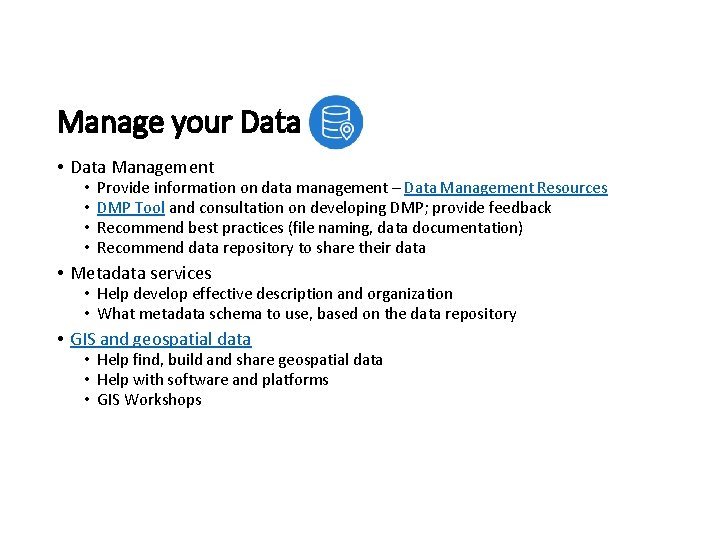
Manage your Data • Data Management • • Provide information on data management – Data Management Resources DMP Tool and consultation on developing DMP; provide feedback Recommend best practices (file naming, data documentation) Recommend data repository to share their data • Metadata services • Help develop effective description and organization • What metadata schema to use, based on the data repository • GIS and geospatial data • Help find, build and share geospatial data • Help with software and platforms • GIS Workshops
Advance your Scholarship • Open Access publishing – UA’s Open Access Policy, open access publishing options, apply for funding to cover publishing charges • Journal publishing – start a new online journal or move your journal online • Scholarly Identity (ORCID) – help you establish an ORCID • Copyright – consultation on copyright issues, fair use, licensing, Creative Commons • Mc. Kiernan et al. gives several pathways available to researchers for open access, UA Libraries supports several of them (e. g. , OA policy, open access fund)
Preserve your Research • Preserve and share your research in the Campus Repository • Preserve and share your unique geospatial datasets in the Spatial Data Explorer • Help you develop a preservation strategy for your research
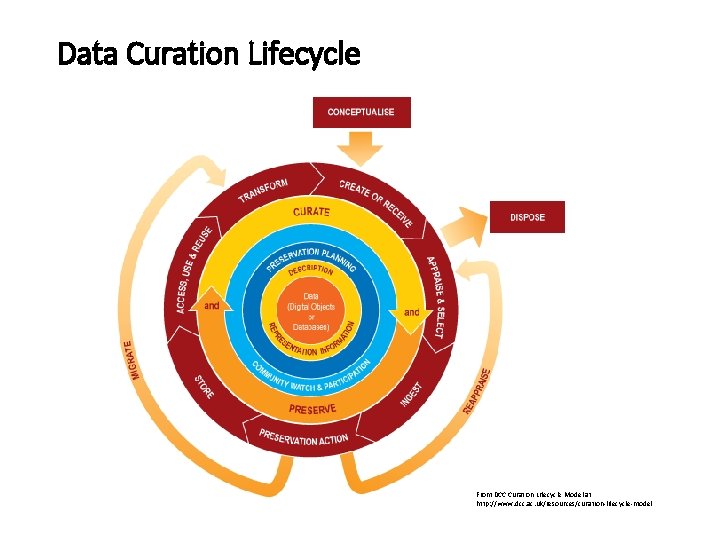
Data Curation Lifecycle From DCC Curation Lifecycle Model at http: //www. dcc. ac. uk/resources/curation-lifecycle-model
Education Workshops and class sessions on data management • Classes include • English 389 – Introduction to Publishing • Library Science 506 – Research Methods • SLHS 649 -- Survival Skills and Ethics (campus-wide graduate course) • Presentations to colleges and departments – CALS, Co. S, CAPLA, LPL • Research groups, such as at the Cancer Center • RDI workshops (through Responsible Conduct of Research) • Developing a DMP online tutorial – available on Data Management website
Campus-Wide Involvement and Programs Campus Committees/Working Groups • Research Computing Governance Committee (RCGC) and Campus Data Management Subcommittee • Federal Open Access Working Group • Open Research Task Force Campus Events • Open Access Week – sponsor Open Data programs • IT Summit – presentation and poster • Love Your Data Week (3 rd year) - Feb 12 -16, 2018 • Data stories program on Feb 16 th 2 -3: 30 in Main Library, room 112 A • Think Tank Graduate Student workshops - Making Your Data Work for You on 3/20 2 -3 pm in SEL Room 311 • OSF Workshops coming – March 30 th, main campus and health sciences
Data Management and Data Curation Pilot • Data Management and Data Curation Pilot recommended in the research data management survey report -- approved and funded by RCGC sponsors • Five research projects participated in the pilot – different disciplines and different stages of the research data cycle • Worked closely with them on variety of data management technology; recommended data workflow and appropriate metadata standards to use for describing data
Pilot Results and Recommendations Key findings • Services need to be fully developed, robust, agile and provided at the point of need as part of the researcher’s workflow • Important to offer data management support at time of need • Concrete solutions (checklists, rubrics) are preferred • Expand RDM training and support new faculty at the start of grant projects Recommendations • Expand RDM services for researchers • Setup OSF for Institutions • Develop an institutional data repository, in partnership with UITS, RDI, and Cy. Verse • Expand training and collaboration with liaison librarians • Expand workshops for graduate students, postdoctoral research associates and researchers
Other Projects Involved With Astro. Labe -- Astronomy Data Hub – as a collaborator Consultations and partnerships • Linguistics • Shrimp pathology lab • East Asian Studies • Breast cancer imaging data GIS projects • National Phenology Network • Regional Energy Opportunity Analysis • Buddhist temples in China • Southern Arizona vegetation studies
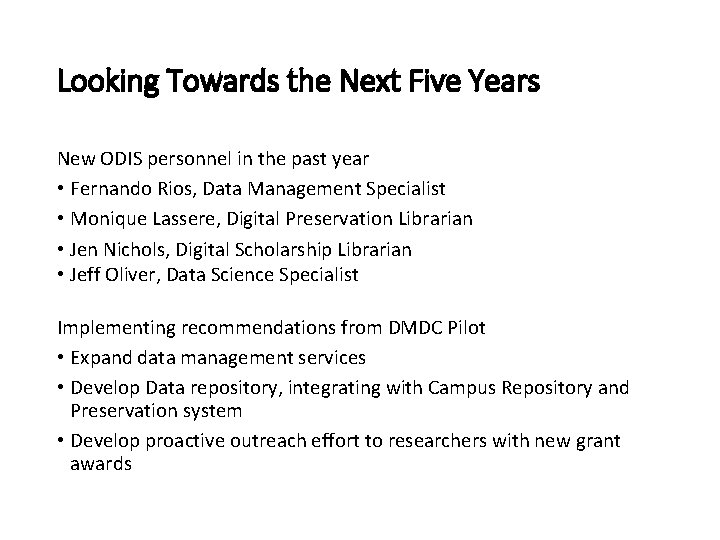
Looking Towards the Next Five Years New ODIS personnel in the past year • Fernando Rios, Data Management Specialist • Monique Lassere, Digital Preservation Librarian • Jen Nichols, Digital Scholarship Librarian • Jeff Oliver, Data Science Specialist Implementing recommendations from DMDC Pilot • Expand data management services • Develop Data repository, integrating with Campus Repository and Preservation system • Develop proactive outreach effort to researchers with new grant awards
Open Science via the Open Science Framework
Mc. Kiernan et al. (2016) • How might you convey the benefits of working openly and sharing resources to busy researchers? • In the context of Faniel & Connaway (2016), what challenges do you identify in terms of an institution providing support for open science tools like the OSF?
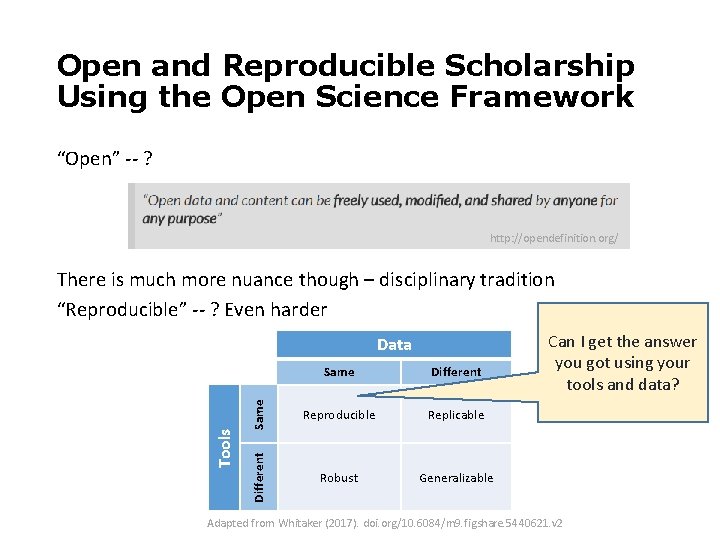
Open and Reproducible Scholarship Using the Open Science Framework “Open” -- ? http: //opendefinition. org/ There is much more nuance though – disciplinary tradition “Reproducible” -- ? Even harder Same Different Same Reproducible Replicable Different Tools Data Robust Generalizable Can I get the answer you got using your tools and data? Adapted from Whitaker (2017). doi. org/10. 6084/m 9. figshare. 5440621. v 2
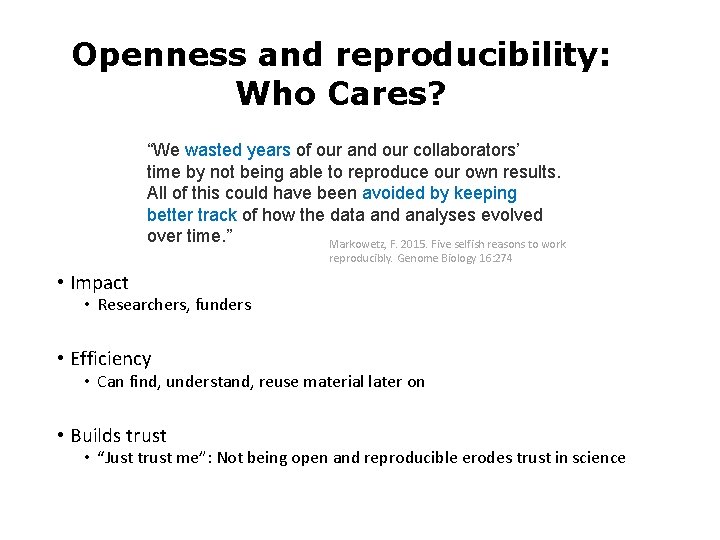
Openness and reproducibility: Who Cares? “We wasted years of our and our collaborators’ time by not being able to reproduce our own results. All of this could have been avoided by keeping better track of how the data and analyses evolved over time. ” Markowetz, F. 2015. Five selfish reasons to work reproducibly. Genome Biology 16: 274 • Impact • Researchers, funders • Efficiency • Can find, understand, reuse material later on • Builds trust • “Just trust me”: Not being open and reproducible erodes trust in science
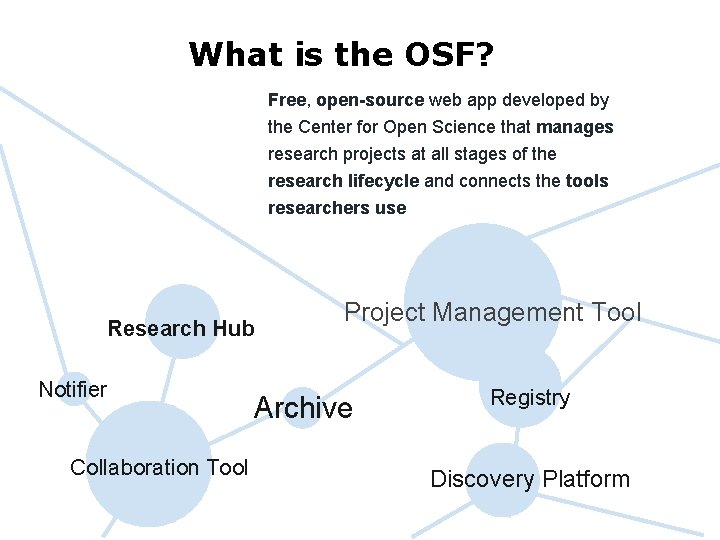
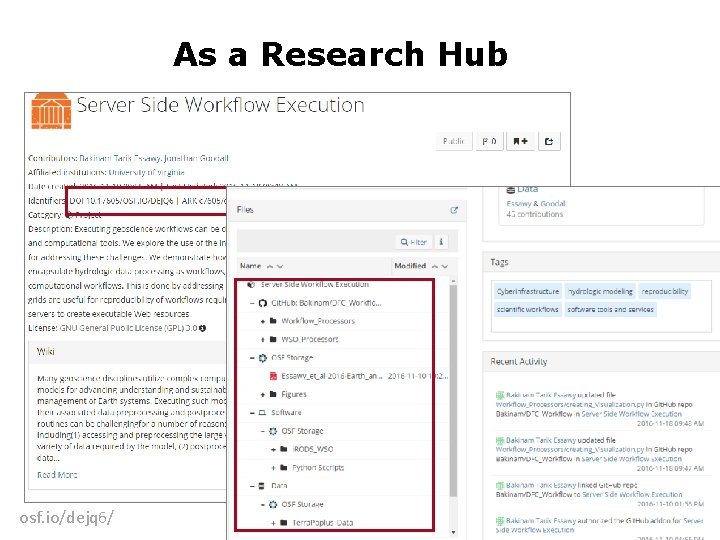
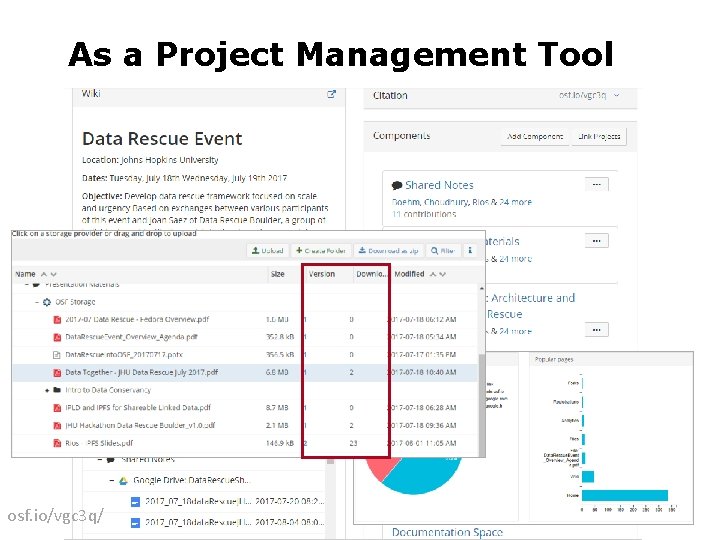
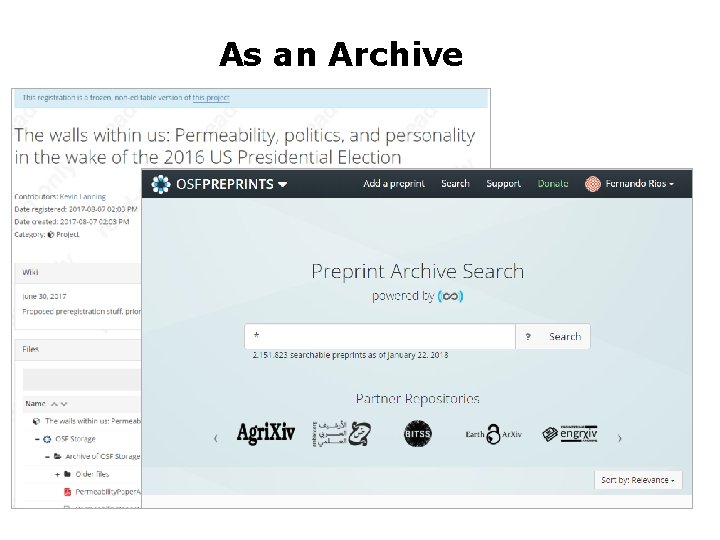
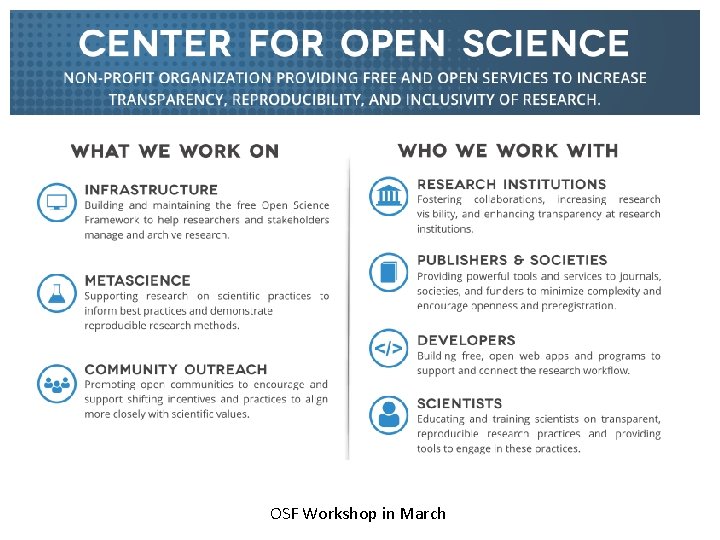
What is the OSF? Free, open-source web app developed by the Center for Open Science that manages research projects at all stages of the research lifecycle and connects the tools researchers use Research Hub Notifier Collaboration Tool Project Management Tool Archive Registry Discovery Platform
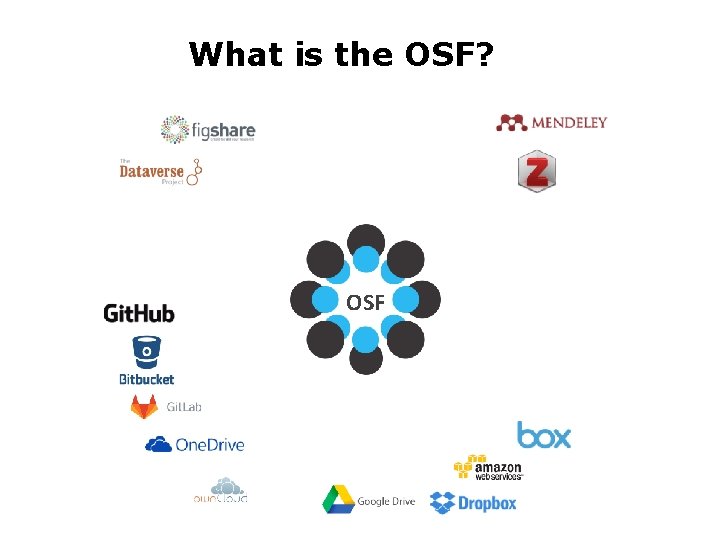
What is the OSF? OSF
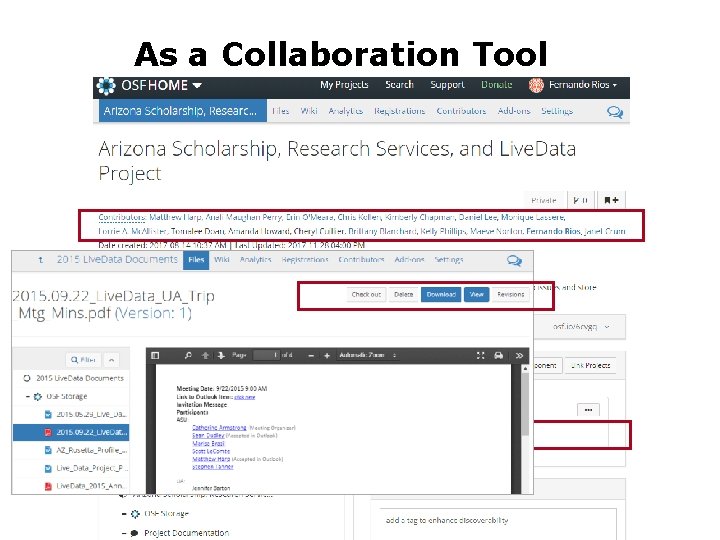
As a Collaboration Tool
As a Research Hub osf. io/dejq 6/
As a Project Management Tool osf. io/vgc 3 q/
As an Archive
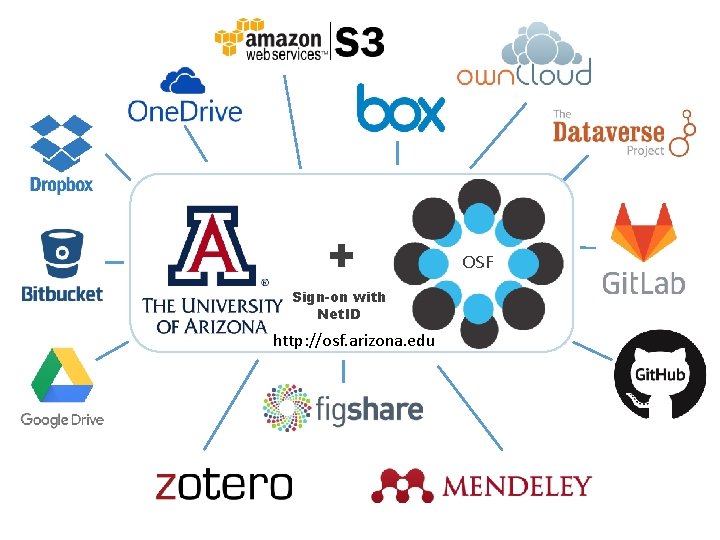
+ Sign-on with Net. ID http: //osf. arizona. edu OSF
OSF Workshop in March
References • Fearon, D. Jr. , Gunia, B. , Lake, S. , Pralle, B. & Sallans, A. L. (2013). Research Data Management Services: SPEC Kit 334. Washington, DC: Association of Research Libraries. • Faniel, Ixchel M. & Connaway, Lynn Silipigni (2018). Librarians’ Perspectives on Factors Influencing Research Data Management Programs. College and Research Libraries, 79(1), p. 100 -119. • Foster, E. D. , & Deardorff, A. (2017). Open Science Framework (OSF). Journal of the Medical Library Association JMLA, 105(2), 203– 206. • Gold, A. (2007). Cyberinfrastructure, data, and libraries. D-Lib, 13(9/10). • Palmer, C. , Cragin, M. , Mac. Mullen, J. , Chao, T. , Renear, A. , Dubin, D. , Sacchi, S. , Michael Welge, M. , & Auvil, L. (2010). The Data Conservancy: Research on data curation and repositories [Power. Point slides]. • Mc. Kiernan, Erin C. et al. (2016) How open science helps researchers succeed. e. Life 2016; 5: e 16800. • Soehner, C. , Steeves, C. & Ward, J. (2010). E-Science and Data Support Services. Washington, DC: Association of Research Libraries. • Tenopir, C. , Birch, B. & Allard, S. Academic Libraries and Research Data Services. Chicago: Association of College and Research Libraries. • Johnston, L. , ed. (2017). Curating Research Data, Volume one: Practical Strategies for your Digital Repository. Chicago: Association of College and Research Libraries. • Johnston, L, ed. (2017). Curating Research Data, Volume two: A Handbook of Current Practice. Chicago: Association of College and Research Libraries.
Questions? Contact Us! Chris Kollen at kollen@email. arizona. edu or 520 -305 -0495 Fernando Rios at frios@email. arizona. edu or 520 -621 -3881