
Metadata for digital preservation a review of recent

- Slides: 29
Metadata for digital preservation: a review of recent developments Michael Day UKOLN, University of Bath m. day@ukoln. ac. uk ECDL 2001, 5 th European Conference on Research and Advanced Technology for Digital Libraries, Darmstadt, Germany, 4 -9 September 2001 ECDL 2001, Darmstadt, 4 -9 September 2001
Presentation overview • Digital preservation strategies and metadata • Recordkeeping approaches • The OAIS model • Some recent projects ECDL 2001, Darmstadt, 4 -9 September 2001
Digital preservation strategies and metadata ECDL 2001, Darmstadt, 4 -9 September 2001
Digital preservation (1) The problem: • “. . . ensuring that digital information of continuing value remains accessible and usable” - (Hedstrom, 1998) • about access, not just long-term storage • is a technical problem • but is also a huge organisational and managerial problem ECDL 2001, Darmstadt, 4 -9 September 2001
Digital preservation (2) Preservation strategies: • Technology preservation - museums of hardware and software • Emulation • Migration All strategies depend to some extent on the creation and maintenance of metadata ECDL 2001, Darmstadt, 4 -9 September 2001
Preservation metadata (1) Metadata is an important part of any digital preservation strategy: – Within a digital repository, “metadata accompanies and makes reference to each digital object and provides associated descriptive, structural, administrative, rights management, and other kinds of information. ” (Lynch, 1999) http: //www. dlib. org/dlib/september 99/09 lynch. html ECDL 2001, Darmstadt, 4 -9 September 2001
Recordkeeping metadata ECDL 2001, Darmstadt, 4 -9 September 2001
Recordkeeping metadata (1) Projects: • Functional Requirements for Evidence in Recordkeeping – Metadata requirements for evidence • Preservation of the Integrity of Electronic Records – reliability and authenticity – identify necessary components of records • Inter. PARES – typology of electronic records ECDL 2001, Darmstadt, 4 -9 September 2001
Recordkeeping metadata (2) Australian initiatives: • Recordkeeping Metadata Schema (RKMS) - Monash University • Recordkeeping Metadata Standard for Commonwealth Agencies - NAA • NSW Recordkeeping Metadata Standard • Victorian Electronic Records Strategy (VERS) ECDL 2001, Darmstadt, 4 -9 September 2001
Recordkeeping metadata (3) Archiving Metadata Forum (AMF): • Set-up at the Recordkeeping Metadata Working Meeting held in the Netherlands in June 2000 http: //www. archiefschool. nl/amf/ ECDL 2001, Darmstadt, 4 -9 September 2001
Reference Model for an Open Archival Information System (OAIS) ECDL 2001, Darmstadt, 4 -9 September 2001
The OAIS model (1) Reference Model for an Open Archival Information System (OAIS): – Consultative Committee on Space Data Systems (CCSDS) – Red Book, Issue 2 (June 2001) – Establishes a common framework of terms and concepts which comprise an OAIS – Facilitates the description and comparison of archives – A basis for further standardisation (ISO) – A basis for conformance http: //ssdoo. gsfc. nasa. gov/nost/isoas/ref_model. html ECDL 2001, Darmstadt, 4 -9 September 2001
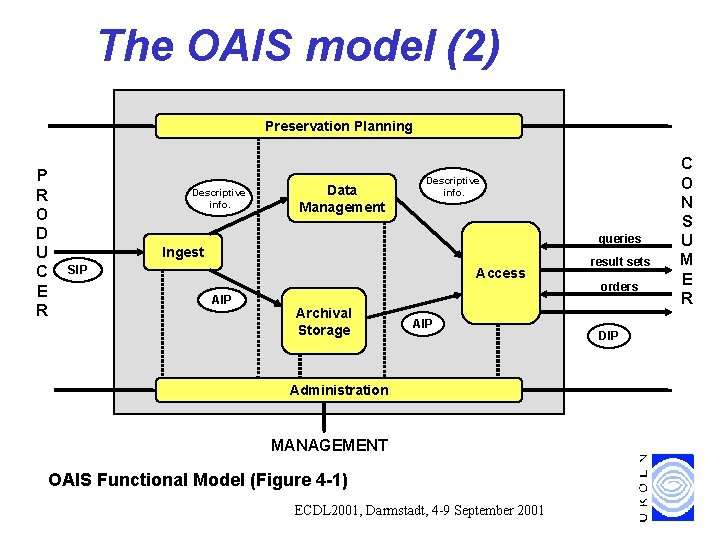
The OAIS model (2) Preservation Planning P R O D U C E R Descriptive info. Data Management Descriptive info. queries Ingest SIP Access AIP Archival Storage AIP Administration MANAGEMENT OAIS Functional Model (Figure 4 -1) ECDL 2001, Darmstadt, 4 -9 September 2001 result sets orders DIP C O N S U M E R
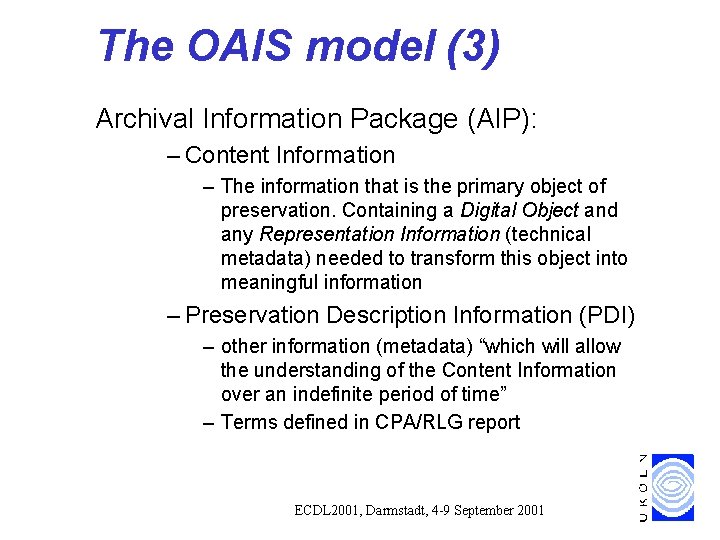
The OAIS model (3) Archival Information Package (AIP): – Content Information – The information that is the primary object of preservation. Containing a Digital Object and any Representation Information (technical metadata) needed to transform this object into meaningful information – Preservation Description Information (PDI) – other information (metadata) “which will allow the understanding of the Content Information over an indefinite period of time” – Terms defined in CPA/RLG report ECDL 2001, Darmstadt, 4 -9 September 2001
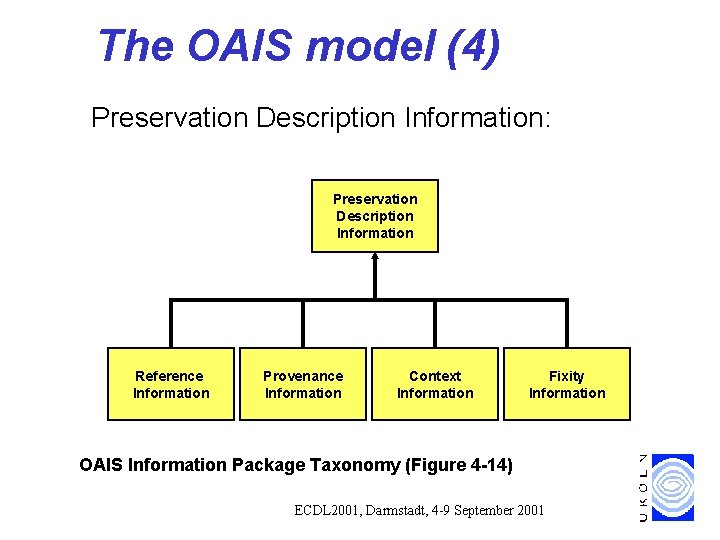
The OAIS model (4) Preservation Description Information: Preservation Description Information Reference Information Provenance Information Context Information Fixity Information OAIS Information Package Taxonomy (Figure 4 -14) ECDL 2001, Darmstadt, 4 -9 September 2001
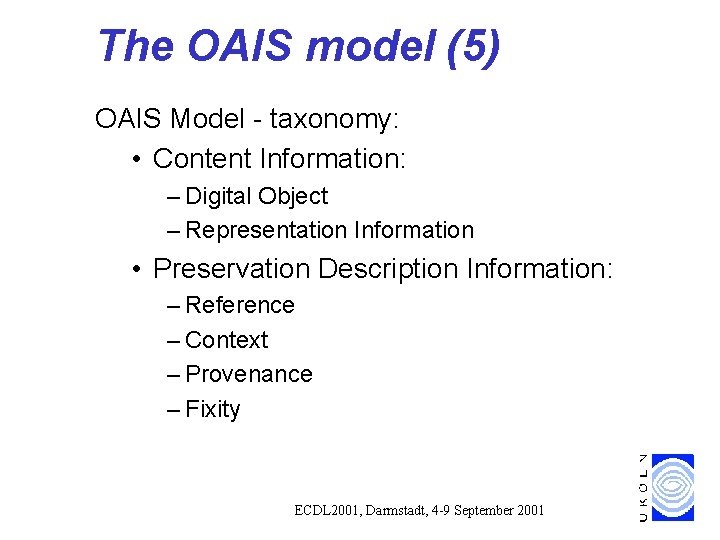
The OAIS model (5) OAIS Model - taxonomy: • Content Information: – Digital Object – Representation Information • Preservation Description Information: – Reference – Context – Provenance – Fixity ECDL 2001, Darmstadt, 4 -9 September 2001
Digital preservation projects ECDL 2001, Darmstadt, 4 -9 September 2001
NLA (1) National Library of Australia • Experience with PANDORA project – practically based, a ‘proof-of-concept’ • Preservation metadata for digital collections (October 1999) – information that a digital storage system would need to generate in order to facilitate preservation management – 25 high level elements, applied to three separate levels of granularity (collection, object file) ECDL 2001, Darmstadt, 4 -9 September 2001
NLA (2) NLA metadata schema: – e. g. , Persistent Identifier, Date of creation, Structural type, Technical Infrastructure of Complex Object, File description, Known System Requirements, Installation Requirements, Storage Information, Access Inhibitors, Finding and Searching Aids, and Access Facilitators, Quirks, etc. – Metadata also records the administrative process of preservation, e. g. Institution Responsible for Archiving Decision, Institution with preservation responsibility, Process, etc. http: //www. nla. gov. au/preserve/pmeta. html ECDL 2001, Darmstadt, 4 -9 September 2001
NEDLIB project (1) NEDLIB (Networked European Deposit Library) • Funded by European Union’s Telematics Applications Programme • Consortium of national libraries, publishers, IT organisations and a national archive • Led by the National library of the Netherlands http: //www. kb. nl/coop/nedlib/ ECDL 2001, Darmstadt, 4 -9 September 2001
NEDLIB project (2) NEDLIB Metadata schema: • Lupovici & Masanès (2000) • adopted the OAIS model’s terminology and broad structure • 18 elements, 38 sub-elements, e. g. : – Representation Information: – e. g. Specific Hardware requirements, Operating system, Object format, Application, etc. – PDI and Descriptive Information: – e. g. Reference Information, Assigned Identifier, URL, Checksum, Change History, etc. ECDL 2001, Darmstadt, 4 -9 September 2001
Cedars project (1) Cedars: • Led by the Consortium of University Research Libraries (CURL) • Funded by the Joint Information Systems Committee, initially as part of phase 3 of the e. Lib Programme • Main partners: Universities of Cambridge, Leeds and Oxford; support from UKOLN for metadata work ECDL 2001, Darmstadt, 4 -9 September 2001
Cedars project (2) Metadata • Review of preservation metadata initiatives (1998) • Draft metadata schema (2000) – Adopted OAIS as framework – Included Content Information (including Representation Information) and PDI http: //www. leeds. ac. uk/cedars/ ECDL 2001, Darmstadt, 4 -9 September 2001
Cedars project (3) PDI: • Reference Information – Resource Description – Title, Creator, etc. – Reference labels – Existing metadata • Context Information – Reason for Preservation – Related Information Objects ECDL 2001, Darmstadt, 4 -9 September 2001
Cedars project (4) • Provenance Information – History of Origin – Management History – Use History – Known Operating Environments – Rights Management • Fixity Information – Checksum ECDL 2001, Darmstadt, 4 -9 September 2001
Cedars project (5) Continued project developments: • Project extension: – practical focus – dissemination – guidance documents on various topics (including preservation metadata) – workshop • CAMi. LEON: – JISC/NSF International Digital Libraries Programme – testing emulation strategies ECDL 2001, Darmstadt, 4 -9 September 2001
OCLC/RLG working groups Preservation Metadata Working Group: – White Paper - “Preservation metadata for digital objects: a review of the state of the art” (March 2001) – Group currently looking in more detail at definitions of Content Information and PDI Digital Archive Attributes Working Group: – Draft paper - “Attributes of a trusted digital repository” - (August 2001) http: //www. oclc. org/digitalpreservation/ ECDL 2001, Darmstadt, 4 -9 September 2001
To conclude. . . • Several different traditions: – Recordkeeping – Digital libraries – There are others. . . sound and video archives, geospatial data, datasets, etc. • Importance of OAIS model • Development of metadata models and schemas: – Not much practical implementation – No clear idea of required expertise and skills (potential costs) ECDL 2001, Darmstadt, 4 -9 September 2001
Acknowledgements UKOLN is funded by Resource: the Council for Museums, Archives and Libraries, the Joint Information Systems Committee (JISC) of the UK higher and further education funding councils, as well as by project funding from the JISC and the European Union. UKOLN also receives support from the University of Bath where it is based. http: //www. ukoln. ac. uk/ ECDL 2001, Darmstadt, 4 -9 September 2001