
Metacommunication and postures I dont want to do
- Slides: 5
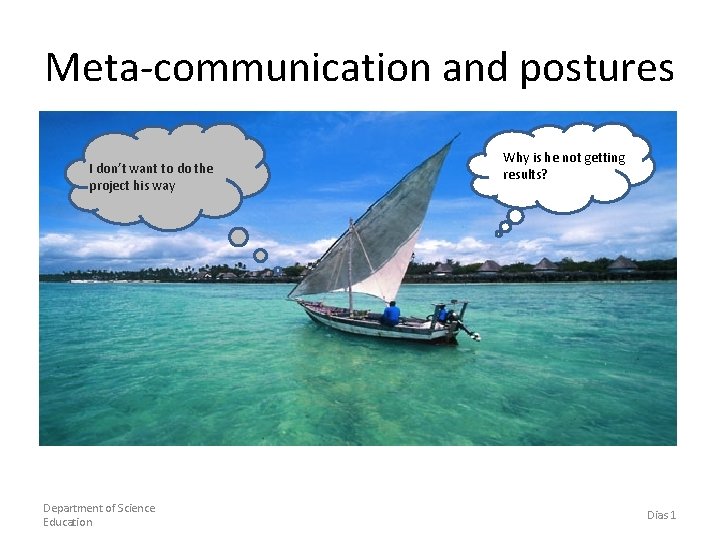
Meta-communication and postures I don’t want to do the project his way Department of Science Education Why is he not getting results? Dias 1
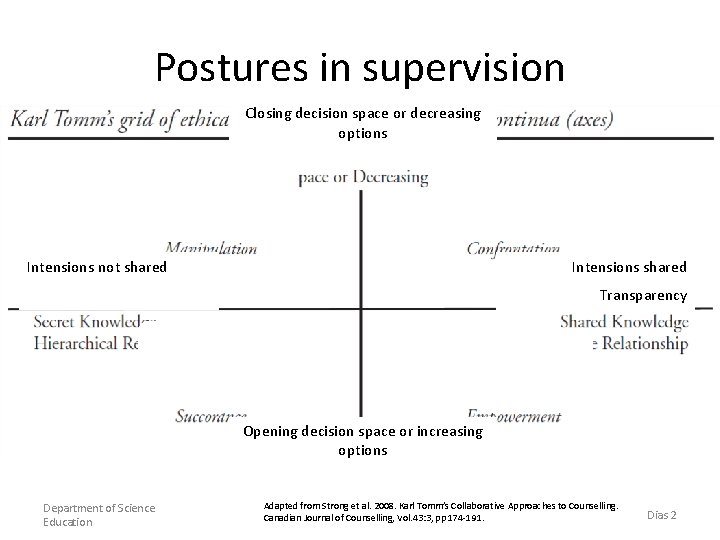
Postures in supervision Closing decision space or decreasing options Intensions not shared Intensions shared Transparency Opening decision space or increasing options Department of Science Education Adapted from Strong et al. 2008. Karl Tomm’s Collaborative Approaches to Counselling. Canadian Journal of Counselling, Vol. 43: 3, pp 174 -191. Dias 2
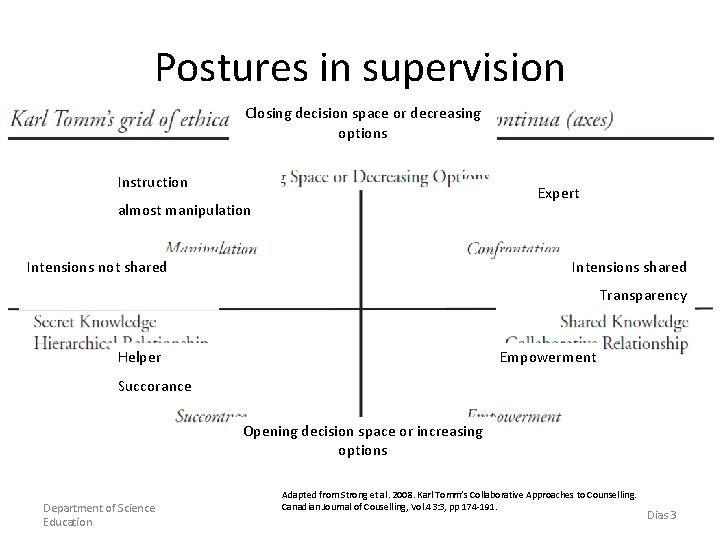
Postures in supervision Closing decision space or decreasing options Instruction Expert almost manipulation Intensions not shared Intensions shared Transparency Helper Empowerment Succorance Opening decision space or increasing options Department of Science Education Adapted from Strong et al. 2008. Karl Tomm’s Collaborative Approaches to Counselling. Canadian Journal of Couselling, Vol. 43: 3, pp 174 -191. Dias 3
Roles as a supervising technique • To take on different hats • • • The bloody-minded examiner, The sceptical reader, The representative of a competing research approach The positive and praising The devil’s advocate • …to make feedback less personal and easier to take in. Department of Science Education Dias 4
Some advise for becoming better supervisors • Listen and ask questions • Show that you can make mistakes • Provide a number of ideas for your Ph. D-student not commands • Remember you can learn from your Ph. D-students • Assist the Ph. D-student in becoming the topic owner • Accept that the Ph. D-student sometimes takes decisions that you would not do • Make the Ph. D-students take advantages of other colleagues competences • Be open to other theoretical and methodological perspectives than the ones you are familiar with