
Metacognitive Reflection 2 Compare your actual Exam 1
- Slides: 38
Metacognitive Reflection #2 Compare your actual Exam #1 score to how you felt you did. To what do you attribute your actual score? How did you prepare for the exam and how can you prepare next time to assure mastery (i. e. work with a study group, create flash cards, write responses to focus questions, etc. )? Be specific. Henniger Teaching Young Children, 5 e. © 2013, 2009, 2005, 2002, 1999 by Pearson Education, Inc. All Rights Reserved 4 -1
Chapter 4: Understanding How a Child Develops and Learns Teaching Young Children Fifth Edition Michael L. Henniger Developed by: Kaye A. Marshall Mt. Baker School District and Whatcom Community College
Goals: Chapter 4 • Learn (DAP) about developmentally appropriate practice • Gain insight into the relationships between child development, learning, and teaching • Study differing perspectives on development • Review characteristics of children at different ages and stages of development • Identify strategies for learning about children and their development Henniger Teaching Young Children, 5 e. © 2013, 2009, 2005, 2002, 1999 by Pearson Education, Inc. All Rights Reserved 4 -3
The Developmentally Appropriate Classroom • Curriculum based on in-depth understanding of child development and learning • Early care and learning professionals – Recognize developmental abilities of children – Use this information to decide what to teach • NAEYC promotes developmentally appropriate practice through books (3 rd edition, 2009) and position statements Henniger Teaching Young Children, 5 e. © 2013, 2009, 2005, 2002, 1999 by Pearson Education, Inc. All Rights Reserved 4 -4
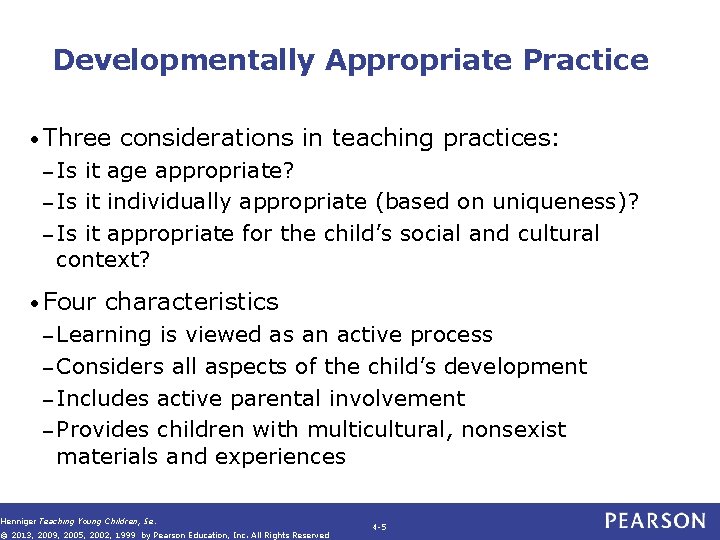
Developmentally Appropriate Practice • Three considerations in teaching practices: – Is it age appropriate? – Is it individually appropriate (based on uniqueness)? – Is it appropriate for the child’s social and cultural context? • Four characteristics – Learning is viewed as an active process – Considers all aspects of the child’s development – Includes active parental involvement – Provides children with multicultural, nonsexist materials and experiences Henniger Teaching Young Children, 5 e. © 2013, 2009, 2005, 2002, 1999 by Pearson Education, Inc. All Rights Reserved 4 -5
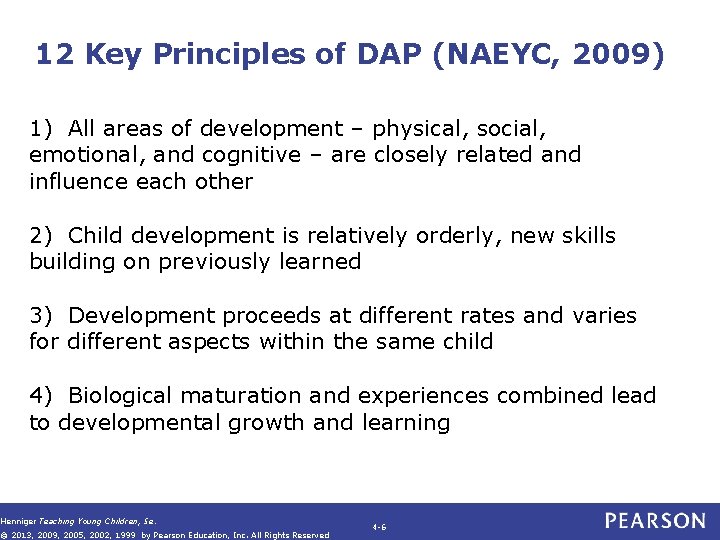
12 Key Principles of DAP (NAEYC, 2009) 1) All areas of development – physical, social, emotional, and cognitive – are closely related and influence each other 2) Child development is relatively orderly, new skills building on previously learned 3) Development proceeds at different rates and varies for different aspects within the same child 4) Biological maturation and experiences combined lead to developmental growth and learning Henniger Teaching Young Children, 5 e. © 2013, 2009, 2005, 2002, 1999 by Pearson Education, Inc. All Rights Reserved 4 -6
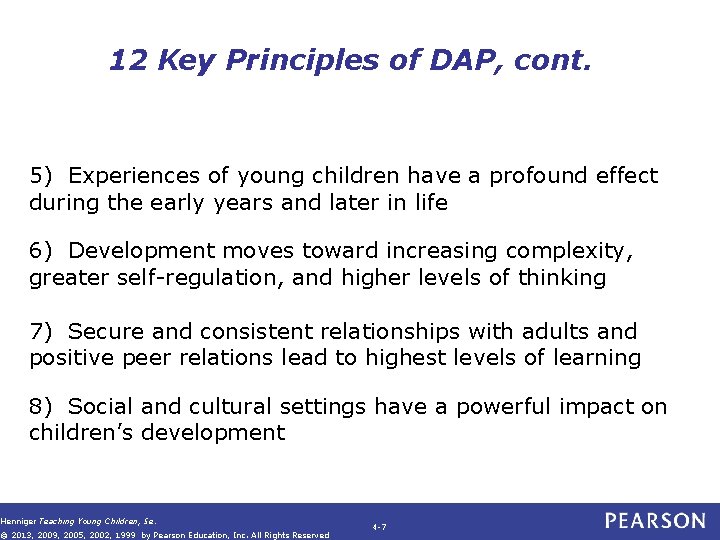
12 Key Principles of DAP, cont. 5) Experiences of young children have a profound effect during the early years and later in life 6) Development moves toward increasing complexity, greater self-regulation, and higher levels of thinking 7) Secure and consistent relationships with adults and positive peer relations lead to highest levels of learning 8) Social and cultural settings have a powerful impact on children’s development Henniger Teaching Young Children, 5 e. © 2013, 2009, 2005, 2002, 1999 by Pearson Education, Inc. All Rights Reserved 4 -7
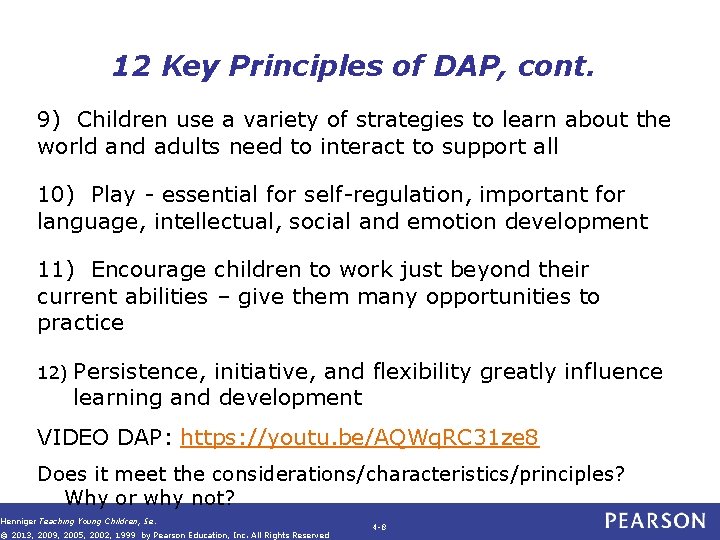
12 Key Principles of DAP, cont. 9) Children use a variety of strategies to learn about the world and adults need to interact to support all 10) Play - essential for self-regulation, important for language, intellectual, social and emotion development 11) Encourage children to work just beyond their current abilities – give them many opportunities to practice 12) Persistence, initiative, and flexibility greatly influence learning and development VIDEO DAP: https: //youtu. be/AQWq. RC 31 ze 8 Does it meet the considerations/characteristics/principles? Why or why not? Henniger Teaching Young Children, 5 e. © 2013, 2009, 2005, 2002, 1999 by Pearson Education, Inc. All Rights Reserved 4 -8
Key Perspectives – Learning and Development • Essential theorists for professionals in the field of early care and education – John Bowlby – Abraham Maslow – Howard Gardner – Maria Montessori – Lev Vygotsky – Erikson – Jean Piaget – Urie Bronfenbrenner – Jack Shonkoff and Deborah Phillips Henniger Teaching Young Children, 5 e. © 2013, 2009, 2005, 2002, 1999 by Pearson Education, Inc. All Rights Reserved 4 -9
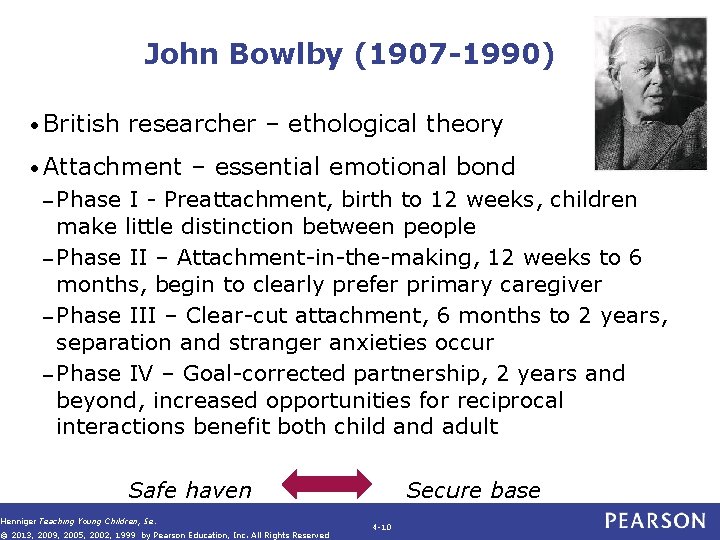
John Bowlby (1907 -1990) • British researcher – ethological theory • Attachment – essential emotional bond – Phase I - Preattachment, birth to 12 weeks, children make little distinction between people – Phase II – Attachment-in-the-making, 12 weeks to 6 months, begin to clearly prefer primary caregiver – Phase III – Clear-cut attachment, 6 months to 2 years, separation and stranger anxieties occur – Phase IV – Goal-corrected partnership, 2 years and beyond, increased opportunities for reciprocal interactions benefit both child and adult Safe haven Henniger Teaching Young Children, 5 e. © 2013, 2009, 2005, 2002, 1999 by Pearson Education, Inc. All Rights Reserved Secure base 4 -10
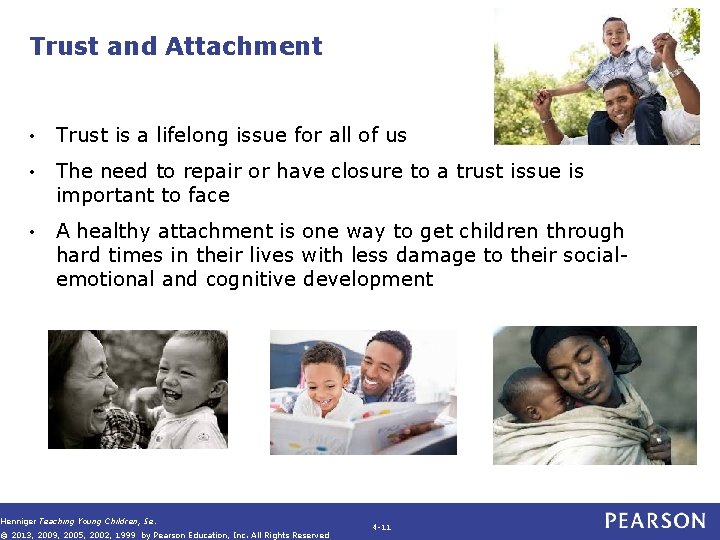
Trust and Attachment • Trust is a lifelong issue for all of us • The need to repair or have closure to a trust issue is important to face • A healthy attachment is one way to get children through hard times in their lives with less damage to their socialemotional and cognitive development Henniger Teaching Young Children, 5 e. © 2013, 2009, 2005, 2002, 1999 by Pearson Education, Inc. All Rights Reserved 4 -11
Trust Exercise Look in your handbags, backpacks, pockets or on your person for something that has personal meaning– something you can hold in your hand that is important to you. Tell the person next to you why it is important and personal. Exchange items. Reflect: How did it feel to give over something to which there is a personal attachment? How might this be like or different from a parent giving his or her child over to a caregiver, provider, or teacher for the first time? Did trust issues come up? What might be ways to help parents feel more confident in separating from their children. Henniger Teaching Young Children, 5 e. © 2013, 2009, 2005, 2002, 1999 by Pearson Education, Inc. All Rights Reserved 4 -12
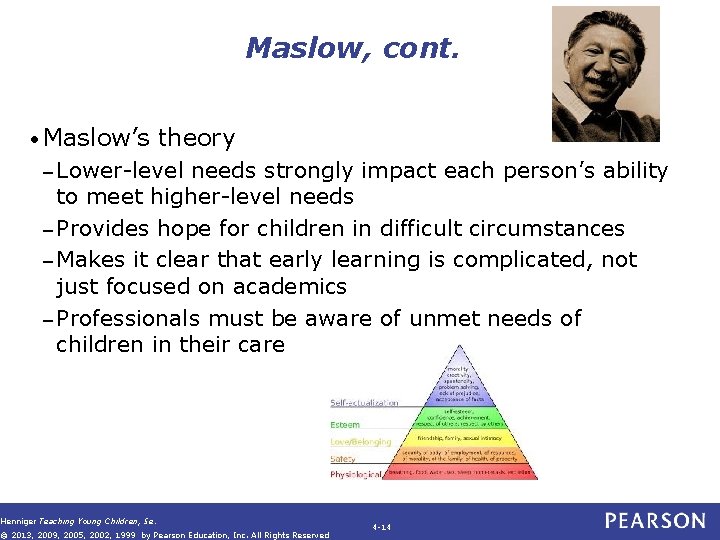
Abraham Maslow (1908 -1970) Humanistic theory – development of self - people have needs that must be met in order to develop Maslow’s Hierarchy of Needs 1) 2) 3) 4) 5) Physiological – food, clothing, water Safety and security – non-threatening environment Belongingness and affection – part of a group, feel loved Self-respect – valued by others, high self-esteem Self-actualization – highest point of every person’s development, perform at maximum potential Henniger Teaching Young Children, 5 e. © 2013, 2009, 2005, 2002, 1999 by Pearson Education, Inc. All Rights Reserved 4 -13
Maslow, cont. • Maslow’s theory – Lower-level needs strongly impact each person’s ability to meet higher-level needs – Provides hope for children in difficult circumstances – Makes it clear that early learning is complicated, not just focused on academics – Professionals must be aware of unmet needs of children in their care Henniger Teaching Young Children, 5 e. © 2013, 2009, 2005, 2002, 1999 by Pearson Education, Inc. All Rights Reserved 4 -14
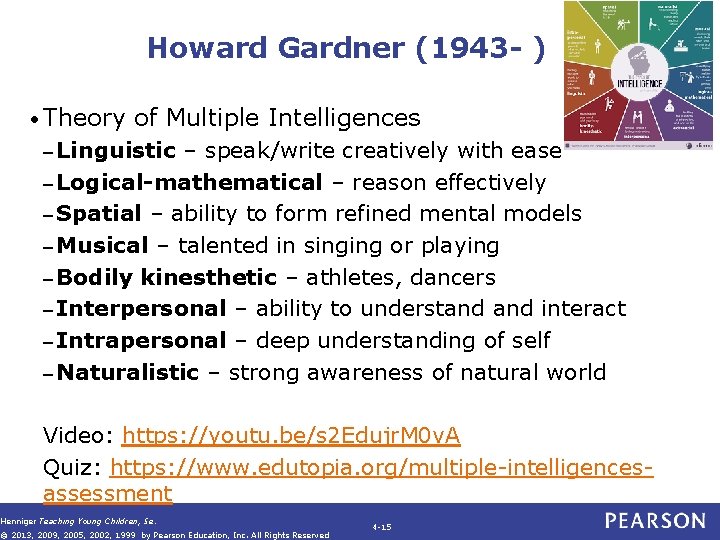
Howard Gardner (1943 - ) • Theory of Multiple Intelligences – Linguistic – speak/write creatively with ease – Logical-mathematical – reason effectively – Spatial – ability to form refined mental models – Musical – talented in singing or playing – Bodily kinesthetic – athletes, dancers – Interpersonal – ability to understand interact – Intrapersonal – deep understanding of self – Naturalistic – strong awareness of natural world Video: https: //youtu. be/s 2 Edujr. M 0 v. A Quiz: https: //www. edutopia. org/multiple-intelligencesassessment Henniger Teaching Young Children, 5 e. © 2013, 2009, 2005, 2002, 1999 by Pearson Education, Inc. All Rights Reserved 4 -15
Maria Montessori (1870 -1952) • Developed maturational theory – Sensitive periods – genetically programmed blocks of time for eager and able learning (ex: toddlers learning to walk) – Unity of mental and physical – learning through doing – Absorbent minds – birth to age 3, while brain is forming, children learn differently from adults • Identified 5 specific periods of growth Henniger Teaching Young Children, 5 e. © 2013, 2009, 2005, 2002, 1999 by Pearson Education, Inc. All Rights Reserved 4 -16
Montessori, cont. • Birth to age 3: Unconsciously absorb information • Age 3 -6: Bring knowledge of unconscious to a conscious level • Age 6 -9: Build academic and artistic skills necessary for success in life • Age 9 -12: Knowledge of the universe gradually opens up • Age 12 -18: Explore areas of special interest in more depth Henniger Teaching Young Children, 5 e. © 2013, 2009, 2005, 2002, 1999 by Pearson Education, Inc. All Rights Reserved 4 -17
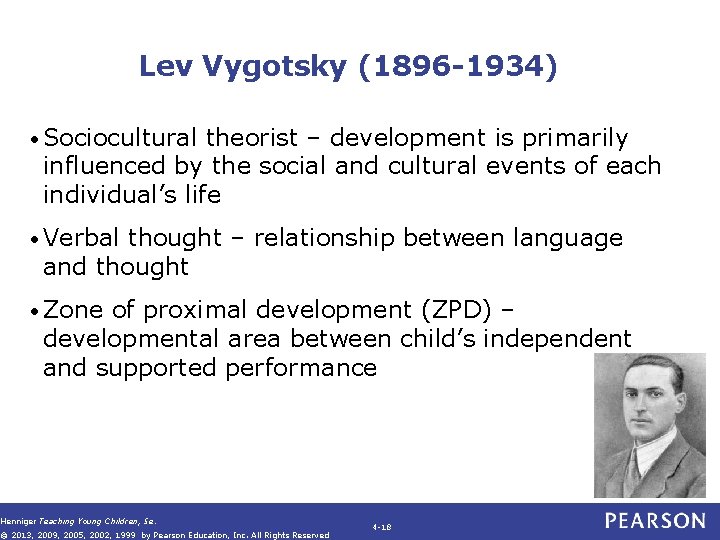
Lev Vygotsky (1896 -1934) • Sociocultural theorist – development is primarily influenced by the social and cultural events of each individual’s life • Verbal thought – relationship between language and thought • Zone of proximal development (ZPD) – developmental area between child’s independent and supported performance Henniger Teaching Young Children, 5 e. © 2013, 2009, 2005, 2002, 1999 by Pearson Education, Inc. All Rights Reserved 4 -18
Vygotsky, cont. • Implications for professionals – Social/Cultural – understand build on experiences that children bring – Relationships – foster strong adult-child and peer relations – Language – essential to support learning – Project learning – important option Henniger Teaching Young Children, 5 e. © 2013, 2009, 2005, 2002, 1999 by Pearson Education, Inc. All Rights Reserved 4 -19
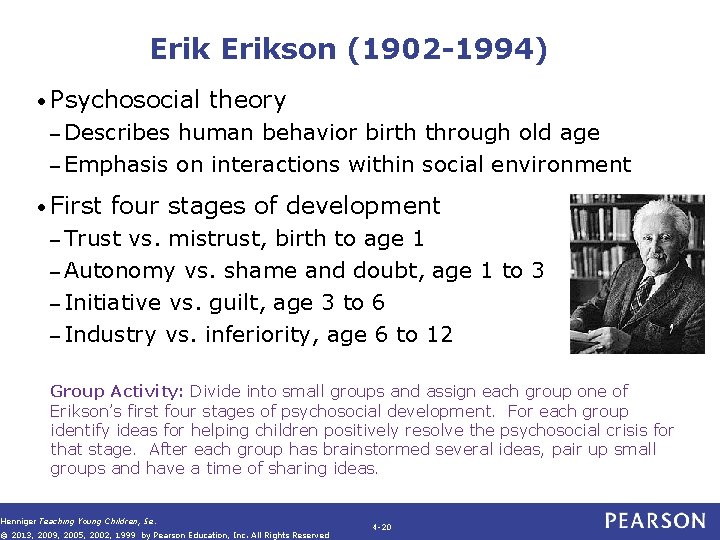
Erikson (1902 -1994) • Psychosocial theory – Describes human behavior birth through old age – Emphasis on interactions within social environment • First four stages of development – Trust vs. mistrust, birth to age 1 – Autonomy vs. shame and doubt, age 1 to 3 – Initiative vs. guilt, age 3 to 6 – Industry vs. inferiority, age 6 to 12 Group Activity: Divide into small groups and assign each group one of Erikson’s first four stages of psychosocial development. For each group identify ideas for helping children positively resolve the psychosocial crisis for that stage. After each group has brainstormed several ideas, pair up small groups and have a time of sharing ideas. Henniger Teaching Young Children, 5 e. © 2013, 2009, 2005, 2002, 1999 by Pearson Education, Inc. All Rights Reserved 4 -20
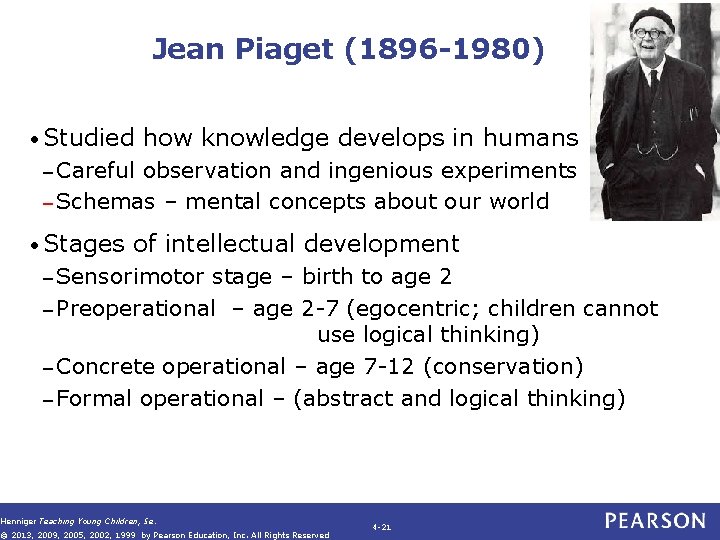
Jean Piaget (1896 -1980) • Studied how knowledge develops in humans – Careful observation and ingenious experiments – Schemas – mental concepts about our world • Stages of intellectual development – Sensorimotor stage – birth to age 2 – Preoperational – age 2 -7 (egocentric; children cannot use logical thinking) – Concrete operational – age 7 -12 (conservation) – Formal operational – (abstract and logical thinking) Henniger Teaching Young Children, 5 e. © 2013, 2009, 2005, 2002, 1999 by Pearson Education, Inc. All Rights Reserved 4 -21
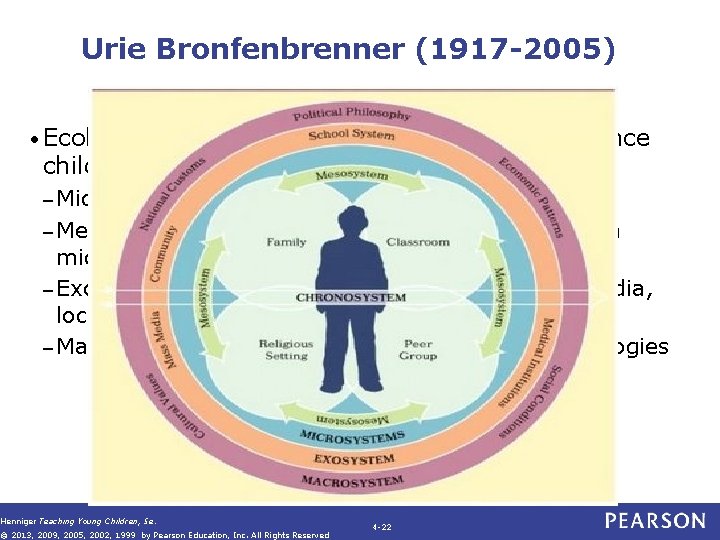
Urie Bronfenbrenner (1917 -2005) • Ecological model – 4 major systems that influence children’s growth – Microsystem – home, school, neighborhood – Mesosystem – interactions and relationships within microsystem (home, school, neighborhood) – Exosystem – local agencies, workplaces, mass media, local industry – Macrosystem – dominant cultural beliefs and ideologies Henniger Teaching Young Children, 5 e. © 2013, 2009, 2005, 2002, 1999 by Pearson Education, Inc. All Rights Reserved 4 -22
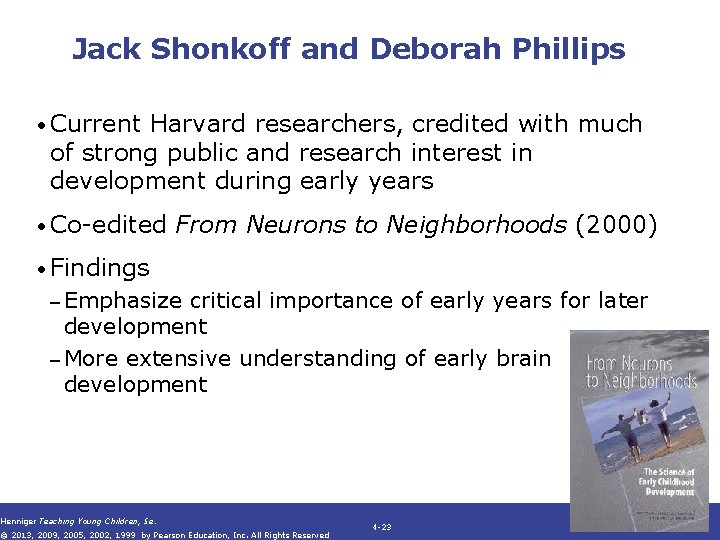
Jack Shonkoff and Deborah Phillips • Current Harvard researchers, credited with much of strong public and research interest in development during early years • Co-edited From Neurons to Neighborhoods (2000) • Findings – Emphasize critical importance of early years for later development – More extensive understanding of early brain development Henniger Teaching Young Children, 5 e. © 2013, 2009, 2005, 2002, 1999 by Pearson Education, Inc. All Rights Reserved 4 -23
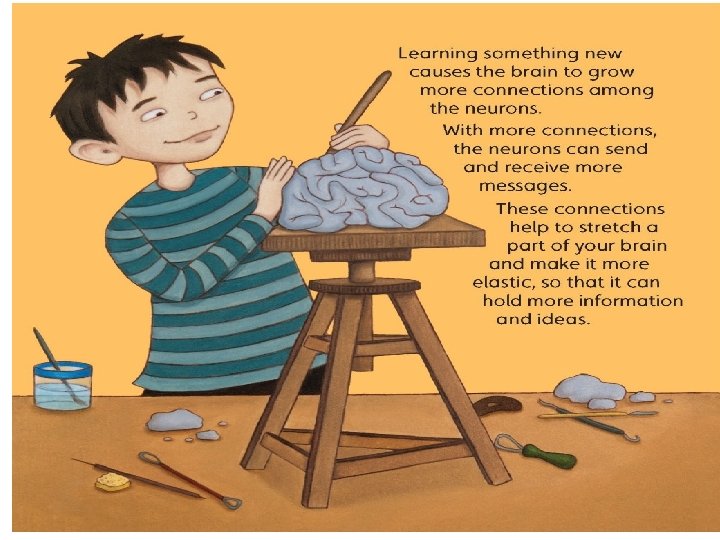
Shonkoff and Phillips: Early brain development • Early brain development – contribution from research review – 4 core concepts – Early experience literally shapes the structure of young brains – Young brain build basic neuron connections first, then develops more complex connections – Cognitive, social, and emotional functioning are interrelated and linked to brain connections – Ability of the brain to change decreases over time Henniger Teaching Young Children, 5 e. © 2013, 2009, 2005, 2002, 1999 by Pearson Education, Inc. All Rights Reserved 4 -24
Shonkoff and Phillips: Self-regulation • Self-regulation – 2 nd outcome of research – Mind in the Making (2010) by Galinsky proposes 7 essential skills needed for success in life ○ Focus and self control ○ Perspective taking ○ Communicating ○ Making connections ○ Critical thinking ○ Taking on challenges ○ Self-directed, engaged learning Henniger Teaching Young Children, 5 e. © 2013, 2009, 2005, 2002, 1999 by Pearson Education, Inc. All Rights Reserved 4 -25
Children: Developmental Similarities and Differences • Understanding typical developmental patterns is the basis for planning and teaching – Knowledge of variations – Identification of atypical development Henniger Teaching Young Children, 5 e. © 2013, 2009, 2005, 2002, 1999 by Pearson Education, Inc. All Rights Reserved 4 -26
Children’s Development (Typical): Infants through age 5 • Infants and toddlers – Infant development – dependence to interaction – One – mobile and exploring, 300 word vocabulary – Two – transition to childhood, 1000 words • Children age 3 through 5: the preschool years – Three – conceptual understanding through play – Four – language play, representational play/art – Five – cooperative play, simple games, more complex number and language knowledge Henniger Teaching Young Children, 5 e. © 2013, 2009, 2005, 2002, 1999 by Pearson Education, Inc. All Rights Reserved 4 -27
Children’s Development: Ages 6 through 8 • Age 6 through 8, the primary school years – Six – recognizing personal strengths/weaknesses – Seven – master basic reading, math operations, desire to be part of the group – Eight – subtle body changes, aware of gender differences, conceptual knowledge increases Henniger Teaching Young Children, 5 e. © 2013, 2009, 2005, 2002, 1999 by Pearson Education, Inc. All Rights Reserved 4 -28
Children’s Development: Special Needs • Children with special needs or exceptionalities – Disabled – At-risk – Gifted • Disability – having difficulty or limitation with a specific task • Categories of disabilities – Intellectual and developmental – Learning disabilities (continues) Henniger Teaching Young Children, 5 e. © 2013, 2009, 2005, 2002, 1999 by Pearson Education, Inc. All Rights Reserved 4 -29
Children’s Development: Exceptionalities, Disabilities • Categories of disabilities, cont. – Attention deficit/hyperactivity disorder (ADHD) – Emotional or behavioral disorders – Communication – Deafness and hard of hearing – Blindness or low vision – Autism spectrum disorders – Low- incidence, multiple, and severe disabilities – Physical and other health impairments VIDEO: Special Needs Pre-School https: //youtu. be/g. CQ 8 ic. BD 9 kg What resources/strategies/adaptations do you see being made available? Henniger Teaching Young Children, 5 e. © 2013, 2009, 2005, 2002, 1999 by Pearson Education, Inc. All Rights Reserved 4 -30
Children’s Development: Special Needs, At-risk • At-risk – not identified as having disabilities, but may experience developmental delays – Biological factors (during pregnancy or after birth) – premature, low birth weight, maternal diabetes, severe illnesses – Environmental factors – poverty, homelessness, child abuse, poor parenting Henniger Teaching Young Children, 5 e. © 2013, 2009, 2005, 2002, 1999 by Pearson Education, Inc. All Rights Reserved 4 -31
Children’s Development: Special Needs, Gifted • Gifted children – demonstrate excellence in development well beyond most children of same age – Complex concept, difficult to define – Traditionally, IQ tests used – More recently, recognition that intelligence comes in many forms (Gardner, 1999) Henniger Teaching Young Children, 5 e. © 2013, 2009, 2005, 2002, 1999 by Pearson Education, Inc. All Rights Reserved 4 -32
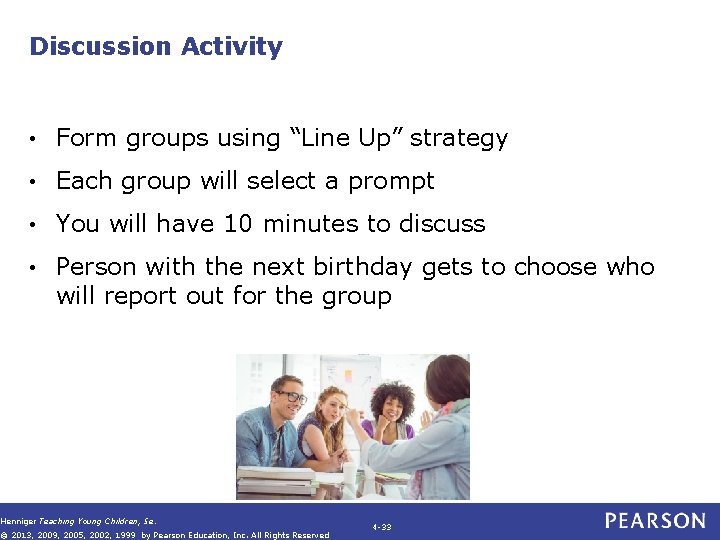
Discussion Activity • Form groups using “Line Up” strategy • Each group will select a prompt • You will have 10 minutes to discuss • Person with the next birthday gets to choose who will report out for the group Henniger Teaching Young Children, 5 e. © 2013, 2009, 2005, 2002, 1999 by Pearson Education, Inc. All Rights Reserved 4 -33
Summary • Developmentally • Key Appropriate Classroom Perspectives on Learning and Development • Children: Developmental Similarities and Differences Henniger Teaching Young Children, 5 e. © 2013, 2009, 2005, 2002, 1999 by Pearson Education, Inc. All Rights Reserved 4 -34
NEUROPLASTICITY 35
NEUROPLASTICITY IN ACTION 7 -8 participants will line up side-by-side and each hold a spoon. You will represent a neural pathway and the spoons will represent connections being made. First person will pass a cotton ball to the next person, using only the spoon. The cotton represents information being passed along the neural pathway. Last person will use their spoon to place the cotton balls in their cup. If a cotton ball falls, you may leave it on the floor and continue Second team will assemble on their own and compete against the first group to see who can successfully collect the most cotton balls in one minute. 36
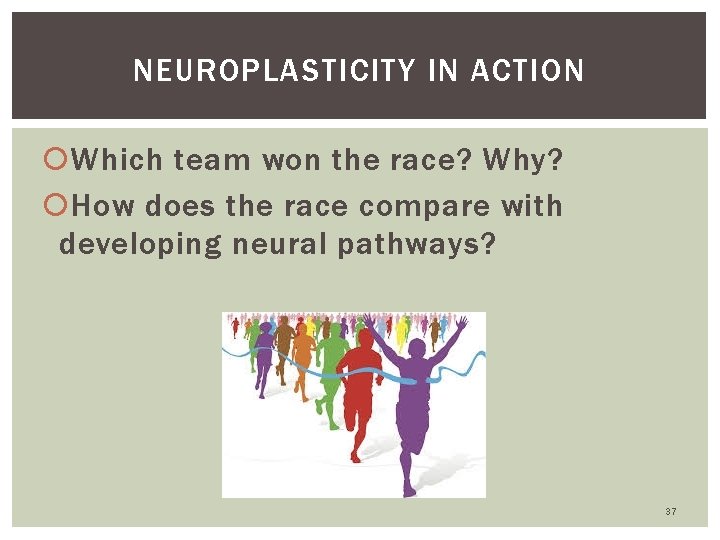
NEUROPLASTICITY IN ACTION Which team won the race? Why? How does the race compare with developing neural pathways? 37