
Metacognition Theoretical Frameworks to Understanding Learning Neil H
- Slides: 21
Metacognition Theoretical Frameworks to Understanding Learning Neil H. Schwartz, Ph. D. Psych 605 Advanced Human Learning Fall Semester 2010
Metacognition � Metacognition refers to a learner’s ability to be aware of and monitor their own learning processes. � Usually defined by it’s component parts.
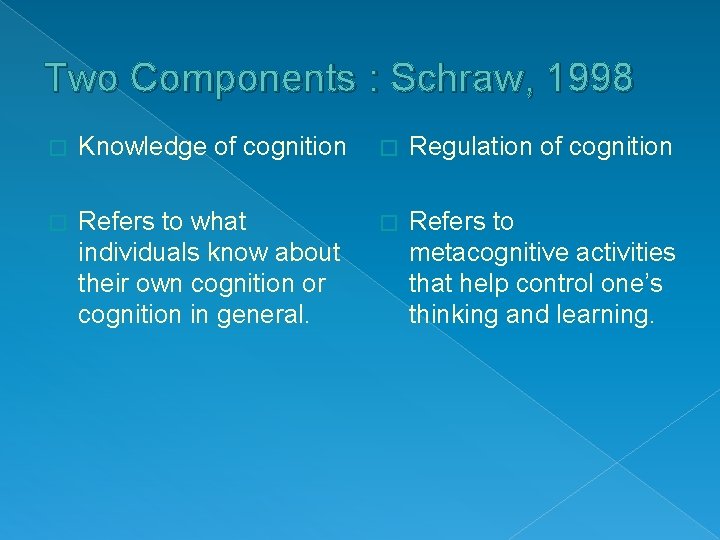
Two Components : Schraw, 1998 � Knowledge of cognition � Regulation of cognition � Refers to what individuals know about their own cognition or cognition in general. � Refers to metacognitive activities that help control one’s thinking and learning.
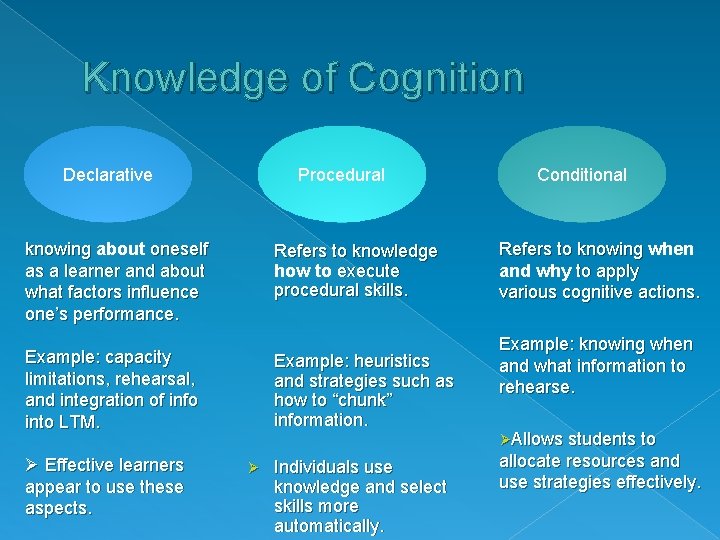
Knowledge of Cognition � Includes three types of metacognitive awareness: � Declarative Knowledge � Procedural Knowledge � Conditional Knowledge
Knowledge of Cognition Declarative Procedural knowing about oneself as a learner and about what factors influence one’s performance. Refers to knowledge how to execute procedural skills. Example: capacity limitations, rehearsal, and integration of info into LTM. Ø Effective learners appear to use these aspects. Example: heuristics and strategies such as how to “chunk” information. Ø Individuals use knowledge and select skills more automatically. Conditional Refers to knowing when and why to apply various cognitive actions. Example: knowing when and what information to rehearse. ØAllows students to allocate resources and use strategies effectively.
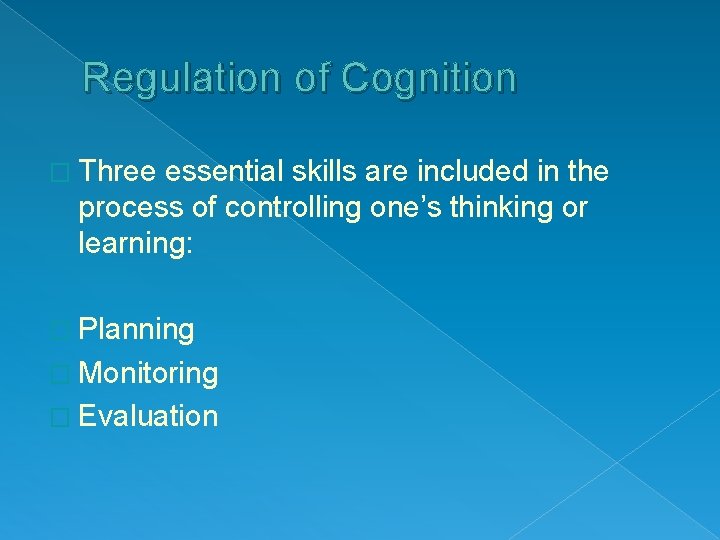
Regulation of Cognition � Three essential skills are included in the process of controlling one’s thinking or learning: � Planning � Monitoring � Evaluation
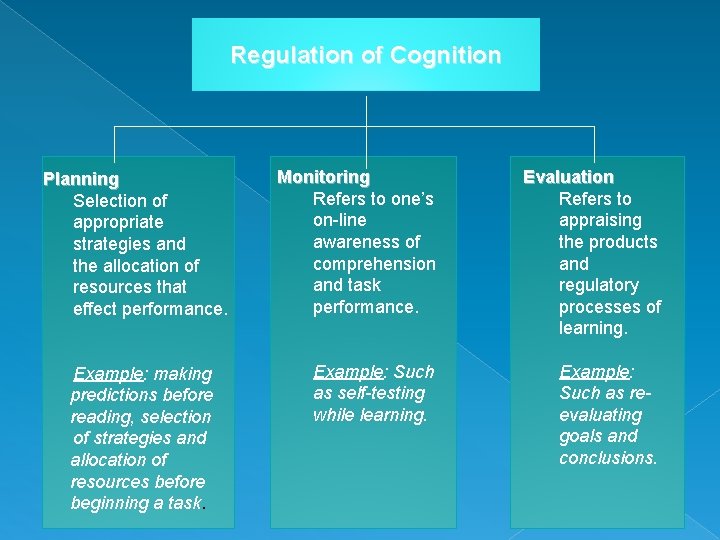
Regulation of Cognition Planning Selection of appropriate strategies and the allocation of resources that effect performance. Example: making predictions before reading, selection of strategies and allocation of resources before beginning a task. Monitoring Refers to one’s on-line awareness of comprehension and task performance. Evaluation Refers to appraising the products and regulatory processes of learning. Example: Such as self-testing while learning. Example: Such as reevaluating goals and conclusions.
Metacognitive Theories � “Is a relatively systematic structure of knowledge that can be used to explain and predict a broad range of cognitive and metacognitive phenomena” (Schraw & Moshman, 1995. ) › These theories are personally derived. › And integrate knowledge of cognition and regulation of cognition.
Metacognitive Theories � Characteristics › Allows an individual to integrate varied aspects of metacognition into a single framework. For example, children have difficulty using knowledge of memory to regulate cognition, because they have not yet integrated metacognitive knowledge and regulatory skills.
Metacognitive Theories Ø Characteristics continued: ØCoordinate beliefs that allow individuals to predict, control and explain their cognition, the cognition of others, or cognition in general. For example, a good strategy user, knows effective learning depends on activating relevant knowledge from memory, selectively using strategies, and motivates oneself to learn material at a deeper level. This guides ands coordinates one’s learning constituting a theory of what it means to be an effective learner.
Metacognitive Theories � There are three different types of metacognitive theories: � Tacit Theories � Informal Theories � Formal Theories
Tacit Theories � Are unconcious frameworks that systematize metacognitive knowledge. � for example, children’s beliefs about intelligence affects behavior in a classroom.
Informal Theories � Individuals are aware of some of their beliefs and assumptions regarding a phenomena, but have not yet constructed a theoretical structure that integrates and justifies beliefs. › Informal theories start as domain specific, and gradually are generalized to other domains.
Formal Theories � A systemized approach to learn something that has a specific form or structure (e g. physics, music, or statistics) that needs to be known, used, or remembered. › Allows individuals to make informed choices about self-regulatory behaviors.
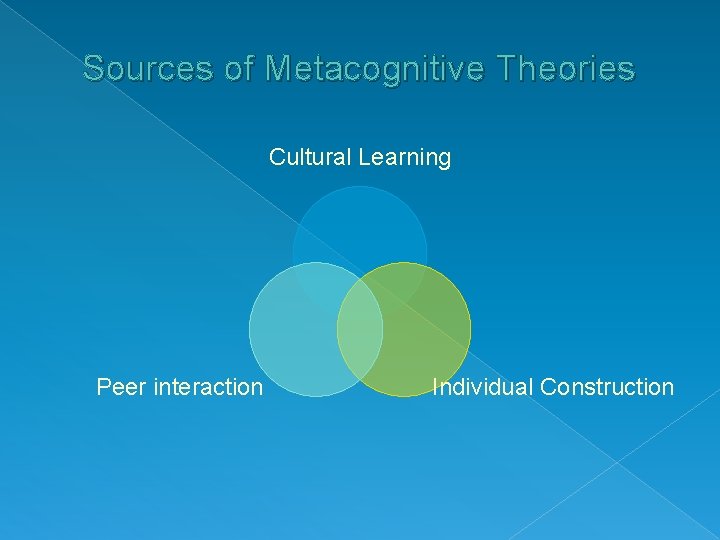
Sources of Metacognitive Theories Cultural Learning Peer interaction Individual Construction
Implications for Educators � When students lack a theory of metacognitive knowledge, they are unable to explain their cognitive performance or plan effectively. › For example, students have difficulty in scientific reasoning due to lack of knowledge of a theory of metacognition. › Students do not differentiate between formal hypotheses and the data used to test these hypothesis, because they lack the skills to think strategically.
Implications for Educators � Many programs do not help students understand the structure of metacognitive theory and use theory to organize knowledge.
Implications for Educators � Thus, Instructional programs should include: › Ways to help construct metacognitive awareness aiding theoretical formalization. › To accomplish this…
Implications for Educators � Educators need to promote general awareness of the importance of metacognition: › Improve regulation of cognition. › And foster environments promoting metacognitive awareness.
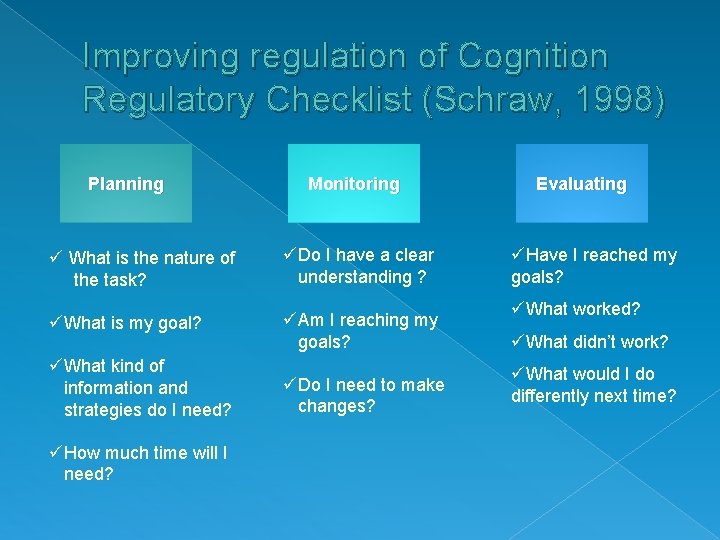
Improving regulation of Cognition Regulatory Checklist (Schraw, 1998) Planning Monitoring ü What is the nature of the task? üDo I have a clear understanding ? üWhat is my goal? üAm I reaching my goals? üWhat kind of information and strategies do I need? üDo I need to make changes? üHow much time will I need? Evaluating üHave I reached my goals? üWhat worked? üWhat didn’t work? üWhat would I do differently next time?
Fostering Environments Promoting Metacognitive Awareness � Promoting goal orientations in the classroom Vs. performance orientations. › Students with mastery orientations seek to improve their competence, whereas, students with a performance orientation seek to prove competence.