
Metacognition Chapter 1 Study Habits Questionnaire Always 10

Metacognition Chapter 1

Study Habits Questionnaire Always (10) 1. I exert effort to find out why I need to do a particular task. 2. I reward myself when I work. 3. I see to it that I give myself regular breaks from work. 4. I am able to keep concentration and does not let my mind “drift away”. 5. I have ways of dealing with distractions. 6. I am willing to do the work I do not enjoy because I see it as important. Sometimes Never (5) (0) Your Score
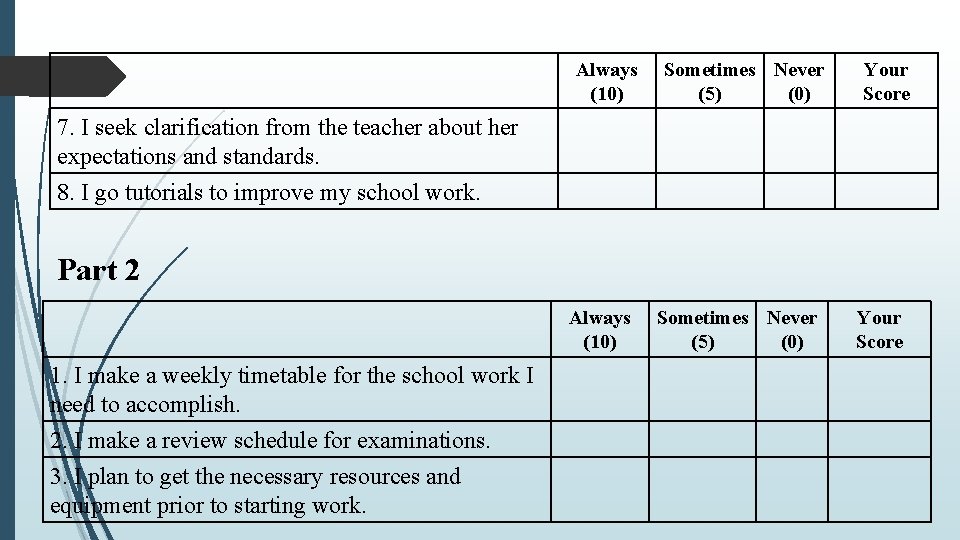
Always (10) Sometimes Never (5) (0) Your Score 7. I seek clarification from the teacher about her expectations and standards. 8. I go tutorials to improve my school work. Part 2 Always (10) 1. I make a weekly timetable for the school work I need to accomplish. 2. I make a review schedule for examinations. 3. I plan to get the necessary resources and equipment prior to starting work. Sometimes Never (5) (0) Your Score
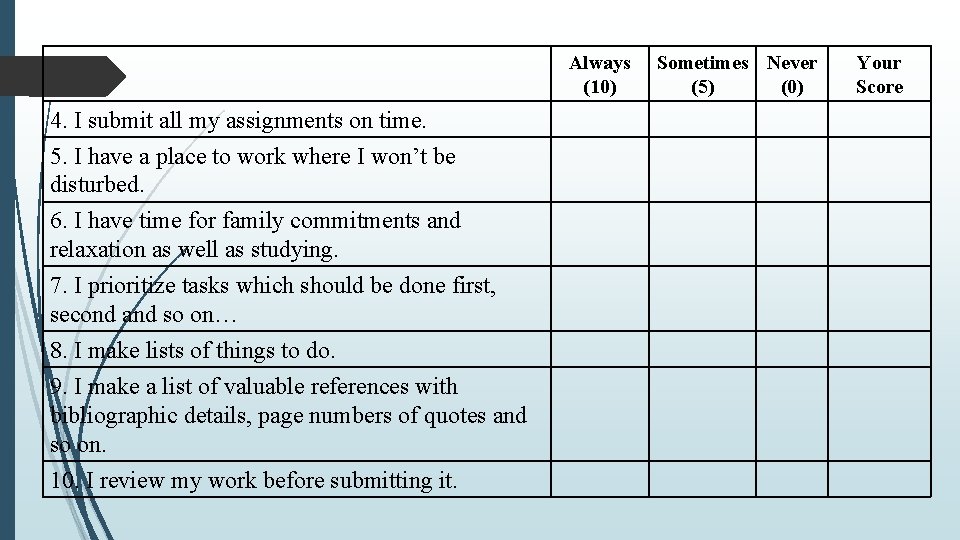
Always (10) 4. I submit all my assignments on time. 5. I have a place to work where I won’t be disturbed. 6. I have time for family commitments and relaxation as well as studying. 7. I prioritize tasks which should be done first, second and so on… 8. I make lists of things to do. 9. I make a list of valuable references with bibliographic details, page numbers of quotes and so on. 10. I review my work before submitting it. Sometimes Never (5) (0) Your Score
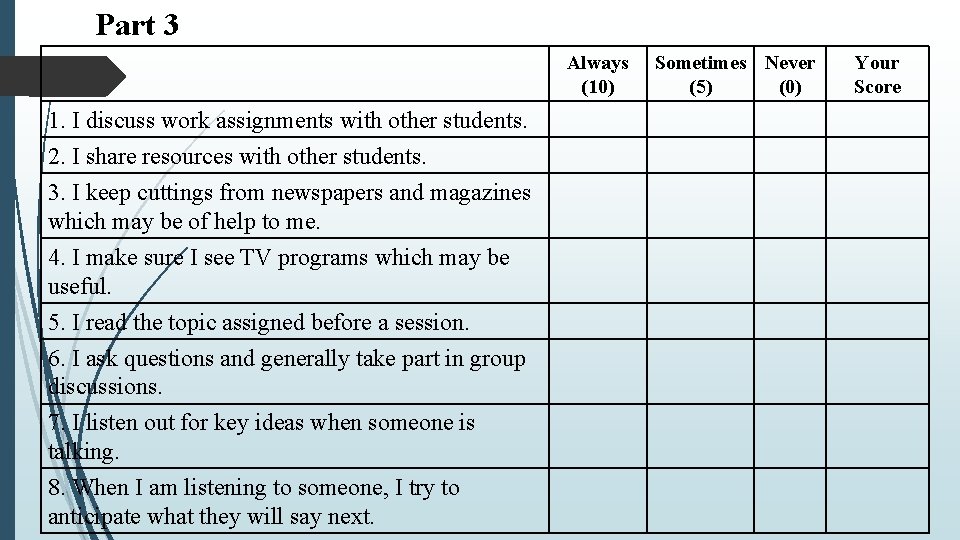
Part 3 Always (10) 1. I discuss work assignments with other students. 2. I share resources with other students. 3. I keep cuttings from newspapers and magazines which may be of help to me. 4. I make sure I see TV programs which may be useful. 5. I read the topic assigned before a session. 6. I ask questions and generally take part in group discussions. 7. I listen out for key ideas when someone is talking. 8. When I am listening to someone, I try to anticipate what they will say next. Sometimes Never (5) (0) Your Score
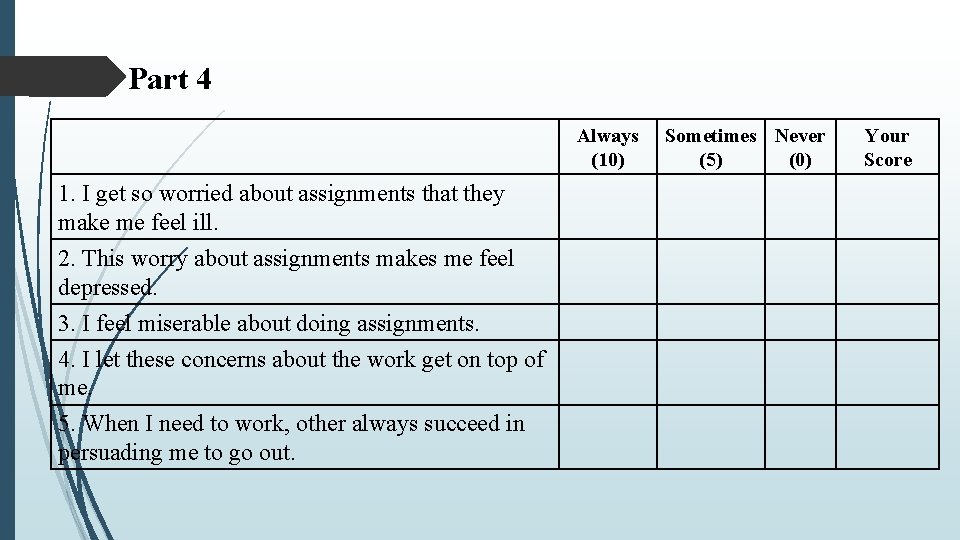
Part 4 Always (10) 1. I get so worried about assignments that they make me feel ill. 2. This worry about assignments makes me feel depressed. 3. I feel miserable about doing assignments. 4. I let these concerns about the work get on top of me. 5. When I need to work, other always succeed in persuading me to go out. Sometimes Never (5) (0) Your Score
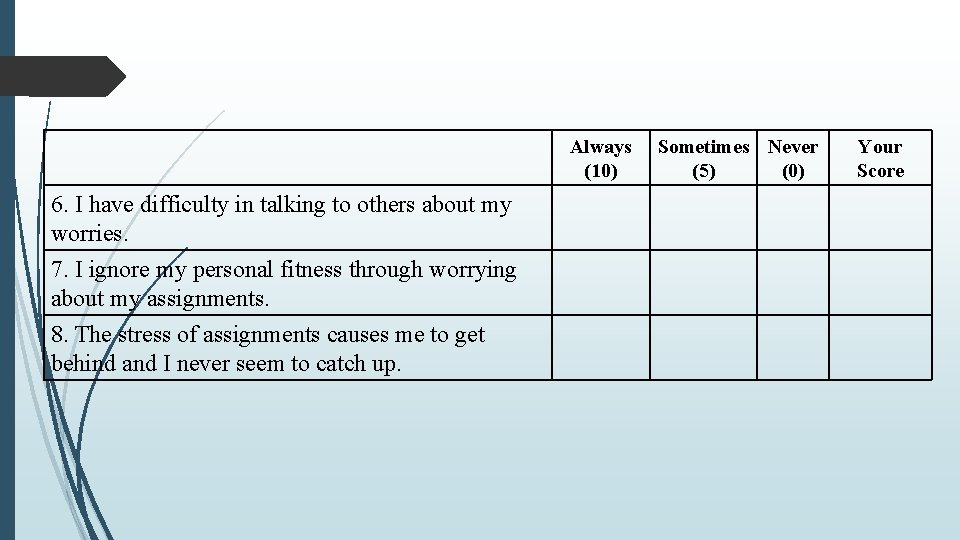
Always (10) 6. I have difficulty in talking to others about my worries. 7. I ignore my personal fitness through worrying about my assignments. 8. The stress of assignments causes me to get behind and I never seem to catch up. Sometimes Never (5) (0) Your Score
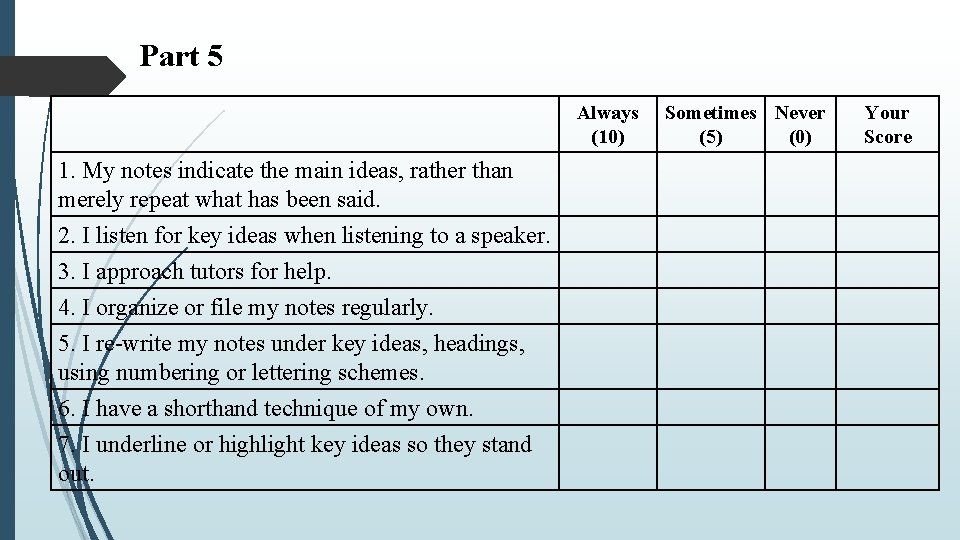
Part 5 Always (10) 1. My notes indicate the main ideas, rather than merely repeat what has been said. 2. I listen for key ideas when listening to a speaker. 3. I approach tutors for help. 4. I organize or file my notes regularly. 5. I re-write my notes under key ideas, headings, using numbering or lettering schemes. 6. I have a shorthand technique of my own. 7. I underline or highlight key ideas so they stand out. Sometimes Never (5) (0) Your Score
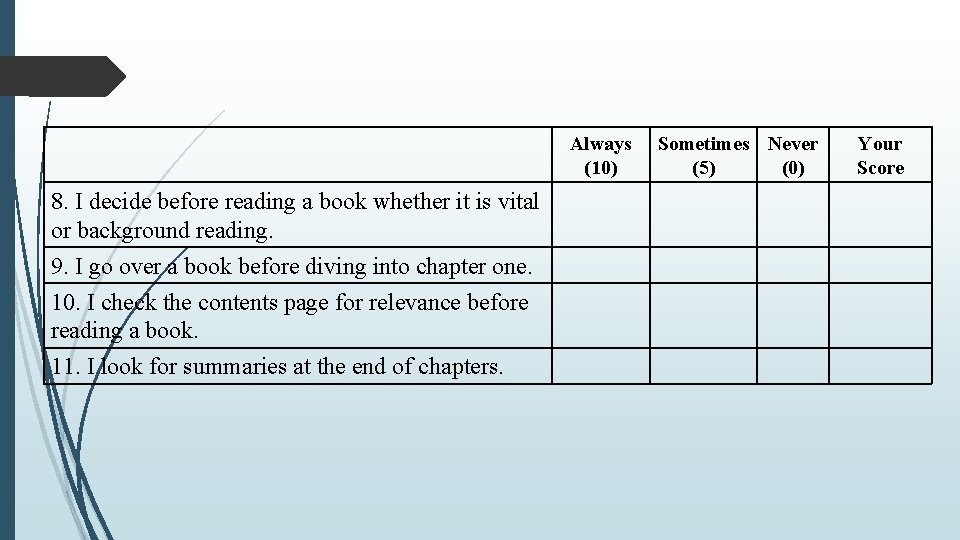
Always (10) 8. I decide before reading a book whether it is vital or background reading. 9. I go over a book before diving into chapter one. 10. I check the contents page for relevance before reading a book. 11. I look for summaries at the end of chapters. Sometimes Never (5) (0) Your Score
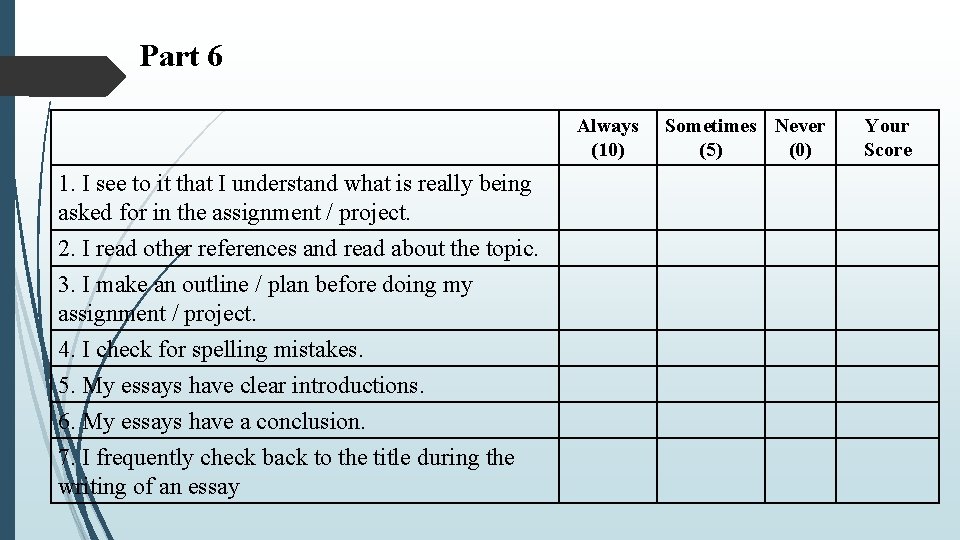
Part 6 Always (10) 1. I see to it that I understand what is really being asked for in the assignment / project. 2. I read other references and read about the topic. 3. I make an outline / plan before doing my assignment / project. 4. I check for spelling mistakes. 5. My essays have clear introductions. 6. My essays have a conclusion. 7. I frequently check back to the title during the writing of an essay Sometimes Never (5) (0) Your Score
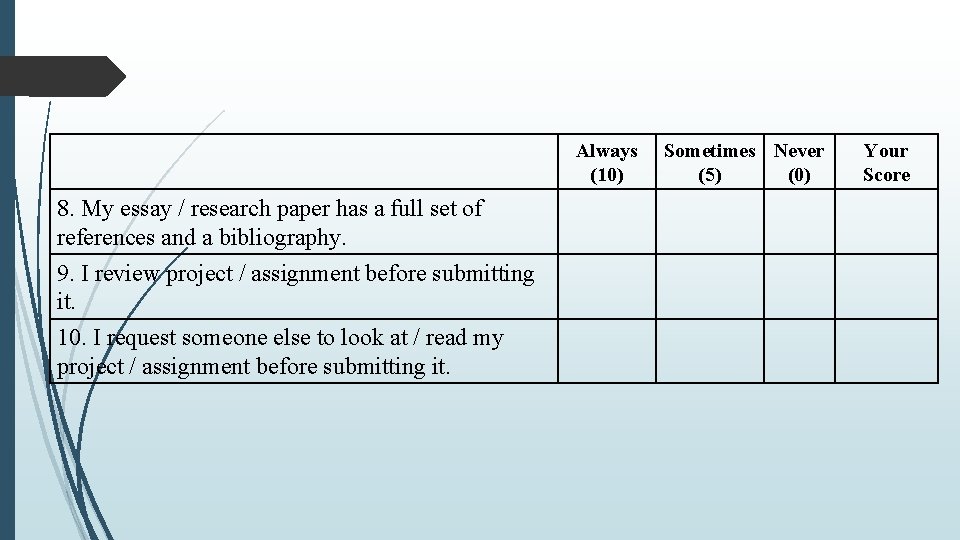
Always (10) 8. My essay / research paper has a full set of references and a bibliography. 9. I review project / assignment before submitting it. 10. I request someone else to look at / read my project / assignment before submitting it. Sometimes Never (5) (0) Your Score
METACOGNITION - coined by John Flavell - consists of both metacognitive knowledge and metacognitive experiences or regulation - simply put, is “thinking about thinking” or “learning how to learn” - refers to higher order thinking which involves active awareness and control over the cognitive processes engaged in learning
- refers to the acquired knowledge about cognitive processes, knowledge that can be used to control cognitive processes - divided into three (3) categories: 1. knowledge of person variables 2. task variables 3. strategy variables
PERSON VARIABLES - includes how one views himself as a learner and thinker - refers to knowledge about how human beings learn and process information, as well as individual knowledge of one’s learning processes - example you may be aware that you study more effectively if you study very early in the morning than late in the evening, and that you work better in a quiet library rather than at home where there a lot of things that make it hard for you to focus and concentrate
TASK VARIABLE - includes knowledge about the nature of the task as well as the type of processing demands that it will place upon the individual - it is about knowing what exactly needs to be accomplished gauging its difficulty and knowing the kind of effort it will demand from you - example you may be aware that it takes more time for you to read and comprehend a book in educational philosophy than it is for you to read and comprehend a novel
STRATEGY VARIABLES - involves awareness of the strategy you are using to learn a topic and evaluating whether this strategy is effective - if you think your strategy is not working, then you may think of various strategies and try out one to see if it will help you learn better - terms like meta-attention and meta-memory are related to strategy variables
- META-ATTENTION – is the awareness of specific strategies so that you can keep your attention focused on the topic or task at hand - META-MEMORY – is your awareness of memory strategies that work best for you - these three variables all interact as you learn and apply metacognition
The following are used in the practice of metacognition: 1. Knowing the limits of one’s own learning and memory capacities. 2. Knowing what learning tasks one can realistically accomplish within a certain amount of time. 3. Knowing which learning strategies are effective and which are not 4. Planning an approach to a learning task that is likely to be successful.
5. Using effective learning strategies to process and learn new materials. 6. Monitoring one’s own knowledge and comprehension. In other words, knowing when information has been successfully learned and when it is not. 7. Using effective strategies for retrieval of previously stored information.
8. Knowledge is said to be metacognitive if it is keenly used in a purposeful manner to ensure that a goal is met. Example: A student may use knowledge in planning how to do homework: “I know that I (person variable) have more difficulty with my Science assignments than English and find Araling Panlipunan easier (task variable), so I will do my homework in Science first, then English, then Araling Panlipunan (strategy variable) • If one is only aware about one’s cognitive strengths or weaknesses and the nature of the task but does not use this to guide his own learning, then NO metacognition has been applied
Metacognitive Strategies to Facilitate Learning - Fang and Cox showed that metacognitive awareness was evident in preschoolers and in students as young as 8 yrs old; during these years children have the capacity to be more aware and reflective of their own learning - challenge for future teacher, is to integrate more activities that would build your students’ capacity to reflect on their own characteristics as learners (self-knowledge), the tasks they are to do (task knowledge) and the strategies that they can use to learn (strategic knowledge)
1. Have students monitor their own learning and thinking. 2. Teach students study or learning strategies. TQLR – this can be taught to younger students - metacognitive strategy before listening to a story or presentation T – Tune in - it is first important for the learner himself to be aware that he is paying attention, and that he is ready to learn
Q – Question - the learner is given questions or he thinks of questions about what he will soon learn L – Listen - the learner then intentionally exerts effort to listen; he becomes aware if he is momentarily destructed and goes back to listen again R – Remember - the learner uses ways or strategies to remember what was learned
PQ 4 R – usually for older students in the intermediate levels and onwards; used to study a unit or chapter P – Preview - scan the whole chapter before delving on each paragraph - check out the objectives - look for outlines or advance organizers that will give you an idea about the important topics and ideas in the chapter - rad the summary of the chapter first (but do not stop on the summary alone)
Q – Question - read the guide questions provided, or think of your own questions about the topic R – Read - check out sub headings as you read - pay attention on words that are printed in bold or italicized - find out the meaning of words that not clear to you - use a marker or colored pencil to highlight important words or phrases
R – Recite - work on answering the questions you had earlier R – Review - pinpoint topics you may need to go back to and read in order to understand better R – Reflect - think about what you read - Is everything clear to you? What are the main points learned? How is this relevant or useful to you?
3. Have students MAKE PREDICTIONS about information to be presented next based on what they have learned. 4. Have students RELATE IDEAS TO EXISTING KNOWLEDGE STRUCTURES. 5. Have students DEVELOP QUESTIONS, ask questions of themselves, about what’s going on around them 6. Help students to KNOW WHEN TO ASK FOR HELP. (Students must be able to self-monitor, require them to show they have attempted to deal with the problems of their own)
7. Show students how to TRANSFER knowledge, attitudes, values, skills to other situations or tasks
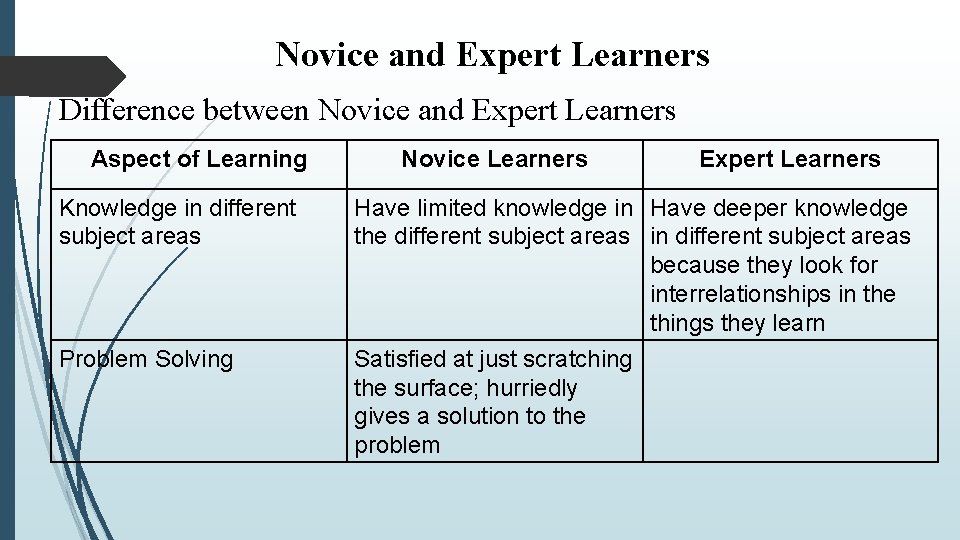
Novice and Expert Learners Difference between Novice and Expert Learners Aspect of Learning Novice Learners Expert Learners Knowledge in different subject areas Have limited knowledge in Have deeper knowledge the different subject areas in different subject areas because they look for interrelationships in the things they learn Problem Solving Satisfied at just scratching the surface; hurriedly gives a solution to the problem
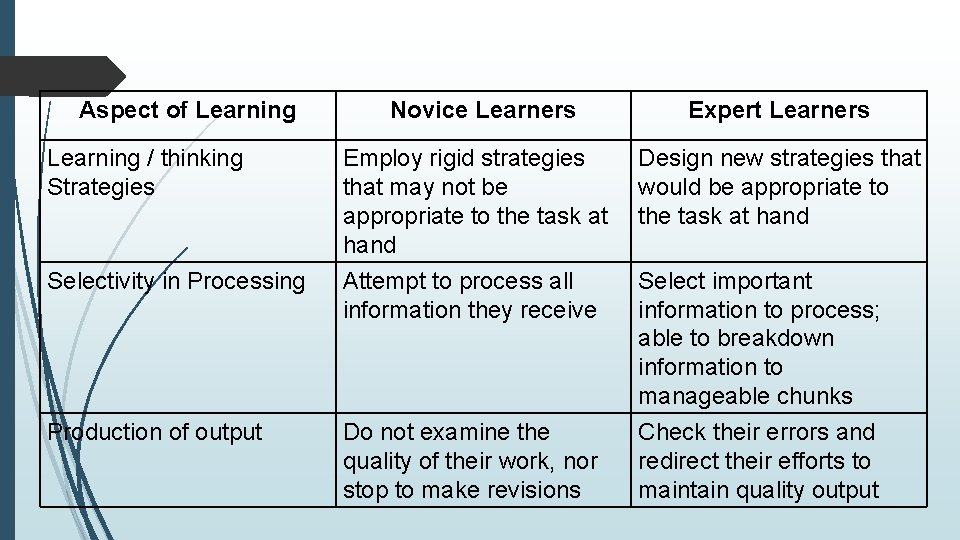
Aspect of Learning / thinking Strategies Selectivity in Processing Production of output Novice Learners Expert Learners Employ rigid strategies that may not be appropriate to the task at hand Attempt to process all information they receive Design new strategies that would be appropriate to the task at hand Do not examine the quality of their work, nor stop to make revisions Check their errors and redirect their efforts to maintain quality output Select important information to process; able to breakdown information to manageable chunks
- Slides: 30