
Metabolism of gut Function of the small intestine
Metabolism of gut
Function of the small intestine Absorption (monosaccharides, fat, aminoacids, vitamines, water, metals and trace elements) Defence against bacteria, toxines and antigen entry Hormone production Motility – transit of nutrients
Absorption in small intestine Jejunum: Glucose and monosaccharides FA, glycerol, monoacylglycerol, phospho lipids Aminoacids Vitamines Electrolytes, Ca, Fe Ileum: Cholic acids B 12 vit H 2 O, Na, K, ….
Investigation of intestinal function: Test of carbohydrate absorption: monosaccharides (D-xylose, Lrhamnose) are not metabolized in the body are excreted and in the urin is measured the content Test of fat absorption: normaly is dietary fat absorbed in the small intestine. Pancreatic, hepatic and intestinal disease increased the fat content in faeces( normaly must be lower than 6 g/24 h). Triolein breath test: 13 C-triolein substrate is metabolized and samples of expired 13 CO 2 : 12 CO 2 are measured. Aminoacid absorption: malabsorption of specific AA occures in inherited metabolis diseases
Decreased absorption of nutrients: malabsorption Deficit microvillar enzymes: alactasia, sucraseisomaltase deficit Pancreatic enzymes deficiency: protein lossing enterophaty Bile salt deficiency: steatorhea Deficit of transport mechanism: Anemia (Fe, folic acid, B 12) Osteomalacia (Ca, D vitamin) Aminoacids
Most ingestet food is absorbed in small intestine, the residue passes into large intestine: Bacteria produce gases: CO 2, CH 4, H 2 S, NH 3, acetic, lactic, propionic and butyric acid H 2 O is absorbed Ions are absorbed End material is excreated in form of stool
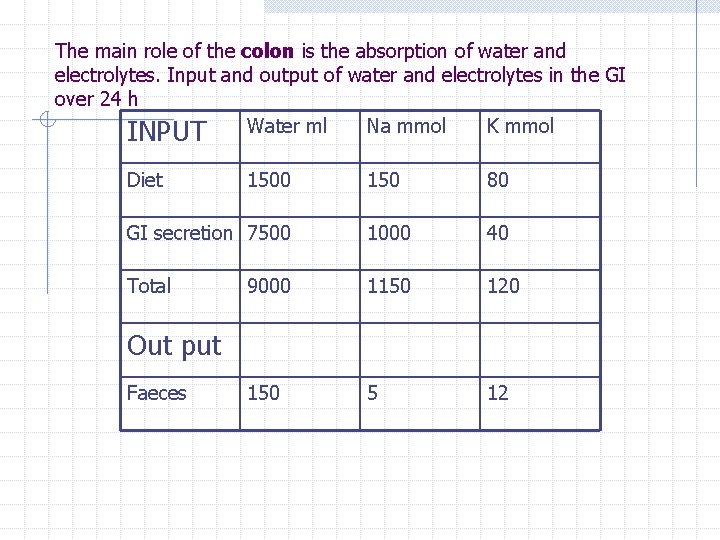
The main role of the colon is the absorption of water and electrolytes. Input and output of water and electrolytes in the GI over 24 h INPUT Water ml Na mmol K mmol Diet 1500 150 80 GI secretion 7500 1000 40 Total 9000 1150 120 150 5 12 Out put Faeces
Stool Volume: <200 g/d (higher volume is in malabsorption) Dry weight make 30% Composition: 25% minerals (Na, K, Cl, Ca, PO 4, Fe, Cu, Mn, Zn, I) 25% intestinal flora 50% organic components
Stool p. H-neutral: (acidic p. H 5, 5 by microbial dyspepsia) Color: from bile pigments – urobilin and stercobilin. Newborns – bilirubin Odour: gases and scatol, indol, thiomethan Enzymes: trypsin, chymotrypsin, elastase Toxic and neurotoxic metabolites: H 2 S, NH 3, diamines, tyramin, neurin
- Slides: 9