
Metabolism Enzymes AP Biology Essential Knowledge 2 A
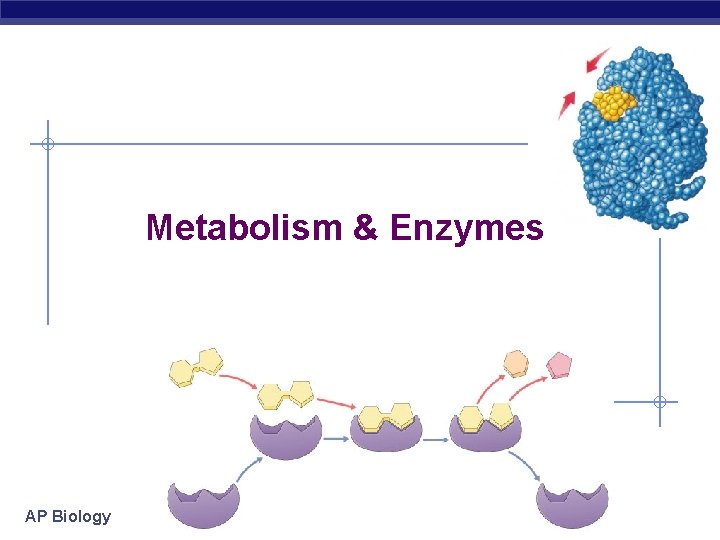
Metabolism & Enzymes AP Biology
Essential Knowledge 2. A. 1 and 4. B. 1 § Life requires a highly ordered system Loss of order or free energy flow results in death u Energy input must exceed energy lost to entropy to maintain order and power cellular processes § Interactions between molecules affect their structure and function u The shape of enzymes, active sites and interaction with specific molecules are essential for basic functioning of the enzyme § The substrate must fit into the enzymes active site § Cofactors and coenzymes affect enzyme function AP Biology u
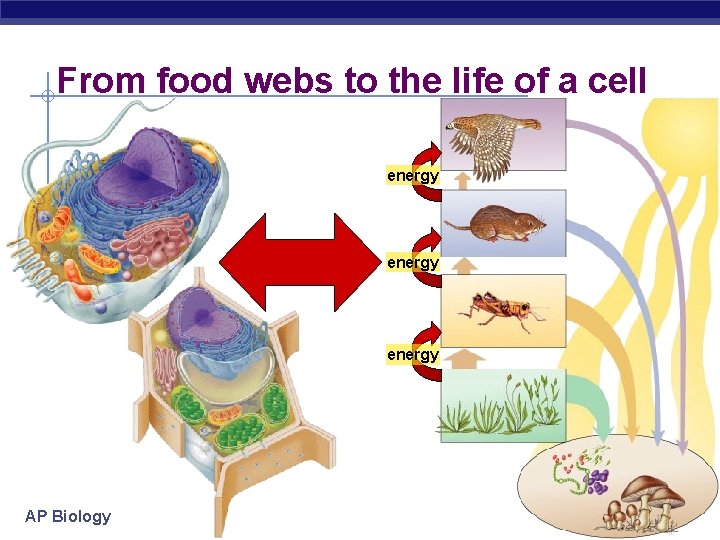
From food webs to the life of a cell energy AP Biology
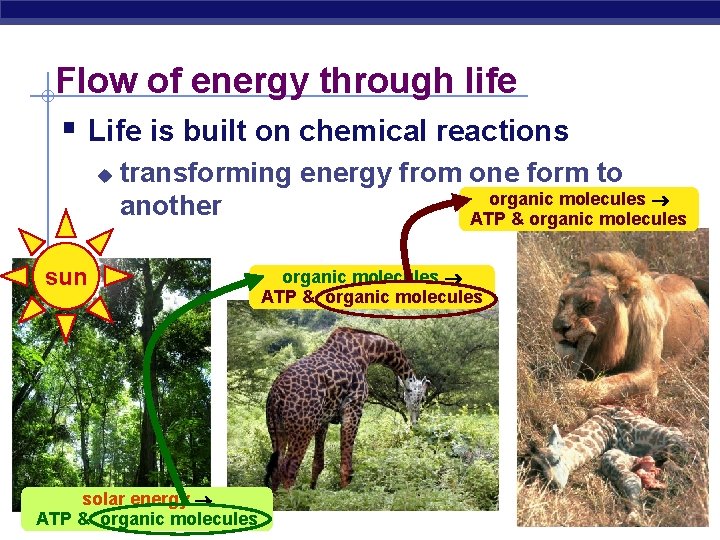
Flow of energy through life § Life is built on chemical reactions u transforming energy from one form to organic molecules another ATP & organic molecules sun solar energy AP Biology ATP & organic molecules
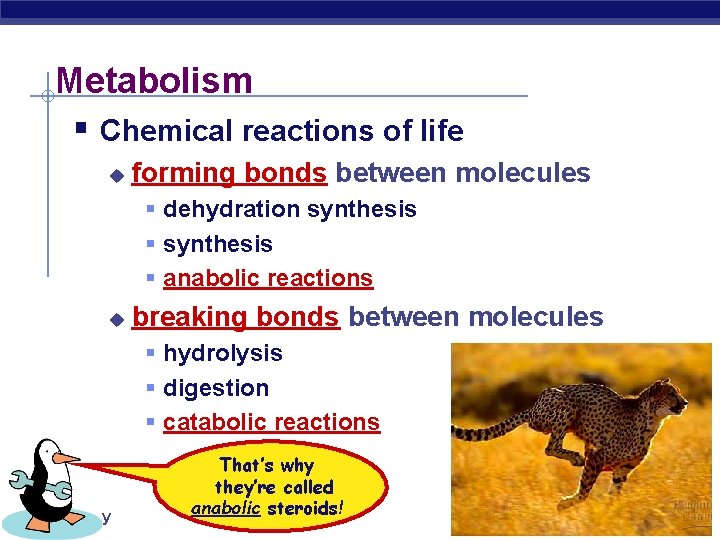
Metabolism § Chemical reactions of life u forming bonds between molecules § dehydration synthesis § anabolic reactions u breaking bonds between molecules § hydrolysis § digestion § catabolic reactions AP Biology That’s why they’re called anabolic steroids!
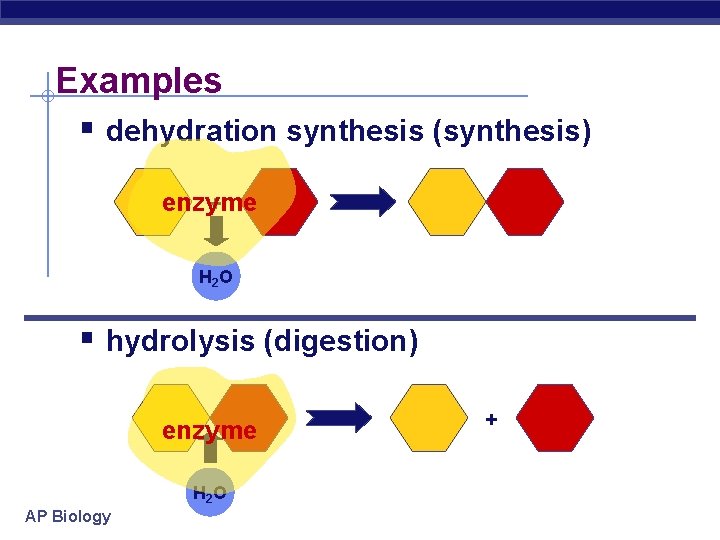
Examples § dehydration synthesis (synthesis) + enzyme H 2 O § hydrolysis (digestion) enzyme H 2 O AP Biology +
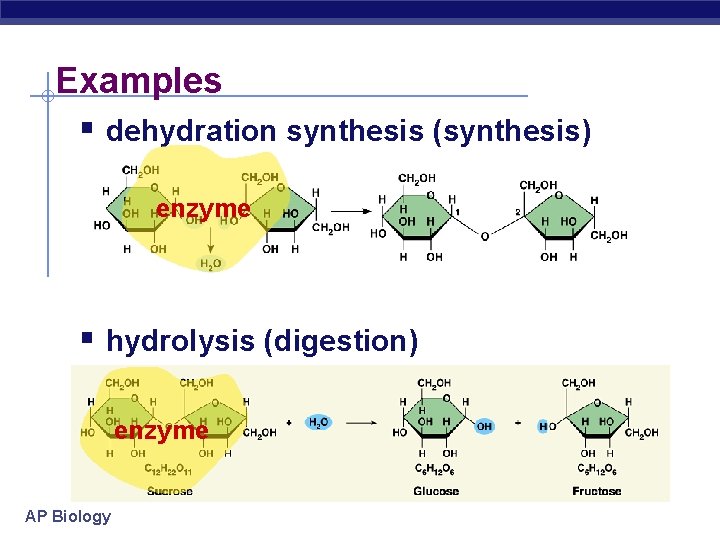
Examples § dehydration synthesis (synthesis) enzyme § hydrolysis (digestion) enzyme AP Biology

Chemical reactions & energy § Some chemical reactions release energy exergonic u digesting polymers u hydrolysis = catabolism u digesting molecules= LESS organization= lower energy state § Some chemical reactions require input of energy building molecules= MORE organization= higher energy state endergonic u building polymers u dehydration synthesis = anabolism u AP Biology
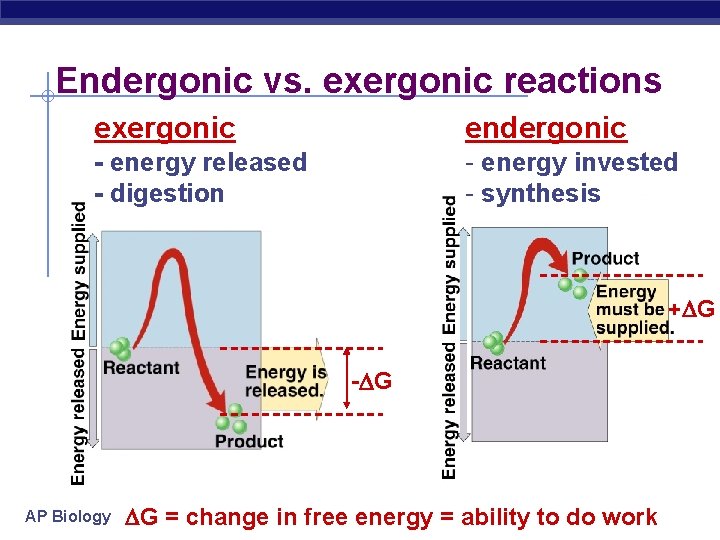
Endergonic vs. exergonic reactions exergonic endergonic - energy released - digestion - energy invested - synthesis + G - G AP Biology G = change in free energy = ability to do work
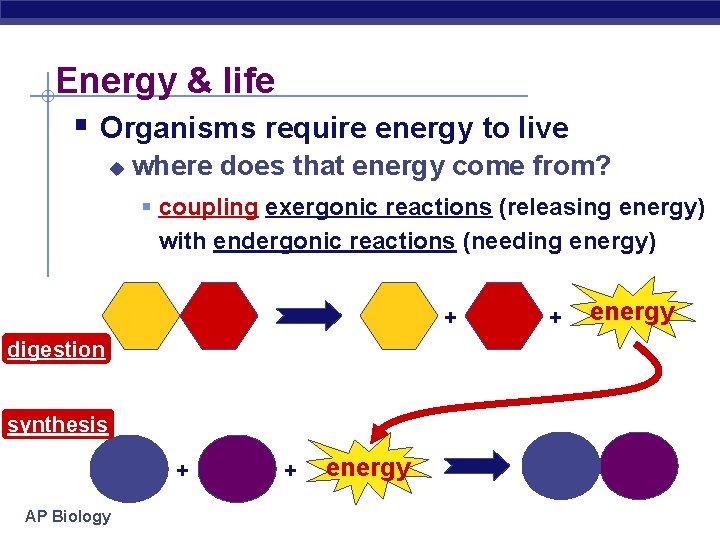
Energy & life § Organisms require energy to live u where does that energy come from? § coupling exergonic reactions (releasing energy) with endergonic reactions (needing energy) + digestion synthesis + AP Biology + energy
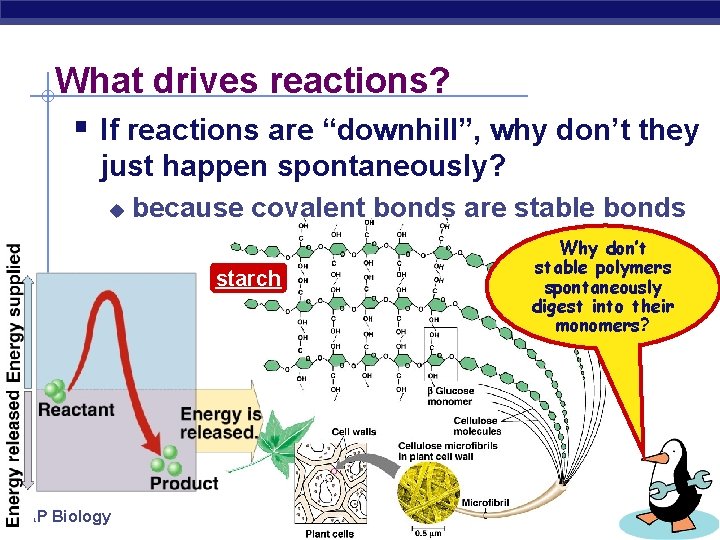
What drives reactions? § If reactions are “downhill”, why don’t they just happen spontaneously? u because covalent bonds are stable bonds starch AP Biology Why don’t stable polymers spontaneously digest into their monomers?
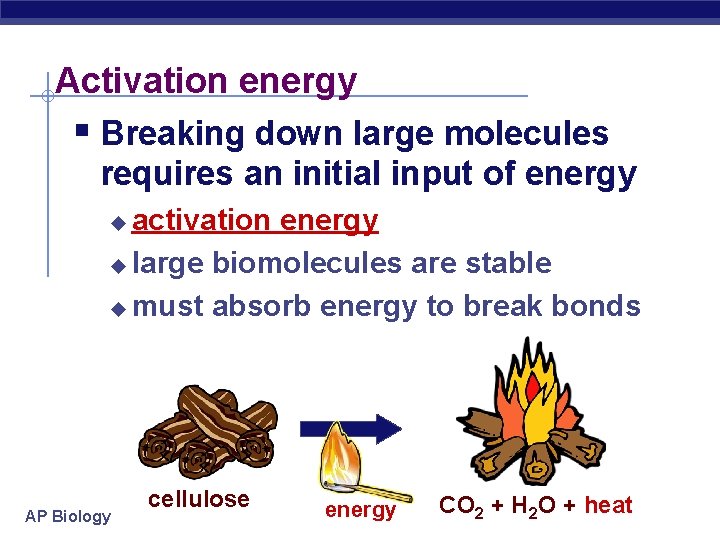
Activation energy § Breaking down large molecules requires an initial input of energy activation energy u large biomolecules are stable u must absorb energy to break bonds u AP Biology cellulose energy CO 2 + H 2 O + heat
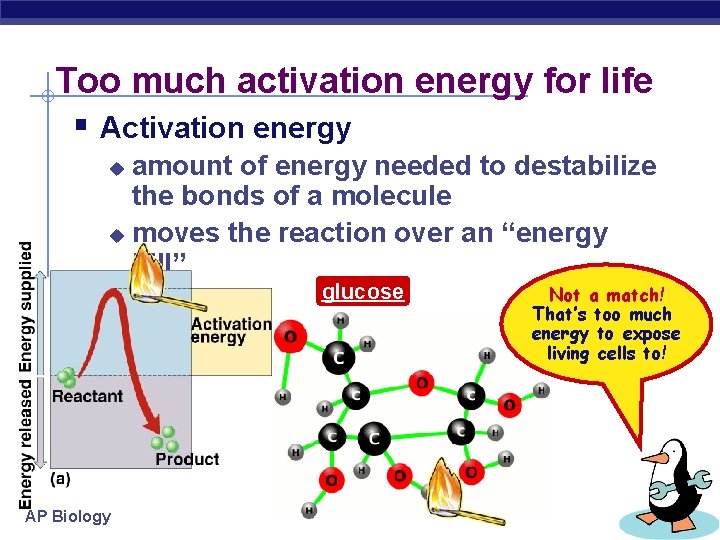
Too much activation energy for life § Activation energy amount of energy needed to destabilize the bonds of a molecule u moves the reaction over an “energy hill” u glucose AP Biology Not a match! That’s too much energy to expose living cells to!
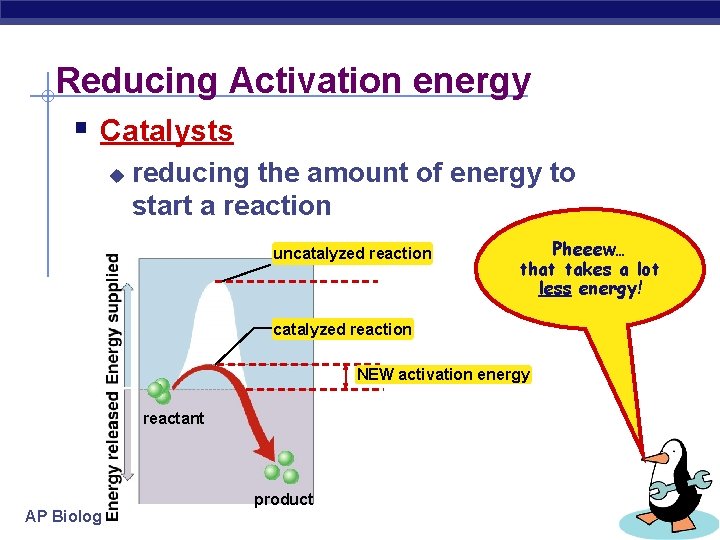
Reducing Activation energy § Catalysts u reducing the amount of energy to start a reaction uncatalyzed reaction Pheeew… that takes a lot less energy! catalyzed reaction NEW activation energy reactant AP Biology product
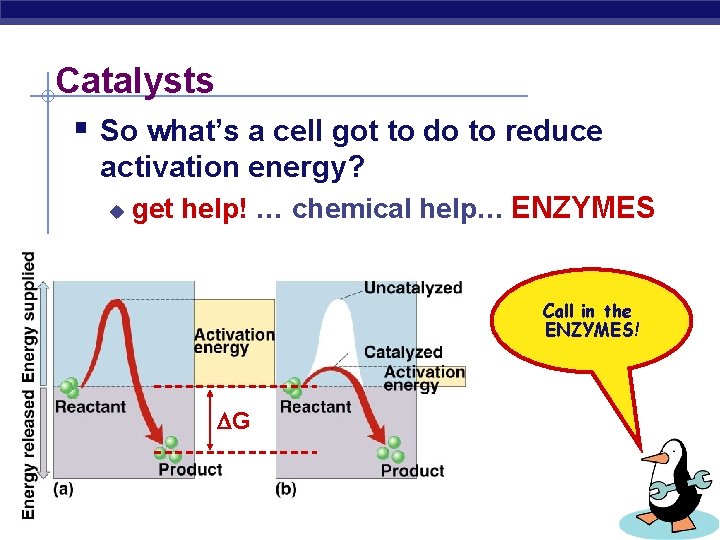
Catalysts § So what’s a cell got to do to reduce activation energy? u get help! … chemical help… ENZYMES Call in the ENZYMES! G AP Biology
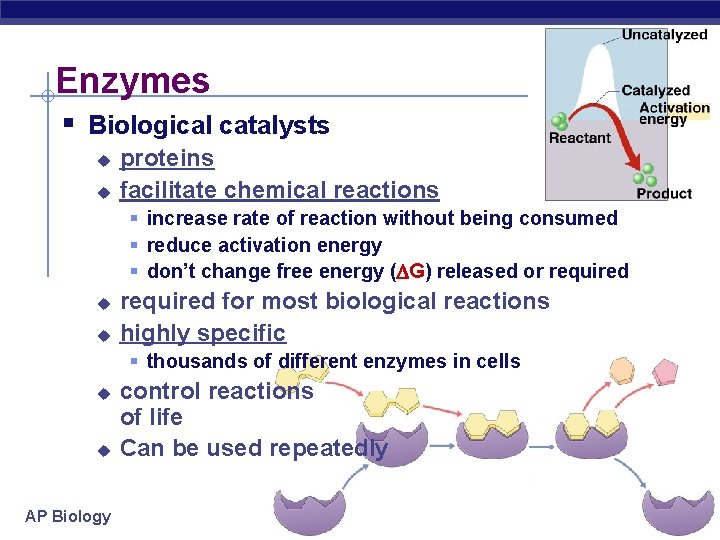
Enzymes § Biological catalysts u u proteins facilitate chemical reactions § increase rate of reaction without being consumed § reduce activation energy § don’t change free energy ( G) released or required u u required for most biological reactions highly specific § thousands of different enzymes in cells u u AP Biology control reactions of life Can be used repeatedly
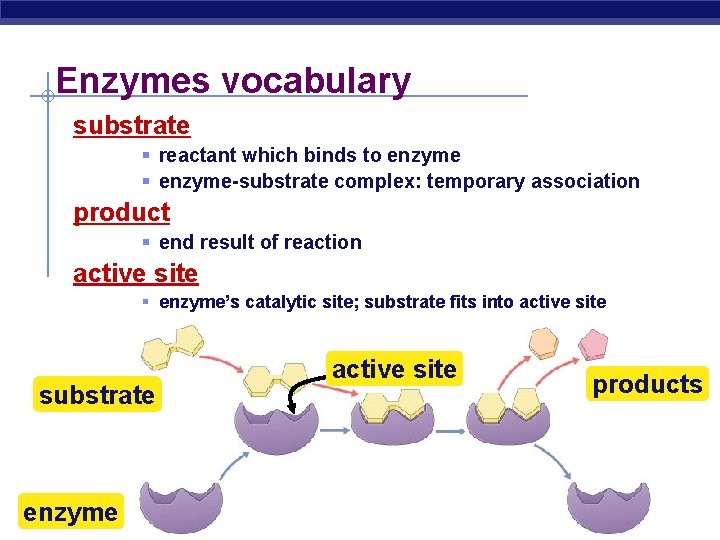
Enzymes vocabulary substrate § reactant which binds to enzyme § enzyme-substrate complex: temporary association product § end result of reaction active site § enzyme’s catalytic site; substrate fits into active site substrate enzyme AP Biology active site products
Properties of enzymes § Reaction specific u each enzyme works with a specific substrate § chemical fit between active site & substrate w H bonds & ionic bonds § Not consumed in reaction u single enzyme molecule can catalyze thousands or more reactions per second § enzymes unaffected by the reaction § Affected by cellular conditions u any condition that affects protein structure § temperature, p. H, salinity, substrate concentration AP Biology
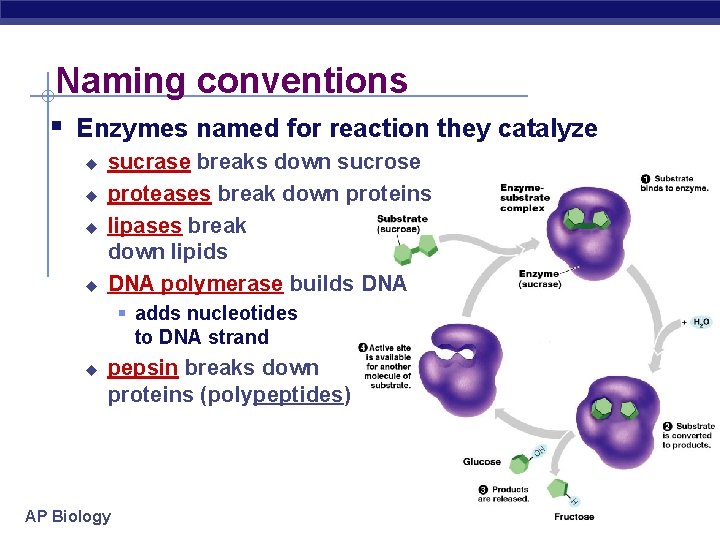
Naming conventions § Enzymes named for reaction they catalyze u u sucrase breaks down sucrose proteases break down proteins lipases break down lipids DNA polymerase builds DNA § adds nucleotides to DNA strand u pepsin breaks down proteins (polypeptides) AP Biology
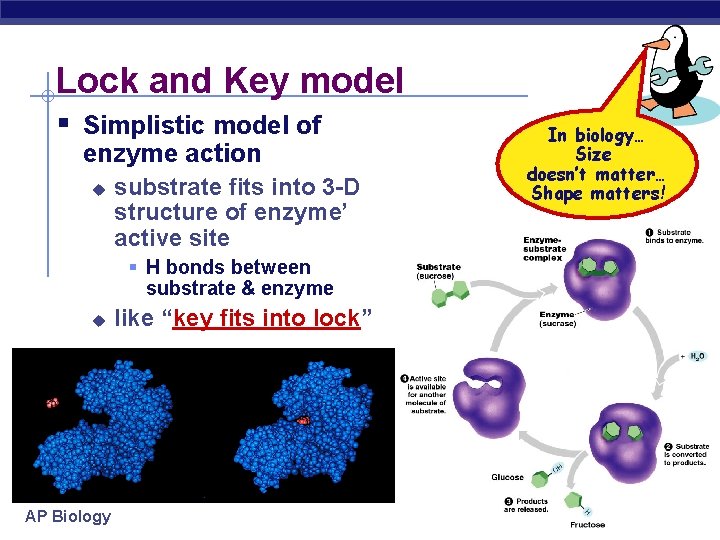
Lock and Key model § Simplistic model of enzyme action u substrate fits into 3 -D structure of enzyme’ active site § H bonds between substrate & enzyme u AP Biology like “key fits into lock” In biology… Size doesn’t matter… Shape matters!
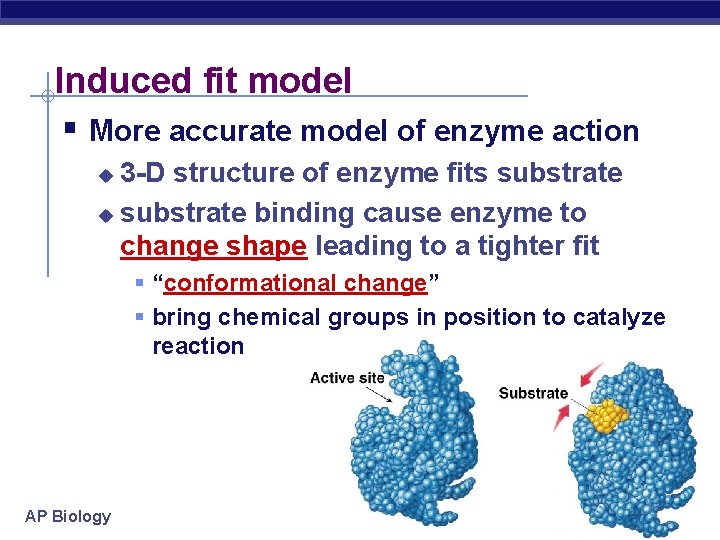
Induced fit model § More accurate model of enzyme action 3 -D structure of enzyme fits substrate u substrate binding cause enzyme to change shape leading to a tighter fit u § “conformational change” § bring chemical groups in position to catalyze reaction AP Biology
How does it work? § Variety of mechanisms to lower activation energy & speed up reaction u synthesis § active site orients substrates in correct position for reaction w enzyme brings substrate closer together u digestion § active site binds substrate & puts stress on bonds that must be broken, making it easier to separate molecules AP Biology
Got any Questions? ! AP Biology 2007 -2008
Factors that Affect Enzymes AP Biology 2007 -2008
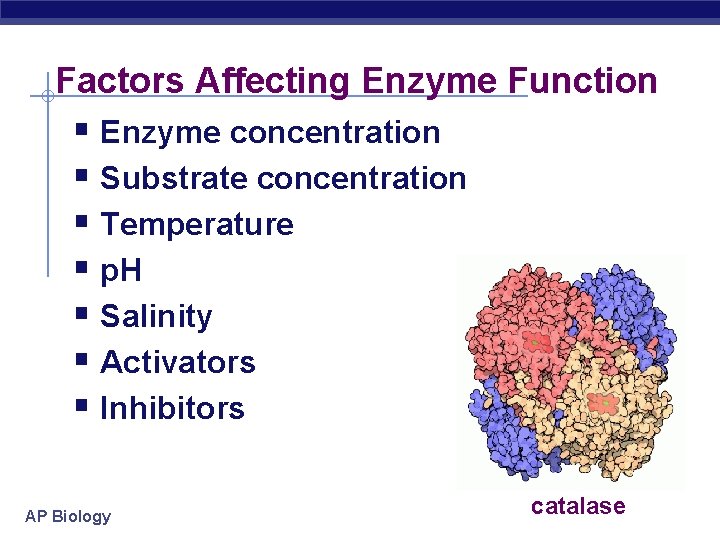
Factors Affecting Enzyme Function § Enzyme concentration § Substrate concentration § Temperature § p. H § Salinity § Activators § Inhibitors AP Biology catalase
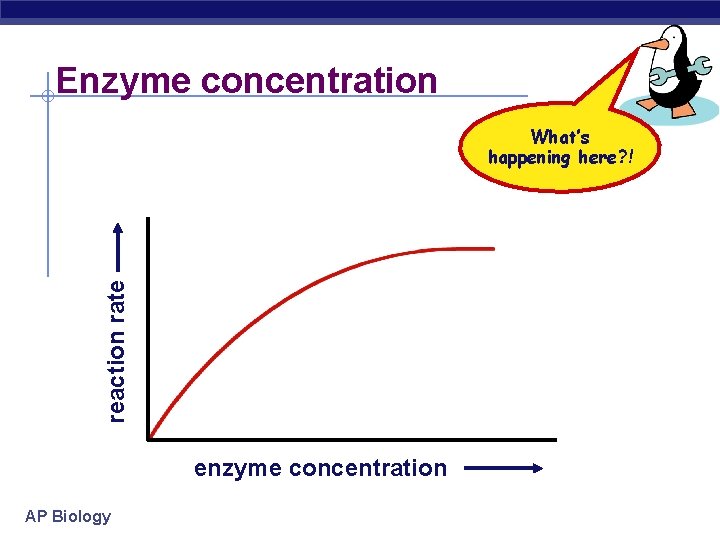
Enzyme concentration reaction rate What’s happening here? ! enzyme concentration AP Biology
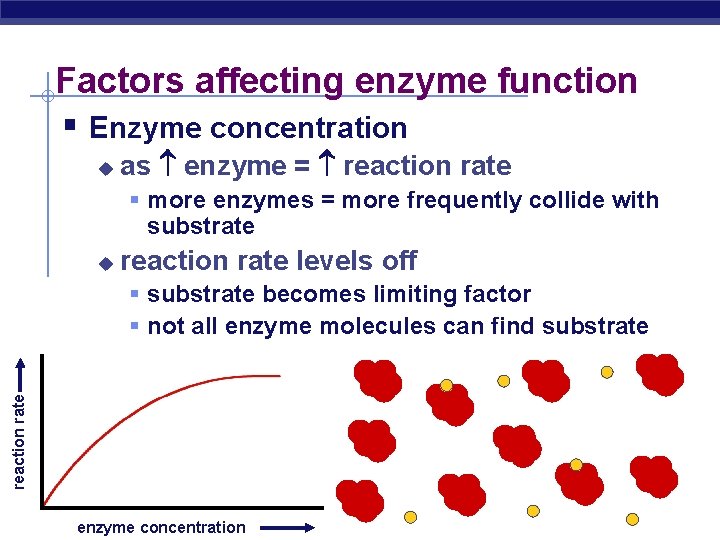
Factors affecting enzyme function § Enzyme concentration u as enzyme = reaction rate § more enzymes = more frequently collide with substrate u reaction rate levels off reaction rate § substrate becomes limiting factor § not all enzyme molecules can find substrate AP Biology enzyme concentration
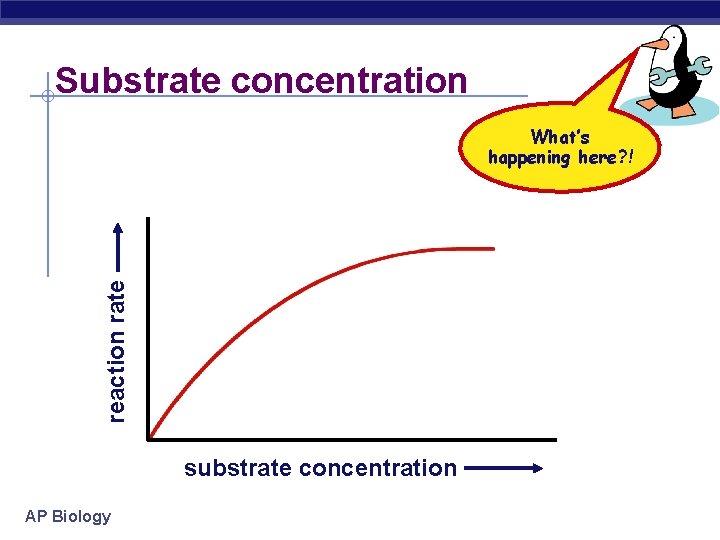
Substrate concentration reaction rate What’s happening here? ! substrate concentration AP Biology
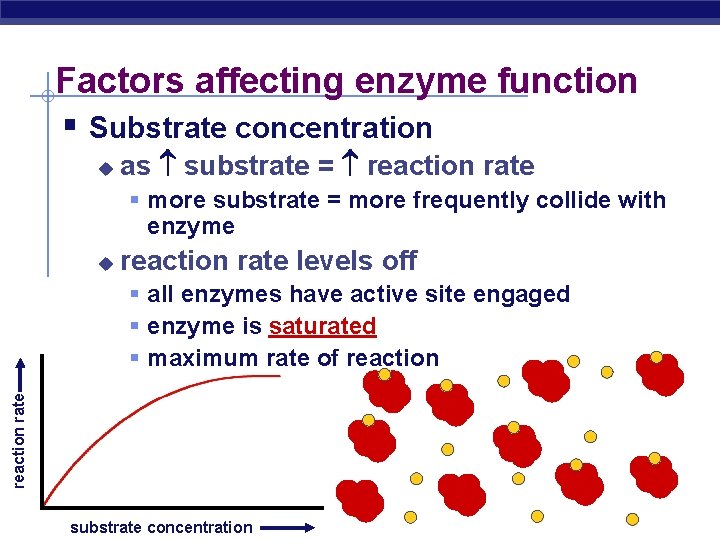
Factors affecting enzyme function § Substrate concentration u as substrate = reaction rate § more substrate = more frequently collide with enzyme u reaction rate levels off reaction rate § all enzymes have active site engaged § enzyme is saturated § maximum rate of reaction AP Biology substrate concentration
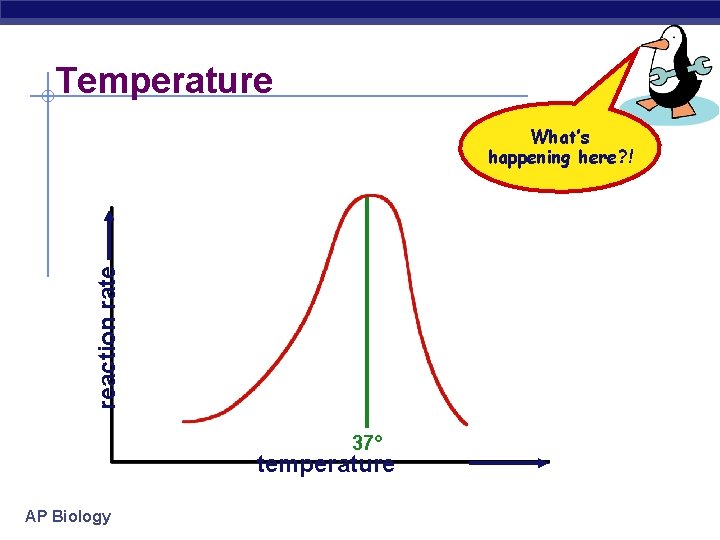
Temperature reaction rate What’s happening here? ! 37° temperature AP Biology
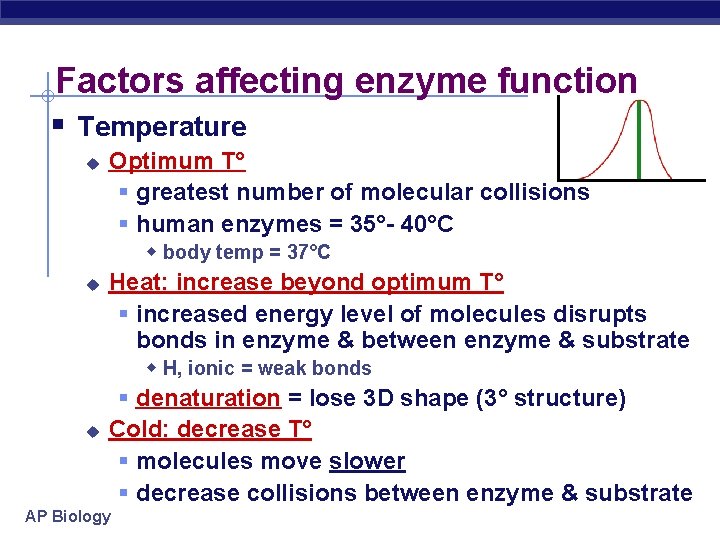
Factors affecting enzyme function § Temperature u Optimum T° § greatest number of molecular collisions § human enzymes = 35°- 40°C w body temp = 37°C u Heat: increase beyond optimum T° § increased energy level of molecules disrupts bonds in enzyme & between enzyme & substrate w H, ionic = weak bonds u § denaturation = lose 3 D shape (3° structure) Cold: decrease T° § molecules move slower § decrease collisions between enzyme & substrate AP Biology
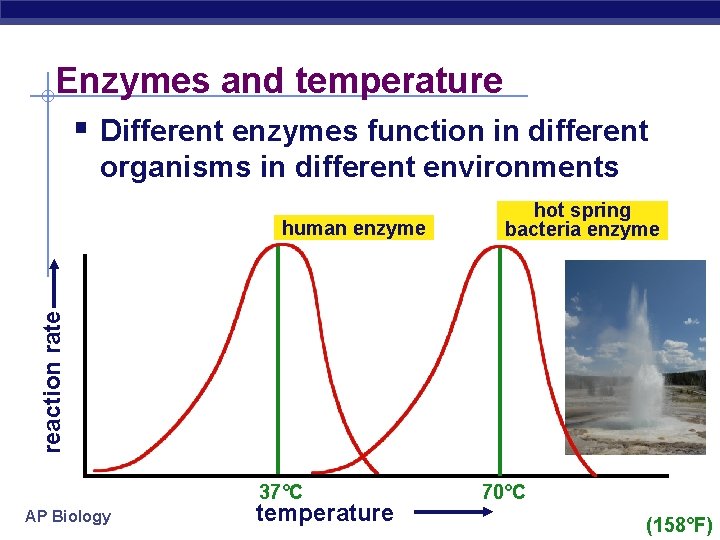
Enzymes and temperature § Different enzymes function in different organisms in different environments reaction rate human enzyme hot spring bacteria enzyme 37°C AP Biology temperature 70°C (158°F)
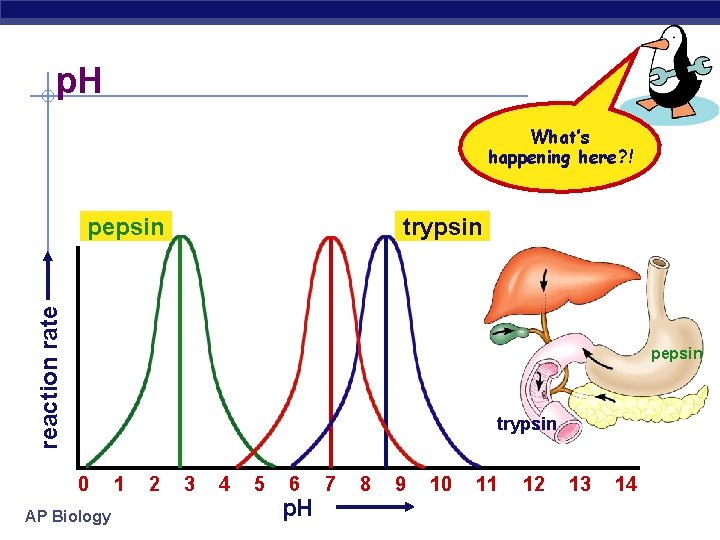
p. H What’s happening here? ! trypsin reaction rate pepsin trypsin 0 AP Biology 1 2 3 4 5 6 p. H 7 8 9 10 11 12 13 14
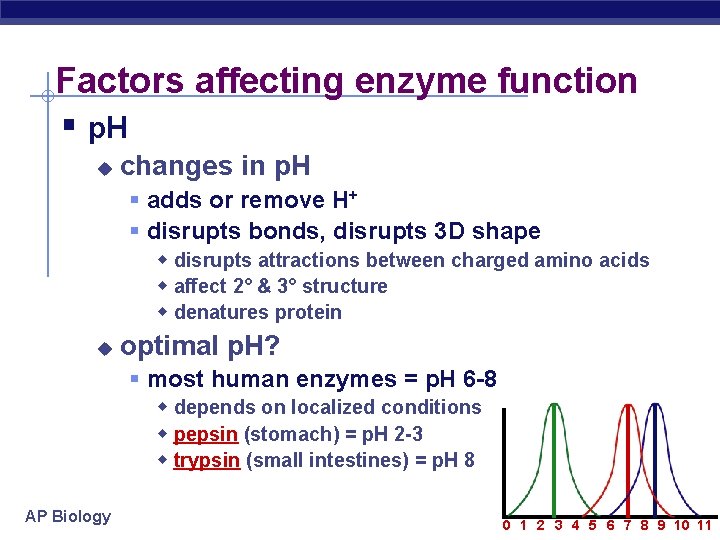
Factors affecting enzyme function § p. H u changes in p. H § adds or remove H+ § disrupts bonds, disrupts 3 D shape w disrupts attractions between charged amino acids w affect 2° & 3° structure w denatures protein u optimal p. H? § most human enzymes = p. H 6 -8 w depends on localized conditions w pepsin (stomach) = p. H 2 -3 w trypsin (small intestines) = p. H 8 AP Biology 0 1 2 3 4 5 6 7 8 9 10 11
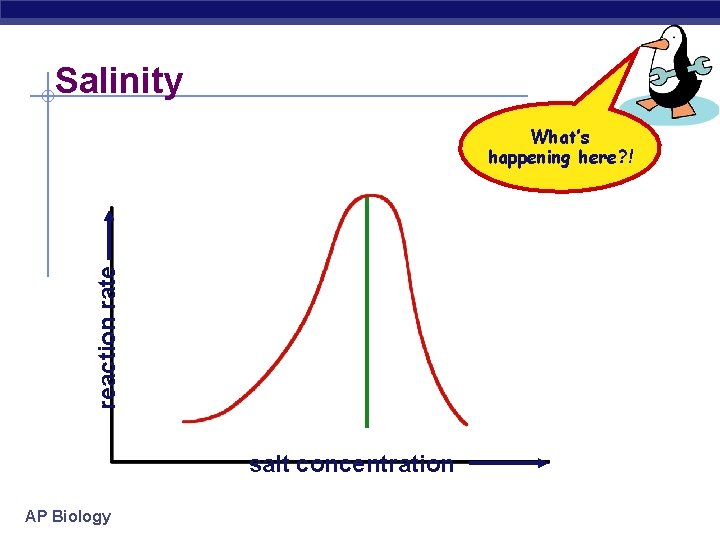
Salinity reaction rate What’s happening here? ! salt concentration AP Biology
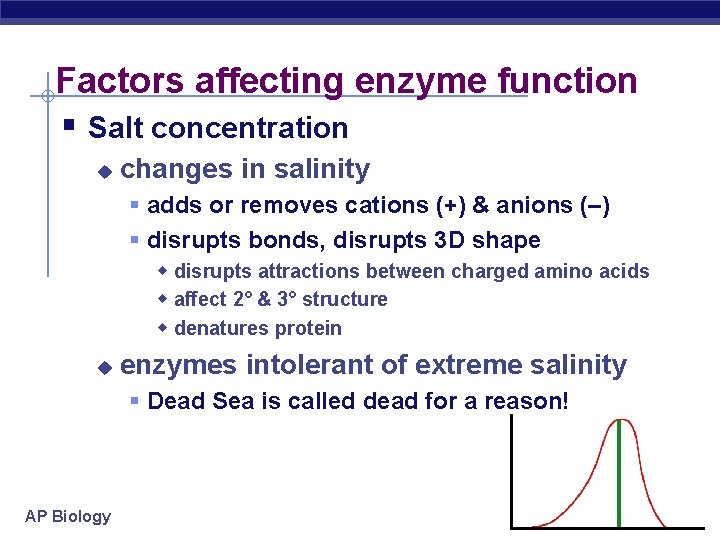
Factors affecting enzyme function § Salt concentration u changes in salinity § adds or removes cations (+) & anions (–) § disrupts bonds, disrupts 3 D shape w disrupts attractions between charged amino acids w affect 2° & 3° structure w denatures protein u enzymes intolerant of extreme salinity § Dead Sea is called dead for a reason! AP Biology
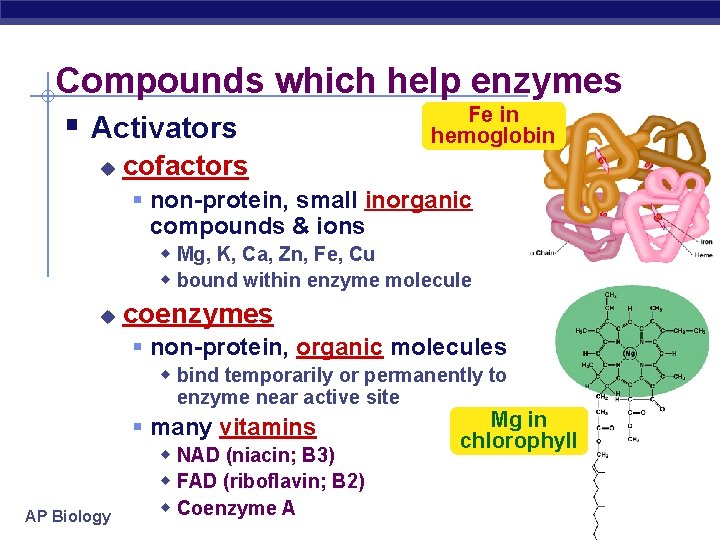
Compounds which help enzymes Fe in § Activators hemoglobin u cofactors § non-protein, small inorganic compounds & ions w Mg, K, Ca, Zn, Fe, Cu w bound within enzyme molecule u coenzymes § non-protein, organic molecules w bind temporarily or permanently to enzyme near active site AP Biology § many vitamins w NAD (niacin; B 3) w FAD (riboflavin; B 2) w Coenzyme A Mg in chlorophyll
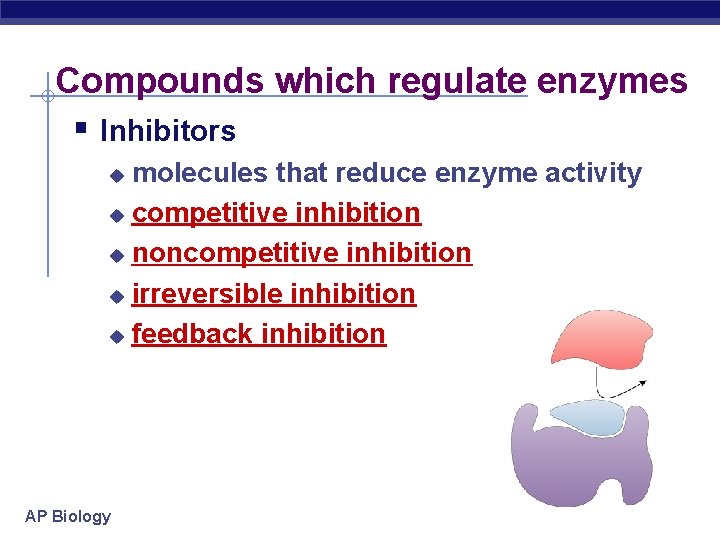
Compounds which regulate enzymes § Inhibitors molecules that reduce enzyme activity u competitive inhibition u noncompetitive inhibition u irreversible inhibition u feedback inhibition u AP Biology
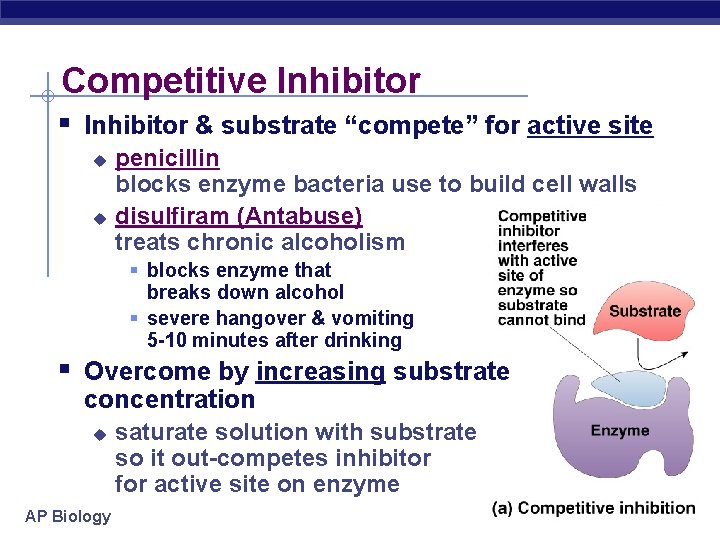
Competitive Inhibitor § Inhibitor & substrate “compete” for active site u u penicillin blocks enzyme bacteria use to build cell walls disulfiram (Antabuse) treats chronic alcoholism § blocks enzyme that breaks down alcohol § severe hangover & vomiting 5 -10 minutes after drinking § Overcome by increasing substrate concentration u AP Biology saturate solution with substrate so it out-competes inhibitor for active site on enzyme
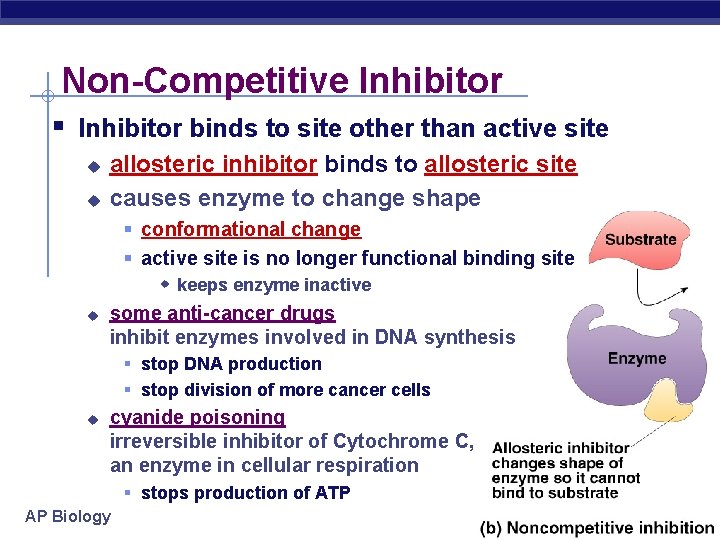
Non-Competitive Inhibitor § Inhibitor binds to site other than active site u u u allosteric inhibitor binds to allosteric site causes enzyme to change shape § conformational change § active site is no longer functional binding site w keeps enzyme inactive some anti-cancer drugs inhibit enzymes involved in DNA synthesis § stop DNA production § stop division of more cancer cells u cyanide poisoning irreversible inhibitor of Cytochrome C, an enzyme in cellular respiration § stops production of ATP AP Biology
Irreversible inhibition § Inhibitor permanently binds to enzyme u competitor § permanently binds to active site u allosteric § permanently binds to allosteric site § permanently changes shape of enzyme § nerve gas, sarin, many insecticides (malathion, parathion…) w cholinesterase inhibitors n AP Biology doesn’t breakdown the neurotransmitter, acetylcholine
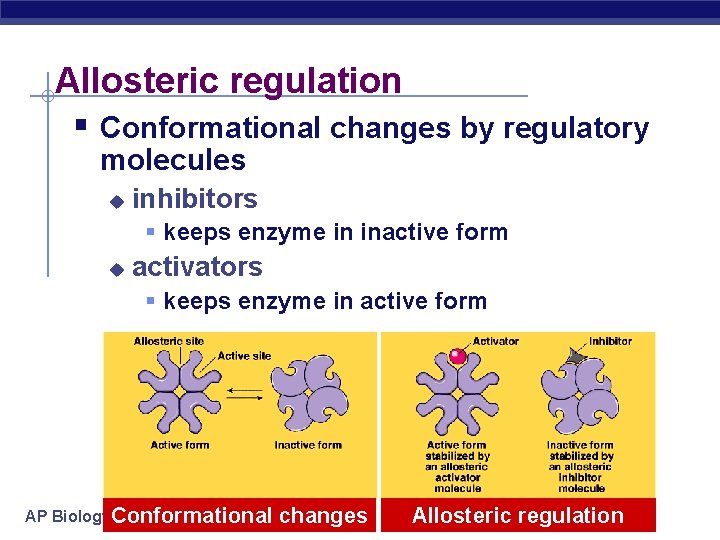
Allosteric regulation § Conformational changes by regulatory molecules u inhibitors § keeps enzyme in inactive form u activators § keeps enzyme in active form AP Biology. Conformational changes Allosteric regulation
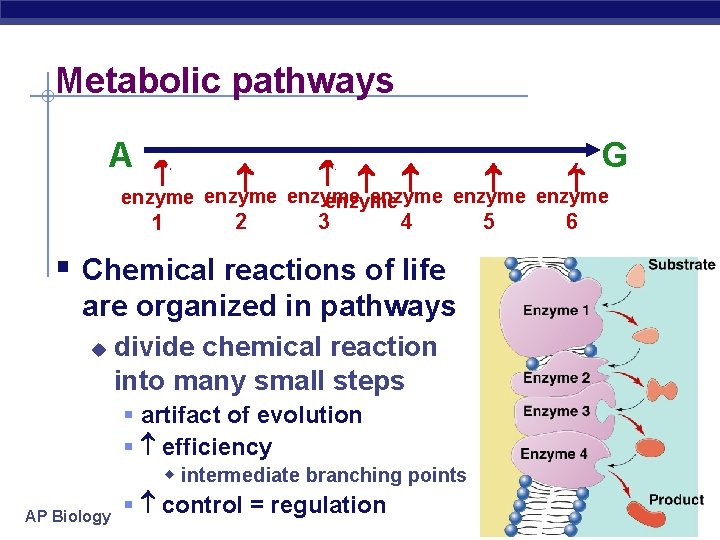
Metabolic pathways 2 1 A B C D E F G 5 6 enzyme enzyme 3 4 § Chemical reactions of life are organized in pathways u AP Biology divide chemical reaction into many small steps § artifact of evolution § efficiency w intermediate branching points § control = regulation
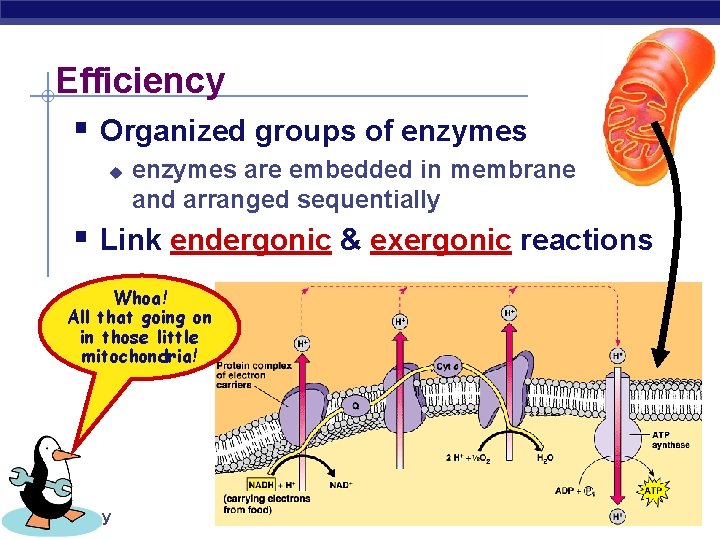
Efficiency § Organized groups of enzymes u enzymes are embedded in membrane and arranged sequentially § Link endergonic & exergonic reactions Whoa! All that going on in those little mitochondria! AP Biology
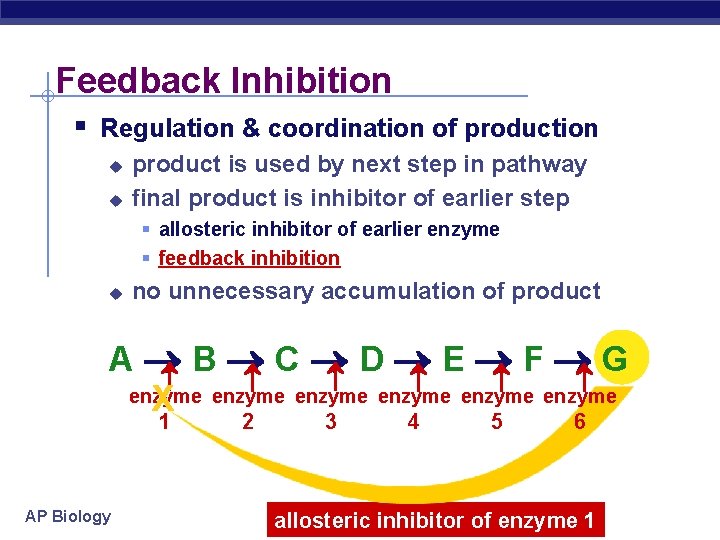
Feedback Inhibition § Regulation & coordination of production u u product is used by next step in pathway final product is inhibitor of earlier step § allosteric inhibitor of earlier enzyme § feedback inhibition u no unnecessary accumulation of product A B C D E F G 1 2 3 4 5 6 X enzyme enzyme AP Biology allosteric inhibitor of enzyme 1
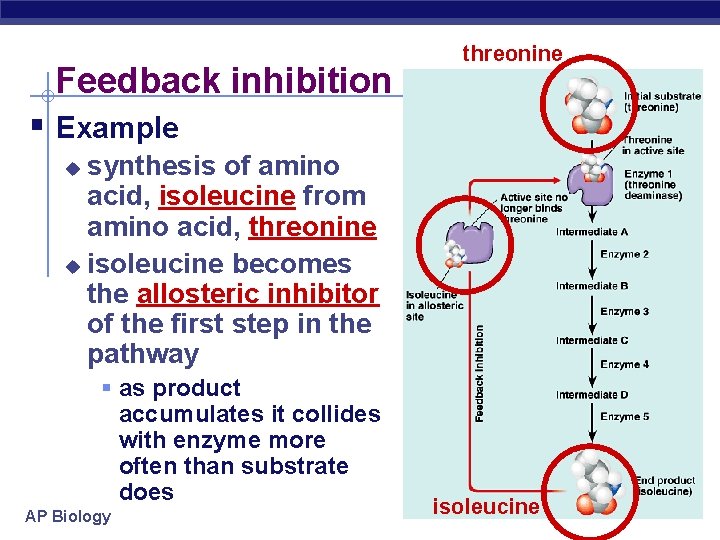
Feedback inhibition threonine § Example synthesis of amino acid, isoleucine from amino acid, threonine u isoleucine becomes the allosteric inhibitor of the first step in the pathway u § as product accumulates it collides with enzyme more often than substrate does AP Biology isoleucine
Don’t be inhibited! Ask Questions! AP Biology 2007 -2008
Ghosts of Lectures Past (Free energy) AP Biology 2007 -2008
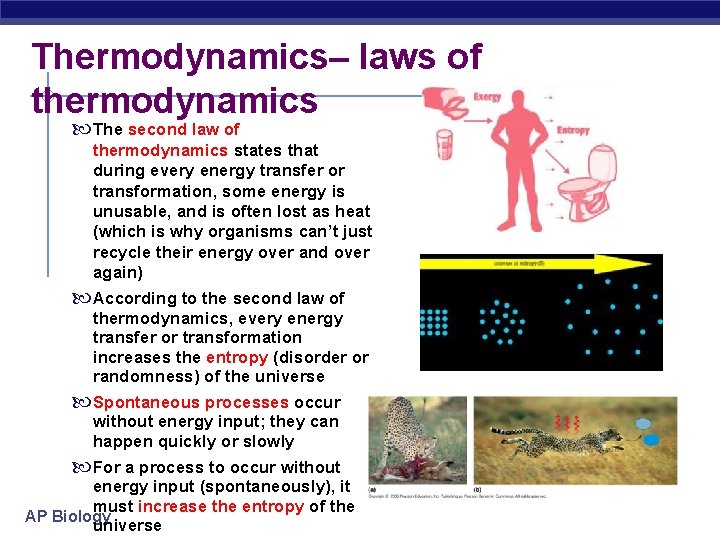
Thermodynamics– laws of thermodynamics The second law of thermodynamics states that during every energy transfer or transformation, some energy is unusable, and is often lost as heat (which is why organisms can’t just recycle their energy over and over again) According to the second law of thermodynamics, every energy transfer or transformation increases the entropy (disorder or randomness) of the universe Spontaneous processes occur without energy input; they can happen quickly or slowly For a process to occur without energy input (spontaneously), it must increase the entropy of the AP Biology universe
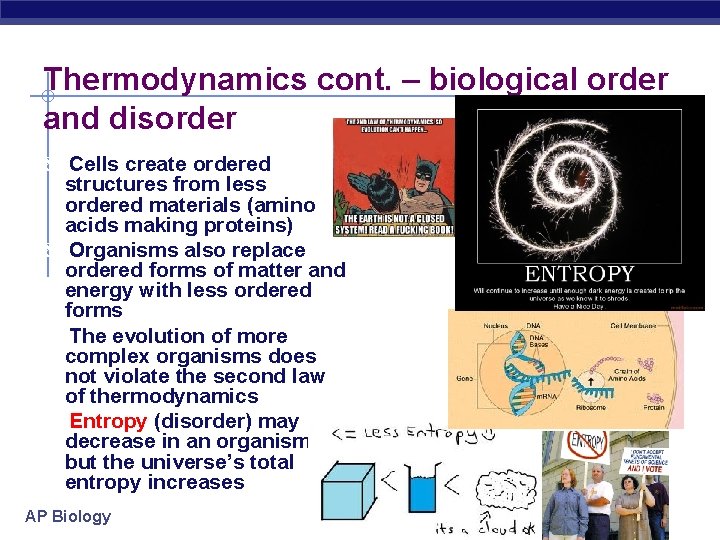
Thermodynamics cont. – biological order and disorder Cells create ordered structures from less ordered materials (amino acids making proteins) Organisms also replace ordered forms of matter and energy with less ordered forms The evolution of more complex organisms does not violate the second law of thermodynamics Entropy (disorder) may decrease in an organism, but the universe’s total entropy increases AP Biology
Free-energy - change § Biologists want to know which reactions occur spontaneously and which require input of energy § To do so, they need to determine energy changes that occur in chemical reactions AP Biology
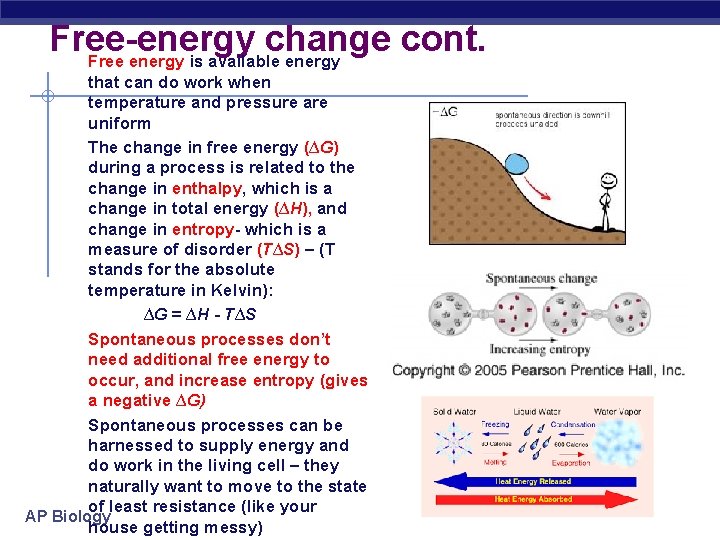
Free-energy change cont. Free energy is available energy that can do work when temperature and pressure are uniform The change in free energy (∆G) during a process is related to the change in enthalpy, which is a change in total energy (∆H), and change in entropy- which is a measure of disorder (T∆S) – (T stands for the absolute temperature in Kelvin): ∆G = ∆H - T∆S • Spontaneous processes don’t need additional free energy to occur, and increase entropy (gives a negative ∆G) • Spontaneous processes can be harnessed to supply energy and do work in the living cell – they naturally want to move to the state of least resistance (like your AP Biology house getting messy)
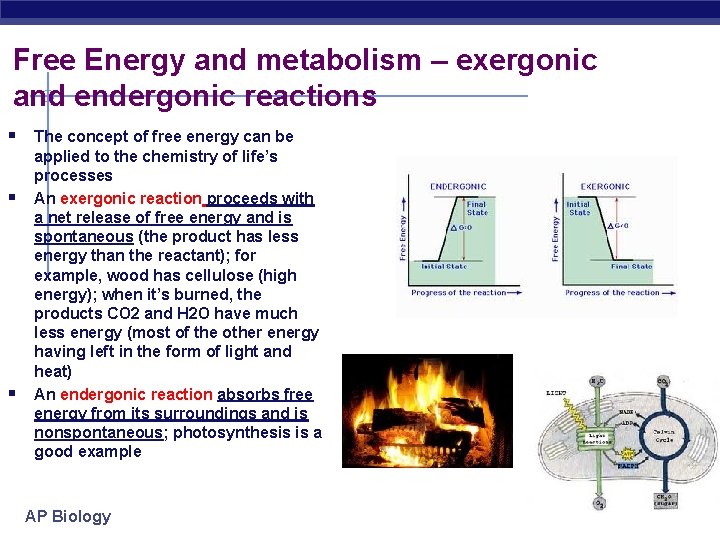
Free Energy and metabolism – exergonic and endergonic reactions § The concept of free energy can be § § applied to the chemistry of life’s processes An exergonic reaction proceeds with a net release of free energy and is spontaneous (the product has less energy than the reactant); for example, wood has cellulose (high energy); when it’s burned, the products CO 2 and H 2 O have much less energy (most of the other energy having left in the form of light and heat) An endergonic reaction absorbs free energy from its surroundings and is nonspontaneous; photosynthesis is a good example AP Biology
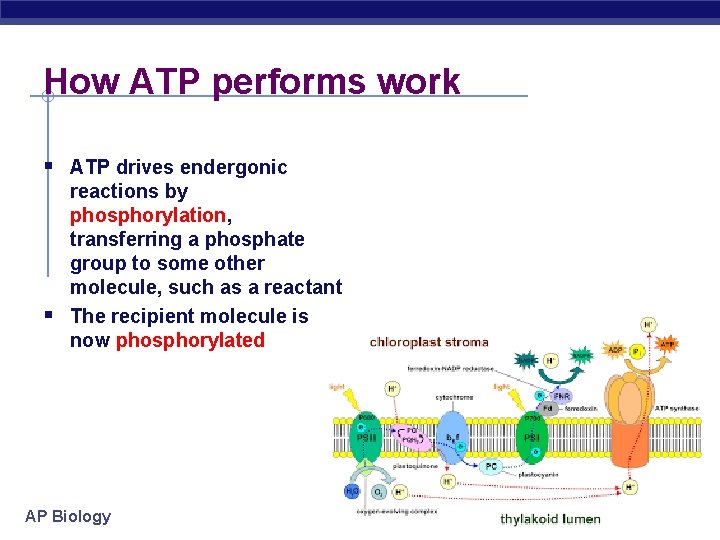
How ATP performs work § ATP drives endergonic § reactions by phosphorylation, transferring a phosphate group to some other molecule, such as a reactant The recipient molecule is now phosphorylated AP Biology
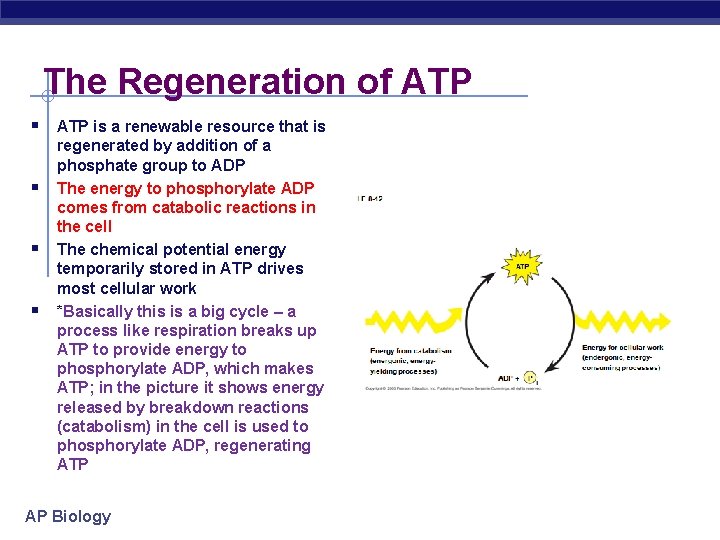
The Regeneration of ATP § ATP is a renewable resource that is § § § regenerated by addition of a phosphate group to ADP The energy to phosphorylate ADP comes from catabolic reactions in the cell The chemical potential energy temporarily stored in ATP drives most cellular work *Basically this is a big cycle – a process like respiration breaks up ATP to provide energy to phosphorylate ADP, which makes ATP; in the picture it shows energy released by breakdown reactions (catabolism) in the cell is used to phosphorylate ADP, regenerating ATP AP Biology
Essential Knowledge 2. A. 1 and 4. B. 1 § Life requires a highly ordered system Loss of order or free energy flow results in death u Energy input must exceed energy lost to entropy to maintain order and power cellular processes § Interactions between molecules affect their structure and function u The shape of enzymes, active sites and interaction with specific molecules are essential for basic functioning of the enzyme § The substrate must fit into the enzymes active site § Cofactors and coenzymes affect enzyme function AP Biology u
Practice Gibbs Free Energy Problems AP Biology
- Slides: 57