
Metabolism Enzymes and Cellular Respiration Copyright The Mc
Metabolism Enzymes and Cellular Respiration
Copyright © The Mc. Graw-Hill Companies, Inc. Permission required for reproduction or display.
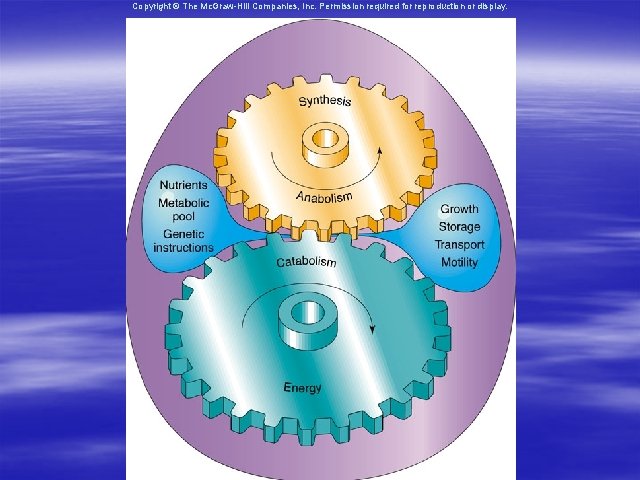
Metabolism § Metabolism is the sum of all the chemical reactions in a cell – Anabolism – Chemical reactions that build molecules by using available energy to form bonds – Catabolism – Chemical reactions that break down larger molecules to release energy, making it available to do work
Enzymes § Enzymes- Organic Catalysts – Speed up reactions – Lower the energy of activation – Used but not used up – Specific to a chemical reaction or substrate § Substrates – the molecules acted on by enzymes § End Products – The products of chemical reactions involving enzymes § Names – “-ase” ending added to substrate or the reaction – Lipase – breaks down lipids – Deaminase – Removes an amine group (not all enzymes end in “-ase” – like trypsin)
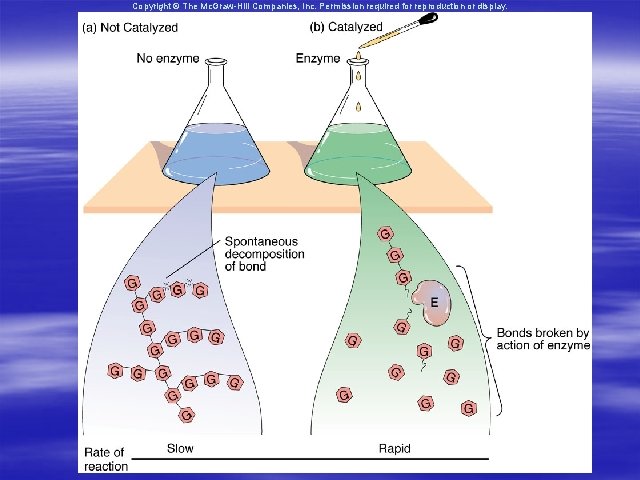
Copyright © The Mc. Graw-Hill Companies, Inc. Permission required for reproduction or display.
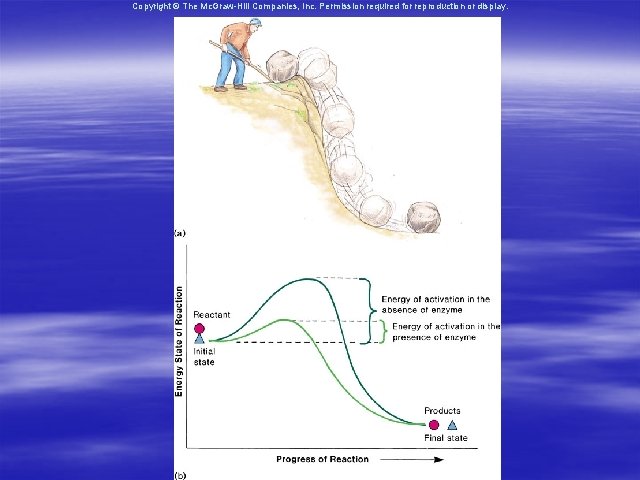
Copyright © The Mc. Graw-Hill Companies, Inc. Permission required for reproduction or display.
Active sites § Certain critical areas of the enzyme that have a shape that matches the substrate of the reaction. § Shape dictates function – therefore, if the shape of the active site changes, the function is altered. § Enzymes are made of protein – therefore temperature and p. H are critical conditions required for enzymatic functioning.
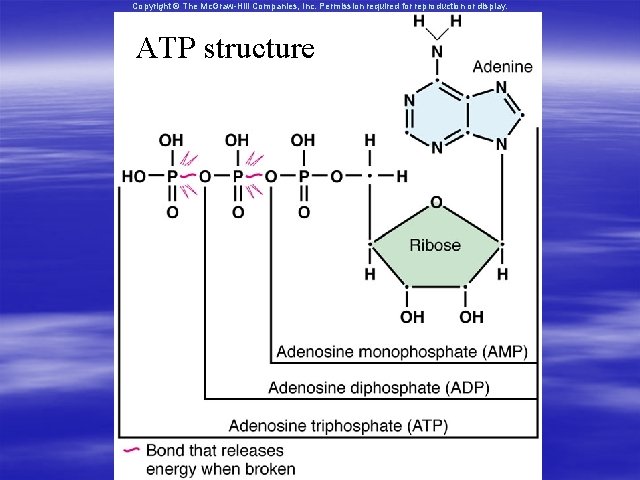
Energy and ATP § Energy – the ability to do work – Kinetic – energy in motion or of movement – Potential – stored energy (gravitational, elastic, and chemical) § Exergonic – energy released as a product (heat released) § Endergonic – energy needed (a reactant in the chemical reaction) (heat absorbed) § ATP – Adenosine Tri. Phosphate - Nucleotide containing: – Adenine – Ribose – 3 Phosphates § Calorie – unit of energy = amount of energy required to raise the temperature of 1 Kilogram of water 1° C. (nutritional Calorie = 1 Kilocalorie = 1000 calories). Capitalized C in Calorie – tells you that it is the Kilocalorie. When you say that a candy bar has 240 Calories, you are talking about the Kilocalorie. § ATPase – enzyme that breaks down ATP – ATP ADP + P § ATP Synthase – enzyme that speeds up the production of ATP – ADP+P ATP
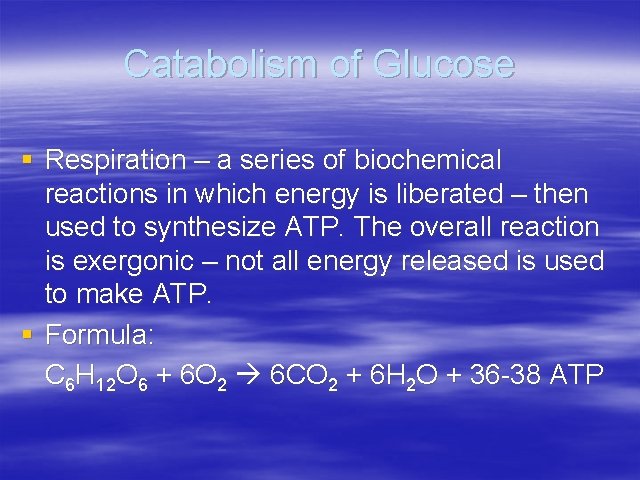
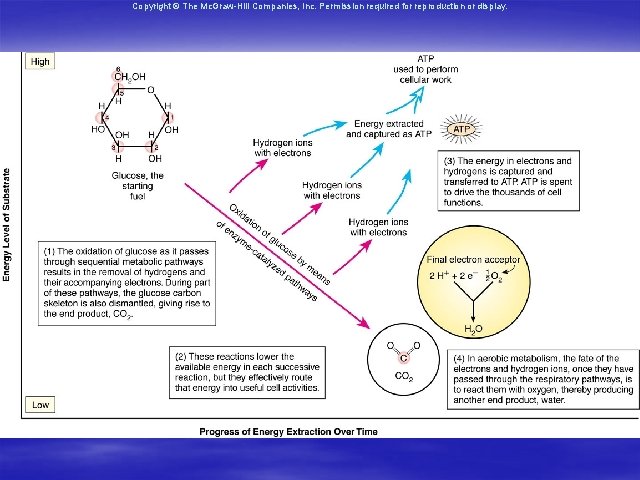
Catabolism of Glucose § Respiration – a series of biochemical reactions in which energy is liberated – then used to synthesize ATP. The overall reaction is exergonic – not all energy released is used to make ATP. § Formula: C 6 H 12 O 6 + 6 O 2 6 CO 2 + 6 H 2 O + 36 -38 ATP
Copyright © The Mc. Graw-Hill Companies, Inc. Permission required for reproduction or display.
Copyright © The Mc. Graw-Hill Companies, Inc. Permission required for reproduction or display. ATP structure
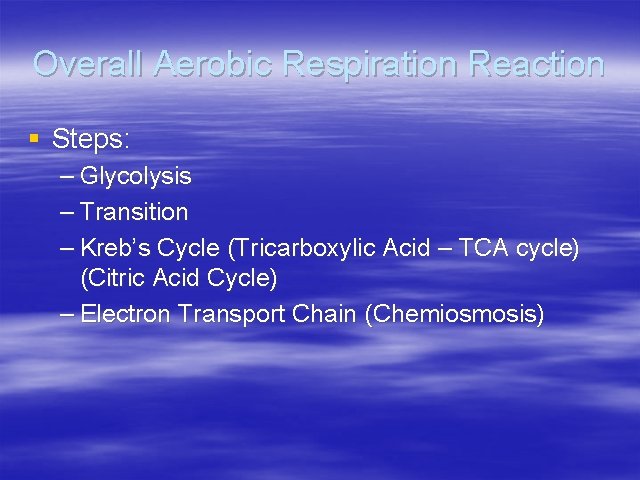
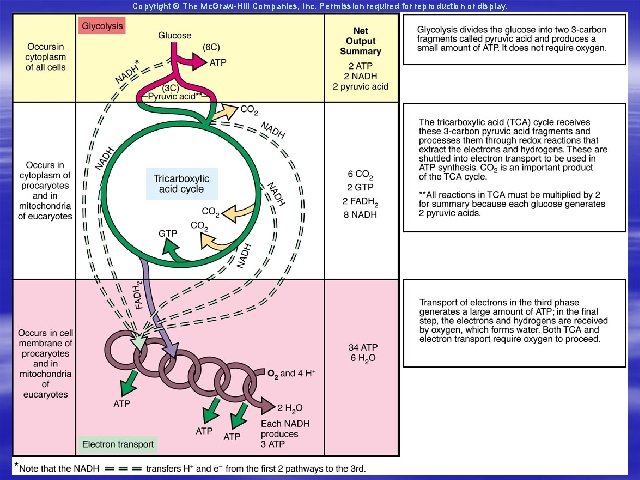
Overall Aerobic Respiration Reaction § Steps: – Glycolysis – Transition – Kreb’s Cycle (Tricarboxylic Acid – TCA cycle) (Citric Acid Cycle) – Electron Transport Chain (Chemiosmosis)
Copyright © The Mc. Graw-Hill Companies, Inc. Permission required for reproduction or display.
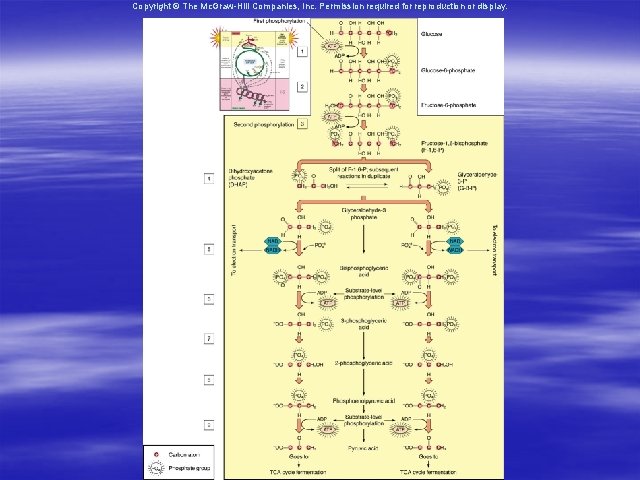
Glycolysis § Location – Cytoplasm of both eukaryotic and Prokaryotic § Reactants – Glucose (6 C sugar) molecule + 2 ATP (to prime the pump) § Products: – 2 NADH – 4 ATP – therefore a Net of 2 ATP – 2 Pyruvic Acid (3 C sugar)
Copyright © The Mc. Graw-Hill Companies, Inc. Permission required for reproduction or display.
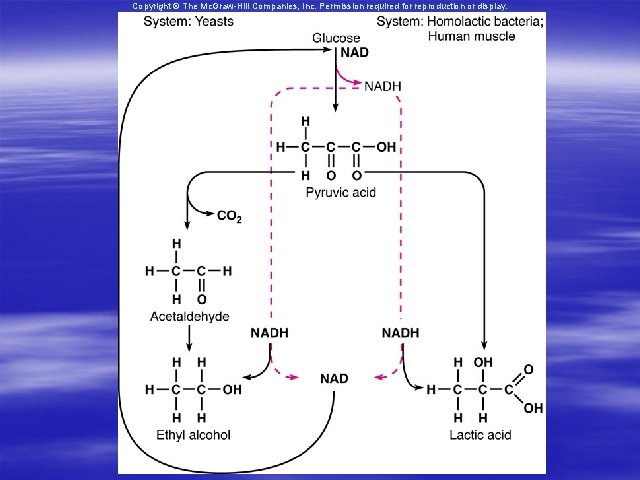
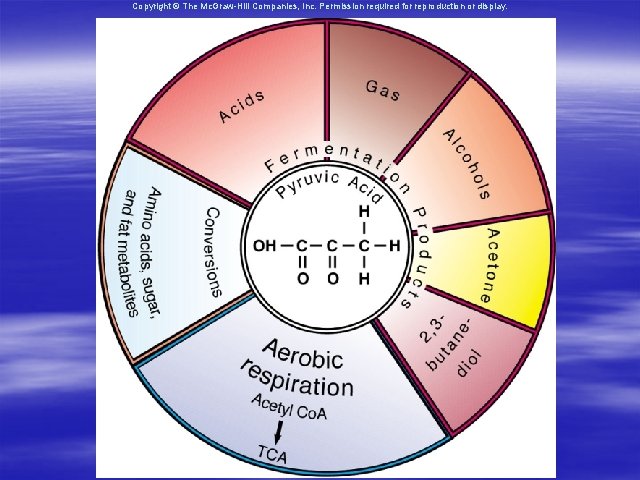
Fermentation § If no oxygen is available – then the cell goes into Fermentation and various products are produced: – Acids – Alcohol – Carbon dioxide
Copyright © The Mc. Graw-Hill Companies, Inc. Permission required for reproduction or display.
Copyright © The Mc. Graw-Hill Companies, Inc. Permission required for reproduction or display.
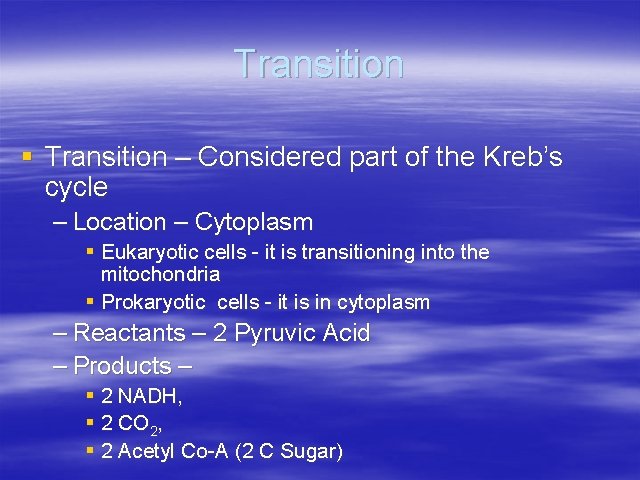
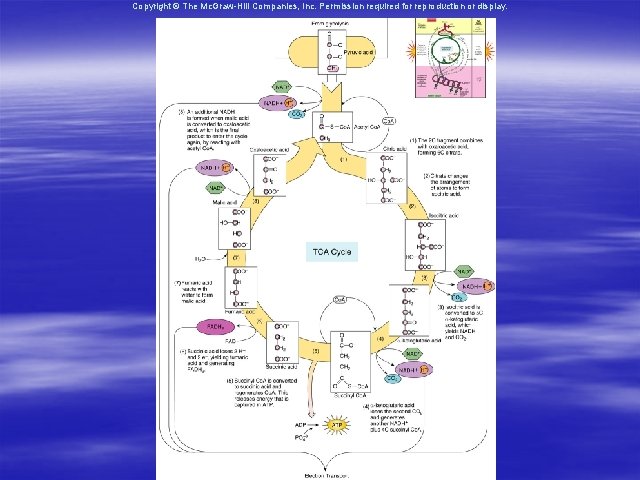
Transition § Transition – Considered part of the Kreb’s cycle – Location – Cytoplasm § Eukaryotic cells - it is transitioning into the mitochondria § Prokaryotic cells - it is in cytoplasm – Reactants – 2 Pyruvic Acid – Products – § 2 NADH, § 2 CO 2, § 2 Acetyl Co-A (2 C Sugar)
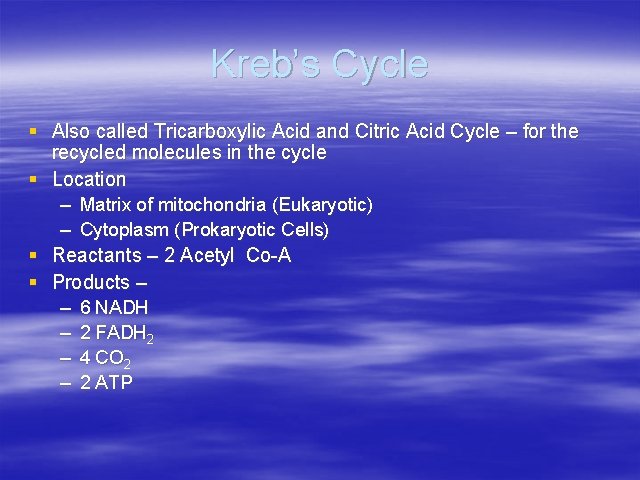
Kreb’s Cycle § Also called Tricarboxylic Acid and Citric Acid Cycle – for the recycled molecules in the cycle § Location – Matrix of mitochondria (Eukaryotic) – Cytoplasm (Prokaryotic Cells) § Reactants – 2 Acetyl Co-A § Products – – 6 NADH – 2 FADH 2 – 4 CO 2 – 2 ATP
Copyright © The Mc. Graw-Hill Companies, Inc. Permission required for reproduction or display.
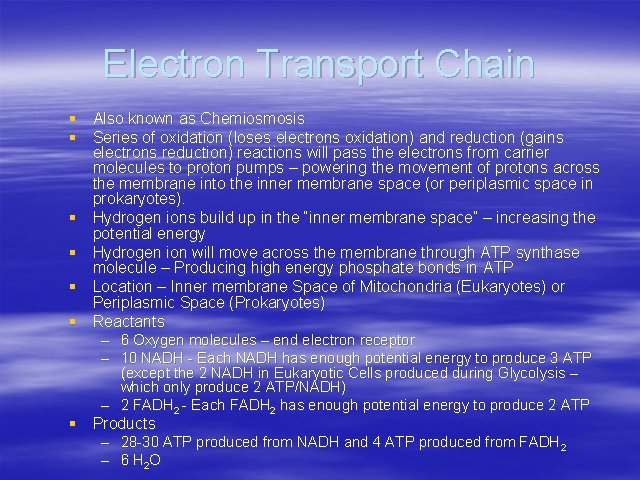
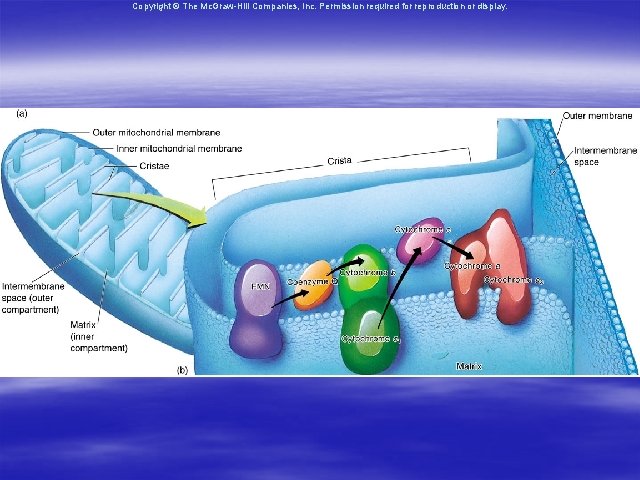
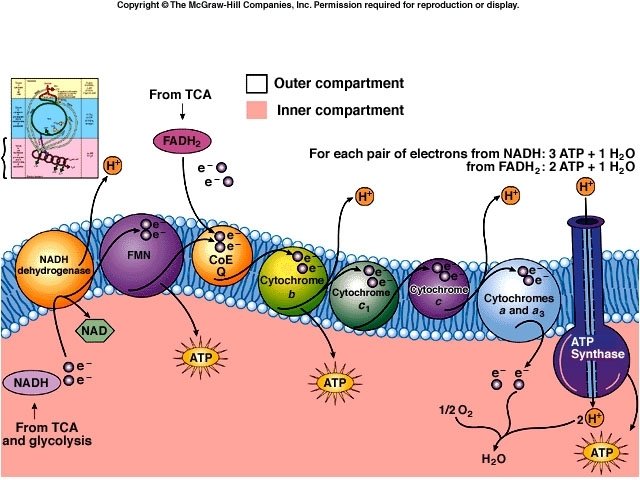
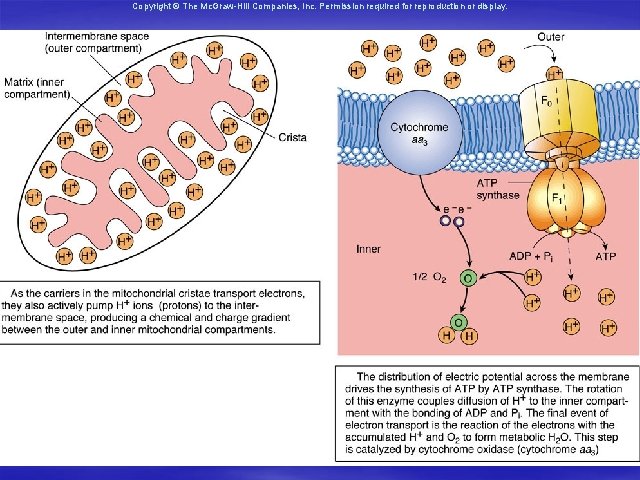
Electron Transport Chain § Also known as Chemiosmosis § Series of oxidation (loses electrons oxidation) and reduction (gains electrons reduction) reactions will pass the electrons from carrier molecules to proton pumps – powering the movement of protons across the membrane into the inner membrane space (or periplasmic space in prokaryotes). § Hydrogen ions build up in the “inner membrane space” – increasing the potential energy § Hydrogen ion will move across the membrane through ATP synthase molecule – Producing high energy phosphate bonds in ATP § Location – Inner membrane Space of Mitochondria (Eukaryotes) or Periplasmic Space (Prokaryotes) § Reactants § – 6 Oxygen molecules – end electron receptor – 10 NADH - Each NADH has enough potential energy to produce 3 ATP (except the 2 NADH in Eukaryotic Cells produced during Glycolysis – which only produce 2 ATP/NADH) – 2 FADH 2 - Each FADH 2 has enough potential energy to produce 2 ATP Products – 28 -30 ATP produced from NADH and 4 ATP produced from FADH 2 – 6 H 2 O
Copyright © The Mc. Graw-Hill Companies, Inc. Permission required for reproduction or display.
Copyright © The Mc. Graw-Hill Companies, Inc. Permission required for reproduction or display.
Copyright © The Mc. Graw-Hill Companies, Inc. Permission required for reproduction or display.
Other Aspects of Catabolism § Catabolism of other Carbohydrates (ie Starch) – Hydrolysis – addition of water and specific enzymes for each carbohydrate (called hydrolases) will cause the decomposition of these carbohydrates § Catabolism of Proteins and Fats Hydrolysis
Anabolism of Carbohydrates § Photosynthesis – Energy + 6 CO 2 + 6 H 2 O C 6 H 12 O 6 + 6 O 2 – Using light from the sun to synthesize carbohydrates
Anabolism of Proteins § Protein Synthesis – Occurs in Ribosomes of Eukaryotics and Prokaryotics – Removing water to form peptide bonds between carboxyl group and amine group of two different amino acids § Transcription – making RNA from DNA code § Translation – making Proteins from RNA § Replication – making a copy of DNA for new cells during cell cycle
- Slides: 28