
Metabolism breaking molecules down and building up new

Metabolism = breaking molecules down and building up new ones
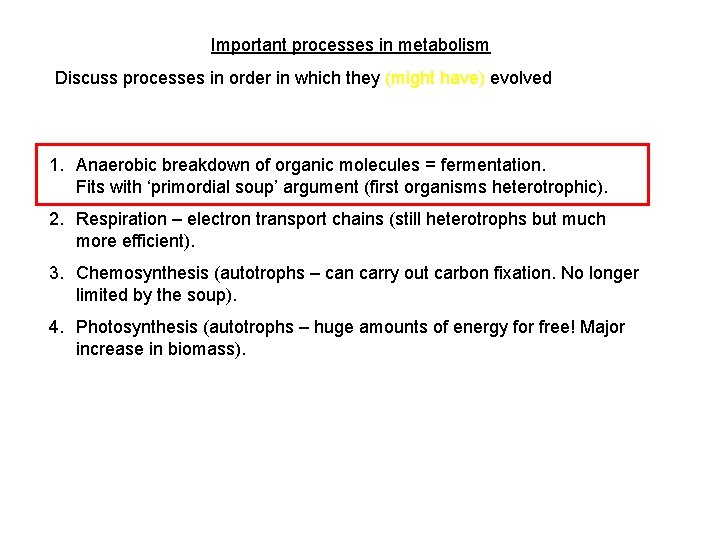
Important processes in metabolism Discuss processes in order in which they (might have) evolved 1. Anaerobic breakdown of organic molecules = fermentation. Fits with ‘primordial soup’ argument (first organisms heterotrophic). 2. Respiration – electron transport chains (still heterotrophs but much more efficient). 3. Chemosynthesis (autotrophs – can carry out carbon fixation. No longer limited by the soup). 4. Photosynthesis (autotrophs – huge amounts of energy for free! Major increase in biomass).

Glycolysis – breakdown of sugar Essentials worth remembering 1 glucose (6 C) 2 pyruvate (3 C) Generates 2 ATP and 2 NADH
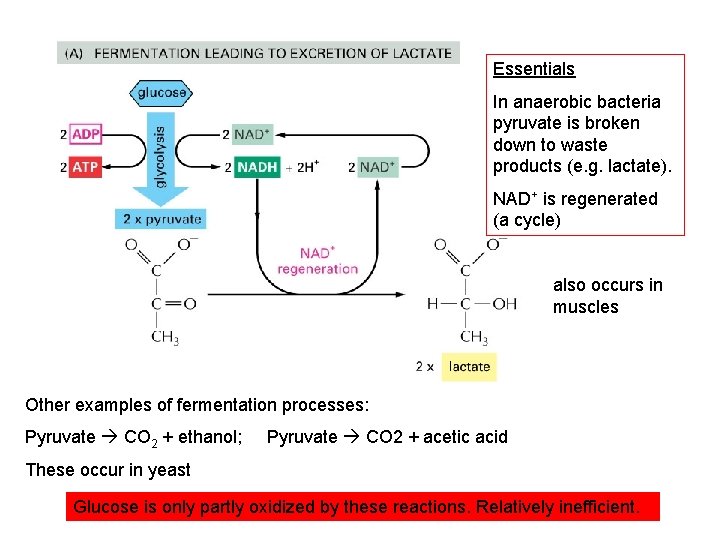
Essentials In anaerobic bacteria pyruvate is broken down to waste products (e. g. lactate). NAD+ is regenerated (a cycle) also occurs in muscles Other examples of fermentation processes: CO 2 + ethanol; Pyruvate CO 2 + acetic acid These occur in yeast Glucose is only partly oxidized by these reactions. Relatively inefficient.
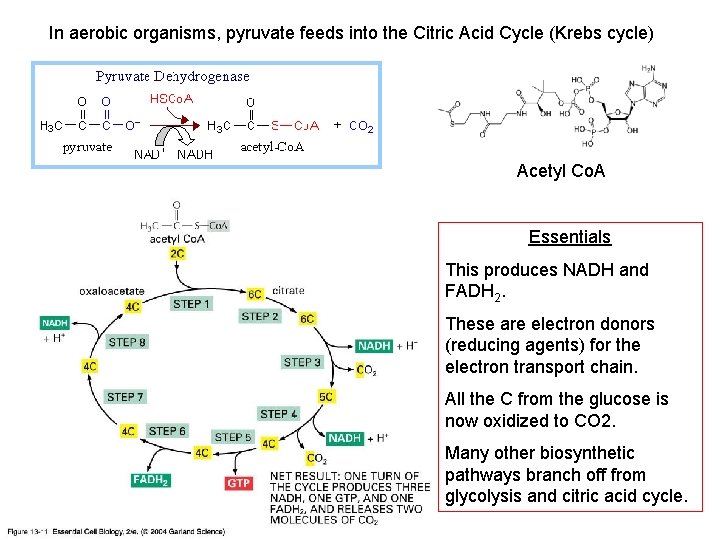
In aerobic organisms, pyruvate feeds into the Citric Acid Cycle (Krebs cycle) Acetyl Co. A Essentials This produces NADH and FADH 2. These are electron donors (reducing agents) for the electron transport chain. All the C from the glucose is now oxidized to CO 2. Many other biosynthetic pathways branch off from glycolysis and citric acid cycle.
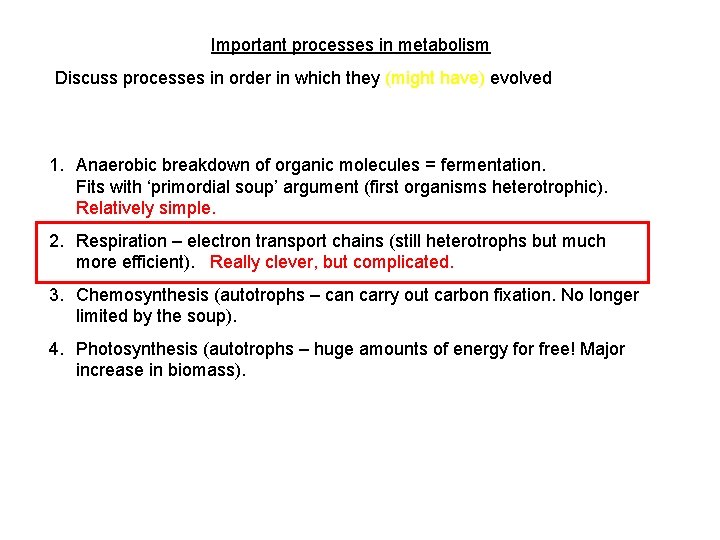
Important processes in metabolism Discuss processes in order in which they (might have) evolved 1. Anaerobic breakdown of organic molecules = fermentation. Fits with ‘primordial soup’ argument (first organisms heterotrophic). Relatively simple. 2. Respiration – electron transport chains (still heterotrophs but much more efficient). Really clever, but complicated. 3. Chemosynthesis (autotrophs – can carry out carbon fixation. No longer limited by the soup). 4. Photosynthesis (autotrophs – huge amounts of energy for free! Major increase in biomass).

Oxidation-Reduction again Nicotinamide adenine dinuclotide NAD+ FAD Flavin adenine dinucleotide oxidizing agent (electron acceptor) FADH 2 NADH reducing agent FADH 2 FAD + 2 H+ + 2 e- (electron donor) NADH NAD+ + H+ + 2 e- Now we are going to make use of those electron donors we just made two slides back. Hang onto your hats!
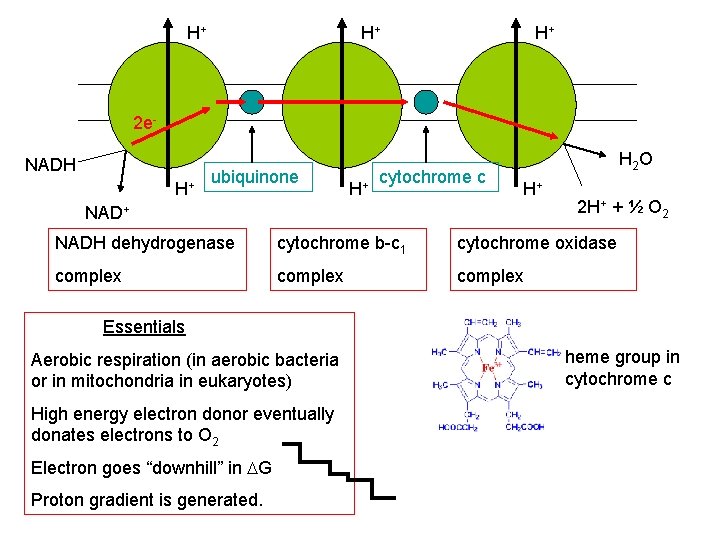
H+ H+ H+ 2 e. NADH H+ ubiquinone H+ cytochrome c H 2 O H+ NAD+ 2 H+ + ½ O 2 NADH dehydrogenase cytochrome b-c 1 cytochrome oxidase complex Essentials Aerobic respiration (in aerobic bacteria or in mitochondria in eukaryotes) High energy electron donor eventually donates electrons to O 2 Electron goes “downhill” in G Proton gradient is generated. heme group in cytochrome c

ATP synthetase complex proton channel Electron transport chain + ATP synthesis = oxidative phosphorylation chemiosmotic process For each molecule of glucose about 30 ATPs generated by ox. phos. but only 2 from glycolysis. Much more energy from the same food! ADP + Pi ATP protons moving downhill provide energy for uphill synthesis of ATP
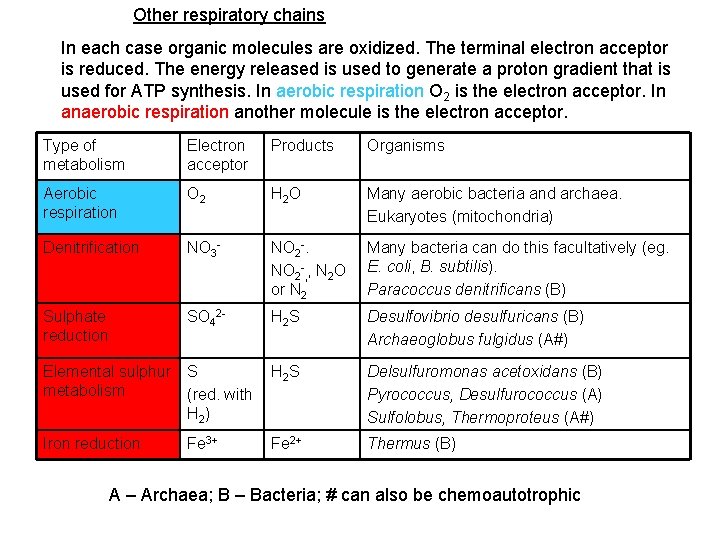
Other respiratory chains In each case organic molecules are oxidized. The terminal electron acceptor is reduced. The energy released is used to generate a proton gradient that is used for ATP synthesis. In aerobic respiration O 2 is the electron acceptor. In anaerobic respiration another molecule is the electron acceptor. Type of metabolism Electron acceptor Products Organisms Aerobic respiration O 2 H 2 O Many aerobic bacteria and archaea. Eukaryotes (mitochondria) Denitrification NO 3 - NO 2 -, , N 2 O or N 2 Many bacteria can do this facultatively (eg. E. coli, B. subtilis). Paracoccus denitrificans (B) Sulphate reduction SO 42 - H 2 S Desulfovibrio desulfuricans (B) Archaeoglobus fulgidus (A#) Elemental sulphur S metabolism (red. with H 2 ) H 2 S Delsulfuromonas acetoxidans (B) Pyrococcus, Desulfurococcus (A) Sulfolobus, Thermoproteus (A#) Iron reduction Fe 2+ Thermus (B) Fe 3+ A – Archaea; B – Bacteria; # can also be chemoautotrophic
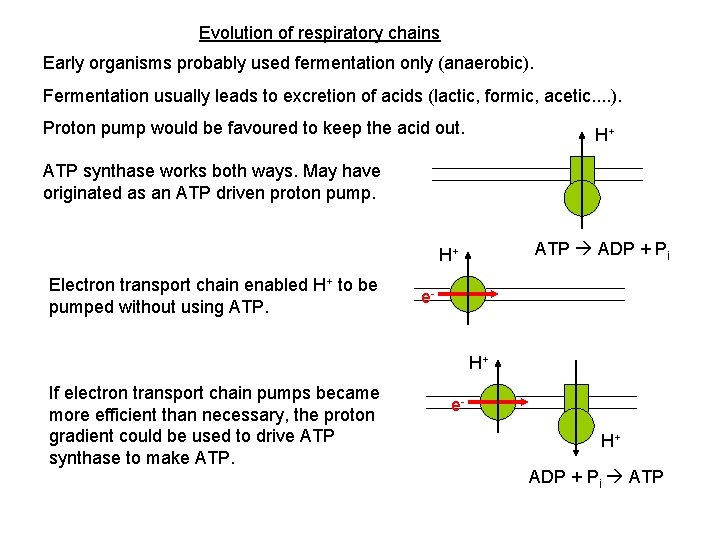
Evolution of respiratory chains Early organisms probably used fermentation only (anaerobic). Fermentation usually leads to excretion of acids (lactic, formic, acetic. . ). Proton pump would be favoured to keep the acid out. H+ ATP synthase works both ways. May have originated as an ATP driven proton pump. ATP ADP + Pi H+ Electron transport chain enabled H+ to be pumped without using ATP. e- H+ If electron transport chain pumps became more efficient than necessary, the proton gradient could be used to drive ATP synthase to make ATP. e. H+ ADP + Pi ATP
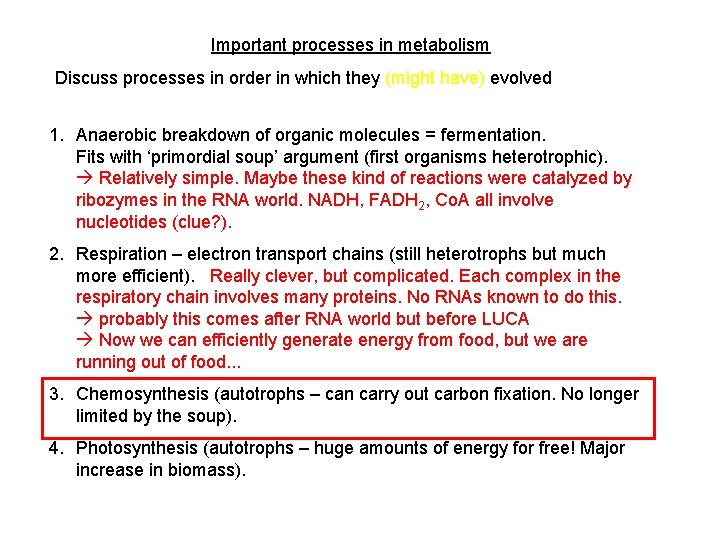
Important processes in metabolism Discuss processes in order in which they (might have) evolved 1. Anaerobic breakdown of organic molecules = fermentation. Fits with ‘primordial soup’ argument (first organisms heterotrophic). Relatively simple. Maybe these kind of reactions were catalyzed by ribozymes in the RNA world. NADH, FADH 2, Co. A all involve nucleotides (clue? ). 2. Respiration – electron transport chains (still heterotrophs but much more efficient). Really clever, but complicated. Each complex in the respiratory chain involves many proteins. No RNAs known to do this. probably this comes after RNA world but before LUCA Now we can efficiently generate energy from food, but we are running out of food. . . 3. Chemosynthesis (autotrophs – can carry out carbon fixation. No longer limited by the soup). 4. Photosynthesis (autotrophs – huge amounts of energy for free! Major increase in biomass).

Chemoautotrophy (Chemolithotrophy) An inorganic reducing agent feeds into an electron transport chain. Generates a proton gradient (more ATP synthesis) and an organic reducing agent (like NAD(P)H), which reduces CO 2 to organic molecules. Several different carbon fixation cycles are known – “opposite” of citric acid cycle. Type of metabolism Energy producing reaction Organisms Hydrogen oxidation H 2 + ½ O 2 H 2 O Alcaligenes, Hydrogenobacter (B) Nitrification (from nitrite or ammonia) NO 2 - + ½ O 2 NO 3 NH 4+ + 1 ½ O 2 NO 2 - + H 2 O + 2 H+ Nitrobacter(B) Nitrosomonas (B) S 2 O 32 - + 2 O 2 + H 2 O 2 SO 42 - + 2 H+ Sulphur oxidation (from thiosulphate, S + 1 ½ O 2 + H 2 O SO 42 - + 2 H+ sulphur or hydrogen 2 H S + O 2 S + 2 H O 2 2 2 sulphide) Sulfolobus (A) Thiobacillus (B) Iron oxidation 2 Fe 2+ + 2 H+ + ½ O 2 2 Fe 3+ + H 2 O Thiobacillus (B) Methylotrophy CH 4 or CH 3 OH or CO 2 Methylomonas (B) Methanogenesis 4 H 2 + CO 2 CH 4 + 2 H 2 O Methanococcus (A) Elemental sulphur metabolism H 2 + S H 2 S Thermoproteus (A) Sulphate reduction H 2 + SO 42 - (or SO 32 - or S 2 O 32 -) H 2 S Archaeoglobus (A)
Essentials Many possible energy sources from redox reactions. Can go “both ways” - 2 examples: • can oxidize S to SO 42 - in aerobic conditions or reduce S to H 2 S in presence of H 2 gas but absence of O 2 ---- both have G < 0 in the right conditions. • methylotrophy (aerobic) v. methanogenesis (anaerobic) Sometimes the same organism goes both ways: e. g. Sulfolobus can be an anaerobic heterotroph with sulphur reduction, or an autotrophic aerobic sulphur oxidizer clever cloggs! Redox reactions in previous table have G < 0. They look simple, but remember they don’t just happen in one step as an inorganic reaction. These reactions are coupled to electron transport chains and proton gradients. .
Important processes in metabolism Discuss processes in order in which they (might have) evolved 1. Anaerobic breakdown of organic molecules = fermentation. Fits with ‘primordial soup’ argument (first organisms heterotrophic). Relatively simple. Maybe occurred in the RNA world. 2. Respiration – electron transport chains (still heterotrophs but much more efficient). Really clever, but complicated. Each complex in the respiratory chain involves many proteins. No RNAs known to do this. probably this comes after RNA world but before LUCA 3. Chemosynthesis (autotrophs – can carry out carbon fixation. No longer limited by the soup). Many possible sources of chemical energy. Some of these types of metabolism are found in both archaea and bacteria, i. e. before LUCA. 4. Photosynthesis (autotrophs – huge amounts of energy for free! Major increase in biomass). Only in bacteria, i. e. after LUCA requires light-harvesting protein complexes (photosystems)
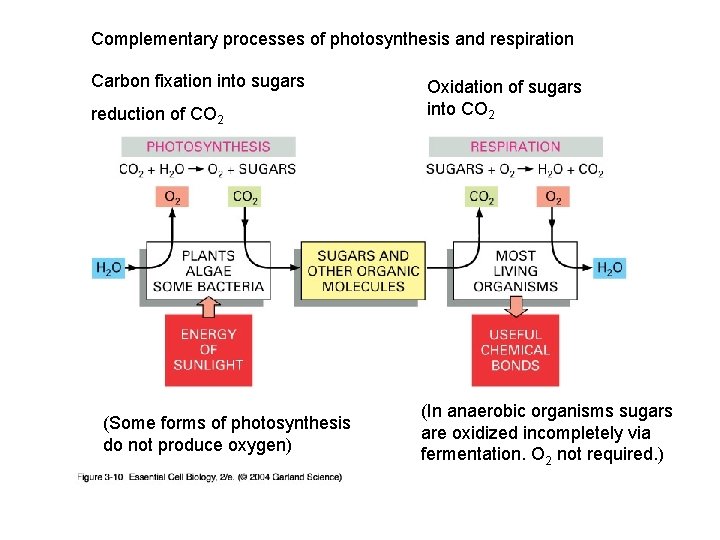
Complementary processes of photosynthesis and respiration Carbon fixation into sugars reduction of CO 2 (Some forms of photosynthesis do not produce oxygen) Oxidation of sugars into CO 2 (In anaerobic organisms sugars are oxidized incompletely via fermentation. O 2 not required. )
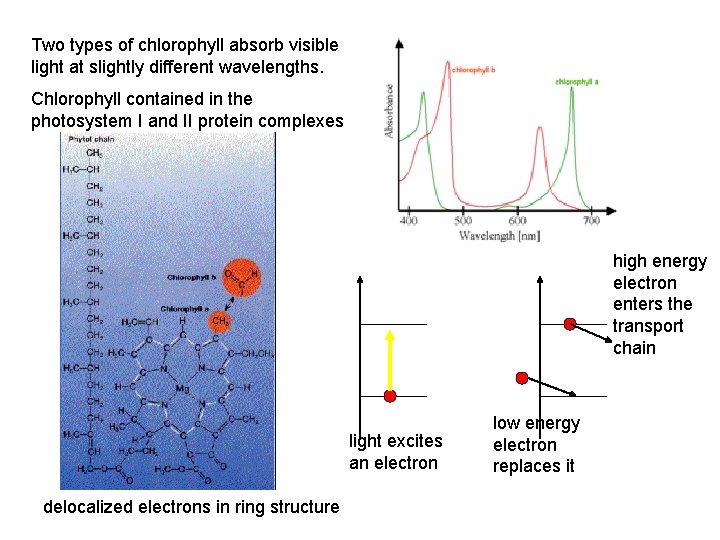
Two types of chlorophyll absorb visible light at slightly different wavelengths. Chlorophyll contained in the photosystem I and II protein complexes high energy electron enters the transport chain light excites an electron delocalized electrons in ring structure low energy electron replaces it
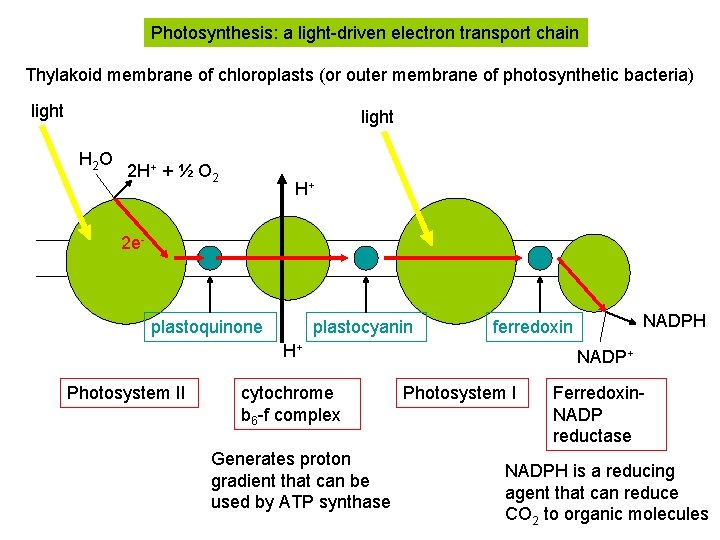
Photosynthesis: a light-driven electron transport chain Thylakoid membrane of chloroplasts (or outer membrane of photosynthetic bacteria) light H 2 O 2 H+ + ½ O 2 H+ 2 e- plastoquinone plastocyanin H+ Photosystem II cytochrome b 6 -f complex Generates proton gradient that can be used by ATP synthase NADPH ferredoxin NADP+ Photosystem I Ferredoxin. NADP reductase NADPH is a reducing agent that can reduce CO 2 to organic molecules
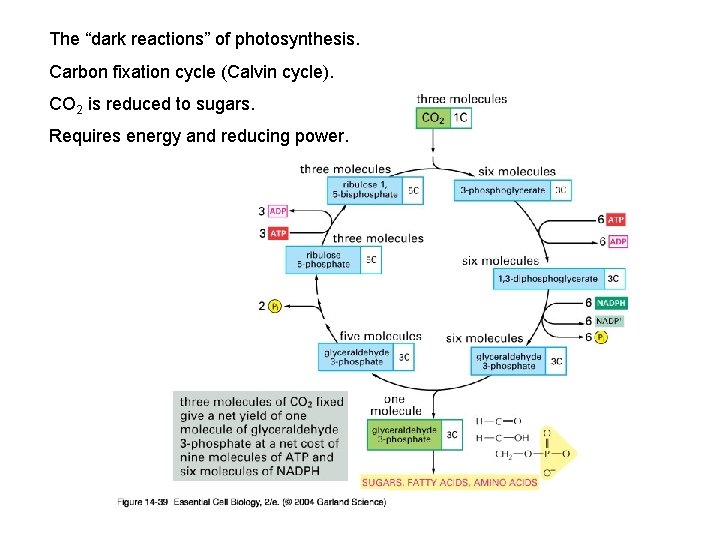
The “dark reactions” of photosynthesis. Carbon fixation cycle (Calvin cycle). CO 2 is reduced to sugars. Requires energy and reducing power.
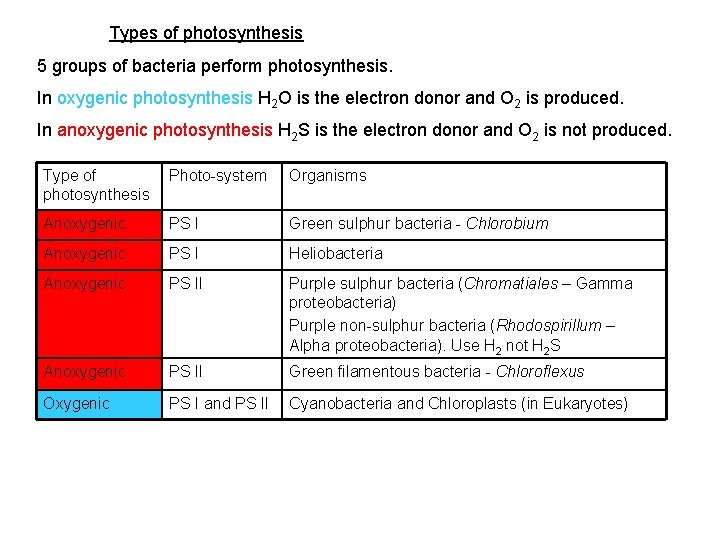
Types of photosynthesis 5 groups of bacteria perform photosynthesis. In oxygenic photosynthesis H 2 O is the electron donor and O 2 is produced. In anoxygenic photosynthesis H 2 S is the electron donor and O 2 is not produced. Type of photosynthesis Photo-system Organisms Anoxygenic PS I Green sulphur bacteria - Chlorobium Anoxygenic PS I Heliobacteria Anoxygenic PS II Purple sulphur bacteria (Chromatiales – Gamma proteobacteria) Purple non-sulphur bacteria (Rhodospirillum – Alpha proteobacteria). Use H 2 not H 2 S Anoxygenic PS II Green filamentous bacteria - Chloroflexus Oxygenic PS I and PS II Cyanobacteria and Chloroplasts (in Eukaryotes)
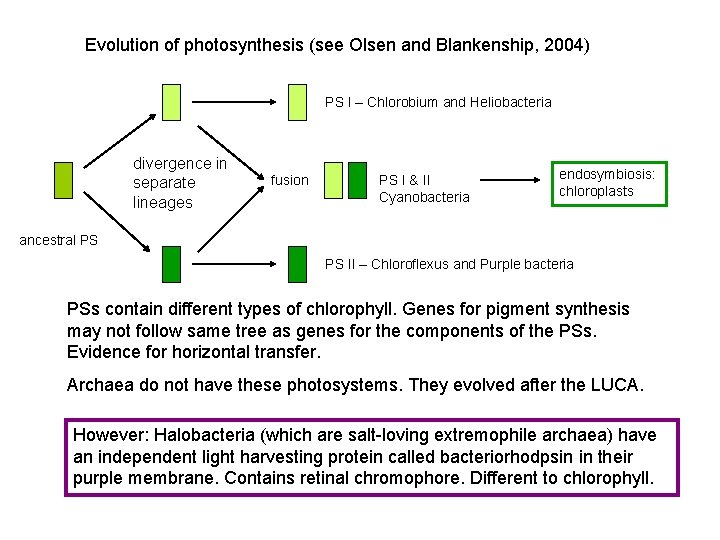
Evolution of photosynthesis (see Olsen and Blankenship, 2004) PS I – Chlorobium and Heliobacteria divergence in separate lineages fusion PS I & II Cyanobacteria endosymbiosis: chloroplasts ancestral PS PS II – Chloroflexus and Purple bacteria PSs contain different types of chlorophyll. Genes for pigment synthesis may not follow same tree as genes for the components of the PSs. Evidence for horizontal transfer. Archaea do not have these photosystems. They evolved after the LUCA. However: Halobacteria (which are salt-loving extremophile archaea) have an independent light harvesting protein called bacteriorhodpsin in their purple membrane. Contains retinal chromophore. Different to chlorophyll.

Archaea Eukaryotes Bacteria chloroplasts Methanogenesis/ Bacteriorhodopsin only in Archaea mitochondria origin of eukaryotic nucleus ? Plausible summary of “Everything” Oxygenic Photosynthesis Anoxygenic Photosynthesis Genes for sulphate reduction, nitrate reduction, sulphur oxidation, oxygen respiration all present in A and B LUCA Modern organisms: DNA + RNA + proteins Chemosynthesis Electron transport chains Genetic code: RNA + proteins RNA world Metabolism first ? Origin of life Simple heterotrophic metabolism / fermentation
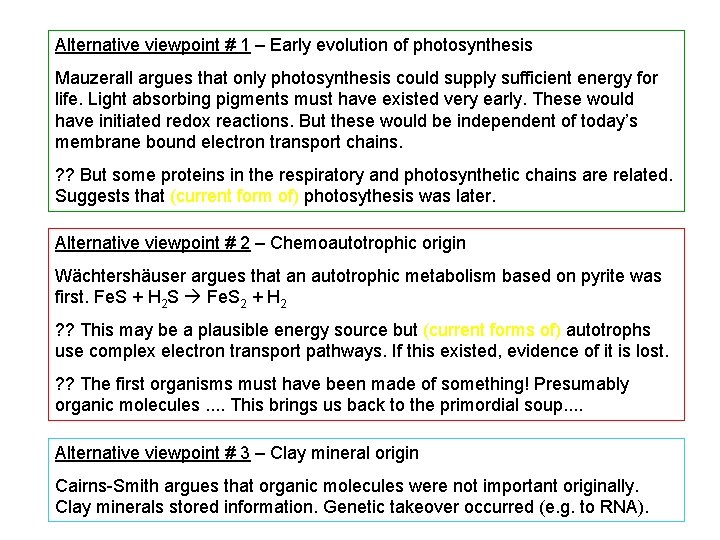
Alternative viewpoint # 1 – Early evolution of photosynthesis Mauzerall argues that only photosynthesis could supply sufficient energy for life. Light absorbing pigments must have existed very early. These would have initiated redox reactions. But these would be independent of today’s membrane bound electron transport chains. ? ? But some proteins in the respiratory and photosynthetic chains are related. Suggests that (current form of) photosythesis was later. Alternative viewpoint # 2 – Chemoautotrophic origin Wächtershäuser argues that an autotrophic metabolism based on pyrite was first. Fe. S + H 2 S Fe. S 2 + H 2 ? ? This may be a plausible energy source but (current forms of) autotrophs use complex electron transport pathways. If this existed, evidence of it is lost. ? ? The first organisms must have been made of something! Presumably organic molecules. . This brings us back to the primordial soup. . Alternative viewpoint # 3 – Clay mineral origin Cairns-Smith argues that organic molecules were not important originally. Clay minerals stored information. Genetic takeover occurred (e. g. to RNA).
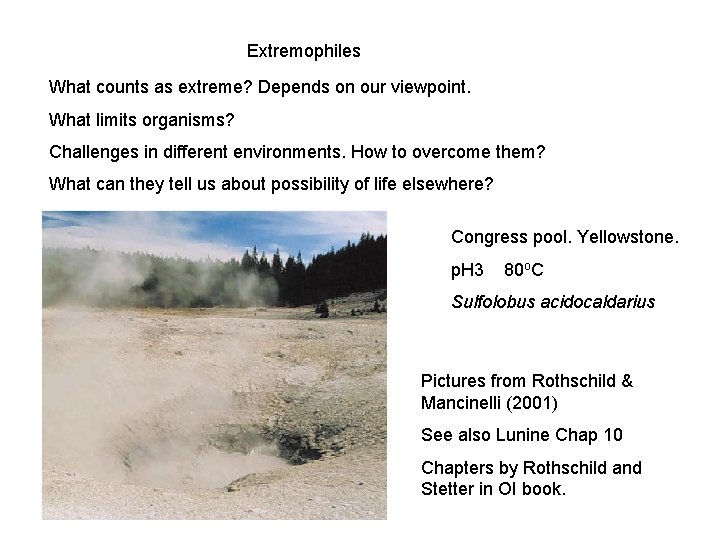
Extremophiles What counts as extreme? Depends on our viewpoint. What limits organisms? Challenges in different environments. How to overcome them? What can they tell us about possibility of life elsewhere? Congress pool. Yellowstone. p. H 3 80 o. C Sulfolobus acidocaldarius Pictures from Rothschild & Mancinelli (2001) See also Lunine Chap 10 Chapters by Rothschild and Stetter in OI book.
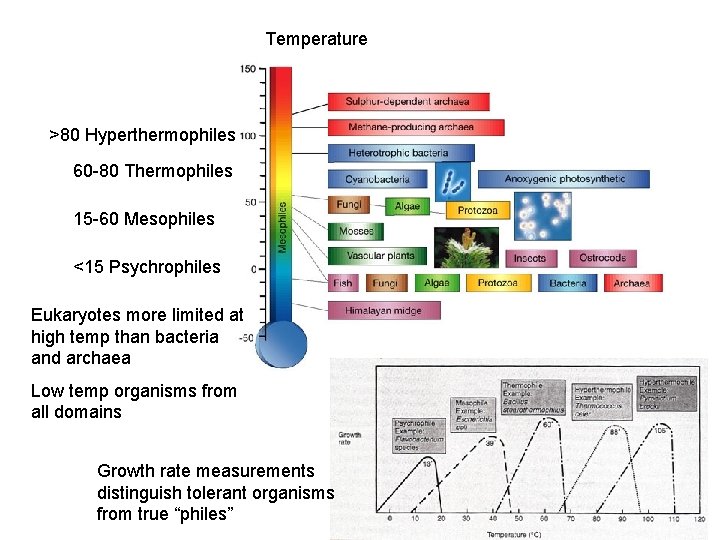
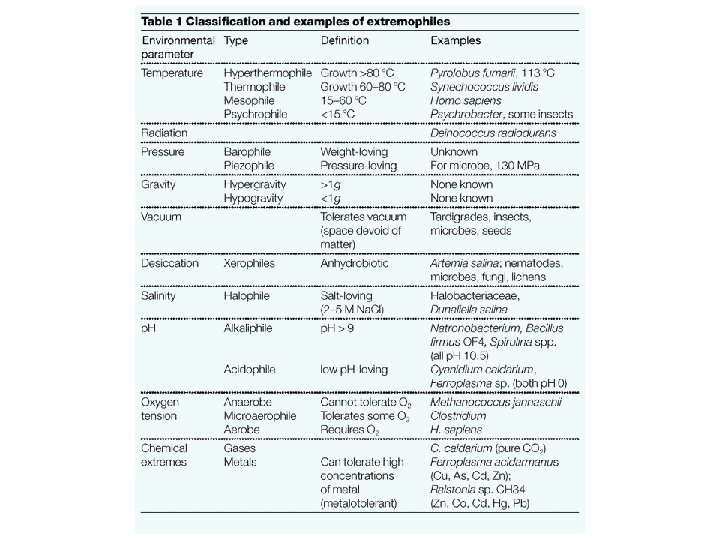
Temperature >80 Hyperthermophiles 60 -80 Thermophiles 15 -60 Mesophiles <15 Psychrophiles Eukaryotes more limited at high temp than bacteria and archaea Low temp organisms from all domains Growth rate measurements distinguish tolerant organisms from true “philes”
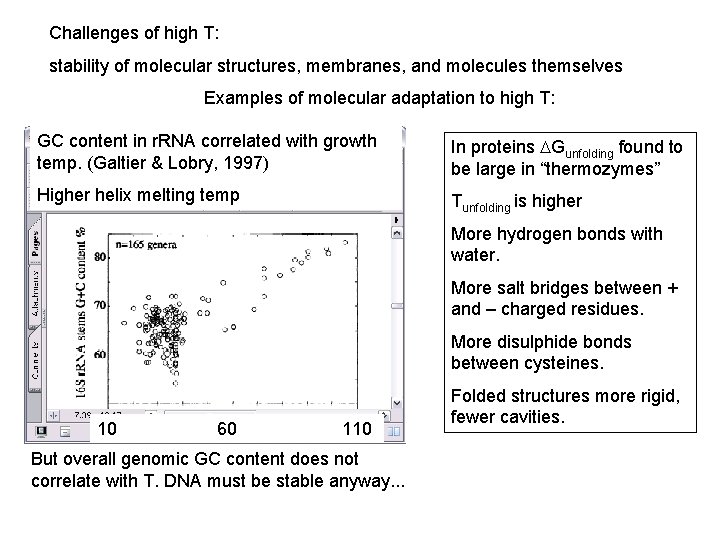
Challenges of high T: stability of molecular structures, membranes, and molecules themselves Examples of molecular adaptation to high T: GC content in r. RNA correlated with growth temp. (Galtier & Lobry, 1997) In proteins Gunfolding found to be large in “thermozymes” Higher helix melting temp Tunfolding is higher More hydrogen bonds with water. More salt bridges between + and – charged residues. More disulphide bonds between cysteines. 10 60 110 But overall genomic GC content does not correlate with T. DNA must be stable anyway. . . Folded structures more rigid, fewer cavities.
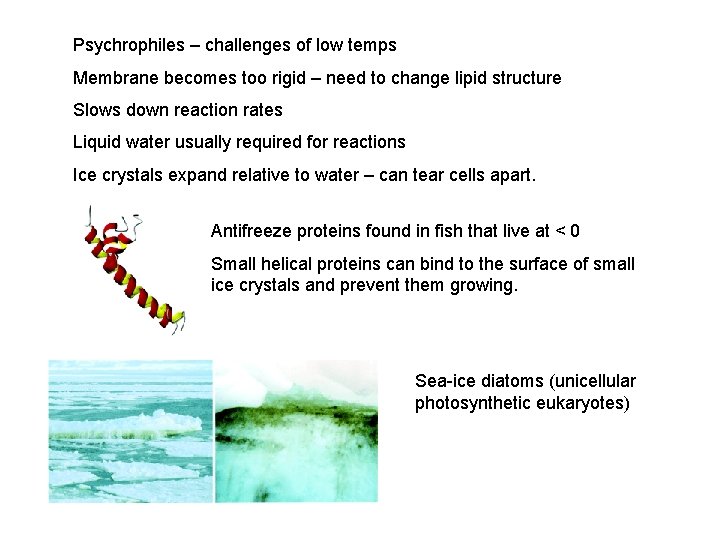
Psychrophiles – challenges of low temps Membrane becomes too rigid – need to change lipid structure Slows down reaction rates Liquid water usually required for reactions Ice crystals expand relative to water – can tear cells apart. Antifreeze proteins found in fish that live at < 0 Small helical proteins can bind to the surface of small ice crystals and prevent them growing. Sea-ice diatoms (unicellular photosynthetic eukaryotes)
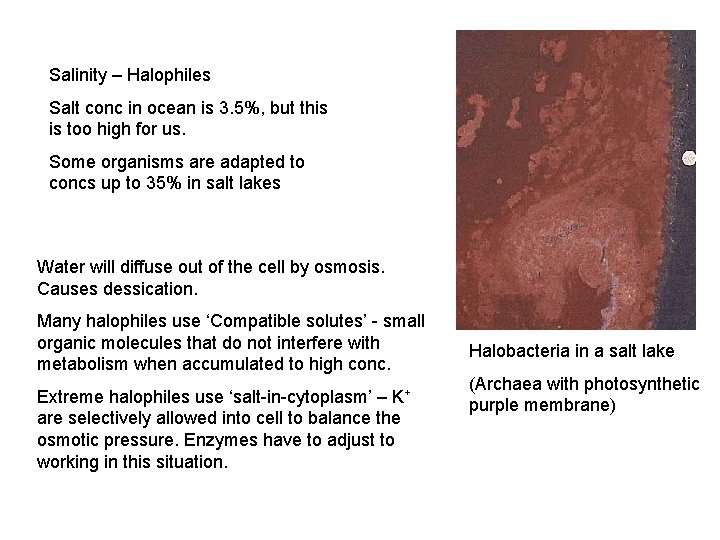
Salinity – Halophiles Salt conc in ocean is 3. 5%, but this is too high for us. Some organisms are adapted to concs up to 35% in salt lakes Water will diffuse out of the cell by osmosis. Causes dessication. Many halophiles use ‘Compatible solutes’ - small organic molecules that do not interfere with metabolism when accumulated to high conc. Extreme halophiles use ‘salt-in-cytoplasm’ – K+ are selectively allowed into cell to balance the osmotic pressure. Enzymes have to adjust to working in this situation. Halobacteria in a salt lake (Archaea with photosynthetic purple membrane)
- Slides: 29