
Metabolic Processes Part III Photosynthesis Test Review Part
Metabolic Processes - Part III Photosynthesis Test Review
Part A: True and False
The one thing that all photosynthetic organisms have in common is chlorophyll. A. True B. False
The one thing that all photosynthetic organisms have in common is chlorophyll. A. True B. False
The structure that connects stacks of thylakoids is the grana. A. True B. False
The structure that connects stacks of thylakoids is the grana. A. True B. False - channels (lamella)
During photosynthesis light energy is transferred to ADP and NADP+, forming ATP and NADPH. A. True B. False
During photosynthesis light energy is transferred to ADP and NADP+, forming ATP and NADPH. A. True B. False
The reactions of carbon fixation depend on the light reactions to supply ATP and NADPH. A. True B. False
The reactions of carbon fixation depend on the light reactions to supply ATP and NADPH. A. True B. False
Light energy is principally transferred by chlorophyll b. A. True B. False
Light energy is principally transferred by chlorophyll b. A. True B. False - chlorophyll a
Most plants are green because that is the colour of light they need for photosynthesis. A. True B. False
Most plants are green because that is the colour of light they need for photosynthesis. A. True B. False - the combination of pigments absorb light at the blue and red end of the spectrum and green is left to reflect back into our eyes
In comparing respiration and photosynthesis, respiration releases energy while photosynthesis stores energy. A. True B. False
In comparing respiration and photosynthesis, respiration releases energy while photosynthesis stores energy. A. True B. False
The source of electrons in photosynthesis is light. A. True B. False
The source of electrons in photosynthesis is light. A. True B. False - water
The inner membrane of both the mitochondrion and the chloroplast is the site of their respective electron transport chains. A. True B. False
The inner membrane of both the mitochondrion and the chloroplast is the site of their respective electron transport chains. A. True B. False - electron transport chain of chloroplast is found in the thylakoid membrane
The location of the H+ reservoir in the chloroplast is the intermembrane space. A. True B. False
The location of the H+ reservoir in the chloroplast is the intermembrane space. A. True B. False - interior of thylakoid
Part B: Multiple Choice
Grana are formed from a. b. c. d. e. stroma photosystem lamellae thylakoids reaction centres
Grana are formed from a. b. c. d. e. stroma photosystem lamellae thylakoids reaction centres
In an investigation of the pigments in the leaves of a particular plant, one spot moved 8. 0 cm from the origin, while the solvent front moved 10. 0 cm. What would the Rf value of the pigment be? a. 80. 0 b. 8. 0 c. 2. 0 d. 1. 25 e. 0. 8
In an investigation of the pigments in the leaves of a particular plant, one spot moved 8. 0 cm from the origin, while the solvent front moved 10. 0 cm. What would the Rf value of the pigment be? a. 80. 0 b. 8. 0 c. 2. 0 d. 1. 25 e. 0. 8
Land plants get the CO 2 they need for photosynthesis mostly from a. breakdown of starch b. carbonates in the soil c. the atmosphere d. carbon fixation in the roots e. water via the roots
Land plants get the CO 2 they need for photosynthesis mostly from a. breakdown of starch b. carbonates in the soil c. the atmosphere d. carbon fixation in the roots e. water via the roots
Which one of the following is not a characteristic of the light reactions? a. electrons are displaced b. carbon fixation happens c. reduction happens d. energy is converted from a physical to a chemical form e. they take place in the thylakoids of chloroplasts
Which one of the following is not a characteristic of the light reactions? a. electrons are displaced b. carbon fixation happens c. reduction happens d. energy is converted from a physical to a chemical form e. they take place in the thylakoids of chloroplasts
Which of the following events of photosynthesis is concerned immediately with light? a. production of ATP b. fixation of carbon dioxide c. transfer of energy from chlorophyll to carbon dioxide d. excitation of chlorophyll e. regeneration of chlorophyll
Which of the following events of photosynthesis is concerned immediately with light? a. production of ATP b. fixation of carbon dioxide c. transfer of energy from chlorophyll to carbon dioxide d. excitation of chlorophyll e. regeneration of chlorophyll
A kind of herbicide works by disrupting the structure of the internal membranes of a chloroplast. Which segment of photosynthesis would be the most affected? a. activation of the photosystems b. reduction c. absorption of light of chlorophyll d. manufacture of ATP e. evolution of oxygen
A kind of herbicide works by disrupting the structure of the internal membranes of a chloroplast. Which segment of photosynthesis would be the most affected? a. activation of the photosystems b. reduction c. absorption of light of chlorophyll d. manufacture of ATP e. evolution of oxygen
Photophosphorylation specifically refers to the a. synthesis of glucose via carbon fixation b. splitting water as a result of light c. synthesis of ATP by photolysis d. reduction of NADPH by electron transport e. synthesis of ATP using light
Photophosphorylation specifically refers to the a. synthesis of glucose via carbon fixation b. splitting water as a result of light c. synthesis of ATP by photolysis d. reduction of NADPH by electron transport e. synthesis of ATP using light
Electrons released as a result of photolysis a. combine with H+ ions and oxygen to form water b. are used directly in the fixation of carbon during the Calvin cycle c. reduce photosystem I chlorophyll molecules d. reduce photosystem II chlorophyll molecules e. oxidize NADP+
Electrons released as a result of photolysis a. combine with H+ ions and oxygen to form water b. are used directly in the fixation of carbon during the Calvin cycle c. reduce photosystem I chlorophyll molecules d. reduce photosystem II chlorophyll molecules e. oxidize NADP+
Photon energy, captured by chlorophyll a, is transferred as chemical energy to a. carbon dioxide b. glucose c. other chlorophylls d. carotenoids e. a series of hydrogen acceptors
Photon energy, captured by chlorophyll a, is transferred as chemical energy to a. carbon dioxide b. glucose c. other chlorophylls d. carotenoids e. a series of hydrogen acceptors
When photosynthesis occurs, the oxygen that is released comes from a. chlorophyll b. an intermediate of the Calvin cycle c. a carbohydrate d. water e. carbon dioxide
When photosynthesis occurs, the oxygen that is released comes from a. chlorophyll b. an intermediate of the Calvin cycle c. a carbohydrate d. water e. carbon dioxide
What does carbon dioxide combine with during photosynthesis? a. G 3 P b. ribulose bisphosphate c. ribulose d. NAD+ e. water
What does carbon dioxide combine with during photosynthesis? a. G 3 P b. ribulose bisphosphate c. ribulose d. NAD+ e. water
Photorespiration occurs principally because of a. b. c. d. e. elevated carbon dioxide levels in the leaves due to photosynthesis elevated oxygen levels in the leaves due to cellular respiration an increase in oxygenase activity relative to carboxylase activity as temperature increases an increase in light intensity none of the above
Photorespiration occurs principally because of a. b. c. d. e. elevated carbon dioxide levels in the leaves due to photosynthesis elevated oxygen levels in the leaves due to cellular respiration an increase in oxygenase activity relative to carboxylase activity as temperature increases an increase in light intensity none of the above
There is a cost associated with the C 4 pathway. This cost consists of a. b. c. d. e. NADPH NADH cytochrome oxidation ATP none of the above
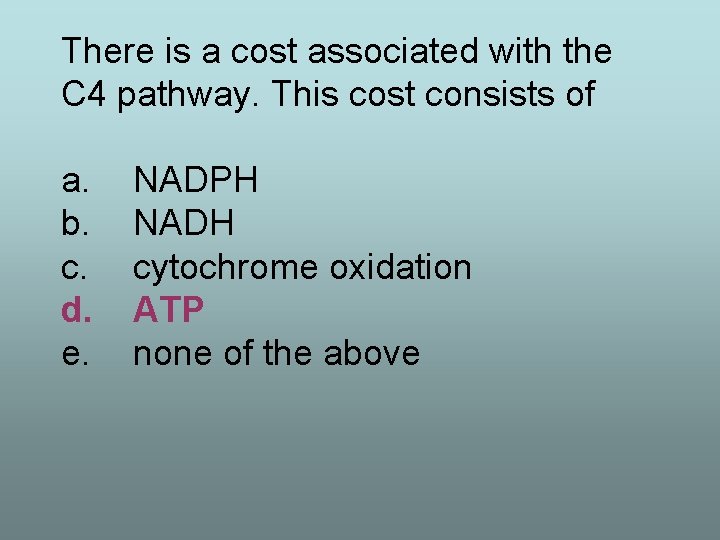
There is a cost associated with the C 4 pathway. This cost consists of a. b. c. d. e. NADPH NADH cytochrome oxidation ATP none of the above
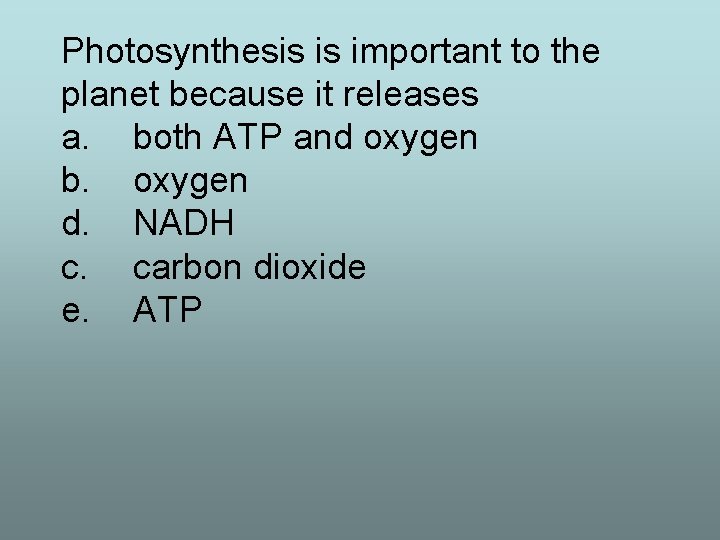
Photosynthesis is important to the planet because it releases a. both ATP and oxygen b. oxygen d. NADH c. carbon dioxide e. ATP
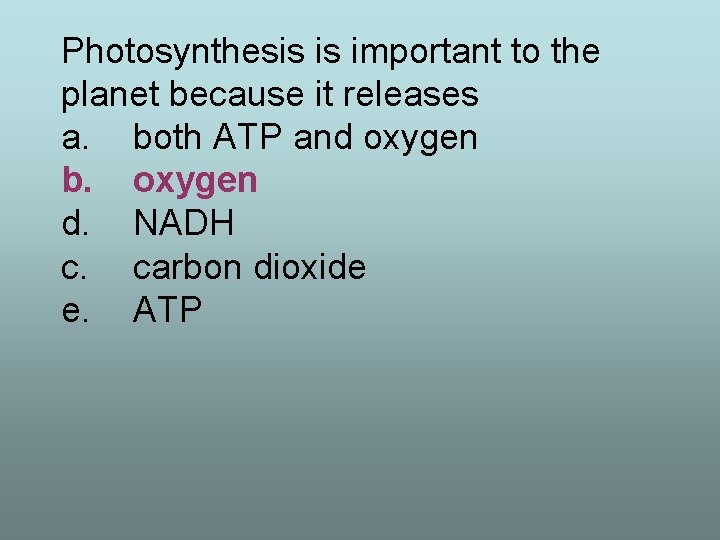
Photosynthesis is important to the planet because it releases a. both ATP and oxygen b. oxygen d. NADH c. carbon dioxide e. ATP
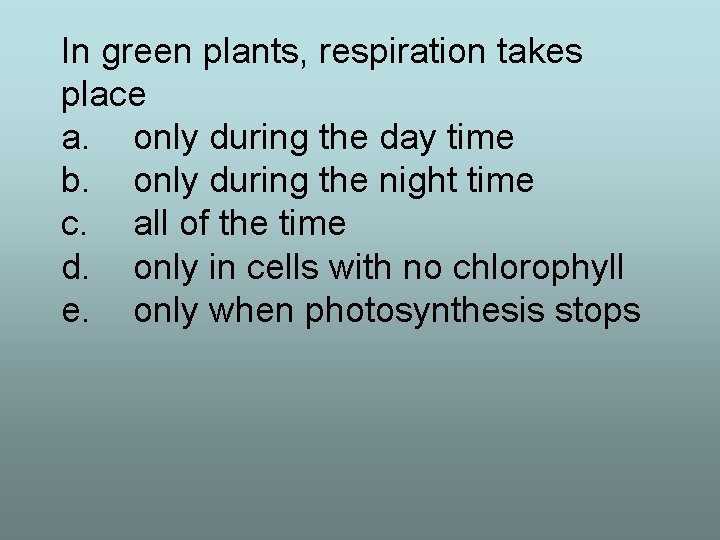
In green plants, respiration takes place a. only during the day time b. only during the night time c. all of the time d. only in cells with no chlorophyll e. only when photosynthesis stops
In green plants, respiration takes place a. only during the day time b. only during the night time c. all of the time d. only in cells with no chlorophyll e. only when photosynthesis stops
Part C: Short Answer
What are the pigments most commonly found in the chloroplasts of leaves in higher plants? Which of these are regarded as accessory pigments and why? What are the advantages, if any, to a plant having several different pigments?
- - - The main pigments found in the leaves of higher plants are the chlorophylls (a and b and to a lesser extent c and d) and carotenoids. All but chlorophyll a are accessory pigments since only chlorophyll a is able to transfer the energy of light to the carbon fixation reactions. By having several different pigments a plant can absorb many different wavelengths of light most efficiently.
When sunlight strikes a leaf, what is the first thing that happens in terms of energy conversion?
A photon of light, of the correct wavelength, strikes a molecule of chlorophyll a in photosystem II, the molecule becomes excited. In this excited state, the chlorophyll is responsible for the splitting of a water molecule which makes hydrogen ions and electrons available, a source of chemical potential energy.
What are the roles of water and light in photosynthesis?
- Water is needed as a source of hydrogen ions and electrons which are used in reduction reactions. - Light is needed as a source of energy to excite electrons of chlorophyll, which results in the splitting of water to form oxygen and release the hydrogen ions and electrons mentioned previously.
Outline the differences between cyclic and noncyclic photophosphorylation.
In cyclic photophosphorylation, the energized electron from photosystem I returns to photosystem I via the cytochrome carrier system. This produces ATP, but not NADPH. In non-cyclic photophosphorylation both photosystems I and II energize an electron to a higher level. And this produces ATP as the electron goes through the cytochrome system and also produces NADPH.
- Slides: 62