
MESSING WITH THEIR HEADS Using Discrepant Events to
- Slides: 10
MESSING WITH THEIR HEADS Using Discrepant Events to Arouse Interest and Combat Misconceptions
What is a discrepant event? A discrepant event causes a discrepancy in what is physically observed and what the observer thinks should happen.
How do I do a discrepant event? 1. The Set Up 1. The Event 2. The Explanation
Essential Elements of Discrepant Events l l l Arouse your students interest -a story, a challenge, etc… Use simple materials Use multiple gateways -demonstrate, pick a volunteer, involve students in a related activity Include examples Show joy and enthusiasm
Why do a discrepant event? l What students know is true is not what they witness, creating cognitive dissonance l Cognitive dissonance makes the student wonder opening their minds to alternative explanations
When do I use discrepant events? l To engage students in learning about a concept, issue, or skill. l To create an opportunity to unlearn a predetermined misconception.
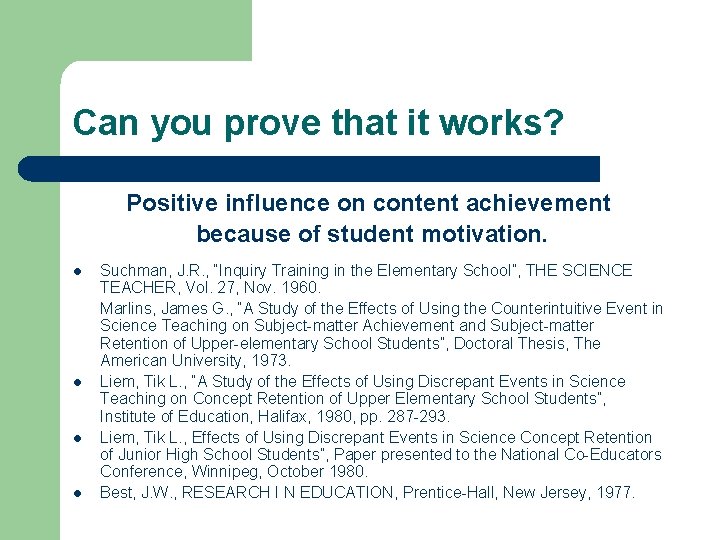
Can you prove that it works? Positive influence on content achievement because of student motivation. l l Suchman, J. R. , “Inquiry Training in the Elementary School”, THE SCIENCE TEACHER, Vol. 27, Nov. 1960. Marlins, James G. , “A Study of the Effects of Using the Counterintuitive Event in Science Teaching on Subject-matter Achievement and Subject-matter Retention of Upper-elementary School Students”, Doctoral Thesis, The American University, 1973. Liem, Tik L. , “A Study of the Effects of Using Discrepant Events in Science Teaching on Concept Retention of Upper Elementary School Students”, Institute of Education, Halifax, 1980, pp. 287 -293. Liem, Tik L. , Effects of Using Discrepant Events in Science Concept Retention of Junior High School Students”, Paper presented to the National Co-Educators Conference, Winnipeg, October 1980. Best, J. W. , RESEARCH I N EDUCATION, Prentice-Hall, New Jersey, 1977.
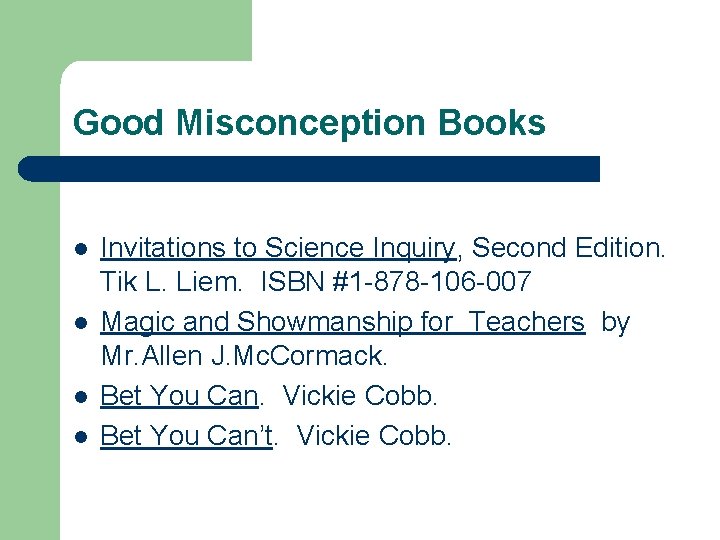
Good Misconception Books l l Invitations to Science Inquiry, Second Edition. Tik L. Liem. ISBN #1 -878 -106 -007 Magic and Showmanship for Teachers by Mr. Allen J. Mc. Cormack. Bet You Can. Vickie Cobb. Bet You Can’t. Vickie Cobb.
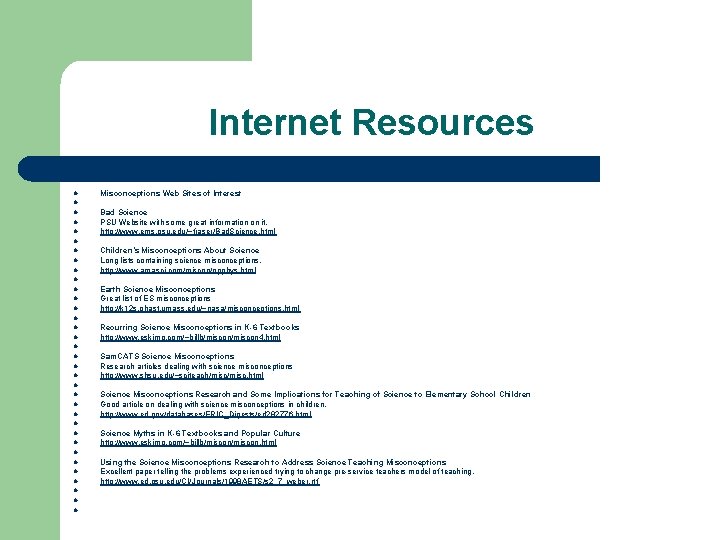
Internet Resources l l l l l l l l l Misconceptions Web Sites of Interest Bad Science PSU Website with some great information on it. http: //www. ems. psu. edu/~fraser/Bad. Science. html Children’s Misconceptions About Science Long lists containing science misconceptions. http: //www. amasci. com/miscon/opphys. html Earth Science Misconceptions Great list of ES misconceptions http: //k 12 s. phast. umass. edu/~nasa/misconceptions. html Recurring Science Misconceptions in K-6 Textbooks http: //www. eskimo. com/~billb/miscon 4. html Sam. CATS Science Misconceptions Research articles dealing with science misconceptions http: //www. shsu. edu/~sciteach/misc. html Science Misconceptions Research and Some Implications for Teaching of Science to Elementary School Children Good article on dealing with science misconceptions in children. http: //www. ed. gov/databases/ERIC_Digests/ed 282776. html Science Myths in K-6 Textbooks and Popular Culture http: //www. eskimo. com/~billb/miscon. html Using the Science Misconceptions Research to Address Science Teaching Misconceptions Excellent paper telling the problems experienced trying to change pre-service teachers model of teaching. http: //www. ed. psu. edu/CI/Journals/1998 AETS/s 2_7_weber. rtf
Your Journal Entry In what part or parts of the 5 E model would you create cognitive dissonance to battle a misconception? Explain why you chose this part of the 5 E model.