
MessagePassing Computing Message passing patterns and collective MPI
![Scatter example Scatter blksz number of rows of an array table[N][N] to each of](https://slidetodoc.com/presentation_image_h2/8607b647e12c88267f68cdfc6892ea75/image-18.jpg "Scatter example Scatter blksz number of rows of an array table[N][N] to each of")


- Slides: 46
Message-Passing Computing Message passing patterns and collective MPI routines ITCS 4/5145 Parallel Computing, UNC-Charlotte, B. Wilkinson, February 5, 2016 5. 1_MPI_Collective. Routines. ppt 1
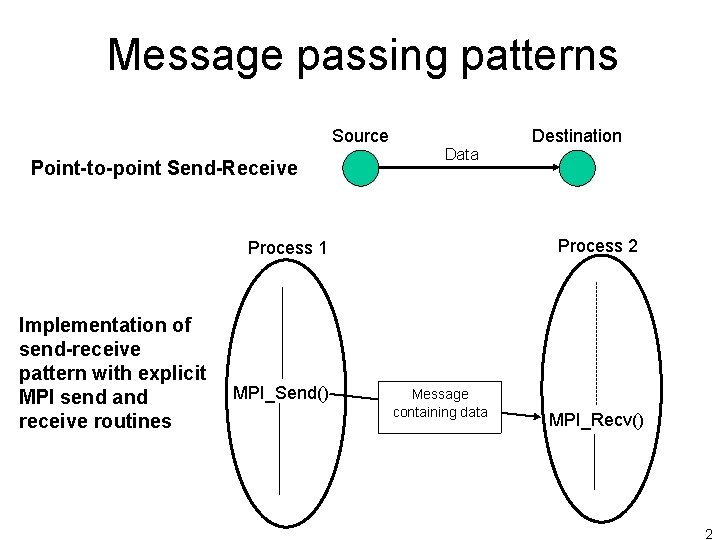
Message passing patterns Source Point-to-point Send-Receive Data Process 2 Process 1 Implementation of send-receive pattern with explicit MPI send and receive routines MPI_Send() Destination Message containing data MPI_Recv() 2
Collective message-passing routines Involve multiple processes. Implements commonly appearing groups of sendreceive patterns efficiently One process (the root) is the source of data sent to other processes, or destination of data sent from other processes. 3
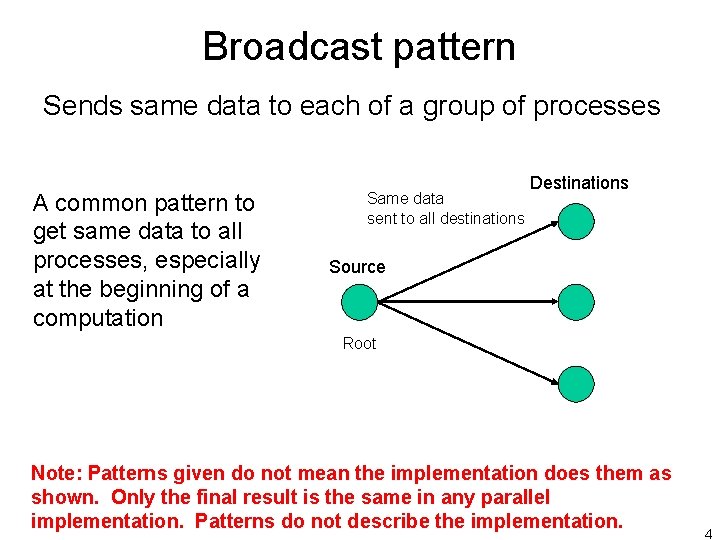
Broadcast pattern Sends same data to each of a group of processes A common pattern to get same data to all processes, especially at the beginning of a computation Same data sent to all destinations Destinations Source Root Note: Patterns given do not mean the implementation does them as shown. Only the final result is the same in any parallel implementation. Patterns do not describe the implementation. 4
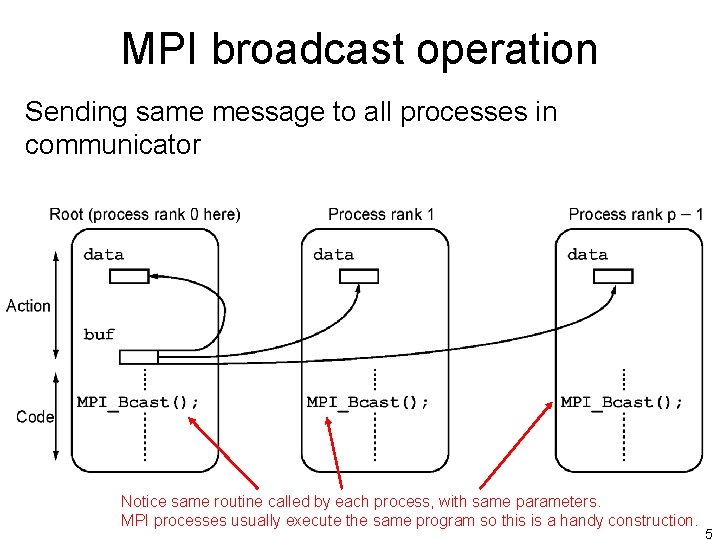
MPI broadcast operation Sending same message to all processes in communicator Notice same routine called by each process, with same parameters. MPI processes usually execute the same program so this is a handy construction. 5
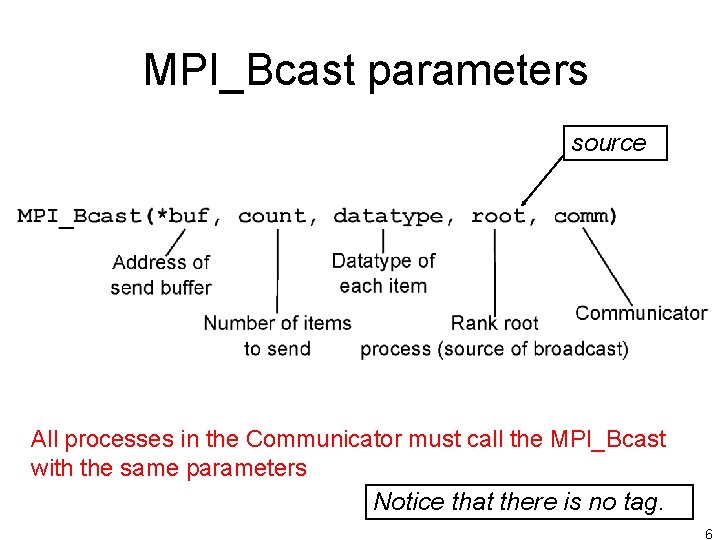
MPI_Bcast parameters source All processes in the Communicator must call the MPI_Bcast with the same parameters Notice that there is no tag. 6
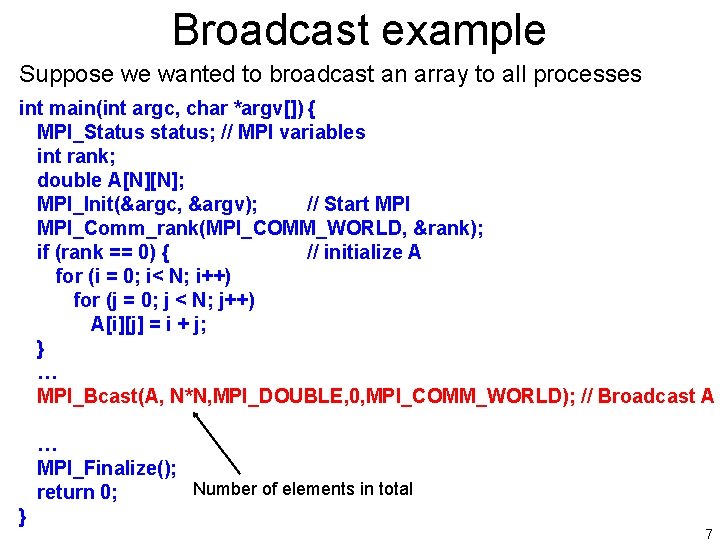
Broadcast example Suppose we wanted to broadcast an array to all processes int main(int argc, char *argv[]) { MPI_Status status; // MPI variables int rank; double A[N][N]; MPI_Init(&argc, &argv); // Start MPI_Comm_rank(MPI_COMM_WORLD, &rank); if (rank == 0) { // initialize A for (i = 0; i< N; i++) for (j = 0; j < N; j++) A[i][j] = i + j; } … MPI_Bcast(A, N*N, MPI_DOUBLE, 0, MPI_COMM_WORLD); // Broadcast A … MPI_Finalize(); Number of elements in total return 0; } 7
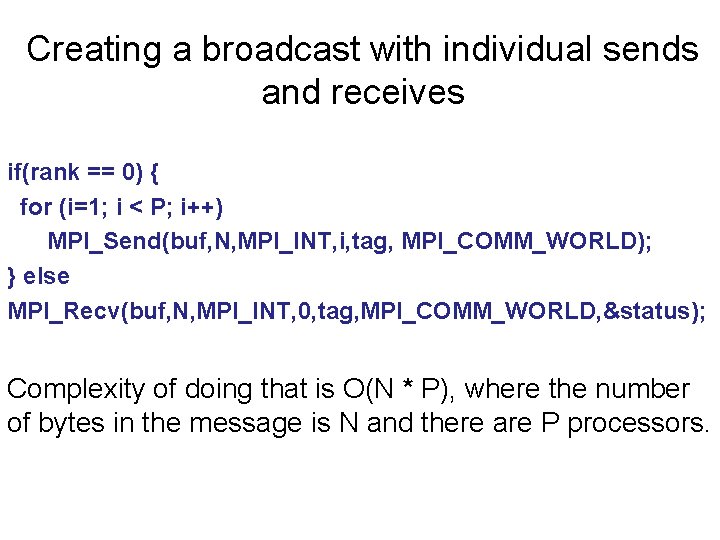
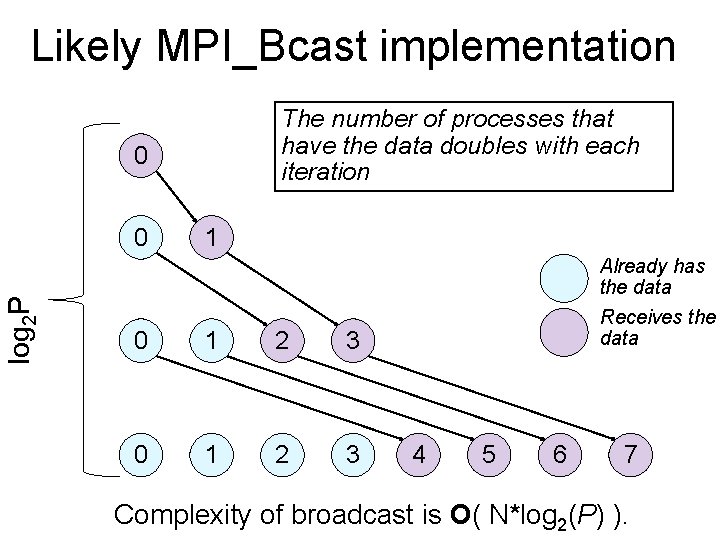
Creating a broadcast with individual sends and receives if(rank == 0) { for (i=1; i < P; i++) MPI_Send(buf, N, MPI_INT, i, tag, MPI_COMM_WORLD); } else MPI_Recv(buf, N, MPI_INT, 0, tag, MPI_COMM_WORLD, &status); Complexity of doing that is O(N * P), where the number of bytes in the message is N and there are P processors.
Likely MPI_Bcast implementation The number of processes that have the data doubles with each iteration 0 log 2 P 0 1 2 3 Already has the data Receives the data 4 5 6 7 Complexity of broadcast is O( N*log 2(P) ).
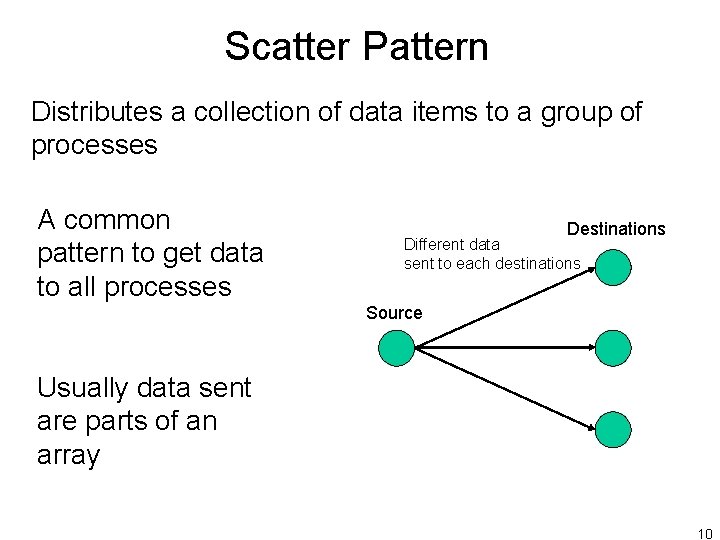
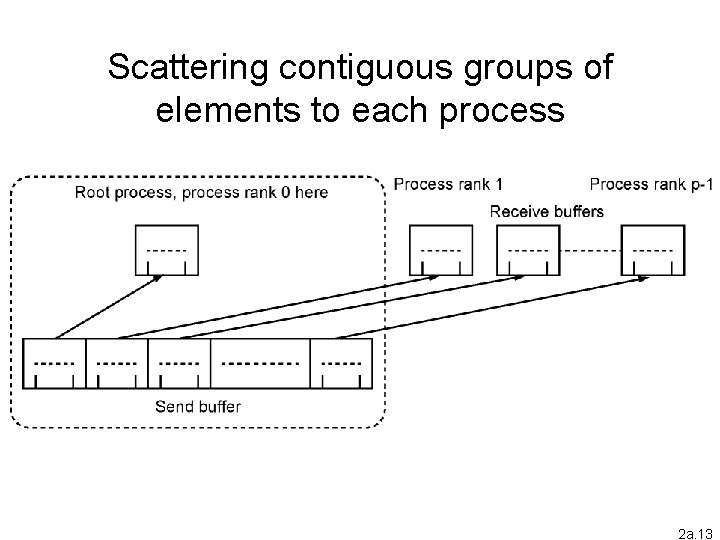
Scatter Pattern Distributes a collection of data items to a group of processes A common pattern to get data to all processes Destinations Different data sent to each destinations Source Usually data sent are parts of an array 10
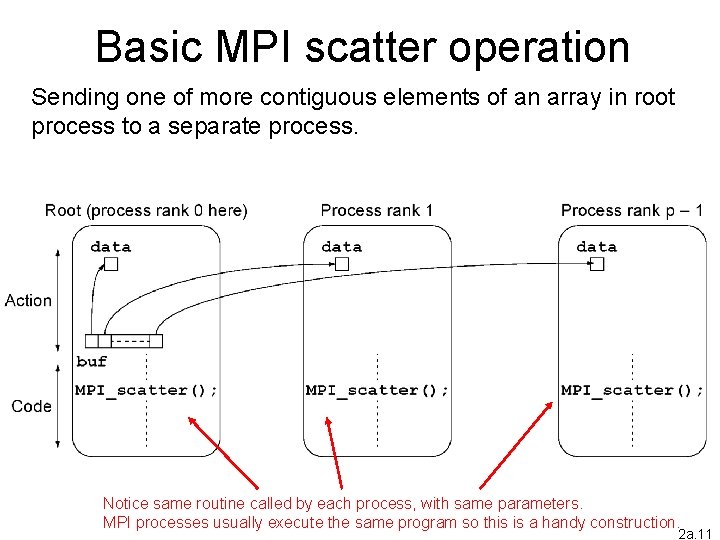
Basic MPI scatter operation Sending one of more contiguous elements of an array in root process to a separate process. Notice same routine called by each process, with same parameters. MPI processes usually execute the same program so this is a handy construction. 2 a. 11
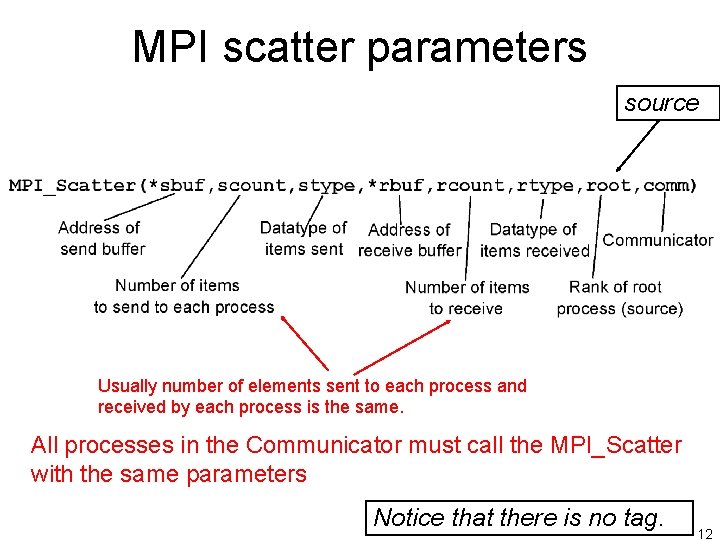
MPI scatter parameters source Usually number of elements sent to each process and received by each process is the same. All processes in the Communicator must call the MPI_Scatter with the same parameters Notice that there is no tag. 12
Scattering contiguous groups of elements to each process 2 a. 13
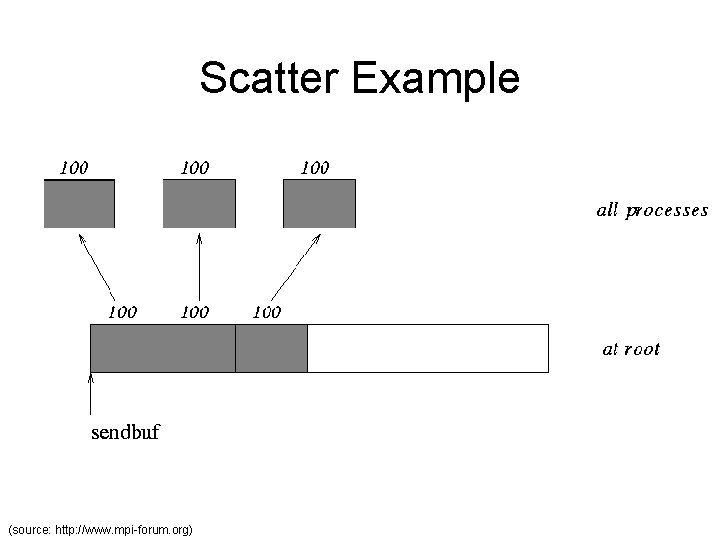
Scatter Example (source: http: //www. mpi-forum. org)
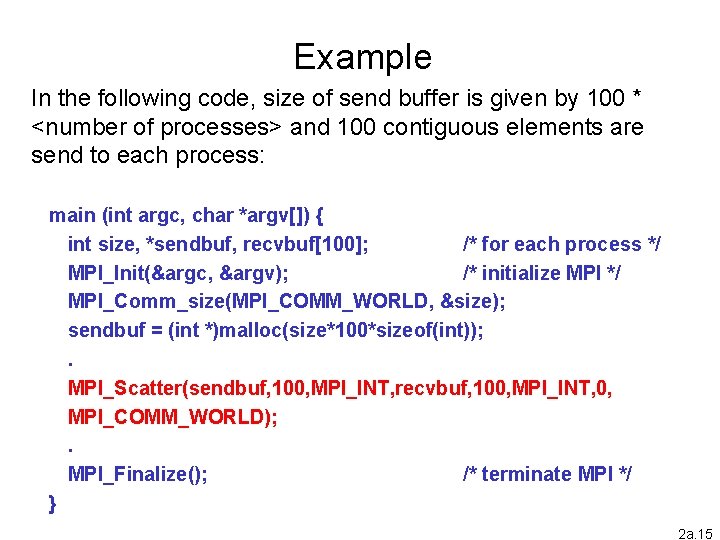
Example In the following code, size of send buffer is given by 100 * <number of processes> and 100 contiguous elements are send to each process: main (int argc, char *argv[]) { int size, *sendbuf, recvbuf[100]; /* for each process */ MPI_Init(&argc, &argv); /* initialize MPI */ MPI_Comm_size(MPI_COMM_WORLD, &size); sendbuf = (int *)malloc(size*100*sizeof(int)); . MPI_Scatter(sendbuf, 100, MPI_INT, recvbuf, 100, MPI_INT, 0, MPI_COMM_WORLD); . MPI_Finalize(); /* terminate MPI */ } 2 a. 15
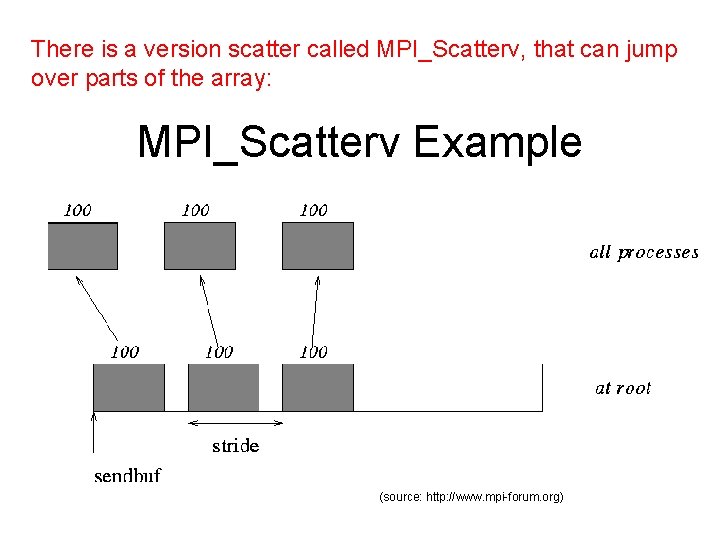
There is a version scatter called MPI_Scatterv, that can jump over parts of the array: MPI_Scatterv Example (source: http: //www. mpi-forum. org)
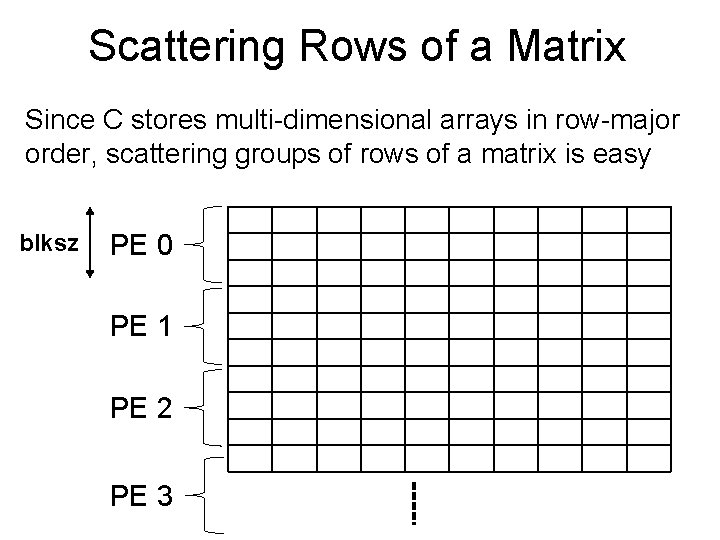
Scattering Rows of a Matrix Since C stores multi-dimensional arrays in row-major order, scattering groups of rows of a matrix is easy blksz PE 0 PE 1 PE 2 PE 3
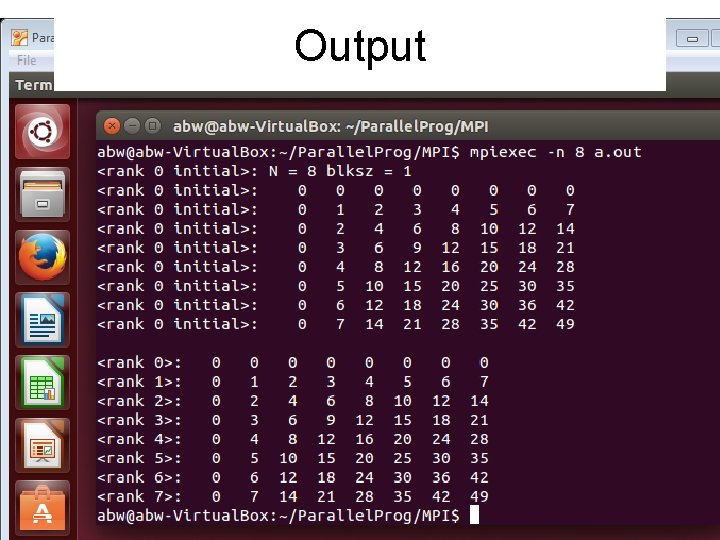
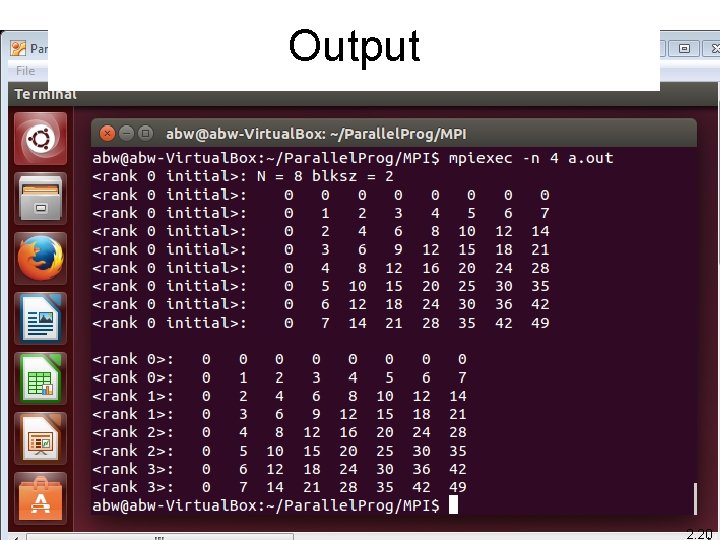
Scatter example Scatter blksz number of rows of an array table[N][N] to each of P processes, where blksz = N/P. … #define N 8 int main( int argc, char **argv ) { int rank, P, i, j, blksz; int table[N][N], row[N][N]; MPI_Init( &argc, &argv ); MPI_Comm_rank( MPI_COMM_WORLD, &rank); MPI_Comm_size( MPI_COMM_WORLD, &P); blksz = N/P; // N/P must be an integer here if (rank == 0) {. . . Initialize table[][] with numbers (multiplication table) } Number or rows sent and received same // All processors do this MPI_Scatter (table, blksz*N, MPI_INT, row, blksz*N, MPI_INT, 0, MPI_COMM_WORLD); … // All processes print what they get MPI_Finalize(); 2. 18
Output 2. 19
Output 2. 20
Generating readable output • Can be tricky as cannot guarantee order of printf statements executed by different processes unless force order that processes execute. • Usually have to add sleep statements (stdout flush and barriers alone do not necessarily work). 2. 21
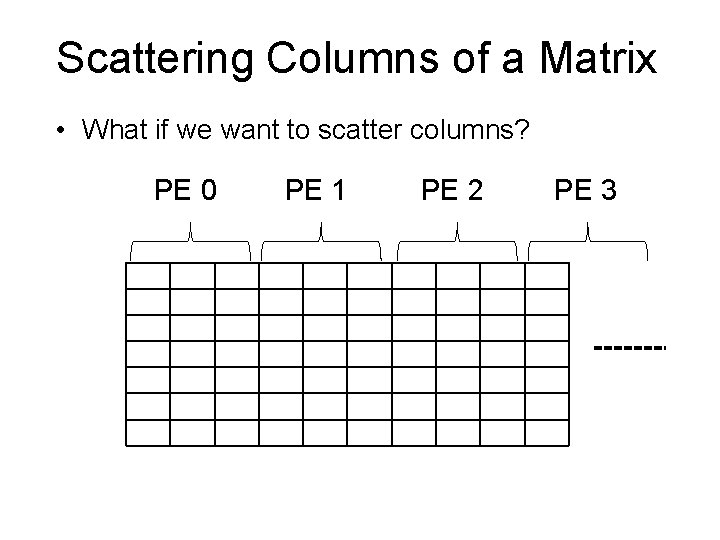
Scattering Columns of a Matrix • What if we want to scatter columns? PE 0 PE 1 PE 2 PE 3
Scattering Columns of a Matrix • The easiest solution would be to transpose the matrix, then scatter the rows (although transpose incurs an overhead especially for large matrices).
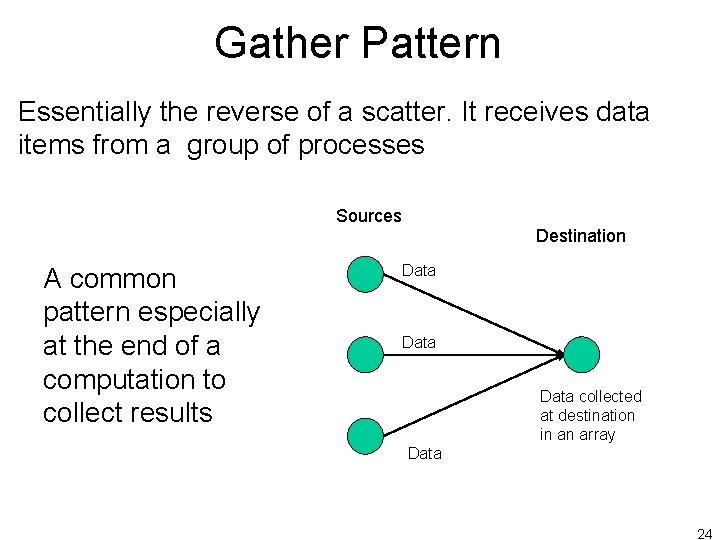
Gather Pattern Essentially the reverse of a scatter. It receives data items from a group of processes Sources A common pattern especially at the end of a computation to collect results Destination Data collected at destination in an array Data 24
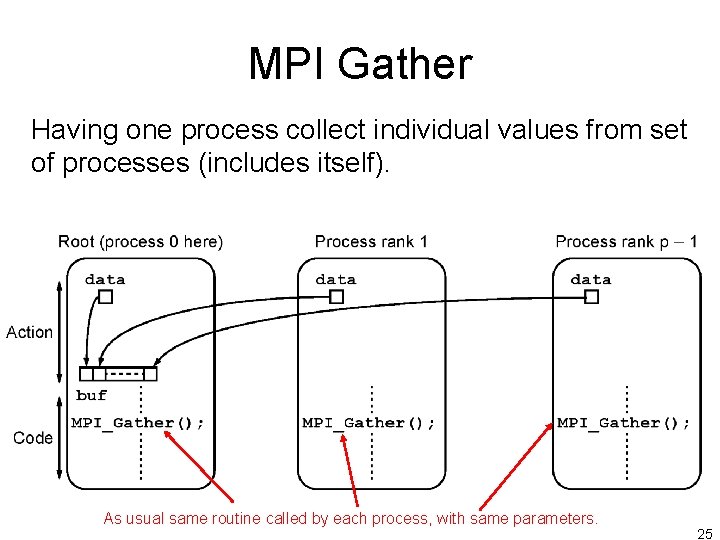
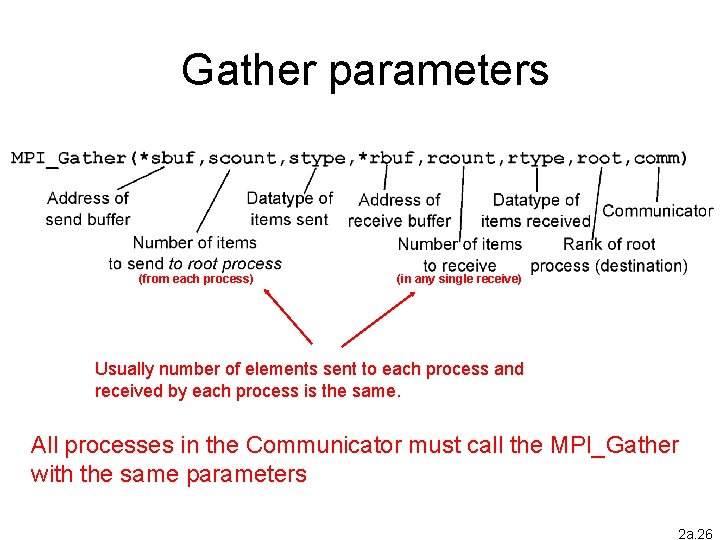
MPI Gather Having one process collect individual values from set of processes (includes itself). As usual same routine called by each process, with same parameters. 25
Gather parameters (from each process) (in any single receive) Usually number of elements sent to each process and received by each process is the same. All processes in the Communicator must call the MPI_Gather with the same parameters 2 a. 26
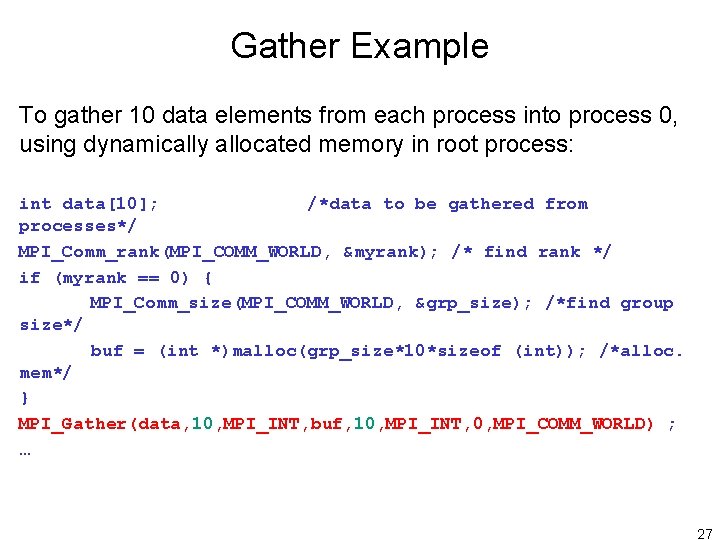
Gather Example To gather 10 data elements from each process into process 0, using dynamically allocated memory in root process: int data[10]; /*data to be gathered from processes*/ MPI_Comm_rank(MPI_COMM_WORLD, &myrank); /* find rank */ if (myrank == 0) { MPI_Comm_size(MPI_COMM_WORLD, &grp_size); /*find group size*/ buf = (int *)malloc(grp_size*10*sizeof (int)); /*alloc. mem*/ } MPI_Gather(data, 10, MPI_INT, buf, 10, MPI_INT, 0, MPI_COMM_WORLD) ; … 27
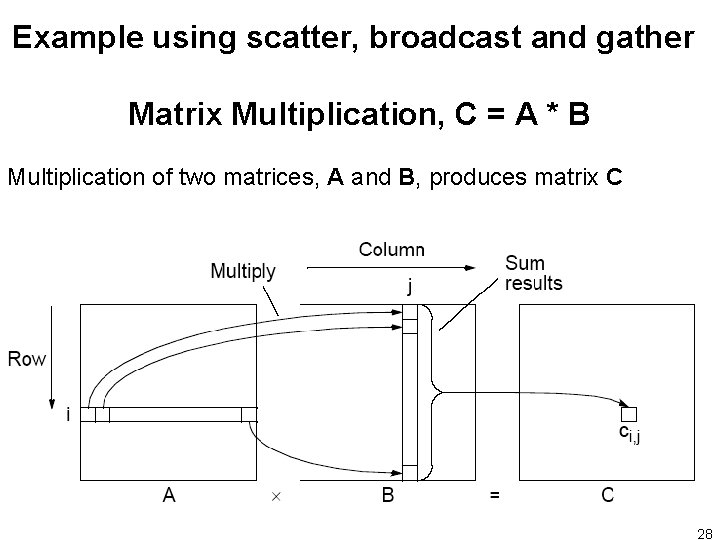
Example using scatter, broadcast and gather Matrix Multiplication, C = A * B Multiplication of two matrices, A and B, produces matrix C 28
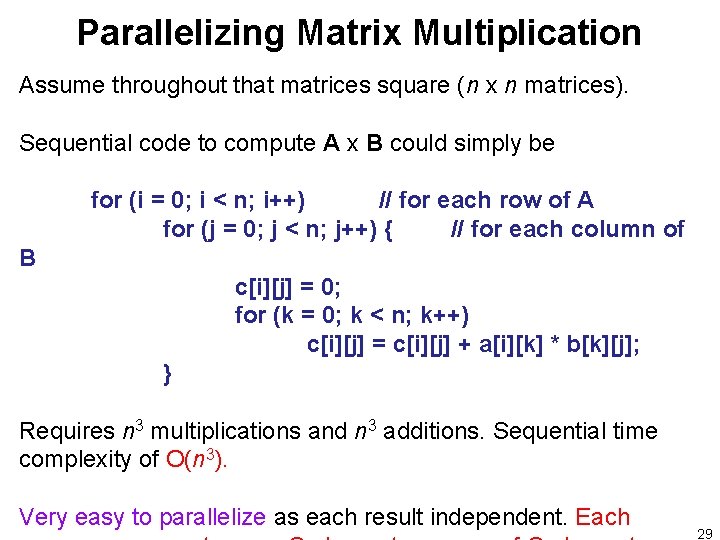
Parallelizing Matrix Multiplication Assume throughout that matrices square (n x n matrices). Sequential code to compute A x B could simply be for (i = 0; i < n; i++) // for each row of A for (j = 0; j < n; j++) { // for each column of B c[i][j] = 0; for (k = 0; k < n; k++) c[i][j] = c[i][j] + a[i][k] * b[k][j]; } Requires n 3 multiplications and n 3 additions. Sequential time complexity of O(n 3). Very easy to parallelize as each result independent. Each 29
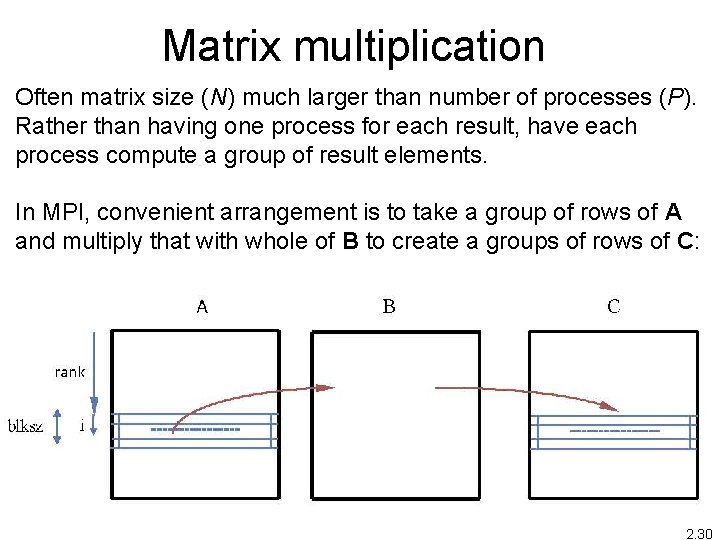
Matrix multiplication Often matrix size (N) much larger than number of processes (P). Rather than having one process for each result, have each process compute a group of result elements. In MPI, convenient arrangement is to take a group of rows of A and multiply that with whole of B to create a groups of rows of C: 2. 30
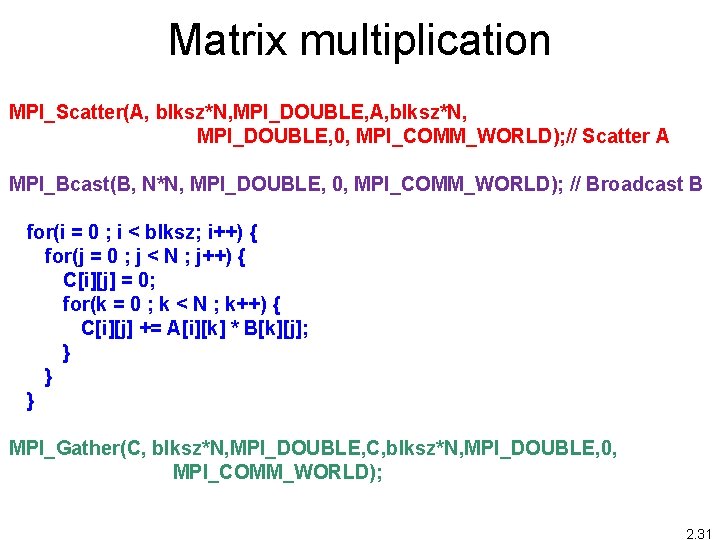
Matrix multiplication MPI_Scatter(A, blksz*N, MPI_DOUBLE, 0, MPI_COMM_WORLD); // Scatter A MPI_Bcast(B, N*N, MPI_DOUBLE, 0, MPI_COMM_WORLD); // Broadcast B for(i = 0 ; i < blksz; i++) { for(j = 0 ; j < N ; j++) { C[i][j] = 0; for(k = 0 ; k < N ; k++) { C[i][j] += A[i][k] * B[k][j]; } } } MPI_Gather(C, blksz*N, MPI_DOUBLE, 0, MPI_COMM_WORLD); 2. 31
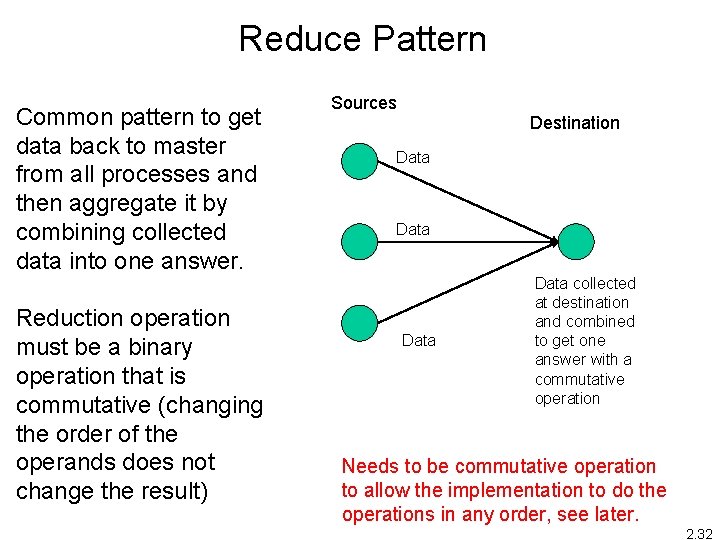
Reduce Pattern Common pattern to get data back to master from all processes and then aggregate it by combining collected data into one answer. Reduction operation must be a binary operation that is commutative (changing the order of the operands does not change the result) Sources Destination Data collected at destination and combined to get one answer with a commutative operation Needs to be commutative operation to allow the implementation to do the operations in any order, see later. 2. 32
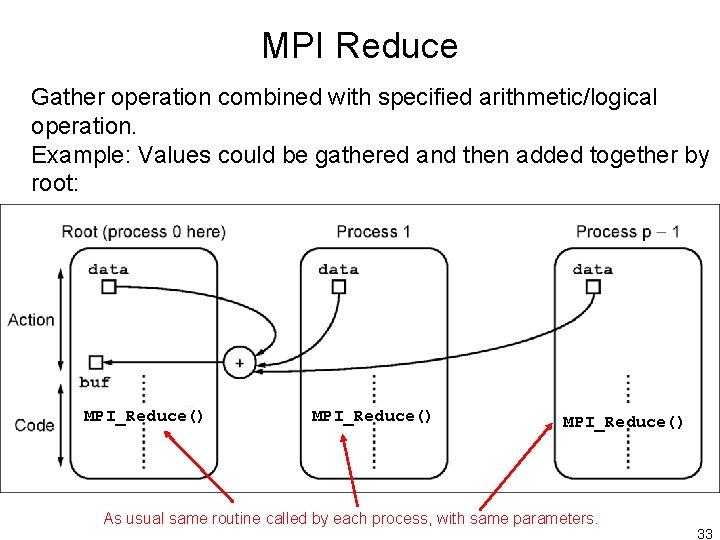
MPI Reduce Gather operation combined with specified arithmetic/logical operation. Example: Values could be gathered and then added together by root: MPI_Reduce() As usual same routine called by each process, with same parameters. 33
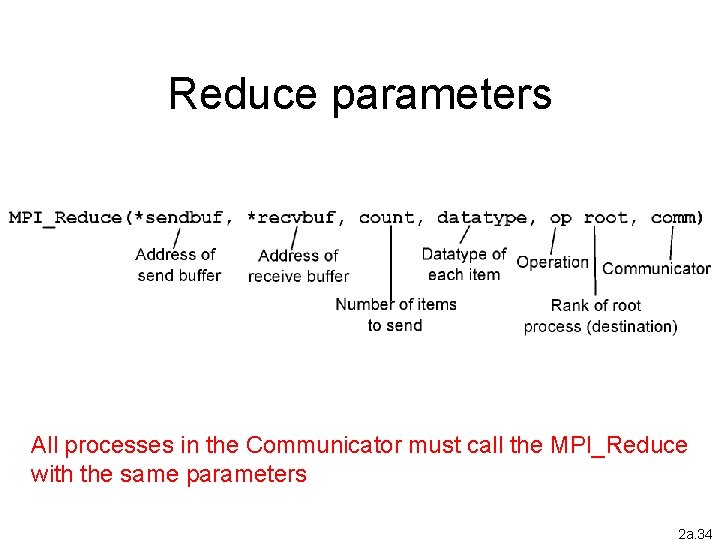
Reduce parameters All processes in the Communicator must call the MPI_Reduce with the same parameters 2 a. 34
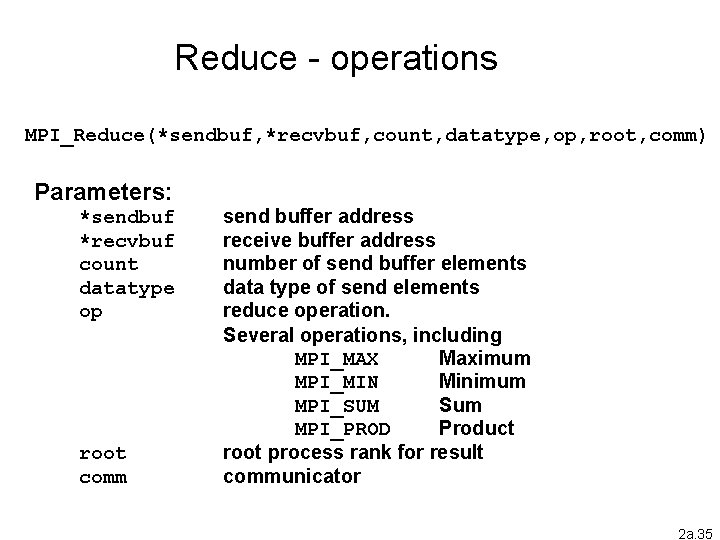
Reduce - operations MPI_Reduce(*sendbuf, *recvbuf, count, datatype, op, root, comm) Parameters: *sendbuf *recvbuf count datatype op root comm send buffer address receive buffer address number of send buffer elements data type of send elements reduce operation. Several operations, including MPI_MAX Maximum MPI_MIN Minimum MPI_SUM Sum MPI_PROD Product root process rank for result communicator 2 a. 35
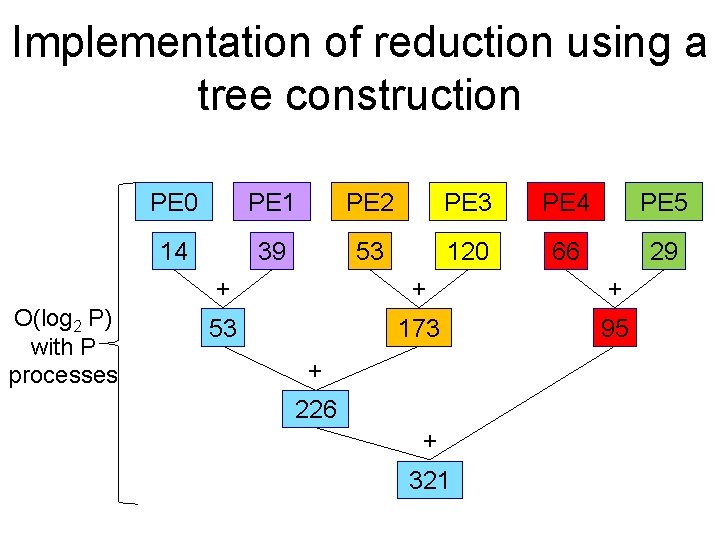
Implementation of reduction using a tree construction O(log 2 P) with P processes PE 0 PE 1 PE 2 PE 3 PE 4 PE 5 14 39 53 120 66 29 + + + 53 173 95 + 226 + 321
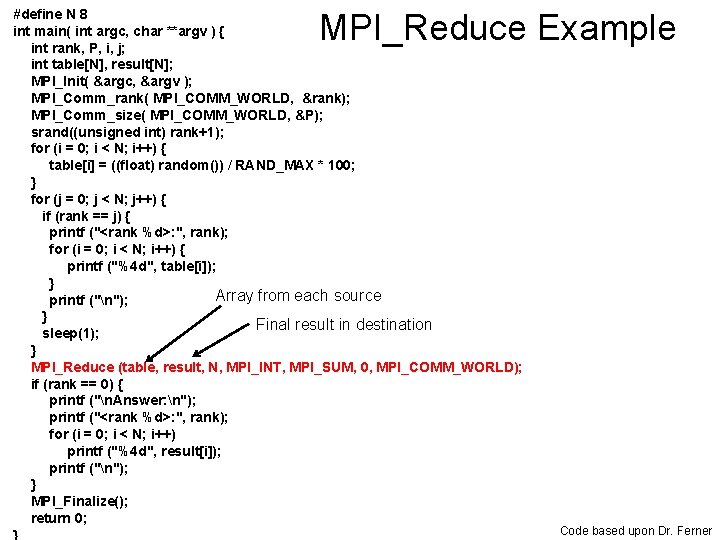
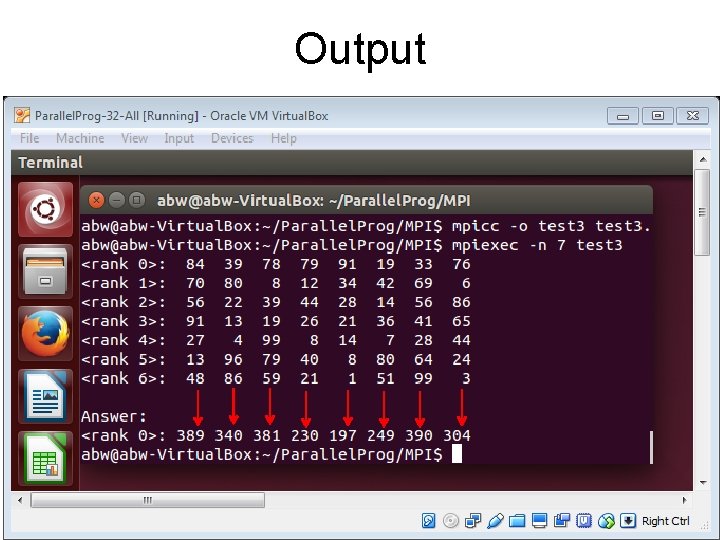
#define N 8 int main( int argc, char **argv ) { int rank, P, i, j; int table[N], result[N]; MPI_Init( &argc, &argv ); MPI_Comm_rank( MPI_COMM_WORLD, &rank); MPI_Comm_size( MPI_COMM_WORLD, &P); srand((unsigned int) rank+1); for (i = 0; i < N; i++) { table[i] = ((float) random()) / RAND_MAX * 100; } for (j = 0; j < N; j++) { if (rank == j) { printf ("<rank %d>: ", rank); for (i = 0; i < N; i++) { printf ("%4 d", table[i]); } Array from each source printf ("n"); } Final result in destination sleep(1); } MPI_Reduce (table, result, N, MPI_INT, MPI_SUM, 0, MPI_COMM_WORLD); if (rank == 0) { printf ("n. Answer: n"); printf ("<rank %d>: ", rank); for (i = 0; i < N; i++) printf ("%4 d", result[i]); printf ("n"); } MPI_Finalize(); return 0; } MPI_Reduce Example Code based upon Dr. Ferner
Output 2. 38
Combined Patterns 2. 39
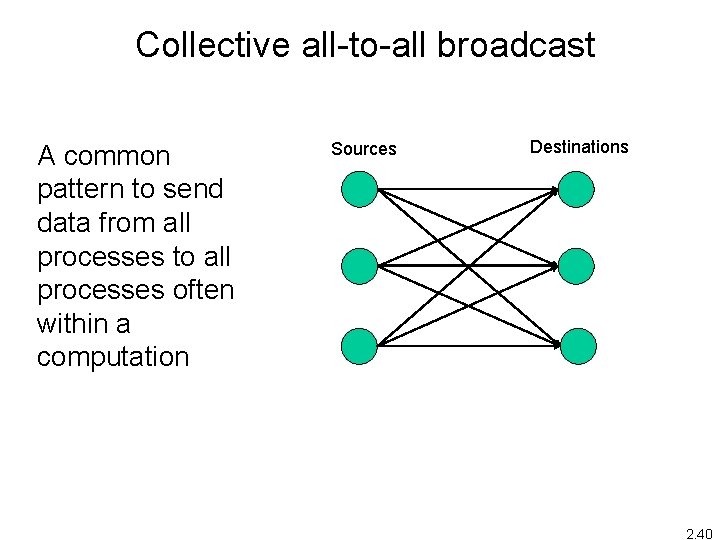
Collective all-to-all broadcast A common pattern to send data from all processes to all processes often within a computation Sources Destinations 2. 40
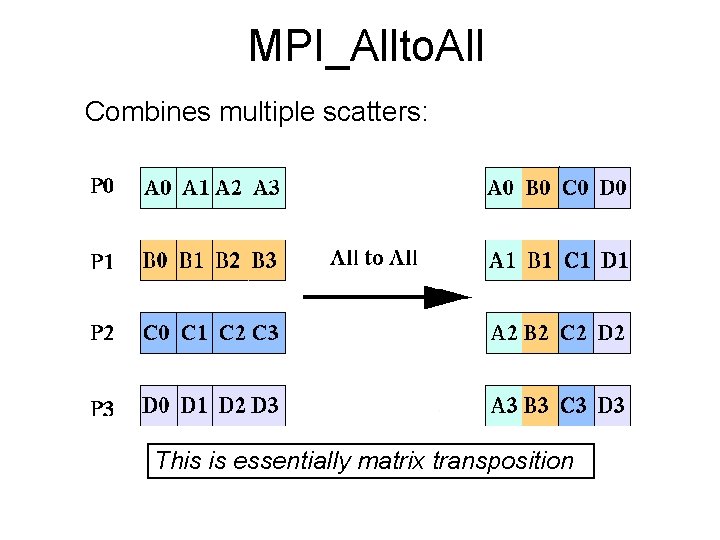
MPI_Allto. All Combines multiple scatters: This is essentially matrix transposition
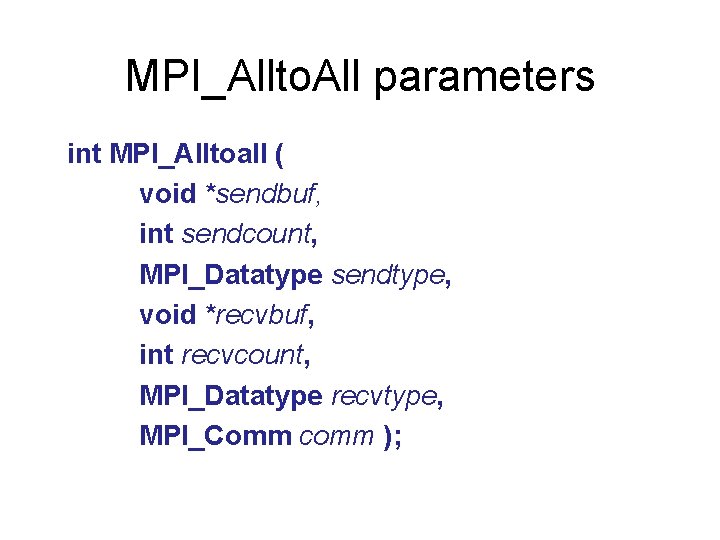
MPI_Allto. All parameters int MPI_Alltoall ( void *sendbuf, int sendcount, MPI_Datatype sendtype, void *recvbuf, int recvcount, MPI_Datatype recvtype, MPI_Comm comm );
Some other combined patterns in MPI • MPI_Reduce_scatter() Combines values and scatters the results • MPI_Allreduce() Combines values from all processes and distributes the results back to all processes • MPI_Sendrecv() Sends and receives a message (without deadlock, see later) 43
MPI Collective data transfer routines General features • Performed on a group of processes, identified by a communicator • Substitutes for a sequence of point-to-point calls • Communications are locally blocking • Synchronization is not guaranteed (implementation dependent) • Most routines use a root process to originate or receive all data (broadcast, scatter, gather, reduce, …) • Data amounts must exactly match • Many variations to basic categories • No message tags needed From http: //www. pdc. kth. se/training/Talks/MPI/Collective. I/less. html#characteristics 44
Data transfer collective routines Synchronization • Generally the collective operations have the same semantics as if individual MPI_ send()s and MPI_recv()’s were used according to the MPI standard. • i. e. both sends and recv’s are locally blocking, sends will return after sending message, recv’s will wait for messages. • However we need to know the exact implementation to really figure out when each process will return. 45
Questions 46