
Message Service System M L Liu 132022 Distributed
Message Service System M. L. Liu 1/3/2022 Distributed Computing, M. L. Liu 1
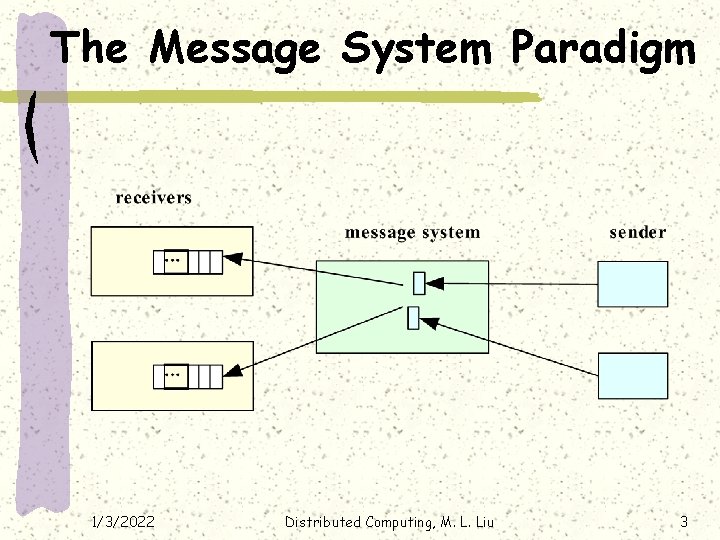
The Message System Paradigm The Message System or Message-Oriented Middleware (MOM) paradigm is an elaboration of the basic messagepassing paradigm. In this paradigm, a message system serves as an intermediary among separate, independent processes. The message system acts as a switch for messages, through which processes exchange messages asynchronously, in a decoupled manner. A sender deposits a message with the message system, which forwards it to a message queue associated with each receiver. Once a message is sent, the sender is free to move on to other tasks. 1/3/2022 Distributed Computing, M. L. Liu 2
The Message System Paradigm 1/3/2022 Distributed Computing, M. L. Liu 3
Message System Models Two subtypes of message system models: Point-to-point Publish-subscribe 1/3/2022 Distributed Computing, M. L. Liu 4
The Point-To-Point Message Model In this model, a message system forwards a message from the sender to the receiver’s message queue. Unlike the basic message passing model, the middleware provides a message depository, and allows the sending and the receiving to be decoupled. Via the middleware, a sender deposits a message in the message queue of the receiving process. A receiving process extracts the messages from its message queue, and handles each one accordingly. Compared to the basic message-passing model, this paradigm provides the additional abstraction for asynchronous operations. 1/3/2022 Distributed Computing, M. L. Liu 5
The Publish/Subscribe Message Model In this model, each message is associated with a specific topic or event. Applications interested in the occurrence of a specific event may subscribe to messages for that event. When the awaited event occurs, the process publishes a message announcing the event or topic. The middleware message system distributes the message to all its subscribers. The publish/subscribe message model offers a powerful abstraction for multicasting or group communication. The publish operation allows a process to multicast to a group of processes, and the subscribe operation allows a process to listen for such multicast. 1/3/2022 Distributed Computing, M. L. Liu 6
Toolkits based on the Message -System Paradigm The MOM paradigm has had a long history in distributed applications. Message Queue Services (MQS) have been in use since the 1980’s. The IBM MQ*Series 6 is an example of such a facility. http: //www-4. ibm. com/software/ts/mqseries/ Other existing support for this paradigm are Microsoft’s Message Queue (MSQ), Java’s Message Service 1/3/2022 Distributed Computing, M. L. Liu 7
Sources of Information Sun's JMS Tutorial http: //java. sun. com/products/jms/tutorial/html/jms. TOC. f m. html Microsoft's Message Queue(MSMQ) http: //msdn. microsoft. com/library/psdk/msmq IBM's MQ-Series http: //www-4. ibm. com/software/ts/mqseries/ 1/3/2022 Distributed Computing, M. L. Liu 8
- Slides: 8