
Message Authentication Codes Ch 12 u u u
- Slides: 50
Message Authentication Codes (Ch. 12) u u u u u Message authentication requirements Message authentication functions Requirements for message authentication codes Security of MACs based on hash functions (HMAC) MACs based on block ciphers (DAA and CMAC) Authenticated encription (CCM and GCM) Pseudorandom number generation using hash functions and MACs Summary Cryptograpgy and Network Security 12 - 1 Anthony J. T. Lee Dept. of Information Management, NTU
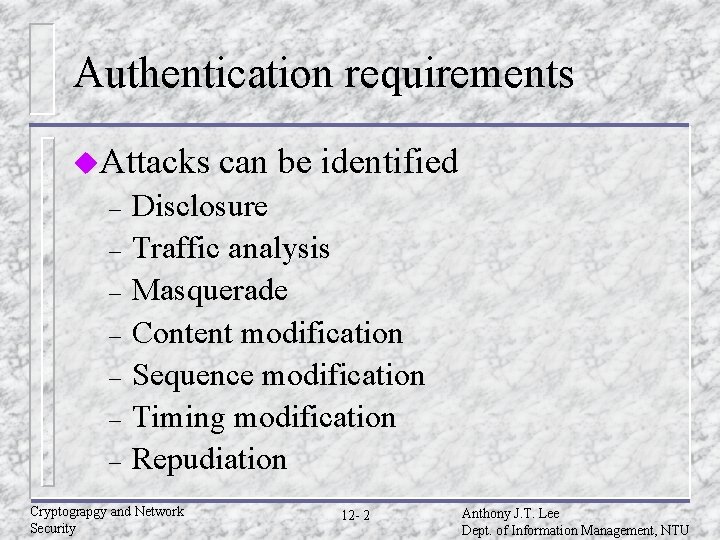
Authentication requirements u. Attacks – – – – can be identified Disclosure Traffic analysis Masquerade Content modification Sequence modification Timing modification Repudiation Cryptograpgy and Network Security 12 - 2 Anthony J. T. Lee Dept. of Information Management, NTU
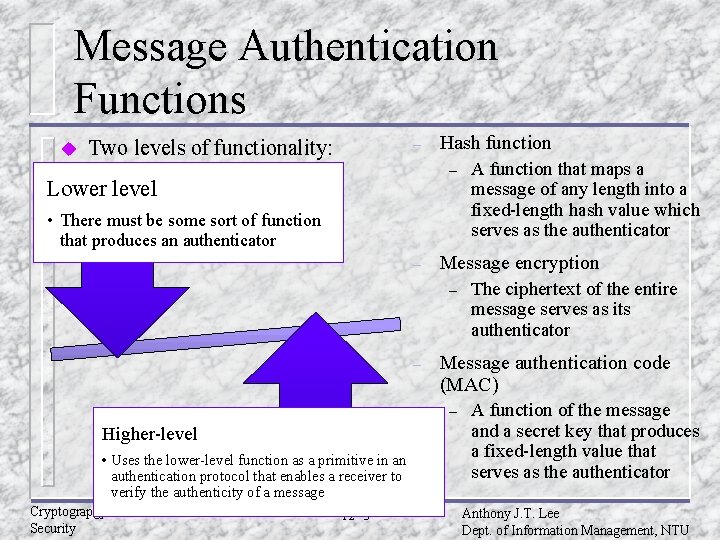
Message Authentication Functions u – Two levels of functionality: Hash function – Lower level • There must be some sort of function that produces an authenticator – Message encryption – – • Uses the lower-level function as a primitive in an authentication protocol that enables a receiver to verify the authenticity of a message Cryptograpgy and Network Security 12 - 3 The ciphertext of the entire message serves as its authenticator Message authentication code (MAC) – Higher-level A function that maps a message of any length into a fixed-length hash value which serves as the authenticator A function of the message and a secret key that produces a fixed-length value that serves as the authenticator Anthony J. T. Lee Dept. of Information Management, NTU
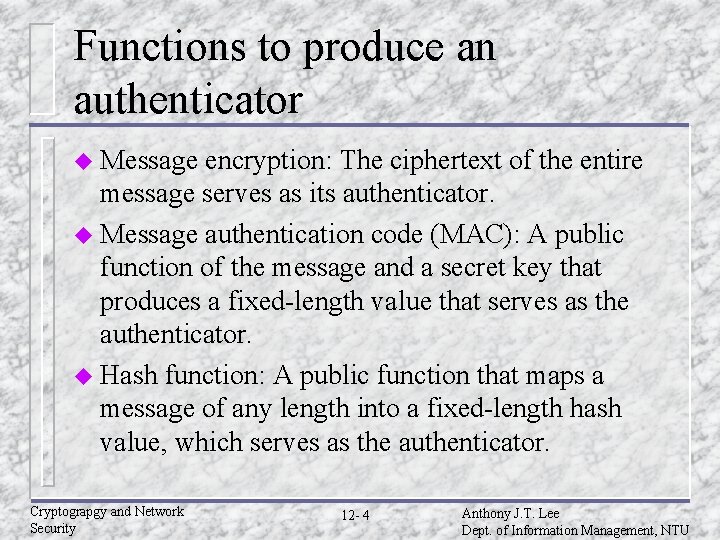
Functions to produce an authenticator u Message encryption: The ciphertext of the entire message serves as its authenticator. u Message authentication code (MAC): A public function of the message and a secret key that produces a fixed-length value that serves as the authenticator. u Hash function: A public function that maps a message of any length into a fixed-length hash value, which serves as the authenticator. Cryptograpgy and Network Security 12 - 4 Anthony J. T. Lee Dept. of Information Management, NTU
Message encryption u Symmetric encryption u Public key encryption Cryptograpgy and Network Security 12 - 5 Anthony J. T. Lee Dept. of Information Management, NTU
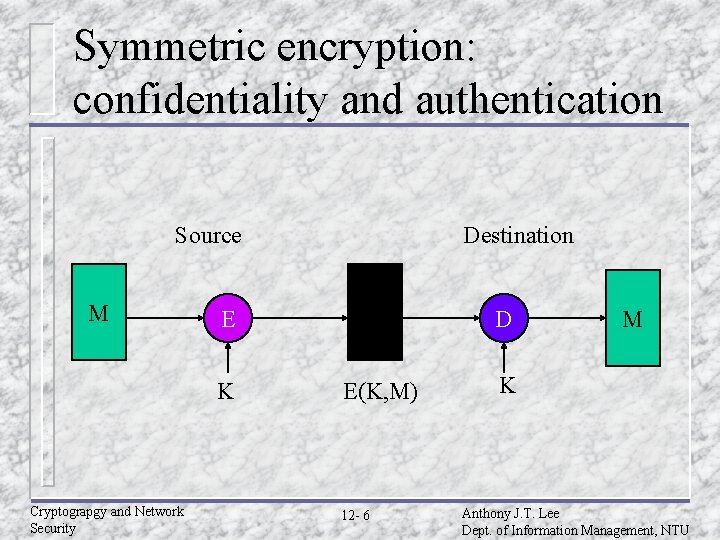
Symmetric encryption: confidentiality and authentication Source M E K Cryptograpgy and Network Security Destination D E(K, M) 12 - 6 M K Anthony J. T. Lee Dept. of Information Management, NTU
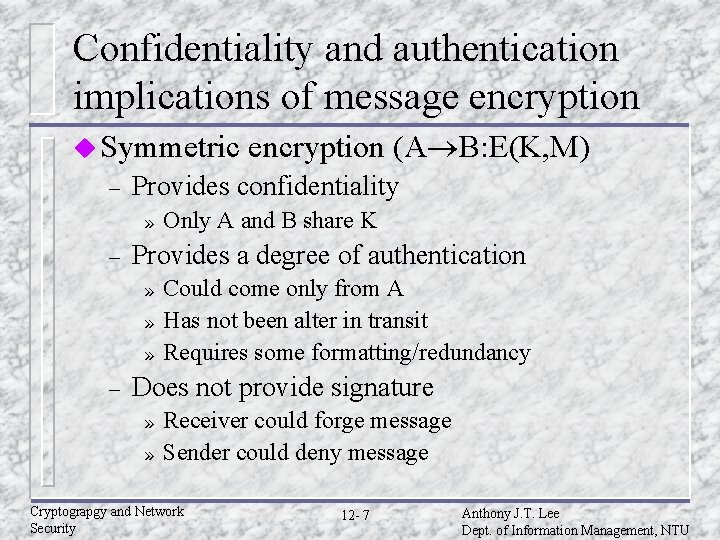
Confidentiality and authentication implications of message encryption u Symmetric – Provides confidentiality » – Only A and B share K Provides a degree of authentication » » » – encryption (A B: E(K, M) Could come only from A Has not been alter in transit Requires some formatting/redundancy Does not provide signature » » Receiver could forge message Sender could deny message Cryptograpgy and Network Security 12 - 7 Anthony J. T. Lee Dept. of Information Management, NTU
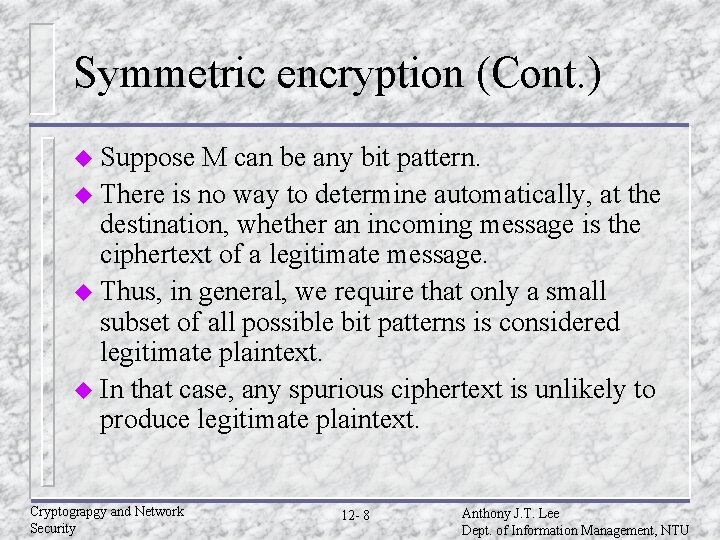
Symmetric encryption (Cont. ) u Suppose M can be any bit pattern. u There is no way to determine automatically, at the destination, whether an incoming message is the ciphertext of a legitimate message. u Thus, in general, we require that only a small subset of all possible bit patterns is considered legitimate plaintext. u In that case, any spurious ciphertext is unlikely to produce legitimate plaintext. Cryptograpgy and Network Security 12 - 8 Anthony J. T. Lee Dept. of Information Management, NTU
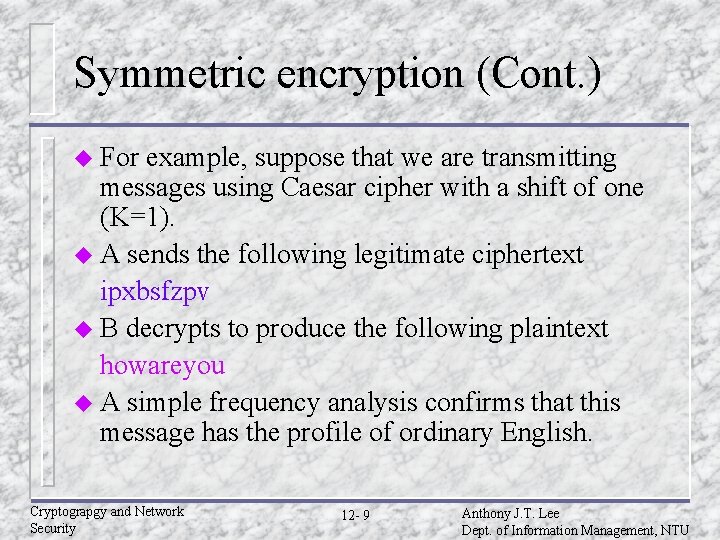
Symmetric encryption (Cont. ) u For example, suppose that we are transmitting messages using Caesar cipher with a shift of one (K=1). u A sends the following legitimate ciphertext ipxbsfzpv u B decrypts to produce the following plaintext howareyou u A simple frequency analysis confirms that this message has the profile of ordinary English. Cryptograpgy and Network Security 12 - 9 Anthony J. T. Lee Dept. of Information Management, NTU
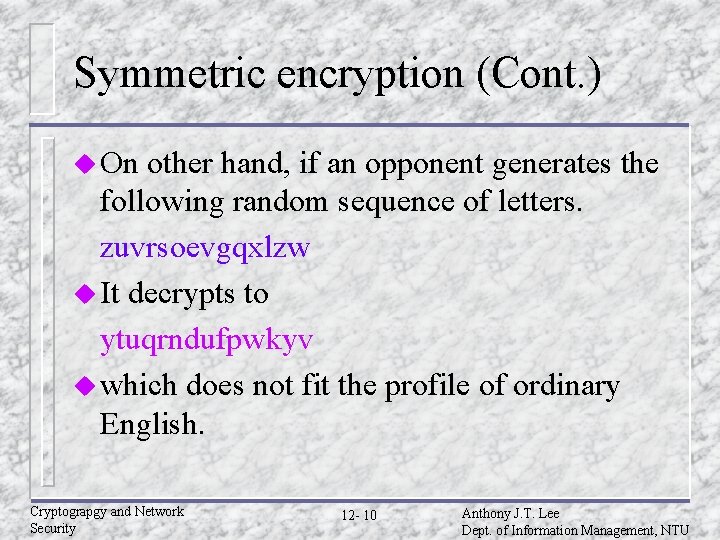
Symmetric encryption (Cont. ) u On other hand, if an opponent generates the following random sequence of letters. zuvrsoevgqxlzw u It decrypts to ytuqrndufpwkyv u which does not fit the profile of ordinary English. Cryptograpgy and Network Security 12 - 10 Anthony J. T. Lee Dept. of Information Management, NTU
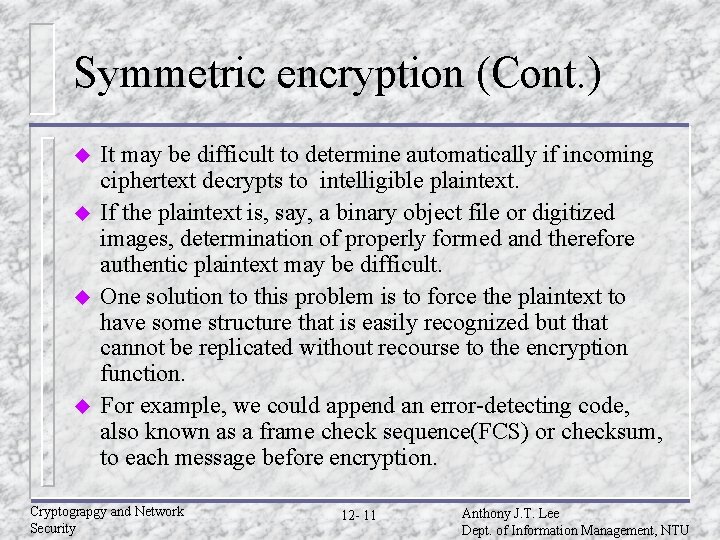
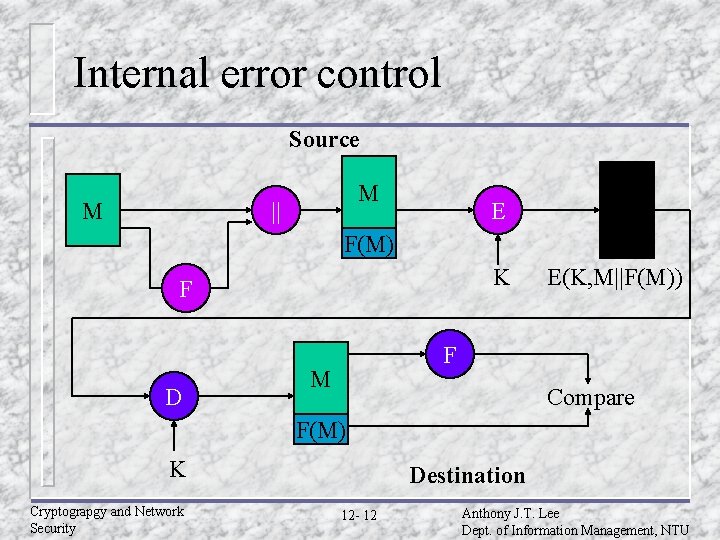
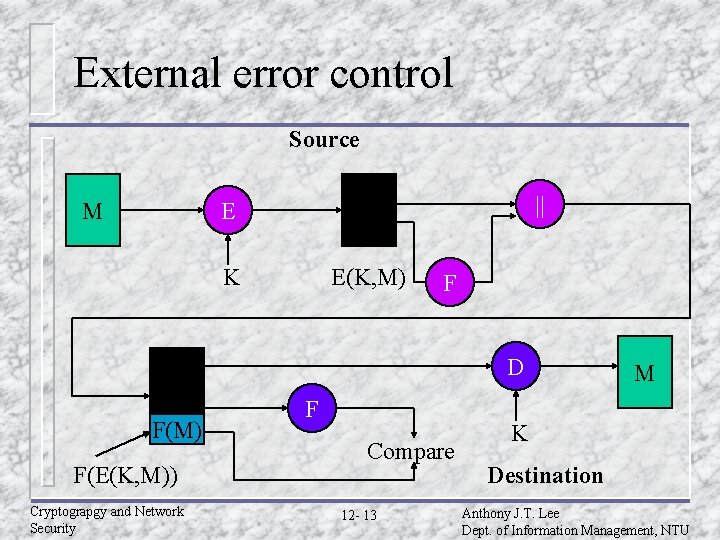
Symmetric encryption (Cont. ) u u It may be difficult to determine automatically if incoming ciphertext decrypts to intelligible plaintext. If the plaintext is, say, a binary object file or digitized images, determination of properly formed and therefore authentic plaintext may be difficult. One solution to this problem is to force the plaintext to have some structure that is easily recognized but that cannot be replicated without recourse to the encryption function. For example, we could append an error-detecting code, also known as a frame check sequence(FCS) or checksum, to each message before encryption. Cryptograpgy and Network Security 12 - 11 Anthony J. T. Lee Dept. of Information Management, NTU
Internal error control Source M || M E F(M) K F D E(K, M||F(M)) F M Compare F(M) K Cryptograpgy and Network Security Destination 12 - 12 Anthony J. T. Lee Dept. of Information Management, NTU
External error control Source M E M K E(K, M) || F D F(M) F(E(K, M)) Cryptograpgy and Network Security F Compare 12 - 13 M K Destination Anthony J. T. Lee Dept. of Information Management, NTU
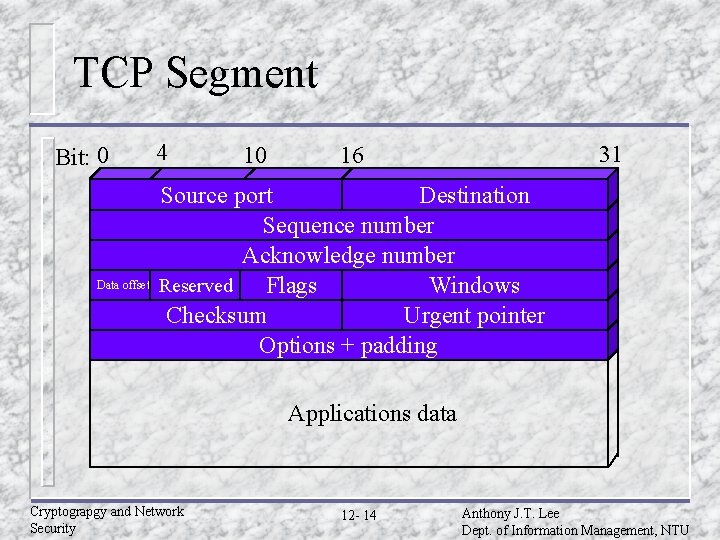
TCP Segment Bit: 0 Data offset 4 10 31 16 Source port Destination Sequence number Acknowledge number Reserved Flags Windows Checksum Urgent pointer Options + padding Applications data Cryptograpgy and Network Security 12 - 14 Anthony J. T. Lee Dept. of Information Management, NTU
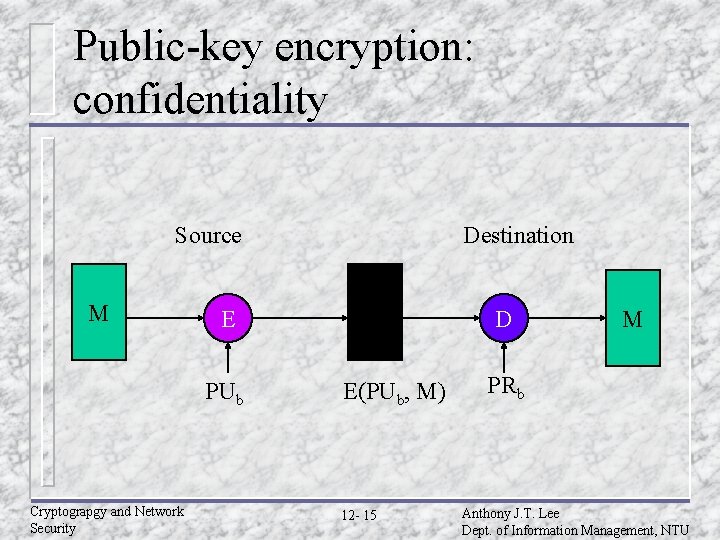
Public-key encryption: confidentiality Source M E PUb Cryptograpgy and Network Security Destination D E(PUb, M) 12 - 15 M PRb Anthony J. T. Lee Dept. of Information Management, NTU
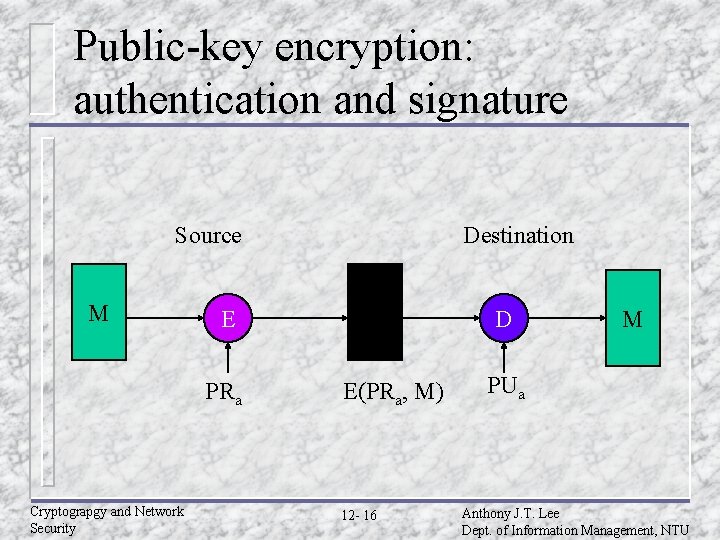
Public-key encryption: authentication and signature Source M E PRa Cryptograpgy and Network Security Destination D E(PRa, M) 12 - 16 M PUa Anthony J. T. Lee Dept. of Information Management, NTU
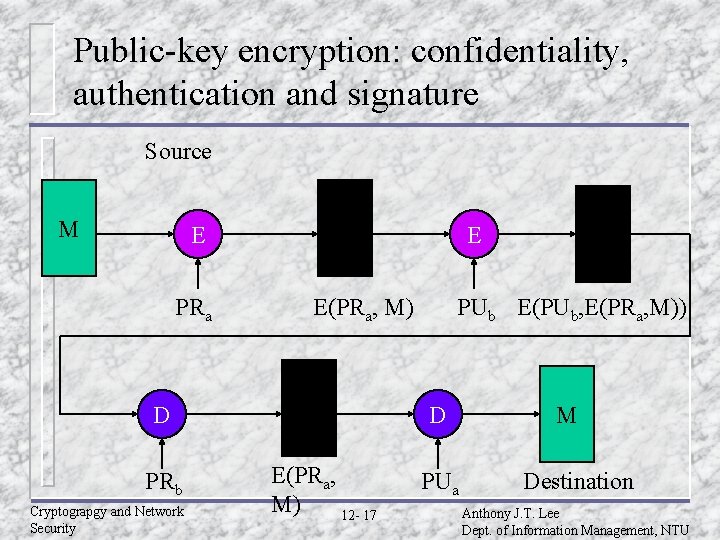
Public-key encryption: confidentiality, authentication and signature Source M E PRa E D PRb Cryptograpgy and Network Security PUb E(PUb, E(PRa, M)) E(PRa, M) D E(PRa, M) 12 - 17 PUa M Destination Anthony J. T. Lee Dept. of Information Management, NTU
Public-key encryption: confidentiality, authentication and signature u The disadvantage of this approach is that the public-key algorithm, which is complex, must be exercised four times rather than two in each communication. Cryptograpgy and Network Security 12 - 18 Anthony J. T. Lee Dept. of Information Management, NTU
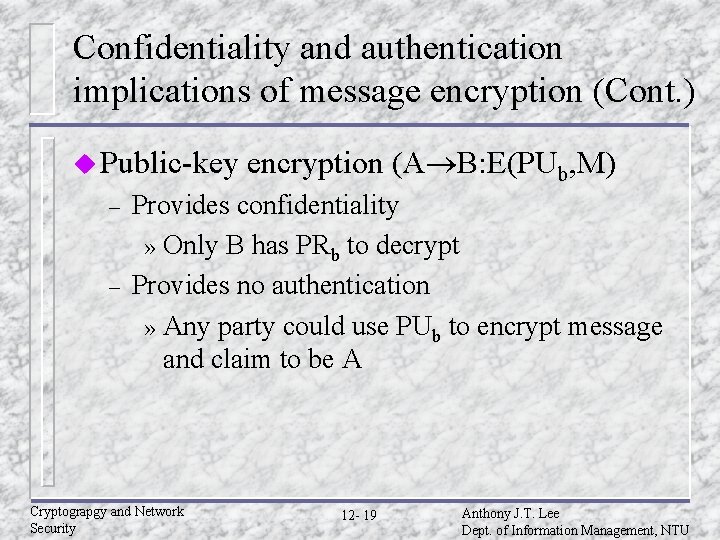
Confidentiality and authentication implications of message encryption (Cont. ) u Public-key – – encryption (A B: E(PUb, M) Provides confidentiality » Only B has PRb to decrypt Provides no authentication » Any party could use PUb to encrypt message and claim to be A Cryptograpgy and Network Security 12 - 19 Anthony J. T. Lee Dept. of Information Management, NTU
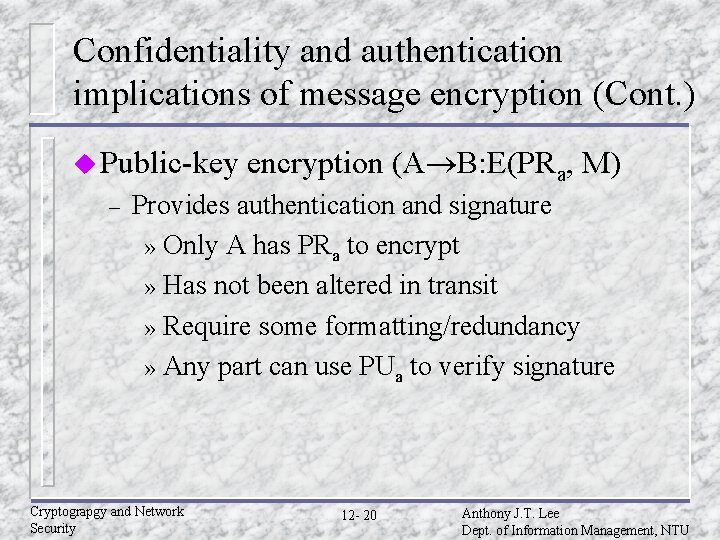
Confidentiality and authentication implications of message encryption (Cont. ) u Public-key – encryption (A B: E(PRa, M) Provides authentication and signature » Only A has PRa to encrypt » Has not been altered in transit » Require some formatting/redundancy » Any part can use PUa to verify signature Cryptograpgy and Network Security 12 - 20 Anthony J. T. Lee Dept. of Information Management, NTU
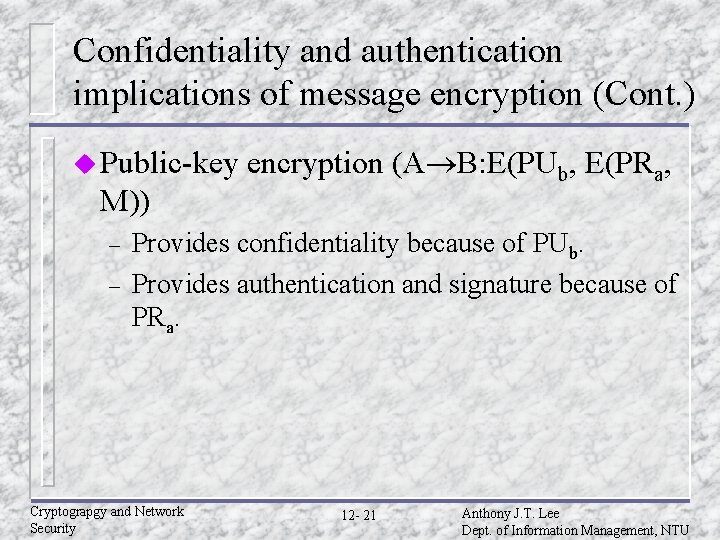
Confidentiality and authentication implications of message encryption (Cont. ) u Public-key M)) – – encryption (A B: E(PUb, E(PRa, Provides confidentiality because of PUb. Provides authentication and signature because of PRa. Cryptograpgy and Network Security 12 - 21 Anthony J. T. Lee Dept. of Information Management, NTU
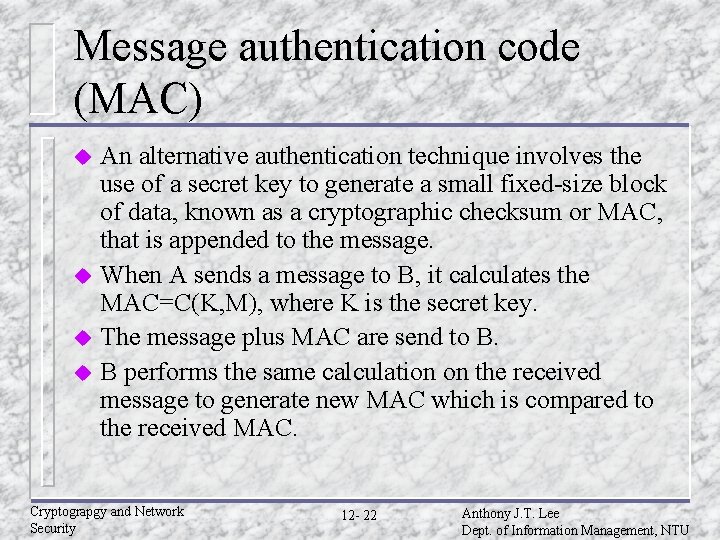
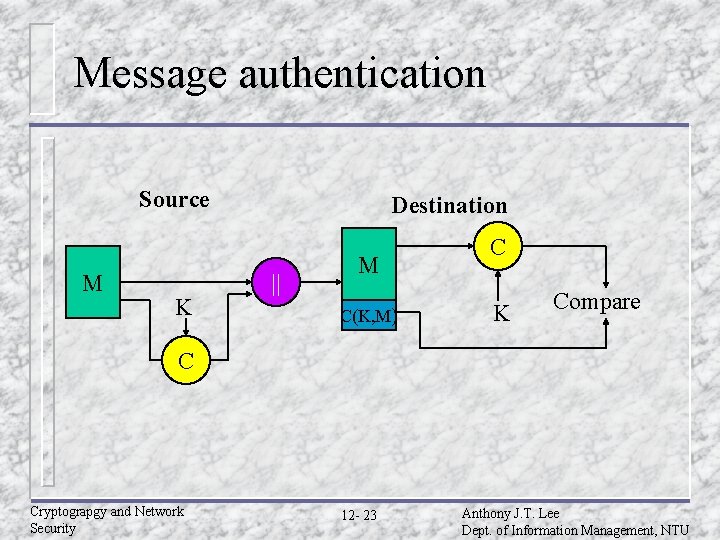
Message authentication code (MAC) An alternative authentication technique involves the use of a secret key to generate a small fixed-size block of data, known as a cryptographic checksum or MAC, that is appended to the message. u When A sends a message to B, it calculates the MAC=C(K, M), where K is the secret key. u The message plus MAC are send to B. u B performs the same calculation on the received message to generate new MAC which is compared to the received MAC. u Cryptograpgy and Network Security 12 - 22 Anthony J. T. Lee Dept. of Information Management, NTU
Message authentication Source M K Destination || M C(K, M) C K Compare C Cryptograpgy and Network Security 12 - 23 Anthony J. T. Lee Dept. of Information Management, NTU
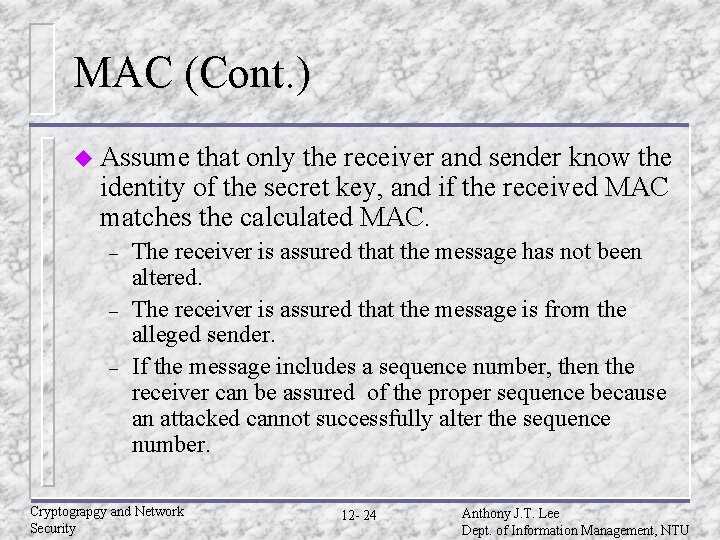
MAC (Cont. ) u Assume that only the receiver and sender know the identity of the secret key, and if the received MAC matches the calculated MAC. – – – The receiver is assured that the message has not been altered. The receiver is assured that the message is from the alleged sender. If the message includes a sequence number, then the receiver can be assured of the proper sequence because an attacked cannot successfully alter the sequence number. Cryptograpgy and Network Security 12 - 24 Anthony J. T. Lee Dept. of Information Management, NTU
MAC (Cont. ) u An MAC function is similar to encryption. u One difference is that the MAC algorithm need not be reversible, as it must for decryption. u It turns out that because of the mathematical properties of the authentication function, it is less vulnerable to being broken than encryption. Cryptograpgy and Network Security 12 - 25 Anthony J. T. Lee Dept. of Information Management, NTU
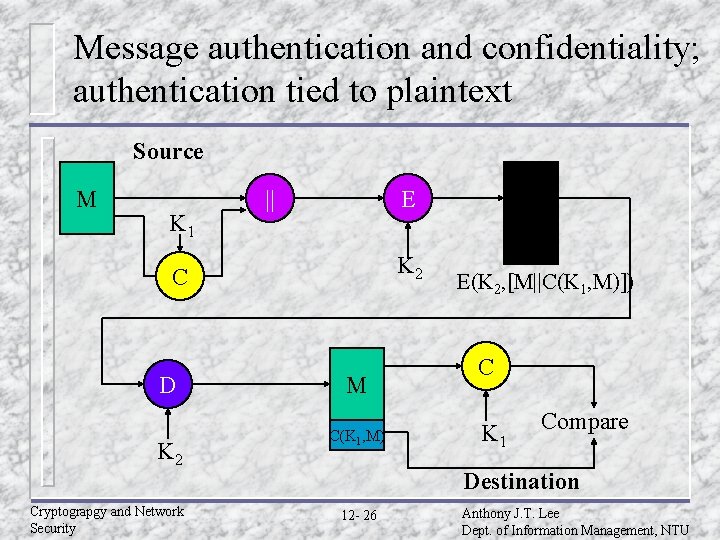
Message authentication and confidentiality; authentication tied to plaintext Source M K 1 || E K 2 C D K 2 Cryptograpgy and Network Security M C(K 1, M) E(K 2, [M||C(K 1, M)]) C K 1 Compare Destination 12 - 26 Anthony J. T. Lee Dept. of Information Management, NTU
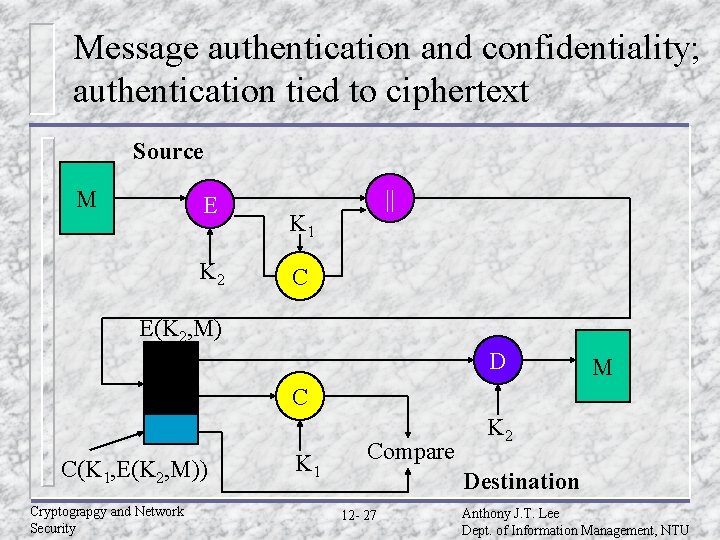
Message authentication and confidentiality; authentication tied to ciphertext Source M E K 2 || K 1 C E(K 2, M) D M C C(K 1, E(K 2, M)) Cryptograpgy and Network Security K 1 Compare K 2 Destination 12 - 27 Anthony J. T. Lee Dept. of Information Management, NTU
The situations where an MAC is used u There a number of applications in which the same message is broadcast to a number of destinations. u Another possible scenario is an exchange in which one side has a heavy load and cannot afford the time to decrypt all incoming messages. u Authentication of a computer program in plaintext is an attractive service. Cryptograpgy and Network Security 12 - 28 Anthony J. T. Lee Dept. of Information Management, NTU
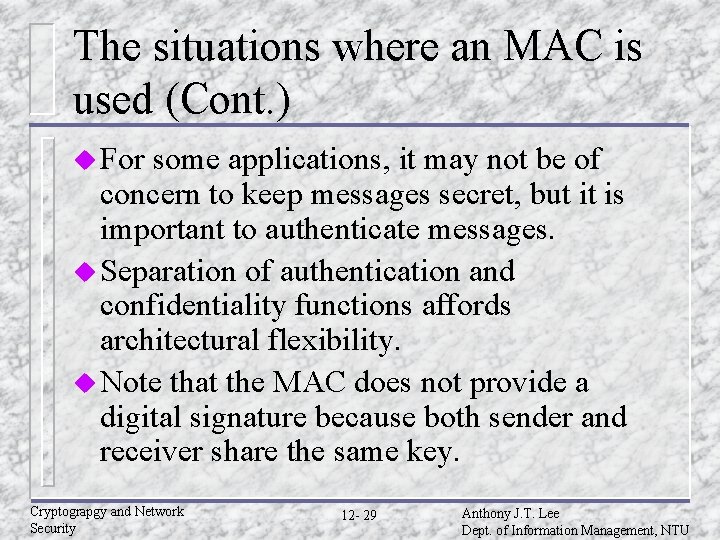
The situations where an MAC is used (Cont. ) u For some applications, it may not be of concern to keep messages secret, but it is important to authenticate messages. u Separation of authentication and confidentiality functions affords architectural flexibility. u Note that the MAC does not provide a digital signature because both sender and receiver share the same key. Cryptograpgy and Network Security 12 - 29 Anthony J. T. Lee Dept. of Information Management, NTU
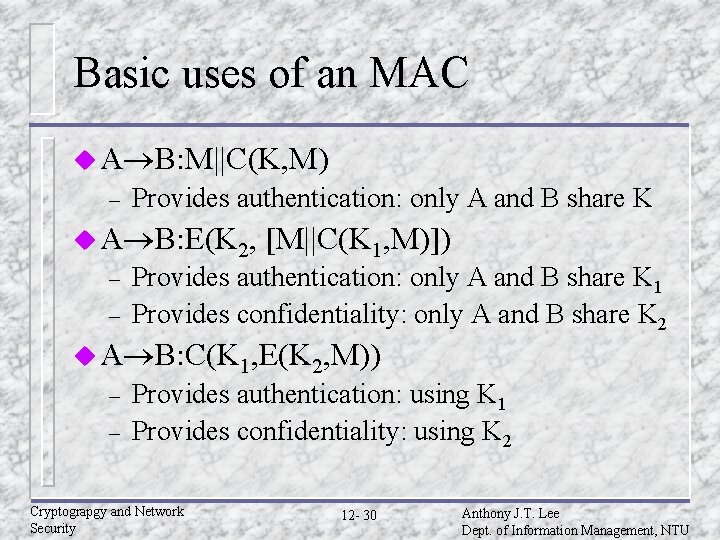
Basic uses of an MAC u A B: M||C(K, M) – Provides authentication: only A and B share K u A B: E(K 2, – – [M||C(K 1, M)]) Provides authentication: only A and B share K 1 Provides confidentiality: only A and B share K 2 u A B: C(K 1, E(K 2, M)) – – Provides authentication: using K 1 Provides confidentiality: using K 2 Cryptograpgy and Network Security 12 - 30 Anthony J. T. Lee Dept. of Information Management, NTU
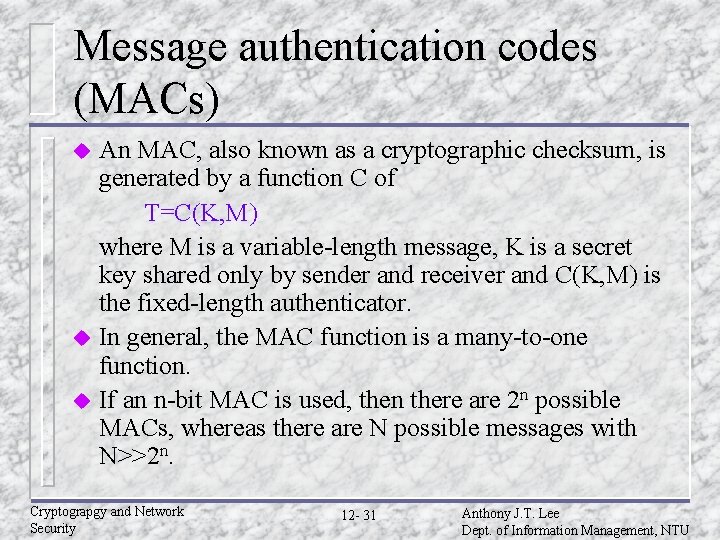
Message authentication codes (MACs) An MAC, also known as a cryptographic checksum, is generated by a function C of T=C(K, M) where M is a variable-length message, K is a secret key shared only by sender and receiver and C(K, M) is the fixed-length authenticator. u In general, the MAC function is a many-to-one function. u If an n-bit MAC is used, then there are 2 n possible MACs, whereas there are N possible messages with N>>2 n. u Cryptograpgy and Network Security 12 - 31 Anthony J. T. Lee Dept. of Information Management, NTU
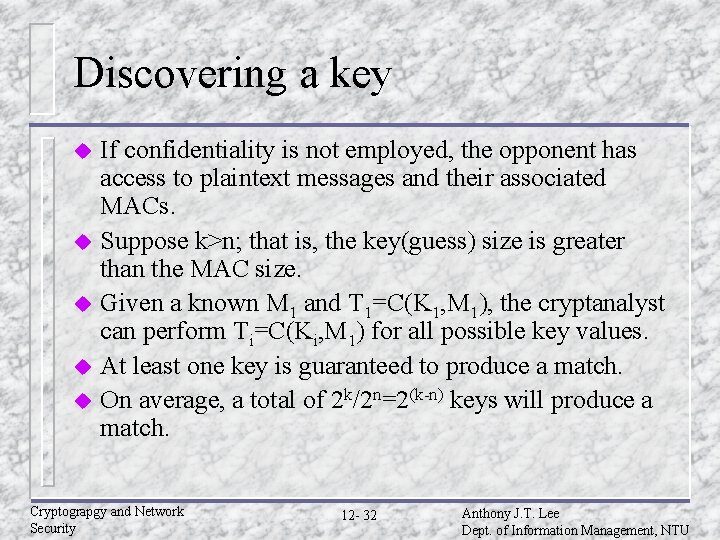
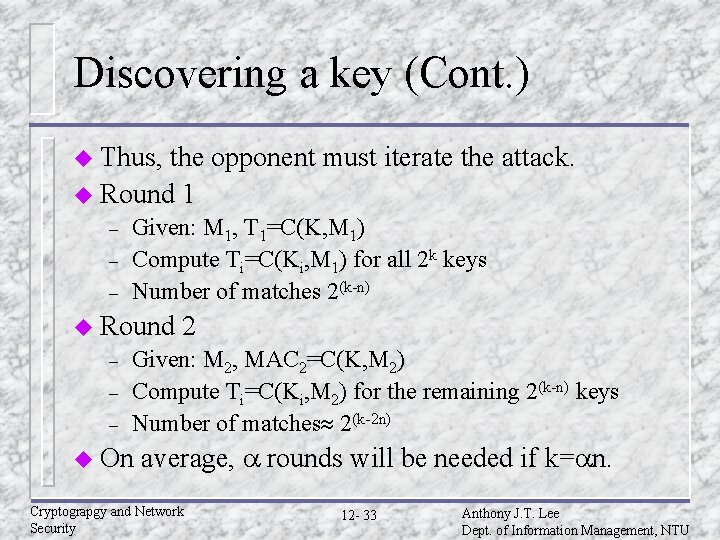
Discovering a key If confidentiality is not employed, the opponent has access to plaintext messages and their associated MACs. u Suppose k>n; that is, the key(guess) size is greater than the MAC size. u Given a known M 1 and T 1=C(K 1, M 1), the cryptanalyst can perform Ti=C(Ki, M 1) for all possible key values. u At least one key is guaranteed to produce a match. u On average, a total of 2 k/2 n=2(k-n) keys will produce a match. u Cryptograpgy and Network Security 12 - 32 Anthony J. T. Lee Dept. of Information Management, NTU
Discovering a key (Cont. ) u Thus, the opponent must iterate the attack. u Round 1 – – – Given: M 1, T 1=C(K, M 1) Compute Ti=C(Ki, M 1) for all 2 k keys Number of matches 2(k-n) u Round – – – 2 Given: M 2, MAC 2=C(K, M 2) Compute Ti=C(Ki, M 2) for the remaining 2(k-n) keys Number of matches 2(k-2 n) u On average, a rounds will be needed if k=an. Cryptograpgy and Network Security 12 - 33 Anthony J. T. Lee Dept. of Information Management, NTU
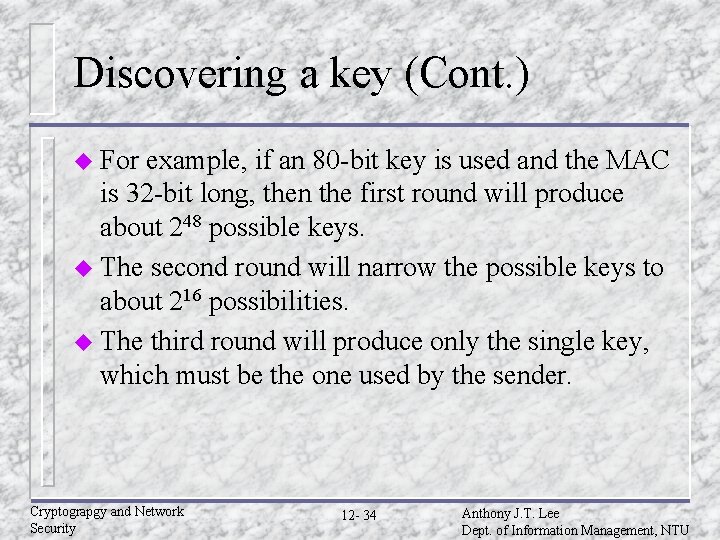
Discovering a key (Cont. ) u For example, if an 80 -bit key is used and the MAC is 32 -bit long, then the first round will produce about 248 possible keys. u The second round will narrow the possible keys to about 216 possibilities. u The third round will produce only the single key, which must be the one used by the sender. Cryptograpgy and Network Security 12 - 34 Anthony J. T. Lee Dept. of Information Management, NTU
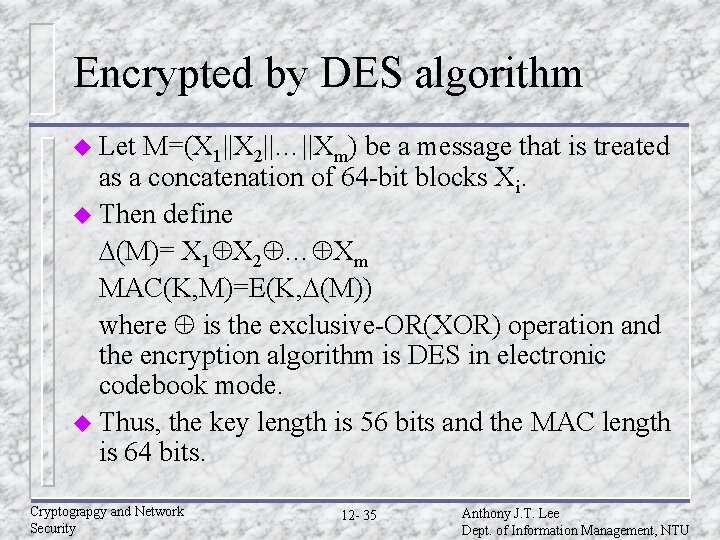
Encrypted by DES algorithm u Let M=(X 1||X 2||…||Xm) be a message that is treated as a concatenation of 64 -bit blocks Xi. u Then define (M)= X 1 X 2 … Xm MAC(K, M)=E(K, (M)) where is the exclusive-OR(XOR) operation and the encryption algorithm is DES in electronic codebook mode. u Thus, the key length is 56 bits and the MAC length is 64 bits. Cryptograpgy and Network Security 12 - 35 Anthony J. T. Lee Dept. of Information Management, NTU
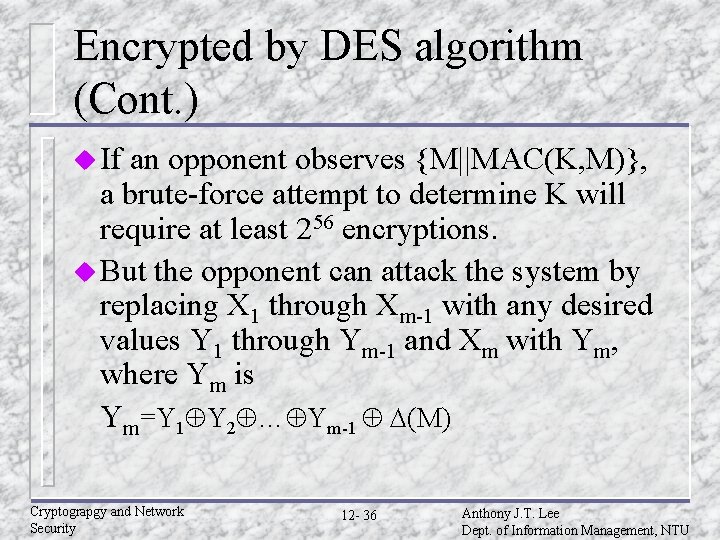
Encrypted by DES algorithm (Cont. ) u If an opponent observes {M||MAC(K, M)}, a brute-force attempt to determine K will require at least 256 encryptions. u But the opponent can attack the system by replacing X 1 through Xm-1 with any desired values Y 1 through Ym-1 and Xm with Ym, where Ym is Ym=Y 1 Y 2 … Ym-1 (M) Cryptograpgy and Network Security 12 - 36 Anthony J. T. Lee Dept. of Information Management, NTU
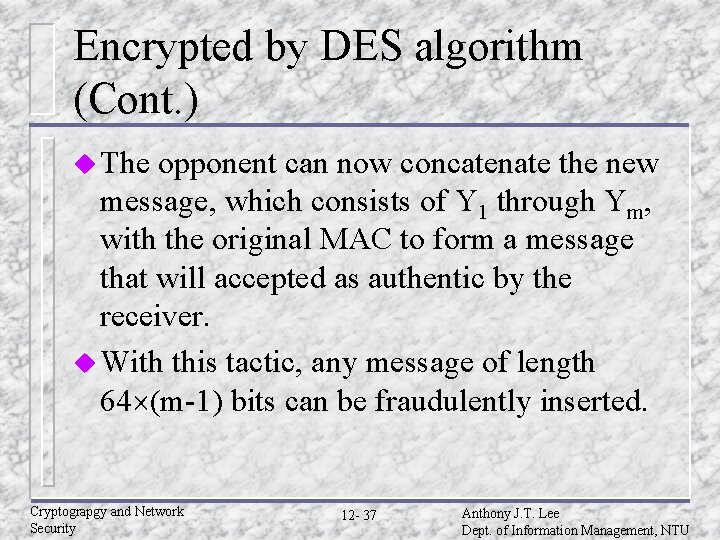
Encrypted by DES algorithm (Cont. ) u The opponent can now concatenate the new message, which consists of Y 1 through Ym, with the original MAC to form a message that will accepted as authentic by the receiver. u With this tactic, any message of length 64 (m-1) bits can be fraudulently inserted. Cryptograpgy and Network Security 12 - 37 Anthony J. T. Lee Dept. of Information Management, NTU
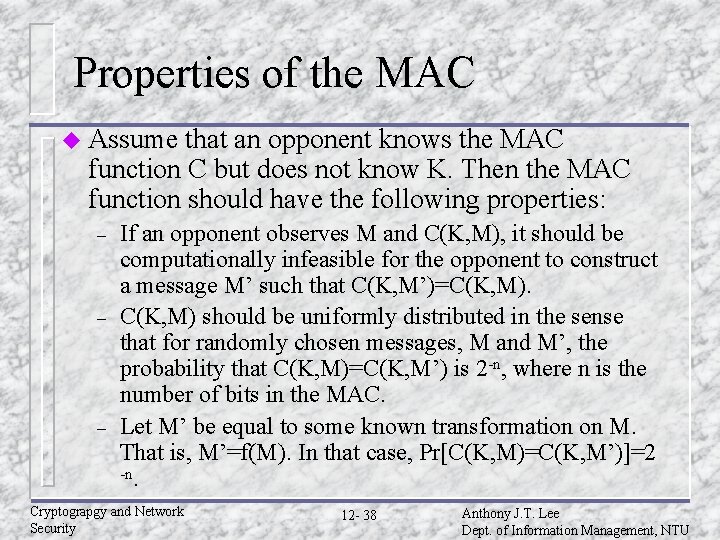
Properties of the MAC u Assume that an opponent knows the MAC function C but does not know K. Then the MAC function should have the following properties: – – – If an opponent observes M and C(K, M), it should be computationally infeasible for the opponent to construct a message M’ such that C(K, M’)=C(K, M) should be uniformly distributed in the sense that for randomly chosen messages, M and M’, the probability that C(K, M)=C(K, M’) is 2 -n, where n is the number of bits in the MAC. Let M’ be equal to some known transformation on M. That is, M’=f(M). In that case, Pr[C(K, M)=C(K, M’)]=2 -n. Cryptograpgy and Network Security 12 - 38 Anthony J. T. Lee Dept. of Information Management, NTU
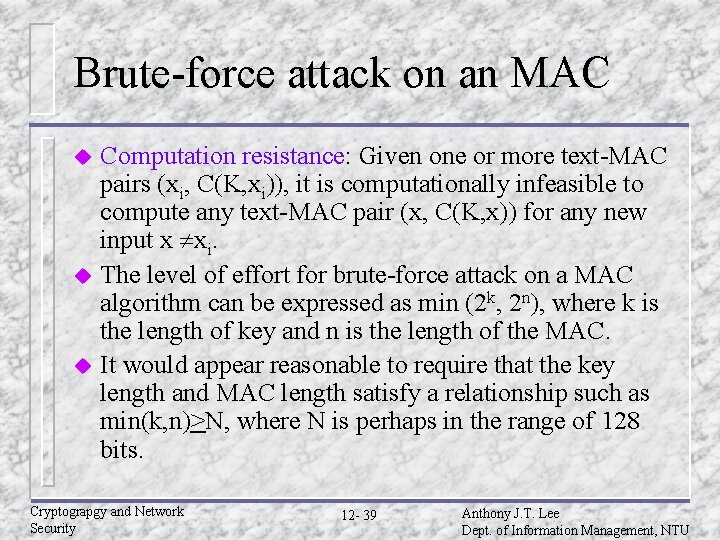
Brute-force attack on an MAC Computation resistance: Given one or more text-MAC pairs (xi, C(K, xi)), it is computationally infeasible to compute any text-MAC pair (x, C(K, x)) for any new input x xi. u The level of effort for brute-force attack on a MAC algorithm can be expressed as min (2 k, 2 n), where k is the length of key and n is the length of the MAC. u It would appear reasonable to require that the key length and MAC length satisfy a relationship such as min(k, n)>N, where N is perhaps in the range of 128 bits. u Cryptograpgy and Network Security 12 - 39 Anthony J. T. Lee Dept. of Information Management, NTU
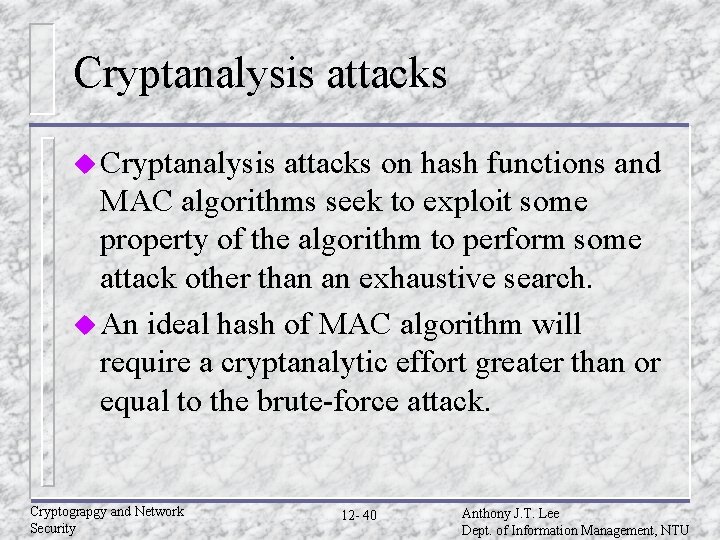
Cryptanalysis attacks u Cryptanalysis attacks on hash functions and MAC algorithms seek to exploit some property of the algorithm to perform some attack other than an exhaustive search. u An ideal hash of MAC algorithm will require a cryptanalytic effort greater than or equal to the brute-force attack. Cryptograpgy and Network Security 12 - 40 Anthony J. T. Lee Dept. of Information Management, NTU
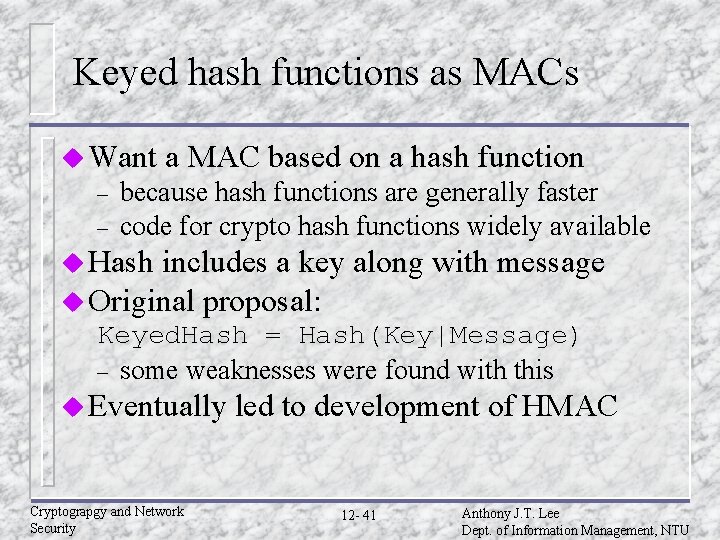
Keyed hash functions as MACs u Want – – a MAC based on a hash function because hash functions are generally faster code for crypto hash functions widely available u Hash includes a key along with message u Original proposal: Keyed. Hash = Hash(Key|Message) – some weaknesses were found with this u Eventually Cryptograpgy and Network Security led to development of HMAC 12 - 41 Anthony J. T. Lee Dept. of Information Management, NTU
HMAC u There has been increased interest in developing an MAC derived from a cryptographic hash code. u The approach that has received the most support is HMAC. u HMAC has been chosen as the mandatoryto-implement HMAC for IP security. Cryptograpgy and Network Security 12 - 42 Anthony J. T. Lee Dept. of Information Management, NTU
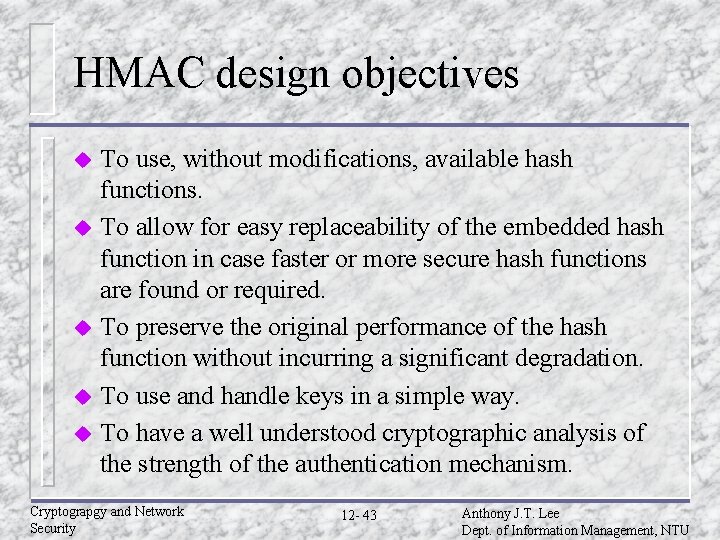
HMAC design objectives To use, without modifications, available hash functions. u To allow for easy replaceability of the embedded hash function in case faster or more secure hash functions are found or required. u To preserve the original performance of the hash function without incurring a significant degradation. u To use and handle keys in a simple way. u To have a well understood cryptographic analysis of the strength of the authentication mechanism. u Cryptograpgy and Network Security 12 - 43 Anthony J. T. Lee Dept. of Information Management, NTU
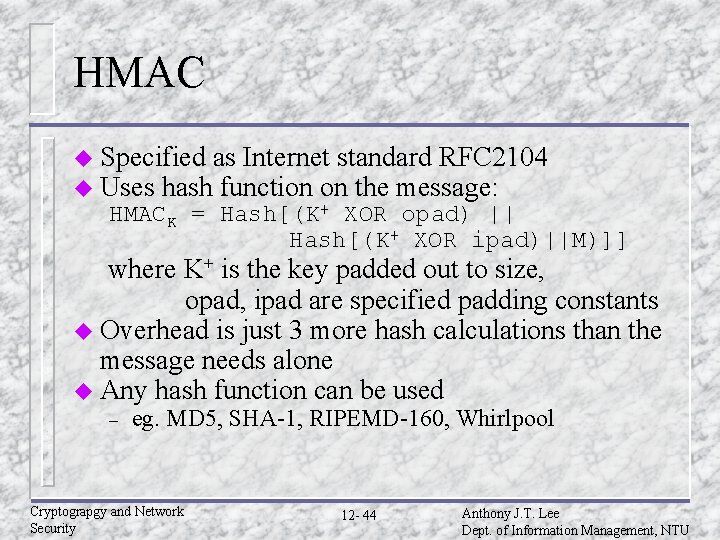
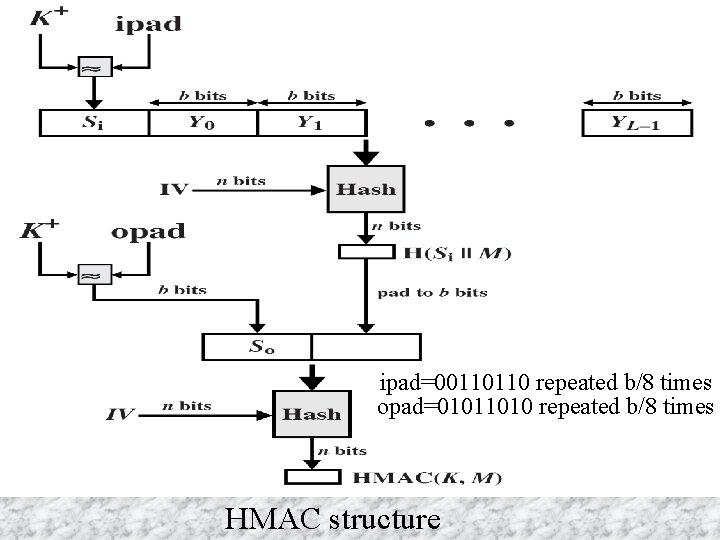
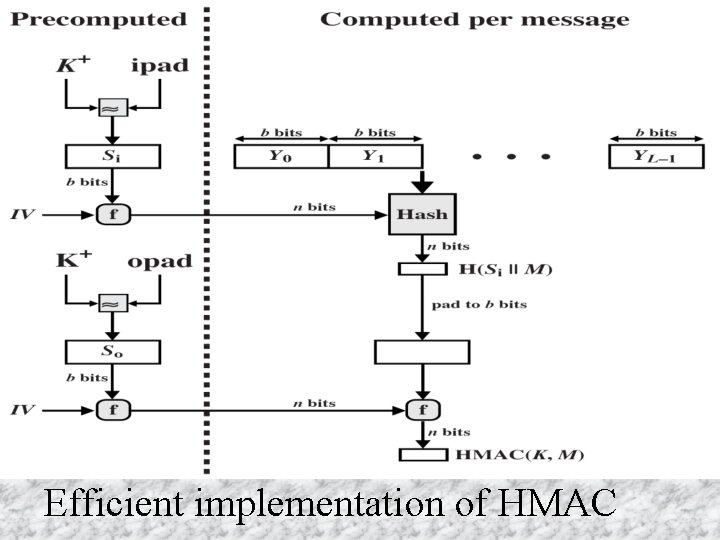
HMAC u Specified as Internet standard RFC 2104 u Uses hash function on the message: HMACK = Hash[(K+ XOR opad) || Hash[(K+ XOR ipad)||M)]] where K+ is the key padded out to size, opad, ipad are specified padding constants u Overhead is just 3 more hash calculations than the message needs alone u Any hash function can be used – eg. MD 5, SHA-1, RIPEMD-160, Whirlpool Cryptograpgy and Network Security 12 - 44 Anthony J. T. Lee Dept. of Information Management, NTU
ipad=00110110 repeated b/8 times opad=01011010 repeated b/8 times HMAC structure
Efficient implementation of HMAC
HMAC security u Proved security of HMAC relates to that of the underlying hash algorithm u Attacking HMAC requires either: – – brute force attack on key used birthday attack (but since keyed would need to observe a very large number of messages) u Choose hash function used based on speed verses security constraints u Attacking HMAC, the attacker cannot generate message/code pairs offline because the attacker does not know K. Cryptograpgy and Network Security 12 - 47 Anthony J. T. Lee Dept. of Information Management, NTU
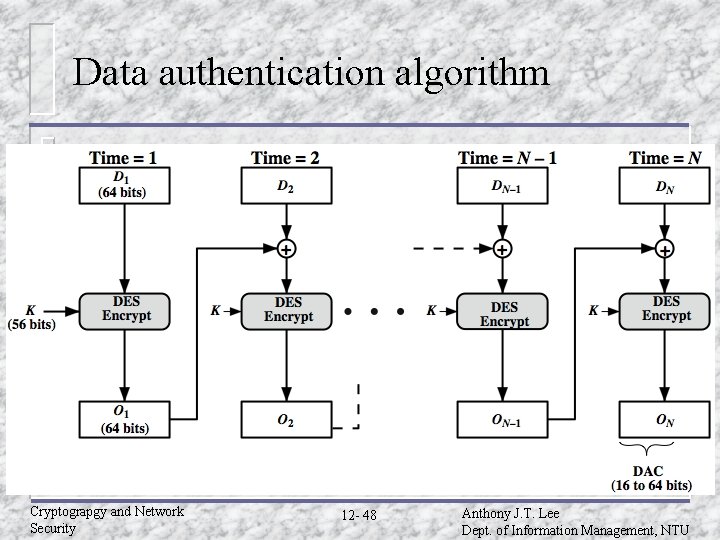
Data authentication algorithm Cryptograpgy and Network Security 12 - 48 Anthony J. T. Lee Dept. of Information Management, NTU
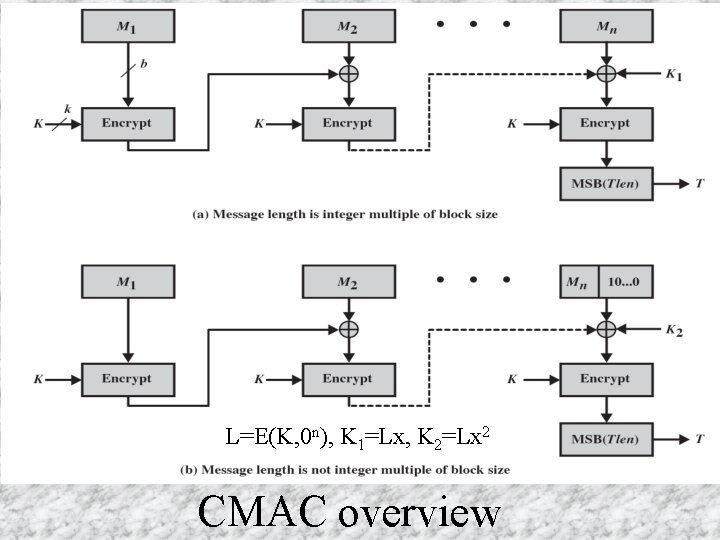
L=E(K, 0 n), K 1=Lx, K 2=Lx 2 CMAC overview
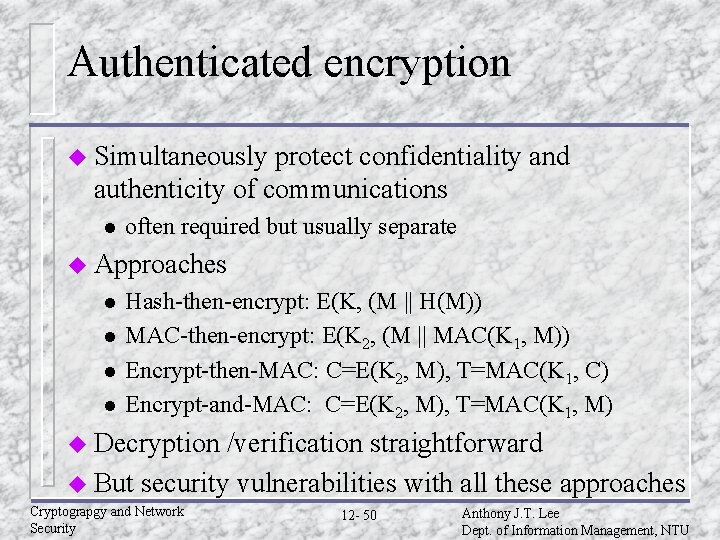
Authenticated encryption u Simultaneously protect confidentiality and authenticity of communications l often required but usually separate u Approaches l l Hash-then-encrypt: E(K, (M || H(M)) MAC-then-encrypt: E(K 2, (M || MAC(K 1, M)) Encrypt-then-MAC: C=E(K 2, M), T=MAC(K 1, C) Encrypt-and-MAC: C=E(K 2, M), T=MAC(K 1, M) u Decryption /verification straightforward u But security vulnerabilities with all these approaches Cryptograpgy and Network Security 12 - 50 Anthony J. T. Lee Dept. of Information Management, NTU