
Mesonmeson molecules and compact fourquark states The 5
- Slides: 28
Meson-meson molecules and compact four-quark states The 5 -th International Conference on Quarks and Nuclear Physics Beijing , September 21-26, 2009 A. Valcarce University of Salamanca (Spain) J. Vijande, N. Barnea, J. -M. Richard. 9/17/2021 Meson-meson molecules. . . 1
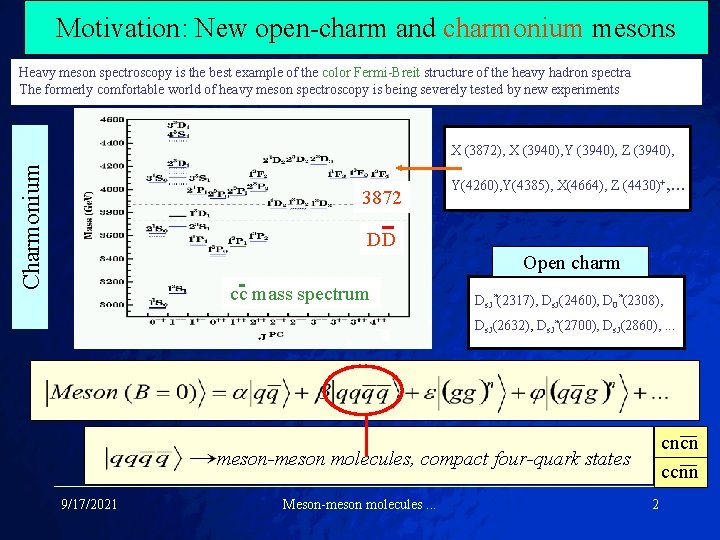
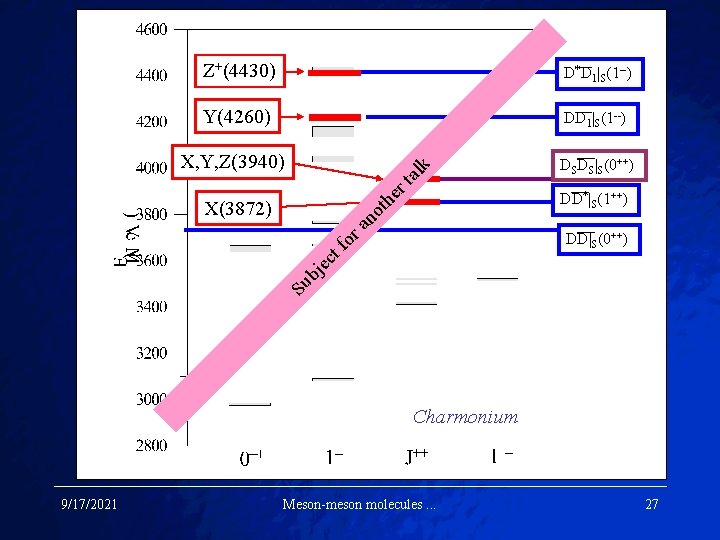
Motivation: New open-charm and charmonium mesons Heavy meson spectroscopy is the best example of the color Fermi-Breit structure of the heavy hadron spectra The formerly comfortable world of heavy meson spectroscopy is being severely tested by new experiments Charmonium X (3872), X (3940), Y (3940), Z (3940), 3872 Y(4260), Y(4385), X(4664), Z (4430)+, . . . DD Open charm cc mass spectrum Ds. J*(2317), Ds. J(2460), D 0*(2308), Ds. J(2632), Ds. J*(2700), Ds. J(2860), . . . cncn ccnn meson-meson molecules, compact four-quark states 9/17/2021 Meson-meson molecules. . . 2
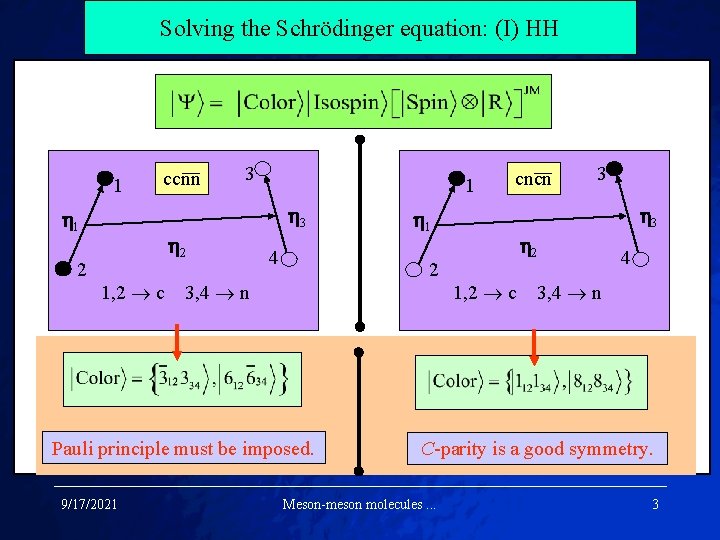
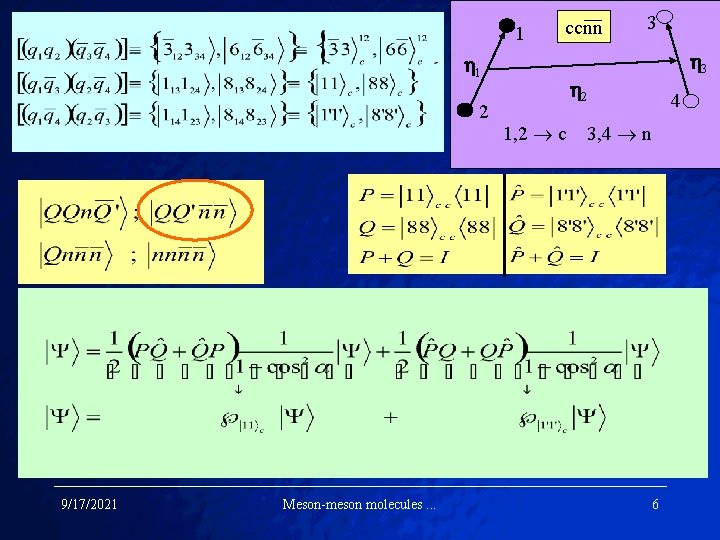
Solving the Schrödinger equation: (I) HH 1 ccnn 1 3 1 2 3 2 1, 2 c 4 3 3 1 2 3, 4 n cncn 2 1, 2 c 4 3, 4 n Radial part is expanded into HH functions, hyperangular part, (up to a Kmax value) and a sum of Laguerre functions, hyperradial part. Pauli principle must be imposed. 9/17/2021 C-parity is a good symmetry. Meson-meson molecules. . . 3
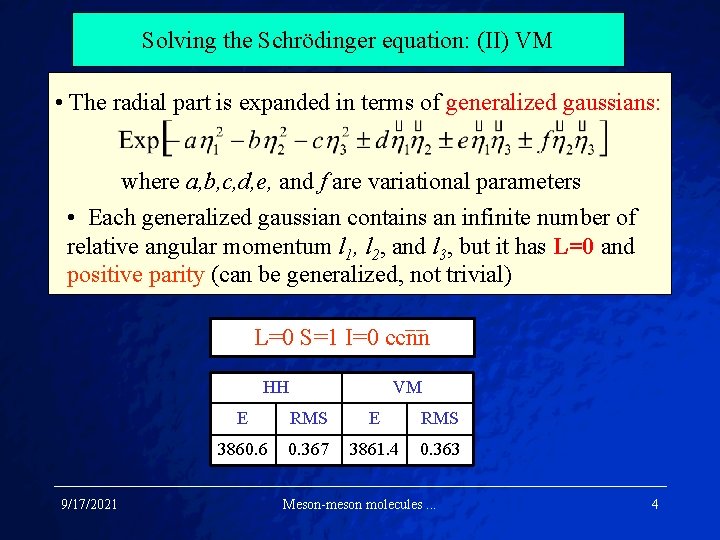
Solving the Schrödinger equation: (II) VM • The radial part is expanded in terms of generalized gaussians: where a, b, c, d, e, and f are variational parameters • Each generalized gaussian contains an infinite number of relative angular momentum l 1, l 2, and l 3, but it has L=0 and positive parity (can be generalized, not trivial) –– L=0 S=1 I=0 ccnn HH 9/17/2021 VM E RMS 3860. 6 0. 367 3861. 4 0. 363 Meson-meson molecules. . . 4
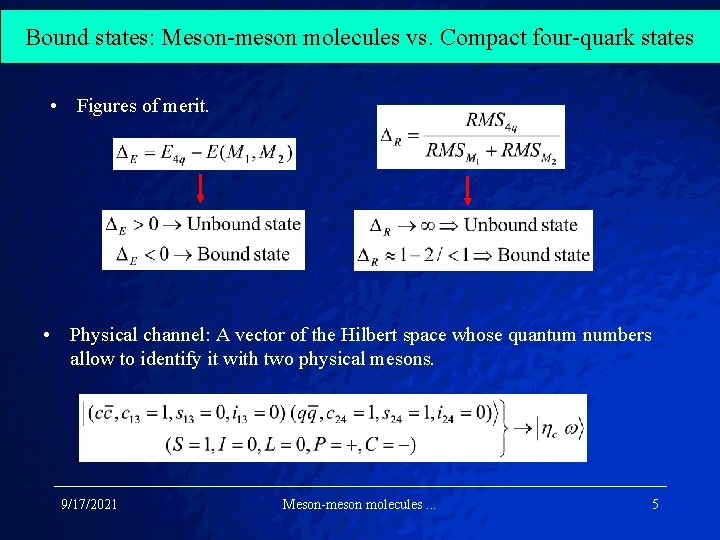
Bound states: Meson-meson molecules vs. Compact four-quark states • Figures of merit. • Physical channel: A vector of the Hilbert space whose quantum numbers allow to identify it with two physical mesons. 9/17/2021 Meson-meson molecules. . . 5
1 ccnn 3 1 2 9/17/2021 Meson-meson molecules. . . 3 2 1, 2 c 4 3, 4 n 6
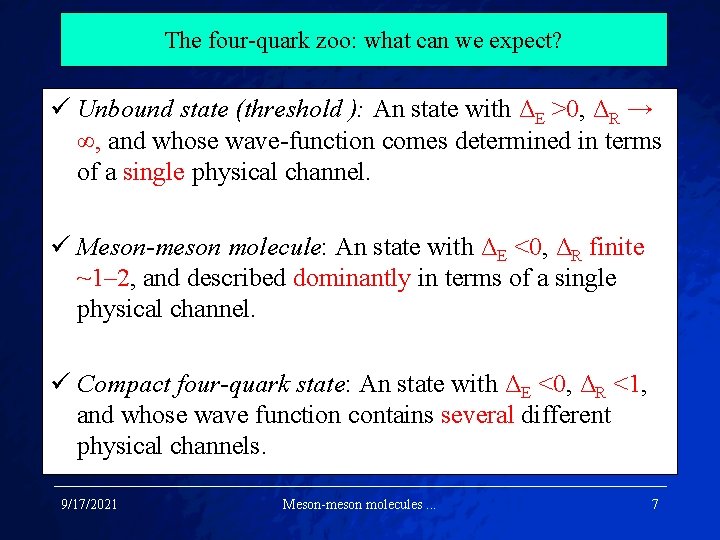
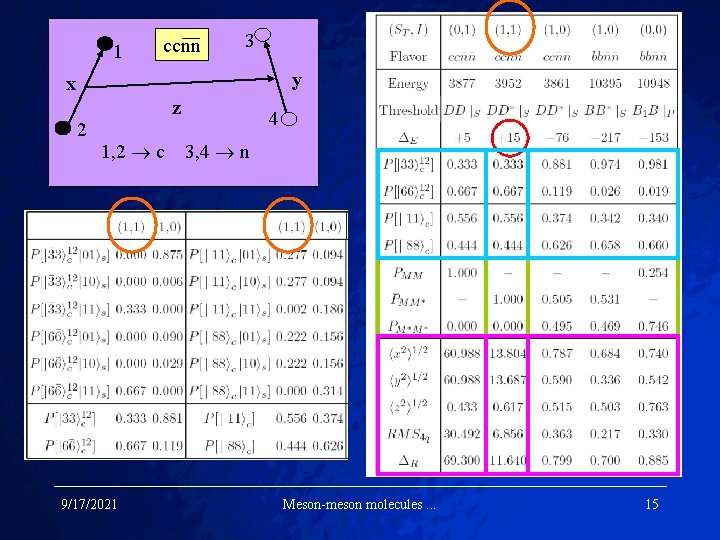
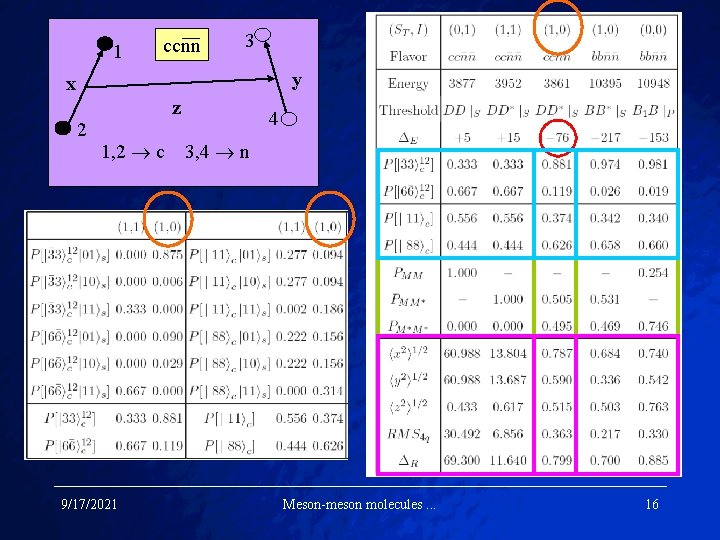
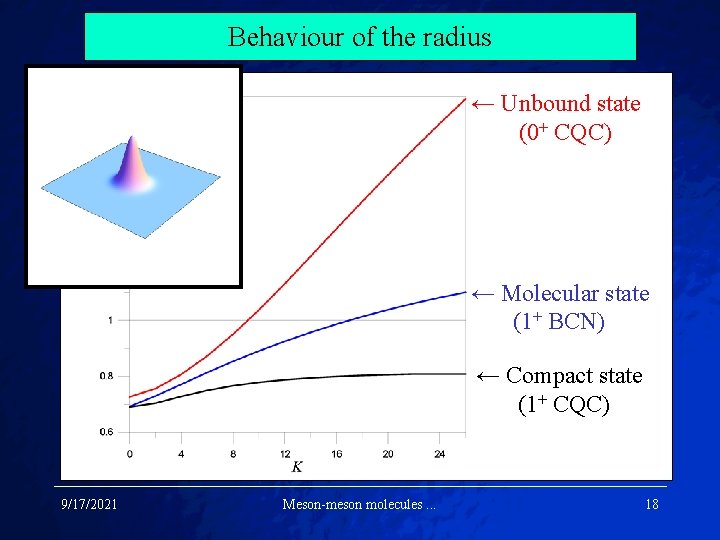
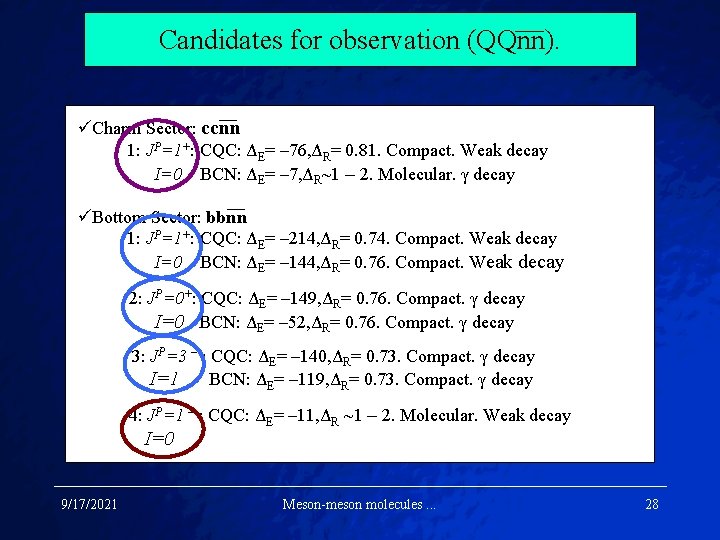
The four-quark zoo: what can we expect? ü Unbound state (threshold ): An state with ΔE >0, ΔR → ∞, and whose wave-function comes determined in terms of a single physical channel. ü Meson-meson molecule: An state with ΔE <0, ΔR finite ~1– 2, and described dominantly in terms of a single physical channel. ü Compact four-quark state: An state with ΔE <0, ΔR <1, and whose wave function contains several different physical channels. 9/17/2021 Meson-meson molecules. . . 7
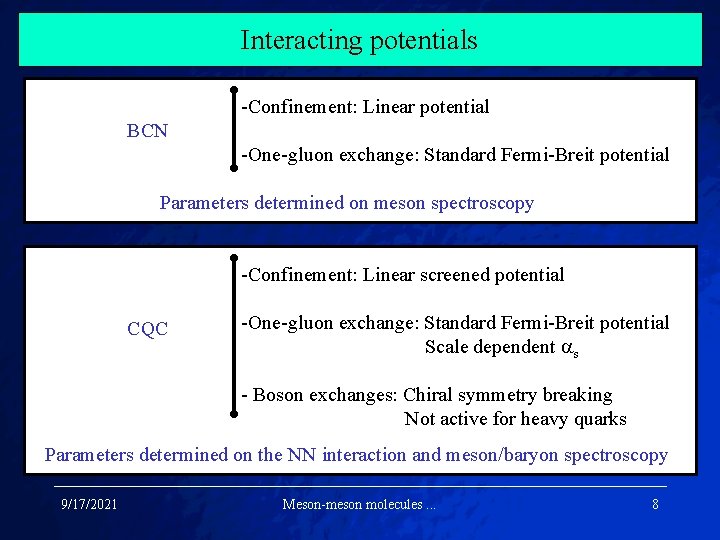
Interacting potentials -Confinement: Linear potential BCN -One-gluon exchange: Standard Fermi-Breit potential Parameters determined on meson spectroscopy -Confinement: Linear screened potential CQC -One-gluon exchange: Standard Fermi-Breit potential Scale dependent as - Boson exchanges: Chiral symmetry breaking Not active for heavy quarks Parameters determined on the NN interaction and meson/baryon spectroscopy 9/17/2021 Meson-meson molecules. . . 8
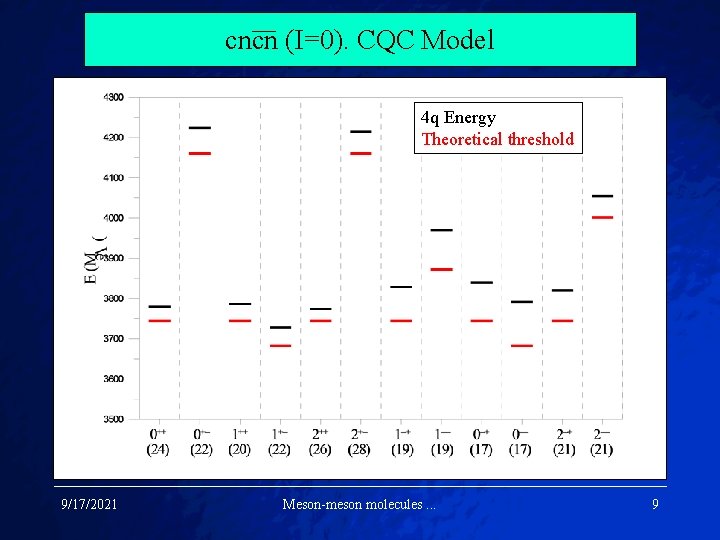
cncn (I=0). CQC Model 4 q Energy Theoretical threshold 9/17/2021 Meson-meson molecules. . . 9
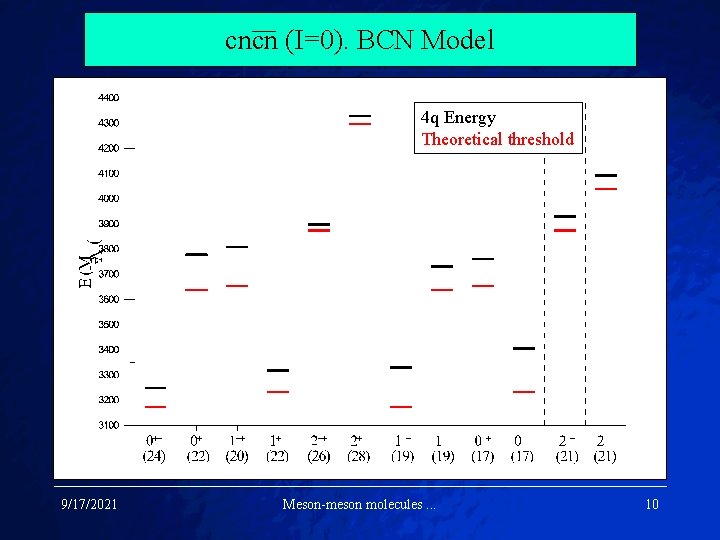
cncn (I=0). BCN Model 4 q Energy Theoretical threshold 9/17/2021 Meson-meson molecules. . . 10
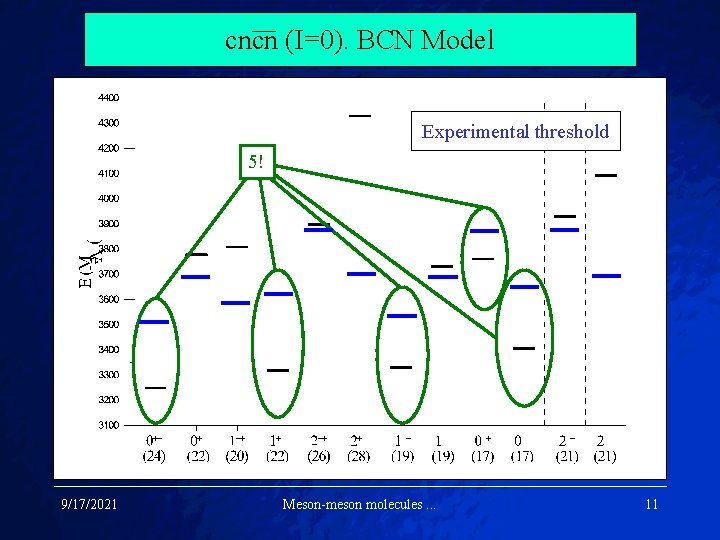
cncn (I=0). BCN Model Experimental threshold Theorerical Thresholds 5! 9/17/2021 Meson-meson molecules. . . 11
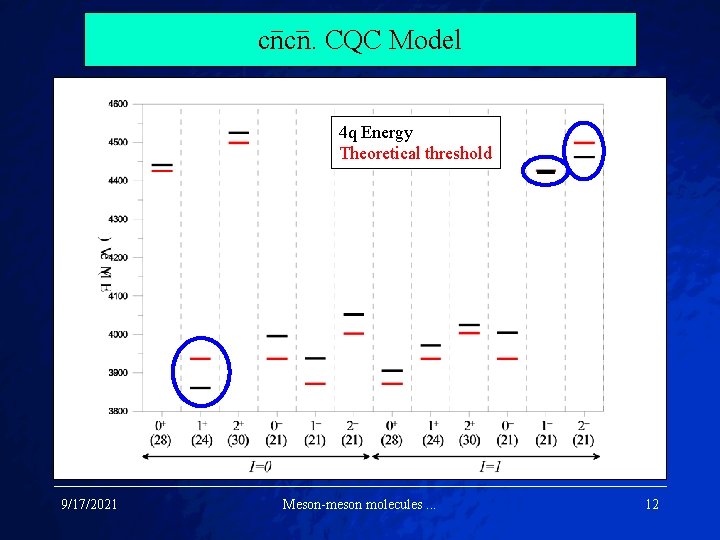
cncn. CQC Model 4 q Energy Theoretical threshold 9/17/2021 Meson-meson molecules. . . 12
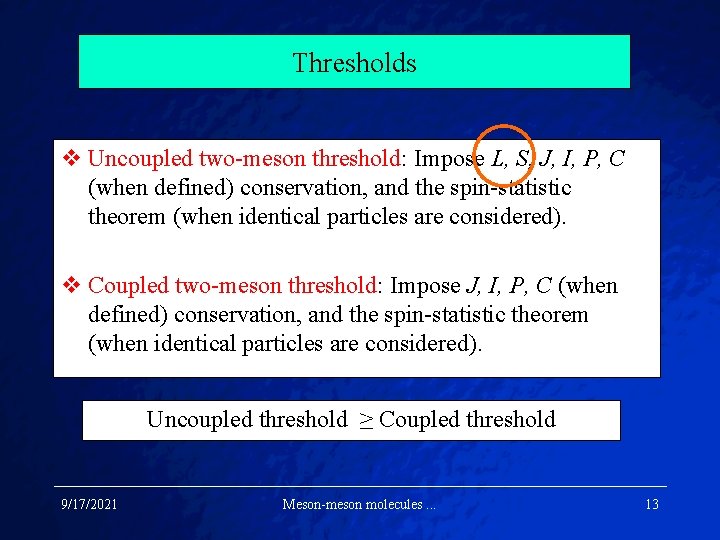
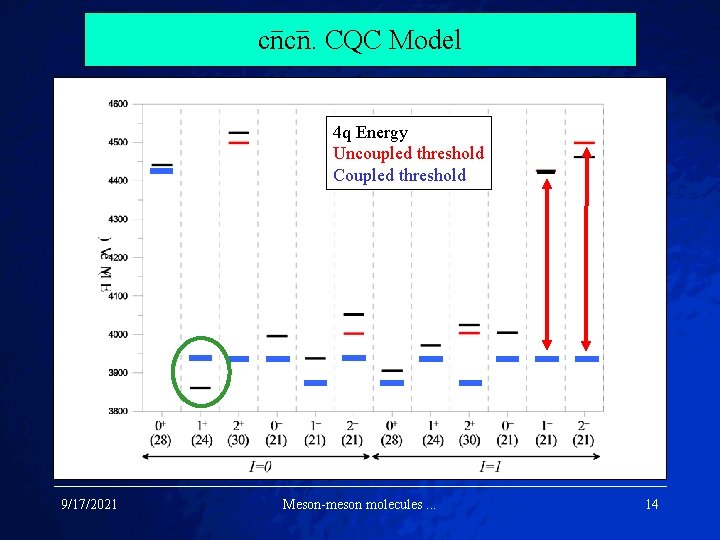
Thresholds v Uncoupled two-meson threshold: Impose L, S, J, I, P, C (when defined) conservation, and the spin-statistic theorem (when identical particles are considered). v Coupled two-meson threshold: Impose J, I, P, C (when defined) conservation, and the spin-statistic theorem (when identical particles are considered). Uncoupled threshold ≥ Coupled threshold 9/17/2021 Meson-meson molecules. . . 13
cncn. CQC Model 4 q Energy Uncoupled threshold Coupled threshold 9/17/2021 Meson-meson molecules. . . 14
1 ccnn 3 y x 2 z 1, 2 c 9/17/2021 4 3, 4 n Meson-meson molecules. . . 15
1 ccnn 3 y x 2 z 1, 2 c 9/17/2021 4 3, 4 n Meson-meson molecules. . . 16
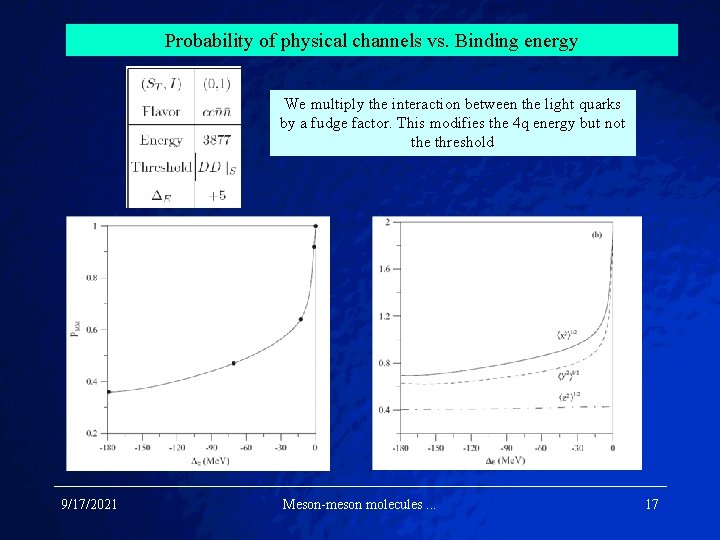
Probability of physical channels vs. Binding energy We multiply the interaction between the light quarks by a fudge factor. This modifies the 4 q energy but not the threshold 9/17/2021 Meson-meson molecules. . . 17
Behaviour of the radius ← Unbound state (0+ CQC) ← Molecular state (1+ BCN) ← Compact state (1+ CQC) 9/17/2021 Meson-meson molecules. . . 18
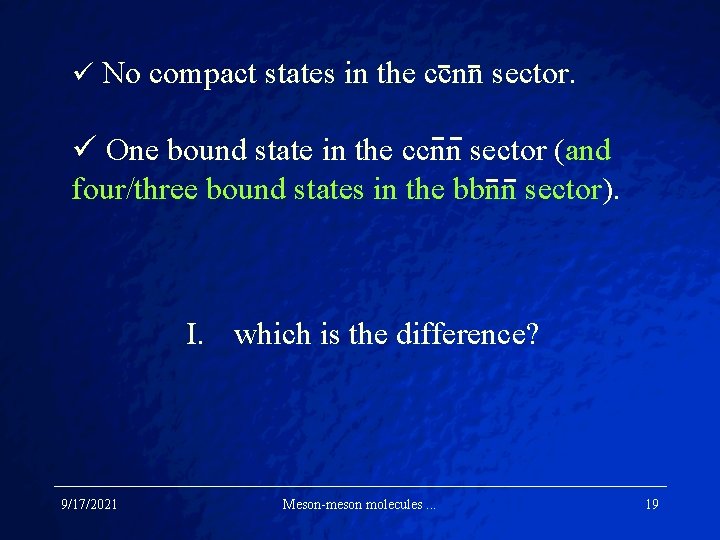
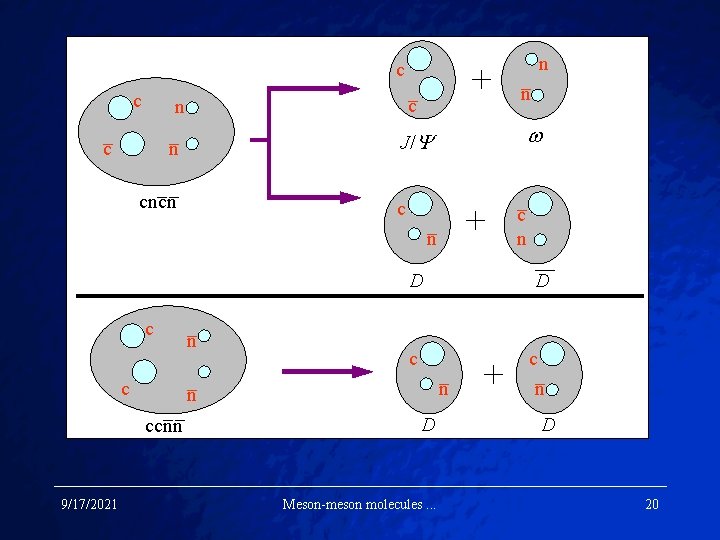
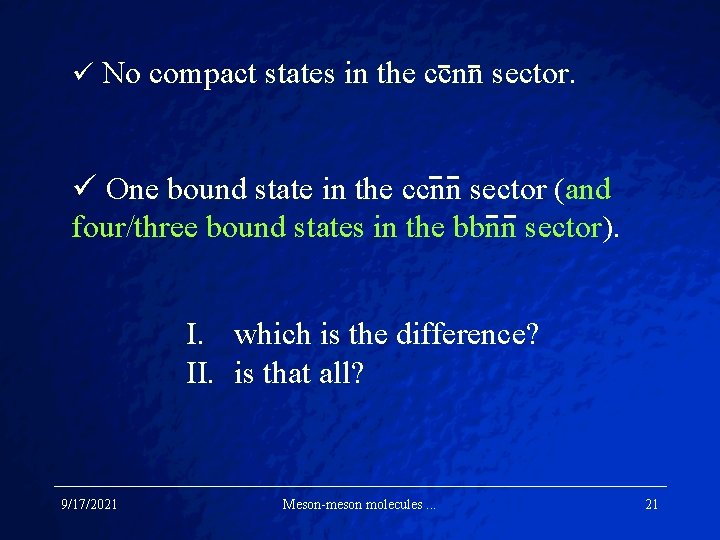
ü No compact states in the ccnn sector. ü One bound state in the ccnn sector (and four/three bound states in the bbnn sector). I. which is the difference? 9/17/2021 Meson-meson molecules. . . 19
c c –c + n –c –n J/ –– cncn c + c –– ccnn 9/17/2021 c –n –n D Meson-meson molecules. . . –c n — D D –n –n w –n c n + c –n D 20
ü No compact states in the ccnn sector. ü One bound state in the ccnn sector (and four/three bound states in the bbnn sector). I. which is the difference? II. is that all? 9/17/2021 Meson-meson molecules. . . 21
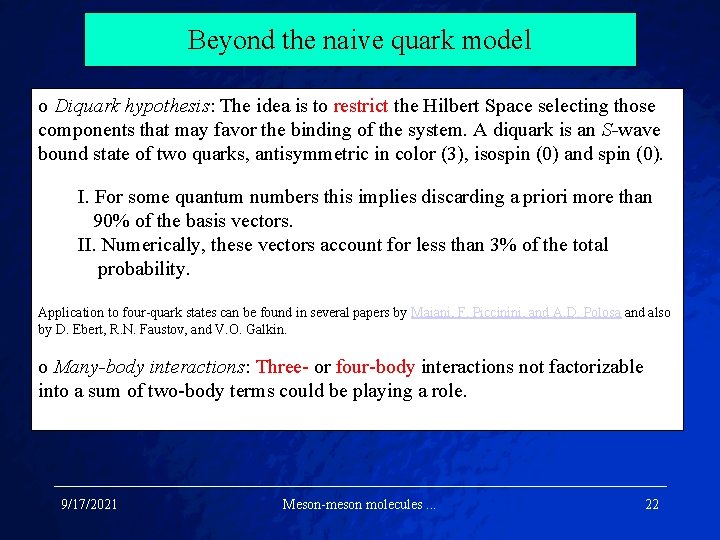
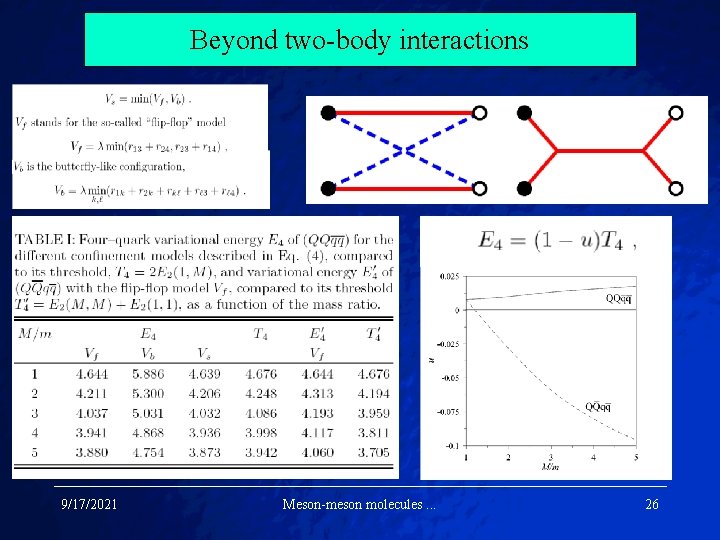
Beyond the naive quark model o Diquark hypothesis: The idea is to restrict the Hilbert Space selecting those components that may favor the binding of the system. A diquark is an S-wave bound state of two quarks, antisymmetric in color (3), isospin (0) and spin (0). I. For some quantum numbers this implies discarding a priori more than 90% of the basis vectors. II. Numerically, these vectors account for less than 3% of the total probability. Application to four-quark states can be found in several papers by Maiani, F. Piccinini, and A. D. Polosa and also by D. Ebert, R. N. Faustov, and V. O. Galkin. o Many-body interactions: Three- or four-body interactions not factorizable into a sum of two-body terms could be playing a role. 9/17/2021 Meson-meson molecules. . . 22
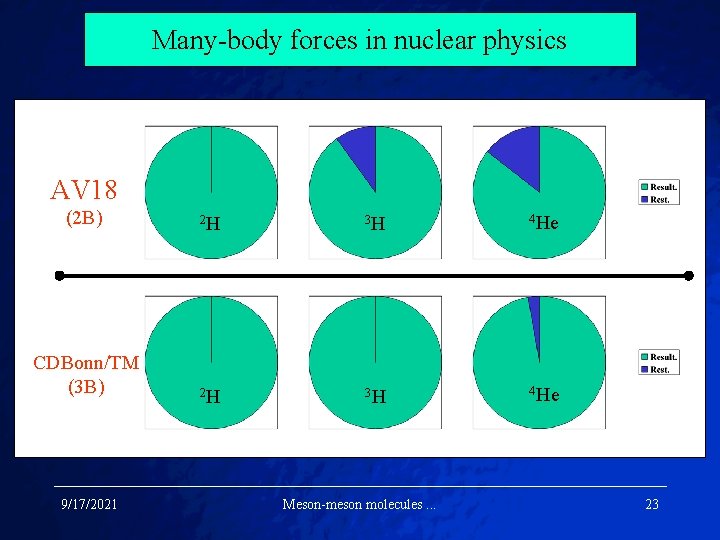
Many-body forces in nuclear physics AV 18 (2 B) CDBonn/TM (3 B) 9/17/2021 2 H 3 H 4 He Meson-meson molecules. . . 23
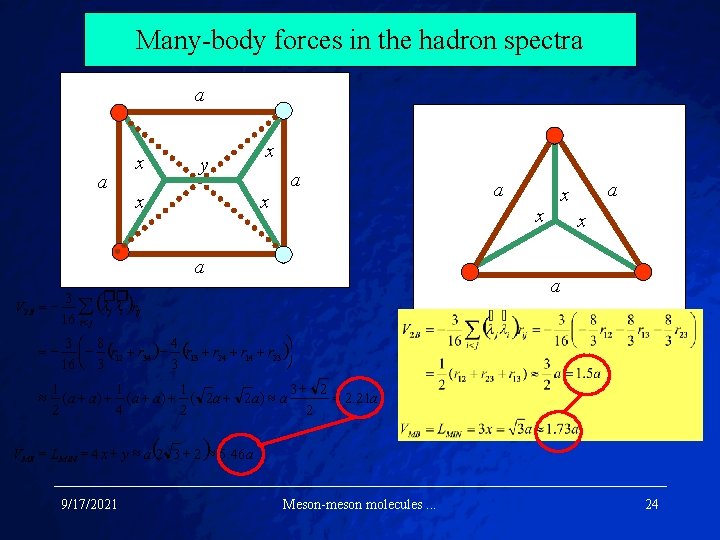
Many-body forces in the hadron spectra a x y x x a V 2 B a x x a ( ) rr 3 = - å l j li rij 16 i < j =- a ö 3æ 8 4 ç - (r 12 + r 34 )- (r 13 + r 24 + r 14 + r 23 ) 16 è 3 3 ø 1 1 1 3+ 2 » (a + a ) + ( 2 a + 2 a ) » a = 2. 21 a 2 4 2 2 ( ) VMB = LMIN = 4 x + y » a 2 3 + 2 » 5. 46 a 9/17/2021 Meson-meson molecules. . . 24
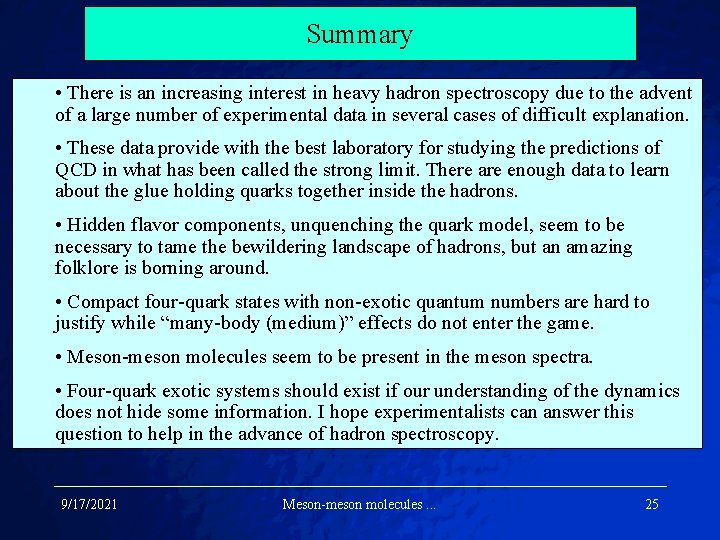
Summary • There is an increasing interest in heavy hadron spectroscopy due to the advent of a large number of experimental data in several cases of difficult explanation. • These data provide with the best laboratory for studying the predictions of QCD in what has been called the strong limit. There are enough data to learn about the glue holding quarks together inside the hadrons. • Hidden flavor components, unquenching the quark model, seem to be necessary to tame the bewildering landscape of hadrons, but an amazing folklore is borning around. • Compact four-quark states with non-exotic quantum numbers are hard to justify while “many-body (medium)” effects do not enter the game. • Meson-meson molecules seem to be present in the meson spectra. • Four-quark exotic systems should exist if our understanding of the dynamics does not hide some information. I hope experimentalists can answer this question to help in the advance of hadron spectroscopy. 9/17/2021 Meson-meson molecules. . . 25
Beyond two-body interactions 9/17/2021 Meson-meson molecules. . . 26
D*D 1|S(1 --) Y(4260) DD 1|S(1 --) X, Y, Z(3940) DSDS|S(0++) he r ta lk Z+(4430) an ot X(3872) DD*|S(1++) Su bj ec tf or DD|S(0++) Charmonium 9/17/2021 Meson-meson molecules. . . 27
Candidates for observation (QQnn). üCharm Sector: ccnn 1: JP=1+: CQC: ΔE= – 76, ΔR= 0. 81. Compact. Weak decay I=0 BCN: ΔE= – 7, ΔR~1 – 2. Molecular. γ decay Electromagnetic: E 4 q > M(D)+M(D) üBottom Sector: bbnn P=1+: CQC: Δ = – 214, Δ = 0. 74. Compact. Weak decay 1: Jmodes. • Decay E R I=0 BCN: ΔE= – 144, ΔR= 0. 76. Compact. Weak decay 2: JP=0+: CQC: ΔEWeak: = – 149, ΔR= 0. 76. Compact. γ decay E 4 q < M(D)+M(D) I=0 BCN: ΔE= – 52, ΔR= 0. 76. Compact. γ decay 3: JP=3 – : CQC: ΔE= – 140, ΔR= 0. 73. Compact. γ decay I=1 BCN: ΔE= – 119, ΔR= 0. 73. Compact. γ decay 4: JP=1 – : CQC: ΔE= – 11, ΔR ~1 – 2. Molecular. Weak decay I=0 9/17/2021 Meson-meson molecules. . . 28