
MERGER AND ACQUISITION INTRODUCTION Mergers and acquisitions are


- Slides: 34
MERGER AND ACQUISITION
INTRODUCTION Mergers and acquisitions are increasingly becoming strategic choice for organizational growth, and achievement of business goals including profit, empire building, market dominance and long term survival. The ultimate goal of this is however maximization of shareholder value. The phenomenon of rising M&A activity is observed world over across various continents, although, it has commenced much earlier in developed countries (as early as 1895 in USand 1920 s in Europe), and is relatively recent in developing countries.
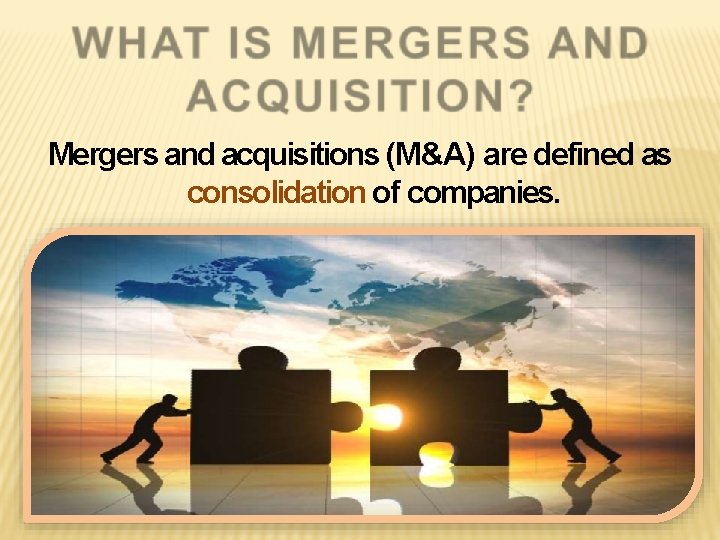
Mergers and acquisitions (M&A) are defined as consolidation of companies. WHAT IS MERGERS AND ACQUISITION?
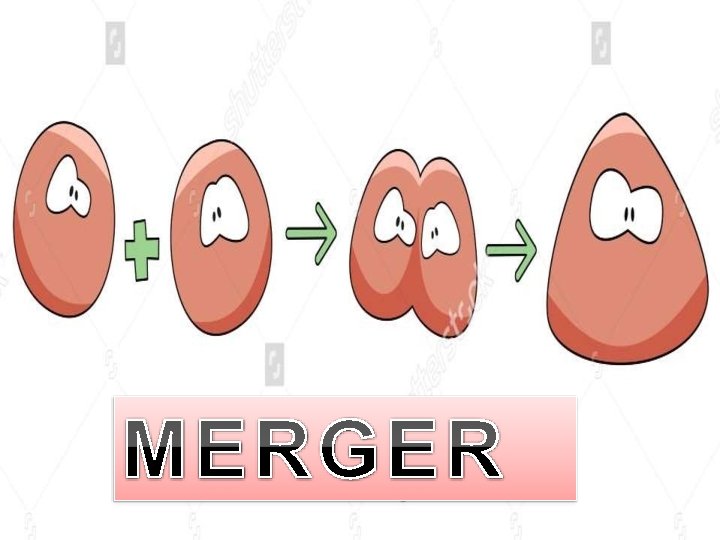
Mergers is the combination of two companies to form one new company. The combination of the two companies involves a transfer of ownership. Both companies surrender their stock and issue new stock as a new company.
WAYS OF MERGER A MERRGERCANTAKESPLACEIN FOLLOWING WAY: BUY PURCHASING OF ASSETS BUY PURCHASING COMMON SHARES BY EXCHANGING SHARES FOR ASSETS BY EXCHANGING SHARES FOR SHARES
1. Horizontal Mergers 2. Vertical Mergers 3. Conglomerate Mergers 4. Concentric Mergers
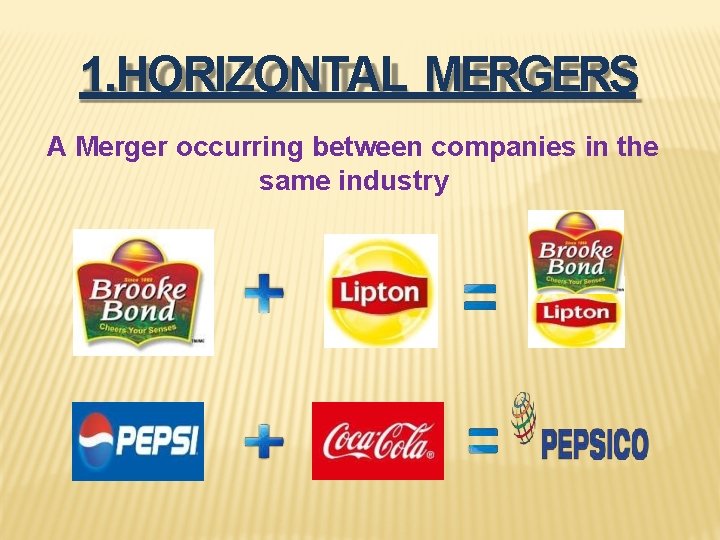
1. HORIZONTAL MERGERS A Merger occurring between companies in the same industry
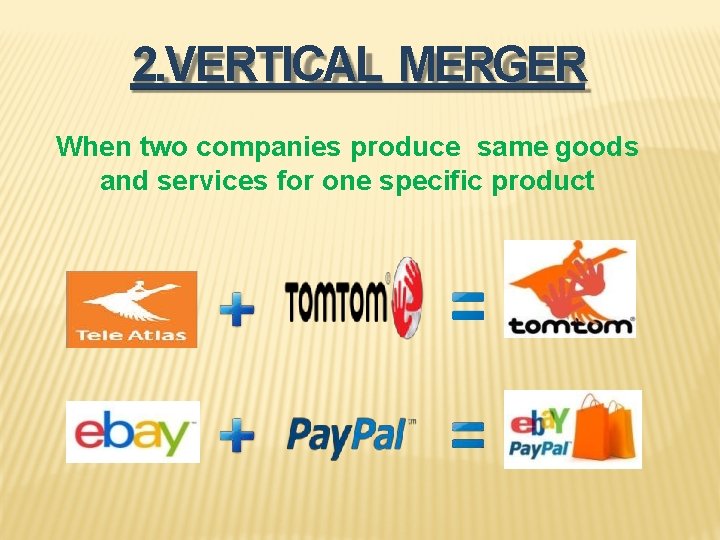
2. VERTICAL MERGER When two companies produce same goods and services for one specific product
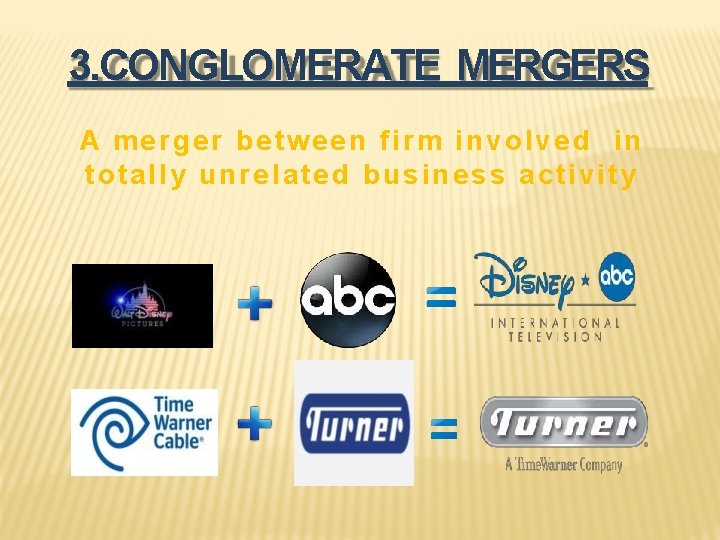
3. CONGLOMERATE MERGERS A m e r g e r b e t w e e n f i r m i n v o l v e d in totally unrelated business activity
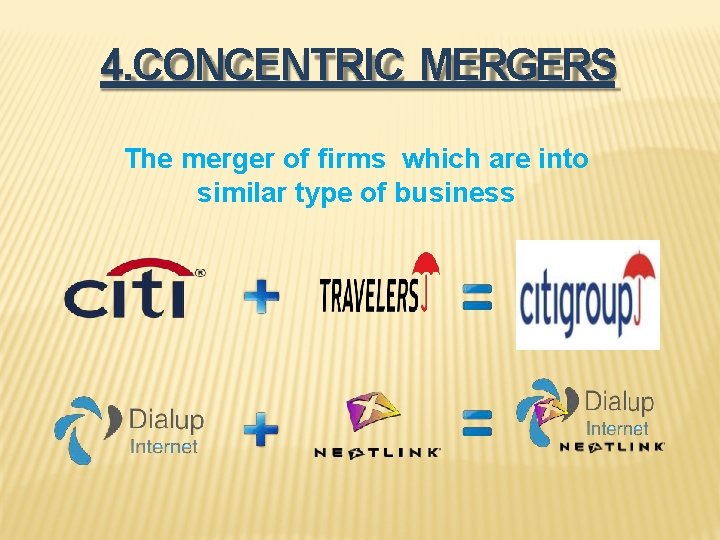
4. CONCENTRIC MERGERS The merger of firms which are into similar type of business
AQUISITION
WHAT IS ACQUISITION? When one company takes over another and clearly established itself as a new owner , the purchase is called an acquisition
TYPES OF ACQUISITION? 1. Friendly acquisition 2. Reverse acquisition 3. Back flip acquisition 4. Hostile acquisition
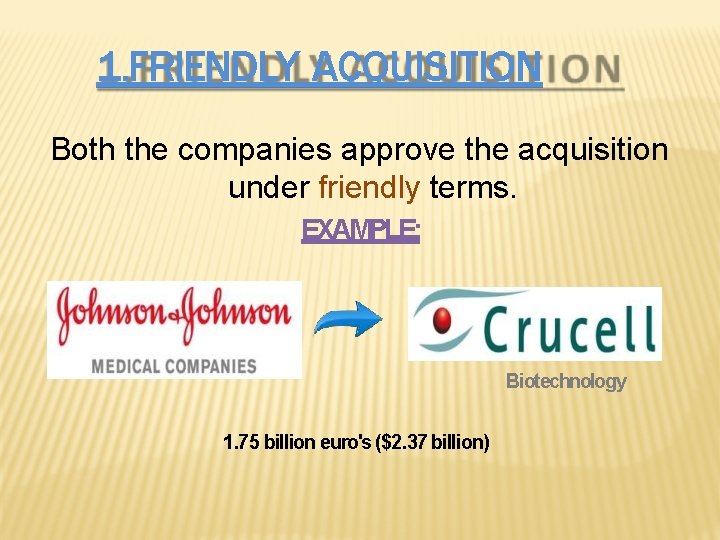
1. FRIENDLY ACQUISITION Both the companies approve the acquisition under friendly terms. EXAMPLE: Biotechnology 1. 75 billion euro's ($2. 37 billion)
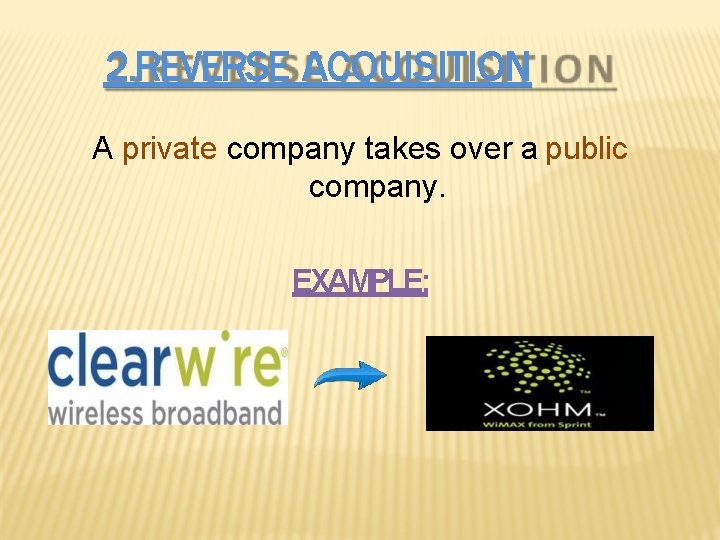
2. REVERSE ACQUISITION A private company takes over a public company. EXAMPLE:
3. BACK FLIP ACQUISITION The purchasing company becomes a subsidiary of the purchased company. EXAMPLE:
4. HOSTILE ACQUISITION � Here, the entire process is done by force. � EXAMPLE: $10. 3 billion
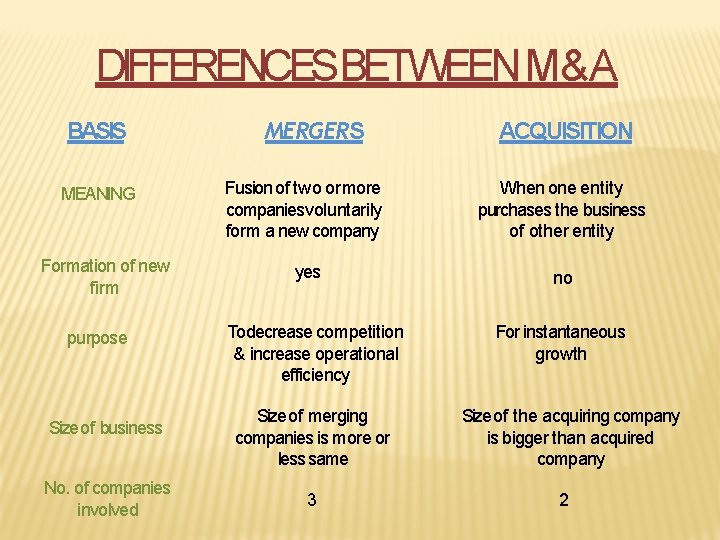
DIFFERENCESBETWEEN M&A BASIS MEANING Formation of new firm purpose Size of business No. of companies involved MERGERS ACQUISITION Fusion of two or more companiesvoluntarily form a new company When one entity purchases the business of other entity yes no To decrease competition & increase operational efficiency Size of merging companies is more or less same 3 For instantaneous growth Size of the acquiring company is bigger than acquired company 2
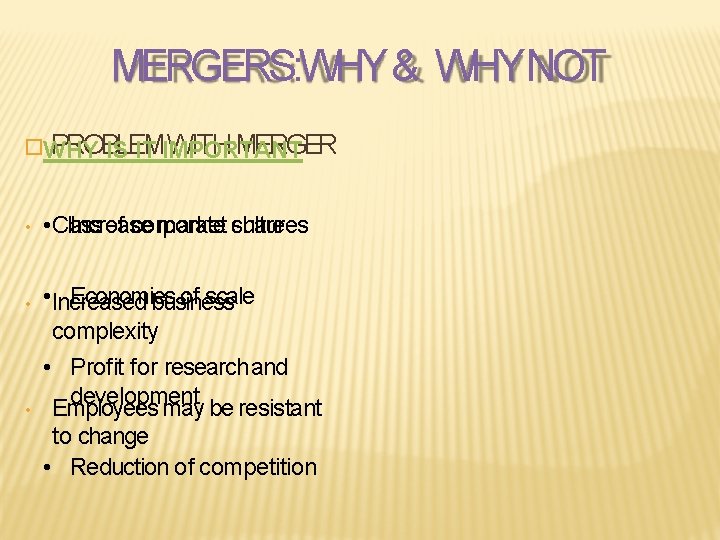
MERGERS: WHY& WHYNOT �WHY PROBLEM WITH MERGER IS IT IMPORTANT • • Class Increase market cultures share of corporate • Increased Economies of scale business complexity • Profit for research and development Employees may be resistant to change • Reduction of competition
ACQUISITION: WHY & WHY NOT � WHY IS IT IMPORTANTPROBLEMWITH ACQUISITION • Increase market share. • Increased diversification. • � excessive competition and cost maximization • Inadequate valuation of target. • Inability to achieve synergy. • Finance by taking huge debt
MOTIVES FORMERGERS& ACQUISITION Economies of large scale business: Enjoys both internal and external economies. Elimination of competition: It eliminates intense & wasteful expenditure by different competing organization. Desire to enjoy monopoly power: M&A leads to monopolistic control in the market. Adoption of modern technology: corporate organization require large resources.
• Greater value generation: M&A generally succeed in generating cost efficiency through the implementation of economies of scale. • Gaining cost efficiency: The joint companies benefits in terms of cost efficiency. as 2 firms form new bigger company. • Increase in market share: An increase in market share is one of the possible benefits of M&A. • Gain higher competitiveness: The new firm is usually more cost-efficient and competitive as compared to its financially weak parent organization.
PROBLEMSOFMERGERS& ACQUISITION • Integration difficulties • Large or extraordinary debt • Managers overly focused on acquisition • Overly diversified
STRATEGIESOFMERGERAND ACQUISITION • There is an important need to assess the market by deciding the growth factors through future market opportunities. • The integration process should be taken in line with consent of management from both the companies venturing into the merger. • Restructuring and future parameters should be decided with exchange of information and knowledge from both ends.
TOP 5 MERGER AND ACQUISITION DEALS
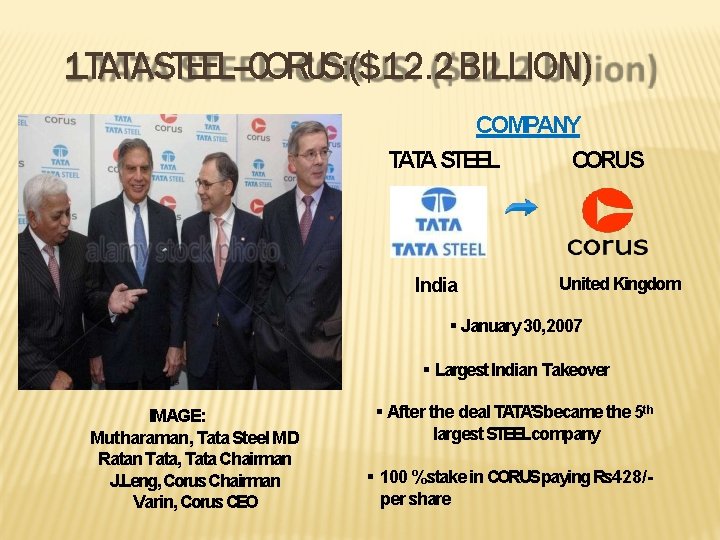
1. TATASTEEL–CORUS: ($12. 2 BILLION) COMPANY TATA STEEL CORUS India United Kingdom January 30, 2007 Largest Indian Takeover IMAGE: Mutharaman, Tata Steel MD Ratan Tata, Tata Chairman J. Leng, Corus Chairman Varin, Corus CEO After the deal TATA’Sbecame the 5 th largest STEELcompany 100 %stake in CORUSpaying Rs 428/per share
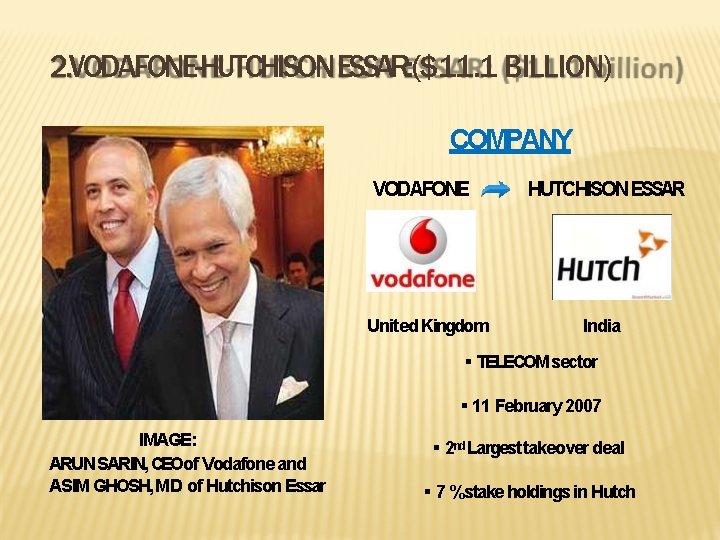
2. VODAFONE-HUTCHISON ESSAR: ($11. 1 BILLION) COMPANY VODAFONE United Kingdom HUTCHISON ESSAR India TELECOM sector 11 February 2007 IMAGE: ARUN SARIN, CEOof Vodafone and ASIM GHOSH, MD of Hutchison Essar 2 nd. Largest takeover deal 7 %stake holdings in Hutch
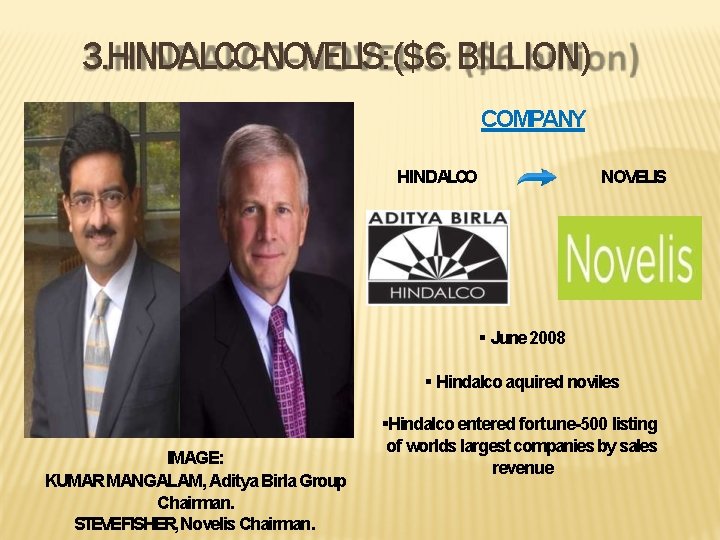
3. HINDALCO-NOVELIS: ($6 BILLION) COMPANY HINDALCO NOVELIS June 2008 Hindalco aquired noviles IMAGE: KUMAR MANGALAM, Aditya Birla Group Chairman. STEVEFISHER, Novelis Chairman. Hindalco entered fortune-500 listing of worlds largest companies by sales revenue
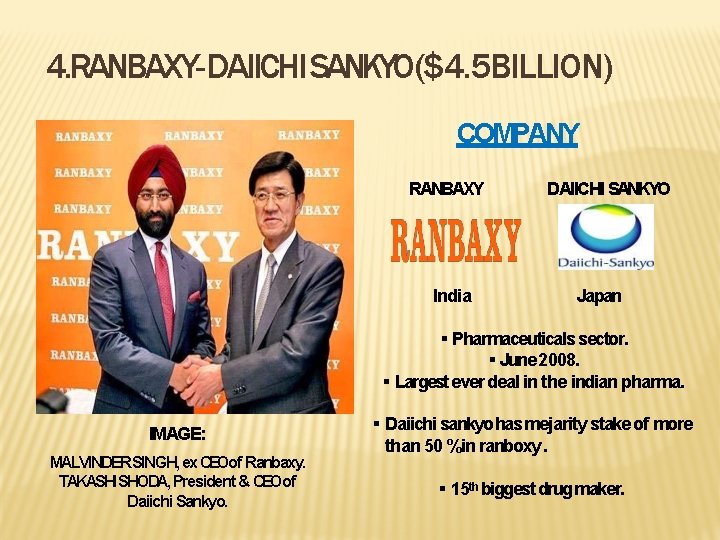
4. RANBAXY- DAIICHI SANKYO($4. 5 BILLION) COMPANY RANBAXY India DAIICHI SANKYO Japan Pharmaceuticals sector. June 2008. Largest ever deal in the indian pharma. IMAGE: MALVINDER SINGH, ex CEOof Ranbaxy. TAKASHISHODA, President & CEOof Daiichi Sankyo. Daiichi sankyo has mejarity stake of more than 50 %in ranboxy. 15 th biggest drug maker.
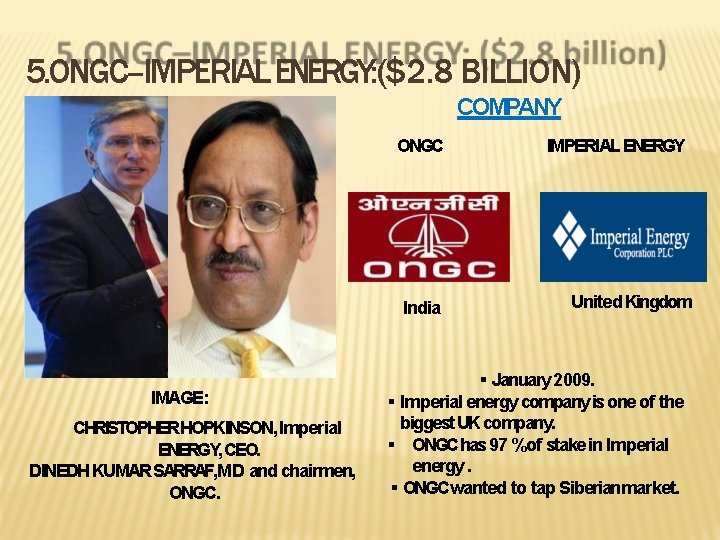
5. ONGC–IMPERIAL ENERGY: ($2. 8 BILLION) COMPANY ONGC India IMAGE: CHRISTOPHERHOPKINSON, Imperial ENERGY, CEO. DINEDH KUMAR SARRAF, MD and chairmen, ONGC. IMPERIAL ENERGY United Kingdom January 2009. Imperial energy company is one of the biggest UK company. ONGChas 97 %of stake in Imperial energy. ONGCwanted to tap Siberianmarket.
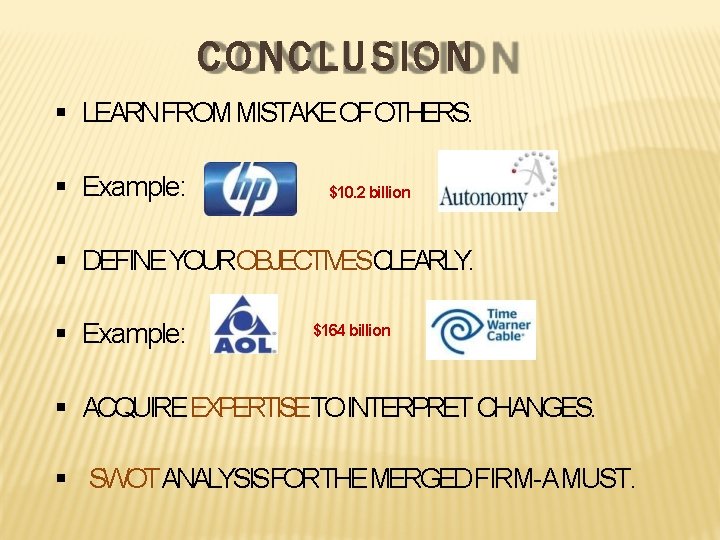
CONCLUSION LEARNFROM MISTAKE OFOTHERS. Example: $10. 2 billion DEFINE YOUROBJECTIVESCLEARLY. Example: $164 billion ACQUIRE EXPERTISETOINTERPRET CHANGES. SWOTANALYSISFORTHEMERGEDFIRM-A MUST.