
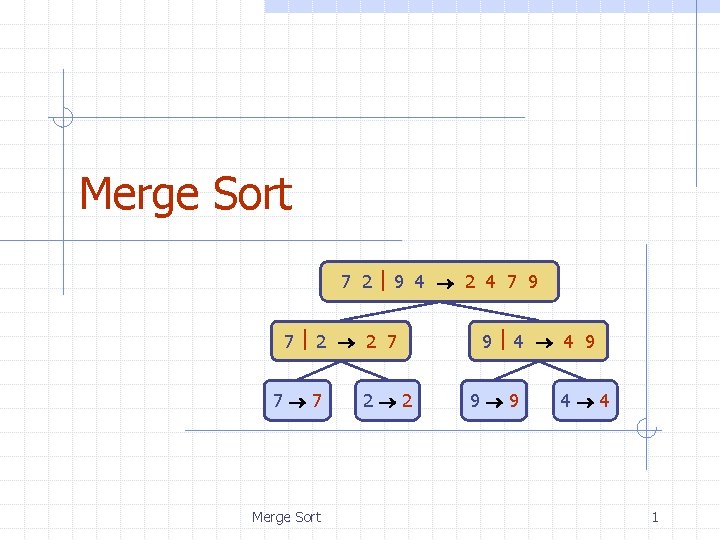
Merge Sort 7 2 9 4 2 4

![Example Key range [0, 9] 7, d 1, c 3, a 7, g 3,](https://slidetodoc.com/presentation_image/ab4b09a15bb56744d6b9e5c3a6a991e1/image-49.jpg "Example Key range [0, 9] 7, d 1, c 3, a 7, g 3,")
- Slides: 63
Merge Sort 7 2 9 4 2 4 7 9 7 2 2 7 7 7 Merge Sort 2 2 9 4 4 9 9 9 4 4 1
Outline and Reading Divide-and-conquer paradigm (§ 4. 1. 1) Merge-sort (§ 4. 1. 1) n n n Algorithm Merging two sorted sequences Merge-sort tree Execution example Analysis Generic merging and set operations (§ 4. 2. 1) Summary of sorting algorithms (§ 4. 2. 1) Merge Sort 2
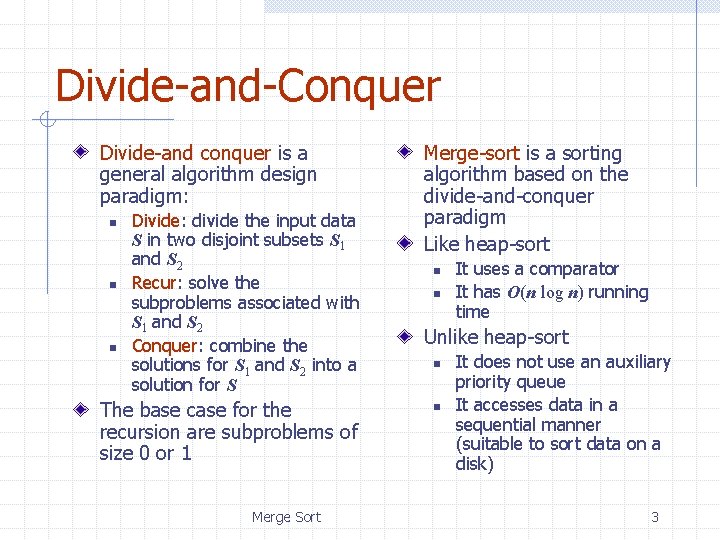
Divide-and-Conquer Divide-and conquer is a general algorithm design paradigm: n n n Divide: divide the input data S in two disjoint subsets S 1 and S 2 Recur: solve the subproblems associated with S 1 and S 2 Conquer: combine the solutions for S 1 and S 2 into a solution for S The base case for the recursion are subproblems of size 0 or 1 Merge Sort Merge-sort is a sorting algorithm based on the divide-and-conquer paradigm Like heap-sort n n It uses a comparator It has O(n log n) running time Unlike heap-sort n n It does not use an auxiliary priority queue It accesses data in a sequential manner (suitable to sort data on a disk) 3
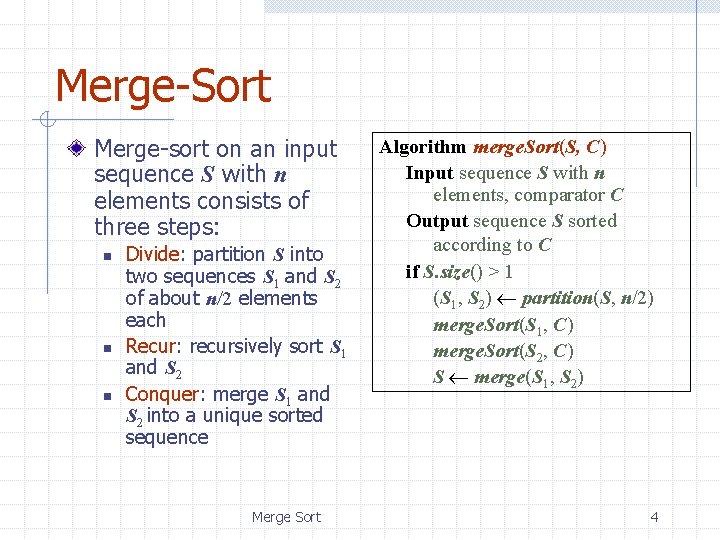
Merge-Sort Merge-sort on an input sequence S with n elements consists of three steps: n n n Divide: partition S into two sequences S 1 and S 2 of about n/2 elements each Recur: recursively sort S 1 and S 2 Conquer: merge S 1 and S 2 into a unique sorted sequence Merge Sort Algorithm merge. Sort(S, C) Input sequence S with n elements, comparator C Output sequence S sorted according to C if S. size() > 1 (S 1, S 2) partition(S, n/2) merge. Sort(S 1, C) merge. Sort(S 2, C) S merge(S 1, S 2) 4
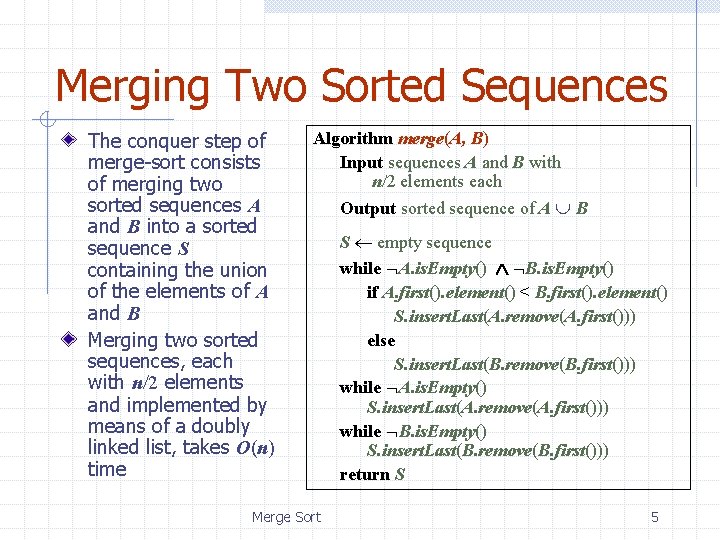
Merging Two Sorted Sequences The conquer step of merge-sort consists of merging two sorted sequences A and B into a sorted sequence S containing the union of the elements of A and B Merging two sorted sequences, each with n/2 elements and implemented by means of a doubly linked list, takes O(n) time Algorithm merge(A, B) Input sequences A and B with n/2 elements each Output sorted sequence of A B Merge Sort S empty sequence while A. is. Empty() B. is. Empty() if A. first(). element() < B. first(). element() S. insert. Last(A. remove(A. first())) else S. insert. Last(B. remove(B. first())) while A. is. Empty() S. insert. Last(A. remove(A. first())) while B. is. Empty() S. insert. Last(B. remove(B. first())) return S 5
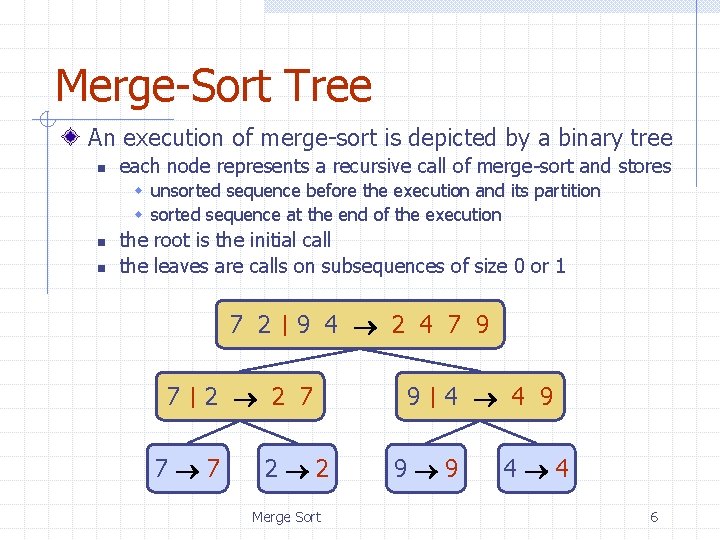
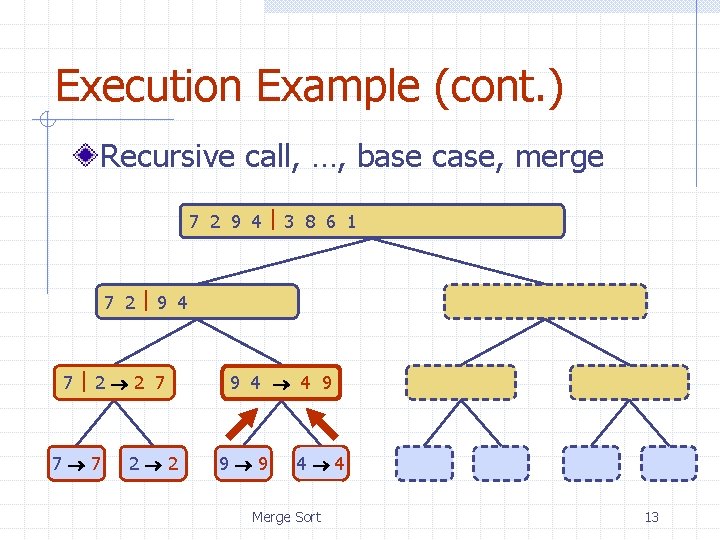
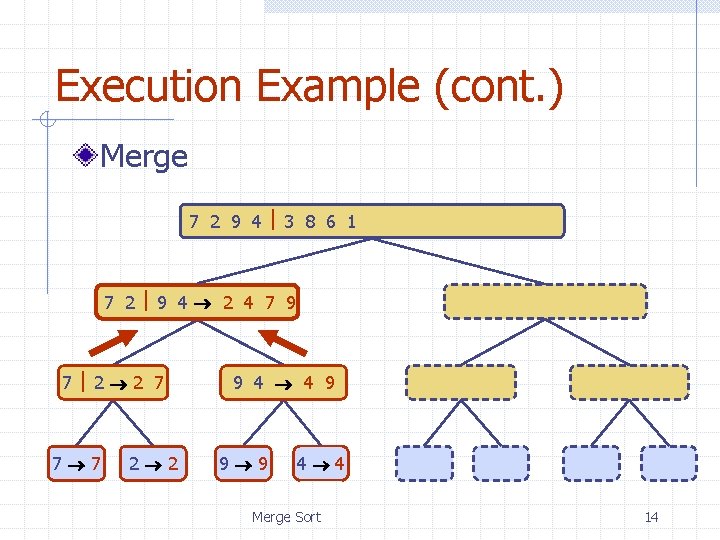
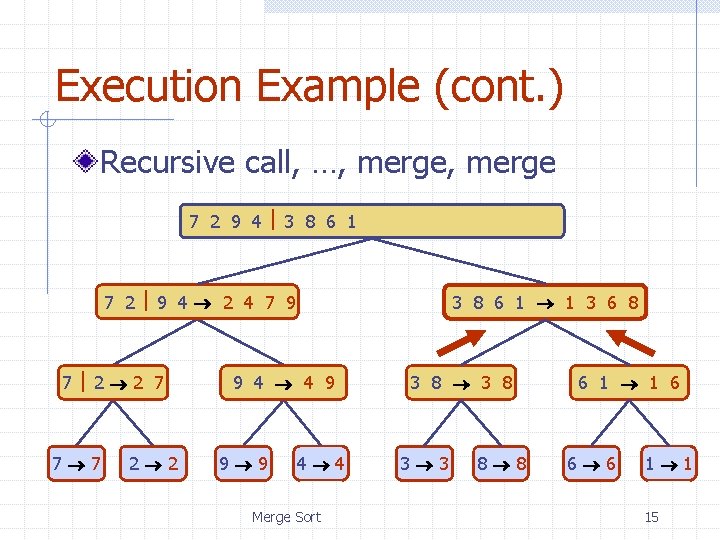
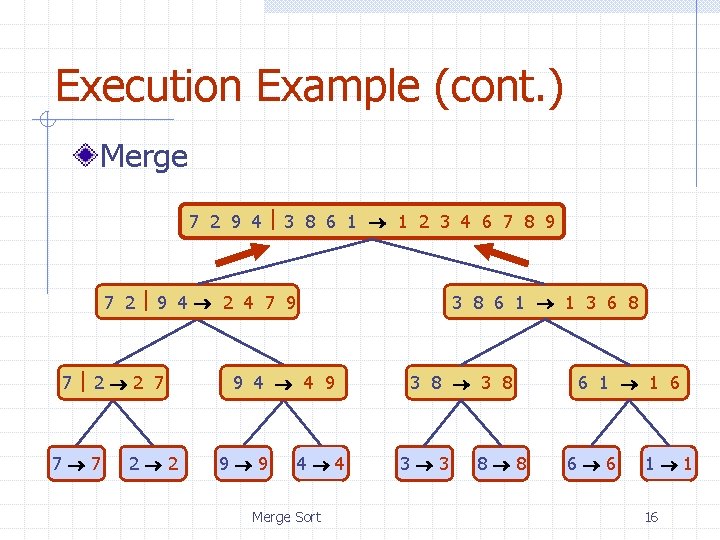
Merge-Sort Tree An execution of merge-sort is depicted by a binary tree n each node represents a recursive call of merge-sort and stores w unsorted sequence before the execution and its partition w sorted sequence at the end of the execution n n the root is the initial call the leaves are calls on subsequences of size 0 or 1 7 2 7 9 4 2 4 7 9 2 2 7 7 7 2 2 Merge Sort 9 4 4 9 9 9 4 4 6
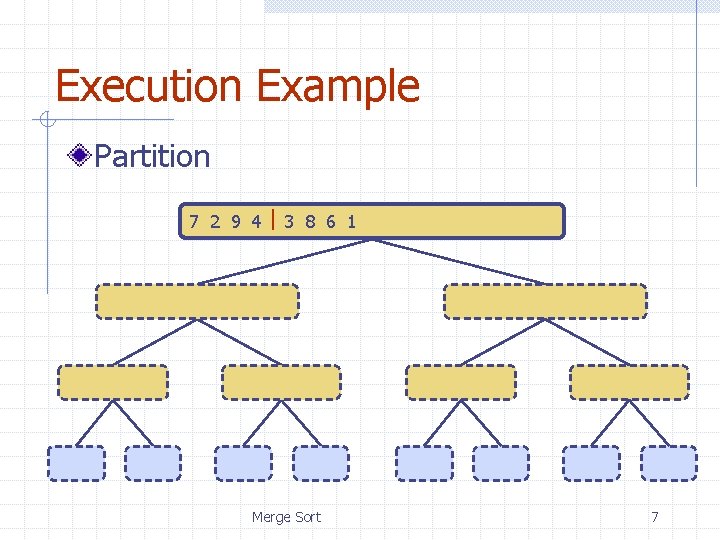
Execution Example Partition 7 2 9 4 3 8 6 1 1 2 3 4 6 7 8 9 7 2 9 4 2 4 7 9 7 2 2 7 7 7 2 2 3 8 6 1 1 3 8 6 9 4 4 9 9 9 4 4 Merge Sort 3 8 3 3 8 8 6 1 1 6 6 6 1 1 7
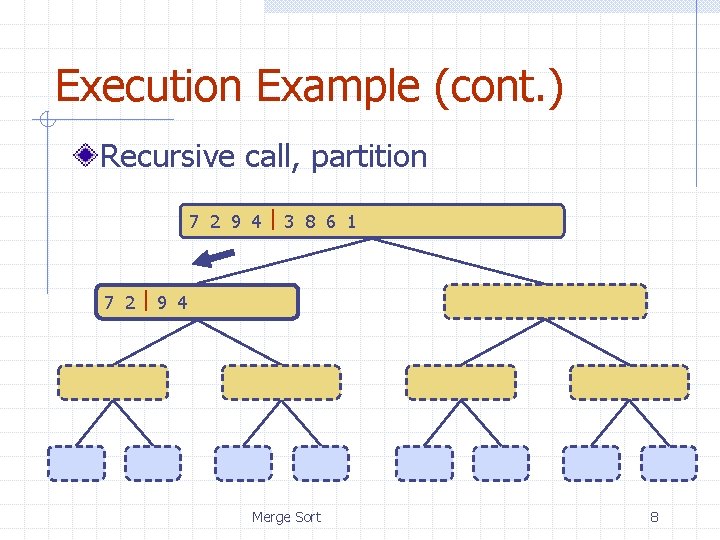
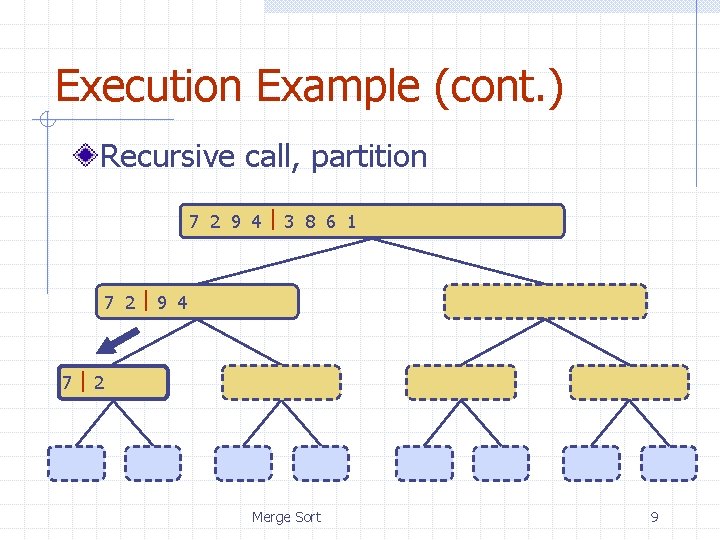
Execution Example (cont. ) Recursive call, partition 7 2 9 4 3 8 6 1 1 2 3 4 6 7 8 9 7 2 9 4 2 4 7 9 7 2 2 7 7 7 2 2 3 8 6 1 1 3 8 6 9 4 4 9 9 9 4 4 Merge Sort 3 8 3 3 8 8 6 1 1 6 6 6 1 1 8
Execution Example (cont. ) Recursive call, partition 7 2 9 4 3 8 6 1 1 2 3 4 6 7 8 9 7 2 9 4 2 4 7 9 7 2 2 7 7 7 2 2 3 8 6 1 1 3 8 6 9 4 4 9 9 9 4 4 Merge Sort 3 8 3 3 8 8 6 1 1 6 6 6 1 1 9
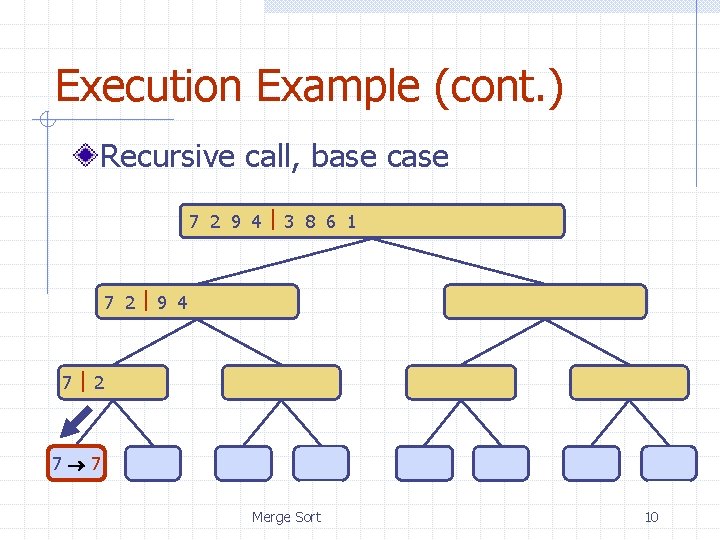
Execution Example (cont. ) Recursive call, base case 7 2 9 4 3 8 6 1 1 2 3 4 6 7 8 9 7 2 9 4 2 4 7 9 7 2 2 7 7 7 2 2 3 8 6 1 1 3 8 6 9 4 4 9 9 9 4 4 Merge Sort 3 8 3 3 8 8 6 1 1 6 6 6 1 1 10
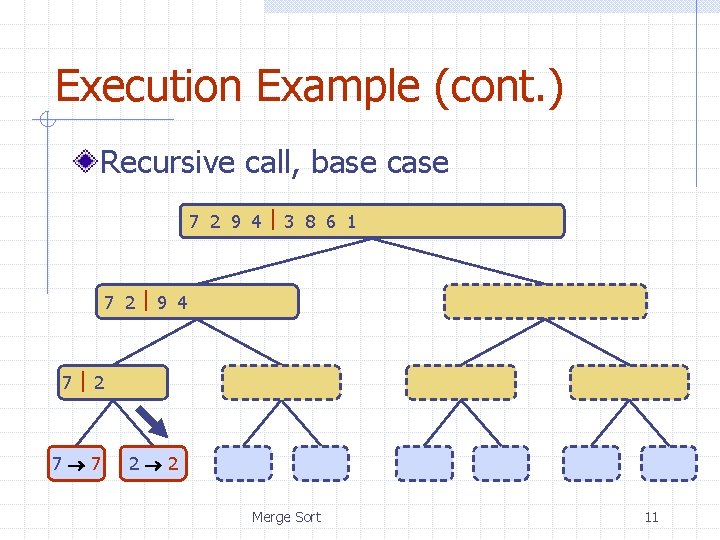
Execution Example (cont. ) Recursive call, base case 7 2 9 4 3 8 6 1 1 2 3 4 6 7 8 9 7 2 9 4 2 4 7 9 7 2 2 7 7 7 2 2 3 8 6 1 1 3 8 6 9 4 4 9 9 9 4 4 Merge Sort 3 8 3 3 8 8 6 1 1 6 6 6 1 1 11
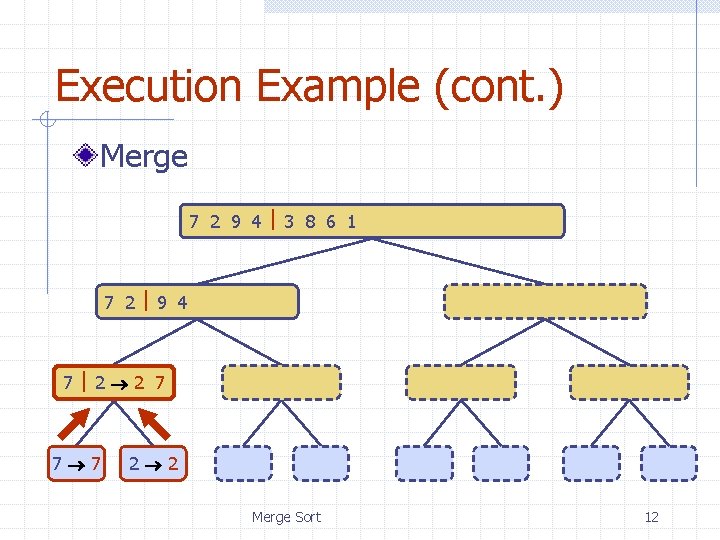
Execution Example (cont. ) Merge 7 2 9 4 3 8 6 1 1 2 3 4 6 7 8 9 7 2 9 4 2 4 7 9 7 2 2 7 7 7 2 2 3 8 6 1 1 3 8 6 9 4 4 9 9 9 4 4 Merge Sort 3 8 3 3 8 8 6 1 1 6 6 6 1 1 12
Execution Example (cont. ) Recursive call, …, base case, merge 7 2 9 4 3 8 6 1 1 2 3 4 6 7 8 9 7 2 9 4 2 4 7 9 7 2 2 7 7 7 2 2 3 8 6 1 1 3 8 6 9 4 4 9 9 9 4 4 Merge Sort 3 8 3 3 8 8 6 1 1 6 6 6 1 1 13
Execution Example (cont. ) Merge 7 2 9 4 3 8 6 1 1 2 3 4 6 7 8 9 7 2 9 4 2 4 7 9 7 2 2 7 7 7 2 2 3 8 6 1 1 3 8 6 9 4 4 9 9 9 4 4 Merge Sort 3 8 3 3 8 8 6 1 1 6 6 6 1 1 14
Execution Example (cont. ) Recursive call, …, merge 7 2 9 4 3 8 6 1 1 2 3 4 6 7 8 9 7 2 9 4 2 4 7 9 7 2 2 7 7 7 2 2 3 8 6 1 1 3 6 8 9 4 4 9 9 9 4 4 Merge Sort 3 8 3 3 8 8 6 1 1 6 6 6 1 1 15
Execution Example (cont. ) Merge 7 2 9 4 3 8 6 1 1 2 3 4 6 7 8 9 7 2 9 4 2 4 7 9 7 2 2 7 7 7 2 2 3 8 6 1 1 3 6 8 9 4 4 9 9 9 4 4 Merge Sort 3 8 3 3 8 8 6 1 1 6 6 6 1 1 16
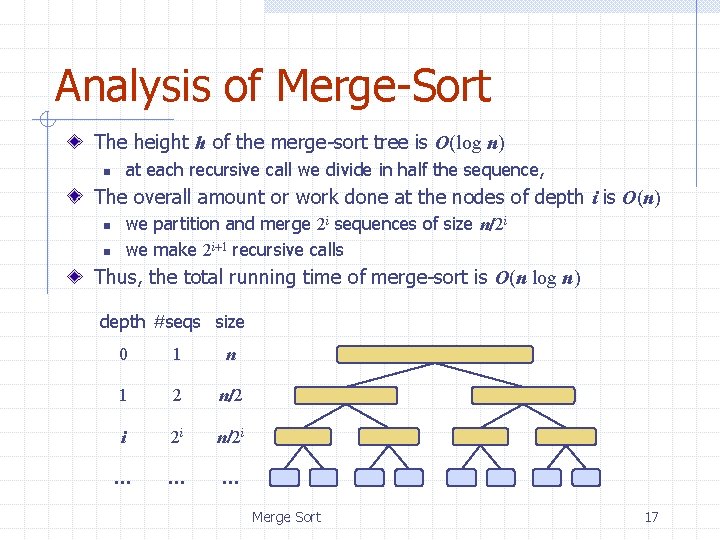
Analysis of Merge-Sort The height h of the merge-sort tree is O(log n) at each recursive call we divide in half the sequence, n The overall amount or work done at the nodes of depth i is O(n) we partition and merge 2 i sequences of size n/2 i we make 2 i+1 recursive calls n n Thus, the total running time of merge-sort is O(n log n) depth #seqs size 0 1 n 1 2 n/2 i 2 i n/2 i … … … Merge Sort 17
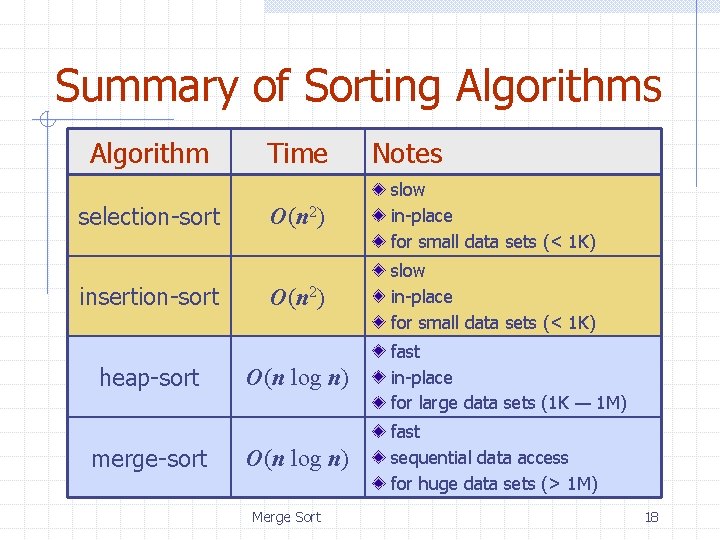
Summary of Sorting Algorithms Algorithm selection-sort insertion-sort heap-sort merge-sort Time Notes O(n 2) slow in-place for small data sets (< 1 K) O(n log n) fast in-place for large data sets (1 K — 1 M) O(n log n) fast sequential data access for huge data sets (> 1 M) Merge Sort 18
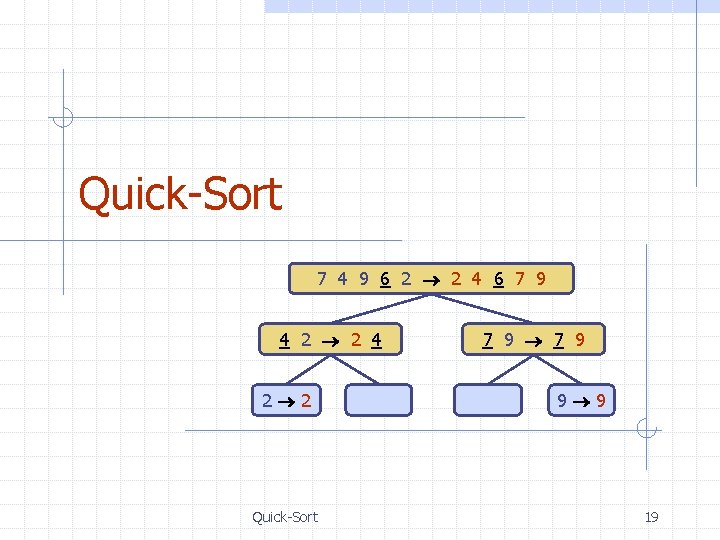
Quick-Sort 7 4 9 6 2 2 4 6 7 9 4 2 2 4 2 2 Quick-Sort 7 9 9 9 19
Outline and Reading Quick-sort (§ 4. 3) n n Algorithm Partition step Quick-sort tree Execution example Analysis of quick-sort (4. 3. 1) In-place quick-sort (§ 4. 8) Summary of sorting algorithms Quick-Sort 20
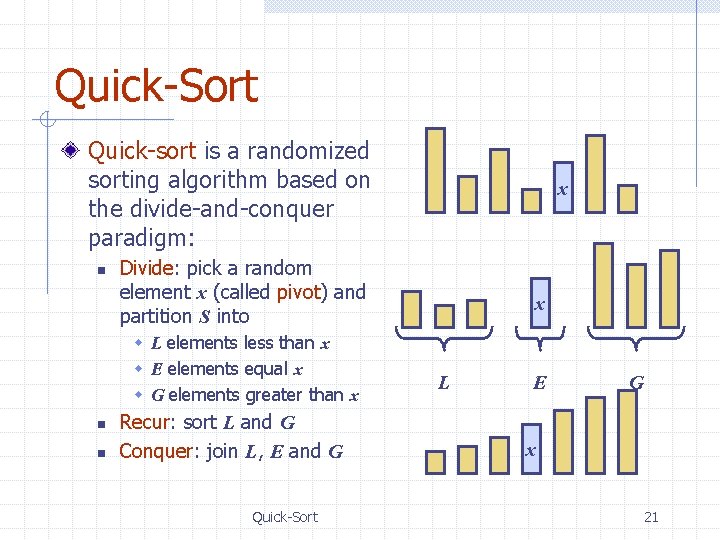
Quick-Sort Quick-sort is a randomized sorting algorithm based on the divide-and-conquer paradigm: n Divide: pick a random element x (called pivot) and partition S into w L elements less than x w E elements equal x w G elements greater than x n n x Recur: sort L and G Conquer: join L, E and G Quick-Sort x L E G x 21
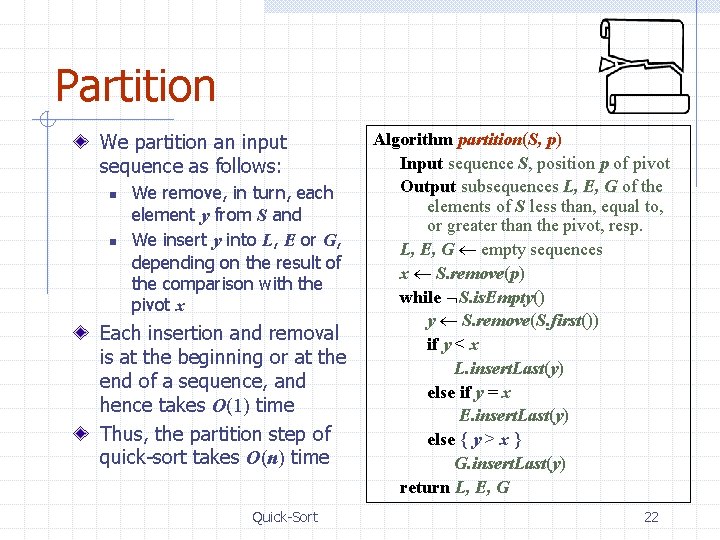
Partition We partition an input sequence as follows: n n We remove, in turn, each element y from S and We insert y into L, E or G, depending on the result of the comparison with the pivot x Each insertion and removal is at the beginning or at the end of a sequence, and hence takes O(1) time Thus, the partition step of quick-sort takes O(n) time Quick-Sort Algorithm partition(S, p) Input sequence S, position p of pivot Output subsequences L, E, G of the elements of S less than, equal to, or greater than the pivot, resp. L, E, G empty sequences x S. remove(p) while S. is. Empty() y S. remove(S. first()) if y < x L. insert. Last(y) else if y = x E. insert. Last(y) else { y > x } G. insert. Last(y) return L, E, G 22
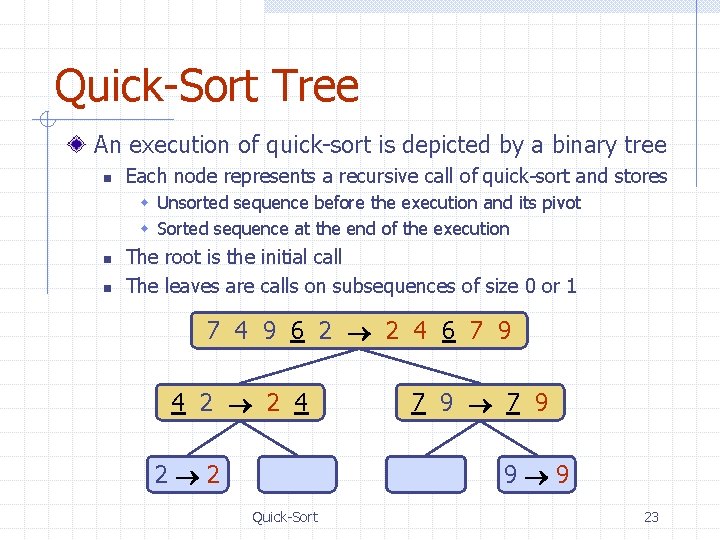
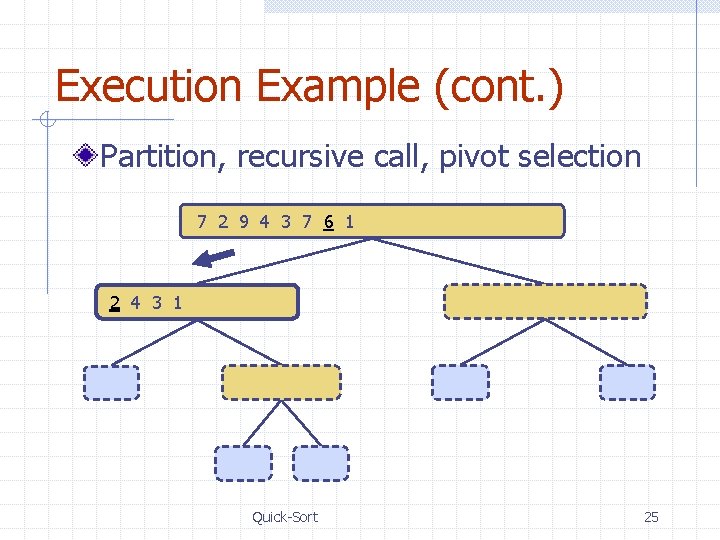
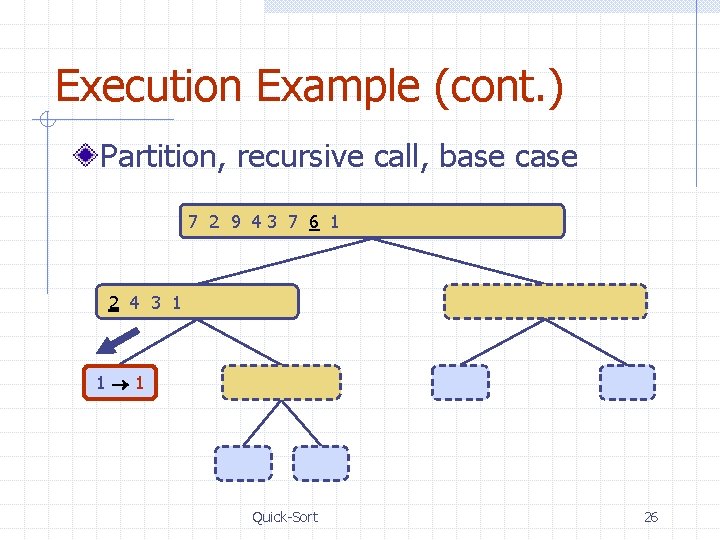
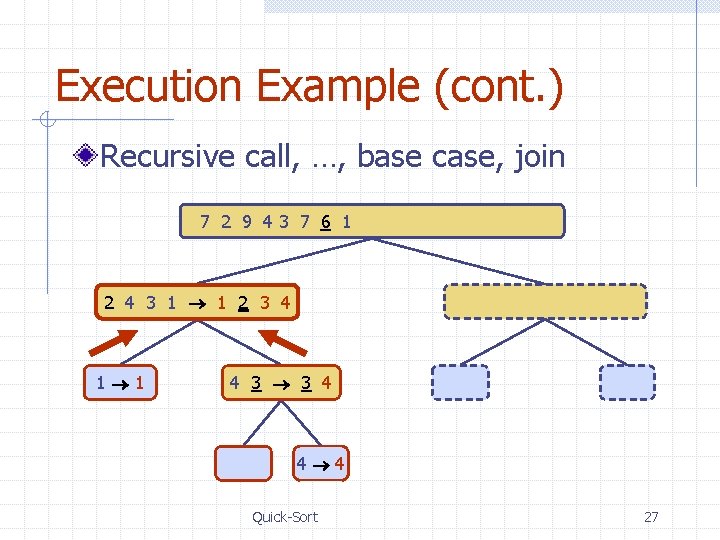
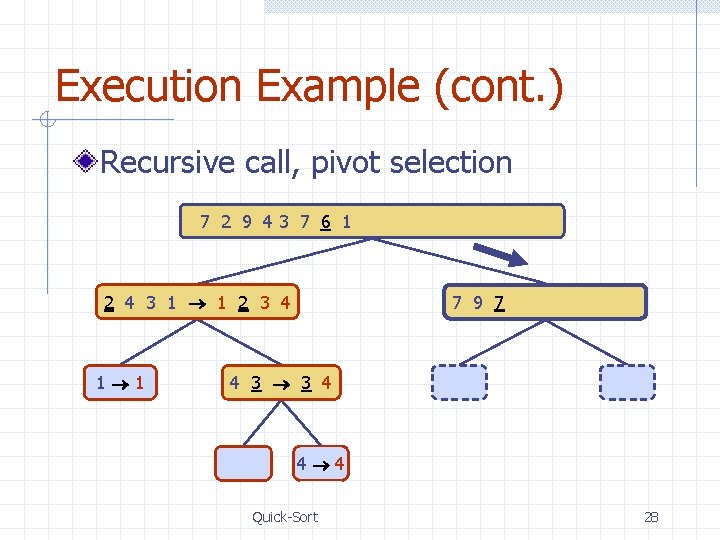
Quick-Sort Tree An execution of quick-sort is depicted by a binary tree n Each node represents a recursive call of quick-sort and stores w Unsorted sequence before the execution and its pivot w Sorted sequence at the end of the execution n n The root is the initial call The leaves are calls on subsequences of size 0 or 1 7 4 9 6 2 2 4 6 7 9 4 2 2 4 2 2 7 9 9 9 Quick-Sort 23
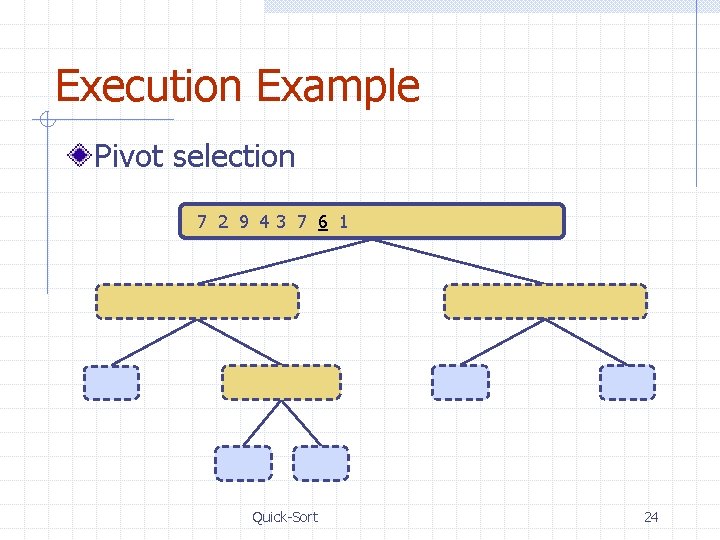
Execution Example Pivot selection 7 2 9 43 7 6 1 1 2 3 4 6 7 8 9 7 2 9 4 2 4 7 9 2 2 3 8 6 1 1 3 8 6 9 4 4 9 9 9 3 3 8 8 4 4 Quick-Sort 24
Execution Example (cont. ) Partition, recursive call, pivot selection 7 2 9 4 3 7 6 1 1 2 3 4 6 7 8 9 2 4 3 1 2 4 7 9 2 2 3 8 6 1 1 3 8 6 9 4 4 9 9 9 3 3 8 8 4 4 Quick-Sort 25
Execution Example (cont. ) Partition, recursive call, base case 7 2 9 43 7 6 1 1 2 3 4 6 7 8 9 2 4 3 1 2 4 7 1 1 3 8 6 1 1 3 8 6 9 4 4 9 9 9 3 3 8 8 4 4 Quick-Sort 26
Execution Example (cont. ) Recursive call, …, base case, join 7 2 9 43 7 6 1 1 2 3 4 6 7 8 9 2 4 3 1 1 2 3 4 1 1 3 8 6 1 1 3 8 6 4 3 3 4 9 9 3 3 8 8 4 4 Quick-Sort 27
Execution Example (cont. ) Recursive call, pivot selection 7 2 9 43 7 6 1 1 2 3 4 6 7 8 9 2 4 3 1 1 2 3 4 1 1 7 9 7 1 1 3 8 6 4 3 3 4 9 9 8 8 9 9 4 4 Quick-Sort 28
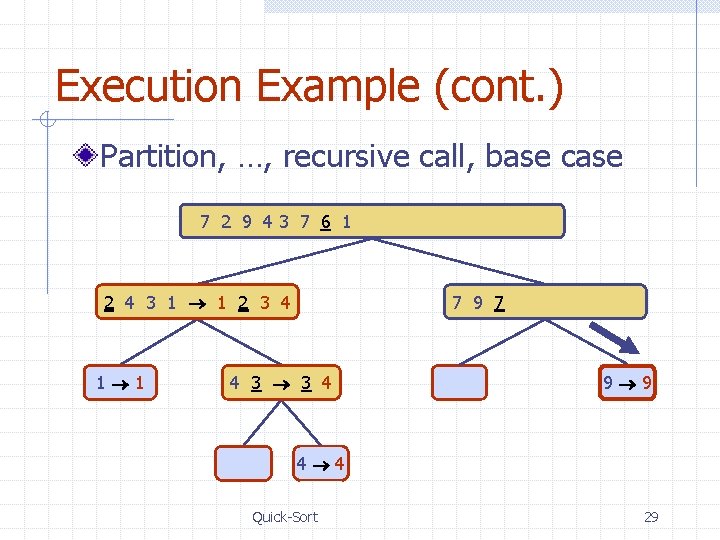
Execution Example (cont. ) Partition, …, recursive call, base case 7 2 9 43 7 6 1 1 2 3 4 6 7 8 9 2 4 3 1 1 2 3 4 1 1 7 9 7 1 1 3 8 6 4 3 3 4 9 9 8 8 9 9 4 4 Quick-Sort 29
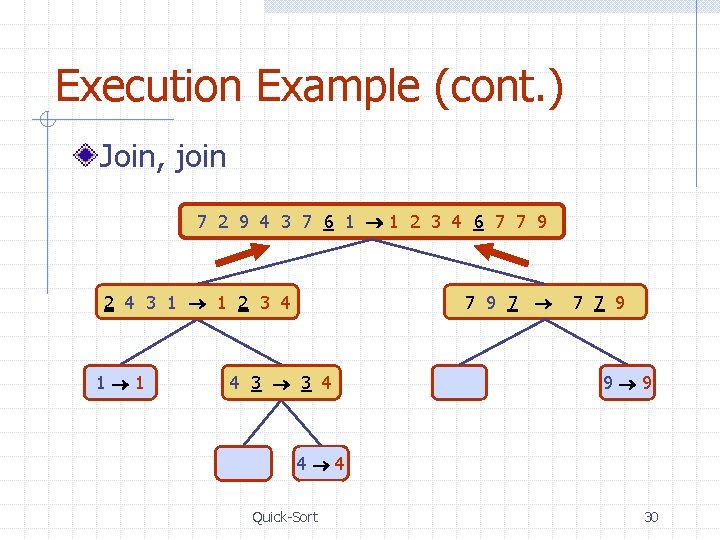
Execution Example (cont. ) Join, join 7 2 9 4 3 7 6 1 1 2 3 4 6 7 7 9 2 4 3 1 1 2 3 4 1 1 7 9 7 17 7 9 4 3 3 4 9 9 8 8 9 9 4 4 Quick-Sort 30
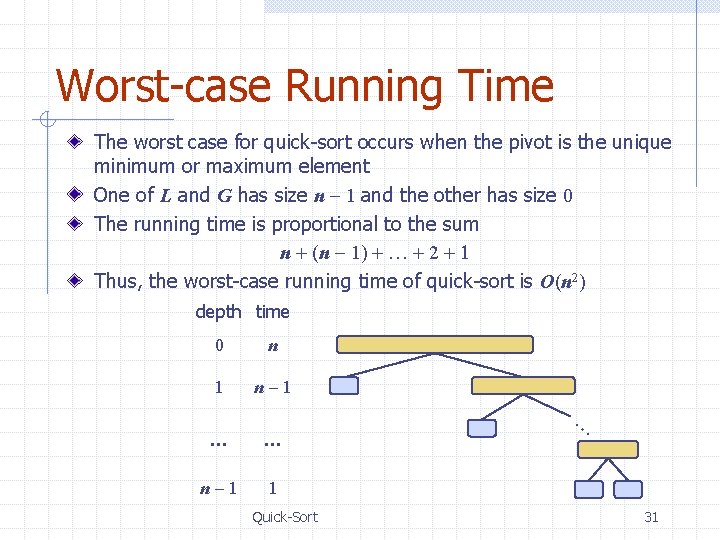
Worst-case Running Time The worst case for quick-sort occurs when the pivot is the unique minimum or maximum element One of L and G has size n - 1 and the other has size 0 The running time is proportional to the sum n + (n - 1) + … + 2 + 1 Thus, the worst-case running time of quick-sort is O(n 2) depth time 0 n 1 n-1 … … … n-1 1 Quick-Sort 31
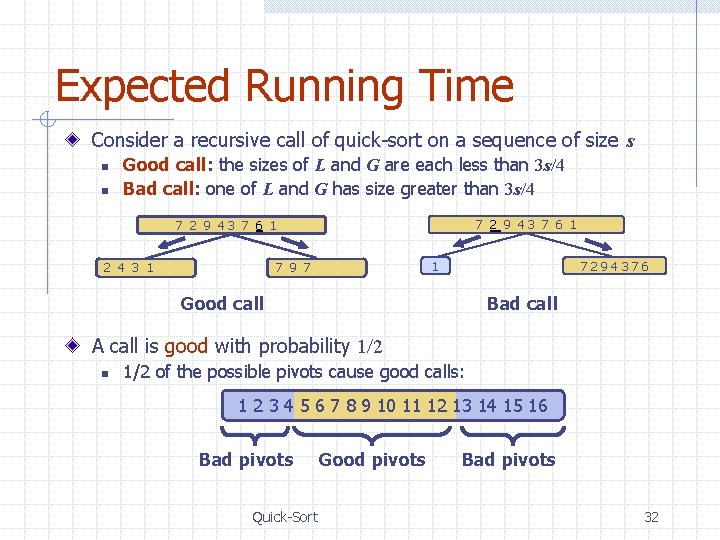
Expected Running Time Consider a recursive call of quick-sort on a sequence of size s n n Good call: the sizes of L and G are each less than 3 s/4 Bad call: one of L and G has size greater than 3 s/4 7 2 9 43 7 6 19 7 1 1 2 4 3 1 1 7294376 Good call Bad call A call is good with probability 1/2 n 1/2 of the possible pivots cause good calls: 1 2 3 4 5 6 7 8 9 10 11 12 13 14 15 16 Bad pivots Quick-Sort Good pivots Bad pivots 32
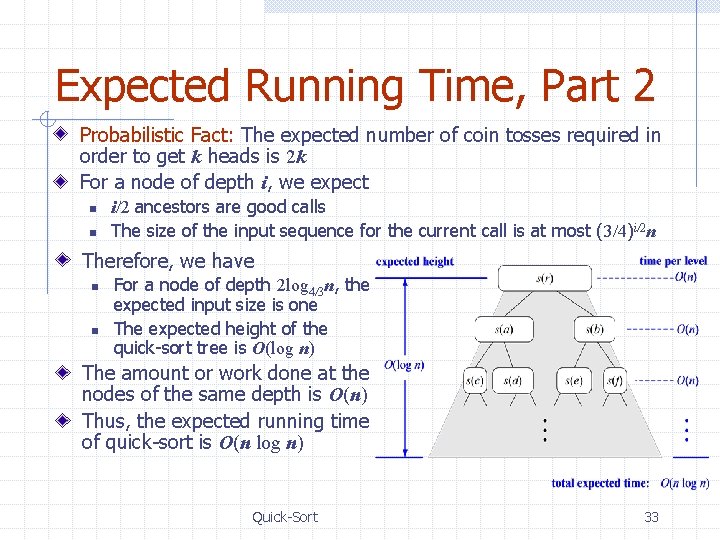
Expected Running Time, Part 2 Probabilistic Fact: The expected number of coin tosses required in order to get k heads is 2 k For a node of depth i, we expect n n i/2 ancestors are good calls The size of the input sequence for the current call is at most (3/4)i/2 n Therefore, we have n n For a node of depth 2 log 4/3 n, the expected input size is one The expected height of the quick-sort tree is O(log n) The amount or work done at the nodes of the same depth is O(n) Thus, the expected running time of quick-sort is O(n log n) Quick-Sort 33
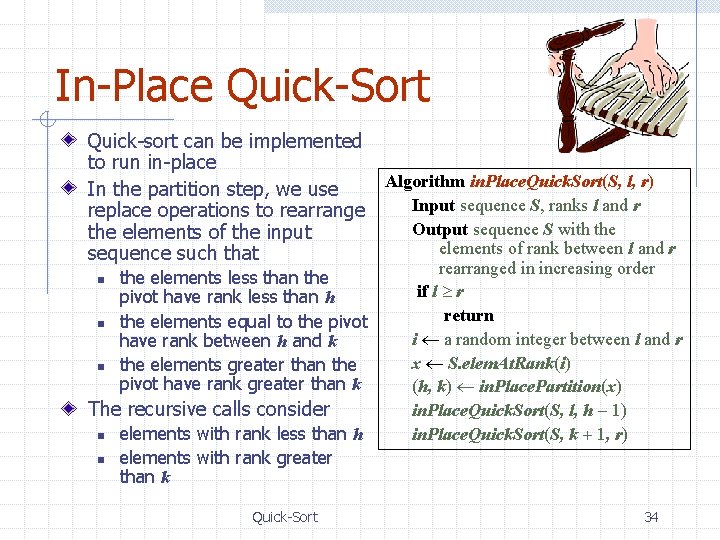
In-Place Quick-Sort Quick-sort can be implemented to run in-place Algorithm in. Place. Quick. Sort(S, l, r) In the partition step, we use Input sequence S, ranks l and r replace operations to rearrange Output sequence S with the elements of the input elements of rank between l and r sequence such that n n n the elements less than the pivot have rank less than h the elements equal to the pivot have rank between h and k the elements greater than the pivot have rank greater than k The recursive calls consider n n elements with rank less than h elements with rank greater than k Quick-Sort rearranged in increasing order if l r return i a random integer between l and r x S. elem. At. Rank(i) (h, k) in. Place. Partition(x) in. Place. Quick. Sort(S, l, h - 1) in. Place. Quick. Sort(S, k + 1, r) 34
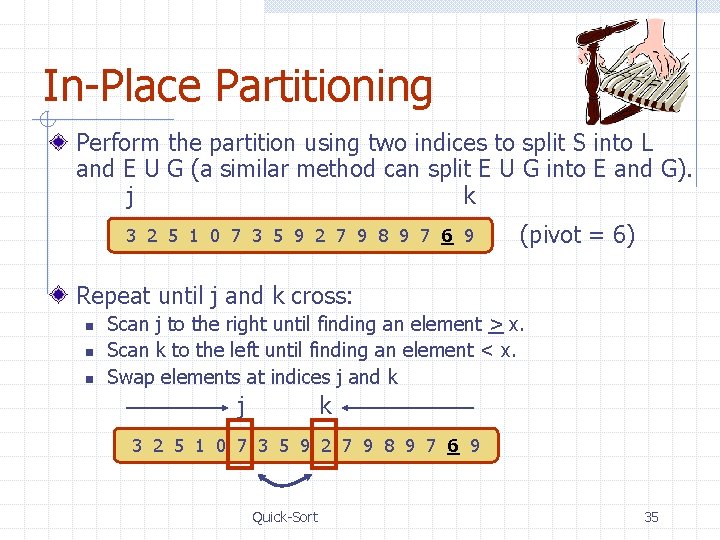
In-Place Partitioning Perform the partition using two indices to split S into L and E U G (a similar method can split E U G into E and G). j k 3 2 5 1 0 7 3 5 9 2 7 9 8 9 7 6 9 (pivot = 6) Repeat until j and k cross: n n n Scan j to the right until finding an element > x. Scan k to the left until finding an element < x. Swap elements at indices j and k j k 3 2 5 1 0 7 3 5 9 2 7 9 8 9 7 6 9 Quick-Sort 35
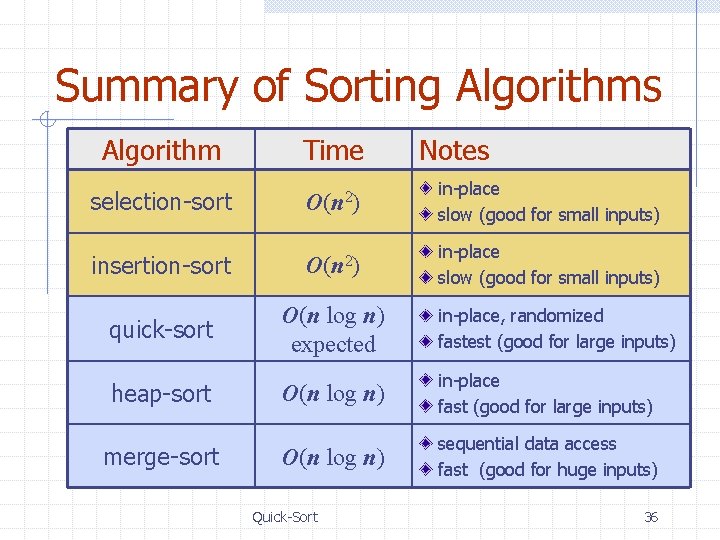
Summary of Sorting Algorithms Algorithm Time selection-sort O(n 2) in-place slow (good for small inputs) insertion-sort O(n 2) in-place slow (good for small inputs) quick-sort O(n log n) expected in-place, randomized fastest (good for large inputs) O(n log n) in-place fast (good for large inputs) O(n log n) sequential data access fast (good for huge inputs) heap-sort merge-sort Quick-Sort Notes 36
Sorting Lower Bound 37
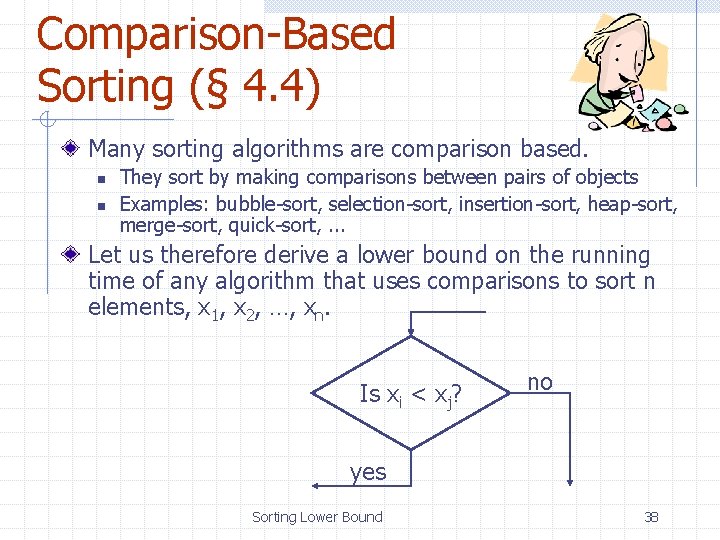
Comparison-Based Sorting (§ 4. 4) Many sorting algorithms are comparison based. n n They sort by making comparisons between pairs of objects Examples: bubble-sort, selection-sort, insertion-sort, heap-sort, merge-sort, quick-sort, . . . Let us therefore derive a lower bound on the running time of any algorithm that uses comparisons to sort n elements, x 1, x 2, …, xn. Is xi < xj? no yes Sorting Lower Bound 38
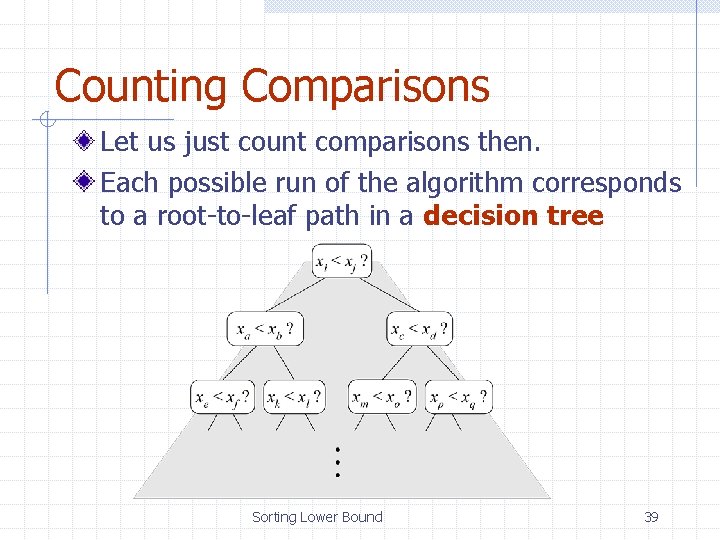
Counting Comparisons Let us just count comparisons then. Each possible run of the algorithm corresponds to a root-to-leaf path in a decision tree Sorting Lower Bound 39
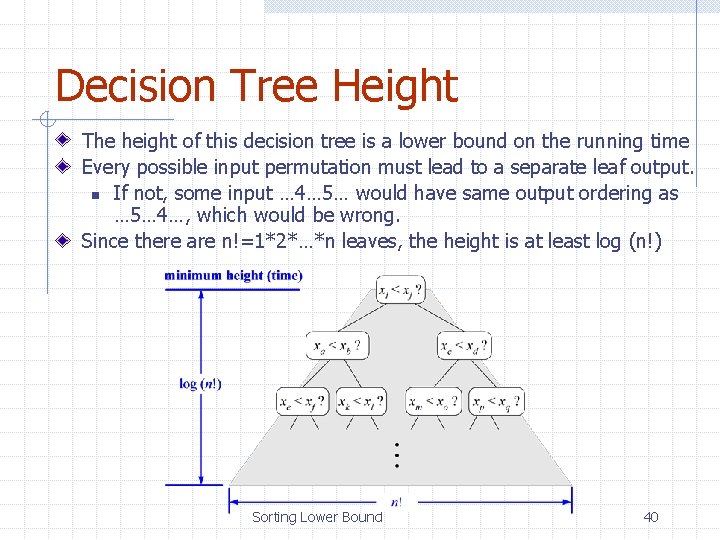
Decision Tree Height The height of this decision tree is a lower bound on the running time Every possible input permutation must lead to a separate leaf output. n If not, some input … 4… 5… would have same output ordering as … 5… 4…, which would be wrong. Since there are n!=1*2*…*n leaves, the height is at least log (n!) Sorting Lower Bound 40
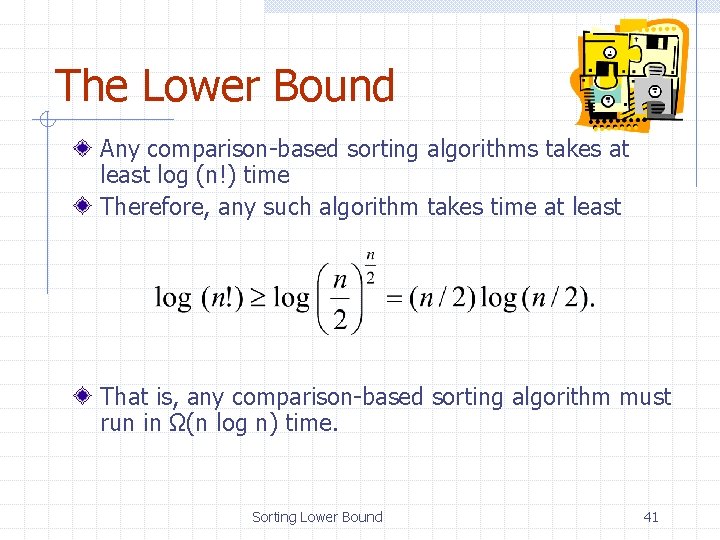
The Lower Bound Any comparison-based sorting algorithms takes at least log (n!) time Therefore, any such algorithm takes time at least That is, any comparison-based sorting algorithm must run in Ω(n log n) time. Sorting Lower Bound 41
Sets 42
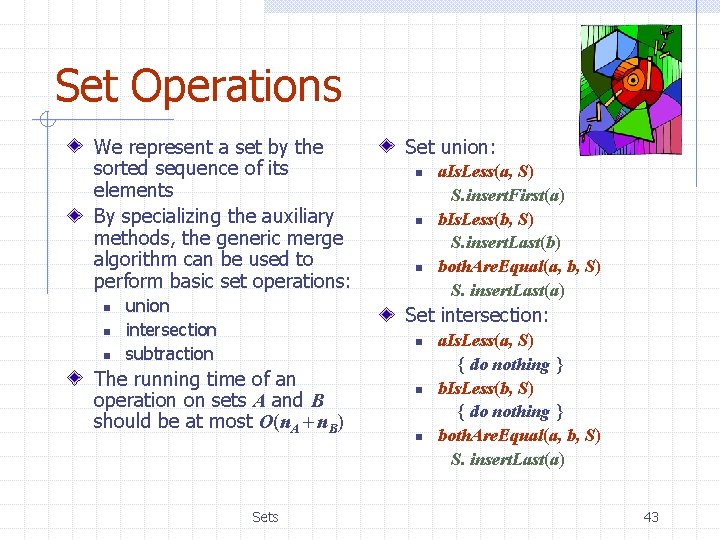
Set Operations We represent a set by the sorted sequence of its elements By specializing the auxiliary methods, the generic merge algorithm can be used to perform basic set operations: n n n union intersection subtraction Set union: n n n a. Is. Less(a, S) S. insert. First(a) b. Is. Less(b, S) S. insert. Last(b) both. Are. Equal(a, b, S) S. insert. Last(a) Set intersection: n The running time of an operation on sets A and B should be at most O(n. A + n. B) Sets n n a. Is. Less(a, S) { do nothing } b. Is. Less(b, S) { do nothing } both. Are. Equal(a, b, S) S. insert. Last(a) 43
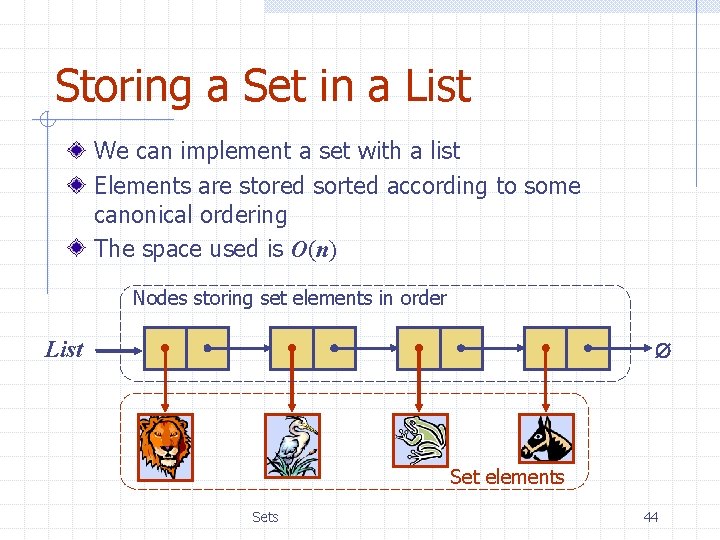
Storing a Set in a List We can implement a set with a list Elements are stored sorted according to some canonical ordering The space used is O(n) Nodes storing set elements in order List Set elements Sets 44
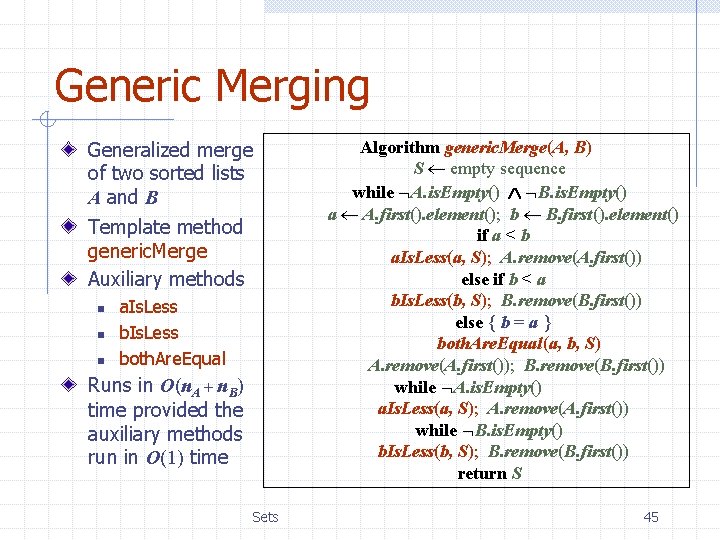
Generic Merging Generalized merge of two sorted lists A and B Template method generic. Merge Auxiliary methods n n n a. Is. Less both. Are. Equal Runs in O(n. A + n. B) time provided the auxiliary methods run in O(1) time Sets Algorithm generic. Merge(A, B) S empty sequence while A. is. Empty() B. is. Empty() a A. first(). element(); b B. first(). element() if a < b a. Is. Less(a, S); A. remove(A. first()) else if b < a b. Is. Less(b, S); B. remove(B. first()) else { b = a } both. Are. Equal(a, b, S) A. remove(A. first()); B. remove(B. first()) while A. is. Empty() a. Is. Less(a, S); A. remove(A. first()) while B. is. Empty() b. Is. Less(b, S); B. remove(B. first()) return S 45
Using Generic Merge for Set Operations Any of the set operations can be implemented using a generic merge For example: n n For intersection: only copy elements that are duplicated in both list For union: copy every element from both lists except for the duplicates All methods run in linear time. Sets 46
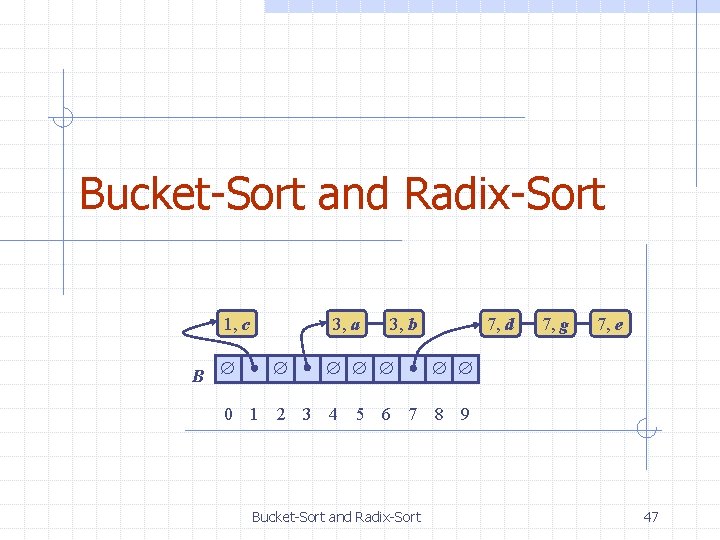
Bucket-Sort and Radix-Sort 1, c B 3, a 3, b 7, d 7, g 7, e 0 1 2 3 4 5 6 7 8 9 Bucket-Sort and Radix-Sort 47
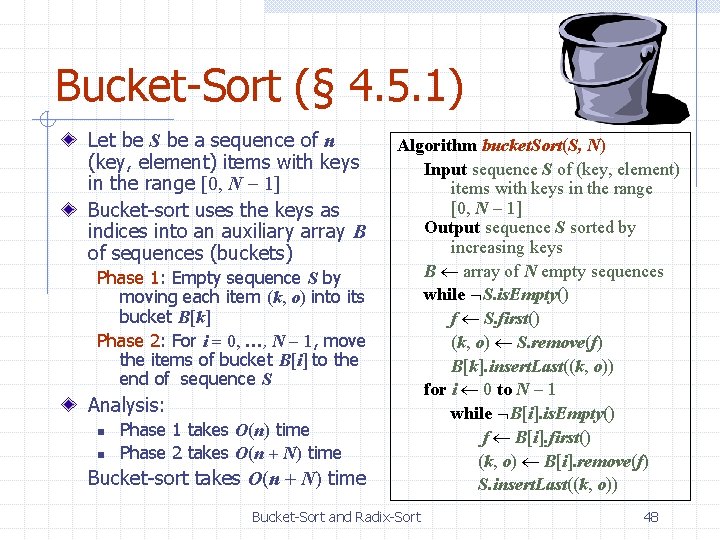
Bucket-Sort (§ 4. 5. 1) Let be S be a sequence of n (key, element) items with keys in the range [0, N - 1] Bucket-sort uses the keys as indices into an auxiliary array B of sequences (buckets) Phase 1: Empty sequence S by moving each item (k, o) into its bucket B[k] Phase 2: For i = 0, …, N - 1, move the items of bucket B[i] to the end of sequence S Analysis: n n Phase 1 takes O(n) time Phase 2 takes O(n + N) time Bucket-sort takes O(n + N) time Algorithm bucket. Sort(S, N) Input sequence S of (key, element) items with keys in the range [0, N - 1] Output sequence S sorted by increasing keys B array of N empty sequences while S. is. Empty() f S. first() (k, o) S. remove(f) B[k]. insert. Last((k, o)) for i 0 to N - 1 while B[i]. is. Empty() f B[i]. first() (k, o) B[i]. remove(f) S. insert. Last((k, o)) Bucket-Sort and Radix-Sort 48
Example Key range [0, 9] 7, d 1, c 3, a 7, g 3, b 7, e Phase 1 1, c B 3, a 0 1, c 1 2 3 3, a 3, b 4 5 6 3, b 7 7, d 8 9 7, g 7, e Phase 2 7, d Bucket-Sort and Radix-Sort 7, g 7, e 49
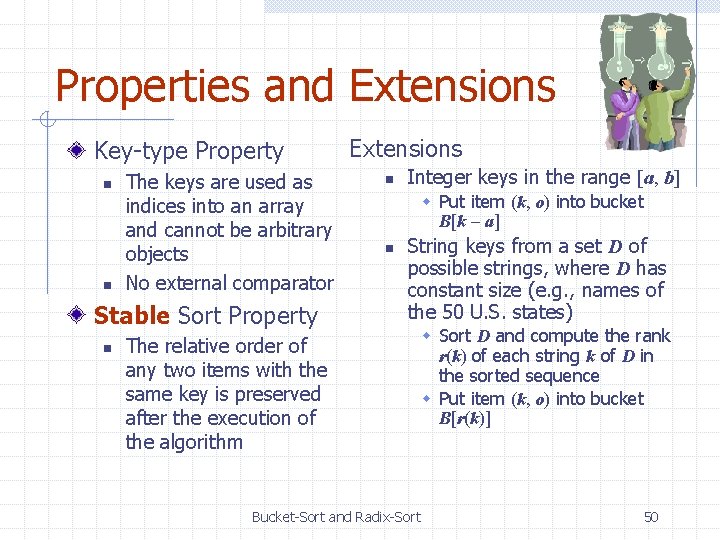
Properties and Extensions Key-type Property n n The keys are used as indices into an array and cannot be arbitrary objects No external comparator Stable Sort Property n Extensions n Integer keys in the range [a, b] w Put item (k, o) into bucket B[k - a] n String keys from a set D of possible strings, where D has constant size (e. g. , names of the 50 U. S. states) The relative order of any two items with the same key is preserved after the execution of the algorithm Bucket-Sort and Radix-Sort w Sort D and compute the rank r(k) of each string k of D in the sorted sequence w Put item (k, o) into bucket B[r(k)] 50
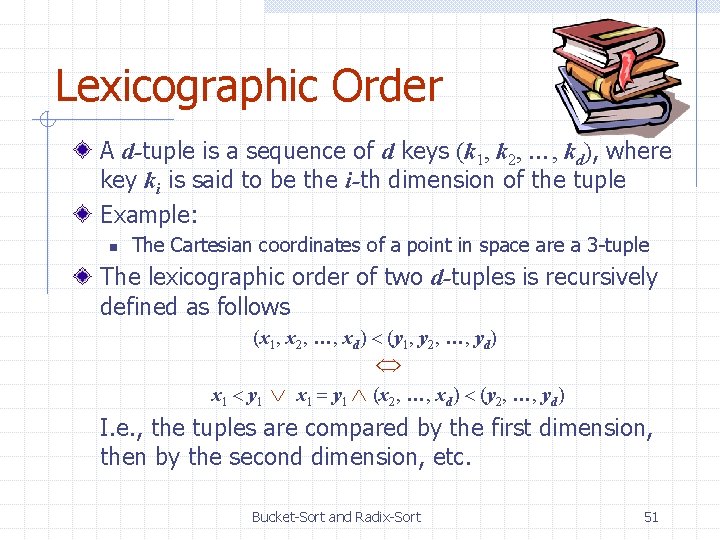
Lexicographic Order A d-tuple is a sequence of d keys (k 1, k 2, …, kd), where key ki is said to be the i-th dimension of the tuple Example: n The Cartesian coordinates of a point in space are a 3 -tuple The lexicographic order of two d-tuples is recursively defined as follows (x 1, x 2, …, xd) < (y 1, y 2, …, yd) x 1 = y 1 (x 2, …, xd) < (y 2, …, yd) I. e. , the tuples are compared by the first dimension, then by the second dimension, etc. x 1 < y 1 Bucket-Sort and Radix-Sort 51
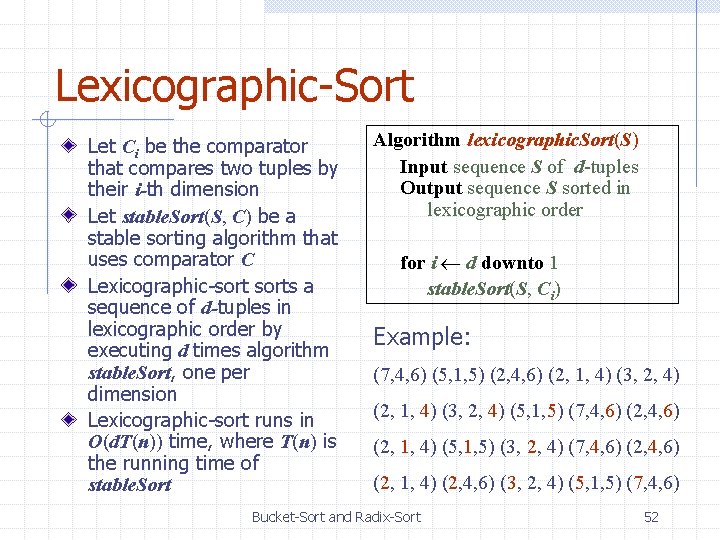
Lexicographic-Sort Let Ci be the comparator that compares two tuples by their i-th dimension Let stable. Sort(S, C) be a stable sorting algorithm that uses comparator C Lexicographic-sorts a sequence of d-tuples in lexicographic order by executing d times algorithm stable. Sort, one per dimension Lexicographic-sort runs in O(d. T(n)) time, where T(n) is the running time of stable. Sort Algorithm lexicographic. Sort(S) Input sequence S of d-tuples Output sequence S sorted in lexicographic order for i d downto 1 stable. Sort(S, Ci) Example: (7, 4, 6) (5, 1, 5) (2, 4, 6) (2, 1, 4) (3, 2, 4) (5, 1, 5) (7, 4, 6) (2, 1, 4) (5, 1, 5) (3, 2, 4) (7, 4, 6) (2, 1, 4) (2, 4, 6) (3, 2, 4) (5, 1, 5) (7, 4, 6) Bucket-Sort and Radix-Sort 52
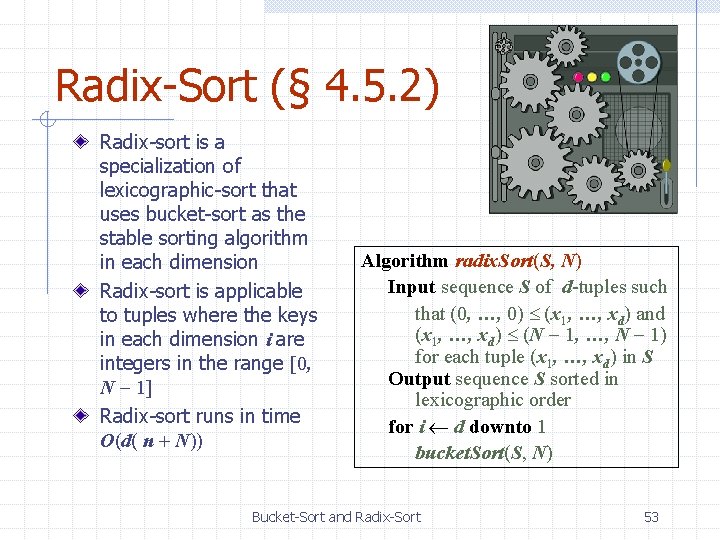
Radix-Sort (§ 4. 5. 2) Radix-sort is a specialization of lexicographic-sort that uses bucket-sort as the stable sorting algorithm in each dimension Radix-sort is applicable to tuples where the keys in each dimension i are integers in the range [0, N - 1] Radix-sort runs in time O(d( n + N)) Algorithm radix. Sort(S, N) Input sequence S of d-tuples such that (0, …, 0) (x 1, …, xd) and (x 1, …, xd) (N - 1, …, N - 1) for each tuple (x 1, …, xd) in S Output sequence S sorted in lexicographic order for i d downto 1 bucket. Sort(S, N) Bucket-Sort and Radix-Sort 53
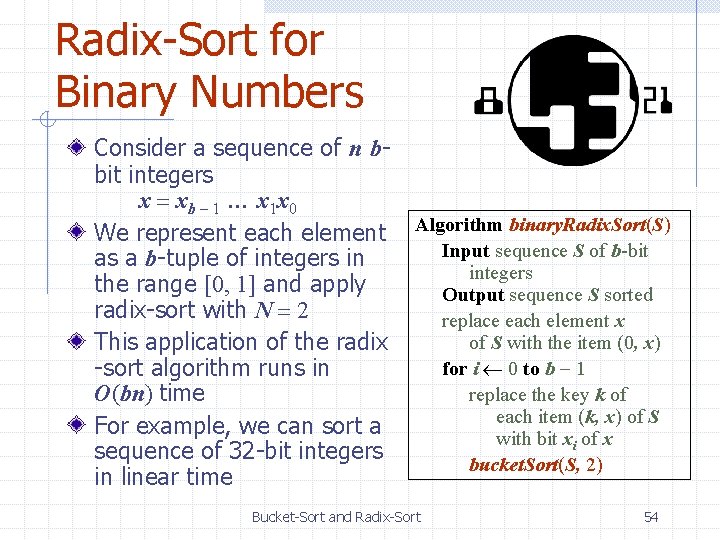
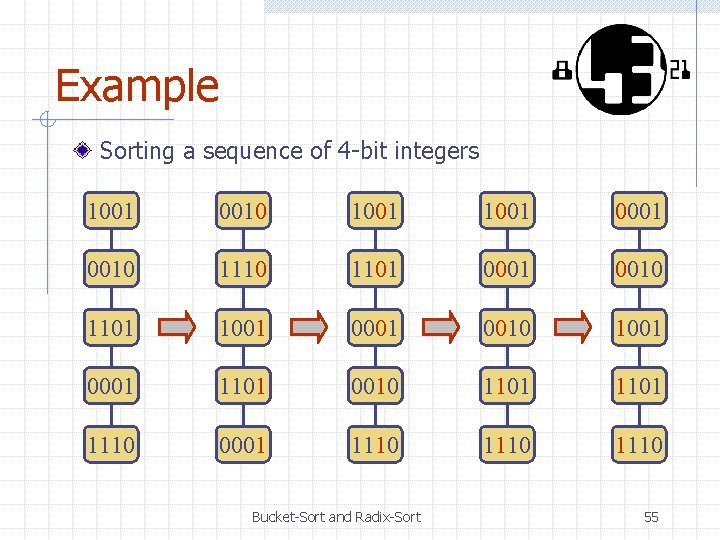
Radix-Sort for Binary Numbers Consider a sequence of n bbit integers x = xb - 1 … x 1 x 0 We represent each element as a b-tuple of integers in the range [0, 1] and apply radix-sort with N = 2 This application of the radix -sort algorithm runs in O(bn) time For example, we can sort a sequence of 32 -bit integers in linear time Algorithm binary. Radix. Sort(S) Input sequence S of b-bit integers Output sequence S sorted replace each element x of S with the item (0, x) for i 0 to b - 1 replace the key k of each item (k, x) of S with bit xi of x bucket. Sort(S, 2) Bucket-Sort and Radix-Sort 54
Example Sorting a sequence of 4 -bit integers 1001 0010 1001 0001 0010 1101 1001 0010 1001 0001 1101 0010 1101 1110 0001 1110 Bucket-Sort and Radix-Sort 55
Selection 56
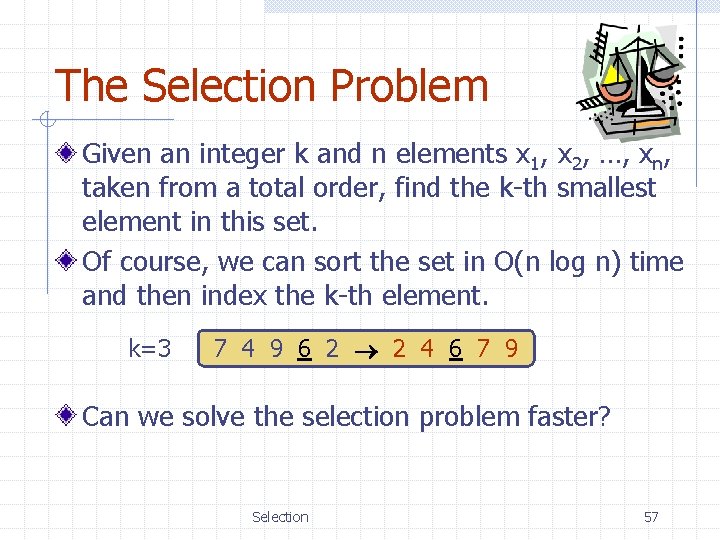
The Selection Problem Given an integer k and n elements x 1, x 2, …, xn, taken from a total order, find the k-th smallest element in this set. Of course, we can sort the set in O(n log n) time and then index the k-th element. k=3 7 4 9 6 2 2 4 6 7 9 Can we solve the selection problem faster? Selection 57
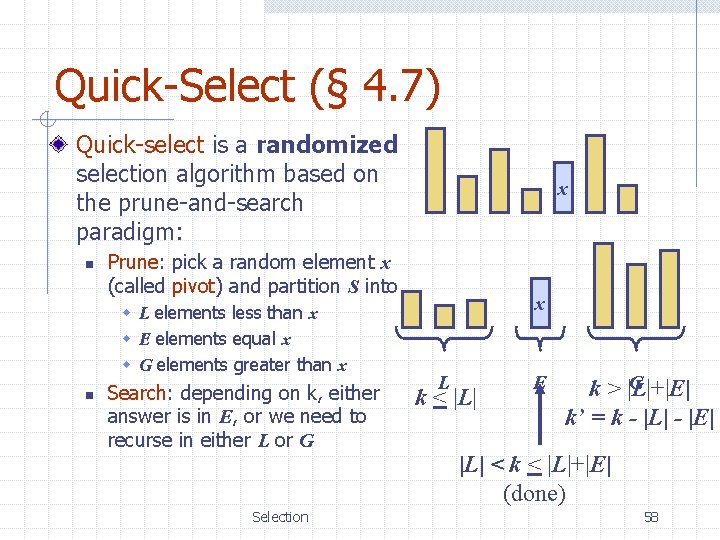
Quick-Select (§ 4. 7) Quick-select is a randomized selection algorithm based on the prune-and-search paradigm: n Prune: pick a random element x (called pivot) and partition S into w L elements less than x w E elements equal x w G elements greater than x Search: depending on k, either answer is in E, or we need to recurse in either L or G Selection x L k < |L| E G k > |L|+|E| k’ = k - |L| - |E| |L| < k < |L|+|E| (done) 58
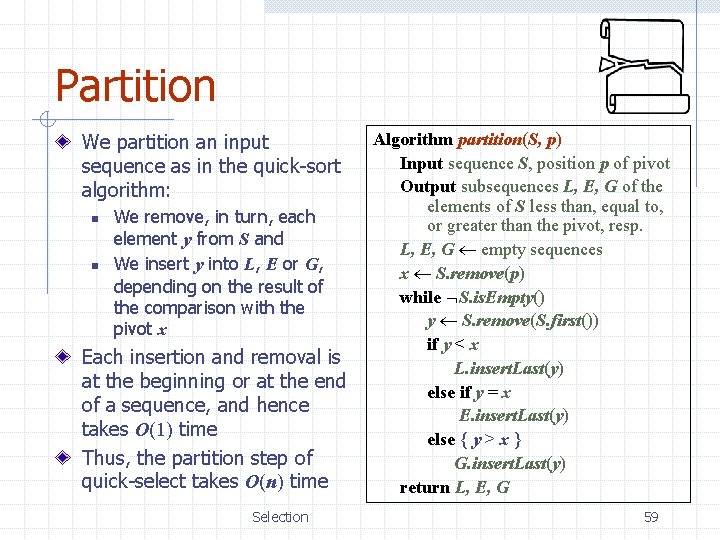
Partition We partition an input sequence as in the quick-sort algorithm: n n We remove, in turn, each element y from S and We insert y into L, E or G, depending on the result of the comparison with the pivot x Each insertion and removal is at the beginning or at the end of a sequence, and hence takes O(1) time Thus, the partition step of quick-select takes O(n) time Selection Algorithm partition(S, p) Input sequence S, position p of pivot Output subsequences L, E, G of the elements of S less than, equal to, or greater than the pivot, resp. L, E, G empty sequences x S. remove(p) while S. is. Empty() y S. remove(S. first()) if y < x L. insert. Last(y) else if y = x E. insert. Last(y) else { y > x } G. insert. Last(y) return L, E, G 59
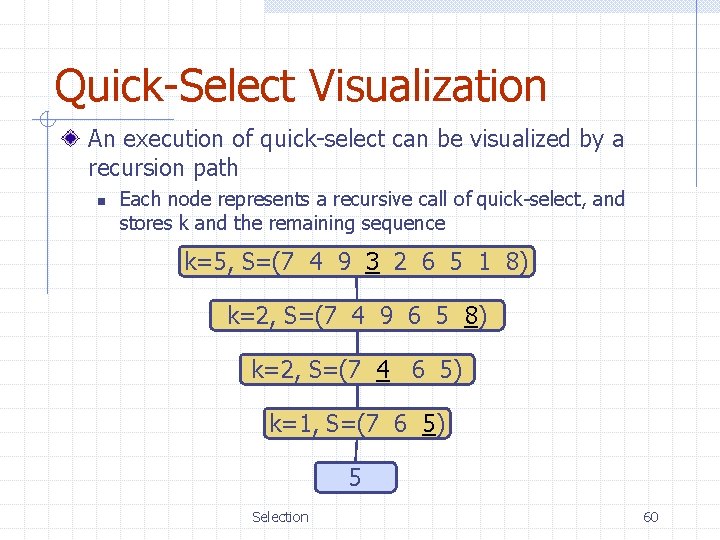
Quick-Select Visualization An execution of quick-select can be visualized by a recursion path n Each node represents a recursive call of quick-select, and stores k and the remaining sequence k=5, S=(7 4 9 3 2 6 5 1 8) k=2, S=(7 4 9 6 5 8) k=2, S=(7 4 6 5) k=1, S=(7 6 5) 5 Selection 60
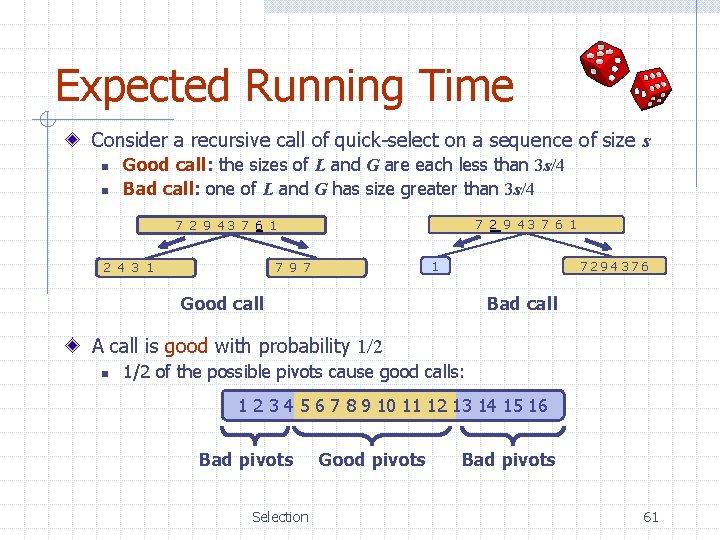
Expected Running Time Consider a recursive call of quick-select on a sequence of size s n n Good call: the sizes of L and G are each less than 3 s/4 Bad call: one of L and G has size greater than 3 s/4 7 2 9 43 7 6 19 7 1 1 2 4 3 1 1 7294376 Good call Bad call A call is good with probability 1/2 n 1/2 of the possible pivots cause good calls: 1 2 3 4 5 6 7 8 9 10 11 12 13 14 15 16 Bad pivots Selection Good pivots Bad pivots 61
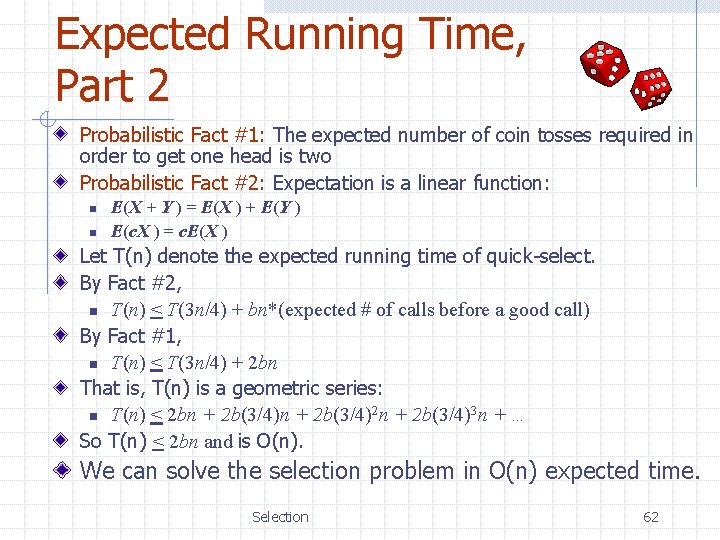
Expected Running Time, Part 2 Probabilistic Fact #1: The expected number of coin tosses required in order to get one head is two Probabilistic Fact #2: Expectation is a linear function: n n E(X + Y ) = E(X ) + E(Y ) E(c. X ) = c. E(X ) Let T(n) denote the expected running time of quick-select. By Fact #2, n T(n) < T(3 n/4) + bn*(expected # of calls before a good call) By Fact #1, n T(n) < T(3 n/4) + 2 bn That is, T(n) is a geometric series: n T(n) < 2 bn + 2 b(3/4)2 n + 2 b(3/4)3 n + … So T(n) < 2 bn and is O(n). We can solve the selection problem in O(n) expected time. Selection 62
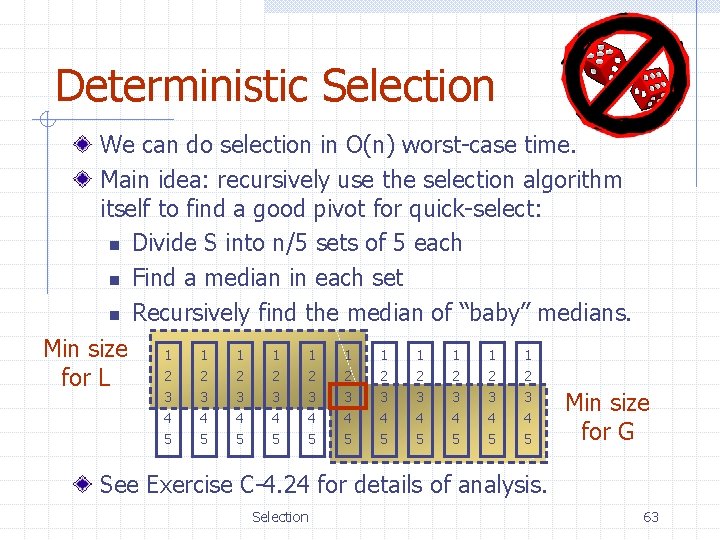
Deterministic Selection We can do selection in O(n) worst-case time. Main idea: recursively use the selection algorithm itself to find a good pivot for quick-select: n Divide S into n/5 sets of 5 each n Find a median in each set n Recursively find the median of “baby” medians. Min size for L 1 2 1 2 1 2 3 4 5 3 4 5 3 4 5 Min size for G See Exercise C-4. 24 for details of analysis. Selection 63