
MEREDITHs CONCEPT MAP PRESENTATION EDID 6503 Instructional Design
- Slides: 7
MEREDITH’s CONCEPT MAP PRESENTATION EDID 6503 –Instructional Design, Theories, Models and Strategies Course Coordinator: Dr C Dickson-Deane Course Facilitator : By Meredith Hodge 9, 2014 Dr L Hill April
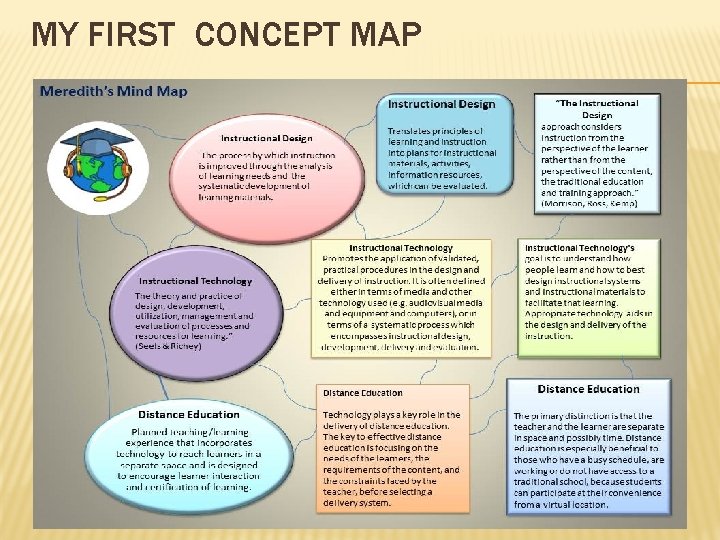
MY FIRST CONCEPT MAP
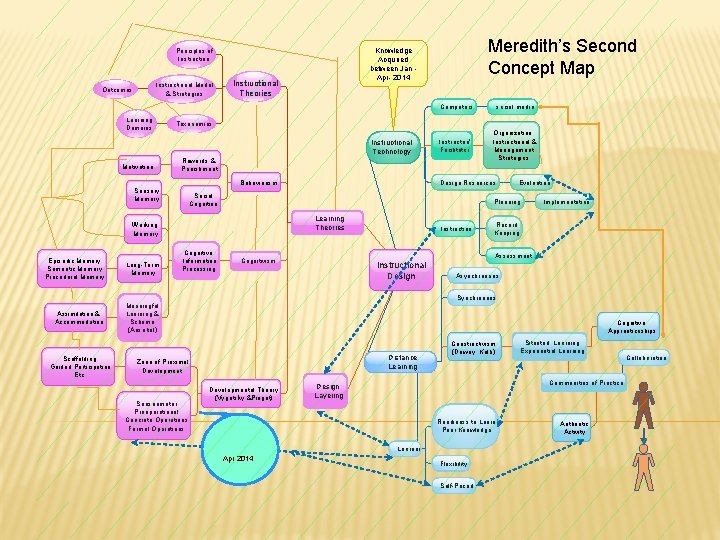
Instructional Model & Strategies Outcomes Meredith’s Second Concept Map Knowledge Acquired between Jan Apr- 2014 Principles of Instructional Theories Computers Learning Domains Taxonomies Instructional Technology Motivation Social Cognition Assimilation & Accommodation Meaningful Learning & Schema (Ausubel) Scaffolding, Guided Participation Etc. Learning Theories Cognitivism Instructional Design Implementation Record Keeping Assessment Asynchronous Synchronous Cognitive Apprenticeships Distance Learning Zone of Proximal Development Sensorimotor Preoperational Concrete Operations Formal Operations Evaluation Planning Working Memory Cognitive Information Processing Organization, Instructional & Management Strategies Design Resources Behaviorism Long-Term Memory Instructor/ Facilitator Rewards & Punishment Sensory Memory Episodic Memory Semantic Memory Procedural Memory social media Developmental Theory (Vygotsky &Piaget) Constructivism (Dewey, Kolb) Communities of Practice Design Layering Readiness to Learn Prior Knowledge Learner Apr 2014 Situated Learning Experiential Learning Flexibility Self-Paced Authentic Activity Collaboration
CHANGES � My first map basically just show the differences between Instructional Design, Instructional Technology and Distance Learning. The Second map is more detailed and shows the relationship between theories, models and strategies that aid learning. � This map includes a sense of time in which this knowledge was acquired. This was an element that was missing from my first map.
REFLECTION When I entered this program I was a blank canvas, all of the information that I was learning about was completely new to me. I was both scared and excited to enter the previously uncharted waters (by me). My first attempt at creating the concept map was a bit of a challenge because I was very intimidated by the whole idea of it. Constructing this second version was no different as the tools were new, my patience was thin and time was short. I am certainly not technologically savvy or artistically inclined, so the experience was definitely a test of both areas for me. I began the ground work for this concept map by constructing little branches of this concept map in my note book as I read. Throughout the course I learned about many theories, models, strategies etc. which made sense on their own but I struggled to connect them all to the “big picture”. When it actually came down to putting the information together I found that my concept map was getting too crowded and complicated. Therefore, I attempted to condense the map but I feared losing the essence of what I was trying to convey. Although there were moments of frustration along the way as I learned to manipulate the shapes, lost information, and repeated the process, this is something that I would do again and it was a worthwhile.
course readings, assignments, research, EDID 6501, course discussions and peer collaboration all played a role in transforming my understanding of the various concepts. For example while conducting research to enable me to complete assignments I came across other information which in some instances clarified areas of uncertainty on particular topics. There were also some areas that made me want to search further to satisfy my own curiosity (e. g. cognitive dissonance and knowledge building etc. ). I really cannot say that I am “there” yet in terms of full comprehension of the subject. Truthfully, I must acknowledge that I did not get to do as much reading as I would have liked to, but I found the material useful and I will definitely continue explore the text and other resources more as time goes by. My only regret is that I am not able to put this new knowledge into practice immediately but being aware of how people learn and the factors that influence learning is beneficial. What I gained from this was sharpened research and technical skills, additional knowledge and a little more patience. I also learned to streamline my thinking process and present my thoughts in an organized way. Things I would execute differently if I had to do this again are: - practice using the software more; seek assistance from someone who is familiar with the software to reduce my frustration; and utilize concept mapping earlier because it is very helpful. Overall this was a great learning experience that helped me to understand the relationships among the different theories models strategies topics which has facilitated my personal development.
References Driscoll, M. , (2005). Psychology of Learning for Instruction. USA. Pearson Education Inc Reigeluth, C. M. Carr-Chellman, A. A. (2009). Instructional –Design Theories and Models. Building a Common Knowledge Base Volume III. NY. London. Routledge